Introduction
Neurofibromatosis type 2 (NF2) is a dominantly transmitted genetic condition, the defect being on chromosome 22. The hallmark of NF2 is the presence of bilateral vestibular schwannomas; however, meningiomas and ependymomas are also associated with the condition. Schwannomas may occur in the spinal canal and/or on peripheral nerves. Slit-lamp examination of the lenses through dilated pupils is likely to reveal the presence of presenile lenticular opacities and cortical opacities.
The impact of NF2 has previously been studied using an open-ended questionnaire and a semi-structured interview approach, involving 20 subjects.Reference Neary, Stephens, Ramsden and Evans1 This study especially considered participation (involvement of individuals with NF2 in a life situation) and personal factors, according to the 2001. World Health Organisation International Classification of Functioning, Disability and Health.2 The findings indicated that NF2 has a particularly marked impact on five areas of the affected person's life: hearing, mobility, facial disfigurement, vision and psychological functioning.
Subsequent to this study, a closed set NF2 patient questionnaire was designed using the most frequently reported difficulties identified by the open-ended questionnaire and semi-structured interviews.
Methods
The present study was undertaken using this closed set NF2 questionnaire, together with version one of the Short Form-36 Health Survey Questionnaire.Reference Ware and Kosinski3 The results of the Short Form-36 questionnaire are published in a separate paper.Reference Neary, Hillier, Flute, Stephens, Ramsden and Evans4
Ethical approval for the study was obtained from the Tameside and Glossop local research ethics committee.
Subjects
Eighty-seven adults affected by NF2 and under the care of the Manchester multidisciplinary NF2 team were sent a study pack containing a letter of invitation to participate in the study, an information leaflet, the closed set NF2 questionnaire, a Short Form-36 questionnaire, and a stamped, addressed envelope with which to return the questionnaires.
Neurofibromatosis type 2 questionnaire
The closed set NF2 questionnaire is shown in Appendix 1.
Analysis of neurofibromatosis type 2 questionnaire
Data from the NF2 questionnaire were entered into a Statistical Package for the Social Sciences version 14 database, and subsequently statistically analysed using this same software.
The frequencies of respondents' various answers to individual NF2 questionnaire questions were calculated. In addition, Kendall's τ correlation coefficient was used to explore the relationship between the condition's primary effects (i.e. difficulty communicating with spouse or significant other, difficulty communicating socially, hearing difficulty, balance difficulty, mobility difficulty, and embarrassment) and secondary effects (i.e. general mood changes and self-confidence changes).
Results and analysis
Sixty-two respondents completed and returned the questionnaires (giving a 71 per cent response rate). Some respondents did not answer every question, or every part of each question, in the NF2 questionnaire. Respondents comprised 29 men and 33 women. The respondents were representative of the 87 subjects invited to participate in the study in terms of representing a wide clinical spectrum, from asymptomatic to severely disabled.
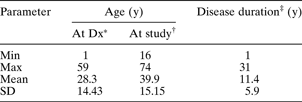
The respondents' mean age was 39.9 years, and their mean age at diagnosis was 28.3 years. Table I shows descriptive statistics for these parameters, and for respondents' duration of disease.
Respondents' age at NF2 diagnosis and at time of study, and disease duration
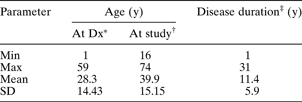
Respondents: *n = 61; †n = 62; ‡n = 61. NF2 = neurofibromatosis type 2; y = years; Dx = diagnosis; min = minimum; max = maximum; SD = standard deviation
Respondents reported various occupations at the time of NF2 diagnosis. Nine did not answer the question. Of the 53 who did, two were attending preschool, nine school and four higher education, 37 were employed, and one was unemployed. At the time of the study, however, respondents' answers indicated that 24 of the 57 who responded (42 per cent) were employed, some at a high level of responsibility. Six respondents were students. Sixteen (28 per cent) were unemployed because of NF2, and nine had taken early retirement on medical grounds because of NF2. Two further individuals, in their seventies, had continued to work until retirement age.
Ranking of neurofibromatosis type 2 problems
Respondents were asked which problem posed the greatest difficulty to them: hearing difficulties, balance problems, facial weakness, eyesight problems or psychological problems. If respondents had more than one problem, they were asked to rank their problems in order, with the greatest problem scored as one, the next greatest as two, and so on.
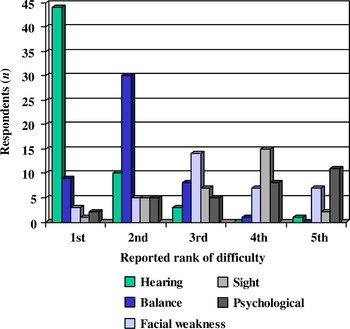
A total of 60 respondents answered this question. Two respondents did not answer any section of the question. Respondents' answers are shown in Figure 1.
Respondents ranking difficulties with hearing, balance, facial weakness, eyesight and psychological problems, from 1 (worst problem) to 5 (least problem).

Twenty-three respondents indicated that all five problems affected them, and ranked these problems on a scale of one to five as requested. Nine respondents were affected by four problems, seven by three and 12 by two. Nine respondents reported only one problem.
Forty-four respondents ranked hearing difficulty as their biggest problem, while 39 ranked balance difficulty as their biggest or second biggest problem. Facial weakness, visual problems and psychological problems were ranked as lesser difficulties.
Communication difficulties
Respondents were asked how much difficulty they had in communicating with the most significant person in their life, and with social contacts, and to what extent hearing difficulties affected their lives.
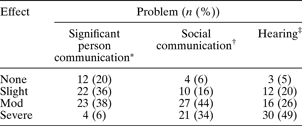
Social communication was found to be the greatest problem: only four respondents reported experiencing no difficulty, a further 10 reported slight difficulty, while 48 (78 per cent) reported either moderate or severe difficulty.
Regarding communication with the most significant person in their life, 12 respondents reported no difficulty and 22 slight difficulty. Twenty-seven respondents (43 per cent) reported moderate or severe difficulty.
Only three respondents indicated that their hearing difficulties had not affected their lives at all. Twelve reported a slight effect, but 46 (75 per cent) indicated moderate or severe effects.
Respondents' answers to questions regarding communication and hearing difficulties are shown in Table II.
Respondents' answers regarding effect of problems communicating with most significant person and with social contacts, and of hearing problems
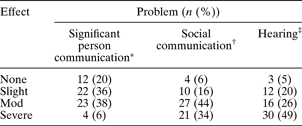
Data represent respondents giving each answer. Respondents: *n = 61; †n = 62; ‡n = 61. Mod = moderate
Balance and mobility problems
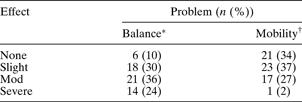
Fifty-nine respondents answered the question on balance problems. Only six indicated that they had no such difficulties, while 18 reported slight problems. Thirty-five (60 per cent) indicated moderate or severe balance problems.
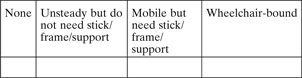
All 62 respondents answered the question on mobility problems. Twenty-one reported no such problems, while 23 indicated they were unsteady but did not need a stick or frame for support. A further 17 reported that they were mobile but needed a stick or frame for support. One patient was wheelchair-bound.
Respondents' answers to the questions on balance and mobility are shown in Table III.
Respondents' answers regarding effect of balance and mobility problems
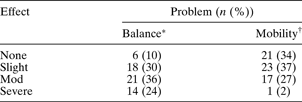
Data represent respondents giving each answer. Respondents: *n = 59; †n = 62. Mod = moderate
Facial weakness
Sixty-one respondents answered the question on facial weakness. Thirty-nine (64 per cent) reported facial weakness, while 22 (36 per cent) reported no facial weakness. It is important to note that this question enquired about whether the subject had any facial weakness, rather than whether they found facial weakness to be their biggest problem.
Respondents were asked whether facial weakness caused them embarrassment. Thirty-nine respondents answered this question. Seven reported no embarrassment, 18 some embarrassment, and 14 moderate or severe embarrassment.
Relationships and emotional support
Respondents were asked how the relationship with their closest significant other had changed since their NF2 diagnosis. Fifty-seven respondents answered the question. Six (11 per cent) indicated that their relationship was better, and thirty-five (61 per cent) that it was the same. Four (7 per cent) reported a worsened relationship, while 12 (21 per cent) reported that their relationship had ended.
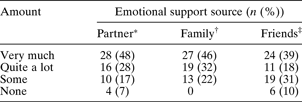
Respondents were asked how much emotional support they had received from their closest significant other, their immediate family and people outside of their family. Fifty-eight individuals answered the question asking about emotional support from their partner, fifty-nine answered about their immediate family and sixty-one responders gave answers relating to people outside of the family. Respondents generally indicated strong support from partners and immediate family, and also considerable support from outside the family. Responses relating to emotional support are shown in Table IV.
Respondents' answers regarding amount of emotional support received from closest partner, immediate family and people outside family
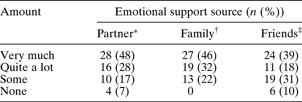
Data represent respondents giving each answer. Respondents: *n = 58; †n = 59; ‡n = 61.
Mood and self-confidence changes
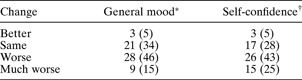
Respondents were asked whether their general mood had changed since they knew they had NF2. Sixty-one respondents answered this question. Three indicated that their mood was better, while 21 reported that it was the same. Twenty-eight (46 per cent) reported that their mood was worse, while nine indicated that it was much worse.
In response to the question on self-confidence, three respondents indicated that their self-confidence was better since their NF2 diagnosis, while 17 reported that it was the same. Twenty-six (43 per cent) reported that it was worse, and 15 much worse.
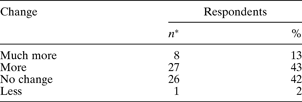
Responses to questions on mood and self-confidence are shown in Table V.
Respondents' answers regarding changes in general mood and self-confidence since NF2 diagnosis
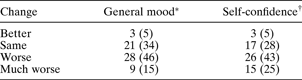
Data represent number (%) of respondents giving each answer. Respondents: *n = 61; †n = 61. NF2 = neurofibromatosis type 2
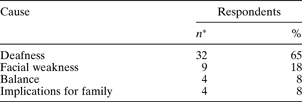
Respondents were asked about the main cause of any loss of self-confidence. Forty-nine responded. Thirty-two respondents indicated that deafness was the main cause of their loss of self-confidence, while nine blamed facial weakness. These responses are shown in Table VI.
Respondents' answers regarding main cause of reduced self-confidence
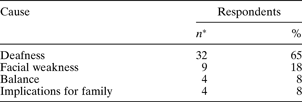
*Total n = 49.
Relationships between primary and secondary effects
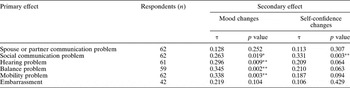
The relationships between the six primary effects of NF2 (i.e. problems communicating with spouse or partner, social communication problems, hearing difficulties, balance problems, mobility problems and embarrassment) and the two secondary effects (i.e. general mood changes and self-confidence changes) were explored using the NF2 ranking scales and Kendall's correlation coefficient, and are shown in Table VII.
Relationship between primary and secondary NF2 effects

τ = Kendall's τ correlation coefficient. * = p < 0.05; ** = p< 0.01. NF2 = neurofibromatosis type 2
Significant positive correlations indicate an association between mood or self-confidence changes and difficulties due to the primary effects of NF2. In particular, general mood change was significantly related to hearing difficulties, balance problems and mobility difficulties (p < 0.01 level for all) and to social communication problems (p < 0.05). In contrast, self-confidence changes were significantly related only to social communication problems (p < 0.01). Neither general mood changes nor self-confidence changes were related to problems with communicating with the respondent's spouse or partner, or to embarrassment.
Caring towards other people
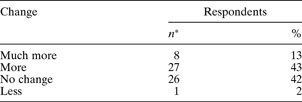
Respondents were asked whether having NF2 had made them more considerate and caring towards other people. All 62 respondents answered this question. Thirty-five (56 per cent) reported that it had made them much more caring, or more caring. These responses are shown in Table VIII.
Respondents' answers regarding NF2 changing their consideration and caring towards others
*Total n = 62. NF2 = neurofibromatosis type 2
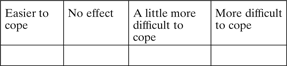
Respondents were asked how having others in the family with NF2 help them cope with their condition. Twenty-eight (45 per cent) of the 62 respondents reported a family history of NF2. Thirteen of these respondents (46 per cent) indicated that they found it easier to cope, four (14 per cent) reported no effect, seven (25 per cent) reported that it was a little more difficult to cope, and four (14 per cent) that it was more difficult to cope.
Work and higher education
Respondents were asked whether they had been employed or attending higher education before they developed NF2. All respondents answered this question. Fifty-four (87 per cent) reported that they had been in work or higher education before developing NF2, seven (11 per cent) reported that they had not, and one (who had been diagnosed in infancy) responded ‘not applicable’.
If respondents answered ‘yes’, they were asked whether they had been able to continue in work or higher education since developing NF2. Fifty-three of the 54 respondents answering ‘yes’ to the previous question answered this question. One person reported that he was working at a higher level since developing NF2. Fifteen reported that they were able to continue in work or higher education at the same level, while six reported continuing in a less demanding role. Seven had continued to work with reduced hours. Twenty-five respondents (40 per cent of the study group) reported that they were unable to work or continue in higher education.
Other methods of communication
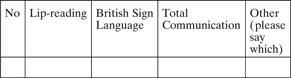
Respondents were asked whether they had learned another method of communication, and they were invited to indicate more than one method if this was appropriate. Thirty-six respondents listed lip-reading, 17 British Sign Language and two Total Communication. Other modes of communication reported were, use of a light writer, sign language other than British Sign Language, finger-spelling, sign-supported English and texting. Twenty-three respondents reported that they had not learned another mode of communication.
Auditory brainstem implant
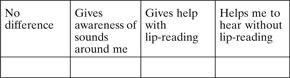
Twenty-one respondents (34 per cent) confirmed that they had undergone insertion of an auditory brainstem implant. If respondents had received such a device, they were asked how much it had helped them; response choices were ‘no difference’, ‘gives awareness of sounds around me’, ‘gives help with lip-reading’ and ‘helps me to hear without lip-reading’. Respondents were allowed to select more than one choice (e.g. a subject could respond that their auditory brainstem implant enabled awareness of sounds around them and also assisted lip-reading). Therefore, these 21 respondents could indicate more than 21 ways of benefitting from their auditory brainstem implant (some indicated more than three).
Twenty-three positive responses regarding auditory brainstem implant insertion were received. Three respondents reported that their auditory brainstem implant enabled them to hear without lip-reading. Eleven indicated that it helped with lip-reading, and a further nine reported that it enabled awareness of sounds around them. Six patients reported that their auditory brainstem implant had never worked and made no difference at all.
Respondents were asked whether they were pleased that they had undergone auditory brainstem implant insertion. Nineteen of the 21 implanted respondents answered. Thirteen confirmed that they were pleased they had undergone implantation, while six indicated they were not pleased as the device had never worked and they had received no benefit from the surgical procedure.
Other consequences
Respondents were asked to report any other consequences of NF2, and to indicate their severity. Forty-eight respondents answered this question, some indicating more than one consequence. Fourteen respondents did not report any other consequences. Twenty-eight reported eyesight difficulties and 13 swallowing difficulties. Ten reported voice problems. Various other consequences were reported infrequently.
Of those respondents reporting other consequences of NF2, 37 indicated a moderate or severe effect while 11 reported only a minimal or mild effect.
Voluntary organisations
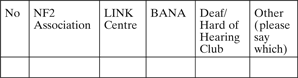
Respondents were asked to indicate whether they had been in touch with a voluntary organisation regarding their NF2; they could list more than one if this was appropriate. Sixty respondents answered this question. Fifteen reported no such contact. Thirty-nine reported contact with the UK Neurofibromatosis Association, 15 with the LINK Centre and seven with the Deaf/Hard of Hearing Club. Four respondents had been in contact with the British Acoustic Neuroma Association. Eight listed other voluntary organisations, including the Leonard Cheshire Association, the Deaf/Blind Club Scotland, the Tinnitus Helpline, The Royal National Institute for Deaf People, Sign Language Congregation and Hearing Dogs for Deaf People. One respondent reported he had started a new voluntary group with the help of LINK in Oldham, named Welcome Hear.
Discussion
After previous research into the difficulties of living with NF2, a closed set NF2 patient questionnaire was designed using the previous respondents' most frequently reported problems. The present study explored the difficulties reported by individuals with NF2, and also the relationships between the primary and secondary effects of the condition.
In the present study, 54 (93 per cent) respondents indicated that deafness was their biggest or their second biggest problem, and they emphasised their difficulties in communicating. Twenty-seven (43 per cent) respondents reported moderate or severe difficulty in communicating with the closest person in their lives, but this figure rose to 48 (78 per cent) when considering social communication. Respondents emphasised the marked extent to which hearing difficulties affected their lives. Difficulties with communication, both within the family, socially and in the workplace, have over time been identified by patients to NF2 support workers as one of the greatest problems with NF2, with many being obliged to give up their employment (J Castle, personal communication). In another study, we assessed the relationship between the normative data based domains of the Short Form-36 questionnaire and the communication issues highlighted by NF2 patients.Reference Neary, Hillier, Flute, Stephens, Ramsden and Evans4 The marked impact of NF2 on working lives was highlighted in our previous study; in the present study, more than 40 per cent of respondents reported being unable to work or continue higher education because of NF2.Reference Neary, Stephens, Ramsden and Evans1
Difficulties with balance were documented by 80 per cent of current study respondents; they described difficulty in the act of walking itself, difficulty in carrying objects whilst walking, and the need to have two free hands to right themselves if they lost their footing. The findings of the current study confirm the presence of balance difficulties in NF2 patients, with 39 respondents ranking balance as their biggest or second biggest problem. Balance difficulties might be expected to affect individuals' mobility. However, 21 respondents confirmed that they did not have any mobility difficulties, while 23 reported they were unsteady and 17 stated they were mobile but needed support when walking. Only one respondent reported being wheelchair-bound.
In our previous study, respondents did not identify facial weakness as a major difficulty.Reference Neary, Stephens, Ramsden and Evans1 Some described the practical difficulties associated with facial weakness, while others reported that they were upset by the cosmetic appearance of their face and had lost confidence in meeting people. However, two respondents with a severe degree of facial weakness did not report any significant problems. Similarly, in the present study most respondents did not rank facial weakness as their biggest problem; only three did so. However, when specifically asked whether their facial weakness caused embarrassment, 32 respondents answered that it caused some, moderate or severe embarrassment.
In our previous study, two-thirds of respondents reported that they had felt depressed since their NF2 diagnosis.Reference Neary, Stephens, Ramsden and Evans1 In the present study, only two respondents ranked psychological problems as their biggest difficulty. However, when specifically asked whether their general mood had changed since their NF2 diagnosis, 37 respondents (60 per cent) reported that their mood was worse or much worse. When specifically asked whether their self-confidence had changed since their NF2 diagnosis, 41 respondents (66 per cent) reported that it was worse or much worse; 32 indicated that deafness was the main cause of their reduced self-confidence.
The observed relationship between the primary and secondary effects of NF2 was interesting, in particular that between general mood changes (a secondary effect) and four of the primary effects. However, this represents rather a ‘chicken and egg’ dilemma, since the presence of a significant correlation cannot be used to decide causality, and the scales used were unsuitable for regression analysis. Nevertheless, it should be noted that we found an implied relationship between general mood changes and the primary, physical problems of hearing difficulties, balance difficulties, mobility difficulties and social communication difficulties. In contrast, self-confidence changes were significantly related only to social communication difficulties.
Members of the Manchester multidisciplinary NF2 team endeavour to be sensitive to the psychological impact of NF2 as a potentially devastating condition for affected individuals and their families. Team members attempt, as much as possible, to ensure that patients are prepared for the psychological blow of eventual total hearing loss, and they initiate appropriate training in non-auditory communication skills when necessary. An experienced NF2 counsellor is part of the multidisciplinary team and is present at NF2 clinic appointments. The counsellor gives her telephone and e-mail contact details to patients and their families, in case they require any clarification of discussions after appointments, or any assistance with other issues arising between appointments. Should a patient require or request additional psychological support, referral is arranged to a psychologist or psychiatrist with expertise in NF2 patient management.
• Neurofibromatosis type 2 (NF2) is a dominantly transmitted genetic condition (defect on chromosome 22)
• The hallmark of NF2 is bilateral vestibular schwannomas
• This study used a closed set questionnaire to explore NF2 patients' difficulties, and the relationship between primary and secondary NF2 effects
• Ninety-three per cent of respondents indicated deafness as their biggest or second biggest problem
• In general respondents emphasised their difficulties with communication, social communication being the most problematic
• All newly diagnosed NF2 patients need very considerable support in dealing with their diagnosis
In the present study, we specifically asked how having others with NF2 in the family helped individuals to cope with their condition. Thirteen respondents (46 per cent) indicated that they found it easier to cope, but 11 (39 per cent) responded that it was a little more difficult or more difficult to cope. We have previously reported that our experience in the multidisciplinary NF2 clinic suggested that the psychological impact of an NF2 diagnosis differs depending on whether the patient represents a new mutation or is a member of an already diagnosed family. The new information obtained from the present study appears to indicate that all individuals newly diagnosed with NF2 need very considerable support in dealing with their diagnosis, as 11 respondents reported more, rather than less, difficulty in coping with their diagnosis, given their family history of the condition.
Conclusions
In a study group of 62 subjects with NF2, respondents' answers emphasised that their greatest problem was deafness, which resulted in communication difficulties with close partners, family, friends and social contacts. Balance problems were identified as respondents' next greatest difficulty. Analysis implied a relationship between general mood changes and problems with hearing, social communication, balance and mobility. Self-confidence changes were significantly related only to social communication problems.
Members of the multidisciplinary NF2 team should be sensitive to the psychological impact of NF2, as a potentially devastating disease, on the affected individual and their family. An experienced NF2 counsellor should be part of the multidisciplinary team, and referral should be available, when indicated, to a psychologist or psychiatrist with expertise in NF2 patient management.
Acknowledgements
We sincerely thank all the patients who so kindly participated in this study. We also thank Dr Stephen Roberts, Department of Biostatistics, University of Manchester, for his helpful advice at the beginning of the study, and Mrs Jennifer Bowers, Public Health Information Department, Warrington Primary Care Trust, for her assistance with data analysis. Finally, we acknowledge financial support for this study from the Frances Brenda Thornley Trust.
Appendix 1. Closed set neurofibromatosis type 2 questionnaire
Study number:
We are constantly trying to improve the services for patients and families with NF2. This is a questionnaire to help us find out how NF2 affects your life. We are looking at five major areas: deafness, balance, facial weakness, eyesight and psychological effects. We wish to obtain information from a large number of patients affected by NF2, so that we can focus our ways of helping patients in the best way possible. Please complete the first few questions, and then tick the boxes to show how you feel you are affected by NF2.
(1) Present age:
(2) Age at diagnosis of NF2:
(3) Occupation when diagnosed with NF2:
(4) Present occupation:
(5) Which of the following is your biggest problem? Please tick the most severe. If you have more than one problem, please show which is the greatest problem (greatest will be ‘1’), then show others in order, so ‘2’ will be the next greatest problem, ‘3’ the next and so on.
– Hearing difficulties □
– Balance problems □
– Facial weakness □
– Problems with eyesight □ (If yes, please ensure you complete questions 28 and 29)
– Psychological problems □
(6) How much difficulty do you have communicating with your spouse/partner/most significant person in your life ? Please tick one box only.

(7) How much difficulty do you have communicating socially? Please tick one box only.
(8) How much have any hearing difficulties affected your life? Please tick one box only.
(9) Have you had an auditory brainstem implant inserted?
Yes □ No □
(10) If yes, please indicate how much it helps you. You may tick more than one box.
(11) Are you pleased that you had it inserted?
Not applicable □ Yes □ No □
(12) How much trouble do you have with your balance? Please tick one box only.
(13) Do you have any trouble getting around? Please tick one box only.
(14) Do you have any facial weakness?
Yes □ No □
(15) If yes, does this cause you embarrassment? Please tick one box only.
(16) Since knowing you have NF2, how has your relationship with your spouse/partner/most significant person in your life changed? Please tick one box only.
(17) Since knowing you have NF2, how much emotional support have you had from your spouse/partner/most significant person in your life? Please tick one box only.
(18) Since knowing you have NF2, how much emotional support have you had from your immediate family? Please tick one box only.
(19) Since knowing you have NF2, how much emotional support have you had from people outside your family? Please tick one box only.
(20) Since knowing you have NF2, has your general mood changed? Please tick one box only.
(21) Since knowing you have NF2, has your self-confidence changed? Please tick one box only.
(22) What is the main cause of your loss of self-confidence?
(23) Has NF2 made you more considerate and caring towards other people? Please tick one box only
(24) How did having others in the family with NF2 help you cope with your condition?
Not applicable □ or tick one of the boxes below.
(25) Before you developed NF2, did you go out to work or attend higher education?
Yes □ No □
(26) If yes, since developing NF2 have you been able to continue in work or higher education? Please tick one box only.
(27) Have you learned another mode of communication? You may tick more than one box.
(28) Has NF2 had any other consequences for you, e.g. problems with eyesight, swallowing difficulties or change in voice? If yes, please specify consequence:
(29) Please rate the severity of the effect this consequence has had on you. Please tick one box only.
(30) Please state other consequences, if there are more than one:
(31) Please rate the severity of the effect these consequence have had on you. Please tick one box only.
(32) Have you been in contact with a relevant voluntary organisation? You may tick more than one box.