Introduction
Termites are distributed throughout the tropical and subtropical regions of the world, with the highest species diversity being found in tropical forests (Eggleton, Reference Eggleton, Abe, Bignell and Higashi2000). For the Afrotropics, approximately 660 species belonging to about 170 genera are currently described (Uys, Reference Uys2002). Termites (Isoptera) consist of more than 2600 described species from seven families (Abe et al., Reference Abe, Bignell and Higashi2000) and are sister taxa to wood roaches (Inward et al., Reference Inward, Beccaloni and Eggleton2007; Klass et al., Reference Klass, Nalepa and Lo2008).
As cellulose, present in wood and wood products, is the principal food of termites, they avidly consume and destroy materials such as paper, fabrics and wood structures and, hence, constant effort is directed towards their control. Field and laboratory tests have indicated that some woods are not resistant to their attack, whereas others are resistant (Skolmen, Reference Skolmen1974; Bultman and Southwell, Reference Bultman and Southwell1976; Bultman et al., Reference Bultman, Beal and Ampong1979; Abreu and Silva, Reference Abreu and Silva2000). Globally, termites are a huge problem in both agricultural and urban areas as they cause significant damage to crops, plants, buildings and woodwork and account for considerable economic loss. To make cellulose digestible and ready for assimilation, termites live in a strong mutualistic relationship with a variety of hindgut-inhabiting endomicrobes (flagellates, bacteria and archaea). These endomicrobes, mainly flagellates, produce the enzyme cellulase, which makes the plant celluloses suitable for assimilation (Breznak, Reference Breznak, Abe, Bignell and Higashi2000). In the present study, Coptotermes heimi (Wasmann) (Isoptera: Rhinotermitidae) was used to evaluate the feeding preferences, both in the field and in the laboratory, and the results indicated that wood consumption by this termite is greater in Populus euramericana Guinier (Salicaceae) than in the other 17 species and Syzygium cumini (L.) Skeels (Myrtaceae) has a high level of resistance. There are numerous factors that affect wood consumption by termites and the relationships between them are complex. Among the most important of these factors are wood species and hardness, the presence of toxic substances, feeding inhibitors or deterrents, the presence or absence of fungi and the degree of fungal decay, and the moisture contents of wood and soil (Smythe et al., Reference Smythe, Carter and Baxter1971; Carter and Smythe, Reference Carter and Smythe1974; Nagnan and Clement, Reference Nagnan and Clement1990).
In recent years, there has been a significant increase in the scientific literature concerning termites (Vargo and Husseneder, Reference Vargo and Husseneder2009), which reflects their economic importance and the availability of funding to support termite research. Various preventive and remedial strategies are currently being used against pest species in the termite control industry (Su and Scheffrahn, Reference Su and Scheffrahn1998, Reference Su, Scheffrahn, Abe, Bignell and Higashi2000). Coptotermes (Rhinotermitidae) is a structural pest of a destructive nature that is globally distributed beyond its native range in Southeast Asia (Gentz et al., Reference Gentz, Rubinoff and Grace2008). It is one of the most common, tough, hardy pest species of Pakistan that destroys structural timbers. It has been reported that it causes deteriorating effects in the living trees of poplar, mulberry and Dalbergia sissoo (shisham). It is widely distributed throughout India, Pakistan and Bangladesh (Ramdev et al., Reference Ramdev, Richa and Sharma2013). Ahmed et al. (Reference Ahmed, Ashraf, Hussain and Riaz2009) isolated three strains of Metarhizium anisopliae from swarming alates of C. heimi from Nowshera Virkan in Gujranwala region, which is the rice-growing area of Punjab, Pakistan. Coptotermes heimi, along with Odontotermes and Microtermes, has also been reported to be abundant in various regions of Punjab (Ahmed et al., Reference Ahmed, Mustafa, Riaz and Hussain2006, Reference Ahmed, Khan and Riaz2007).
Pakistan is blessed with different types of climates, ranging from tropical to temperate, which results in a rich diversity as well as physical and climatic features that create favourable conditions for sustaining varied termite faunas. Coptotermes heimi has been reported to be a serious pest in the urban areas and agricultural fields of Pakistan (Manzoor and Mir, Reference Manzoor and Mir2010; Manzoor et al., Reference Manzoor, Chaudhary and Sheikh2011) and is a termite species that is extensively abundant (Chaudhry and Ahmad, Reference Chaudhry and Ahmad1972). The detrimental effect of this species has been detected in the living trees of shisham (Dalbergia sissoo), mulberry (Morus alba) and poplar (Populus deltoides). It not only attacks logs and wooden installations, but also infests the standing trees to the extent that the trees become completely hollow. In Peshawar, a wooden bridge was found to be seriously infested by this termite (Sen-Sarma et al., Reference Sen-Sarma, Thakur, Misra and Gupta1975). The extent of the damage caused by termites is well known, and the phylogeny of the global genus Coptotermes – which includes some of the most economically damaging termites – remains unclear. The genus comprises an estimated 71 species, while the family Rhinotermitidae includes 15 genera (Kambhampati and Eggleton, Reference Kambhampati, Eggleton, Abe, Bignell and Higashi2000); 33 Coptotermes species have been reported from China (Gao et al., Reference Gao, Lam, Owen, Lam and O'Toole1990; Wang and Grace, Reference Wang and Grace1999).
Different types of studies and experiments have been carried out on the feeding preferences of termites and on the natural resistance of timber. In Pakistan, forests are the main source of wood and wood products. Wood is a renewable natural resource, mostly used for building, construction and production. High-quality wood products are often preferred by customers, but physical or biological damage reduces their value. Wood and wood products need to be protected during manufacture, storage and transportation and when in use (Uzunovic et al., Reference Uzunovic, Byrne, Gignac and Yang2008).
The diverse termite species in different ecological zones of Pakistan may have different feeding preferences. For example, Anacanthotermes vagans causes maximum damage to woodwork in buildings in Chaman (Quetta District), but is not present in Punjab, where C. heimi, Microcerotermes unicolar, Odontotermes obesus and Heterotermes indicola cause havoc (Akhtar, Reference Akhtar1983). The natural resistance of the native timber species to termites in Pakistan has been reported by various investigators (Ahmad, Reference Ahmad1955; Akhtar, Reference Akhtar1972, Reference Akhtar1974; Howick, Reference Howick1975; Roonwal, Reference Roonwal, Krishan and Weesner1976; Ahmad et al., Reference Ahmed, Sheikh and Jafri1979; Akhtar and Ali, Reference Akhtar and Ali1979; Afzal, Reference Afzal1981; Akhtar and Raja, Reference Akhtar and Raja1985; Shahid and Akhtar, Reference Shahid and Akhtar1989; Akhtar and Kausar, Reference Akhtar and Kausar1991; Manzoor et al., Reference Manzoor, Zameer, Malik, Cheema and Rahmin2009). However, the development of a valid approach to assess the feeding preferences of termites in Pakistan is still in its infancy, owing to the approaches used to determine natural resistance.
There are numerous factors that affect wood consumption by termites and these are highly interconnected. It has been widely accepted that the palatability of species is one of the influential parameters of termite wood consumption (Rasib, Reference Rasib2005, Reference Rasib2008).
Keeping in view the importance of wood and damage caused by termite species to the ecosystem of Pakistan, the present study was carried out to evaluate the feeding preferences of C. heimi for commercial and non-commercial woods.
Materials and methods
Termite collection
Termite workers were collected from different areas of Lahore District, including Changa Manga forest, Jallo Park, Wagha border, Ravi siphon and Jinnah Garden, and from agricultural crops and fallen logs infested under natural conditions in hot rainy weather (July–August 2012). Termites were also collected by baiting them with the most palatable wood of P. euramericana supplemented with sugarcane stalks to obtain maximum number of termites. The collection of termites was also carried out using artificial baiting methods, such as bucket traps/dampened toilet rolls/cardboard, consisting of plastic bottles with small holes at the base as well as on the sides to permit the entry of termites into the baits. The baits were buried in the soil to a quarter of their length and regularly inspected twice a month. Termites collected from different sources were brought to the laboratory for identification with the help of a key (Ahmad, Reference Ahmad1955; Akhtar, Reference Akhtar1975).
Termite augmentation
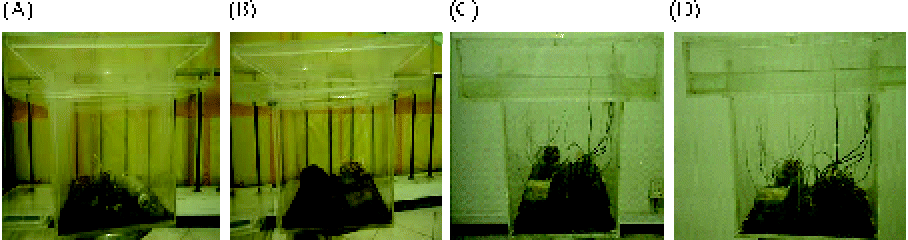
The colonies of C. heimi were maintained under laboratory conditions on P. euramericana blocks. Wood blocks (length × width × thickness: 30 × 4 × 2 cm) were purchased from commercial timber vendors. They were cleaned with distilled water and kept in a dry place for 1 week before use. The transparent test apparatus was made up of acrylic sheets with specific dimensions (length × height × width: 30 × 35 × 30 cm) (Fig. 1). Sterile soil/sand (2 kg) was added along with 300 termite workers, 50 soldiers and 100 alate pairs into each transparent cage containing four tiers of P. euramericana blocks. The termites were handled with a moist scientific brush no. 2. Workers of a uniform stage were used and obtained from the field as well as a laboratory-augmented colony (Buchli, Reference Buchli1958). Their morphology and stomach contents were examined to determine whether they were functional workers. All cages were then covered with black polythene/cloth to minimize the effects of light and placed in a controlled room at 26+1 °C and 75% relative humidity. Moisture in the containers was judiciously maintained through a humidifier under controlled conditions.
(colour online) Termite rearing/augmentation cages ((A)–(D)) showing the successful establishment of termite colonies under controlled conditions.

Wood species
Important commercial and non-commercial timber species were selected for the experiments. Non-commercial woods are also important with respect to comparison and feeding preferences, viz. Pinus roxburghii (chir pine), M. alba (mulberry), Mangifera indica (mango), P. euramericana (poplar), Cassia fistula (Amaltas), Azadirachta indica (neem), Eucalyptus camaldulensis (Safaeda), D. sissoo (shisham), Butea monosperma (Dhak), S. cumini (Jaman), Heterophragma adenophyllum (Beri Patta), Erythrina suberosa (Gul-e-Nishtar), Ailanthus excelsa (Ailanthus), Albizia lebbeck (Shreen), Jacaranda mimosifolia (Gul-e-Neelam), Bauhinia variegata (Kachnar), Tectona grandis (Sagwan) and Bambusa bamboo (Bamboo). The blocks (4.0 × 2.2 × 1 cm) were cut from a single piece of each wood. Fine-grade sandpaper was used to smooth the sides of the block to encourage active foraging, as termites are uncomfortable with rough surfaces. The blocks were dried at 60 oC for 48 h before exposure to termites. The moisture content of woods was altered after drying, so distilled water was used to maintain the moisture levels.
No-choice laboratory trials
All blocks were dried at 60 °C for 24 h. Only one type of wood block was placed in a glass Petri dish (9.8 cm diameter and 2 cm high) and 150 worker termites of C. heimi were released in three replicates. The blocks were dried to avoid contaminants in bioassays and to prevent termites from feeding on them. Later, the blocks were treated with distilled water to maintain the moisture content to assist in termite survival and facilitate feeding activity. The Petri dishes were maintained at 26 °C for 14 days. At the end of the test period, the blocks were dried to the same temperature as that before exposure to termites, and the amount of wood consumed was calculated by applying the wood consumption percentage formula:
 $$\begin{eqnarray} \end{eqnarray}$$
The survival of termites restricted to one type of wood for 14 days was also recorded. Wood consumption/individual (mg) was also calculated using the following formula: (W 1− W 2)/N, where W L is the wood loss, W 1 is the pre-weight of wood, W 2 is the post-weight of wood and N is the number of initial workers.
Choice laboratory trials
A series of paired choice tests were also conducted to compare the preference of C. heimi for P. euramericana versus P. roxburghii (PE/PR), A. excelsa versus M. alba (AE/MA), D. sissoo versus M. indica (DS/MI), B. variegata versus A. indica (BV/AI), E. suberosa versus B. monosperma (ES/BM), C. fistula versus E. camaldulensis (CF/EC), A. lebbeck versus H. adenophyllum (AL/HA), J. mimosifolia versus B. bamboo (JM/BB), and S. cumini versus T. grandis (SC/TG). Wood blocks were arranged in combinations to assess the mass loss by comparing one wood pair with another pair. This feeding preference comparison was considered to be more indicative of a feeding choice that termites encounter in their natural environment. Therefore, termites had the choice of consuming whichever wood block they chose and avoiding those that they did not prefer or find palatable. Each pair of test or wood blocks was placed in a glass Petri dish (9.8 cm diameter and 2 cm height) and 300 worker termites were introduced into it. The Petri dishes were maintained under the same conditions as in the no-choice trials, i.e. at 26 °C for 14 days. Both choice and no-choice bioassays under laboratory and field conditions were discontinued simultaneously to determine the feeding preferences. The wood consumption rate was calculated using the following formula:
 $$\begin{eqnarray} \end{eqnarray}$$
where W C is the weight of wood consumed, W 1 is the pre-weight of wood and W 2 is the post-weight of wood.
No-choice field trials
Test blocks measuring 4.0 × 2.2 × 1 cm of 18 different types of wood species were prepared as described in the no-choice laboratory trials section and dried at 60 oC for 24 h. For each wood species, three replicates (n= 3) were tied together into separate bundles and buried 30 cm deep into the soil close to the base of P. euramericana trees located along the canal bank near FC College, Lahore. All bundles were treated with a phagostimulant, preferably sugarcane molasses. All bundles were removed from the field after 14 days, reweighed and dried at 60 oC for 48 h to calculate the percentage of mass loss in the wood blocks due to C. heimi using the following formula:
 $$\begin{eqnarray} \end{eqnarray}$$
Choice field trials
For each pair of wood species, three replicates (n= 3) of wood blocks were used. In this way, a total of 27 bundles were prepared and inserted into three nests, indicated as being active by the recent formation of moist galleries on the surface of the nests. Similarly, the nests were dug out and fungal combs were examined for the presence of termites; this indicates that a nest is active. Before the insertion of different wood blocks in pairs into the nests, all blocks were treated with molasses. Wood as bait was made more competitive than other termite food resources. Each pair of test/wood blocks was tied and arranged together using wire and then inserted directly, vertically as well as horizontally, into different active sites of the nests. After 2 weeks, all the paired wood blocks were removed to estimate the wood consumption rate by applying the following formula:
 $$\begin{eqnarray} \end{eqnarray}$$
where W 1 is the pre-weight of wood and W 2 is the post-weight of wood.
Different wood species have differential absorption properties, which could have an effect on feeding preferences, and subterranean termites prefer feeding on food resources with high moisture content.
Statistical analysis
On the conclusion of the no-choice laboratory trials, data on wood consumption, percentage of wood consumption and percentage of survival were subjected to one-way analysis of variance. Data obtained in the choice laboratory and field trials were statistically analysed using a paired comparison t test. Similarly, the percentage of mass loss in wood species in the no-choice field trails was analysed using Tukey's test.
Results
Feeding preferences of Coptotermes heimi for different timber species under no-choice laboratory conditions
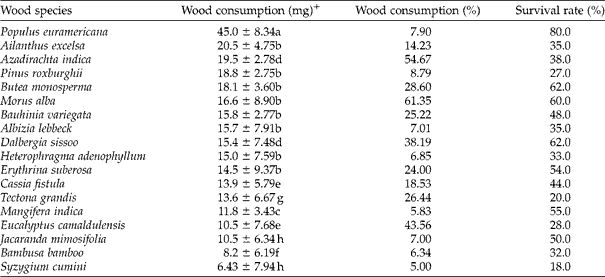
The no-choice feeding trials indicated that P. euramericana was the most palatable wood species (45 mg) among the 18 different wood species when tested against C. heimi. The percentage of wood consumption was 7.90; survival was 80%. The correlation between wood consumption and the percentage of survival of termites confined in cages containing P. euramericana blocks was positive and significant (r= 0.810.0). However, minimum wood consumption (6.43 mg) was observed in S. cumini. Consequently, the survival was apparently as low as 18.0%. The correlation between wood consumption and the percentage of survival of termites was statistically non-significant (r= − 0.742).
These results are important for evaluating the antifeedant property and repellent quality of different wood species against C. heimi and also helpful for determining the foraging behaviour of termites.
Differences among P. roxburghii, S. cumini, T. grandis and B. bamboo with regard to wood consumption were not significant, while those among other species were statistically significant (P< 0.05). Pinus roxburghii and T. grandis exhibited a significant difference (Table 1).
Amount of mean wood consumption (mg) and wood consumption (%) in blocks of 18 different wood species exposed to the workers of Coptotermes heimi for 2 weeks under no-choice laboratory conditions
Means followed by the same letter within a column are not significantly different (P< 0.05, Tukey's test).
+ Values are means from three replications.
Choice bioassay under laboratory conditions
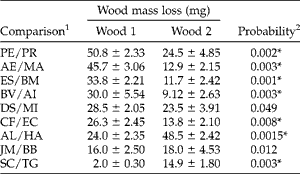
When different species of wood were exposed in combinations of two wood species in Petri plates to C. heimi workers, maximum feeding was recorded in P. euramericana and P. roxburghii (50.8–24.5 mg) and minimum feeding in S. cumini (2.06 mg) and T. grandis (14.9 mg). The consumption rate recorded for other wood block combinations in descending order was as follows: AE/MA>DS/MI>BV/AI>ES/BM>CF/EC>AL/HA>JM/BB. The amount of wood consumed was significantly different (P= 0.006) (Table 2).
Mean ( $$\overline{X} $$±SD) wood consumption/mass loss (mg) in nine different wood pairs when exposed in combination to the workers of Coptotermes heimi for PE/PR (Populus euramericana and Pinus roxburghii), AE/MA (Ailanthus excelsa and Morus alba), DS/MI (Dalbergia sissoo and Mangifera indica), BV/AI (Bauhinia variegata and Azadirachta indica), ES/BM (Erythrina suberosa and Butea monosperma), CF/EC (Cassia fistula and Eucalyptus camaldulensis), AL/HA (Albizia lebbeck and Heterophragma adenophyllum), JM/BB (Jacaranda mimosifolia and Bambusa bamboo) and SC/TG (Syzygium cumini and Tectona grandis) in 2-week choice trials under laboratory conditions
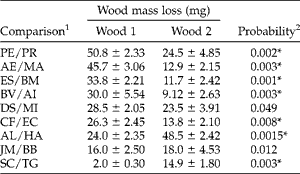
1 Each wood block was paired with a block of another species (wood 1/wood 2) in a Petri plate containing 100 termites (n= 3).
2 Difference in mass loss for each pair of wood blocks indicated by * = 0.05 is significantly different (paired comparison t test).
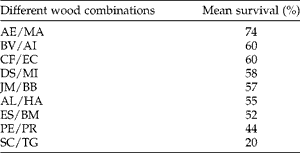
The mean percentage of survival of C. heimi on wood blocks exposed in combination in laboratory trials is summarized in Table 3. Maximum survival (74%) was recorded for AE/MA, whereas minimum survival (20%) was recorded for SC/TG. The difference in mass loss for each pair of wood blocks was statistically significant (P>0.05).
Mean survival percentage of the workers of Coptotermes heimi on nine different combinations of wood blocks in choice feeding laboratory trials after 14 days of exposure
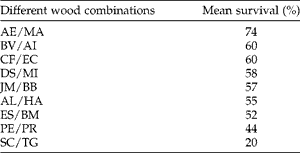
AE/MA, Ailanthus excelsa and Morus alba; BV/AI, Bauhinia variegata and Azadirachta indica; CF/EC, Cassia fistula and Eucalyptus camaldulensis; DS/MI, Dalbergia sissoo and Mangifera indica; JM/BB, Jacaranda mimosifolia and Bambusa bamboo; AL/HA, Albizia lebbeck and Heterophragma adenophyllum; ES/BM, Erythrina suberosa and Butea monosperma; PE/PR, Populus euramericana and Pinus roxburghii; SC/TG, Syzygium cumini and Tectona grandis.
No-choice bioassay under field conditions
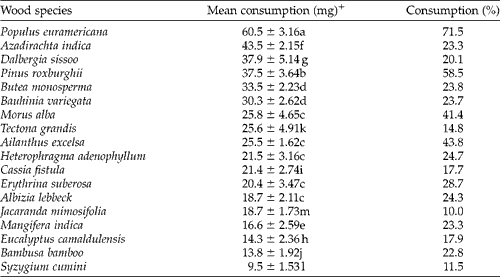
Among the 18 species of wood, minimum percentage of mass loss in no-choice trials was recorded in S. cumini (11.5%). Coptotermes heimi consumed more amounts of P. euramericana (71.5%) after 2 weeks. From these results, it can be concluded that S. cumini is least preferred by C. heimi and therefore can be classified as highly resistant. On the other hand, P. euramericana was highly susceptible. The mean consumption value recorded for A. excelsa was 25.5 mg; M. alba, 25.8 mg; E. suberosa, 20.4 mg; H. adenophyllum, 21.5 mg; A. lebbeck, 18.7 mg; B. monosperma, 33.5 mg; B. variegata, 30.3 mg; M. indica, 16.6 mg; A. indica, 43.5 mg; D. sissoo, 37.9 mg; E. camaldulensis, 14.3 mg; C. fistula, 21.4 mg; B. bamboo, 13.8 mg; and J. mimosifolia, 18.7 mg.
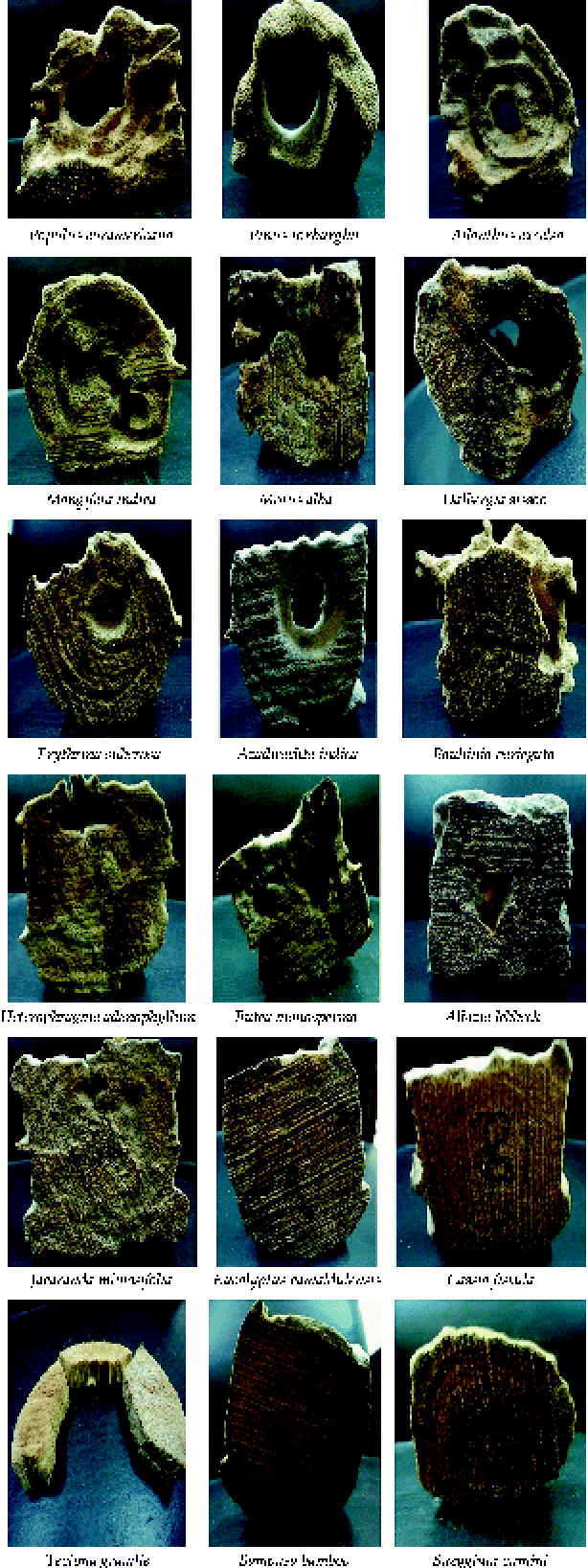
In the no-choice bioassay, minimum feeding was recorded in S. cumini (9.5 mg) and maximum feeding in P. euramericana (60.5 mg) (Table 4). In the remaining species, the amount of wood consumed was not significantly different among A. excelsa, M. alba, E. suberosa, H. adenophyllum, B. monosperma and B. variegata (P< 0.05, Tukey's test). However, P. euramericana, P. roxburghii, M. indica, D. sissoo, E. camaldulensis, C. fistula, B. bamboo, T. grandis, S. cumini and J. mimosifolia exhibited significant differences with regard to wood consumption (P< 0.05, Tukey's test) (Fig. 2).
Mean consumption (mg) and percentage of consumption of 18 different timber species exposed to Coptotermes heimi in no-choice feeding bioassay after 2 weeks under field conditions
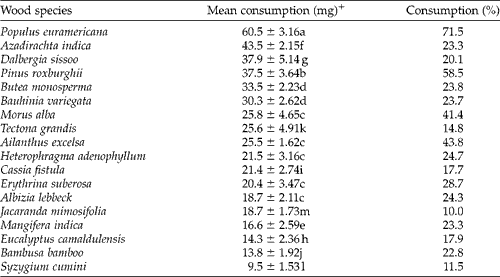
Means followed by the same letter within a column are not significantly different (P< 0.05, Tukey's test).
+ Values are means from three replications.
(colour online) Range of damage caused by the workers of Coptotermes heimi (Isoptera: Rhinotermitidae) on blocks of 18 different wood species during no-choice bioassay in the field after 2 weeks.
Choice bioassay under field conditions
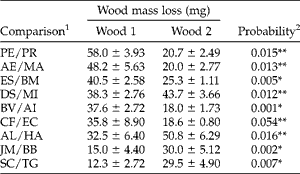
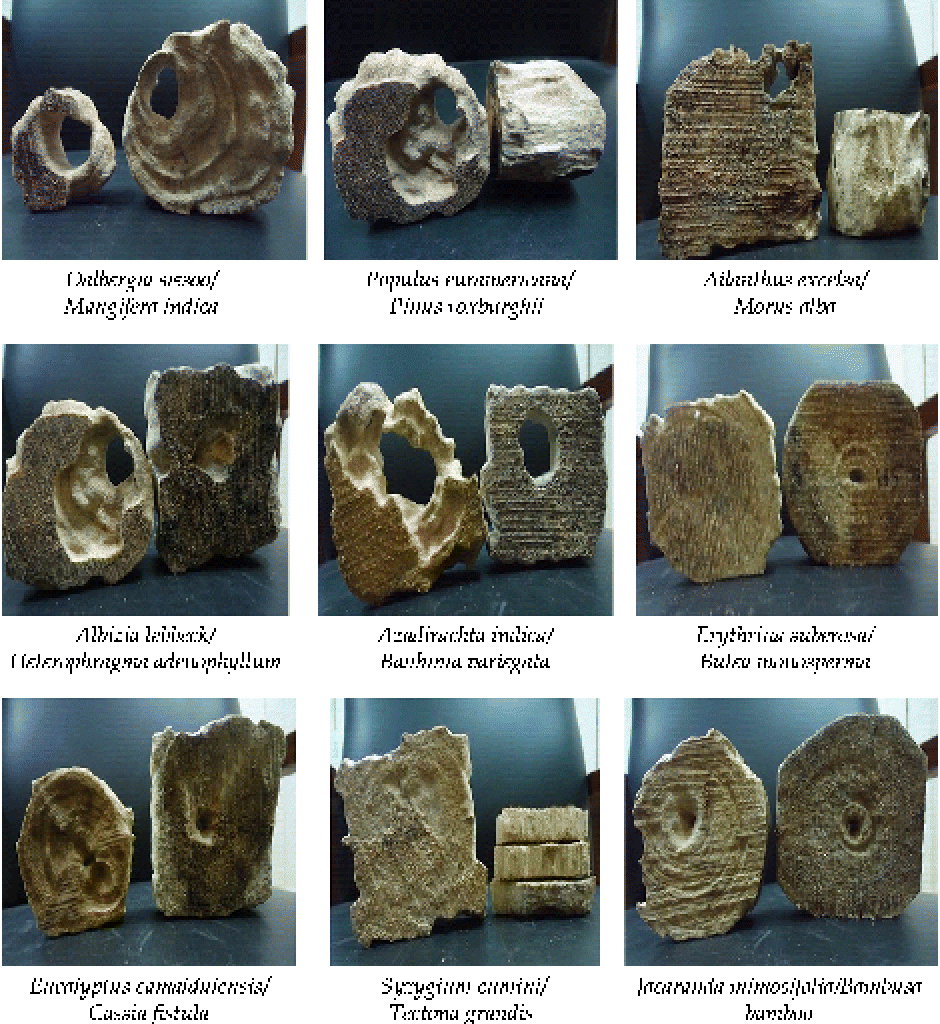
Among the blocks exposed in combinations of two wood species in the choice bioassay under field conditions, maximum feeding was recorded in P. euramericana and P. roxburghii (5820.7 mg) and minimum feeding in S. cumini and T. grandis (12.3 and 29.5 mg) (Table 5). Wood consumption recorded in other wood species was also high; feeding preferences of termites for the combinations in descending order were as follows: AE/MA>DS/MI>BV/AI>ES/BM>CF/EC>AL/HA>JM/BB. The difference in mass loss for each pair of wood blocks was significantly different (P>0.05, paired comparison t test) (Fig. 3).
Mean ( $$\overline{X} $$±SD) wood mass loss (in mg) in nine different wood pairs when exposed in combination to Coptotermes heimi for PE/PR (Populus euramericana and Pinus roxburghii), AE/MA (Ailanthus excelsa and Morus alba), DS/MI (Dalbergia sissoo and Mangifera indica), BV/AI (Bauhinia variegata and Azadirachta indica), ES/BM (Erythrina suberosa and Butea monosperma), CF/EC (Cassia fistula and Eucalyptus camaldulensis), AL/HA (Albizia lebbeck and Heterophragma adenophyllum), JM/BB (Jacaranda mimosifolia and Bambusa bamboo) and SC/TG (Syzygium cumini and Tectona grandis) in 2-week choice trials under field conditions
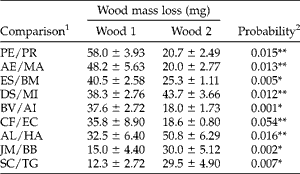
1 Each wood block was paired with a block of another species (wood 1/wood 2) in the termite mound (n= 3).
2 Differences in mass loss for each pair of wood blocks indicated by * = 0.05 and ** = 0.01 are significantly different (paired comparison t test).
(colour online) Feeding preferences and damage caused by the workers of Coptotermes heimi on different wood blocks when exposed in combination under choice field conditions after 2 weeks.
Discussion
In the present study, 18 wood species were used to determine the feeding preferences of C. heimi. Knowledge on termite feeding behaviour is important in the planning of termite control strategies. Termite investigators have long observed that certain wood species are resistant to termites. Wolcott (Reference Wolcott1951) and Wood (Reference Wood and Brian1978) reported that the resistance of timber to attack by termites is due to specific chemicals in wood that repel certain termites. Toxic chemicals present in wood may act on the termites directly or indirectly by affecting their symbiotic protozoa. For instance, Mauldin et al. (Reference Mauldin, Carter and Rich1981) reported that protozoan populations varied in termites exposed to the heartwood samples of 21 American species. Neither hardness nor high lignin content prevents wood from being eaten by dry-wood termites (Wolcott, Reference Wolcott1951). However, Behr et al. (Reference Behr, Behr and Wilson1972) reported that there is a strong correlation between the hardness of wood and its resistance to attack by termites other than dry-wood termites. In developing countries, such as Pakistan, severe termite infestation of structures is often tolerated as the cost of control may exceed the cost of replacing or renewing the damaged timber. However, with the increase in income and improvement in living standards in the big cities of Pakistan, the trend has changed and people are now very conscious of the damage caused by termites to their valuable structures. In Pakistan, 53 termite species have been described, but only 11 species have been found to cause economic damage (Iqbal and Saeed, Reference Iqbal and Saeed2013)
The main purpose of this study was to determine the wood species with the highest levels of resistance and susceptibility to attack by C. heimi. Appreciable work has been carried out by various researchers in Pakistan to study the feeding preferences of termites (Akhtar and Ali, Reference Akhtar and Ali1979; Akhtar and Jabeen, Reference Akhtar and Jabeen1981). However, in Pakistan, local knowledge related to termites revealed that wood species such as P. roxburghii, D. sissoo and T. grandis possess antitermetic properties, but the results of the present study differ from those of the previous work regarding C. heimi, which even consumed a substantial amount of wood of P. roxburghii and D. sissoo, whereas S. cumini was moderately resistant. However, it is also important to mention that the extractive content of wood is also one of the parameters determining the resistance against the damaging agents (Martawijaya, Reference Martawijaya1996). The results of the present study reveal that the inherent resistance of wood protects it from termite attack. Also, the results support a previous report that the natural resistance of wood to termite attack is related to the higher specific gravity of the wood species (Esenther, Reference Esenther1977; Peralta et al., Reference Peralta, Menezes, Carvalho and Aguiar2004).
Wood feeding preferences and resistance will alter with the hardness, lignin content or chemical constitution of wood. Organic chemicals, such as phenol, quinones, terpenoids and lignins at high concentrations, may also have an effect on the ecology where feeding occurs. The pH of wood content might also be important. Sapwood, which has more starch and sugar, is generally preferred over heartwood. Therefore, many of the indigenous trees are more resistant to termite attack and have developed chemical defence mechanisms to protect themselves. These chemical defence mechanisms are more prevalent in immature trees and crops, making them less susceptible to termite attack. The concentrations of chemicals in trees can change from the outside to the inside layers. Older trees may develop cracks in the bark and the resistant chemicals may not be present near the outer layers of the tree, possibly allowing termite attack to occur (Pearce, Reference Pearce1997). Similarly, Chaudhry et al. (Reference Chaudhry, Malik and Arshad1978) studied the natural resistance of various timber species to the attack by C. heimi. They also investigated the survival of this species on the sawdust of 12 common Pakistani timber species in laboratory conditions. Based on the longevity of the workers and soldiers, Cassia deodara and T. grandis were reported to be resistant to termite attack, while Salmalia malabarica, Acacia pindrow and Picea smithiana were reported to be the most susceptible. A survey conducted on termite infestation on trees associated with farms in the districts of Jhang and Faisalabad revealed that Acacia arabica (kikar) and D. sissoo (shisham) are the most common trees along the borders of different crop farms. These trees provide timber to farmers for various applications. This study was conducted in Lahore District where P. euramericana is the most widely planted tree because of its dense canopy and commercial application. That is why this region is highly infested by C. heimi.
Manzoor et al. (Reference Manzoor, Rahim, Shiday, Malik, Habibpur, French and Jabeen2010a) surveyed seven forests of Punjab to investigate the infestation of termites on economically important tree species. They observed 12 termite species from soil, dead logs, live wood and living trees, while the major wood species prevalent in these forests are as follows: A. arabica, Tamarix articulata, D. sissoo, M. alba, E. camaldulensis, Melia azedarach, Abies pindrow, T. grandis, dry grass, Bombax cieba, Arjun terminalia, Prosopis sp., Ficus religiosa, M. indica, A. lebbeck, Phyllanthus emblica, S. cumini, Broussonetia papyrifera, Dendrocalamus strictus, S. malabarica, Populus sp. and rubber tree. In all these forests, 20% of dead wood logs and branches exhibited signs of subterranean termite infestation, while C. heimi was found to cause maximum damage to D. sissoo, T. articulata, A. pindrow, M. indica, A. lebbeck, M. alba and Populus sp. However, least damage was observed in the case of T. grandis and S. cumini, which is consistent with our findings.
Similar to most of the other termite species, C. heimi is capable of locating/identifying palatable wood and avoiding wood that has some natural resistant properties. Under field conditions, a slight shift was observed in the feeding preferences when compared with those observed in the laboratory. In feeding bioassays on C. heimi, the impact of different species exposed to this termite reveals the following descending order of feeding preferences: P. euramericana>A. excelsa>A. indica>P. roxburghii>B. monosperma>M. alba>B. variegata>A. lebbeck>D. sissoo>H. adenophyllum>E. suberosa>C. fistula>T. grandis>M. indica>J. mimosifolia>E. camaldulensis>B. bamboo>S. cumini. Manzoor et al. (2010b) evaluated the resistance of four wood species (A. indica, P. roxburghii, D. sissoo and P. deltoides) against C. heimi through choice and no-choice field and laboratory trials and found D. sissoo to be the most resistant wood and P. deltoides to be the most preferred.
Future studies on the extracts of the most resistant wood species, followed by the analysis of the resistant components, can reveal the resistance of wood. This could be the real task in the eco-friendly management of termites. It is extremely important to carry out feeding bioassays before the application of a bait toxicant, because the bioassays could prove useful for enhancing the efficacy of bait while selecting the most palatable wood species for an effective baiting strategy.
Conclusion
From the results of this study, it can be concluded that infestation rate under natural conditions would be reduced when resistant tree species are planted in combination with those that are susceptible. It could also help in the enhancement of the shelf life of wood. When some species, i.e. PE/PR, were used in combination, the degree of infestation was reduced up to some level and less deterioration was observed. However, the rate of consumption was very low in S. cumini and T. grandis because both these wood species are resistant, so local growers are recommended to adopt the plan of planting trees in combination to prevent economic losses. The separation of food niches impedes interspecific competition for food and therefore allows an overlap of foraging territories. Thus, differences in feeding preferences may well be one of the major factors that lead to the effective separation of the different termite species present in the same area. As food choices are almost always available to termites in nature, bait attractiveness is critical to bait performance. Seeding bioassays could prove useful for enhancing the efficacy of bait while selecting the most palatable wood species for an effective baiting strategy. Future studies on the extracts of the most resistant wood species can reveal the resistance of wood and analysis of the resistant components could be the real task in the eco-friendly management of termites. The results of studies of this type are also important for evaluating the levels of preservative treatments required to protect timbers in regions with high levels of termite infestation and to identify naturally durable wood that may not require preservative treatment. Natural durability is an area of increasing interest that can help in reducing the application of industrial chemicals in the environment.
Acknowledgements
The authors thank the Pakistan Science Foundation (PSF) for providing support through a grant.