The continuum of care following acquired brain injury (ABI) often involves the provision of post-acute-care services for injured persons and their family caregivers. Once the injured person's immediate medical needs are addressed and stabilized in trauma centres, emergency rooms, and other acute hospitalization environments, some are transferred to acute rehabilitation units (Uomoto & McLean, Reference Uomoto and McLean1989). Such units offer the injured person and their family access to ABI interventions through services such as neuropsychology, clinical psychology, speech and language therapy, physical therapy, vocational rehabilitation counselling, prosthetics and orthotics, rehabilitation engineering, occupational therapy, rehabilitation nursing, social work, recreation, and case management. Following the acute stage of ABI rehabilitation, many of these types of supports can continue on an outpatient basis (Sohlberg & Brock, Reference Sohlberg and Brock1985).
The provision of outpatient and other community-based supports is critically important to help injured persons maintain and build on rehabilitation gains made during inpatient ABI rehabilitation (McCabe et al., Reference McCabe, Lippert, Weiser, Hilditch, Hartridge and Villamere2007). Moreover, post-acute-care support offers a means of reducing stress and burden amongst family caregivers (Smith et al., Reference Smith, Vaughan, Cox, McConville, Roberts, Stoddart and Lew2006) and can better equip caregivers to meet their injured family member's care needs (Malec & Ponsford, Reference Malec, Ponsford, Frank and Elliott2000). Acute-care rehabilitation units provide discharge planning services, which can include referral for post-acute-care (Greenwald, Reference Greenwald2010), which thereby offers a means of linking injured persons and their families with ABI services on an extended basis.
Not all however benefit from this mechanism, as many injured persons and their family caregivers do not receive post-acute rehabilitation support in home and other community-based settings. Injured persons and their families often encounter a long-term ABI system in the United States that is fragmented, inconsistent geographically, and largely insufficient (Degeneffe et al., Reference Degeneffe, Boot, Kuehne, Kuraishi, Maristela, Noyes and Will2008), with some professionals lacking necessary training and expertise on ABI (Degeneffe & Bursnall, Reference Degeneffe and Bursnall2015). Given the important role ABI rehabilitation units play in linking injured persons and their family caregivers to long-term care through post-acute-care support, the present study was guided by the following research questions:
-
1. To what extent do persons with ABI and their family caregivers utilize post-acute-care ABI services following discharge from acute-care rehabilitation?
-
2. What barriers do persons with ABI and their family caregivers experience in utilizing post-discharge ABI services?
Given the study's limited sample, we offer the study as a Brief Report to highlight findings needing continued examination and research.
Method
Participants
There were a total of 21 participants. All of the following percentages describing participants were rounded. Most were female (76%), spouse/partners (71%), White (57%), and Catholic or Protestant (62%). Mean participant income was $79,916 (SD = $44,464) (Note: four participants did not provide income information). Regarding employment, 43% worked full-time, whilst 24% worked part-time. Many participants held either an undergraduate or graduate degree (48%). The average participant age was 48.6 years (SD = 13.5). One participant did not provide caregiver and injured person demographic information.
On average, the time since the ABI was 10.1 months (SD = 2.8), with the time ranging from 7 to 20 months. The mean number of months since discharge from acute-care was 8.1 months (SD = 1.5), varying from 6 to 11 months. The average time in acute-care was 1.4 months (SD = 0.7), from a low of less than 1 month to a high of 3 months. Two participants did not provide information for the injury and acute-care discharge dates.
The injured family members were mostly male (62%), White (52%), not employed (62%), and possessed a junior college/community college level of education (33%). The average age of the injured family members was 52.9 years (SD = 17). The majority (81%) of injured family members lived at home with family. Most (71%) participants indicated ‘other’ as the cause of the injury, with specific causes listed as motor vehicle accidents (14%) and assaults (5%). Many of the ‘other’ causes were likely non-traumatic forms of ABI such as strokes.
Procedure
The injured family members and their caregivers were served by an ABI rehabilitation facility in the southwestern part of the United States. All of the injured family members had received acute-care, inpatient services, and were offered ongoing post-acute-care support by the facility.
A two-part data collection strategy was used. The initial strategy collected data from five participants at the time of discharge (which included demographic questions for participants and the injured family members), with a second follow-up survey given approximately 6 months later. To increase the number of participants, a second data collection approach involved sending surveys to all families (n = 168) of persons discharged from acute, inpatient care from a period of 6 months to 1 year. A total of 17 surveys were completed. The two-pronged data collection strategies resulted in 22 completed surveys. One survey was removed for not meeting study inclusion criteria. The study received institutional board approval from the first author's university as well as the ABI rehabilitation facility.
To determine the representativeness of participant data to the overall population served by the ABI facility, demographic information for the facility's 2014 inpatient admissions was compared to the present sample. Since participant data was collected in different years, the 2014 inpatient admission data was viewed as a proxy indicator of the overall representativeness of the sample population. The inpatient data was largely consistent with the present study's demographic information (the present study demographics are listed in parentheses). In 2014, 83.1% of patients with ABI were discharged to the home setting (81% in the present study), with the average time for inpatient care being 20.3 days (1.4 months in the present study). This difference may be due to inpatient care time being measured in months and not days in the present study. The mean age of patients was 59 years (52.9 years in the present study). A total of 17.5% of 2014 patients had traumatic forms of ABI (19.1% of participants incurred traumatic brain injury [TBI] through motor vehicle accidents or assaults).
Instrumentation
Surveys contained items on demographics and injured family member impairment. Survey items also assessed family caregiver depression, ratings of family functioning, and perceptions of post-injury rehabilitation needs. Per the focus of the present study, participants were also asked about their use of the ABI facility's post-acute-care services. Out of 14 possible services, participants were asked to rate (a) if they received the service (yes or no); (b) if the service was received, their satisfaction with the service (yes or no); (c) if the service was not received, the barrier to receive the service (transportation, lack of insurance, lack of awareness that this service was available, or other [please describe]); and (d) if the service was not received, was it obtained through a different provider (yes or no).
Participants were also asked five open-ended questions regarding their use and experiences with the services provided by the ABI facility. Of interest to the present study, participants were asked (a) ‘Describe if your family's health insurance has been adequate to cover the cost of available [ABI facility] services since your family member left inpatient acute care’, and (b) ‘Describe any other barriers (e.g., transportation) your family has experienced in trying to use [ABI facility] services since your family member has returned home’.
Previous survey results on the relationships amongst service use and service satisfaction to participant depression, family functioning, and perceptions of post-injury rehabilitation needs were reported in Rehabilitation, Research, Policy, and Education (Degeneffe, Green, & Jones, in press).
Data Analysis
To address research question 1 (service use), the number of services used by participants was calculated, along with the specific percentage of use for all 14 service categories. When participants did not indicate if a service was received, it was assumed they did not receive the service. To further address research question 1, the mean percentage that another provider was used across all 14 service areas was calculated, along with the specific percentages that other providers were used for all 14 service areas. Participants were asked about other provider use when they indicted they did not receive the service from the ABI facility. When participants did not give an ‘other provider’ response, the response option ‘no’ was entered.
To address research question 2 (service barriers), the mean percentage of barriers amongst all 14 service areas was calculated, along with the specific percentages of the top barriers for each service area. Participants were allowed to rate one of the four barriers options when they did not receive a respective service. When participants did not provide a barrier response, an ‘other’ response was entered. Research question 2 was further addressed by categorizing participant open-ended questions about (a) the adequacy of their health insurance and (b) the barriers experienced in utilizing the ABI facility's post-discharge services. The first author categorized open-ended survey responses via the HyperRESEARCH version 2.8 (Depuis, Reference Depuis2007) software qualitative data analysis programme. Each participant response was categorized per its central meaning. The second and third authors reviewed and confirmed the accuracy of the assigned categories.
Results
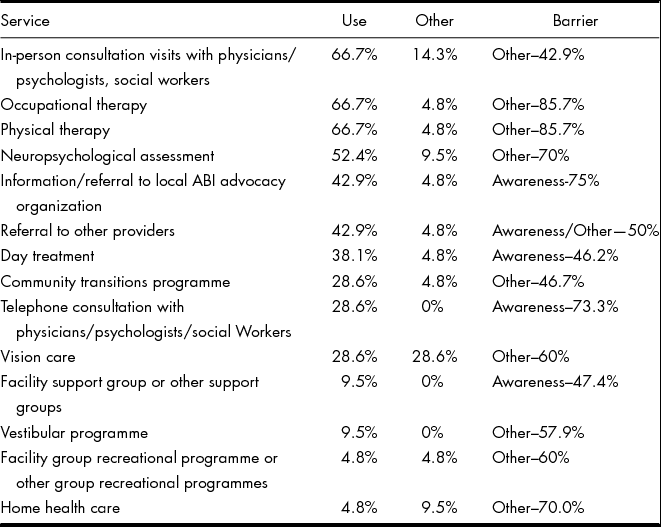
With regard to research question 1 (service use), the average number of post-acute-care services used was 4.9 (SD = 3.6), with a range of 0 to 11 services. Three families did not receive any post-care services from the ABI facility. Across the 14 service categories (see Table 1), the most frequently (66.7%) used services were (a) in-person consultation visits with physicians/psychologists, social workers; (b) occupational therapy; and (c) physical therapy. The least used (4.8%) services were (a) ABI facility group recreational programme or other group recreational programmes, and (b) home health care. Concerning other provider use, on average, 6.8% (SD = 7.4%) of the 14 service areas were provided outside of the ABI facility, ranging from 0% to 28.6%.
Post-acute-care service use, use of other providers, and service barriers

Concerning research question 2 (service barriers) across the 14 post-acute-care service areas, the most common (M = 53.9%; SD = 20.0%) barrier was listed as ‘other’ followed by ‘lack of awareness’ (M = 35.2%; SD = 23.4%) and ‘lack of insurance’ (M = 11.0%; SD = 8.2%). Lack of transportation was not listed as a barrier for any of the 14 services. With regard to the reasons listed for the ‘other’ barrier response, in many cases participants offered no explanation. Amongst the stated reasons for ‘other’, the most common was that the service was not necessary. Other reasons included needing a service referral, logistical concerns, lack of insurance, lack of interest amongst the injured family members, and confusion about the nature of the service. Table 1 lists the most common barrier for each of the 14 services.
The open-ended survey responses conveyed similar information to the quantitative items. Regarding the adequacy of participant health insurance to pay for services, 15 of the 21 participants believed their coverage was adequate, albeit not always ideal: ‘For most all treatment our insurance has covered all aspects of her rehabilitation; the only problem[s] we have encountered were with out of network physicians on her initial in-patient hospital care’. Five participants, however, felt their insurance coverage was not adequate:
His insurance covered 60 physical therapy/occupational therapy/speech therapy sessions per calendar year. These went quickly with his enrollment in the Day Treatment Program. He only went 3 days a week (instead of 5), for 5 hours per day (instead of 6) and attended approximately 6-1/2 weeks (not sure what the max is – 12?). When that ended, it was too bad, because he was very engaged in the program and making a lot of progress. I tried to muster as many resources as I could, but I was back at work, so I couldn't provide nearly the same intensity as the program. He was able to return to physical therapy and occupational therapy in January (speech therapy wasn't needed), but after a couple months that stopped – not exactly sure why? He plateaued? Coverage for inpatient has been fine.
One other participant felt the question was not applicable.
Regarding other barriers, participants encountered in using post-acute-care services, the responses were fairly equal, with the most common (n = 5 responses) that there were no barriers. Four participants described transportation barriers in getting to services:
Transportation was very challenging because he couldn't drive. I had to take off from work constantly to take him to appointments –this was very stressful because I had a new job. Day treatment was better because I could drop him off in the morning and then pick him up at the end (I often made him wait 1–2 hours! So that made me feel terribly guilty also). I was either guilty because I left work or guilty because I made him wait. Then take him home, cook, clean and take care of everything else myself.
Another four participants indicated the primary barrier to using services was due to the reluctance of their injured family members to receive available services. For example, one participant stated, ‘None, all barriers are created by the patient’. Three participants described logistical challenges in using outpatient support. For instance, one participant shared, ‘Times are not convenient. We are early morning/day people; evening activities are held too late in the day’. Finally, one other participant indicated a need for case management by stating, ‘Need for a case manager to sort out referral needs to see[k] out network physicians’.
Discussion
The present study findings underscore the importance of acute rehabilitation units in linking injured persons and their families with post-acute-care support. ABI presents multiple short- and long-term functional impairments in such areas as cognition, personality, mobility, and sensory function. Use and access to post-acute-care is critically important to address ABI impairment and increase the potential for vocational participation, independent living, and overall positive quality of life.
Some general observations of the findings are noted. It appeared services were used largely consistent with need. When services were not provided by the ABI facility, there was limited use of outside providers and the most common barrier to the use of services was ‘other’, where many participants indicated the service was not needed or a reason for the ‘other’ response was not provided. Also, insurance coverage and transportation were not significant barriers to service use. However, for five service areas, the most common barrier was not knowing the service was available, preventing access to outside referrals, day treatment, local advocacy, telephone professional consultation, and support groups. This serves as a reminder that professionals in acute rehabilitation units need to be fully aware of the range of available potential supports and diligent in informing injured persons and their families about available post-discharge services.
Because of its limited sample size, the present study lacks generalizability to post-acute-care service use by injured persons and their family caregivers on a larger scale. Therefore, caution should be exercised in making inferences from study findings. As a Brief Report, however, the present study should serve as a foundation for larger scale studies examining barriers to service use following acute rehabilitation in the United States as well as other countries. ABI presents a pervasive public health concern worldwide (Degeneffe, Reference Degeneffe2013). It is important to create strategies to better link injured persons and their families to available outpatient and community-based services. Documenting service barriers is an important first step in creating these strategies.
Acknowledgement
This study was supported with funding from the San Diego State University, University Grants Program.