Introduction
Many ecological, veterinary or conservation questions relating to host–parasite systems require quantitative estimates of parasitism within particular hosts, and of the variation in parasitism among hosts in a population of interest (Anderson & May, Reference Anderson and May1978). Estimation of gastro-intestinal (GI) parasite burdens in living animals, however, is no simple task. In post-mortem examination, it is possible to count or estimate the parasite burden directly within the digestive tract. In live animals, particularly in free-ranging wildlife, estimation of parasite burden is much more challenging. Available non-invasive methods estimate GI parasite intensity indirectly, by quantifying parasite propagules or DNA excreted in faecal matter, or by detecting antigens in faeces using enzyme-linked immunosorbent assay (ELISA)-based tests (Wilson et al., Reference Wilson, Bjørnstad, Dobson, Merler, Poglayen, Randolph, Read, Skorping, Hudson, Rizzoli, Grenfell, Heesterbeek and Dobson2001). These indirect measures may produce biased estimates of parasitism in hosts and may have unknown or varying specificity and sensitivity (Wilson et al., Reference Wilson, Bjørnstad, Dobson, Merler, Poglayen, Randolph, Read, Skorping, Hudson, Rizzoli, Grenfell, Heesterbeek and Dobson2001), but without lethal sampling are often the only means available for estimating parasite intensity in wildlife.
To reduce possible biases introduced though these indirect methods, several studies have highlighted factors that can confound estimates of parasite intensity from faecal measures. For example, the time of day in which sampling occurs can affect egg/oocyst output in faeces and, therefore, stratifying sampling times can help reduce within-day variation in intensity estimates (Ezenwa, Reference Ezenwa2003; Villanúa et al., Reference Villanúa, Pérez-Rodríguez, Gortázar, Höfle and Viñuela2006). The symptoms of disease associated with parasite infection can also affect quantitative parasite measures. High burdens of GI parasites can cause diarrhoea, which increases the ratio of water to dry matter in faeces and reduces faecal egg counts (Le Jambre et al., Reference Le Jambre, Dominik, Eady, Henshall and Colditz2007). To correct for the influence of variation in the water content of faeces on faecal egg counts, various adjustment factors have been proposed (Levine & Clark, Reference Levine and Clark1956; Gordon, Reference Gordon1967; Le Jambre et al., Reference Le Jambre, Dominik, Eady, Henshall and Colditz2007) which re-scale faecal egg counts based on visually assessed categorical estimates of faecal consistency.
This study examined faecal water variation and parasite intensity estimates from faecal egg counts obtained using the McMaster technique, a commonly used non-invasive method for quantifying parasitism (Bowman, Reference Bowman2003). This technique is based on the wet weight of faeces, and variation in faecal water content may confound or obscure patterns in relation to the variables of interest. Although this study presents data in the context of this particular method, the findings have relevance to any estimate of parasite intensity that is obtained from examination of faeces.
Variation in faecal water content was examined in relation to host age class (juvenile, yearling, adult), sex and seasonality, three factors commonly evaluated in ecological studies. Quantitative measures of faecal water content were used to assess these differences for two free-ranging wild ungulate species, springbok (Antidorcas marsupialis) and plains zebra (Equus quagga, previously Equus burchelli). Because researchers are not always able to measure faecal water content directly in the field, we also assessed whether a categorical scale for estimating faecal water content adequately described the measured variation in water content of faecal samples. Finally, we evaluated whether or not variation in faecal water content significantly influenced the outcome of statistical analyses of ecological patterns in strongyle nematode intensity for these two wild ungulates.
Materials and methods
Study site
This study was undertaken in Etosha National Park, a 22,915 km2 reserve in northern Namibia between 18°30′–19°30′S and 14°15′–17°10′E. Etosha contains a 4760 km2 salt pan, a dominant geological feature which is the remnant of a palaeolake (Hipondoka et al., Reference Hipondoka, Busche, Kempf and Jousse2006). The vegetation is classified as arid savanna (Huntley, Reference Huntley, Huntley and Walker1982) with a single wet and a single dry season each year. Much of Etosha National Park is covered by mopane (Colophospermum mopane) shrubveld or treeveld, but extensive sweet grassveld plains surround the Etosha salt pan (Le Roux et al., Reference Le Roux, Grunow, Morris, Bredenkamp and Scheepers1988). The only perennial water comes from boreholes and artesian or contact springs (Auer, Reference Auer1997). Rainfall is strongly seasonal, mainly falling between November and April, with the greatest monthly rainfall occurring in January and February (Engert, Reference Engert1997).
Sample collection
Faecal samples were collected between February 2006 and April 2008 from zebra (N = 666) and springbok (N = 634) in the central Okaukuejo section of Etosha National Park. Samples were collected between 07.00 and 13.00 hours to reduce daily variation in parasite egg output. Binoculars were used to observe individuals defecating and a homogenized subsample of the faeces was collected within 10 min of deposition to avoid desiccation. The date, time, species, age, sex and the faecal consistency (pellets formed, semi-formed, unformed, liquid) were recorded for each faecal sample. The ageing criteria (juvenile, < 1 year; yearling, 1–2 years; and adult, 2+years) of Gasaway et al. (Reference Gasaway, Gasaway and Berry1996) was used to characterize individuals. Seasons were defined based on rainfall, with the wet season from January to April, and the dry season from May to October. No samples were collected in November or December.
Samples were collected in a zip-lock plastic bag and immediately placed in a refrigerator mounted on the vehicle. Each sample was evaluated for parasites within 48 h of collection, using a modification of the McMaster method for faecal egg counts (FAO, 2005). In brief, this method requires the combination of 4 g of homogenized fresh faecal matter with 56 ml of a saturated salt (NaCl) solution, removal of large plant debris via a strainer, and filling of each chamber on a McMaster slide with a separate homogenized aliquot of the filtrate. The number of eggs observed in each chamber, using a compound microscope, is added together and multiplied by 50 to get the number of eggs/gram of faeces. After parasitological analysis, samples were stored frozen ( − 20°C) in their sealed, original zip-lock bags.
A subset of the frozen samples was selected in 2007 and 2008 for quantitative faecal water content measurement (N = 243 for zebra, N = 266 for springbok). This subset included samples collected in the wet and dry seasons of 2006–2007, and samples were chosen to represent the sexes equally and all age classes in both species. Samples were defrosted completely and then mechanically homogenized while still in the bags. Roughly one-third of each sample was then removed for weighing. Each of these subsamples was weighed on a piece of aluminium foil, sealed loosely into a foil packet and placed in a drying oven (80–100°C) for 48 h. Each sample was weighed again after drying. The percent water content (m) was determined by dividing the difference between the wet (w w) and dry weights (w d) by the original wet weights and converting to a percentage (i.e. m = 100 (w w − w d)/w w).
Statistical analyses
The effect of age on faecal water content was assessed using an analysis of variance. The relationship between faecal water content and season or sex was evaluated using a t-test for each species. The juvenile and yearling age classes were excluded when analysing the effect of sex on percent water. An analysis of variance was used to test whether the categorical faecal consistency scale could adequately describe variation in faecal water content. Faecal water content was estimated on a four-point scale (1, pellets formed; 2, semi-formed; 3, unformed; or 4, liquid, ranging from viscous to watery) but there were so few liquid samples (3/634 for springbok and 3/666 for zebra) that this category was combined with the unformed category and a three-point scale was used for analyses. The effect of faecal water content on faecal egg counts was evaluated using a generalized linear model (GLM) that also included season, age and sex as independent variables. A negative binomial GLM (Wilson et al., Reference Wilson, Grenfell and Shaw1996) was used because the count data were overdispersed and could not be transformed for parametric analyses.
For simplicity, this analysis focused on the strongyle nematodes (Nematoda, Strongylida), although other parasites were observed in faecal flotation, including nematodes in the genus Strongyloides, coccidia in the genus Eimeria, and cestodes in the family Anoplocephalidae (Turner, unpublished data). Parametric analyses were performed using JMP 4.1 (SAS Institute, Cary, North Carolina, USA); GLMs were performed in R 2.7.0 (R Core Development Team, 2008). Means are reported with standard errors unless otherwise stated.
Results
Variation in percent water of faeces
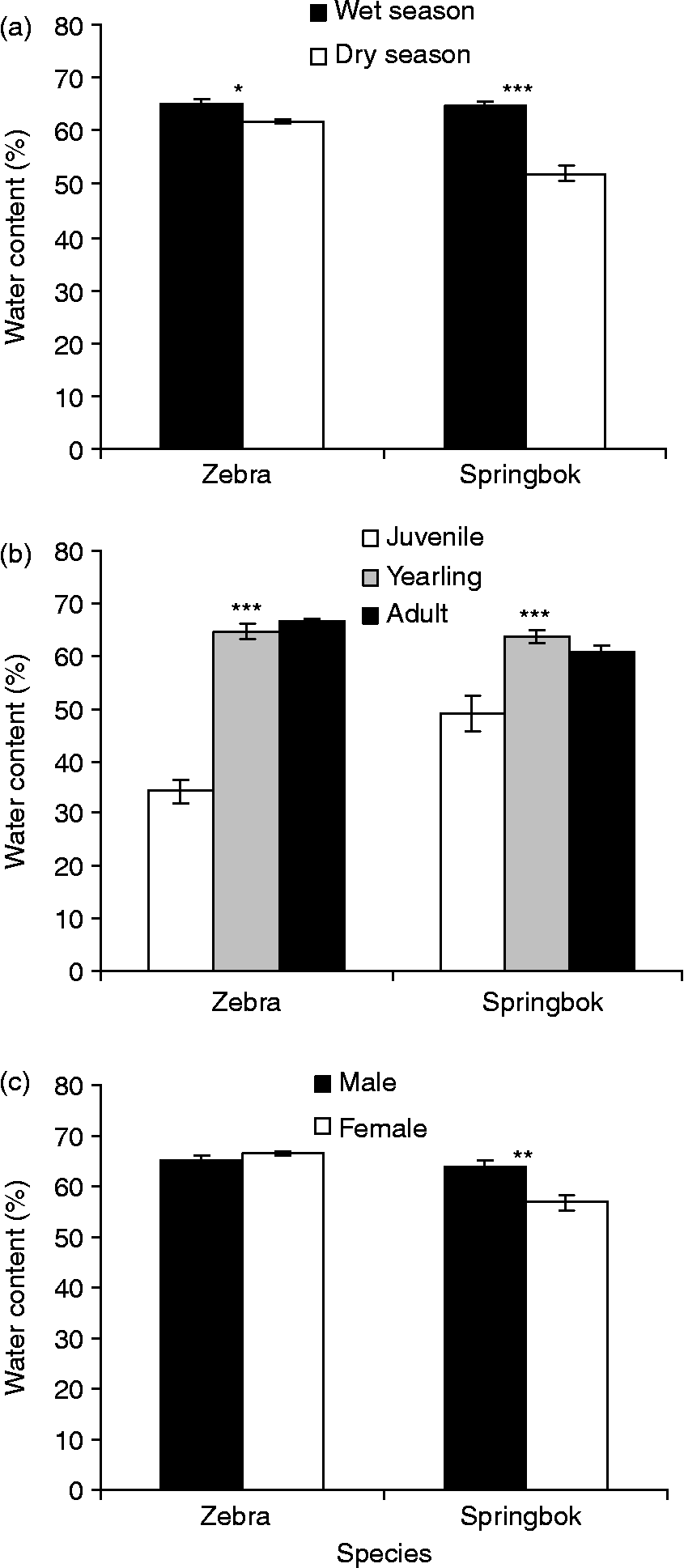
The percent water content of springbok faeces was significantly higher in the wet season than in the dry season (t = − 8.2, df = 264, P < 0.0001; fig. 1a). In zebra, the percent faecal water content was marginally higher in the wet season than in the dry season (t = − 2.3, df = 241, P = 0.022; fig. 1a). While this was a statistically significant result, the difference between the means was very small (fig. 1a) with little of the observed variation in faecal water content described by season.
The mean ± SE percent faecal water content for zebra and springbok by (a) season, (b) age and (c) sex. Only adult individuals were used in the comparison of water content by sex. Significance levels are indicated as: *** P < 0.0001; ** P < 0.001; * P < 0.05.
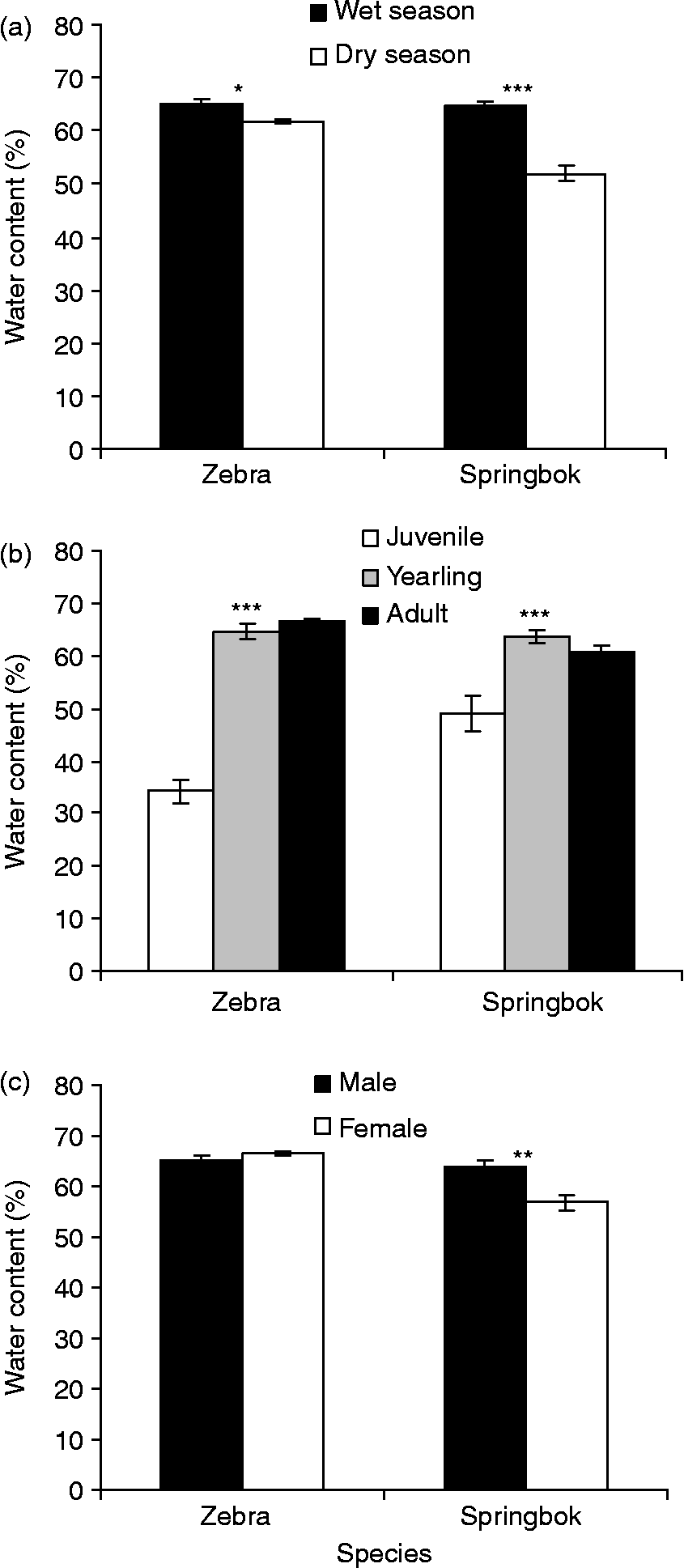
The percent water of zebra faeces was significantly related to age (F = 247.6, N = 243, P < 0.0001; fig. 1b), with juvenile zebra faeces having nearly half the water content of yearling or adult faeces. Juvenile springbok faeces also had a significantly lower percent faecal water than yearling or adult faeces (F = 10.1, N = 266, P < 0.0001; fig. 1b), but the pattern was not as pronounced as for zebra. Adult male springbok faeces had significantly higher percent water than adult female faeces (t = − 3.66, N = 171, P = 0.0003; fig. 1c), but there was no significant difference in percent water content between the faeces of adult male or female zebra (t = 1.79, N = 175, P = 0.076; fig. 1c).
Faecal consistency and percent water content
The categorical faecal consistency scale was able to describe 32% of the variation in faecal water observed in springbok (pellets, 52.9 ± 1.0%; semi-formed, 65.2 ± 1.3%; unformed, 71.7 ± 1.7%; F = 55.1, N = 240, P < 0.0001). For zebra, the consistency scale was significantly related to percent water, but the variance explained was only 3% (pellets, 62.5 ± 0.7%; semi-formed, 66.5 ± 3.3%; unformed, 74.9 ± 4.3%; F = 4.6, N = 228, P = 0.011). The poor fit of this model for zebra was perhaps driven by the very low water content of juvenile faeces and the homogeneity of faecal consistencies. Juvenile faecal pellets were very dry compared to pellets in other age classes, and when juveniles were excluded from the model, the fit improved but was still low, with only 13% of variance explained (F = 15.6, N = 208, P < 0.0001). For zebra, the consistency scale did not successfully capture variation in percent faecal water, as the consistencies observed were very homogeneous: 93% of faecal samples were classified as formed pellets.
In light of the low success in describing variation in faecal water content using the categorical scale, the effect of water variation on faecal egg counts was evaluated using only the individual measurements of percent dry matter, and not a categorical adjustment factor calculated from consistency measurements. Additionally, calculating an adjustment factor (as done by Le Jambre et al., Reference Le Jambre, Dominik, Eady, Henshall and Colditz2007) assumes that the ordinal categories (consistency values 1–3) are continuous variables and that the distance between 1 and 2 is the same as between 2 and 3, an assumption we chose not to make.
Faecal egg counts and percent water content
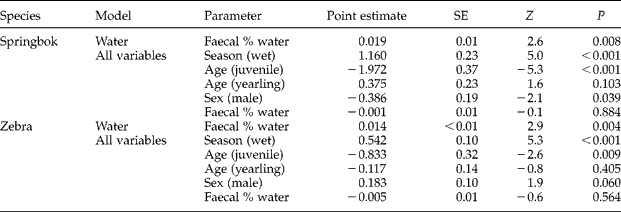
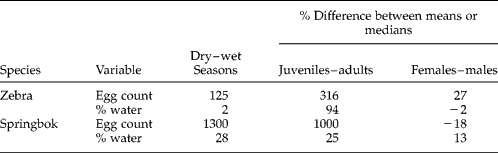
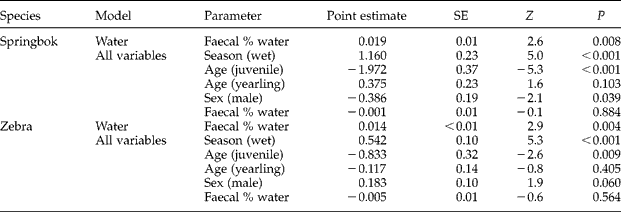
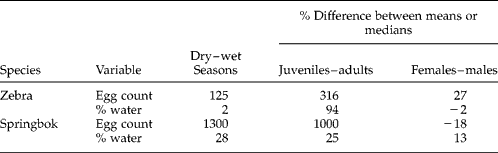
The percent water content of faeces was significantly related to faecal egg counts for springbok and zebra when tested alone, with faecal egg counts increasing as water content increased, although the slopes were very close to zero (table 1). There was no significant influence of the measured faecal water content on egg counts once the ecological and demographic variables were included in analyses (table 1). As a statistical parameter, the effect of faecal water content was swamped out by the much greater differences in faecal egg counts by season and age (table 2). For sex, however, the percent differences between males and females due to faecal water content and parasite egg counts are of similar magnitude, and the directionality ( ± ) of the difference is opposite for parasite counts and water content for each species (table 2). These two factors together make sex the variable with the greatest potential for water variation to confound significance estimates.
Negative binomial GLMs of strongyle faecal egg counts by percent faecal water alone and percent faecal water with the ecological variables (age, sex, season) for springbok and zebra.
The percent change in median faecal egg count and mean percent water from dry to wet seasons, from juvenile to adult age classes and from females to males for zebra and springbok. Here, adults are all animals older than 1 year, as there was no significant difference between animals 1–2 and 2+years of age for faecal egg count or percent faecal water.
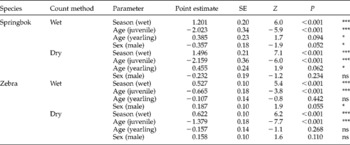
For strongly significant variables, such as season and age, water variation had little effect on the slope or significance of the egg count estimates. For variables which were borderline significant, like sex, water variation may still confound estimates, despite the non-significance of percent water as a model parameter. This point was demonstrated using GLMs of estimated faecal egg counts (FEC) rescaled by the amount of dry matter per gram of faecal matter: FECdry-weight = (FECwet-weight)/(1 − m/100), where m is the percentage of water in the sample. Sex appeared nearly significant using count estimates based on wet weight (springbok, P = 0.052; zebra, P = 0.055; table 3), but when analyses were performed with estimated dry weight counts, host sex became non-significant for both species (springbok, P = 0.234; zebra, P = 0.268; table 3).
Negative binomial GLMs of strongyle faecal egg counts (eggs/g) based on wet weights or dry weights of faeces by age, sex and season for springbok and zebra.

*** P < 0.001; ** 0.001 < P < 0.05; * 0.05 < P < 0.1; ns, P>0.1.
Discussion
This study considered whether or not variation in faecal water content significantly biased estimates of parasite intensity recorded for two species of wild ungulates. We found evidence that water variation could lead to a spurious conclusion that parasitism was significantly different between males and females of each species. Although there were significant differences in faecal water content among the categories of season, age and sex, there was no statistical relationship indicating an effect of faecal water content on model estimates of egg counts by season or age. The seasonal and age-related differences in faecal water content were obscured by much greater differences in strongyle egg counts for these same variables.
Patterns of variation in the percent water content of faecal samples in relation to the ecological and demographic variables were not consistent for both species studied. Springbok showed the greatest variation seasonally, but also had significant differences in faecal water content by age and sex. Zebra had the greatest variation in faecal water content by age, and little variation by season or sex. These differences between zebra and springbok may be due to species differences in feeding ecology, drinking behaviour, mating system and digestive physiology.
Springbok are ruminants, have a mixed diet composed of grasses and shrubs, and seasonal changes in their preferred food sources (Skinner & Louw, Reference Skinner and Louw1996). Springbok will drink when water is abundant, but do not require drinking water to achieve water balance in dry periods or regions (Nagy & Knight, Reference Nagy and Knight1994), an ecological adaptation that may result in greater seasonal variation in faecal water content. In contrast to springbok, zebra are non-ruminant grazers and a much more water-dependent species (Skinner & Chimimba, Reference Skinner and Chimimba2005); their relative homogeneity of diet type and water intake may reduce the seasonal variation in zebra faecal water content.
The drier faeces observed for juveniles of both species may be due to dietary differences between juveniles and older animals. The digestive systems of juveniles must adjust from a primarily milk-based diet to a primarily plant-based diet during their first year. Springbok lambs move to a plant-based diet far sooner than do zebra foals, which may explain why the age-related pattern in faecal water content was much less pronounced in springbok than in zebra. Springbok are weaned around 4 months of age while zebra are only weaned after 11 months (Skinner & Chimimba, Reference Skinner and Chimimba2005). The differences in faecal water content by sex for springbok and not zebra may relate to mating system; male zebra remain with female groups whereas territorial male springbok segregate from female groups (Skinner & Chimimba, Reference Skinner and Chimimba2005). Sexual segregation in springbok may lead to sex differences in faecal water content through variation in diet, drinking frequency or spatial use between the sexes; however, more research would be needed to explain this pattern.
Given observed differences in faecal water content, various correction factors have been proposed to account for water variation in faecal egg counts based on visually assessed categorical scales (Levine & Clark, Reference Levine and Clark1956; Gordon, Reference Gordon1967; Le Jambre et al., Reference Le Jambre, Dominik, Eady, Henshall and Colditz2007). Depending on the species studied, a categorical scale may or may not be able to describe this variation adequately. The categorical faecal consistency scale described 32% of the variation in percent faecal water observed in springbok but only 3% of the variation for zebra, or 13% when juveniles were excluded from the analysis. There was far less variation in the percent water content or consistency of zebra faeces than of springbok faeces, making it difficult to capture differences on a categorical scale. The low success in describing water variation with a categorical scale implies that an adjustment factor may not be an adequate means of correcting for faecal water variation, and that the fit can vary substantially by species. These results suggest that researchers should evaluate the ability of a categorical scale to describe the water variation observed in a species of study before using it with correction factors developed for another species (e.g. sheep: Gordon, Reference Gordon1967; Le Jambre et al., Reference Le Jambre, Dominik, Eady, Henshall and Colditz2007).
There was a positive relationship between faecal water content and egg counts, although once the ecological and demographic variables were included in the model, faecal water content was no longer significant. The slight positive relationship found between faecal water content and egg counts indicates that water content did not reduce egg counts in this study. Le Jambre and colleagues (Reference Le Jambre, Dominik, Eady, Henshall and Colditz2007) found a significant negative relationship between a simulated faecal egg count and faecal water content in sheep given parasite burdens sufficient to induce diarrhoea. If increasing faecal water content is negatively related to parasite count, then it could indeed be biasing estimates of parasite intensity. However, the severity of diarrhoea produced in their experiment was rarely observed in springbok or zebra; nearly all faeces encountered during this study were on the drier half of their six-point scale. It may be that diarrhoea must be present in order for an effect of faecal water content on egg counts to be strongly apparent.
Variation in faecal water content may have a limited potential to confound estimates of parasite intensity from faecal egg counts in free-ranging wildlife systems. Heavily parasitized individuals are those most likely to exhibit signs of disease (i.e. increased faecal water content from diarrhoea). Many wildlife populations are subject to predation and predators may selectively remove heavily parasitized individuals in comparison to non-parasitized or minimally parasitized individuals (Ives & Murray, Reference Ives and Murray1997). Additionally, free-ranging animals can modulate their foraging to select food items which improve parasite resistance or contain antiparasitic compounds (Lozano, Reference Lozano1991). These factors may help explain why, when contrasting patterns of parasite intensity in two wildlife species by season and age, there was no significant influence of faecal water content.
In conclusion, faecal water content varied with each of the variables commonly examined in ecological studies (season, age and sex), and had a slightly positive relationship with increasing faecal egg counts. The differences in parasite counts between seasons and among age classes of hosts were so great that faecal water variation was trivial in comparison and did not alter faecal egg count conclusions. For sex, however, faecal water variation did change the model outputs and conclusions regarding parasite loads. In cases for which significance levels are borderline, or in which water content is increasing as egg counts are decreasing, analyses may be confounded by faecal water variation. Future studies should assess how variation in water content relates to the variables of interest to control for possible confounding effects when performing quantitative estimates of parasite intensity using faecal indices. Although this study did not address individual variation, controlling for water content of faeces may improve the repeatability of successive parasite estimates collected from individuals.
Acknowledgements
This manuscript benefited from comments by Wayne Sousa. We thank the Namibian Ministry of Environment and Tourism for permission to do this research; head of Etosha, Michael Sibalatani, and the park wardens, Rehabeam Erckie, Shadrick Kaseba, Immanuel Kapofi, Shayne Kötting, Bonnie Simaata and Isaskar Uahoo from the Directorate of Parks, Wildlife and Management for permission to work throughout Etosha, and the staff in the Directorate of Scientific Services at the Etosha Ecological Institute for logistical support and assistance: Nigel Berriman, Seth Guim, Johannes Kapner, Werner Kilian, Birgit Kötting and Wilferd Versfeld. We give special thanks to Werner Kilian, Wilferd Versfeld and Shayne Kötting for all their help in keeping our research programme running smoothly. We thank Mathias Bosseau, Aimee Boursaw, Emily Kalenius, Birgit Kötting, Martina Küsters and Monika Shikongo for assistance with sample collection. This research was supported by a Fulbright fellowship, Andrew and Mary Thompson Rocca Scholarships, the Professor Earl Storie Memorial Scholarship, the G. Fitzgarrald Martin Scholarship, and a grant from the Department of Environmental Science, Policy and Management, University of California, Berkeley to W.C.T., and NIH Grant GM83863 to W.M.G.