There is no salvation on earth outside the framework of an organized state.
–Joseph StrayerFootnote 1States are both the primary violators and the foremost defenders of human rights.Footnote 2 Although human rights are thought to inhere in all individuals regardless of their membership in particular states,Footnote 3 these rights continue to depend on states—and in particular “organized” states, as Strayer aptly recognized—for their realization. Frail and failed states lack the basic capacities to protect or implement human rights, even if they desire to do so.
Despite this basic fact, much research on countries' human rights practices assumes that state officials actively decide to respect or repress rights. Hafner-Burton, for example, contends that human rights abuse “is almost always caused by purposeful disobedience by actors who choose defection from the rules.”Footnote 4 Correlatively, Cingranelli and Richards attribute favorable human rights practices to a “government's willingness to respect the human rights of its citizens,” ignoring its ability to do so.Footnote 5 In this view, self-interested leaders deliberately abuse human rights whenever political expediency or raison d'état dictates, even if it means abrogating their human rights treaty commitments.Footnote 6 At their Machiavellian worst, some countries ratify human rights treaties with the intention of violating them. Blatant violations of this sort presumably signal a government's willingness to use repressive tactics as an instrument of rule.Footnote 7
These explanations for noncompliance with international human rights treaties, although not necessarily incorrect, are nevertheless incomplete. Focusing too much on intentions obscures another important dimension of compliance: countries' ability to translate treaty commitments into practices. I analyze whether states' bureaucratic, infrastructural, and coercive capacities condition their compliance with international human rights law. My theoretical point of departure is the managerial school.Footnote 8 According to this perspective, “compliance problems often do not reflect a deliberate decision to violate an international undertaking on the basis of a calculation of interests.”Footnote 9 Although treaty violations are sometimes premeditated and nefarious, failures to comply can also reflect basic structural problems—namely, “limitations on the capacity of parties to carry out their undertakings.”Footnote 10
The managerialist perspective contrasts with the “enforcement” approach, which presumes that governments weigh the costs and benefits of honoring or abrogating their treaty commitments when deciding whether to comply. This decision-making calculus takes into account a government's ex ante practices and preferences—on the assumption that radical departures from the status quo are costlier than modest changes—as well as external rewards for compliance and punishments for defection. An important limitation of this approach is its implicit assumption that states are able to respond to inducements or sanctions. Efforts to enforce international law, in other words, are predicated first and foremost on a state's capacity to bring its behaviors into compliance. Even if a government wants to honor its human rights treaty obligations, whether out of a desire to reap rewards or prevent punishments, it may simply be unable to do so.
To analyze whether state capacity enhances compliance with human rights treaties, I examine the effect of membership to the International Covenant on Civil and Political Rights (ICCPR) on civil, political, and physical integrity rights outcomes. The ICCPR, adopted in 1966 and entering into force ten years later, forms part of the so-called “International Bill of Human Rights” with the Universal Declaration of Human Rights and the International Covenant on Economic, Social, and Cultural Rights. Its provisions include basic civil, political, and physical integrity rights such as the freedoms of speech and religion, the right to vote, and freedom from torture, thus enabling researchers to study its effect on a range of outcomes. In keeping with previous research, I find that the ICCPR has no discernible independent effect on the civil, political, or physical integrity rights practices of state parties. However, treaty membership sometimes interacts with state capacity—and, in particular, a state's bureaucratic efficacy—to improve human rights conditions.
Human Rights Treaty Effects: A Review
The question Koh posed nearly two decades ago—“Why do nations obey international law?”—continues to animate research agendas in political science, sociology, and legal studies.Footnote 11 In the human rights literature, this question is often inverted: Why do countries violate international human rights treaties? Early studies demonstrated that human rights treaties, by themselves, were ineffective or even counterproductive, and many studies have sought to explain these paradoxical findings. More recently, analysts have begun to ask a more nuanced question: When do nations obey international human rights treaties? Studies have identified a variety of conditions under which treaties have their intended effects. My study falls within this camp, but it focuses on a set of conditions that have been largely neglected in research on compliance with human rights treaties: state capacity.
Why Do Countries Violate International Human Rights Treaties?
The prevailing view of (non)compliance with international human rights treaties focuses, implicitly or explicitly, on a rational calculus of costs and benefits. According to this perspective, states comply with treaties only when it is beneficial—or, at least, costless—for them to do so, for one of three primary reasons: (1) they would have behaved the same way even in the absence of the treaty; (2) they are coerced into complying, such that the penalties for defection outweigh the costs of compliance; or (3) they derive some important benefit from compliance that outweighs the cost of commitment.
Early research found human rights treaties to be ineffectual at best and deleterious at worst, with human rights conditions often worsening after ratification.Footnote 12 Scholars advanced a number of explanations to account for these perverse effects. Some explanations focus on countries' dubious motivations for joining these treaties in the first place. Treaty ratification has been interpreted alternately as cheap talk, window dressing, an exercise in legitimation, and a perfunctory gesture designed to mollify domestic or international critics.Footnote 13 Insincere treaty commitments, in turn, are disconnected from or even “radically decoupled” from subsequent human rights practices.Footnote 14
Widespread noncompliance is made possible by the “very low level of enforcement mechanisms for most human rights treaties.”Footnote 15 Because the treaties' “monitoring, compliance, and enforcement provisions are nonexistent, voluntary, or weak and deficient,”Footnote 16 repressive countries can join them with relative impunity. There is therefore little reason to expect that these agreements will be effective in isolation.
So why do countries join human rights treaties, only to violate them? Countries need not ratify treaties with which they will not (or cannot) comply.Footnote 17 According to Tallberg, “the proposition that states may willfully choose not to comply [with a treaty] rests on the recognition that states' interests may include signature but not compliance.”Footnote 18 Many analysts argue that treaty membership, even if insincere, confers important “expressive” benefits on repressive governments by signaling their support for legitimizing norms.Footnote 19 Ratifying human rights treaties is thought to shield countries from external criticism of domestic human rights violations and may even provide the cover for intensifying abuses.Footnote 20 Others suggest that human rights treaty membership may prolong the tenure of autocratic leaders and attract financial aid.Footnote 21 Countries therefore benefit from joining human rights treaties but are rarely punished for abrogating them, creating a perverse incentive to make insincere commitments.
Noncompliance, in short, is seen as an enforcement problem,Footnote 22 and human rights treaties present enforcement problems of a peculiar sort. International agreements that regulate relations between or among states are upheld via self-enforcing accountability mechanisms. If an interstate agreement is violated, the principles of reciprocity and reputation ensure that the defector is punished: the agreement in question will likely be terminated, and the defecting party may find it difficult to enter into future agreements. Human rights treaties, which purport to regulate how states behave toward their citizens rather than toward other states, are not self-enforcing in this manner.Footnote 23 One state's decision to abrogate its human rights treaty commitment does not adversely affect other states, and purely altruistic motivations for enforcing treaty violations tend to be weak.Footnote 24
Even if altruism were a more powerful and consistent basis for enforcing human rights treaties, the idea that weak states can be bullied into compliance is problematic on both empirical and theoretical grounds. Research shows external pressure to be unreliable, ineffective, and at times counterproductive. Economic sanctions, for example, tend to exacerbate rather than diminish human rights violations, even when the stated goal is to improve human rights outcomes.Footnote 25 The logic of such sanctions, according to Peksen, is to undermine a state's coercive capacity—its ability to engage in gross human rights violations.Footnote 26 But some human rights commitments may require enhanced capacity to be implemented. Sanctions are therefore self-defeating: they undermine the ability of governments to address the very problems being targeted in the first place. Neither do “carrots” such as preferential trade agreements seem to enhance compliance with human rights treaties very much.Footnote 27
When Do Nations Obey Human Rights Treaties?
In the absence of either endogenous compliance incentives or effective horizontal enforcement, human rights treaties rely on vertical mechanisms and structures for their enforcement.Footnote 28 Domestic political and judicial institutions, in particular, enhance treaty effects by providing enforcement mechanisms the treaties themselves lack. When governments are held accountable via periodic elections or independent courts, they are more likely to honor their human rights treaty obligations.Footnote 29 Human rights treaties also have positive effects in transitional or democratizing regimes, which often undertake these commitments as a way of “locking in” domestic reforms.Footnote 30
Treaties are effective primarily when they can be leveraged by lawyers, voters, or activists, and when they are compatible with existing practices and preferences. Indeed, precisely because countries with democratic institutions and strong courts are more likely to be held accountable for treaty violations, they enter into treaty commitments more cautiously than their politically unchecked and legally unconstrained counterparts.Footnote 31 It also means, however, that human rights treaties have their greatest effects where they are least needed,Footnote 32 in countries where domestic policies and practices are already broadly consonant with international human rights principles.
As with theories of external enforcement, explanations emphasizing the domestic enforcement of human rights treaties also presuppose a state's capacity to implement treaty terms. Just because a court rules that a government failed to comply with its treaty obligations does not mean that the government is able to comply with the court's decision. In fact, the same structural deficiencies that rendered a government incapable of “first-order” compliance with the international treaty may also undermine its ability to comply with a “second-order” court decision.Footnote 33 Likewise, low-capacity democracies may be willing but unable to implement treaties owing to a lack of administrative reach or an inability to prevent abuses by private actors or state agents.Footnote 34
Thus, whereas much research attributes the ineffectiveness of international human rights law to the weakness of human rights treaties or failures of external enforcement, noncompliance can also be explained by the weakness of states. Unlike studies that often show how treaty effects are positively conditioned by domestic institutions, I argue that they are also conditioned by domestic capacities.
State Capacity and Treaty Compliance: A Managerial View
I take the managerial school of international relations as my theoretical point of departure.Footnote 35 According to this perspective, noncompliance with international treaty obligations is neither willful nor premeditated, but rather stems from one of four problems. First, changing social or economic conditions can make it difficult for states to abide by their original commitments, requiring that treaty terms be renegotiated or adjusted to reflect new realities. Second, treaties addressing difficult or costly issues can take time to implement, requiring that treaty enforcement occur incrementally. Third, treaty terms can be ambiguous, requiring that obligations be specified more precisely. Finally, states may be unable to implement their treaty commitments, requiring that they be aided externally or invested with the indigenous capacity to comply. Noncompliance, then, is largely inadvertent; it can often be traced to changing circumstances, compliance lags, unclear treaty terms, or structural incapacities.
Research on human rights treaties has addressed some but not all of these basic tenets. For example, unforeseen changes in domestic conditions—and periods of national crisis in particular—affect treaty compliance.Footnote 36 The ICCPR itself allows states to derogate from their treaty commitments “in time of public emergency” (Article 4), thereby giving states “breathing space to respond to domestic crises by suspending individual liberties without breaching their treaty obligations.”Footnote 37 Neumayer found that countries “mean business” when they invoke this provision: human rights practices worsen significantly during periods of derogation from the ICCPR, especially among nondemocratic countries. However, his data also show that human rights practices improve once countries rescind their derogation.Footnote 38
The managerial perspective also acknowledges that many treaties, and especially human rights treaties, simply take time to implement, such that the “effort to protect human rights by international agreement [is] an extreme case of time lag between undertaking and performance.”Footnote 39 In other work I showed that ratification of two human rights treaties—the ICCPR and the Convention against Torture—did not improve countries' practices immediately in a straightforward linear fashion; rather, postratification practices improved in the long run, after a twelve- to fourteen-year lag.Footnote 40 Ramirez and I reached a similar conclusion with respect to national human rights institutions.Footnote 41
Ambiguity can also give rise to noncompliance, implying that treaties should become more effective once their obligations are clarified. In the human rights domain, treaty bodies play a central role in interpreting treaty-based obligations. These bodies issue concluding observations evaluating states' compliance with human rights treaties, draft general comments expounding upon treaty provisions, and adjudicate claims of abuse brought forth by individuals.Footnote 42 The ICCPR's treaty body, the Human Rights Committee, serves as “chief interpreter of the ICCPR” and helps to “clarify the nature of state parties' commitments to and obligations under the ICCPR.”Footnote 43 Consistent with the managerial perspective, individual abuse claims decided under the ICCPR significantly reduced civil liberties abuses in targeted states, although they had no appreciable effect on physical integrity violations.Footnote 44 Civil liberties provisions tend to be more ambiguous and contested than physical integrity rights standards,Footnote 45 and hence are more responsive to the kinds of interpretive work performed by oversight committees.
Despite empirical support for these aspects of managerialism, one part of the elephant remains untouched: the relationship between capacity and compliance. I consider whether “compliance gaps” that plague human rights treaty regimes can be attributed to countries' inability to implement treaty principles, as opposed to their unwillingness to do so. My expectation is simple. Quite apart from external incentives or internal proclivities to honor human rights treaties, governments that lack the requisite capacity for implementing human rights treaties will have higher rates of noncompliance than countries with enhanced capacities. Reciprocally, as a state's capacity to monitor and implement treaty commitments strengthens, human rights treaties will become more effective. At the same time, some dimensions of state strength—coercive capacities in particular—may be deployed in ways that violate human rights treaties.
Hypothesizing the Capacity-Compliance Nexus
Human rights treaties create legal obligations to respect, protect, and fulfill the rights enumerated in human rights treaties. Rights are respected when states abstain from interfering with or violating them, fulfilled when states take active measures toward their realization, and protected when states prevent them from being abused by third parties. I contend that the ability to satisfy (or resist) these obligations depends, in part, on states' coercive, bureaucratic, and infrastructural capacities.
Coercive Capacity and Respect for Human Rights
Hobbes argued that “Covenants, without the Sword, are but Words, and of no strength to secure a man at all.”Footnote 46 He saw coercive capacity as a necessary condition for the enforcement of agreements. But leviathans can also wield the sword to abrogate covenants, and the literature shows that coercive capacity is associated more often with human rights violations than with protections. Blanton, for example, found that arms imports increase the use of torture and other forms of physical abuse, leading her to conclude that coercive means are less “instruments of security” than they are “tools of repression.”Footnote 47 An analysis of trade in small arms reached similar conclusions.Footnote 48 Vadlamannati and Pathmalal, for their part, demonstrated that military spending exacerbates physical repression in South Asian countries, and Davenport concluded that military regimes are more likely than other authoritarian systems to repress their citizens physically.Footnote 49
As so-called negative rights, physical integrity rights are respected through forbearance. Governments must refrain from torturing, disappearing, politically imprisoning, or extrajudicially killing their citizens.Footnote 50 Yet these are precisely the activities that militaries deploy “out of habit, familiarity, an impulse to meet specific organizational norms, and a desire to expand prestige in/control over the political system.”Footnote 51 For proscriptive obligations more generally, the capacity to act facilitates contumacy rather than compliance; violations presuppose and even require capacity, whereas compliance often does not. Compliance with nuclear test ban treaties, for example, occurs when states refrain from testing nuclear weapons, but not all states have the capacity to conduct nuclear tests.Footnote 52 Some states actively decide to comply despite having the capacity to violate, whereas other states are simply incapable of carrying out the proscribed activity.
Freedom from physical integrity abuses follows a similar logic. Some states lack the coercive capacities for systematically violating these rights, at least on a large scale;Footnote 53 other states are militarily strong but do not violate physical integrity rights; and still other states use their military capacities to abuse and repress. Only the first two sets of countries are “in compliance” with physical integrity rights standards: the former by default, the latter by choice.
Although a state's capacity to repress does not necessarily imply its willingness to do so, militarily strong states are nevertheless prone to violate physical integrity rights.Footnote 54 By extension, I predict that a surfeit of coercive capacity will lead states to violate human rights treaties protecting these rights. More precisely, I expect that militarily strong states will engage in physical repression despite their human rights treaty commitments. Tilly warned that in very high-capacity states, “decision making by state agents acquires enough weight to overwhelm mutually binding consultation between government and citizens,” even in democratic countries.Footnote 55 If coercive capacity can prompt democracies to disregard the rule of domestic law, there is every reason to expect, a fortiori, that high-capacity states in general will flout their international legal commitments.
States may also use their coercive capacities to neutralize real or perceived threats to their power, threats that are heightened, ironically, by their endorsement of human rights treaties. Human rights treaties spur political mobilization by exposing gaps between regimes' stated principles and actual practices, and by simultaneously empowering individuals and groups to criticize these gaps.Footnote 56 When faced with opponents mobilized along these lines, coercively strong regimes may resort to the use of repressive tactics. For these reasons, I offer the following prediction:
H1A
As coercive capacity increases, human rights treaties will become less effective in curbing physical integrity rights abuses, and may even increase repression.
In addition to facilitating physical repression, coercive capacity also enables states to violate basic civil and political rights. Fortin-Rittberger has linked military size to election fraud; in fact, she argued that coercive capacity is a necessary condition for electoral malpractice because leaders rely on police, security forces, and the military to intimidate or obstruct would-be voters.Footnote 57 More generally, Albertus and Menaldo demonstrated that the relative size of a country's military force reduces both its level of democracy and its propensity for democratization.Footnote 58
As before, the nexus between coercive capacity and the abridgement of civil and political rights may paradoxically be stronger in countries that have ratified human rights treaties. Treaty ratification contributes to rising expectations and a declining tolerance for persistent rights violations, prompting citizens to expect—and demand—more from their governments. Speech and assembly rights may be acknowledged, but only if they are not used to speak out or demonstrate against sitting regimes. Likewise, elections may be tolerated, but only until viable opposition leaders emerge. Based on the dynamic of ratification, mobilization, and repression, I expect that coercively strong states will curb civil and political rights in an effort to neutralize dissent, reestablish control, and maintain stability. Thus, as a direct corollary to H1A, I offer another hypothesis:
H1B
As coercive capacity increases, human rights treaties will become less effective in promoting the implementation of empowerment rights, and may result in greater abuse.
Bureaucratic Capacity and the Fulfillment of Human Rights
Another form of capacity, administrative or bureaucratic in nature, pertains to “the capacity of the state actually to … implement logistically political decisions.”Footnote 59 Taking “political decisions” to include countries' decisions to ratify human rights treaties, it follows that effective bureaucratic institutions empower states to fulfill their human rights obligations. Among other things, bureaucratic rationalization is credited with “enhancing the transparency and accountability of administrative systems, curbing corruption, institutionalizing oversight of administrative operations, strengthening the rule of law … deepening democracy, [and] empowering civil society.”Footnote 60 Effective bureaucracies have also been shown to promote economic growth and facilitate policy implementation in domains such as environmental protection.Footnote 61 To be sure, state capacity is a necessary ingredient for the execution of policy in general.Footnote 62 I therefore expect that bureaucratic capacity will give states the administrative and logistical abilities to implement their human rights treaty commitments.
Bureaucratic capacity should improve countries' physical integrity rights practices and, consequently, their ability to implement treaty-based protections of this sort. Although physical integrity protections are frequently cast as negative rights “requir[ing] ‘nothing more’ than that the state refrain from incursions on personal liberty and bodily integrity,” this set of rights also “requires positive endeavors by the state.”Footnote 63 Protection from torture, for example, necessitates not only abstention on the part of central government authorities but also presupposes the ability of governments to train, regulate, and if need be constrain their agents. For this reason, human rights watchdogs often include improved police training as part of an overall strategy to reduce human rights violations. Amnesty International recently recommended that officers in Greece be trained in the use of anti-riot equipment and proper restraint techniques. It further suggested that “the legal training of police should familiarize themselves with Greece's human rights obligations and other human rights standards.”Footnote 64 Such a proactive approach requires strong, reliable, and independent bureaucracies that enable and empower governments to implement their treaty commitments. Consequently:
H2A
Human rights treaties will have a positive effect on physical integrity rights as bureaucratic capacity increases.
As so-called positive rights, basic civil liberties and political freedoms—what Cingranelli and Richards call “empowerment” rights—depend even more obviously on state performance for their implementation and enjoyment.Footnote 65 The word empowerment by definition suggests that states must actively invest individuals with rights or otherwise create the conditions under which rights can be exercised.Footnote 66 The right of citizens to exercise choice at the ballot box requires a great deal of infrastructural, technological, and financial resources because elections are logistically complex to administer; bureaucratic weakness, conversely, inhibits free and fair elections.Footnote 67 Due process rights depend on effective judicial systems, access to legal representation (at state cost, if needed), and so on. States that seek to increase or facilitate the capacities of their citizens in this manner must themselves command a certain degree of capacity, and such rights are mostly likely to be implemented in bureaucratically effective states.
Even civil liberties such as the freedoms of speech and assembly, although often interpreted as mandating government noninterference, require a good deal of positive state action. In his classic essay on citizenship, Marshall argued that civil and political rights cannot be fully realized unless states first imbue individuals with the capacities and resources to exercise those rights. He noted that “the freedom of speech has little real substance if, from lack of education, you have nothing to say that is worth saying, and no means of making yourself heard if you say it.”Footnote 68 An individual's right to speech therefore implies a government's positive obligations to educate its citizens and to establish forums where they can engage in public discourse. Such was not always the case; during the nineteenth century, extending civil rights to the working classes “did not confer a right” so much as it “recognized a [preexisting] capacity.”Footnote 69 Based on this thinner conception of civil liberties, states merely agreed not to interfere with individuals who happened to possess the capacities for exercising their rights. It was not until the twentieth century, with the advent of social rights, that states undertook to empower disadvantaged individuals to do the same.
All told, I take bureaucratic capacity as an indicator that states are capable of implementing civil and political rights obligations. In this view, “peace, order, and good government” are essential prerequisites for the enjoyment of “life, liberty, and the pursuit of happiness.” Thus, I offer the following hypothesis:
H2B
Human rights treaties will have a positive effect on empowerment rights as bureaucratic capacity increases.
Territorial Reach and the Protection of Human Rights
Yet another dimension of state capacity is predicated on a state's territorial reach, or its ability to project authority outward from the organizational center into peripheral areas.Footnote 70 These capacities enable central governments to monitor police forces, prison guards, and military personnel who might otherwise engage in self-serving or abusive activities.Footnote 71 Even if the central governments that ratify human rights treaties sincerely desire to honor their commitments, infrastructural deficiencies may render them unable to protect individuals from abuses perpetrated by third parties.
Surveillance and the prevention of “agency loss” are made possible by strong communication networks.Footnote 72 Five decades ago, Cutright cited “communications development”—measured as a combined index of per capita newspaper readership, newsprint consumption, domestic mail volume, and telephones—as one of the primary factors driving national political development.Footnote 73 Well-developed communications infrastructures “compress” space, enhance governmental reach, and facilitate direct rule.Footnote 74 In this vein, Hechter noted that the extension of direct rule in England depended on “regular communication linking London to peripheral regions.”Footnote 75 Conversely, low levels of integration and direct rule provide the breeding grounds for rebellion and repression.Footnote 76 Because infrastructural capacities allow governments to monitor compliance with its treaty obligations throughout its territory, I expect that this dimension of state strength will positively condition the relationship between treaty membership and human rights practices.
Both physical integrity and empowerment rights can be violated by state agents acting beyond a central government's reach, and hence are susceptible to infrastructural weaknesses. Consider the use of torture. Even if a central government outlaws torture and does not authorize its use, “thousands of officials in hundreds of police precincts throughout a country” may continue to abuse individuals for their own strategic or sadistic ends.Footnote 77 Similarly, although high-level authorities generally decide whether to hold elections,Footnote 78 local groups can interfere with individuals' right to cast a ballot. Former US president Jimmy Carter's assessment of Jamaican elections in 1997 offers an example:
One unique and most disturbing feature of Jamaican politics is a number of “garrison” communities, mostly in the urban area of Kingston, each of which is totally dominated by one of the two major political parties. Within them, opponents can enter only at the risk of being attacked. In many cases in these areas, votes are tabulated several hours before the polls close, 100 percent of those registered having “voted” for the dominant party—no matter how many have actually come to the polling site.Footnote 79
“Despite this and other problems,” Carter continued, “the election was judged to be remarkably successful, and the results were not disputed by opponents—except for a few routine legal challenges.” Electoral self-determination prevailed systemwide, even though garrison “dons” obstructed voting rights in particular communities.
The main point is that states are not unitary actors, and they “will likely contain opponents of the treaty regime as well as supporters.”Footnote 80 Based on the assumption that territorial reach enables central governments to project power, monitor agents, prevent decentralized abuses by regime opponents or defectors, and thereby implement treaty obligations, I offer the following, and final, pair of hypotheses:
H3A
Human rights treaties will have a positive effect on physical integrity rights as infrastructural capacity increases.
H3B
Human rights treaties will have a positive effect on empowerment rights as infrastructural capacity increases.
Data and Method
Dependent Variables
Previous research on state strength and human rights has examined only one type of outcome, physical integrity rights, to the exclusion of others.Footnote 81 My analysis focuses on two measures of human rights—empowerment and physical integrity rights—from the Cingranelli-Richards (CIRI) Human Rights Dataset.Footnote 82 These measures, available from 1981 onward, are coded from the US Department of State's Country Reports on Human Rights Practices and Amnesty International's Annual Report. Analyzing two sets of rights allows us to consider whether the moderating effect of state capacities on treaty effectiveness is further conditioned by differences in rights outcomes.
The empowerment rights index, ranging from 0 to 10, assesses the right to vote, workers' rights, and the freedoms of movement, speech, assembly, and religion. The physical integrity rights index, ranging from 0 to 8, gauges freedom from torture, extrajudicial killing, political imprisonment, and disappearances. Both sets of rights appear in the ICCPR, which safeguards the right to vote (Article 25) and the freedoms of movement, conscience, expression, assembly, and association (Articles 12, 18, 19, 21, 22). It also upholds the right to life (Article 6) and protects against torture (Article 7) and arbitrary arrest (Article 9). Higher scores on both measures represent better human rights practices.
Importantly for the purposes of this analysis, the CIRI database pertains only to “the human rights practices of governments,” including “any and all of its agents, such as police or paramilitary forces.”Footnote 83 Practices not traceable to the government were not evaluated, nor were human rights policies, laws, or constitutional provisions, which may be divorced from actual practices. Thus, human rights violations committed by private actors are not counted, whereas those perpetrated by state agents acting beyond the control of the central government are included.Footnote 84
Independent Variables
The analyses include two independent variables: (1) ICCPR membership and (2) a set of state capacity factors hypothesized to moderate the effect of ICCPR membership on human rights outcomes.
I operationalize ICCPR membership using the dummy variable treaty membership coded 1 after a country ratified the covenant, and 0 beforehand.Footnote 85 I treat ratification, which is preceded by signature, and accession, which is not, equally in the analysis. I also code successions, in which new states created from existing states inherit the treaty commitments of their predecessors, as new ratifications.
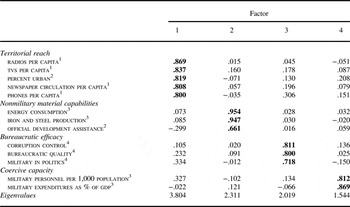
To determine whether state capacity moderates compliance with the ICCPR, I constructed four factor-analytic indices: the degree of (1) bureaucratic efficacy and (2) territorial reach enjoyed by governments, as well as countries' (3) coercive capacity and (4) nonmilitary material strength. Table 1 presents factor loadings and eigenvalues from these analyses.
Exploratory factor analysis of state capacity components

Notes: Bolded entries indicate the items with the largest loadings in each factor. 1Banks and Wilson Reference Banks and Wilson2013. 2World Bank 2008. 3Correlates of War 2010. 4Political Risk Services Group 2008.
bureaucratic efficacy combines three variables from the International Country Risk Guide database: a measure of the military's role in politics, with higher scores indicating lesser military involvement in political affairs; an index gauging whether a country's “bureaucracy has the strength and expertise to govern without drastic changes in policy or interruptions in government services”;Footnote 86 and a variable measuring control of political corruption, with higher scores indicating less corruption.Footnote 87 Countries scoring highly on this factor have autonomous, durable, and effective administrative institutions capable of translating policies—including treaty commitments—into practices. In contrast, impotent, corrupt, or servile bureaucracies should hamper or obstruct the implementation of human rights treaties. Military regimes, as noted, systematically repress civil and political rights,Footnote 88 so undue military influence in civilian bureaucracies does not bode well for the ICCPR. Corruption impedes the administration of justice, inserts fraud and favoritism into the political process, and undermines public trust, all with negative consequences for human rights.Footnote 89 Englehart, too, contends that corruption is an important symptom of state weakness, and links it empirically to human rights abuse.Footnote 90 In short, bureaucratic capacities should matter for the implementation of human rights treaties.
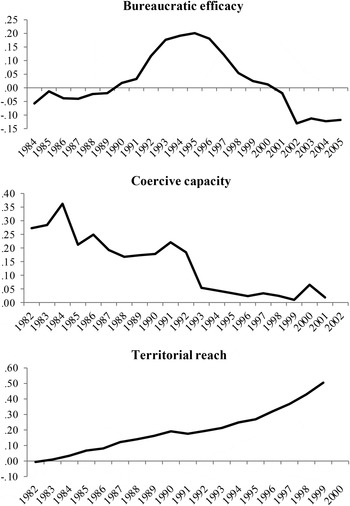
The top panel of Figure 1 plots average bureaucratic efficacy scores globally over time. The trend is distinctly nonmonotonic: scores increased until the mid-1990s but then declined thereafter. Further analysis (not reported but available on request) showed that the global decline after 1995 is attributable to worsening political corruption ratings. Average control of corruption scores dipped worldwide, even among Western countries, but downward trends were especially pronounced in Central and Eastern Europe, the Middle East, and sub-Saharan Africa.
Global averages in state capacity factor scores

These global and regional trends conceal much cross-country variation. Countries with bureaucratic efficacy scores in the top quartile include the United States, Canada, Australia, New Zealand, and most Western Europe states, together with non-Western countries such as South Africa, Namibia, Botswana, Israel, Japan, Malaysia, and Singapore. Countries scoring lowest on this factor include several Latin American countries (for example, Bolivia, El Salvador, Guatemala, Honduras, Panama, Paraguay, Peru) and most of sub-Saharan Africa.
Another state capacity dimension, territorial reach, describes a country's communications infrastructure and level of urbanization. This factor is made up of five variables, four of which measure newspaper circulation, phones, radios, and televisions in per capita terms.Footnote 91 A fifth variable gives the percentage of the population living in urban areas.Footnote 92 Countries scoring lowest on this factor feature highly mountainous terrain: Bhutan (94 percent mountainous), Burundi (75 percent), Nepal (74 percent), and Rwanda (74 percent).Footnote 93 The ability of central governments in these countries to penetrate into peripheral regions is limited, making it difficult—in the absence of sufficient resources, at least—to project power or authority throughout the territory. Such limitations also inhibit the ability of central governments to monitor and control their local agents, who are then able to violate individuals' rights with impunity. Countries scoring highest on this factor include an autocracy (that is, the former USSR) as well as several democracies (for example, the United States and Scandinavian countries). Globally, however, scores on the territorial reach factor have trended steadily upward, as the middle panel of Figure 1 shows.
A third factor, coercive capacity, measures a state's military capabilities and includes two variables from the National Material Capabilities data set: military expenditures and personnel.Footnote 94 Using data from World Bank,Footnote 95 I standardized these measures by national wealth and population size, respectively, yielding military expenditures as a percentage of gross domestic product and military personnel per 1,000 capita. Consistent with the increasing capital intensiveness of militaries,Footnote 96 personnel ratios have declined globally while expenditures have remained relatively constant over the period. Taken together, global trends in overall coercive capacity have sloped downward; the bottom panel of Figure 1 shows a particularly steep drop with the fall of communism during the early 1990s. The USSR, many of its former Eastern European satellites, and now postcommunist Russia score highly on this factor, as do several Middle Eastern countries such as Syria, Jordan, Saudi Arabia, Kuwait, the United Arab Emirates, and Israel. Low-scoring countries include Japan, Papua New Guinea, Indonesia, the Philippines, Bangladesh, Mexico, Costa Rica, and a host of sub-Saharan African countries.
Finally, nonmilitary material strength consists of two variables from the National Material Capabilities data set—iron and steel production (in thousands of tons) and energy consumption (in thousands of coal-ton equivalents)—as well as a measure of official development assistance.Footnote 97 In the ensuing analyses, this factor did not moderate the effect of ICCPR membership, nor did it exert an independent effect on human rights scores. Consequently, I do not present or discuss its results.Footnote 98
Control Variables
The analyses control for a variety of additional factors shown to influence human rights practices.Footnote 99 Three variables are consistently associated with better human rights outcomes: institutionalized democracy/autocracy, which ranges from –10 (most autocratic) to +10 (most democratic); gross domestic product (gdp) per capita (logged), which taps general levels of economic development; and trade as a proportion of gdp, which measures trade openness and global economic integration.Footnote 100
Other factors are typically associated with human rights abuses. Population pressures, measured as population density (logged),Footnote 101 increase government repression because of competition over scarce resources, the threat (real or perceived) that large populations pose to entrenched regimes, and, more generally, the increased opportunities for abuse in populous countries.Footnote 102 Internal conflicts also generate human rights abuses,Footnote 103 so I include a dummy variable from the Correlates of War project indicating whether a country was involved in a civil war during a given year.Footnote 104
Analyses of human rights practices must also guard against “information paradoxes” that can occur when increased attention to and awareness of human rights violations results in spuriously inflated perceptions of abuse.Footnote 105 When a country's human rights practices are placed under the microscope, violations are more likely to be detected, labeled, and reported, even if actual rates of abuse remain constant. To adjust for this phenomenon, I compute a naming-and-shaming index that sums the standardized scores of four variables: media reporting of human rights abuses in (1) The Economist and (2) Newsweek; (3) Amnesty International press releases targeting a country's human rights blemishes; and (4) UN Commission on Human Rights resolutions condemning a country's human rights performance.Footnote 106 This index also provides a measure of third-party monitoring, which is a central element in the enforcement theory of compliance.Footnote 107 Monitoring raises the likelihood that treaty violations will be detected, thereby reducing states' incentives to defect from their commitments.
Finally, I include lagged dependent variables to adjust for autocorrelation and to model dynamic changes in countries' rated human rights practices rather than static levels of those practices.
Estimation Strategies
Recent studies have acknowledged that the relationship between treaty membership and outcomes may be causally recursive,Footnote 108 although different sources of bias are posited. A “least-cost complier” perspective suggests that countries will ratify a treaty only if they have the will and capacity to implement it.Footnote 109 Failing to account for this pattern can bias treaty effects upward. Others contend that repressive countries are especially prone to ratify human rights treaties because of the legitimating effects of treaty membership.Footnote 110 Were this the case, treaty effects would be biased downward.
To guard against these potential biases, I employ a three-step method for estimating regression models with endogenous binary variables.Footnote 111 This method proceeds as follows: (1) use probit models to regress the endogenous binary variable (ICCPR membership) on all internal and external instruments; (2) obtain predicted values from the probit analyses; (3) estimate two-stage least-squares models that use the predicted values from the second step to instrument the endogenous binary variable. In models that estimate ICCPR-by-capacity interaction terms, I interact the external instrument (predicted ICCPR membership scores) with the corresponding state capacity factor.
Following Simmons,Footnote 112 instrumental variables for ICCPR membership include an index of ratification hurdles based on the number of potential veto players in government to tap the relative difficulty of ratifying treaties; a dummy variable for countries with common-law legal systems,Footnote 113 on the assumption that they undertake international treaty obligations more carefully than other countries because treaties can conflict with existing legal precedents or create new precedents; a dummy variable for presidential systems,Footnote 114 based on the possibility that divided governments can delay the ratification process; and a variable tallying the cumulative number of prior iccpr ratifications globally, to tap diffusion and emulation dynamics.Footnote 115 First-stage models also include a variable that models duration dependence (the number of years each country is “at risk” of ratifying the ICCPR).Footnote 116
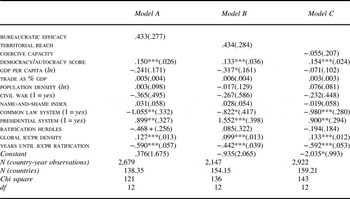
Table 2 presents results from the first-stage binary probit estimates of ICCPR membership. Of the four instrumental variables, three achieved statistical significance. Countries with common-law legal systems are less likely than other countries to belong to the ICCPR, whereas countries with presidential systems are significantly more likely to have ratified, perhaps because strong presidents are able to steer foreign policy decisions (including the decision to ratify human rights treaties). The propensity to ratify also increases as a function of previous ratifications worldwide. The coefficient on years-until-ratification, however, is significantly negative: the longer a country waits to ratify the ICCPR, the less likely it is to join. Democracies, not surprisingly, are also more likely than autocracies to belong to the ICCPR. Finally and most importantly, no dimension of state capacity bears significantly on ICCPR membership. These null findings suggest that a country's ability to implement, monitor, or even violate its human rights obligations does not affect its decision to join the ICCPR, inspiring confidence that any role state capacity plays in moderating the ICCPR's effects cannot be attributed to selection mechanisms or endogeneity bias.
Binary probit estimates predicting membership to the International Covenant on Civil and Political Rights (first-stage estimates)

Notes: Standard errors in parentheses. df = degrees of freedom. + p <.10, * p < .05, ** p < .01, *** p < .001 (two-tailed).
Results
For each two sets of results (one for physical integrity rights and another for empowerment rights) I estimate the independent and interactive effects of each state capacity factor—bureaucratic efficacy, territorial reach, and coercive capacity—and ICCPR membership.
Physical Integrity Rights
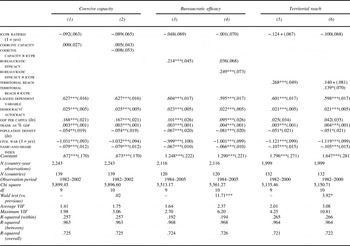
Table 3 reports two-stage least-squares estimates for the effects of state capacity and ICCPR membership on physical integrity rights scores. Odd-numbered models examine the net effects of state capacity and treaty membership, and even-numbered models enter capacity-by-membership interaction terms.
Two-stage least-squares estimates for the independent and interactive effects state capacity and ICCPR membership on physical integrity rights outcomes (second-stage estimates)

Notes: Standard errors in parentheses. df = degrees of freedom. VIF = variance inflation factor. + p <.10, * p < .05, ** p < .01, *** p < .001 (two-tailed).
The first main finding is that ICCPR membership does not independently affect physical integrity rights outcomes at conventional levels of statistical significance, although estimated coefficients are negative across models. In contrast, two state capacity factors—bureaucratic efficacy and territorial reach—significantly improve physical integrity rights outcomes, controlling for other variables (Models 3 and 5). Bureaucratic and infrastructural dimensions of state capacity also appear to enhance the ICCPR's effectiveness because interactions between these factors and ICCPR membership are significantly positive (Models 4 and 6). Coercive capacity, in contrast, is not associated with physical integrity rights scores either independently or interactively (Models 1 and 2).
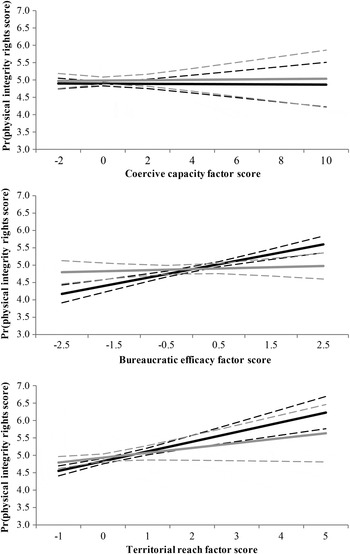
Figure 2 illustrates these capacity-by-membership interaction effects. Each graph depicts estimated physical integrity rights scores (with 95% confidence intervals) among countries that do and do not belong to the ICCPR, with control variables held constant at their mean values and state capacity factors allowed to vary across their empirical ranges. The first, middle, and last panels evaluate, respectively, H1A, H2A, and H3A.
Estimated effect of state capacity factors on the physical integrity rights index, by ICCPR membership

The middle and last panels show that physical integrity scores are significantly lower for countries that belong to the ICCPR than for nonparties, but only among low-capacity states. At the lowest levels of bureaucratic efficacy and territorial reach, physical integrity abuses are actually worse for ICCPR parties than for nonparties. Although these paradoxical results are consistent with the notion that physically repressive regimes are particularly disposed to ratify human rights treaties,Footnote 117 my analyses account for the endogeneity of treaty membership and should mitigate selection biases of this sort. Another possibility is that countries with weak bureaucracies and infrastructures have a difficult time implementing or protecting human rights regardless of their membership in human rights treaties, but that ICCPR parties are simply more likely to have these inabilities spotlighted, reported, and criticized precisely because they have formally endorsed human rights standards.
Despite the perverse effect of ICCPR membership at low levels of state capacity, Figure 2 also demonstrates that physical integrity rights scores are significantly higher for parties than for nonparties at higher levels of bureaucratic capacity, as indicated by the (barely) nonoverlapping confidence intervals. This finding supports H2A, which predicted that human rights treaties would have a positive effect on physical integrity rights as bureaucratic capacity increases. Scores also improve for ICCPR members scoring highly on the territorial reach factor, albeit not enough to overcome nonparties' scores at standard levels of statistical significance. H3A is therefore not supported.
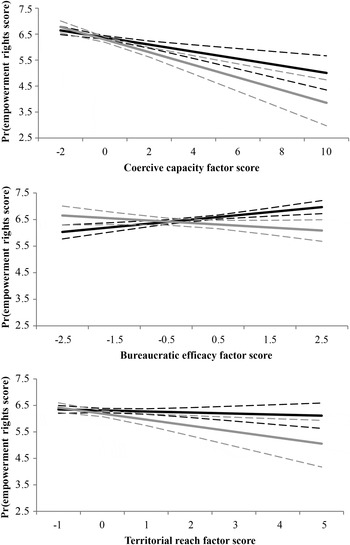
Estimated effect of state capacity factors on the empowerment rights index, by ICCPR membership

Coercive capacity does not significantly moderate the relationship between ICCPR membership and physical integrity practices, contrary to H1A. Indeed, rated levels of physical integrity abuse for parties and nonparties alike remain virtually constant across the range of coercive capacity scores. (Note, however, that scores are slightly better for nonparties relative to parties, again suggesting that “spotlight” dynamics are at work). Simply having a large and expensive military does not increase the tendency to use physical repression, but neither are states with relatively weak and dispersed coercive capacities immune from physical integrity abuses. Small arms, after all, are “the most likely tools of the torturer” and other abusers of physical integrity rights.Footnote 118 Individuals' physical integrity rights can be violated by decentralized agents wielding small weapons (or even their fists) as well as by central governments deploying highly concentrated and sophisticated means of violence.
As for control variables, nearly each one is reliably associated with physical integrity rights scores. Scores improve as levels of democracy, trade openness, and national income increase,Footnote 119 but they are lower in war-torn countries, densely populated countries, and highly scrutinized countries.
Empowerment Rights
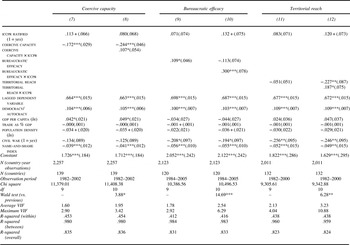
Table 4 reports structurally parallel analyses for the effects of ICCPR membership and state capacity on empowerment rights. As with physical integrity rights scores, the ICCPR is not independently associated with empowerment rights scores, although in this case coefficient estimates are universally positive. With respect to state capacity, empowerment rights scores decrease with coercive capacity (Model 7) but increase with bureaucratic efficacy (Model 9), net of treaty membership and control variables. Territorial reach does not independently affect empowerment rights outcomes (Model 11).
Two-stage least-squares estimates for the independent and interactive effects state capacity and ICCPR membership on empowerment rights outcomes (second-stage estimates)

Notes: Standard errors in parentheses. df = degrees of freedom. VIF = variance inflation factor. + p <.10, * p < .05, ** p < .01, *** p < .001 (two-tailed).
According to the membership-by-capacity interactions in Models 8, 10, and 12, all three dimensions of capacity—bureaucratic efficacy, territorial reach, and coercive capacity—interact positively with ICCPR membership. But a closer look reveals that only one of these interactions significantly improves human rights outcomes. Among countries with high levels of bureaucratic efficacy, ICCPR parties have better empowerment rights scores than nonparties, as shown in the middle panel of Figure 2. This finding is consistent with H2B. For countries that do not belong to the ICCPR, empowerment rights scores actually decline as bureaucratic efficacy increases, indicating that nonparties use their bureaucratic strength to repress rather than respect civil and political rights. This downward trend should be interpreted with caution, however, as the main effect for bureaucratic efficacy in Model 10 (that is, the effect of bureaucratic efficacy among countries that have not ratified the ICCPR), although negative, is statistically insignificant. What does seem clear is that bureaucratically strong states are better able to implement their civil and political rights obligations as spelled out in the ICCPR. Otherwise, ICCPR membership merely slows the rate at which territorial reach and, especially, coercive capacity reduces empowerment rights scores, although the differences between parties and nonparties are not statistically significant in either case. H1B and H3B lack support.
The effects of control variables on empowerment rights are much less robust than they were for physical integrity rights. Aside from the lagged dependent variable, only two controls—democracy and the name-and-shame index—are consistently associated with empowerment rights scores: the former has a positive effect, the latter a negative effective. Civil war also reduces empowerment rights scores in the bureaucratic efficacy and territorial reach models, but not in models that include coercive capacity.
Discussion and Conclusion
This article adds to the long-standing debate between proponents of the managerial approach, who view treaty violations as largely inadvertent, and advocates of the enforcement approach, who argue that compliance is coincidental and defections are deliberate in the absence of effective enforcement. It focuses on one core aspect of the managerial thesis: the notion that noncompliance can be attributed to a country's structural incapacity to implement a treaty, rather than its strategic unwillingness to comply with it.Footnote 120 The corollary augment—and the focus of my analysis—is that the prospects of treaty compliance are greater in strong states. To test this proposition, I constructed multiple state capacity factors and analyzed whether they condition the relationship between treaty membership and human rights outcomes.
My analyses produced three distinct sets of results: the independent effects of (1) ICCPR membership and (2) different state capacities on human rights outcomes, and (3) the effect of ICCPR membership as conditioned by these state capacities.
The net effect of ICCPR membership on physical integrity and empowerment rights outcomes is easily summarized: there are no statistically reliable effects. These null findings accord with research showing that human rights treaties, by themselves, are of little consequence for their members' human rights practices.
Analyses gauging the independent effects of state capacity yielded much stronger results. Bureaucratic efficacy exerted the strongest independent effect on countries' human rights practices. Independently of ICCPR membership and other standard control variables, bureaucratic efficacy improves both physical integrity and empowerment rights outcomes. Effective, autonomous, and stable bureaucracies not only enable governments to fulfill “positive” empowerment rights but they also empower them to protect “negative” physical integrity rights.
Territorial reach improves physical integrity rights outcomes but is not associated with empowerment rights. This pattern suggests that well-developed communications infrastructures enable governments to curb decentralized physical integrity abuses, but they do not facilitate implementation of civil and political rights. Territorial reach, then, appears to serve a protective function: it enables central governments to monitor and prevent egregious human rights abuses,Footnote 121 but it does not necessarily empower governments to fulfill their positive human rights obligations.
Coercive capacity, conversely, has no discernable net effect on physical integrity rights but contributes to the infringement of empowerment rights. These findings resonate with Davenport's description of the “tyrannical peace,” whereby low levels of physical integrity abuse come at the expense of civil and political rights restrictions.Footnote 122 By clamping down on empowerment rights—for example, by restricting citizens' rights of assembly or speech—militarily strong regimes obviate the widespread use of physical repression. Because citizens are unable or unwilling to voice their dissent, regimes feel less threatened; consequently, rates of political imprisonment and other physical integrity violations designed to neutralize opponents decline. Tyrannical regimes of this sort are therefore “peaceful” only to the extent that citizens, fearful of provoking government repression or retaliation, remain quiescent.
Although the net effects of treaty membership and state capacity are interesting in their own right, my main purpose was to evaluate interactions between them. The primary question is whether the widely studied and much lamented compliance gap in human rights treaty regimes can be attributed, at least partly, to structural incapacity rather than to willful and calculated malevolence. Although coercive capacity and territorial reach do not condition the effects of ICCPR membership, highly capable bureaucracies enhance civil, political, and physical integrity rights outcomes among ICCPR parties. Bureaucratic efficacy promotes compliance with the ICCPR by investing governments with the administrative capacity to implement its terms. As such, my analysis calls into question the assumption that “noncompliance in the area of human rights … can rarely be explained by bureaucratic failure.”Footnote 123 Indeed, the quality of bureaucratic institutions, more than any other dimension of state capacity, significantly increases the prospects of compliance with at least one core human rights treaty. Pace Hobbes, it is the bureaucrat, and not the sword, that renders this covenant effective.
At the same time, ICCPR parties' human rights scores are often significantly lower than nonparties' scores in weak states. These trends cannot be attributed to selection biases. It is often alleged that countries with poor human rights records ratify human rights treaties disingenuously in a ploy to deflect external criticism of their practices, thereby making it appear that treaties have a negative effect on subsequent practices.Footnote 124 Because my analyses directly adjust for self-selection biases, I offer an alternative—indeed, contradictory—interpretation. Treaty ratification, it seems, attracts rather than deflects attention to human rights practices. The decision of low-capacity states to ratify a human rights treaty invites increased scrutiny of their poor human rights conditions.
Once this spotlight has shone and revealed shortcomings in treaty implementation, what is to be done? To blame noncompliance on willful contravention or ineffective enforcement tells only part of the story because it fails to consider that some regimes simply lack the capacity for implementing treaty terms. The findings reported in this study, in combination with other findings in the literature, suggest that investing weak states with the capacity to comply with their treaty commitments may be a more effective strategy than punishing states that violate their commitments. To be sure, punishments of various kinds—economic sanctions, structural adjustment programs, or military intervention—not only fail to improve human rights practices in targeted states but often exacerbate the very abuses they seek to remedy.Footnote 125
Analyses that address implementation gaps from a variety of angles are important because different modalities of noncompliance imply divergent and even contradictory strategies for improving the treaties' effectiveness. Efforts to incentivize compliance by, for example, withholding multilateral aid or conditioning preferential trade agreements on human rights performance assume that countries have the capacity to respond to such punishments and inducements.Footnote 126 But when noncompliance stems from state weakness, sanctions are likely to be perverse, serving to weaken further the targeted government's capacities and hence undermine its ability to redress human rights problems. Instead of withholding aid, governments in weak states may need additional assistance in order to stabilize their rule, improve their infrastructures, and take more effective control over human rights conditions within their territories.
A mixed strategy of the sort Tallberg proposed, in which capacity building is coupled with improved treaty-based accountability mechanisms, may be the most fruitful strategy for enhancing levels of compliance with human rights treaties.Footnote 127 Increased monitoring alone, without accompanying efforts to build states' capacities for meeting treaty obligations, may serve only to highlight recurring failures. Weak countries cannot be shamed into compliance any more than they can be coerced to comply. Both strategies assume that treaty violations are deliberate and under a government's direct control. As this study has shown, the inability of states to implement a treaty sometimes accounts for noncompliance, quite apart from any considerations of presumed interest or will.