


Introduction
Private litigants’ expanding access to international courts (ICs) is among the most profound transformations sparked by the ‘judicialization of politics’ (Stone Sweet and Brunell Reference Stone Sweet and Brunell2013; Hirschl Reference Hirschl2008; Alter et al Reference Alter, Hafner-Burton and Helfer2019). Gone are the days when soliciting international justice was the prerogative of sovereign states. Since 1945, seventeen ‘new-style’ ICs (Alter Reference Alter2012, Reference Alter2014) have been established with access to individuals and businesses via direct actions or referrals from national courts (Figure 1). While some of these ICs remain dormant, others adjudicate hundreds of yearly cases.
Proliferation of international courts with private access, 1945–2019.

But ICs not only expand opportunities for private actors (Cichowski Reference Cichowski2007; Vanhala Reference Vanhala2012; Alter Reference Alter2006, Reference Alter2014; Helfer and Voeten Reference Helfer and Voeten2014); private litigation also creates opportunities for judges to promote their own authority. This article shows how ICs can refract private litigation as a legitimation strategy: an attempt to shift the perceptions and actions of a social audience to ‘justify their [own] practices and power’ (Alter et al Reference Alter, Helfer and Madsen2016, p. 6). We focus on regional economic courts, for they can be easily dismissed by private litigants as corporate tools or playthings of the powerful. Countering these perceptions is important: without broader social support, ICs can be starved of cases and crippled by state backlashes (Alter et al Reference Alter, Helfer and Madsen2016; Madsen et al Reference Madsen, Cebulak and Weibusch2018; Voeten Reference Voeten2020; Pavone and Stiansen Reference Pavone and Stiansen2021; Thatcher et al Reference Thatcher, Sweet and Rangoni2022), for they can neither rely on the legitimacy bestowed by national constitutions nor the presumption of centralized enforcement (Føllesdal Reference Føllesdal2020).
We argue that ICs can respond to these vulnerabilities through a two-part legitimation strategy to cultivate social support: leveling and spotlighting. ICs ‘level’ by flipping allegations of a pro-business bias on their head, favoring the claims raised by actors who tend to be disempowered in international litigation – individuals. In political contexts wherein individual rights are a powerful discursive currency, opening the ‘legal opportunity structure’ in individuals’ favor (Vanhala Reference Vanhala2010, Reference Vanhala2012, Reference Vanhala2018) helps ICs justify an active role in intergovernmental polities wherein individuals lack alternative avenues to advance their interests. Leveling can be litigant-driven, as when ICs apply existing rules in individuals’ favor to counterbalance their disadvantages as litigants (Haynie Reference Haynie1994; Miller et al Reference Miller, Keith and Holmes2015). More ambitiously, leveling can be claim-driven, as when ICs create novel social entitlements and rights that protect entire classes of individuals from corporate or state encroachment.
But judicial leveling is not enough: these actions need to be broadcast to a social audience that finds them appealing. While existing research stresses how public support protects judges from government interference (Vanberg Reference Vanberg2005; Staton and Vanberg Reference Staton and Vanberg2008; Carrubba Reference Carrubba2009), most people ignore ICs and their rulings (Pavone Reference Pavone2022; Voeten Reference Voeten2013; Caldeira and Gibson Reference Caldeira and Gibson1995; Gibson and Caldeira Reference Gibson and Caldeira1995). ICs are thus better off targeting more attentive legal professionals who could mobilize as a ‘judicial support network’ (Weiler Reference Weiler1994; Vauchez Reference Vauchez2015; Pavone Reference Pavone2022; Gerzso Reference Gerzso2023), especially since lawyers and legal scholars often gravitate towards individual rights causes (Halliday et al Reference Halliday, Feeley and Karpik2007; Dyevre et al Reference Dyevre, Glavina and Ovádek2021). ICs can ‘spotlight’ pro-individual rights rulings to legal professionals by using well-known communication strategies – like procedural tweaks and targeted press releases (Staton Reference Staton2006; Krehbiel Reference Krehbiel2016; Dederke Reference Dederke2022; Gerzso Reference Gerzso2023; Bailey et al Reference Bailey, Collins, Rhodes and Rice2024). By broadcasting support for individual rights over other claims, ICs can focus the attention of legal practitioners, who then amplify their rulings in journals, cast them as authoritative, and promote follow-up litigation.
To assess our theory, we scrutinize the first IC to provide access to private parties, a court that has become a strikingly influential judicial policymaker: the European Court of Justice (ECJ). Established with an economic mandate, the ECJ is often criticized as a pro-business court (Conant Reference Conant2002; Börzel Reference Börzel2006; Scharpf Reference Scharpf2010; Conant et al Reference Conant, Hofmann, Soennecken and Vanhala2018; Kahraman Reference Kahraman2023) that has built its authority by stealth (Weiler Reference Weiler1994; Burley and Mattli Reference Burley and Mattli1993; Blauberger and Martinsen Reference Blauberger and Martinsen2020). Triangulating between the public advocacy of ECJ judges and a novel dataset of nearly 7,000 cases referred by national courts, we show that neither claim is true. Although casual observers may note that the Court delivers many rulings supporting businesses, we demonstrate that this is due to businesses outnumbering individuals as litigants – not due to ECJ judges having a pro-business bias. In fact, the ECJ consistently engages in claim-driven leveling: despite their disadvantages as litigants, persons claiming individual rights enjoy a higher win-rate than any other party, including better-resourced businesses. ECJ judges are hardly quiet about these efforts: they spotlight them via public advocacy, by allocating larger chambers, and by focusing press releases on pro-individual rights rulings, which attracts law journal commentaries that disproportionately amplify these decisions to lawyers and litigants. The ECJ neither lies low nor favors the powerful. The Court goes public and favors the weak to build legitimacy and cultivate judicial support networks.
Our study is the first to analyze the relationship between judicial decision-making and party capability before ICs. We make a number of revisionist claims. First, we challenge the conventional wisdom that individual litigants lose out while the corporate ‘haves’ come out ahead (Galanter Reference Galanter1974; McGuire Reference McGuire1995; Songer et al Reference Songer, Sheehan and Haire1999; Haire et al Reference Haire, Lindquist and Hartley1999; Szmer et al Reference Szmer, Johnson and Sarver2007; Nelson and Epstein Reference Nelson and Epstein2022). Instead, we theorize when and why international judges level the odds, demonstrating that party capability is not destiny before ICs. Second, we challenge the view that ICs build their authority by ‘de-politicizing’ their actions and hiding behind the law’s ‘mask and shield’ (Burley and Mattli Reference Burley and Mattli1993; Louis and Maertens Reference Louis and Maertens2021). We demonstrate that some ICs both broadcast and justify their agendas to cultivate judicial support networks.
In the rest of this paper, we first elaborate our theory of why building legitimacy matters to new-style ICs and how leveling and spotlighting would plausibly help. Next, we justify our case selection of the ECJ, derive testable hypotheses from our theory, and outline our empirical strategy. We first present qualitative evidence from ECJ judges’ public advocacy, demonstrating that they repeatedly cajole support from legal practitioners and citizens by claiming to favor individual rights. We then assess whether judges match words with deeds by analyzing novel data on judicial decisions, private litigation, and law journal commentaries. We conclude by probing the uniqueness of the ECJ, the scope conditions and practical implications of our findings, and fruitful pathways for future research.
A Theory of Judicial Leveling and Spotlighting
Although some scholars predicted that private litigation before ‘new-style’ ICs would automatically spark a virtuous cycle of rights-claiming and judicial policy making (Stone Sweet and Brunell Reference Stone Sweet and Brunell1998; Fligstein and Stone Sweet, Reference Fligstein and Stone Sweet2002), many ICs are seldom solicited and struggle to cultivate social support (Alter Reference Alter2014). After all, twelve of the seventeen new-style ICs were narrowly tailored as regional economic courts without clear relevance for individuals and their rights. These courts consequently risk attracting a narrow set of corporate disputes – as with the Andean Tribunal (Alter and Helfer Reference Alter and Helfer2017) – and being dismissed as pro-business courts that empower the powerful. We need to unpack how judges can proactively invite and harness a broader spectrum of private litigation and devise legitimation strategies to cultivate social support for their lawmaking agendas.
Building on empirical research on ICs, we use legitimacy as a shorthand for ’sociological legitimacy’: the perceptions of social actors that ‘legitimize courts … [by] allow[ing] courts to justify their practices and power’ (Alter et al Reference Alter, Helfer and Madsen2016, p. 6). These perceptions facilitate legal mobilization: when social actors perceive an IC as legitimate, they may go beyond passive support or selective compliance and mobilize as a judicial support network that amplifies an IC’s claims to authority and promotes follow-up litigation (Madsen et al Reference Madsen, Mayoral, Strezhnev and Voeten2022; Gerzso Reference Gerzso2023). ICs devise legitimation strategies when they adjudicate and publicize cases to appeal to a social audience with the goal of cultivating it into a judicial support network.
There are three reasons why ICs benefit from developing legitimation strategies. First, state governments are unreliable partners to ensure judicial effectiveness. Government non-compliance, court-curbing, and criticism can afflict all courts, yet ICs are particularly vulnerable to such attacks (Madsen et al Reference Madsen, Cebulak and Weibusch2018; Stiansen and Voeten Reference Stiansen and Voeten2020; Pavone and Stiansen Reference Pavone and Stiansen2021; Thatcher et al Reference Thatcher, Sweet and Rangoni2022). Lacking centralized enforcement and the imprimatur of legitimacy that national constitutions can bestow, intergovernmental backlash against ICs is common and potentially crippling (Carrubba Reference Carrubba2005, Reference Carrubba2009; Pollack Reference Pollack2023). While ICs can respond by hiding behind the law’s ‘mask and shield’ (Burley and Mattli Reference Burley and Mattli1993; Louis and Maertens Reference Louis and Maertens2021), this strategy is unhelpful to more ambitious ICs whose authority is increasingly politicized (Blauberger and Martinsen Reference Blauberger and Martinsen2020). ICs thus have an incentive to spearhead public relations campaigns to cultivate an alternative reservoir of social support (Caserta and Cebulak Reference Caserta and Cebulak2021; Dederke Reference Dederke2022).
Second, although ICs must build social support to build their authority (Vanberg Reference Vanberg2005; Staton and Vanberg Reference Staton and Vanberg2008; Carrubba Reference Carrubba2009; Cheruvu and Krehbiel Reference Cheruvu and Krehbiel2023), the public at large is less aware of ICs compared to established domestic courts (Caldeira and Gibson Reference Caldeira and Gibson1995; Gibson and Caldeira Reference Gibson and Caldeira1995; Voeten Reference Voeten2013; Pavone Reference Pavone2022). ICs are thus better off appealing to more attentive intermediary judicial support networks that can boost public awareness and promote ICs as venues to pursue claims (Gerzso Reference Gerzso2023; Bailey et al Reference Bailey, Collins, Rhodes and Rice2024). Legal professionals (lawyers, law professors, and judges) are crucial in this regard, for two reasons. Upstream, they can spearhead ‘pedagogical interventions’, publishing law journal articles that explain IC rulings and imbue them with the imprimatur of authority (Schepel and Wesseling Reference Schepel and Wesseling1997; González-Ocantos Reference González-Ocantos2016; Dyevre et al Reference Dyevre, Glavina and Ovádek2021). Particularly in civil law countries, legal commentaries are accorded ’substantially greater importance’ as a source of law (Merryman and Perez-Perdomo Reference Merryman and Perez-Perdomo2007, p. 108). Down the line, legal professionals can mobilize as mediators in civil society to push fellow lawyers and private actors to pursue follow-up litigation, particularly when governments do not comply (Pavone Reference Pavone2019, Reference Pavone2022; Gonzalez-Ocantos and Sandholtz Reference Gonzalez-Ocantos and Sandholtz2022). One of the key features distinguishing successful from unsuccessful ICs is the degree to which lawyers in their jurisdiction mobilize as judicial support networks (Alter Reference Alter2014).
Third, to target legal professionals, ICs need to broadcast a message that lawyers find normatively appealing (Alter et al Reference Alter, Helfer and Madsen2016, p. 6). Like other regional economic courts, the best-known new-style IC – the ECJ – is often criticized as ‘empower[ing] the already powerful’ (Börzel Reference Börzel2006; Scharpf Reference Scharpf2010; Hofmann Reference Hofmann2023), with many lawyers and NGOs believing that ‘its priority is to protect business interests’ (Kahraman Reference Kahraman2023, p. 74). Countering these negative perceptions can help an IC bolster legitimacy with legal professionals. Comparative studies have traced how lawyers and legal scholars gravitate towards individual rights causes to build their autonomy from the market and valorize their social role (Halliday et al Reference Halliday, Feeley and Karpik2007). As Karpik (Reference Karpik2007, p. 464) puts it, ‘individual rights have become more or less strongly incorporated into their professional bodies’. For instance, lawyers’ commentaries in EU law journals disproportionately focus on individual rights litigation despite economic matters being the predominant focus of EU law (Dyevre et al Reference Dyevre, Glavina and Ovádek2021).
Favoring individual rights claims is an attractive legitimation strategy for ICs because individuals are disadvantaged as litigants and subjects of international law. Scholars have shown that individuals’ limited finances and capacity to hire effective counsel – their ‘party capability’ – hampers their success in court compared to businesses (Galanter Reference Galanter1974; McGuire Reference McGuire1995; Songer et al Reference Songer, Sheehan and Haire1999; Haire et al Reference Haire, Lindquist and Hartley1999; Szmer et al Reference Szmer, Johnson and Sarver2007; Skiple et al Reference Skiple, Bentsen and McKenzie2021; Nelson and Epstein Reference Nelson and Epstein2022). These inequities are magnified before ICs, since mobilizing international law requires specialized knowledge and expensive counsel (Kritzer Reference Kritzer1998; Pavone Reference Pavone2022). By counterbalancing individuals’ disempowerment and favoring their rights claims, ICs can justify judicial policy making as empowering the ‘have nots’. We refer to this strategy as ‘leveling’, where judges level the odds for weaker private litigants.
While the concept of leveling is not new (Haynie Reference Haynie1994), existing research attributes it to lawyers over judges (Miller et al Reference Miller, Keith and Holmes2015; Miller and Curry Reference Miller and Curry2022) and is unclear about whether it is driven by litigants’ identities or claims (Epp Reference Epp1999). Distinguishing litigant-driven and claim-driven leveling matters because they imply different legitimation strategies, audiences, and effects.
Litigant-driven leveling is retrospective, case-specific, and concealable behind the law’s ‘mask and shield’ (Burley and Mattli Reference Burley and Mattli1993). By distributing wins to individuals irrespective of the substantive claims they bring, judges counterbalance their capability disadvantages as litigants. This strategy, however, does not necessarily alter legal rules, help ICs broaden their economic mandates, or broadcast an individual rights agenda to audiences beyond the parties to the case. Litigant-driven leveling tips case outcomes in individuals’ favor without substantially altering the rules of the game.
In contrast, claim-driven leveling is prospective, rule-creating, and public-facing. By favoring individuals specifically when they raise claims that enable the expansion of individual rights, judges create a more favorable ‘legal opportunity structure’ for entire classes of disadvantaged actors (Vanhala Reference Vanhala2012, Reference Vanhala2018) and signal a policy agenda to a broader audience, inviting future litigation by the ‘have nots’. Claim-driven leveling is thus a more ambitious legitimation strategy: by leveraging private litigation to reshape the rules of the game, an IC reorients international law in individuals’ favor.Footnote 1 While conceptually distinct, claim-driven leveling can beget litigant-driven leveling in practice, as when judges favor the rights claims disproportionately raised by individuals.
Both forms of judicial leveling are especially useful to new-style ICs established as economic courts. While these ICs may not be more rights-conscious than other courts, leveling bestows a powerful raison d’etre for their judges. First, claim-driven leveling enables these ICs to eschew their narrow mandates and broaden their relevance as rights protectors. Since the legal opportunity structure in intergovernmental economic regimes favors states and businesses, ICs can cast judicial lawmaking as necessary to counterbalance market failures and safeguard individuals’ social interests (Caporaso and Tarrow Reference Caporaso and Tarrow2009). Second, litigant-driven leveling is especially useful to ICs compared to domestic courts. In contrast to democracies with robust means for citizen representation, the ‘political opportunity structure’ (Kitschelt Reference Kitschelt1986) of intergovernmental regimes grants few avenues for individuals to exercise their voice (Dahl Reference Dahl1999; Føllesdal and Hix Reference Føllesdal and Hix2006). By siding with ‘the little guy’, ICs can claim to be boosting individuals’ voices at the international level (Burley and Mattli Reference Burley and Mattli1993, p. 64).
Next, ICs must broadcast their efforts to level the odds to prospective judicial support networks: what we call ’spotlighting’. As we argued, judges have good reasons to target legal professionals with their spotlighting efforts, since lawyers can amplify their rulings in journal commentaries, inform individuals of their rights, and promote follow-up litigation (González-Ocantos Reference González-Ocantos2016; Pavone Reference Pavone2019, Reference Pavone2022; Gonzalez-Ocantos and Sandholtz Reference Gonzalez-Ocantos and Sandholtz2022; Bailey et al Reference Bailey, Collins, Rhodes and Rice2024). ICs can attract the attention of legal professionals by manipulating procedural rules and targeting press releases to specifically spotlight those cases where they support individual rights (Dederke Reference Dederke2022; Krehbiel Reference Krehbiel2016; Staton Reference Staton2006). When lawyers and law journals predominantly amplify IC rulings that favor individual rights, the court has taken a first step towards cultivating a judicial support network and broadcasting a legitimating narrative to civil society.
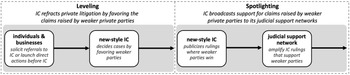
A theory of leveling and spotlighting by new-style ICs.

Figure 2 summarizes our argument, where leveling and spotlighting serve as the mechanism (the ‘entities engaging in activities’; see Beach and Pedersen (Reference Beach and Pedersen2019, pp. 99–100)) that converts private litigation into a legitimation strategy. Our theory thus draws on Haynie (Reference Haynie1994) – who theorized how national courts may favor the ‘have nots’ to legitimize the political regimes in which they are embedded – to explain when the expectations of legal mobilization and judicial politics research should be flipped on their head. From courts in the United States, Canada, Taiwan, Denmark, and Norway (McGuire Reference McGuire1995; Songer et al Reference Songer, Sheehan and Haire1999; Haire et al Reference Haire, Lindquist and Hartley1999; Johnson et al Reference Johnson, Wahlbeck and Spriggs2006; Miller et al Reference Miller, Keith and Holmes2015; Szmer et al Reference Szmer, Songer and Bowie2016; Nelson and Epstein Reference Nelson and Epstein2022; Szmer et al Reference Szmer, Johnson and Sarver2007; Skiple et al Reference Skiple, Bentsen and McKenzie2021; Chen et al Reference Chen, Huang and Lin2015), studies consistently find that businesses hire larger, more experienced legal teams than individuals and are more likely to win judges’ support. Resource inequalities are not unique to domestic litigation; we demonstrate that they also pervade international litigation. Yet in stressing how money and expertise drive judicial outcomes, capability arguments understate judges’ agency and agendas. When international judges seek to escape a narrow economic mandate, when they inhabit contexts wherein individual rights are a legitimating discourse, and when they face a receptive legal profession, they may adopt a pro-individual rights agenda to bolster their legitimacy, thereby refracting inequalities in party capability.
Case Selection and Hypotheses
To assess our theory, we derive two hypotheses that we test by scrutinizing patterns of private litigation and judicial decision-making at the ECJ.
The ECJ is well-suited for testing our theory for two reasons. First, it is an ‘influential case’ for understanding ICs broadly (Seawright and Gerring Reference Seawright and Gerring2008; Gerring and Cojocaru Reference Gerring and Cojocaru2016, pp. 404–5). The ECJ is not only the first new-style IC to procure access to private litigants; it has also developed into the most active, studied, and emulated IC in the world. The Court has adjudicated thousands of cases – most originating in disputes that private litigants raised before national courts and then referred to the ECJ (Kelemen and Pavone Reference Kelemen and Pavone2019). Its success triggered attempts to ‘transplant’ the Court: eleven regional economic courts were established as ‘operational copies’ (Alter Reference Alter2014, p. 1935; Alter Reference Alter2012).
Second, the ECJ is a ‘critical case’ (Seawright and Gerring Reference Seawright and Gerring2008; Gerring and Cojocaru Reference Gerring and Cojocaru2016, pp. 404–5) for evaluating arguments that successful regional economic ICs conceal their agendas (Burley and Mattli Reference Burley and Mattli1993; Blauberger and Martinsen Reference Blauberger and Martinsen2020) and favor ‘the economic interests of business enterprises’ (Conant Reference Conant2002; Börzel Reference Börzel2006; Louis and Maertens Reference Louis and Maertens2021; Scharpf Reference Scharpf2010, pp. 221–2). If the ECJ is a pro-business court that has cultivated its authority by stealth, it would call into question whether any of its transplants can function as rights-promoters attracting broader social appeal.
That private litigation would anchor the ECJ’s legitimacy-building efforts was not apparent when it was established to facilitate interstate trade and business investment. During negotiations for the 1957 Treaty of Rome, ‘without much discussion’, policymakers approved a procedure enabling national judges to refer lawsuits raised by private parties to the ECJ (Pescatore Reference Pescatore1981; Boerger and Rasmussen Reference Boerger and Rasmussen2023). This ‘preliminary reference procedure’ opened the ECJ’s doors to individuals ‘without awareness of this innovation’s importance’ (Pescatore Reference Pescatore1981, pp. 159, 173).
The ECJ cajoled individuals to solicit it when in 1963 and 1964 it held that European law has primacy over conflicting national law and endows individuals with rights they can invoke before domestic courts (Rasmussen Reference Rasmussen2014). Unsurprisingly, some governments and constitutional courts resisted the Court’s ambitions. They attacked the ECJ’s legitimacy, accusing it of lacking democratic accountability and jeopardizing national constitutions protecting individual rights, since the Treaty of Rome’s economic provisions ‘did not contain a bill of rights at all’ (Rasmussen Reference Rasmussen1986; Davies Reference Davies2012; Weiler Reference Weiler1986, p. 1105). The French government even sought to pack the Court and curb its jurisdiction (Fritz Reference Fritz2015).
The ECJ’s response to these critiques generated a debate that we can advance. Some scholars claim that the ECJ went into hiding, concealing its agenda behind ‘“technical” legal garb’ (Burley and Mattli Reference Burley and Mattli1993, pp. 70–72), whereas others claim that the ECJ responded via a public relations campaign (Dederke Reference Dederke2020, Reference Dederke2022). Scholars also debate whether the ECJ stuck to its economic mandate as a ‘pro-business court’ (Conant Reference Conant2002; Börzel Reference Börzel2006; Scharpf Reference Scharpf2010; Kahraman Reference Kahraman2023) or seized on a broader social role as protector of individual rights (Burley and Mattli Reference Burley and Mattli1993; Cichowski Reference Cichowski2007; Stone Sweet Reference Stone Sweet2010).
The stakes of this debate are highlighted by Caporaso and Tarrow (Reference Caporaso and Tarrow2009) and Höpner and Schäfer (Reference Höpner and Schäfer2012). The Treaty of Rome permitted ‘the Community legislature to disregard individual rights’ while creating a common market (Weiler Reference Weiler1986, p. 1105), as member states did not approve a binding Charter of Fundamental Rights until 2009. Conscious of the social upheavals generated by economic liberalization, Caporaso and Tarrow (Reference Caporaso and Tarrow2009) argue that the Court ‘socially embedded’ protections for the have nots. Focusing on some of the Court’s key rulings on the free movement of workers, they show how – after ruling that EU law can endow individuals with directly effective rights in the abstract – the ECJ seized a few vague treaty articles and secondary legislation to concretize individuals’ rights as mobile workers. The ECJ then gradually broke the link with cross-border activity to protect individuals irrespective of their employment status or mobility. In this view, ECJ rulings on work-time regulation, equal pay for men and women, parental rights, work benefits for migrants, and access to unemployment, disability, and social security benefits offset the EU’s limited redistributive capacity and ‘market-making’ bias (Caporaso and Tarrow Reference Caporaso and Tarrow2009, pp. 602–3).
This argument has not gone uncontested. Höpner and Schäfer (Reference Höpner and Schäfer2012) rebut that Caporaso and Tarrow neglect that the ECJ predominantly adjudicates ‘market-making’ disputes. With member states preferring to regulate individual and social rights via non-justiciable soft law, in their view the ECJ remains hamstrung as an economic court (Höpner and Schäfer Reference Höpner and Schäfer2012, pp. 439–41). Moreover, the Court’s most high-profile case law on non-discrimination also benefits businesses. Non-discrimination based on nationality – often lumped together with non-discrimination based on gender, sexuality, race, or religion – is frequently used as an argument to give market access to foreign businesses. In other words, in addition to well-established EU economic rules favoring corporate interests, the Court’s legal inventions also benefit businesses.
The foregoing debate remains unresolved because scholars have insufficiently theorized the Court’s agency and lacked comprehensive data to test their claims. We break this impasse by assessing our theory of judicial leveling and spotlighting through a systemic analysis of cases raised by private parties before national courts subsequently adjudicated by the ECJ.
We expect that the ECJ sought to legitimate an active policy-making role and cultivate judicial support networks via leveling and spotlighting. First, ECJ judges’ own public advocacy should highlight individuals’ disadvantages as litigants and their limited rights as EU subjects, claim to be leveling the odds in their favor, and promote the Court as protector of the weak. Given their well-documented ambition to serve as judicial lawmakers, we also expect ECJ judges to stress that they are not just applying existing rules in individuals’ favor (litigant-driven leveling), but to emphasize their lawmaking role to advance individual rights and social entitlements (claim-driven leveling). Since words ring hollow if they do not match actions, we follow Höpner and Schäfer (Reference Höpner and Schäfer2012) and use the win rate of businesses as a benchmark to assess whether the Court truly favors individuals. We expect the Court to disproportionately support individuals when they raise rights claims compared to businesses making economic claims, despite businesses coming to Court with bigger and more experienced legal teams. This leads to (H 1):
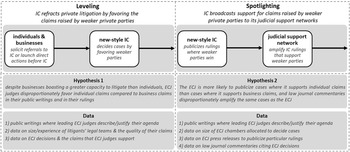
HYPOTHESIS 1 - leveling: Despite businesses boasting a greater capacity to litigate than individuals, ECJ judges disproportionately favor individual claims compared to business claims in their public advocacy and rulings.
Next, we expect the Court to spotlight its pro-individual rights decisions to legal professionals. Lawyers and legal scholars have long been targeted as a crucial support network by the ECJ (Rasmussen and Martinsen Reference Rasmussen and Martinsen2019; Vauchez Reference Vauchez2015, p. 88). Lawyers founded law journals – most prominently the Common Market Law Review (CMLR) – ‘to provide legitimacy to the new jurisprudence of the ECJ’ (Byberg Reference Byberg2017, p. 46). To ‘rally [lawyers] as one around the Court’ (Schepel and Wesseling Reference Schepel and Wesseling1997, p. 186), ECJ judges tapped these support networks, contacting the CMLR’s editorial board to suggest commentaries of particular rulings and ‘delive[r] counterattacks’ to ‘national criticism of the ECJ’s jurisprudence’ (Byberg Reference Byberg2017, pp. 52, 57).
So long as law journals disproportionately amplify the Court’s pro-individual rights rulings, even heated debates concerning these decisions would boost social awareness of the ECJ as a forum wherein new rights can be claimed. To this end, the Court can allocate larger chambers to individual rights cases to signal their ’significance’ (Carrubba et al Reference Carrubba, Gabel and Hankla2008; Larsson and Naurin Reference Larsson and Naurin2016; Kelemen Reference Kelemen2012; Dederke Reference Dederke2022, p. 51) and target press releases when it issues rulings that endorse individuals’ rights claims (Staton Reference Staton2006; Dederke Reference Dederke2020). Building on studies probing news coverage of ECJ rulings and the allure of individual rights for lawyers (Dederke Reference Dederke2020, Reference Dederke2022; Dyevre et al Reference Dyevre, Glavina and Ovádek2021), we expect lawyers to disproportionately amplify the Court’s pro-individual rights rulings in journal commentaries. This leads to (H 2):
HYPOTHESIS 2 - spotlighting: The ECJ is more likely to publicize cases where it supports individual claims than cases where it supports business claims, and law journal commentaries disproportionately amplify the same cases as the ECJ.
Empirical Strategy and Original Data
We leverage a multimethod strategy that integrates qualitative evidence with the analysis of an original, multipronged quantitative dataset (Seawright Reference Seawright2016). Figure 3 presents a correspondence diagram that matches our theory and two hypotheses with the data we use to evaluate them.
We first establish the plausibility of judicial leveling (H 1) and spotlighting (H 2) by assessing whether ECJ judges intentionally and publicly invoke this legitimation strategy. We focus on the subset of judges that have mobilized as ‘publicists’ by writing articles, giving speeches, and granting interviews targeting legal professionals in civil society (Phelan Reference Phelan2020). The Court’s PresidentsFootnote 2 usually assume this role: presidents can credibly speak for their colleagues (who elected them) and have a vested interest in promoting the legitimacy of the institution they lead. US Supreme Court Chief Justice John Roberts is often highlighted for this role (Christenson and Glick Reference Christenson and Glick2015). We identify four leading ECJ publicists to probe three questions: Have they consistently highlighted how individuals are disempowered in the EU legal system compared to businesses? Have they publicly claimed to level the odds in individuals’ favor, and do they stress litigant or claim-driven leveling? Finally, do they appeal to legal professionals to support the Court by emphasizing how judicial leveling legitimates it as a policymaker?
Correspondence of theory, hypotheses, and data.

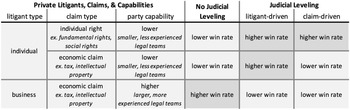
Our quantitative analysis then tests whether ECJ judges match words with deeds: do they counterbalance the capability disadvantages of individuals, particularly when they invoke individual rights (H 1)? Figure 4 specifies the evidence that would be consistent and inconsistent with our claims. The litmus test for claim-based leveling is that individuals raising rights claims not only have a higher win rate than businesses represented by larger, more experienced legal teams (a comparison between rows 1 and 3), but also that these individuals have a higher win rate than other individuals who raise economic claims (a comparison between rows 1 and 2). By comparing across and within litigant type, we isolate whether the ECJ favors individuals irrespective or because of their claims and mitigate adverse selection whereby resourceful risk-taking businesses might pursue weaker claims (Galanter Reference Galanter1974). These predictions are conditional on a model that holds party capability constant.
Observable implications of no judicial leveling, litigant-driven leveling, and claim-driven leveling.

We constructed the first dataset of all parties and their lawyers involved in 6,919 cases referred to the ECJ from 1961 to 2016. For each case, we document the type of litigant, the quality of their legal counsel, the types of claims they raise, how developed the ECJ’s caselaw is vis-à-vis these claims, and which claims the ECJ supports (along with a number of controls).
The final part of our empirical analysis assesses whether the ECJ disproportionately spotlights cases where it supports individuals’ claims, along with whether lawyers act as a judicial support network by amplifying this pro-individual rights agenda (H 2). We leverage an original dataset of 4,418 press releases by the Court, exploiting the fact that the ECJ’s in-house public relations team selectively publicizes some rulings over others. We then draw on an original dataset of 116,334 case annotations in law journals from across the EU to trace whether the legal community amplifies the Court’s spotlighting by primarily discussing pro-individual rights rulings.
Protector of the Individual: Judges’ Legitimating Rhetoric
Are ECJ judges intentionally crafting a legitimation strategy with a specific audience mind? Did they repeatedly intervene in debates in the legal community about whether the ECJ is ‘a weapon of the weak or remains a “hollow hope”’ (Conant et al Reference Conant, Hofmann, Soennecken and Vanhala2018, pp. 1384–5)? Few scholars have looked beyond the private views and correspondence of ECJ judges to scrutinize their public advocacy (Bailleux and Bernard Reference Bailleux and Bernard2020). Here, we demonstrate that the Court’s four leading ‘publicists’ appealed to legal practitioners (and secondarily to citizens) by promoting themselves as a ’social Court’ building a ‘citizens’ Europe’ by leveling the odds for individuals, consistent with H 1 and H 2. They particularly stressed claim-based leveling: the desirability of creating individual rights for the disempowered to counterbalance ‘business Europe’.
This ‘protector of the individual’ narrative grew out of a disagreement within the Court. In the 1960s, the Court was split between a conservative wing resisting appeals to individual rights – led by Dutch judge André Donner – and an activist wing intent on leveraging the ECJ’s ‘new-style’ elements to appeal to individuals – led by French judge Robert Lecourt and Italian judge Alberto Trabucchi (Rasmussen Reference Rasmussen2008a, p. 94). When the latter prevailed in the 1963 Van Gend en Loos case – holding that European law ‘confer[s] upon [individuals] rights (…) which national courts must protect’ – Donner resigned as President and Lecourt took over (Phelan Reference Phelan2017; Rasmussen Reference Rasmussen2008b). Lecourt became the Court’s first publicist, pioneering a legitimating rhetoric that ECJ judges would invoke time and again.
Drawing on his past experience as a journalist, Lecourt knew that the ECJ needed to prove its relevance and legitimacy as a policy maker: ‘many parts of the Court of Justice’s distinctive information and persuasion strategy … have been directly connected with judge Lecourt’ (Phelan Reference Phelan2020, p. 11). Lecourt perceived that the Court could prove its relevance by grafting individual and social rights onto the pro-business scaffolding of European law. By broadcasting these actions, Lecourt sought to spur ‘publications in academic journals and mass-circulation media’ so that its ‘bold decisions were defended … and advertised to the wider public’ (Phelan Reference Phelan2020, pp. 8–9).
These motives drove Lecourt to pen his renowned 1976 book, L’Europe des Juges. A ‘popularizing’ manifesto targeting ‘national lawyers and judges who might apply European law in national litigation’ (Phelan Reference Phelan2017, p. 944), the book justifies a lawmaking agenda to embed individual rights within EU law so that it would not just serve ‘business Europe’:
The work of judges … [is] to discretely but peremptorily delegitimize the charge … that they are only preoccupied with business Europe. The work of judges testifies that a social Europe also exists … Certainly, litigation of Community law is most often economically based … but … what would be the point [of the ECJ] if she did not precisely ensure the protection of individual rights … she would fail to live up to her primary role. (Lecourt Reference Lecourt1976, pp. 196–7, 211–12)
Lecourt concluded his book with a call to action for lawyers to pay greater attention to – and support – the ECJ as ‘protector of the individual’:
[Our] judicial motivations finally reveal an objective of the Community that is rarely observed: its role as protector of the individual… Community law would then appear in a completely new light. We would become more aware that next to a so-called technocratic Europe, or a business Europe, there also exists a Europe of consumers and shopkeepers, farmers and migratory workers, [a Europe] preoccupied with judicial protections and respect for fundamental rights, wherein the application of the law by the judge is dominated by their concern for protecting the weak. (Lecourt Reference Lecourt1976, pp. 308–9)
Lecourt’s repeated appeals to legal practitioners were intended to counter criticisms by some governments and constitutional courts that EU law – and the ECJ with it – would prioritize economic interests and run roughshod over individual rights (Davies Reference Davies2012; Fritz Reference Fritz2015; Rasmussen and Martinsen Reference Rasmussen and Martinsen2019; Phelan Reference Phelan2020). But Lecourt’s efforts were also proactive: to justify broadening the Court’s mandate in the service of ‘social Europe’.
As European integration grew increasingly salient in domestic politics by the 1990s, resistance to the ECJ rose among populist and Euroskeptic political parties (Hooghe and Marks Reference Hooghe and Marks2009). As charges that EU law suffered from a ‘democratic deficit’ became recurrent (Føllesdal and Hix Reference Føllesdal and Hix2006), a new generation of ECJ publicists again cast themselves as antidotes. None was more prolific than judge Federico Mancini from 1982 until his death in 1999. Mancini directed his legitimating rhetoric to legal professionals because, as he put it, ‘in spite of today’s mixed political environment, most academics specialized in Community law continue to praise the Court’s work’ (Mancini Reference Mancini2000, p. xxiv). He penned dozens of law journal articles justifying the ECJ’s activism. But he also stressed more clearly than Lecourt that the Court could only achieve this end via ambitious lawmaking overcoming the lack of EU legislation protecting individual and social rights. Appealing to ‘today’s young labor law scholars’ (Mancini Reference Mancini2000, p. xvi), Mancini argued:
[ECJ] activism was often driven by a desire to extend the jurisdiction of the [EU] (…) the founding fathers’ frigidity towards social issues does not apply to the Judges of the Court. If ours is not just a traders’ Europe, and if it is good that this is so, it is the Judges of the Court whom we must thank (…) Whilst not taking the ‘affirmative action’ route, the Court has attempted to distill as much equality as possible from the EC Treaty and secondary legislation. (Mancini Reference Mancini2000, pp. 24, 100, 128)
Like Lecourt, Mancini concluded his writings with calls to action. He emphasized how the Court is vulnerable to the ‘anti-European campaign by the popular press’ and governments ‘still challeng[ing] [the Court’s] jurisprudence’ and subjecting it to ‘threats’ that it ‘is sadly lacking in democratic legitimacy’ (Mancini Reference Mancini2000, pp. xix, 142, 165). Through leveling and spotlighting, Mancini hoped to bolster ‘the approval and support of [legal] experts’ (Mancini, Reference Mancini2000, p. xxiv):
[As] more and more people become aware of [the ECJ’s] ability to impinge positively on their lives, the politicians of Europe will realize that a further emasculation of the Court does not necessarily provide a vote-winning platform (…) As long as the Court goes on handing down judgments that enable ordinary men and women to savor the fruits of integration, it will continue to demonstrate its usefulness. (Mancini and Keeling Reference Mancini and Keeling1995, pp. 24, 100, 128)
By the turn of the millennium, a third generation of ECJ judges took on the same legitimating narrative. In a speech to a society of barristers in London, Vassilios Skouris – the Court’s President from 2003 to 2015 – pushed it as follows: ‘Ladies and gentlemen, dear colleagues (…) [economic] integration can be extremely problematic without the necessary guarantees for the protection of fundamental rights (…) This is why the Court has often used fundamental rights [as a] counterbalance’ (Skouris Reference Skouris2006, pp. 225, 238). Instead of yielding to ‘critics’ accusing the Court of ‘impos[ing] its own vision of Europe to the Member States’, Skouris stressed to his legal audience that by ‘invent[ing] the protection of fundamental rights in the EU legal order’, the ECJ ‘enhance[d] the democratic legitimacy of the European Union itself’ (Skouris Reference Skouris2006, pp. 229, 238).
Skouris’ successor – current ECJ President Koen Lenaerts – broadcast the same narrative of a Court that ’shifted from the Europe of markets to the Europe of citizens’ (Lenaerts Reference Lenaerts2017-03-29). Lenaerts has penned over 100 law journal articles and granted dozens of interviews. Therein, he casts the Court as transforming EU law from an ‘economic device’ into a tool to ‘plac[e] the individual at the center of the European integration project’, thereby ‘recruit[ing]…private parties as allies’ (Lenaerts Reference Lenaerts1992, Reference Lenaerts2018, pp. 1–4, 23). Although ‘[the] EEC was essentially an economic organization’, ‘the Court could not ignore’ citizens: ‘today’s Social Europe would not be what it is without the Court’s contribution’ (Lenaerts et al Reference Lenaerts, Adam, Van de Velde-Van Rumst and Jorens2023, pp. 4, 29). Hence, when a journalist reproached the Court for a ‘liberal vision’ biased towards ‘economic and financial matters’, Lenaerts rebutted by channeling Lecourt:
If you were a fly on the wall, you would hear us debating the problems of the Finnish retiree … or the student who goes to study [abroad] … This Court is a social Court, which never ceases to preoccupy itself, via its rulings, with … citizens [and] their daily lives. (Lenaerts, 11 October 2012)
Is this mere cheap talk, and is it effective? Qualitatively, Lenaerts’ legitimating rhetoric seems to have resonated with legal professionals. For instance, when a Belgian law school bestowed an honorary doctorate on Lenaerts, it argued that ‘through his actions and his writings’, Lenaerts and the Court have ‘given Europe back to its citizens’ (Actus Reference Actus2017). And upon being invited to address a similar law school audience in Romania, Lenaerts called on ‘lawyers (…) to help citizens valorize their rights’ and support the ECJ in building ‘a Union made for and by the citizens (…) perhaps one day, your students will be the origins of such a principled lawsuit before the ECJ’ (Lenaerts Reference Lenaerts2018). In the next section, we provide more systematic quantitative tests that bolster these qualitative insights.
Claim-Driven Leveling: Individuals Win Against All Odds (H 1)
ECJ judges’ public writings testify that the protection of individuals by EU law was unsatisfactory, creating legal blind spots that they claim to have filled. But does the ECJ really tip the scales in individuals’ favor? And is there systematic evidence that the legal community amplifies the Court’s spotlighting? Our econometric analysis begins by probing whether individuals also face resource inequities, before probing whether this disadvantage translates into differential win-rates.
Individuals Have a Capability Disadvantage
The ECJ’s publicists and existing research assume that businesses are ‘comparatively [more] resourceful’ than individuals (Conant et al Reference Conant, Hofmann, Soennecken and Vanhala2018, p. 1384). Yet this claim has never been systematically verified. Here, we show that the capabilities of individuals and businesses before the ECJ indeed align with the distinction between the ‘have nots’ and the ‘haves’.
Our dependent variable captures the quality of legal representation that private parties muster. To ensure that our results are comparable with existing research, we draw on three common operationalizations of capability (McGuire Reference McGuire1995; Wahlbeck Reference Wahlbeck1997; Szmer et al Reference Szmer, Songer and Bowie2016; Nelson and Epstein Reference Nelson and Epstein2022). Each measure is then regressed on the type of litigant.
First, we consider whether litigants submitted a written observation after a case is filed at the ECJ. Poorly represented litigants might not recognize that having your voice heard matters: nineteen per cent of private litigants do not communicate their views. Our first model is a binomial logistic regression that captures the probability of submitting an observation.
We then use two measures of the quality of legal counsel capturing what Kritzer (Reference Kritzer1998) calls ‘substantive’ and ‘process’ expertise. Larger legal teams hold more specialized knowledge through their division of labor, while experienced lawyers can more dexterously navigate the ECJ’s procedures. The size of parties’ legal team varies substantially. While the median private litigant that submitted an observation relied on a single lawyer, one in five had two or more on their payroll. Next, lawyer experience counts the number of ECJ appearances of the most experienced team member. Both measures serve as dependent variables in hurdle models: we treat the size and experience of the legal team as a joint probability of first submitting an observation and – if so – the quality of counsel. The models treat each side in a case as a litigant, resulting in a dataset with 12,286 observations (1962–2016). Our explanatory variable is the type of litigant (individual vs. business). The models control for whether cases were joined by the ECJ (joined case), if the litigant is an applicant or defendant, and includes decade fixed effects.
The results are reported in Table 1 and illustrated in Figure 5. In line with the premise of H 1, individuals have lower capacity to litigate than businesses: they are less likely to submit observations before the ECJ, and – when they do – they rely on smaller and less experienced legal teams.
Variation in quality of representation across parties: businesses rely on larger and more experienced teams than individual litigants

Note: *p < 0.1; **p < 0.05; ***p < 0.01. Regression coefficients with standard errors in parentheses. ref., reference group.
When it comes to communicating claims to the ECJ, businesses have a clear advantage. Businesses are almost twice as likely to submit an observation than individuals in comparable disputes. One in four individuals do not submit an observation, with a predicted submission rate of seventy-eight per cent. By contrast, only one in ten corporate litigants neglect to communicate their views (a submission rate of eighty-seven per cent).
Inequities in party capability persist among those that submit observations. Individuals hire legal teams that are on average fourteen per cent smaller and with thirty-three per cent less experience than those of businesses. This implies that compared to businesses, individuals’ lawyers have less substantive and process expertise. In other words, while existing studies have lamented the lack of EU legal stock favoring individuals, we find that individuals’ disadvantages in securing effective legal representation further bolsters their status as ‘have nots’.
Unequal claiming: businesses are represented by larger and more experienced legal teams than individuals (illustration of models in Table 1).

The ECJ Disproportionately Supports Individuals in Cases Involving Individual Rights
Litigation before the ECJ is clearly plagued by the same inequalities in party capability as before domestic courts. In the absence of judicial leveling, we would expect a lower win-rate for individuals than for businesses. Has the ECJ compensated for these inequities by leveling the odds? Here, we probe whether individuals raising individual rights claims have a disproportionately higher win-rate than other applicants.
Our dependent variable, win, indicates if the Court supported an applicant’s claims. It builds on two influential projects coding the legal positions of litigants and ECJ decisions (1961–97, Carrubba et al Reference Carrubba, Gabel and Hankla2008; 1996–2008, Larsson and Naurin Reference Larsson and Naurin2016). Both projects elaborate an outcome measure for (potentially) different legal questions nested within judgments. Bivariate statistics already suggest that the claims raised by individuals are favored by the ECJ: in the 1961–97 period, the Court supported fifty-eight per cent of individuals’ claims (forty-one per cent in 1996–2008), compared to only forty-five per cent of business’ claims (thirty per cent in 1996–2008).
Our explanatory predictor is rights-claim by individual, which we interpret as evidence of judicial leveling if it is linked with a higher win-rate. We have argued that ECJ judges should focus their leveling on the stock of rights that only persons can claim – such as unemployment benefits, work-time protections, and pension and sick leave, as well as fundamental rights such as family rights and freedom from discrimination based on sex, race, and religion. We proceed in two steps to identify these cases. We first flag instances where the applicant is listed as an individual, then select the rights-related cases by their topic, as reported in the judgment (‘keywords’) or on the EU’s official website (‘subject matter’; for a full list, see the Appendix). These topics are not mutually exclusive.
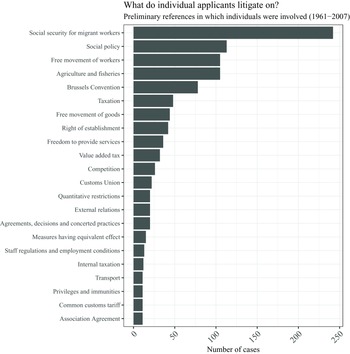
Figure 6 illustrates the most frequent subject matters litigated by individual applicants from 1961 to 2007. As is clear from the figure, individuals often raise claims related to their economic activity, not unlike businesses. This includes when they take up work in a different country (‘migrant workers’, ‘free movement of workers’, ‘freedom to provide services’, ‘right of establishment’) but also when they produce and sell goods (‘agriculture and fisheries’, ‘free movement of goods’, ‘taxation’, ‘value added tax’, and ‘competition’).
Subject matters on which individuals litigate.

However, individuals also raise cases invoking rights that only they can claim: social policies (including social security for migrant workers), non-discrimination and fundamental rights, and free movement of workers and services. Sixty-one per cent of the disputes brought by individuals from 1961 to 2016 pertain to individual and social rights. Overall, the descriptive statistics reflect both the Court’s original economic mandate as well as Caporaso and Tarrow’s argument (2009) that private litigation creates an opportunity for the Court to embed individual rights within the economic scaffolding of EU law.
Individual rights cases are qualitatively different from the economic litigation that dominates the Court’s docket. Individual litigation is often linked to rulings deepening European integration compared to business litigation (Hermansen and Pavone Reference Hermansen, Pavone, Naurin, Sadl and Zglinski2025), and we argue that this is due to the opportunities that individual claiming open for judicial lawmaking: the relative lack of Treaty provisions and legislation on individual and social rights should leave a larger interpretative space for ECJ judges. Further, individual rights are potentially disruptive because they constrain the power of governments. In the 1995–2011 period, seventy-nine per cent of ECJ rulings favoring individual rights simultaneously constrained the autonomy of member states. By comparison, other claims – such as the economic claims that businesses raise – only led to restrictions in twenty-three per cent of the decisions (Larsson et al Reference Larsson, Naurin, Schroeder, Wallerman Ghavanini, Björnberg, Coster, Näsström, Otero, Lindholm, Naurin, Sǎdl, Wallerman Ghavanini, Brekke, Fjelstul, Hermansen, Larsson, Moberg, Näsström, Ovádek, Pavone and Schroeder2022). We thus zoom in on cases that allow the Court to counterbalance business power, challenge governments, broaden its mandate, and appeal to the legal community.
To test our hypothesis, we run a linear probability model with fixed effects where the two aforementioned coding projects are merged. Separate analyses show that the results are similar across the two periods, so the results are neither time-dependent nor driven by idiosyncratic measurement choices (see the Appendix). Since the type of litigants only varies at the case level, we weigh down observations by the number of legal questions the Court answers and cluster the standard errors accordingly.
Our analysis also hedges against alternative explanations. One potential confounder is the merits of the case – how well a claim is grounded in established law. Following legal opportunity structure arguments (De Fazio Reference De Fazio2012), a claim’s legal merit is harder to determine if the law is unclear or the stock of justiciable rights is lacking. Since disputes invoking individual rights have fewer hooks to the EU Treaties and legislation than economic claims, they have inherently lower legal merits and higher uncertainty because their success hinges on ECJ judges exercising their discretion and law-making powers to expand the stock of justiciable rights. For instance, without clear precedents, the Court tends to defer to the shifting political preferences of member states (Hermansen Reference Hermansen2020), making it harder for litigants to predict whether their claims will be deemed well-founded the first few times an EU rule is interpreted. As the Court’s case law crystallizes and is disseminated throughout the legal community, the legal merit of a claim becomes easier to assess. We therefore account for the information available to lawyers concerning the ECJ’s previous case law. Drawing on the same data as Hermansen (Reference Hermansen2020), we introduce fixed effects to compare judicial outcomes strictly between cases involving laws litigated an equal number of times. Our results are thus driven by a comparison of cases with approximately similar merits and degrees of legal certainty. To further zoom in on instances where the Court’s discretion is high, we also fit the same equation for those cases where an EU law is litigated for the first time (model 3).
At the same time, we must guard against underestimating the extent of judicial leveling. Litigants rely on lawyers to advise them on when to bring a case to court and when to desist. Mobilizing before the ECJ requires a significant level of expertise usually possessed by ‘euro-lawyers’ and corporate law firms (Vauchez Reference Vauchez2015; Passalacqua Reference Passalacqua2021; Pavone Reference Pavone2022). We have shown that individuals have weaker legal representation than businesses, and existing studies emphasize that individuals should therefore raise weaker arguments resulting in lower win rates. To intervene in debates about whether the ECJ is a pro-business court, we benchmark on the win rates of businesses (the reference group) while controlling for other types of litigants: individuals that bring other claims than individual rights, non-governmental organizations, state institutions, and other actors. This allows us to approximate the resources the litigants enjoy, while distinguishing any claims-based judicial leveling from litigant-based leveling. We also control for the size and experience of litigants’ legal teams (difference in lawyer experience/legal team size).
Finally, our models adjust for other factors that influence Court decisions. The ECJ tends to reserve its more audacious rulings to periods when its decisions are unlikely to spur political controversy (Šadl and Hermansen Reference Šadl, Hermansen, DeWitte and Dawson2024), aligning its decisions with the preferences espoused by governments in their observations (Castro-Montero et al Reference Castro-Montero, Alblas, Dyevre and Lampach2018; Larsson and Naurin Reference Larsson and Naurin2016; Carrubba et al Reference Carrubba, Gabel and Hankla2008). As individual rights cases tend to constrain member states’ autonomy, all models control for intergovernmental pressures by including the net number of government observations favoring the applicant. We also control for the few instances where the validity of an EU law is challenged, given the ECJ’s purported pro-EU law bias. Lastly, we include indicators for the type of litigant that the applicant is facing, as well as the coding project from which the outcome is drawn.Footnote 3
Evidence consistent with claim-driven judicial leveling (H 1) is displayed in the first column of Table 2 and visualized in Figure 7. The results are in line with our expectation that the ECJ has seized on individual rights claims to level the odds.
Variation in the likelihood of winning among applicants across types of litigants

Note: *p < 0.1; **p < 0.05; ***p < 0.01. d.f., degrees of freedom; MS, member state.
We highlight three comparisons that support our argument over alternative explanations. First, the overall probability of an individual winning the Court’s support is sixteen percentage points higher when they raise individual and social rights compared to when businesses go to court. Importantly, the marginal effect of invoking individual rights (11.6 percentage points) is clearly distinguishable from the baseline win-rate of businesses.
Second, we find little evidence that individuals win more often than businesses when litigation does not relate to individual rights (a 4.4 percentage point difference that is not statistically significant). As we can see from the second model, the higher win-rate of individuals is driven by the subset of cases where they claim specific individual rights – a clear indication that the Court is embracing claim-based leveling over litigant-driven leveling. In sum, these empirical results indicate that the Court disproportionately supports individual rights and seeks to empower the weak. Conversely, we uncovered no evidence that the ECJ exhibits a pro-business bias, even with respect to other litigant types. For instance, businesses do not win more often than state institutions or interest groups.
Leveling the odds: the ECJ is more likely to support claims relating to individual rights raised by individuals than all other claims raised by either individuals or businesses (illustration of model 2 in Table 2. The figure uses ‘state institution’ as a reference group).

The behavior of our control variables aligns with previous research, adding confidence in our analysis. The ECJ is less likely to support challenges to the validity of EU laws. Furthermore, it tends to grant claims that are also supported by the majority of member state observations. For a business to match an individual’s probability of winning in an individual rights case, it would need to receive more than two additional government observations supporting its claims. Strikingly, our findings do not support the conventional wisdom that the quality of legal representation impacts ECJ decisions. Businesses’ larger and more experienced legal teams gain them little sway over the Court’s judges.
Crucially, our findings also help explain why casual observers may nonetheless conclude that the ECJ has a pro-business bias. The answer lies in the underlying distribution of litigants: businesses outnumber individuals three to two in ECJ disputes. This lopsided distribution likely reflects the large stock of justiciable EU corporate rights (Höpner and Schäfer Reference Höpner and Schäfer2012) alongside businesses’ greater capacity to absorb the costs of litigation. Thus, even if the ECJ intentionally favors individual rights claims, on aggregate it delivers more judgments supporting business claims (735 v. 676 supportive judgments in 1961–97, and 463 v. 252 supportive judgments in 1996–2008). In sum, these aggregate statistics can be misleading, and they should not distract from our main takeaway: the ECJ consistently levels the odds for individuals by using individual rights as its linchpin. As we demonstrate in the Appendix, this pro-individual rights bias is astonishingly stable over the half-century covered in our data. While this result breaks from research on party capability, it is consistent with our theory of judicial leveling.
Spotlighting and Amplifying (H 2): Broadcasting Decisions Where Individuals Win
Granting wins to citizens is only half the battle. To establish itself as the cornerstone of a new individual rights regime, the ECJ must also legitimate itself and attract the attention of legal professionals capable of amplifying its judgments. Here, we demonstrate that the ECJ disproportionately spotlights decisions when it supports individuals’ claims (H 2). We then show that the legal community clearly responds to the Court’s spotlighting.
Spotlighting: The ECJ is More Likely to Publicize Decisions that Support Individual Claims
The Court has several procedural choices at its disposal to publicize cases, and we test whether the Court wields them in three ways.
First, during the proceedings, the Court can signal the significance it attributes to a case through the number of judges it allocates. Our first (ordinal) model thus regresses the size of the chamber (small/medium/large) on the type of applicant, contrasting individuals with businesses. Second, we probe what the Court does after it delivers a ruling. Our second (binomial logit) model captures whether the ECJ disproportionately issues press releases in cases involving individuals. Finally, our third model focuses specifically on decisions where individuals win, leveraging an interaction term.
Our data is at the case level. While the first model covers the entire history of ECJ preliminary references, our model of press releases is limited to the years where these are available (1995–2016). Our third model is further limited to cases where the outcome is available (1961–2008). All three models include the same control variables. Since the Court often convenes a larger chamber in response to the number of observations submitted by member governments, we control for the proportion of member states submitting observations. We also control for the number of times that EU law is applied as well as the size and experience of parties’ legal teams. Finally, since the Court’s reliance on smaller chambers and its use of press releases has increased over time (Kelemen Reference Kelemen2012; Fjelstul Reference Fjelstul2023; Brekke et al Reference Brekke, Fjelstul, Hermansen and Naurin2023), all models include decade fixed effects.
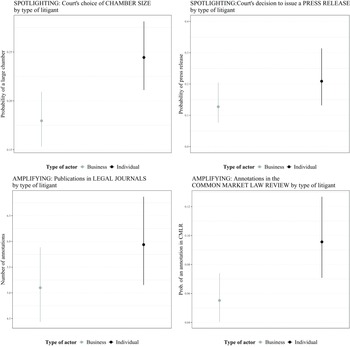
Evidence consistent with judicial spotlighting is reported in Tables 3 and 4 and illustrated in Figure 8. The ECJ disproportionately publicizes cases involving individuals over those involving businesses – especially when individuals win.
Spotlighting and amplifying: judicial and academic issue attention depend on the type of litigants involved

Note: *p < 0.1; **p < 0.05; ***p < 0.01. CMLR: Common Market Law Review.
Spotlighting and amplifying: issue attention as a function of whether the individual applicant wins

Note: *p < 0.1; **p < 0.05; ***p < 0.01.
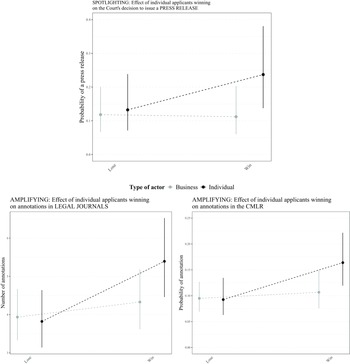
First, ceteris paribus, the likelihood that the Court allocates a larger chamber to a case increases by forty-eight per cent if a dispute involves individuals compared to businesses. After it delivers a ruling, the Court is then twice as likely to issue a press release if the case was brought by an individual (columns 1 and 2 in Table 3). Crucially, column 1 in Table 4 then makes clear that it is only when individuals win that a significant pro-individual bias in spotlighting emerges. The Court is more than twice as likely to publicize judgments via a press release where it supports an individual’s claim compared to when individuals lose. No other type of litigant sees the same favorable shift in the Court’s outreach strategy when they win.
Yet the question remains: does the Court have reasons to believe that its spotlighting strategy is impactful? Is anyone paying attention?
Spotlighting and amplifying: The ECJ and legal commentators disproportionately publicize cases involving individual claims compared to business claims (illustration of models in Table 3).

Amplifying: Legal Commentators Reinforce the ECJ’s Spotlighting
The ECJ’s judges have long aimed to catalyze commentaries in law reviews, especially in journals like the Common Market Law Review (CMLR). Commentaries of judgments (‘annotations’) are important sources of information about new legal opportunities that national lawyers, judges, and academics can seize to raise litigants’ legal consciousness and pressure governments into compliance. Here, we perform four tests demonstrating that lawyers act as a support network by amplifying the Court’s pro-individual rights message.
We first count the number of annotations that ECJ judgments generate in law journals (a Poisson model), then we flag cases covered by the CMLR (a binomial logistic model). For each measure, we test whether cases brought by individuals are commented more often, then zoom in on whether the effect is driven by cases where individuals win. The Poisson models also include fixed effects to control for the national origin of the dispute. Annotations are quite rare, even in journals founded to popularize knowledge of the ECJ’s case law. For instance, only ten per cent of ECJ judgments have received annotations in the CMLR, and only a few have received more than one commentary.
Results consistent with law journals amplifying the ECJ’s pro-individual agenda are reported in the two last columns in Tables 3 and 4, and they are illustrated in the two bottom panes of Figure 8. Our findings reveal a striking similarity between the Court’s leveling and spotlighting efforts and the rulings that lawyers selectively amplify in their commentaries.
First, cases brought by individuals attract sixteen per cent more journal annotations than those brought by businesses. This pro-individual bias in coverage is even more stark when we consider the leading EU law journal, the CMLR: ECJ rulings concerning individuals are eighty-one per cent more likely to be annotated compared to rulings concerning business.
Second, Figure 9 reveals that law journals devote greater attention to precisely the subset of rulings that the ECJ spotlights in its press releases. When individuals win support for their claims, the number of commentaries in legal journals increases by twenty-nine per cent compared to when they lose, while the CMLR is sixty-eight per cent more likely to publish a commentary. By contrast, no such differentiation with respect to judicial outcomes occurs when businesses litigate. Figure 9 thus highlights how an IC’s efforts to spotlight a pro-individual rights agenda is amplified by a crucial judicial support network.
In the Appendix, we unpack this chain of events, demonstrating that the Court’s spotlighting – its choice of chamber size and press releases – mediates these results. Tellingly, our analysis also aligns Dyevre et al (Reference Dyevre, Glavina and Ovádek2021)’s finding that lawyers commenting in law journals have a higher baseline interest in discussing cases involving individual litigants, even without the Court’s intervention. Consequently, the disproportionate attention to individual litigation emerges from a cumulative process: the Court more frequently spotlights cases involving individuals particularly when they win, and legal academics amplify this message both in response to the Court’s signals and due to their own pre-existing interests.
Spotlighting and amplifying: The ECJ is more likely to issue press releases (pane 1) and legal journals are more likely to publish commentaries (panes 2 and 3) for cases where individuals win support for their claims.

Conclusion
That the ‘haves’ come out ahead may be the most consistent finding of legal mobilization research. Yet we have shown that judges can systematically counterbalance inequalities among private litigants and rectify the ways that these inequities are encoded in the law. Courts facing legitimacy deficits may find individual rights claims useful for justifying their lawmaking agendas and cultivating judicial support networks. Consequently, courts may favor individual claimants even when the legal rules they are tasked to apply are predominantly economic and businesses show up with better lawyers.
Drawing on novel qualitative and quantitative evidence concerning the world’s first new-style IC – the ECJ – we demonstrate that it is actually the ‘have nots’ that tend to come out ahead. Despite its economic mandate and alleged pro-business bias, the ECJ is not only more likely to support the claims that individuals raise compared to better-resourced businesses, but it also disproportionately spotlights pro-individual rights decisions to lawyers who amplify them in law journals. Through judicial leveling and spotlighting, ECJ judges demonstrate that party capability is not destiny before ICs.
Could our findings travel to the eleven other new-style ICs designed as transplants of the ECJ (Alter Reference Alter2014, Reference Alter2012)? Or is the ECJ unique and subject to ’scope conditions’ (Goertz and Mahoney Reference Goertz and Mahoney2009) limiting other ICs from serving as weapons of the weak? Our theory implies that there are three scope conditions to our findings: judicial ambition to expand a court’s mandate, the viability of individual rights as a legitimating currency, and the presence of an active and receptive legal profession.
First, ICs must possess the ambition to eschew their narrow economic mandates. Although ‘scholars of supranational judicial organs’ often presume that ‘judges are the main driving force behind the expansion of judicial power’ (Hirschl Reference Hirschl2008, p. 97), recent studies demonstrate that ‘not all international courts seek to expand their influence and authority’ (Alter and Helfer Reference Alter and Helfer2017, pp. 14–15). For instance, judges at the Andean Tribunal have been more self-restrained (Alter and Helfer Reference Alter and Helfer2017) than judges at the East African Court of Justice, who have ‘been proactive in encouraging human rights cases to come before [them]’ despite being set up as an economic court (Gathii Reference Gathii2016, p. 37). Absent judicial ambition, ICs have little need for legitimation strategies to justify lawmaking and mitigate the backlashes that may follow.
Second, ICs must be embedded in political contexts where individual rights are a viable legitimating currency. Post-war Europe proved a fertile terrain for individual rights discourses (Dyevre et al Reference Dyevre, Glavina and Ovádek2021), yet the backlash that crippled the South African Development Community Tribunal underscores that support for individual rights has ‘soured in much of the developing world’ (Madsen et al Reference Madsen, Cebulak and Weibusch2018, p. 27). Where individual rights are perceived as tools of neoliberalism or colonialism (Gathii Reference Gathii1999), leveling the odds for individuals and spotlighting their rights claims would not be an effective legitimation strategy for ICs.
Third, ICs must be embedded in political contexts with an active civil society and receptive legal profession. The proliferation of law schools and lawyers in post-war Europe – combined with the authority of legal scholars and attorneys’ capacity to mobilize without state interference – positioned the legal community as an important interlocutor for the ECJ (Weiler Reference Weiler1994). But the legal profession is neither active nor independent everywhere (Halliday et al Reference Halliday, Feeley and Karpik2007; Alter Reference Alter2014). When an IC faces a prostrate legal profession and a civil society captured by the state, even a compelling legitimation strategy may fail to mobilize judicial support networks.
Our argument also opens avenues for future research. Although we demonstrate that lawyers and law journals are responsive to the ECJ’s leveling and spotlighting efforts, we did not probe whether the Court succeeds in cultivating broader public support. Public support can be crucial to disincentivize government court-curbing (Vanberg Reference Vanberg2005; Staton and Vanberg Reference Staton and Vanberg2008; Carrubba Reference Carrubba2009), and judicial support networks sometimes succeed in promoting court rulings and building the legal consciousness of those whose rights are affected (Bailey et al Reference Bailey, Collins, Rhodes and Rice2024). Future research could probe whether legal commentaries amplifying the ECJ’s pro-individual rights rulings translate into heightened public support and follow-up litigation.
Finally, our findings also have practical implications, highlighting opportunities that private litigants and the ‘have nots’ can leverage. Whereas resourceful corporations can influence international policy via lobbying (Coen and Richardson Reference Coen and Richardson2009), new-style ICs may be individuals’ best bet to voice their interests. After all, whether the ‘haves’ or ‘have nots’ come out ahead is not merely a question of amassing the most resources; it is also a question of raising claims that help judges legitimate their authority and agendas. And at least in this respect, pensioners, consumers, and migrant workers are often better positioned than their corporate counterparts.
Supplementary material
The supplementary material for this article can be found at https://doi.org/10.1017/S0007123425100987.
Data availability statement
Replication data for this article can be found in Harvard Dataverse at: https://doi.org/10.7910/DVN/FMGLOU.
Financial support
This research received no specific grant from any funding agency, commercial, or not-for-profit sectors.
Competing interests
The authors have no competing interests to declare.







 Open access

