


Introduction
Interpersonal violence is a major public health problem affecting individuals, communities, and health systems. Worldwide, it contributes to preventable death and disability. According to the World Health Organization, violence-related injuries account for approximately 1.25 million deaths annually. 1 The United Nations Office on Drugs and Crime reports that the annual global number of homicide victims has ranged from 400,000 to 450,000 in recent years. 2 In the United States, emergency department visits for assault-related injuries averaged approximately 1.5 million annually during 2019-2021, representing 1.1% of all emergency department visits and 4.4% of injury-related visits.Reference Davis and Santo 3
The epidemiology of violence cannot be fully characterized using criminal justice data alone. Many violent incidents are not recorded by law enforcement, particularly when individuals seek medical care without filing formal reports. Health-system data therefore provide an important complementary source for violence surveillance. Emergency department and ambulance service data can provide complementary information on the burden, timing, and geographic distribution of violence-related injuries, particularly in urban settings.Reference Florence, Shepherd and Brennan 4 , Reference Sutherland, Strang and Stepanek 5 Prehospital EMS records are especially relevant because they capture both the initial clinical response to injury and the operational characteristics of service demand. Ambulance-based studies indicate that violence-related incidents predominantly involve young men, often occur at night, and are concentrated in urban and socioeconomically disadvantaged areas.Reference Quigg, McGee and Hughes 6 This evidence supports the use of ambulance records for violence surveillance because such records capture injury and violence patterns not fully represented in other surveillance systems.Reference Sutherland, Strang and Stepanek 5 , Reference Ariel, Weinborn and Boyle 7 , Reference Backe and Andersson 8
Operational indicators across the EMS care pathway, including dispatch response, station mobilization, on-scene duration, ambulance offload time, and total ambulance busy time, are also important markers of emergency system functioning. Prolonged intervals may reflect geographic accessibility, case complexity, scene conditions, resource constraints, hospital congestion, or downstream workflow pressures.Reference Lundberg, Lapidus and Bäckström 9 , Reference Morley, Unwin and Peterson 10 Population-based evidence has linked longer ambulance offload times with adverse downstream outcomes in certain clinical groups, although the relationship between operational delays and patient outcomes is context-dependent and should not be interpreted uniformly.Reference Dawson, Andrew and Stephenson 11 , Reference Stewart, Lang and Wang 12 NHS England and the Royal College of Emergency Medicine have identified ambulance response and hospital handover delays as operational and patient-safety concerns because prolonged handovers can postpone the transfer and delivery of care and reduce ambulance availability for new emergencies. 13 – 15
Despite growing recognition of violence as a health-system issue, few prehospital studies have integrated epidemiological profiles, clinical presentation, operational characteristics, transfer outcomes, and mortality.Reference Taylor, Boyle and Sutherland 16 Existing research has focused mainly on emergency department surveillance or the temporal patterns of assault-related ambulance use; fewer registry-based EMS studies have examined violence-related encounters and operational workflow within a single analytic framework.Reference Quigg, McGee and Hughes 6 , Reference Taylor, Boyle and Sutherland 16 , Reference Downing, Wilson and Cooke 17 This gap is particularly relevant in large metropolitan settings, where population density, mobility, hospital congestion, and variable service demand may influence both EMS use and operational performance.Reference Lundberg, Lapidus and Bäckström 9 , Reference Morley, Unwin and Peterson 10 , Reference Hassler and Ceccato 18
The present study analyzed ambulance-attended violence-related EMS encounters recorded on the Anatolian side of Istanbul from 2019 to 2023. Its primary objective was to describe the epidemiological, clinical, and operational characteristics of these encounters. The secondary objectives were to compare encounters by sex and to examine characteristics associated with confirmed prehospital death status.
Methods
Study Design and Setting
This retrospective observational registry-based study used routinely collected EMS data from the Anatolian side of Istanbul, Türkiye, and included violence-related encounters recorded from 2019 to 2023. Because the registry covered a defined service area rather than the entire city, the analysis represents a regional EMS registry study rather than a population-based study of all violent incidents in Istanbul. Türkiye’s 112 EMS is coordinated through provincial Health Command and Control Centers and uses ASOS 19 for ambulance case documentation. Authorized ambulance team personnel enter or update clinical and diagnostic codes at the scene or during ambulance care, after which the completed case form is submitted to the Health Command and Control Center for closure approval. The anonymized research export did not include a historical station roster or stable identifiers for stations, hospitals, clinicians, or users. When mobile data entry could not be completed, the case form could be completed on paper and entered into ASOS before case closure.
Data Source and Case Definition
The source registry contained EMS encounter records generated through the ambulance coordination system. The original EMS registry contained 958,212 records. Annual files were first consolidated into a single dataset for preprocessing and quality assessment. The dataset was reviewed for year-to-year comparability, structural consistency, and availability of core variables.
Violence-related EMS encounters were identified using the registry-provided structured reason-of-call category coded as “Violence & Assault.” This category was not created by the researchers. According to the ASOS data-entry workflow confirmed with ambulance personnel responsible for collecting these records, case coding is entered and may be updated by authorized ambulance-team personnel during the prehospital episode before the case form is submitted to the Health Command and Control Center for closure approval.
ICD-10 codes refer to the International Classification of Diseases, 10th Revision, 20 and were used in this study to describe recorded injury diagnoses and external causes within the violence-related EMS sample. Because ICD-10 documentation in routine EMS data may reflect clinical assessment and routine registry coding during the prehospital episode, these codes were treated as descriptive clinical variables rather than as the sole basis for identifying violence-related encounters.
Study Sample and Selection Process
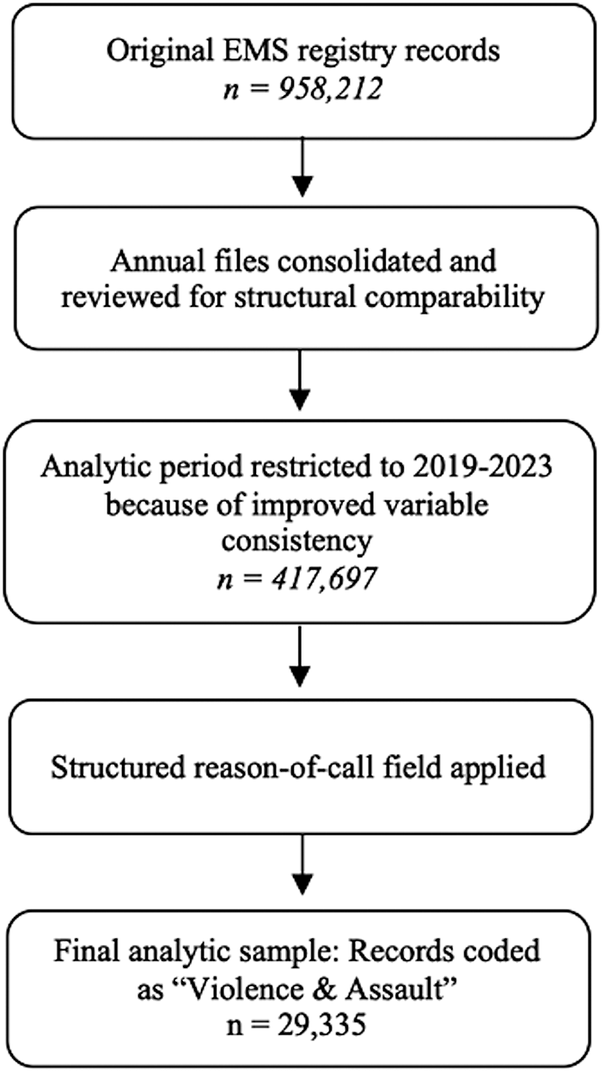
Data consistency varied across the full registry period. Earlier records showed greater variation in coding structure, variable availability, and documentation practices. In some years, diagnostic information was incorporated into free-text coordination notes, whereas in others, structured demographic or clinical fields were inconsistently available. To maintain analytic comparability, the study period was restricted to 2019-2023, during which the relevant registry fields were more consistently available. After restricting the dataset to records coded as “Violence & Assault” in the structured reason-of-call field, the final analytic sample consisted of 29,335 EMS encounters (Figure 1).
Study sample selection flow diagram.

Figure 1. Long description
The flowchart consists of five rectangular boxes connected by downward arrows.
* The first box at the top is labeled Original E M S registry records with n = 958,212.
* An arrow points down to the second box, labeled Annual files consolidated and reviewed for structural comparability.
* An arrow points down to the third box, labeled Analytic period restricted to 2019-2023 because of improved variable consistency with n = 417,697.
* An arrow points down to the fourth box, labeled Structured reason-of-call field applied.
* The final arrow points to the fifth box at the bottom, labeled Final analytic sample: Records coded as Violence & Assault with n = 29,335.
Variables and Definitions
The registry included demographic, geographic, clinical, diagnostic, operational, triage, transfer, and outcome variables. Demographic variables included age, sex, and nationality. Geographic variables included district, urban–rural classification, regional status, district socioeconomic development category, and district population-size category. Clinical variables included level of consciousness, pupillary status, respiratory status, skin appearance, pulse status, and recorded pulse value where available. Diagnostic information was represented by ICD-10 diagnosis codes and grouped ICD-10 categories.
Triage was recorded as Red, Yellow, Green, Black, or Social Indication. Red indicated immediate life threat, Yellow indicated urgent but stable status, Green indicated minor acuity, Black indicated patients considered dead or non-survivable, and Social Indication referred to encounters without a clear medical need for EMS intervention.
Transfer outcome was recorded as Standard Transfer, On-Scene Intervention, Refusal of Transfer, Transport by another vehicle, or False/Invalid Report. Operational variables included command reaction time, station reaction time, on-scene intervention duration, hospital handover duration, and total ambulance busy time. These variables were retained in seconds. Standard Transfer indicates use of the ambulance for transport and is not a vital-status category, so it may include both living patients and encounters with confirmed death.
For the geographical distribution of cases, two binary district attributes were used to control for district differences: socioeconomic development (highly developed vs less-developed, based on SEGE-2022 district classification) and population size (>500,000 vs ≤500,000 residents, based on official district population totals).Reference Acar, Şahin Cinoğlu and Karagöz 21
Outcome Definition
The mortality-related outcome variable was confirmed death status as recorded within the prehospital EMS registry. For analysis, confirmed death required concordant mortality coding in two ASOS diagnostic fields: R96, R98, or R99 in the ICD-10 diagnosis field and R95-R99 in the “ICD10 2nd Level Code” field. This registry-based confirmation therefore refers to death documented within the prehospital EMS episode and does not incorporate post-hospital mortality. This variable was distinct from Black triage status. Black triage reflected an operational triage category indicating patients considered dead or non-survivable at the scene and was not used to define confirmed death because it is a separate registry field. The comparison category comprised encounters that did not meet the dual-code confirmed-death definition and should not be interpreted as independently verified survival.
Data Harmonization and Processing
Data harmonization was performed before statistical analysis. Variable names and category labels were standardized across registry fields. Structured consciousness, pupillary, respiration, and skin variables were supplied as existing ASOS fields in the research export and were not generated by the researchers from the parallel raw fields. Their provenance and availability relative to the parallel raw fields are summarized in Supplementary Table 6. Operational time variables were retained in seconds and summarized using medians and interquartile ranges because of right-skewed distributions. ICD-10 codes were preserved in their original form and additionally grouped where clinically meaningful. Free-text narrative fields were not used for case identification or modeling because of variation in documentation practices and the absence of consistent standardization across years.
Missing Data
Missingness was evaluated at the variable level before analysis. Both system-missing values and registry placeholders indicating unavailable or non-recorded information were considered. Core structured variables used for case definition, sample selection, demographic description, temporal analysis, triage, transfer outcome, confirmed death status, and operational time intervals were complete in the analytic file. The structured clinical fields for consciousness, pupillary status, respiration, and skin appearance were complete in the analytic export, whereas their parallel raw fields contained a substantial number of unavailable values. Unavailable values or placeholders in the parallel raw fields were not imputed or reassigned by the researchers to normal structured categories. However, several raw clinical fields had substantial numbers of unavailable values, including raw consciousness, raw respiration, raw skin appearance, raw pulse status, pulse value, and blood pressure. ICD-10 diagnostic fields were unavailable in approximately one quarter of the sample and were therefore used descriptively rather than as mandatory variables in the exploratory multivariable analysis.
Descriptive analyses used available-case denominators where appropriate. For the exploratory multivariable analysis, candidate covariates were selected from variables with complete or near-complete availability and clinical relevance. Variables with substantial missingness, non-standard raw formatting, or potential outcome leakage were excluded from the exploratory multivariable analysis. Variable-level missingness and modeling-related missingness decisions are reported in Supplementary Tables 1 and 2.
Statistical Analysis
All data processing and descriptive analyses were conducted in Python 3.13.5. Data wrangling and aggregation were performed using pandas 2.2.3, numerical operations using NumPy 2.1.0, and statistical tests using SciPy 1.14.1, including mannwhitneyu, chi2_contingency, and fisher_exact. Because confirmed death was rare and conventional maximum-likelihood logistic regression showed evidence of quasi-complete separation, Firth-penalized logistic regression was used for the exploratory multivariable association analysis.Reference Firth 22 , Reference Heinze and Schemper 23 Because the firthlogist package is not compatible with Python 3.13, the Firth model was fitted in a separate Python 3.10 environment using firthlogist 0.5.0 and its FirthLogisticRegression() implementation. Firth regression applies Jeffreys-prior penalization to reduce first-order bias and provides finite parameter estimates in logistic regression settings affected by separation. Model estimation used the implementation’s Newton-Raphson procedure with a maximum of 25 iterations and a convergence tolerance of 0.0001. Adjusted odds ratios were obtained by exponentiating the fitted coefficients, with 95% profile-likelihood confidence intervals and penalized likelihood-ratio P values. The realized number of iterations was not retained in the archived model output.
Descriptive statistics were used to summarize the demographic, clinical, geographic, and operational characteristics of violence-related EMS cases. Due to the right-skewed distribution of operational times and clinical metrics, continuous variables were summarized via medians and interquartile ranges. Categorical variables were reported as frequencies and percentages. Sex was analyzed as documented in the EMS registry, and sex-based comparisons were conducted as secondary descriptive analyses. Continuous variables were compared between sex groups using Mann-Whitney U tests, and categorical variables were compared using chi-square tests. Effect sizes were reported with p-values. Rank-biserial correlation was used for continuous variables, and Cramér’s V was used for categorical variables.
Comparisons by death status were conducted between encounters with confirmed death and other encounters. These comparisons were interpreted descriptively because operational intervals may reflect case severity, resuscitation requirements, documentation processes, or downstream workflow rather than independent causal effects.
A Firth-penalized multivariable logistic regression model was used as a secondary exploratory analysis to estimate adjusted associations with confirmed prehospital death status. Candidate covariates were selected based on clinical relevance and availability in the registry. Because field-level timestamps were unavailable, clinical and operational covariates were interpreted as concurrent encounter characteristics rather than confirmed pre-intervention predictors. Variables with direct conceptual or temporal overlap with death, such as death-related diagnostic codes, black triage status, and post-outcome documentation fields, were excluded from the exploratory multivariable analysis to reduce leakage risk. Results were reported as adjusted odds ratios with 95% confidence intervals. On-scene/intervention time was retained as a concurrent operational covariate rather than as a baseline predictor. Reporting was reviewed against the STROBE statement,Reference von Elm, Altman and Egger 24 with item-level reporting mapped in Supplementary Table 7.
Ethical Approval, Consent to Participate, and Data Governance
This study was approved by the Hamidiye Scientific Research Ethics Committee (approval date: August 22, 2024; approval number: 9/16). The study was conducted in accordance with the principles of the Declaration of Helsinki. The data were obtained from Istanbul Provincial Health Directorate, Office of Anatolian Ambulance Service, which maintains the EMS registry for ambulance-attended encounters on the Anatolian side of Istanbul. Following ethics committee approval, the research team submitted an institutional data request to Istanbul Provincial Health Directorate. Data access was granted under Research Committee administrative approval and authorization (approval date: September 04, 2024; approval number: 254859865). No separate data-sharing agreement was required beyond this administrative authorization. The data-holding institution generated an anonymized registry export for the 2019-2023 study period after removing direct patient identifiers. The anonymized dataset was transferred to the research team through encrypted file transfer. The research team did not have direct access to the live EMS database or identifiable patient-level records. Because the study used retrospectively collected anonymized registry data, the requirement for individual informed consent was waived.
Results
Analytic Sample Characteristics and Data Completeness
A total of 29,335 EMS encounters coded as “Violence & Assault” in the structured reason-of-call field were included in the final analytic sample. Core demographic, temporal, triage, transfer, outcome, and operational time variables were complete in the analytic file. Detailed ICD-10 diagnostic descriptor fields were available for 22,060 encounters (75.2%), while pulse value was available for 17,458 encounters (59.5%). Therefore, ICD-10 fields and raw vital-sign variables were used descriptively and were not included as covariates in the exploratory multivariable analysis.
Epidemiological and Geographic Characteristics
A total of 29,335 violence-related EMS cases recorded on the Anatolian side of Istanbul between 2019 and 2023 were included in the analysis. Table 1 presents demographic and clinical characteristics of the sample. Most of the cases were intra-regional (89.2%) and occurred in urban settings (98.7%). The majority of cases arose in highly developed districts (80.2%), and the distribution by district population size was relatively balanced, with 51.4% of incidents occurring in districts with populations greater than 500,000. Patients were mostly Turkish nationals (96.1%), while other nationalities, including Syrian, Afghan, and Turkmen individuals, each accounted for less than 1% of cases. Case volume was concentrated in some districts: Pendik (14.4%), Ümraniye (12.4%), Kadıköy (10.6%), Kartal (9.4%), and Üsküdar (9.0%), which accounted for more than half of all violence-related EMS calls. Marked demographic concentration was also evident. Males accounted for 77.6% of the sample and females for 22.4%. The affected population comprised predominantly young adults, with a mean age of 33.47 (±15.61) years and a median age of 31 years. By age group, 34.3% of cases occurred among persons aged 18-29 years and 38.5% among those aged 30-44 years.
Geographic, demographic, and clinical characteristics of violence-related EMS encounters

Table 1. Long description
The table is organized into two main sections of features.
Left Section:
- Region: Intra-regional 26,167 (89.2 percent), Out-of-region 3,168 (10.8 percent).
- Urbanity: Urban 28,960 (98.7 percent), Rural 375 (1.3 percent).
- Development Status: Highly developed 23,515 (80.2 percent), Less developed 5,820 (19.8 percent).
- Population: Over 500K 15,089 (51.4 percent), Below 500K 14,246 (48.6 percent).
- Sex: Female 6,571 (22.4 percent), Male 22,764 (77.6 percent).
- Age: 0 to 17 2,565 (8.7 percent), 18 to 29 10,058 (34.3 percent), 30 to 44 11,289 (38.5 percent), 45 to 59 3,883 (13.2 percent), 60 to 74 1,078 (3.7 percent), 75 plus 462 (1.6 percent).
- Consciousness: Open 24,931 (85.0 percent), Blurred or clouded 447 (1.5 percent), Closed 787 (2.7 percent), Coma 135 (0.5 percent), Confused 957 (3.3 percent), Sedated 758 (2.6 percent), Semicoma 1,320 (4.5 percent).
Right Section:
- Pupillary Status: Anisocoric 61 (0.2 percent), Fixed dilated 432 (1.5 percent), Isocoric 682 (2.3 percent), Mydriatic 112 (0.4 percent), Miotic 107 (0.4 percent), Normal 26,623 (90.8 percent), Non-reactive 1,318 (4.5 percent).
- Respiration: Dyspnea 407 (1.4 percent), Regular 25,094 (85.5 percent), Irregular 296 (1.0 percent), Intubated 890 (3.0 percent), Rapid 823 (2.8 percent), Absent 1,541 (5.3 percent), Shallow 284 (1.0 percent).
- Skin appearance: Hyperemic 769 (2.6 percent), Icteric 18 (0.1 percent), Dry 134 (0.5 percent), Normal 25,883 (88.2 percent), Cyanotic 866 (3.0 percent), Pale 1,232 (4.2 percent), Diaphoretic 433 (1.5 percent).
- Confirmed Death Status: Dead 132 (0.4 percent), Other 29,203 (99.6 percent).
Notes. Table n = 29,335. Values are presented as n (%). Percentages were calculated using the full analytic sample as the denominator (n = 29,335). Clinical categories reflect structured ASOS registry fields for consciousness, pupillary status, respiration, and skin appearance. Confirmed death required concordant mortality coding in the 2 ASOS diagnostic fields defined in the Methods and was distinct from Black triage status. Geographic categories are based on registry location variables, SEGE-2022 district socioeconomic development classification, and official district population-size categories.
Clinical Presentation and Diagnostic Patterns
In the structured EMS assessment, most patients had preserved clinical findings. Consciousness was recorded as open in 85.0% of cases, pupillary findings were normal in 90.8%, respiration was regular in 85.5%, and skin appearance was normal in 88.2%. Confirmed death status was positive in 132 encounters, corresponding to 0.45% of the sample.
A smaller but clinically important subgroup showed evidence of physiological instability. Absent respiration was documented in 1,541 cases (5.3%), non-reactive pupils in 1,318 cases (4.5%), cyanotic skin appearance in 866 cases (3.0%), and coma in 135 cases (0.5%). Although these findings represented a minority of encounters, their absolute frequency indicates a subgroup requiring urgent clinical assessment and potentially resource-intensive prehospital care. Among encounters with available ICD-10 diagnostic information, diagnostic coding included external-cause and head-injury patterns. The most common pattern involved external cause code W51, denoting accidental striking against or bumping into another person, combined with injury codes from the S00–S09 range or pain-related codes from the R52 category. The combination W51 + S00 occurred in 4.9% of cases, while W51 + R52.9 occurred in 4.0%. Other mechanisms, including falls and sharp-object injuries, were less frequent. Because ICD-10 fields were unavailable in approximately one quarter of the sample, these diagnostic patterns were interpreted descriptively rather than as the basis for case identification or mortality modeling. An X85-Y09-only sensitivity restriction was not applied because the prespecified case definition was the structured reason-of-call field and detailed ICD-10 information was unavailable in 24.8% of encounters.
Triage, Transfer Outcomes, and Operational Indicators
Most cases resulted in hospital transport. Standard transfer was documented in 77.0% of cases, while transport by another vehicle accounted for 12.5%. The remaining encounters consisted of refusal of transfer, on-scene intervention, and false or invalid reports. Triage acuity was predominantly moderate to high. Yellow-coded cases accounted for 47.7% of encounters, and Red-coded cases accounted for 37.9%, meaning that 85.6% of all encounters were assigned either Yellow or Red triage. Green-coded cases represented 13.7%, whereas Black triage and Social Indication together accounted for less than 1%.
Cross-tabulation of triage category and transfer outcome showed distinct operational patterns (Table 2). The association between triage assignment and transfer outcome was statistically significant (χ 2 = 13,321, P < 0.001). Yellow-coded cases were managed predominantly through Standard Transfer (95.2%). Red-coded cases showed greater heterogeneity; although Standard Transfer remained the most common outcome (57.9%), 33.1% were recorded as Transport by another vehicle. Among Green-coded cases, 66.1% resulted in Standard Transfer, while refusal of transfer was more frequent than in higher-acuity groups. Black-coded cases were documented mainly as Standard Transfer, whereas Social Indication cases more often ended in refusal or completion of care on scene.
Cross-tabulation of transfer outcome by triage category

Table 2. Long description
A data table with 7 columns and 7 rows including headers. The columns are: Triage category, Standard transfer, On-scene intervention, Refusal of transfer, Transport by another vehicle, False or Invalid Report, and Total. Data is presented as n (row percent).
* Red code: 6,444 (58.0 percent) standard transfer; 37 (0.3 percent) on-scene intervention; 113 (1.0 percent) refusal; 3,675 (33.1 percent) transport by another vehicle; 847 (7.6 percent) false or invalid report; Total 11,116.
* Yellow code: 13,335 (95.2 percent) standard transfer; 95 (0.7 percent) on-scene intervention; 574 (4.1 percent) refusal; 0 (0.0 percent) other categories; Total 14,004.
* Black code: 142 (98.6 percent) standard transfer; 0 (0.0 percent) on-scene intervention; 2 (1.4 percent) refusal; 0 (0.0 percent) other categories; Total 144.
* Social indication for intervention: 10 (24.4 percent) standard transfer; 4 (9.8 percent) on-scene intervention; 27 (65.9 percent) refusal; 0 (0.0 percent) other categories; Total 41.
* Green code: 2,662 (66.1 percent) standard transfer; 274 (6.8 percent) on-scene intervention; 1,094 (27.1 percent) refusal; 0 (0.0 percent) other categories; Total 4,030.
* Total: 22,593 (77.0 percent) standard transfer; 410 (1.4 percent) on-scene intervention; 1,810 (6.2 percent) refusal; 3,675 (12.5 percent) transport by another vehicle; 847 (2.9 percent) false or invalid report; Grand Total 29,335.
Statistical notes: Pearson chi-square equals 13,321; d f equals 16; P is less than 0.001; Cramer’s V equals 0.337.
Notes. Values are presented as n (row %). Pearson chi-square test for the association between triage category and transfer outcome: χ 2 = 13,321; df = 16; P < 0.001; Cramer’s V = 0.337. Triage categories and transfer outcomes reflect structured EMS registry fields. Zero counts for Transport by another vehicle and False/Invalid Report outside Red triage were retained as recorded workflow-dependent structural combinations and were not treated as missing values.
Operational time intervals showed short early mobilization intervals but greater variability in later stages of the EMS pathway. Median command reaction time was 185 seconds, and median station reaction time was 43 seconds. Median on-scene/intervention time was 480 seconds, median hospital handover time was 480 seconds, and median total ambulance busy time was 2,423 seconds.
Confirmed-Death and Other Encounter Comparisons
Comparisons between encounters with confirmed death and other encounters are presented in Supplementary Table 3. Confirmed death occurred in 132 encounters, corresponding to 0.4% of the sample. Supplementary Table 3 summarizes demographic, clinical, triage, transfer, operational, and geographic differences between encounters with and without confirmed death. Of the 132 encounters meeting the confirmed-death definition, 125 (94.7%) were recorded as Black triage, and all 132 were recorded as Standard Transfer. Nineteen Black-triage encounters did not meet the confirmed-death definition and had ICD-10 diagnoses within the I30-I52 range, including I46. These relationships are presented in Supplementary Table 5.
Sex-Based Comparisons
Sex-based comparisons are presented in Supplementary Table 4. Females accounted for 22.4% of the sample (n = 6,571), and males accounted for 77.6% (n = 22,764). The age distribution was broadly similar between groups, although the median age was slightly higher among female patients. Green triage was more frequent among female patients, whereas Yellow triage and Standard Transfer were more frequent among male patients. Several operational indicators differed statistically by sex, but effect sizes were generally small. Confirmed death status did not differ significantly by recorded sex: confirmed death was recorded in 34 female encounters (0.5%) and 98 male encounters (0.4%; p = 0.411, Cramér’s V = 0.005).
Exploratory Multivariable Association Analysis
Firth-penalized multivariable logistic regression was used as a secondary exploratory analysis because confirmed death was rare and conventional logistic regression showed evidence of quasi-complete separation. The model included clinically relevant covariates with complete availability in the analytic file. Variables with direct conceptual or temporal overlap with mortality, including Black triage status, death-related ICD-10 codes, post-outcome documentation fields, hospital handover time, total ambulance busy time, and transfer outcome, were excluded from the exploratory multivariable analysis.
In the adjusted model, severe respiratory status showed the largest adjusted association with confirmed prehospital death status, followed by altered consciousness and cyanotic skin appearance (Table 3). Age showed a modest positive association with confirmed prehospital death status. Sex, district socioeconomic development category, and district population-size category were not significantly associated with confirmed prehospital death status after adjustment. Longer command reaction time, station reaction time, and on-scene/intervention time were also statistically associated with confirmed prehospital death status.
Exploratory Firth penalized multivariable logistic regression analysis of characteristics associated with confirmed prehospital death status

Table 3. Long description
The table contains four columns: Variable, Adjusted O R, 95 percent C I, and P value.
* Age, per 10-year increase: Adjusted O R 1.17, 95 percent C I 1.05 to 1.30, P value 0.006.
* Sex (female): Adjusted O R 0.81, 95 percent C I 0.47 to 1.38, P value 0.434.
* Altered consciousness: Adjusted O R 10.71, 95 percent C I 1.67 to 68.67, P value 0.012.
* Severe respiratory status: Adjusted O R 56.02, 95 percent C I 8.62 to 364.05, P value less than 0.001.
* Cyanotic skin appearance: Adjusted O R 4.24, 95 percent C I 2.67 to 6.73, P value less than 0.001.
* Command reaction time, per 1-minute increase: Adjusted O R 1.01, 95 percent C I 1.00 to 1.01, P value less than 0.001.
* Station reaction time, per 1-minute increase: Adjusted O R 1.02, 95 percent C I 1.01 to 1.02, P value less than 0.001.
* On-scene or intervention time, per 10-minute increase: Adjusted O R 1.46, 95 percent C I 1.38 to 1.54, P value less than 0.001.
* Highly developed district: Adjusted O R 1.73, 95 percent C I 0.89 to 3.38, P value 0.106.
* District population greater than 500,000: Adjusted O R 0.83, 95 percent C I 0.53 to 1.29, P value 0.405.
Notes. Outcome was confirmed prehospital death status, operationally defined by concordant mortality coding in the 2 ASOS diagnostic fields described in the Methods. Model n = 29,335; encounters with confirmed death, n = 132. OR = odds ratio; CI = confidence interval. Severe respiratory status was defined as absent respiration or intubated/mechanically ventilated respiration. Altered consciousness was defined as any recorded consciousness status other than open, including sedation. Black triage, death-related ICD-10 codes, post-outcome documentation fields, hospital handover time, total ambulance busy time, and transfer outcome were excluded from the exploratory model because of direct conceptual or temporal overlap with confirmed death and risk of outcome leakage. Pulse value and blood pressure were excluded because of substantial missingness and non-standard documentation. On-scene/intervention time was retained as a concurrent operational covariate rather than as a baseline predictor. Because field-level timestamps were unavailable, clinical and operational variables were interpreted as concurrent encounter characteristics rather than confirmed antecedent predictors. Reference categories were male sex, open consciousness, non-severe respiratory status, non-cyanotic skin appearance, less-developed district, and district population ≤500,000.
Discussion
This retrospective registry-based analysis of 29,335 violence-related EMS encounters recorded on the Anatolian side of Istanbul provides an epidemiological, clinical, and operational profile of EMS-attended interpersonal trauma. The main findings indicate that violence-related EMS demand was concentrated among young adult males, most encounters showed preserved clinical findings during the EMS assessment, and confirmed prehospital death status was rare. Nevertheless, a clinically important subgroup presented with physiological instability, including altered consciousness, abnormal respiration, and cyanotic skin findings. Operational intervals showed short early mobilization but greater variability in later stages of the EMS pathway. Sex-based differences were statistically detectable but generally modest in magnitude. In the exploratory mortality-related analysis, indicators of physiological instability were more strongly associated with confirmed prehospital death status than demographic or district-level characteristics, while operational intervals were interpreted as markers of case complexity and EMS workflow rather than as independent causal determinants.
The demographic profile of the sample was broadly consistent with previous violence surveillance studies. Violence-related presentations have commonly been reported to cluster among young men and to vary according to late evening hours, weekends, and summer months.Reference Quigg, McGee and Hughes 6 , Reference Bellis, Leckenby and Hughes 25 A recent trauma-center study from Istanbul similarly found that patients presenting after assault were predominantly young adults, with presentations increasing during summer.Reference Sanlier, Al and Celebi 26 In this study, violence-related EMS encounters recorded on the Anatolian side of Istanbul were concentrated among young adult males and were commonly associated with external-cause and head-injury coding patterns.
District-level concentration was also observed in the analytic sample, with a limited number of districts accounting for a substantial share of violence-related EMS calls. This pattern is consistent with the literature indicating that service utilization due to assaults is predominantly observed in urban and socially stratified contexts.Reference Quigg, McGee and Hughes 6 However, raw district counts should not be interpreted as direct indicators of district-level violence risk. Such counts may reflect population density, nightlife patterns, mobility, socioeconomic structure, reporting behavior, proximity to hospitals and ambulance stations, or differences in EMS utilization. Because the present analysis was limited to district-level aggregation and did not use population-adjusted incidence rates, the geographic findings should be interpreted descriptively. Nonetheless, the concentration of EMS-attended violence-related encounters in specific districts may still be relevant for service planning and future public health surveillance studies.
An important clinical finding is that the majority of patients did not appear to be in a life-threatening state during the EMS assessment. Open consciousness, normal pupillary findings, regular respiration, and normal skin appearance predominated, while confirmed prehospital death status remained rare. This pattern aligns with the Istanbul trauma-center study, in which life-threatening conditions were identified in only 0.79% of patients presenting after assault.Reference Sanlier, Al and Celebi 26 However, the absolute number of patients with altered consciousness, absent or abnormal respiration, cyanotic skin, or coma was not negligible. Although these cases represented a minority of the sample, they identify a subgroup requiring urgent assessment, airway support, close neurologic monitoring, resuscitation, or rapid transport. Thus, violence-related EMS demand appears to combine high-volume lower-acuity encounters with a smaller but clinically and operationally demanding subgroup.
The clinical importance of physiological instability is also supported by trauma and emergency-care principles. The character of the pulse can contribute to rapid assessment of circulatory compromise in trauma, although it should not be interpreted as a standalone measure of hemodynamic stability.Reference McManus, Yershov and Ludwig 27 , Reference Ciaraglia, Convertino and Johnson 28 Prehospital trauma assessment emphasizes respiratory, circulatory, and neurologic compromise when identifying patients requiring high-acuity care.Reference Newgard, Fischer and Gestring 29 In a high-volume urban EMS system, even a relatively small proportion of patients with these features represents an important clinical and operational burden.
Operational indicators suggested a system characterized by short early response intervals but greater variability later in the care pathway. Dispatch and station response times were short, while on-scene/intervention time, hospital handover time, and total ambulance busy time showed broader variability. This pattern may indicate effective early mobilization in an urban EMS setting, while also reflecting vulnerability to case complexity, scene conditions, resuscitation requirements, hospital congestion, and downstream bottlenecks.Reference Lundberg, Lapidus and Bäckström 9 , Reference Morley, Unwin and Peterson 10 In high-density urban settings, response and mobilization intervals remain important indicators of system readiness; evidence suggests that even a one-minute increase in response time can be associated with measurable increases in the likelihood of severe impairment and death.Reference Huang, Ouyang and Yan 30 , Reference Mills, Mills and Blomberg 31 However, in the present study, operational intervals should be interpreted cautiously because they may reflect both prehospital system performance and the clinical severity of the encounter.
On-scene/intervention time deserves particular caution in interpretation. Encounters with confirmed death had substantially longer on-scene/intervention times than other encounters, but this difference should not be interpreted as a direct causal effect of delay on confirmed death. Longer on-scene time may reflect resuscitation attempts, scene safety constraints, clinical complexity, documentation procedures, or formal death-related processes. Previous trauma studies have reported higher mortality among patients with severe penetrating trauma when on-scene time exceeded 20 minutes, although no corresponding association was observed for blunt trauma,Reference McCoy, Menchine and Sampson 32 while more recent evidence suggests that the relationship between on-scene time and mortality may be substantially attenuated after controlling for the type and number of prehospital interventions.Reference Wu, Yiang and Chen 33 Nevertheless, the present registry data do not allow the temporal sequence between deterioration, intervention, and documentation to be fully reconstructed. Therefore, on-scene/intervention time is best interpreted as a marker of case complexity and prehospital workflow rather than as an independent causal pathway. This interpretation is consistent with the descriptive comparison between encounters with confirmed death and other encounters in Supplementary Table 3, which showed longer on-scene/intervention time and total ambulance busy time among encounters with confirmed death and zero median hospital handover time among encounters with confirmed death.
Hospital handover time and total ambulance busy time also require careful interpretation. Hospital handover time is meaningful primarily among transported patients and is not uniformly applicable to cases in which death is documented before hospital transfer. In the present analysis, encounters with confirmed death often had zero hospital handover time, consistent with confirmed death being recorded before hospital handover. Within transported cases, however, prolonged handover may reflect patient complexity, the need for stabilization, hospital crowding, or challenges in transfer of care.Reference Cone, Middleton and Marashi Pour 34 In mass-casualty and other severely resource-constrained settings, triage may require prioritizing population-level benefit under limited time and resource availability.Reference Lerner, Schwartz and Coule 35 This broader interpretation of operational processes as markers of system-level stress is supported by prior EMS research indicating that prehospital data can reflect broader health-system stress and shifts in ambulance demand across receiving hospitals.Reference Smith, Braun and Portelli 36 It also aligns with the literature suggesting that delays at different stages of the emergency-care pathway have been associated with adverse outcomes, although the relevant exposure and patient population differ across studies. Longer ambulance offload times have been associated with increased 30-day mortality among patients transported for non-traumatic chest pain,Reference Dawson, Andrew and Stephenson 11 while longer scene times have been associated with 24-hour mortality in selected major-trauma populations.Reference Siripakarn, Triniti and Srivilaithon 37 Prolonged delays from emergency-department arrival to inpatient admission have likewise been associated with increased 30-day mortality.Reference Jones, Moulton and Swift 38 Handover delays themselves have been reported to be more pronounced in large hospitals and urban areas.Reference Cone, Middleton and Marashi Pour 34
However, the relationship between handover delay and mortality is not uniform across all settings. In a large propensity-matched sample, EMS offload delays were not found to be associated with increased mortality or hospital length of stay, aligning with evidence that such delays may affect process measures more consistently than definitive clinical endpoints.Reference Stewart, Lang and Wang 12 Recent analyses also show that offload performance varies substantially across regions,Reference Feldmeier, Reyes and Chen 39 reflecting differences in emergency department crowding, bed capacity, and patient flow management at the hospital level.Reference Mallows, Salter and Chapman 40 These mixed findings support the cautious interpretation adopted in the present study: operational intervals are important indicators of EMS and hospital-interface functioning, but registry-based associations should not be treated as proof of independent causal effects on mortality.
Sex-based comparisons showed statistically significant differences in selected triage, clinical, and operational variables, but the magnitude of these differences was generally small. Female patients showed slightly longer station reaction and on-scene/intervention times, shorter hospital handover times, and a greater proportion of Green triage assignments. These differences may reflect variations in injury patterns, social context, transport decision-making, scene dynamics, or documentation practices. However, because the effect sizes were small and the registry did not include contextual violence variables, these findings should be interpreted as descriptive differences in EMS-recorded encounter characteristics rather than as evidence of sex-specific causal mechanisms. Although evidence on sex-specific prehospital indicators remains limited, existing population-based evidence suggests that female patients may experience longer on-scene times than male patients in some medical emergency scenarios.Reference Moafa, van Kuijk and Moukhyer 41 Previous ambulance-based violence surveillance research also indicates that violence-related ambulance call-outs may vary according to timing, calendar events, public holidays, and broader social context.Reference Davies, Quigg and Germain 42
Descriptive sex-based comparisons reported above were included because violence involving women is an important public health and policy concern in Türkiye, as reflected in national action plans and national survey initiatives. 43 – 45 However, the EMS registry recorded sex but did not include variables identifying intimate partner violence, domestic violence, or gender-based violence. Therefore, these findings should be interpreted only as sex-based descriptive comparisons of EMS-attended violence-related encounters, not as an analysis of gender-based or domestic violence.
The exploratory multivariable model showed that physiological instability, particularly severe respiratory compromise, altered consciousness, and cyanotic skin appearance, was more strongly associated with confirmed prehospital death status than demographic or district-level characteristics. This finding is clinically plausible because these variables represent acute respiratory, circulatory, or neurologic compromise that forms part of the physiologic assessment used to identify patients at high risk of serious injury.Reference Newgard, Fischer and Gestring 29 The model also showed associations between selected operational intervals and confirmed prehospital death status, but these associations should be interpreted in light of the temporal and procedural limitations of registry data. Longer on-scene/intervention time, for example, may reflect time required for prehospital interventions and resuscitation rather than a delay-driven pathway to death.Reference Wu, Yiang and Chen 33 In the present registry, scene complexity or formal death-related procedures may also have contributed, although these components could not be separately identified. Overall, the regression-based findings show strong concurrent associations with physiological status while supporting a cautious interpretation of operational variables.
In summary, most violence-related EMS encounters in this regional registry did not meet the confirmed-death definition and involved patients with preserved initial clinical findings. However, a smaller subgroup presented with physiological instability and required more intensive prehospital attention. Operational intervals provided useful information about EMS workflow and case complexity, but they should not be interpreted as independent causal determinants of confirmed prehospital death status. Sex-based differences were detectable but modest. Taken together, these findings suggest that violence-related EMS demand imposes a dual burden: high-volume service use driven largely by encounters without confirmed-death coding and a clinically important subset requiring urgent, resource-intensive response. Future work should incorporate population-adjusted spatial rates, more detailed contextual variables, and linked hospital outcomes to clarify the relationship between violence-related EMS demand, operational workflow, and patient outcomes.
Limitations
Several limitations should be considered. First, this study was based on retrospective EMS registry data from the Anatolian side of Istanbul and should not be interpreted as representing all violent incidents or all EMS encounters in Istanbul. The findings reflect EMS-attended violence-related encounters within a defined service area rather than the population-level incidence of violence. Second, violence-related encounters were identified using the structured reason-of-call field coded as “Violence & Assault.” Misclassification is possible if violence-related incidents were recorded under other EMS categories or if the initial reason-of-call coding differed from subsequent clinical interpretation. Third, the quality and completeness of documentation may have varied over time, although the analysis was restricted to 2019-2023 to improve structural comparability. Fourth, the dataset lacked several clinically important variables, including formal injury severity scores, injury mechanism details beyond available diagnostic coding, alcohol or substance use, scene safety conditions, interventions performed, and linked hospital outcomes. These omissions limited adjustment for injury severity and confounding. Fifth, several raw clinical and diagnostic fields had substantial missingness or non-standard documentation. ICD-10 codes and raw vital-sign variables were therefore used descriptively and were not treated as mandatory covariates in the exploratory multivariable analysis.
Sixth, operational intervals require cautious interpretation. On-scene/intervention time, hospital handover time, and total ambulance busy time may reflect case severity, resuscitation requirements, documentation procedures, scene conditions, hospital workflow, or post-event operational processes. Hospital handover time was meaningful primarily among transported patients and was not uniformly interpretable in cases of confirmed prehospital death status. The dataset also did not permit detailed linkage of prolonged handover intervals to subsequent in-hospital mortality, limiting interpretation of temporal relationships between transfer processes and death. Therefore, operational intervals should not be interpreted as independent causal determinants of confirmed prehospital death status. Confirmed death was rare, accounting for only 132 encounters, or 0.4% of the analytic sample. Rare-event settings are methodologically challenging and may yield unstable estimates. Although Firth-penalized logistic regression was used to reduce small-sample and separation-related bias in the exploratory multivariable analysis, the estimates should still be interpreted cautiously. Also, the anonymized export did not contain patient-linkage, ambulance-station, hospital, clinician, or user identifiers, preventing assessment of repeated-patient and station- or hospital-level clustering, and the 2019-2023 study period included the COVID-19 pandemic. Finally, population-adjusted district rates and comprehensive annual, seasonal, weekly, and hourly analyses were outside the scope of the present encounter-level analysis. Forensic cases found dead at the scene and released through prosecutorial procedures to municipal funeral services rather than transported through the ambulance pathway are not represented in the analytic dataset, so the observed death frequency should not be interpreted as the total burden of violence-related confirmed prehospital death status in the catchment area.
Conclusions
Violence-related EMS encounters recorded on the Anatolian side of Istanbul were concentrated among young adult males and were commonly associated with external-cause and head-injury coding patterns. Most patients showed preserved clinical findings during the EMS assessment, and confirmed prehospital death status was rare. Nevertheless, a clinically important subgroup presented with physiological instability, including altered consciousness, severe respiratory compromise, and cyanotic skin appearance, indicating the need for urgent and resource-intensive prehospital assessment.
In the exploratory multivariable analysis, clinical indicators of physiological instability showed the strongest associations with confirmed prehospital death status. Selected operational intervals were also associated with confirmed prehospital death status, but these findings should be interpreted cautiously because such intervals may reflect case complexity, resuscitation requirements, documentation procedures, scene conditions, and EMS workflow rather than independent causal effects. Overall, violence-related EMS demand appears to impose a dual burden on the prehospital care system: high-volume service use driven largely by encounters without confirmed-death coding and a smaller but clinically critical subgroup requiring intensive response. These findings support the value of EMS registry data for violence-related surveillance and service planning, while also highlighting the need for population-adjusted spatial analyses and linked hospital outcomes in future research.
Supplementary material
The supplementary material for this article can be found at http://doi.org/10.1017/dmp.2026.10456.
Data availability statement
The data used in this study are anonymized administrative EMS registry data obtained from Istanbul Provincial Health Directorate, Office of Anatolian Ambulance Service. The dataset is not publicly available because it is derived from institutional emergency health records subject to legal and administrative restrictions. Requests for access should be directed to the data-holding institution and would require ethics approval and institutional authorization.
Author contribution
M.F.E.: Conceptualization; formal analysis; visualization; writing-original draft; supervision; project administration; writing-review and editing. T.T.Y.: Conceptualization; formal analysis; writing-original draft; validation; writing-review and editing.
Funding statement
The authors declare that no specific funding was received for this research from any funding agency in the public, commercial, or not-for-profit sectors.
Competing interests
None.
Consent to participate
Not applicable.
Consent to publish
Not applicable.
Ethical approval
This study was approved by the Hamidiye Scientific Research Ethics Committee (approval date: August 22, 2024; approval number: 9/16). The study was conducted in accordance with the principles of the Declaration of Helsinki. Details of the data access and governance pathway are provided in the Methods section.


 Open access

