Introduction
London MuseumFootnote 1 was created in 1976 after the merge of the Guildhall Museum (founded in 1826) with the original London Museum (founded in 1911), and documents the history, archaeology and social history of the city and its people. In December 2022, the museum closed its main site at London’s Barbican to prepare the collection for the relocation to a new building in neighbouring West Smithfield (Picture 1).
A Library has been a permanent feature in all the different manifestations of the museum, with books collected for almost 200 years as both historical items and research resources.Footnote 2 At present, the library collection comprises around 28,000 items, including approximately 3,600 in the special collections (rare books, maps and manuscripts). Highlights include the Bell Collection on the Great Plague and the Great Fire; the Tangye Collection of Cromwelliana; the Warwick Wroth Collection of scrapbooks on Vauxhall Gardens and South London Pleasure Gardens; the Harry Matthews Collection of fashion books and periodicals; and the Mary Young Papers, household accounts of an early 19th century middle-class family.
With a new museum being built, and inspired by the organisation’s vision (‘a once-in-a-generation opportunity to reconceive what a museum for London can be’),Footnote 3 the Library also has an opportunity to reinvent its service and institutional presence. With this in mind, work is taking place towards very specifics objectives: a) to make the library more relevant to all museum staff, b) to improve the cataloguing and documentation of the collection, and therefore c) be able to increase awareness among the broader external research audience by promoting its unique holdings.
Proposed aerial view of the new London Museum.

Picture 1 Long description
The image presents an aerial view of the London Museum, showcasing its distinctive architecture with a green roof and a central dome. Surrounding the museum are various buildings and city structures, including a construction site with visible scaffolding and ongoing work. The scene captures a bustling urban environment with people walking around the museum area. In the background, the cityscape extends with numerous buildings and skyscrapers, indicating a vibrant and developed metropolitan area.
This case study focuses on the auditing and recataloguing exercise and discusses how this is happening in two collections management systems, the library’s and the museum’s.
Complete audit and recataloguing of the library collection
As per the rest of the museum’s collection stores, the Library is currently being audited in preparation for the move to our new museum buildings. Organised as part of the Collections Information and Upgrade Project (CIUP), the exercise consists of several tasks: the physical auditing and recataloguing of the holdings including general reference books and special collections such as pamphlets, maps, manuscripts, and rare books; the barcoding of items, containers and locations; and finally the solving of historical documentation and storage issues.
An audit methodology is in place to assist navigate what is far from a straightforward ‘stocktaking’ exercise. The library collection is formed of museum accessioned items (core) and general reference items (non-core); for historical reasons later discussed, these are often recorded in two collections management systems, the museum’s (Axiell’s Mimsy XG) and the library’s (SirsiDynix’s EOS.Web). The audit of bibliographical material therefore takes place in both databases, albeit with different approaches.
Dual recording of collections: the challenges and complexities
Since EOS.Web has its own public-facing portal (the OPAC)Footnote 4 it was decided that this would be the main catalogue for the museum’s book collection. Therefore, all library items are fully audited in the integrated library system (ILS).Footnote 5 As explained in the next section, the recataloguing is done by editing existing non-compliant records (‘legacy data’) to international standards, implementing MARC 21 and RDA cataloguing rules, and introducing Library of Congress Authorities.
On Mimsy XG, the cataloguing of museum accessioned items is done by CIUP project assistants trained on museum collections cataloguing standards.Footnote 6 Project assistants improve records with traditional bibliographical details (title, author, publisher, date, measurements) then draw upon the upgraded data in the library catalogue to complete more descriptive fields around provenance, binding or marginalia. Project assistants will also create People authorities for previous owners, or link records to historical events covered or depicted in the item being audited.
A note on upgrading ‘legacy data’
So much of a library’s activity is built upon the library catalogue that Dan Lipcan calls it ‘the planet around which our other [library] services orbit.’Footnote 7 From access to resources to promotion, success is dependent on the quality of the data stored on the ILS. It became clear therefore that the ‘once-in-a-generation’ opportunity to upgrade the museum’s collection information had to include as well the complete recataloguing of the library’s.
Under the umbrella-concept ‘legacy data’ are all the records created before 2018, those that do not follow cataloguing rules to the desired international standards. These records have varied provenance:
-
Digitisation of the card catalogue (circa 2009-2010). Bibliographical records were created with MARC 21 in mind but in practice, accuracy was poor. Records are often incomplete and may include typographical errors as data was taken from a handwritten source.
-
Export of records from Mimsy XG (2011). Mapping across systems was done as systematically as this was possible, but the original source did not follow bibliographic cataloguing standards to begin with. These records lack, for instance, subject headings.
-
Copy cataloguing (2011-2018). Normal practice among small libraries, copying bibliographic details from larger institutions or consortia’s online catalogues. Museum librarian and author Joan M. Benedetti described this approach as ‘pragmatic […] even if less than ideal in the long term.’Footnote 8 Often the data is incomplete or non-compliant, lacking the conventions that should make it machine-readable.
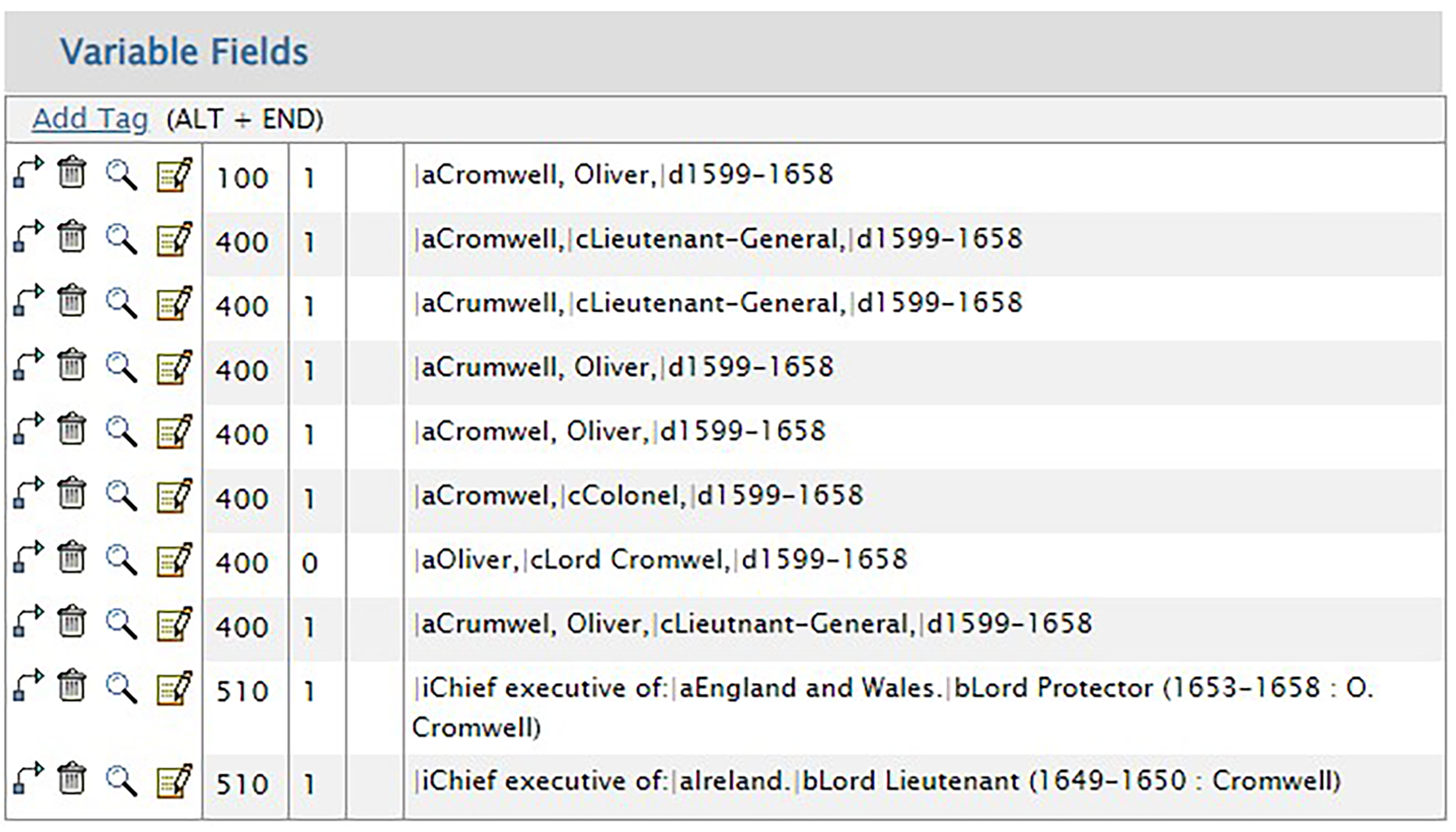
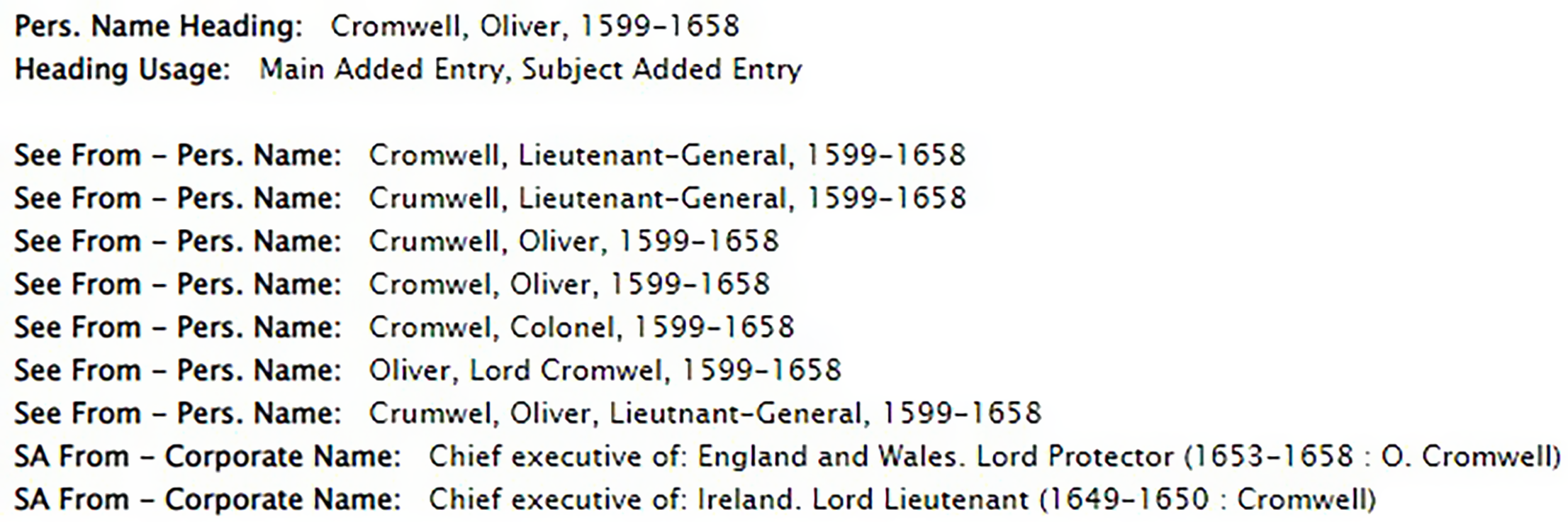
Legacy data is thus upgraded, applying MARC 21 and RDA cataloguing rules one record at a time. Library of Congress Authorities are also sourced and applied, creating See and See also cross-references if needed. By improving the controlled vocabulary index within the ILS, I am refining the browsability of the library catalogue, which then can redirect the reader when non-authorised terminology is used in a search (Pictures 2 & 3).
Editing view of the index entry for Oliver Cromwell in the library management system.

Pictures 2 Long description
The table displays multiple index entries for Oliver Cromwell in a library management system. It includes different variations of his name and titles, such as Lieutenant-General and Colonel, along with his birth and death years, 1599-1658. The table has 10 rows and 4 columns, with column headers indicating tag addition options, entry codes, and the index terms themselves. Each row represents a different entry variation, with some entries marked as active and others as inactive. The table also includes entries for Cromwell's roles as Chief Executive of England and Wales and Lord Lieutenant of Ireland, specifying the years he held these positions.
Standard view of the index entry for Oliver Cromwell in the library management system.

Pictures 3 Long description
The table presents different personal name entries and corporate names associated with Oliver Cromwell. It includes variations of his name such as Cromwell, Oliver, 1599-1658, Lieutenant-General, Colonel, and Lord Cromwell. The corporate names listed are Chief executive of England and Wales, Lord Protector from 1653 to 1658, and Chief executive of Ireland, Lord Lieutenant from 1649 to 1650. The table has multiple rows and columns, detailing the different entries and their usage.
Realistically, one could argue that the time invested in the recataloguing workflow slows down the overall audit project. The opportunity however allows for the proper recording of not only bibliographical data, but also unique copy details such as previous ownership, binding typologies or marginalia present in the volumes. As explained by Beth Morris, ‘each of these distinctive properties can add greater value and scholarly potential to the object and to the collection as a whole’,Footnote 9 and the time invested has already returned results. For example, research into provenance led me into the discovery of previously unrecorded songs in the Library’s Emma Hamilton music books, resulting in interest from the press, academic visits, and a public event. The recording of bookplates found in volumes inspired a blog article,Footnote 10 and has offered a better understanding of former ownership within our collection. Both examples have been a direct consequence of the opportunity to comb through volumes looking for those aspects that could make them distinctive, perhaps even interesting to the external public. The contextual histories contained in museum library books have a potential audience much broader than the institutions’ research community.Footnote 11
When the library catalogue is not the right place
Although EOS.Web is the main repository of bibliographical data, Mimsy XG takes the lead in three areas: movement management/locations, curatorial and conservation input, and object recognition photography.
Location and movement control is one of Spectrum’s primary procedures. Therefore, accessioned collections in the Library (namely rare books, maps and manuscripts) have their permanent and current locations recorded on Mimsy XG only. As this and EOS.Web do not communicate (so location updates would not happen automatically) records for accessioned collections on the library catalogue have a location code of ‘See Mimsy’. Consequently, the Librarian relies on both systems when retrieving accessioned items (although permanent location can be recorded on the ILS under a non-displaying Staff Note field).
Research work on collections items is also only stored on Mimsy XG, as this would not have a natural place in a bibliographical record. Mimsy XG allows for several levels of item description: physical; content description or interpretation; online caption; object history; historical context and association. Due to the time pressures of the project, most items are only given a physical description. This text will feature on the object’s Collections Online page (Mimsy XG’s public interface).Footnote 12 When available, further information may be displayed too, often research undertaken for items displayed in permanent galleries or temporary exhibitions. Conservation reports on library items are equally only kept on Mimsy XG.
Regarding digitisation, audited museum collections are normally given recognition photography during CIUP. Images are often useful for internal projects but can have an external audience if uploaded to Collections Online. With the library volumes however, it was decided against this practice: binding is fairly frequently quite standard, and the fast-paced auditing would not allow for the photography of title pages. In the end, photography has only been organised for those items with ornamented bindings or unique features such as bookplates or interesting marginalia.
Dual recording of collections: the opportunities and advantages
The audit has brought an opportunity to solve documentation issues that seemed too complex to tackle during the decade-long coexistence of the two management systems. The work towards its methodology helped unpick problems such as the need for:
-
different legal statuses for non-core items recorded on Mimsy XG, from when the library lacked an ILS and new acquisitions were recorded there;
-
a policy on how to treat non-core items that fall under the special collections designation (i.e. published before 1850) that may require secure storage as per practice with core items;
-
barcodes on volumes, to facilitate and record movement. Barcoding has simplified lending to patrons and will be key when moving the library collections across sites. An added complexity has been how to barcode items with multiple part records on Mimsy XG, such as extra-illustrated volumes where plates were given individual entries to aid discovery;
-
a plan to tackle duplication of bibliographical records as part of the recataloguing of the collection, merging data when records were created for copies rather than works;
-
the disposal of superfluous volumes, which is managed as part of the rationalisation of the collection and follows the Library’s collecting policy.
The exercise is also uncovering issues to be resolved alongside other collection store audits, or that may require further methodology work before a solution can be in place:
-
the presence of comparable items in other museum stores, such as maps and plans in the Prints, Paintings and Drawings collection, or almanacs and pocket books in the Printed Ephemera collection. With the latter, the main concern is the collection not being represented in full in the library catalogue;
-
the presence of accessioned items within the general collection, exposed to the vulnerabilities of being on the open shelves;
-
the existence of uncatalogued accessioned collections that, due to their volume, may require a different auditing approach (for instance, ‘box-level’ cataloguing on Mimsy XG only, as per practice in other stores).
Probably the main advantage of having library items in the two abovementioned databases is the incidental doubling of the library collection’s exposure. Our holdings have essentially two very different ‘points of entry’: a researcher (being museum staff or external academia) may first approach the museum’s library collection locating and browsing the OPAC; the general public may discover that books can also be museum items by serendipitously finding them while navigating Collections Online.
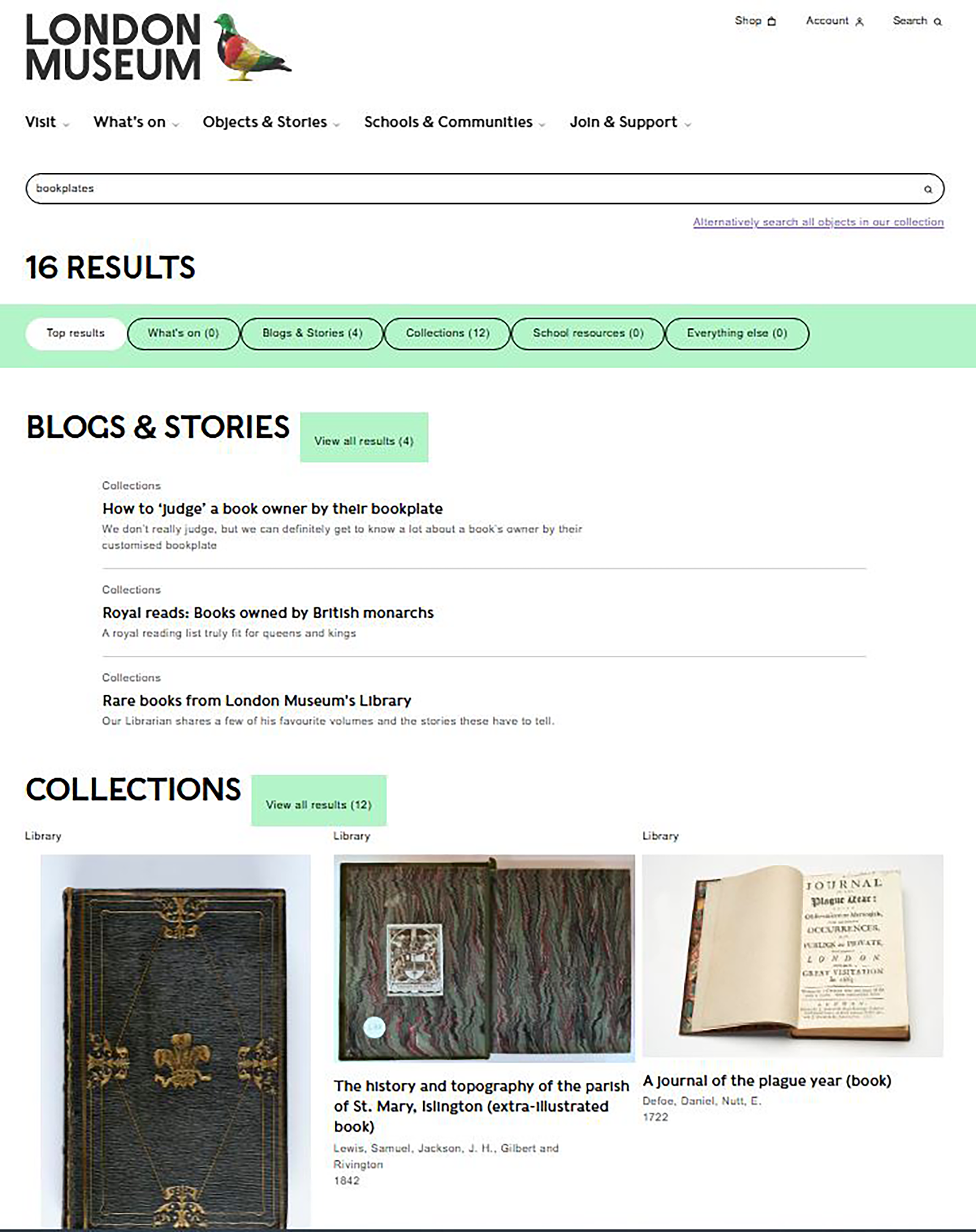
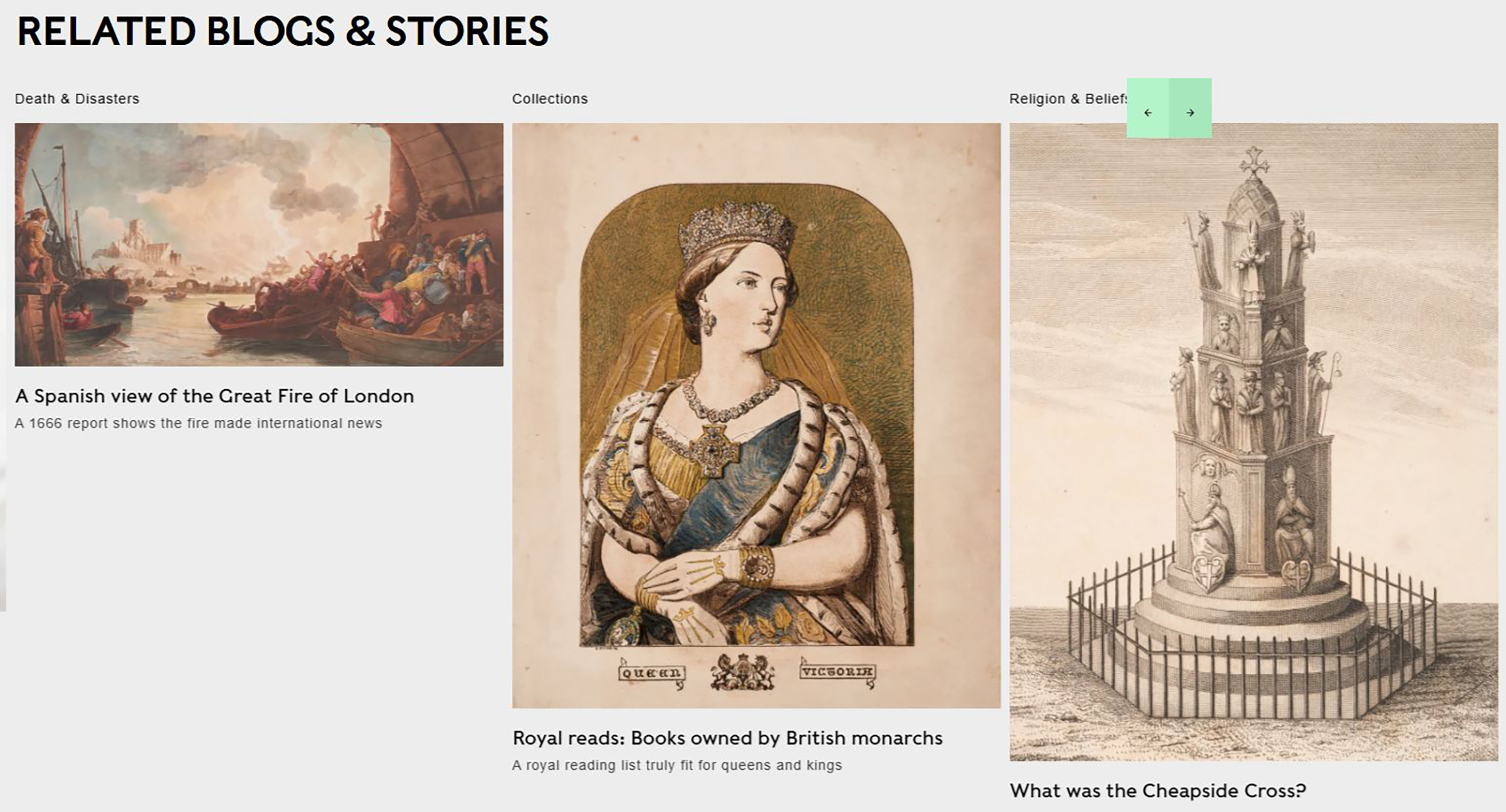
Whilst cross-searches across databases are not (yet?) a possibly, signposting and linking is. For instance, searches on Collections Online allow the user to filter by category (‘Library’). And entries for objects always include links to other related items or further content on the museum’s website, such as Blogs and Stories. These are short pieces aimed at the general reader and may themselves be about or feature library items. When present, mentions of library books are hyperlinked to the OPAC (Pictures 4 & 5).
Example of a general search for the term ‘bookplates’ in the museum’s website; see suggestions for library collection items and blog posts.

Picture 4 Long description
Screenshot of a museum website search results page for bookplates. The page displays 16 results, divided into sections for blogs and stories, and collections. The blogs and stories section includes articles such as 'How to judge a book owner by their bookplate,' 'Royal reads: Books owned by British monarchs,' and 'Rare books from London Museum's Library.' The collections section shows images of books with titles like 'The history and topography of the parish of St. Mary, Islington (extra-illustrated book)' and 'A Journal of the plague year (book).' The search bar is visible at the top, and navigation options are present at the top of the page.
As a more recent development towards discovery, in July 2025 the museum’s website launched Clio 1.0,Footnote 13 a ‘conversational search agent’ powered by artificial intelligence. Clio only uses data from within the museum’s website to answer questions, and this evidently includes Collections Online. In a question such as ‘do you have original accounts of the Great Fire?’ Clio shares information about books and letters in the Library, recommends reading a blog post about a pamphlet, and explains how to contact the museum for further information. It is worth underlining that the Library collection would be instantly excluded from all this extremely valuable exposure if its special collections were not on the museum’s collections management system.
Last but not least, while improving the Library presence on our local databases, the audit and recataloguing workflow also includes the recording of volumes on the English Short Title Catalogue (ESTC), and the quarterly upload of upgraded records on the National Bibliographic Knowledgebase’s Library Hub Discover.
Progress of the audit so far
The audit of the general reference collection (on the open shelves) started in April 2021. I dedicate an average of four days a week to the project, which progresses alongside the day-to-day running of the library service. My work is supported by a team of volunteers that very generously assist with tasks such as barcoding, labelling or data processing. As of January 2026, over 15,000 volumes have been fully audited and recatalogued.
The audit of the special collections started in September 2023, with a first stage dedicated to the over 1,000 maps and architectural plans stored in the Library. This part of the project was led by the CIUP team: as the historical maps and plans had never been added to EOS.Web, it was decided that Mimsy XG would be the best repository for that collection.Footnote 14 The audit exercise also improved the storing of the collection, for example, by moving items from map chests to new vertical storage units, reducing therefore both the number of locations to eventually pack and move, and the floor space they occupy. The digitisation of the cartographic collections is still ongoing; this is organised by CIUP project assistants but is delivered by the museum’s Photography Studio.
Related blogs and stories suggested when looking at Great Fire of London primary sources.

Picture 5 Long description
The first image is a painting depicting the Great Fire of London from a Spanish perspective. The second image is a portrait of Queen Victoria, showcasing her regal attire and jewelry. The third image is an illustration of the Cheapside Cross, a historical monument. These images are part of a collection of related blogs and stories.
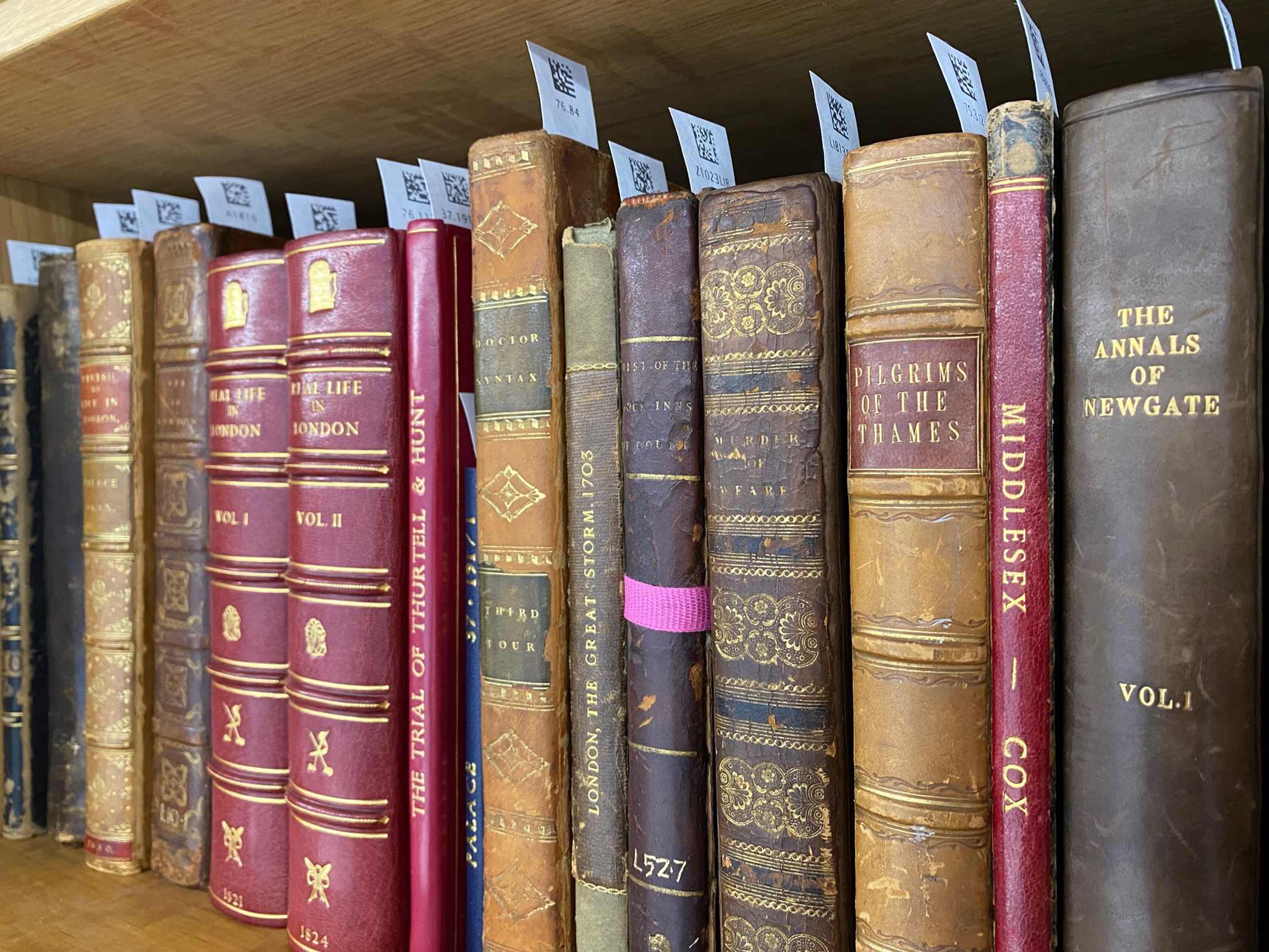
Audited rare books in the library collection.

Picture 6 Long description
The image features a collection of rare books neatly arranged on a wooden library shelf. Each book has a distinct title and binding, with some spines showing intricate designs and others appearing more worn. The titles include 'The Trial of Thurtell and Hunt,' 'The Life and Times of London,' 'Pilgrims of the Thames,' and 'The Annals of Newgate.' Each book has a label on top, likely for cataloging purposes. The books vary in color, with some having dark leather covers and others featuring lighter, more ornate designs. The overall scene suggests a well-maintained and historically significant library collection.
With the maps and plans completed in September 2024, the CIUP project assistants and myself began the audit of the rare books and historical manuscripts. This took place in both systems, an average of two days a week depending on the project assistants’ availability. By its completion in early September 2025, we had audited 2,500 rare books and 100 manuscripts (Picture 6).
Work will now continue with what remains of the general collection, circa 5,000 volumes.
CONCLUSION
Although the complete audit and recataloguing of a library may sound like a dauting project, it can be a very transformative exercise, an opportunity to draw a line in the sand and establish, revisit and update local collections management policies and practices. For museum libraries, this ought to be a chance to improve how our collections are perceived, especially by the institution we are part of. Having our most special items in the museum’s collections management system will boost discoverability and help confirm something us librarians already knew: that our sometimes silenced, undervalued collections contain treasures worth shouting about.