NOMENCLATURE
- E
-
Young’s modulus
- M n
-
regularization mass matrix
- K n
-
stiffness matrix
- C n
-
Rayleigh damping matrix
- I n
-
unit matrix
- q n
-
time-domain response
- f a
-
unit force
- V(t)
-
voltage
- k e
-
quantization factor
- k ec
-
quantization factor
- k u
-
perameter factor
- u(xʹ k )
-
membership value
- x ʹ k
-
fuzzy data
- xʹ
-
output signal
- x
-
state vector
- f
-
force vector
- A
-
system matrix
- B
-
input matrix
- Fe
-
exiataion force
- Fa
-
control force
- Ma
-
unit bending moment
- fn (Hz)
-
natural frequency
Greek Symbol
- αT
-
coefficient of thermal expansion
- α
-
perameter
- β
-
perameter
- ζ
-
damping ratio
- Ω n (rad)
-
natural frequency
- ρ
-
density
- ν
-
Poisson’s ratio
1.0 INTRODUCTION
In general, a microsatellite is composed of a rigid body and several flexible appendages, such as solar panel, antenna and so on, and these appendages are flexible with the characteristics of light weight, great flexibility and weak damping, which induce low frequency vibration. When the external excitation affects the low-frequency vibration of flexible structure, the dynamic response becomes more complex considering the typical characteristics. For example, if the microsatellite is subjected to the transient excitation and steady-state excitation, the dynamic response will produce large amplitude and slow attenuation process. Especially, once the disturbance frequency is close to the fundamental frequency of a flexible structure, the resonance phenomenon occurs immediately. This phenomenon must give rise to seriously dynamic response impacting on the performances of microsatellite such as stability, reliability, accuracy and so on. Because most of the microsatellites are used for the data transmission of space and ground, a small problem causes a serious accident accordingly. What is more, the microsatellite may be scrapped under certain circumstances. As viewed from these problems, in order to suppress the vibration of flexible structures, smart material is applied to design smart structure to establish the active vibration control (AVC) system, which is closed-loop control system(Reference An, Xu, Luo and Wu1,Reference Ma, Gao, Xu and Feng2) . It is generally true that the key technologies are control algorithms, sensors and actuators.
In recent years, different control algorithms have been discussed. For example, Li(Reference Li and Huang3) designed a piezoelectric adaptive truss using the linear quadratic Gaussian control. Luo(Reference Luo, Xu, Yan and Zhang4) used PD control for vibration suppression of a hoop truss structure based on a novel piezoelectric bending actuator. Mystkowski(Reference Mystkowski and Koszewnik5) adopted robust control for a three-dimensional flexible bar using PZT actuators. Zhao(Reference Zhao and Hu6) applied a new numerical method to investigate the vibration control of an axially translating robot arm using displacement and velocity control law. Kim(Reference Kim7) presented the vibration control of a trailed two-wheeled implement using sliding mode control. Moreover, based on global analytical modes, Liu(Reference Liu, Cao and Wei8) developed a rigid-flexible coupling dynamic model for spacecraft with solar panel. This model enables the convenient and precise calculation of natural characteristics and includes an attitude control law for suppressing vibration simultaneously. Besides, there are other control algorithms for establishing the vibration control systems(Reference Motta and Quaranta9,Reference Brillante, Morandini and Mantegazza10) . Among these control algorithms, PD control is a kind of linear feedback control algorithm, and it is easy to design and operate. However, fuzzy control is a kind of logic control algorithm, and it is suitable for flexible objects like solar panel.
Because the sensors and actuators are designed by various piezoelectric materials, they are widely applied. But the stiffness of ordinary piezoelectric material is relatively large. For example, some actuators fabricated from PZT have high sensitivity, but they have great stiffness and brittleness. Therefore, considering that the solar panel in the satellite is easily vibrated to give rise to large deformation, scholars’ studies may be more reasonable if the structure applies flexible sensor and actuator. There are highly sensitive and flexible strain gauges, but complicated bridges need to be measured. In addition, strain gauges are also susceptible to temperature. Compared with traditional materials, macro fibre composite (MFC) is a developed smart material, and more flexible. The MFC has been widely applied in various situations(Reference Ro, Chien, Wei and Sun11,Reference Steiger and Mokry12,Reference Zhang, Zhang, Xu and Luo13) . This new material is originally developed as a means of overcoming many of the practical difficulties associated with using monolithic piezoelectric actuators in structural control applications(Reference Bent14). Sohn(Reference Sohn, Jeon and Choi15) also observed that this material has excellent sensing performance in measuring dynamic response and monitoring structural vibration. In a word, this new piezoelectric material is suitable for designing sensor and actuator. For example, Steiger(Reference Steiger and Mokry12) proposed MFC as actuator by means of negative capacitance shunted circuit. Zhang(Reference Zhang, Zhang, Xu and Luo13) used MFC as actuator for suppressing plate-like solar panels. If the sensors and actuators are all flexible, the AVC will be widely used in aerospace field.
This paper proposes a vibration suppression method of a microsatellite with two solar panels based on smart structure by using of MFC sensor and actuator. The remaining parts of the paper are organised as follows. In Section 2, the mode analysis of a microsatellite is investigated to obtain the vibration characteristics, and the state space equation is established with consideration of fuzzy algorithm. In Section 3, a simulation program is presented to refer to control principle, and the dynamic responses to three excitations are significantly decreased after applying the fuzzy control.
2.0 MODE AND THEORETICAL ANALYSIS
2.1 Mode analysis
Here is a microsatellite that consists of a rigid body, two solar panels, an antenna and other appendages, as shown in Fig. 1. Because vibration characteristics are the basis of the AVC, the frequencies, modes and other characteristics of microsatellite need to be calculated. According to the mechanics theory, a satellite system is modeling as a rigid-flexible coupling multi-body system. When the main flexible body is solar panel, only the characteristics of solar panel is analysed in the mode analysis. MSC Patran is used to establish a three-dimensional finite element model on account of the parameters in Table 1. This model consists of two solar panels and several flexible beams. The two solar panels with MFC patches constitute two smart structures, where the sensors and actuators are flexible.
The satellite model.

The model contains 354 nodes, 20 CBAR elements, 140 CQUAD4 elements and 6 MFC elements. Then MSC Nastran is used to solve the natural frequencies and modes using Lanczos method. Generally, a flexible structure has complex vibration modes. With consideration of low-frequency vibration, there are the first four order modes selected as shown in Fig. 2.
It is found that the first and second order modes are the deformation of solar panel, similar to a bending beam. What is more, the first order natural frequency is 3.452Hz belonging to low frequency, and these patches have almost no effect on the frequency as shown in Table 2.
The satellite parameters

The microsatellite frequencies

The first four order modes of satellite.

2.2 The vibration control theoretical analysis
It is usually that the AVC is suitable to suppress low-frequency vibration. Because the vibration of the solar panel is just low-frequency vibration, the AVC is used to suppress the vibration of the solar panel. This research object is a multi-degree of freedom structure, and the vibration equation of closed-loop control system is
 \begin{align}{{\rm M}_n} {\ddot q_n} + {C_n} {\dot q_n} + {K_n} {q_n} = {\phi _n} {F_e} + {\phi _n} {F_a},\end{align}
where M n , K n and are the regularization mass, stiffness matrices respectively,
 \begin{align}{M_n} = {I_n},{K_n}= 2\pi \cdot diag\left[ {{\omega _n}} \right],\end{align}
where
 ${\omega _n}=2\pi {f_n}$
,
C
n
is reflected as the Rayleigh damping matrix,
 \begin{align}{C_n} = \alpha {M_n} + \beta {K_n},\end{align}
where the two perameters α , β are constructed by Equation (3) containing natural frequency ɷ n and damping ratio ζ,
 \begin{align}a = \left[ {\begin{array}{cccc}{\frac{1}{{{\omega _1}}}}&{{\omega _1};}&{\frac{1}{{{\omega _2}}}}&{{\omega _2}}\end{array}} \right];b=2\left[ {\begin{array}{c}\zeta \\ \zeta \end{array}} \right];\alpha = {a^{ - 1}}b\left[ 1 \right];\beta = {a^{ - 1}}b\left[ 2 \right]\end{align}
These characteristic parameters have been calculated by the finite element analysis above. Besides, q
n
is time-domain response representing output,
 ${\phi _n}$
is spatial displacement function, F
e
is disturbance excitation, F
a
is control force generated by MFC actuator. In the case of negative feedback signal adopting fuzzy algorithm, the control force and control voltage is,
 \begin{align}{F_a} = {f_a}V\left( t \right),V\left( t \right) = {F_u}\left[ { - {k_e}q, - {k_{ec}} \dot q} \right]{k_u},\end{align}
where f a is unit force, V(t) is control voltage, k e, k ec and k u are the parameters, respectively.
Figure 3 shows the fuzzy controller where the input signal is divided into two signals x and dx/dt, and the two signals are multiplied by the quantisation factors k e and k ec to quantise the signals. Then the signals are taken for fuzzy processing to output definite fuzzy data.
Fuzzy controller.

The fuzzy processing contains three steps such as fuzzification (D/F), fuzzy rule base (FRB) and inverse operation of fuzzification (F/D). At the beginning of fuzzy processing,
 $x\begin{array}{c}{{k_e}}\end{array}$
and
 $\left( {dx/dt} \right){k_{ec}}$
are converted into fuzzy field through the fuzzification, where the membership function is ec[-6 6] and e[-6 6]. Secondly, the fuzzy rule base adopts Mamdani-type logic ruler to deal with the two-dimensional data. Thirdly, the data after operating in the previous step are determined through the F/D process, where the membership function is u[-6 6]. Finally, if the F/D process adopts gravity center method, the output signal
 $x'$
multiplied by ku will be control signal.
 \begin{align} x^{\prime} = {{\sum\limits_{k=1}^n {u({{x_k^{\prime}}}) \cdot {{x_k^{\prime}}}} } \Bigg/ {\sum\limits_{k=1}^n {u({{x_k^{\prime}}})} }},\end{align}
where
 $u({x'_k})$
is membership value,
 ${x'_k}$
is fuzzy data.
Control principle.

Substitute Equations (2)-(5) into Equation (1), and reduce the degrees of freedom by means of mode truncation method; the vibration equation can be reduced to a state space equation Equation (7) describing the transfer of input and output signals. Then the solution is just the response.
 \begin{align} \dot x = A x + B f,\end{align}
where x is state vector, A is system matrix, B is input matrix, and f is force vector, respectively.
 \begin{align}x &= \left\{ {\begin{array}{c}{\dot q}\\q\end{array}} \right\};A = - B\left[ {\begin{array}{c@{\quad}c}{ - {M_n}}&0\\0&{{K_n}}\end{array}} \right]\!;\nonumber\\[3pt] B &= {\left[ {\begin{array}{c@{\quad}c}0&{{M_n}}\\{{M_n}}&{{C_n}}\end{array}} \right]^{ - 1}};\ f = \left[ {\begin{array}{c@{\quad}c}0&{{\phi _n} {F_e} + {\phi _n}{f_a}{F_u}\left[ { - {k_e}{q_n}, - {k_{ec}} {{\dot q}_n}} \right]{k_u}}\end{array}} \right]\end{align}
3.0 THE ACTIVE VIBRATION CONTROL SIMULATION
3.1 The control method
The control system consists of sensor, charge amplifier, control algorithm, actuator, high-voltage power amplifier and other devices in the experiment are shown in Fig. 4. In this section, Matlab/Simulink is applied to set up the closed-loop control simulation for the first order mode of solar panel as shown in Fig. 5. Although the MFC sensor outputs strain in practice, the simulation adopts displacement sensor (Out1) instead of strain sensor because of the linear correlation between strain and displacement. Furthermore, the excitation signal F e is pulse, harmonic or random signals, respectively. The solution to the state space equation is just as response and feedback signal that is calculated by fuzzy algorithm to produce control signal. Meanwhile, the MFC actuators convert the control signal into force F a (M a ) in order to suppress the vibration, where the unit-bending moment M a is set to 2 Nm/100V.
Simulation program.

3.2 The simulation result
Figure 6 shows the response of node 250 on the finite element model after pulse excitation. As the amplitude droppers to 5% of the peak, the attenuation time lasts 19s. When the fuzzy control adds in the response, the attenuation time is 1.3s. As a result, the attenuation ratio is 93.15%. It is thus clear that the attenuation time is greatly shortened.
Fuzzy control for pulse excitation.

Harmonic excitation and random excitation.

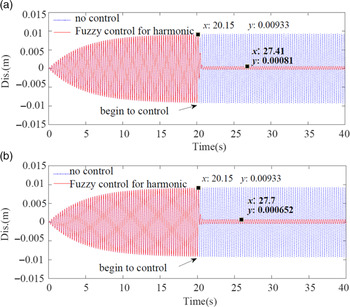
(a) Fuzzy control for harmonic excitation. (b) Fuzzy control for harmonic excitation.

Fuzzy control for random excitation.

Figure 7 shows the sinusoidal excitation and random excitation, and the mean and variance of random excitation is 0 and 1, respectively. Figures 8 and 9 show the response of node 250 after fuzzy control. At the beginning, there is only the excitation, but the control force begins to affect the solar panel after 20s.
As is shown in the Figs. 8 and 9, it can be seen that the curves of steady-state vibration and random vibration are obviously decreased. For example, Fig. 8(a) shows the response amplitudes are 0.00933 and 0.00081m before fuzzy control and after fuzzy control, respectively, and the corresponding amplitude suppression rate is 91.32%. When the response amplitude after fuzzy control is 0.000652m shown in Fig. 8(b), the amplitude suppression rate is 93.01%. As for the random vibration, the power spectral density reduces to 0.7% shown in Fig. 10. Fig. 11 shows the control voltages when the excitations are harmonic and random excitations respectively. Table 3 shows the parameters of fuzzy controller and control results.
PSD before control and after control.

Control voltage.

The suppression result

4.0 CONCLUSION
This paper provides a vibration suppression method of a microsatellite consisting of two solar panels and several MFC patches. According to the present calculation and simulation, the following main conclusions are obtained. In the mode analysis, the MFC patches have little effect on the natural frequencies, and the first four order modes show the deformation of solar panel. What is more, the first frequency is low, and the first order mode is bending mode. In the simulation, the external excitation can result in significant response. However, it is obvious that the response can be suppressed dramatically by the actuators. The figures and tables are presented to illustrate the control results after adopting fuzzy algorithm. It is found that the amplitude inhibition percentages are all more than 90%. Moreover, the power spectral density falls by two orders of magnitude. Consequently, based on smart structure embodying flexible sensor, actuator and fuzzy algorithm, the AVC is effective for solar panel vibration suppression.
ACKNOWLEDGEMENTS
This work is supported by the State Key Laboratory for Strength and Vibration of Mechanical Structures (Grant no. SV2020-KF-01), and the Basic Research Plan of Natural Science in Shannxi Province (No.2018JM5099).