Introduction
A crucial abiotic factor that influences juvenile development in ectotherms, including bees, is temperature. In bees, as in other ectotherms, higher temperatures within a species’ tolerance range generally lead to both higher metabolic rates and faster development, while lower temperatures lead to slower metabolic rates and development (Whitfield and Richards Reference Whitfield and Richards1992). In bees, maternal decisions about where to build their nests can have profound consequences for offspring fitness, because nesting in warm or cool micro-environments strongly influences brood survival, growth, and development (Potts and Willmer Reference Potts and Willmer1997). Studies of nest-site selection suggest that mother bees assess the thermal micro-environment of potential nest sites. In soil-nesting bees that live in relatively cool habitats, bees more frequently nest in relatively warm sites (Potts and Willmer Reference Potts and Willmer1997). In warmer nests, mothers can start raising brood earlier in the season, and brood can develop faster; this not only allows mothers more time to raise more offspring but also ensures that brood will eclose before the end of the summer, leaving time for crucial activities such as feeding and mating prior to overwintering (Packer Reference Packer1990; Weissel et al. Reference Weissel, Mitesser, Liebig, Poethke and Strohm2006). In hotter climates, bees may display a preference for cooler nests. For example, the leafcutter bee, Megachile apicalis Spinola (Hymenoptera: Megachilidae), prefers to nest in shade, although it also nests in sunny, exposed nests in which larvae experience significantly higher and occasionally lethal temperatures during the day; larvae in sunny nests develop faster but also exhibit higher stress responses and higher stress-associated mortality (Hranitz et al. Reference Hranitz, Barthell, Thorp, Overall and Griffith2009). On the other hand, tolerance for relatively high temperatures during development seems to be key to the invasion success of M. apicalis in central California, where most native bees have lower temperature tolerances (Barthell et al. Reference Barthell, Frankie and Thorp1998, Reference Barthell, Hranitz, Thorp and Shue2002).
The small carpenter bees in the genus Ceratina Latreille (Hymenoptera: Apidae) excavate their nests in the twigs of small trees and herbaceous plants in a variety of habitats (Vickruck et al. Reference Vickruck, Rehan, Sheffield and Richards2011). In southern Ontario, Canada, Ceratina females naturally choose nest sites in either sunny or shady sites and in a variety of plant substrates, but experimental evidence suggests that given a choice, they prefer to nest in the stems of brambles (Rubus sp.) (Rosaceae) in sun (Vickruck and Richards Reference Vickruck and Richards2012). This is surprising, because brambles are more often found in shady or semi-shady sites along woodland edges, so most females must choose to nest either in sunny sites with a less-preferred substrate or in shady sites with a preferred substrate.
Despite Ceratina’s apparently strong maternal preference for nesting in sunny areas, there are no obvious fitness consequences for choosing to nest in sun or shade: in a field experiment in southern Ontario, sunny and shady nests contained similar numbers of brood, with similar survival rates, parasitism rates, and body sizes (Vickruck and Richards Reference Vickruck and Richards2012). However, there may be more subtle consequences of nesting in shade versus sun. The metabolic rates of developing larvae and pupae inside nests are presumably influenced mainly by ambient temperatures, so juveniles in nests in full sun would be expected to have faster metabolism and faster development. Nevertheless, when larvae and pupae from shady and sunny nests were brought into the common environment of the lab and raised at room temperature, those from sunny nests developed more slowly than those from shady nests (Vickruck and Richards Reference Vickruck and Richards2012). A possible hypothesis to explain the differences in developmental rates is that juvenile bees somehow adjust their metabolic rates according to the thermal environment in which they develop and that this adjustment persists long enough to produce differences in developmental time from the larval stages to adult eclosion. Because insects generally exhibit a correlation between metabolic and developmental rates (Penick et al. Reference Penick, Diamond, Sanders and Dunn2017), the slower development of juveniles from sunny nests suggests that their metabolic rates were adjusted downwards or that the metabolic rates of juveniles from shady nests were adjusted upwards (or both).
We tested the hypothesis that the thermal environment experienced by C. calcarata larvae and pupae results in persistent adjustments to metabolic rates, using both field and lab experiments.
In the field experiment, bee nests were placed in full sun, part shade, and full shade soon after they were first constructed by adult females. The field treatments were chosen to represent natural variation in the microhabitats of Ceratina nests, including open meadow areas that would be in sun throughout the day, wooded areas with dappled sunshine throughout the day, and deeply shaded areas that receive little or no direct sunlight. We then brought nests into the lab in order to measure the metabolic rates of larvae, pupae, and newly eclosed adults at three temperatures (10 °C, 25 °C, and 40 °C) representing realistic night and daytime conditions experienced by nesting and developing bees at our field sites.
Methods
Field work
Field work followed methods described previously (Vickruck and Richards Reference Vickruck and Richards2012). In spring 2016, we collected raspberry (Rubus sp.) (Rosaceae) canes about 6–10 mm in diameter and 40–50 cm long. Canes were cut either from recently dead or living plants, ensuring that the pith of each twig was not desiccated. Canes were attached to bamboo stakes, placed in a sunny location to attract nest foundresses, and then monitored daily. As soon as a nest entrance appeared, the nest was randomly assigned to the shade, semi-shade, or sunny treatment. Nests were moved to their treatment sites in the evening or early morning with nest entrances covered to make sure that mothers remained inside.
Field treatments were replicated at two sites representing separate C. calcarata populations. On the campus of Brock University, in St. Catharines, Ontario, Canada, nests were placed in sites in full sun in the middle of a meadow on the east side of the campus, in semi-shaded forest edge on the north side of this meadow, or in a fully shaded area on the north edge of the campus, close to the edge of the escarpment. Nests in the sunny site were in direct sunlight all day, those in the semi-shady site were in dappled sunlight throughout the day, while those in the shady sites received no direct sunlight at all. On the campus of the University of Toronto at Scarborough, Scarborough, Ontario, Canada, nests were set up near the campus border with Colonel Danforth Park. These nests were placed either in a clearing next to the Science Research Building, receiving direct sunlight for several hours each day, or in shaded, forested area approximately 30 m further from the building.
After being moved to the experimental treatment sites, nests were inspected several times per week to monitor nest fate, including damage, predation, or parasitism, until the time of nest collection. Nests were collected when the oldest offspring were estimated to be in the late pupal stages (Rehan and Richards Reference Rehan and Richards2010), but because the oldest brood in a nest can be several weeks older than the youngest, nests contained a wide range of juvenile ages. In the lab, each nest was carefully opened by slicing the twig longitudinally to reveal the brood inside. Juveniles and their food were transferred to 0.25-mL microcentrifuge tubes to continue larval development at room temperature in the lab.
Because we could not determine the developmental stages of juvenile bees before opening their nests, we could not control the amount of time that juvenile bees were exposed to the three different field treatments. Based on developmental rates in the lab (Rehan and Richards Reference Rehan and Richards2010), we estimated that brood brought into the lab as pupae would have been exposed to field treatments for about three weeks (up to 5 days as eggs and 19 days as larvae), whereas larvae would have been exposed for as little as a week.
To quantify differences in temperature among sun, semi-shade, and shade habitats, in 2016, we used dataloggers suspended from woody vegetation in sites at Brock University. However, subsequent fieldwork suggested that the dataloggers might be over-heating, especially in the sunny sites, and so might be exaggerating temperature differences between microhabitats (J. de Haan, G. Tattersall, and M.H. Richards, unpublished data). In 2018, we measured air and nest-twig temperatures (± 0.1 °C precision) at noon, using a thermocouple meter (Omega HH209 with Type T probes; Omega, St.-Eustache, Québec, Canada) with one probe free to measure air temperature and the second probe installed inside a “dummy” nest (a hollowed-out raspberry cane). Temperatures were gathered by allowing the two probes to equilibrate in the environment for a minimum of five minutes. The data from 2018 are presented here to demonstrate temperature differentials between nest-twig and ambient conditions but do not represent the environmental conditions experienced by bees in our field experiments in 2016.
Metabolic rate measurements
We used stop-flow, small-chamber respirometry to evaluate Ceratina metabolic rate (Lighton and Halsey Reference Lighton and Halsey2011). Pupae and adults were weighed on a Mettler Toledo MS104S balance with a “readability” precision of 0.1 mg (Mettler Toledo Canada, Mississauga, Ontario, Canada) and then were placed in small (~ 10-mL) quartz-glass, airtight respirometry chambers. Larvae were not weighed, as moving them frequently resulted in fatal injuries. To prevent their escape, newly eclosed adults were held inside 0.6-mL microcentrifuge tubes perforated at the top and bottom to allow gas exchange, were weighed (after taring for tube weight), and these were placed in the quartz-glass respirometry chambers. Four to six individuals were tested at a time but in separate chambers. The chambers were held inside either a reach-in (KB055-SS; Darwin Chambers, St. Louis, Missouri, United States of America) or walk-in environmental chamber (Custom installation, LabWorks, Vaughan, Ontario, Canada) maintained at the specified testing temperature. Metabolic rates were measured at 10 °C, 25 °C, or 40 °C; the stated precision of the chamber was ± 0.2 °C for control of temperature at sensor and ± 0.2 °C for temperature-sensor accuracy.
Air was scrubbed of water vapour and CO2 by passing it through a column containing Drierite (VWR, Mississauga, Ontario, Canada) or magnesium perchlorate (Sigma Aldrich, Oakville, Ontario, Canada) and Ascarite II (Fisher Scientific Co., Markham, Ontario, Canada) and was pumped through respirometry chambers at a (dry, CO2-free) flow rate of 150 mL/min. Air flow through each chamber was controlled by a FlowBar-8 mass flow meter system in combination with a RM-8 flow multiplexer (Sable Systems International, Las Vegas, Nevada, United States of America). After flushing each chamber flow through, the chamber was stopped, and the insect was allowed to build up respired gases for 38–43 minutes, at which point the chamber was flushed with dry, CO2-free ambient air for seven minutes. This was repeated once more for each chamber, such that the second dwell period followed one hour after the first began. We ran empty chambers as negative controls several times each week. In all cases, the empty chambers consistently had zero CO2, indicating there was negligible leak into the chambers. Carbon dioxide-free air was flowed through the chambers for ~20 minutes before any recording, to minimise the potential for build-up of CO2 prior to recording.
Gases flushed from the chambers flowed to a LiCor 7000 CO2 and water vapour analyser (Sable Systems International). Water vapour in kPa and CO2 fractional concentration data output from the LiCor 7000 were recorded in Expedata 1.8.4 (Sable Systems International) at 1 Hz. Because the flow rate entering the chamber was that for dry, CO2-free air, we could employ equation (10.4) from Lighton (Reference Lighton2008) to calculate CO2 production rate (VCO2 in mL/min):
 $${\dot V_{C{O_2}}} = FR\left( {{F_e}C{O_2} - {F_i}C{O_2}} \right)$$
where FR = flow rate in mL/min, FeCO2 is the fractional concentration of CO2 in the excurrent chamber air and FiCO2 is the fractional concentration of CO2 in the incurrent air, which in this case was equal to zero and was thus dropped from the equation.
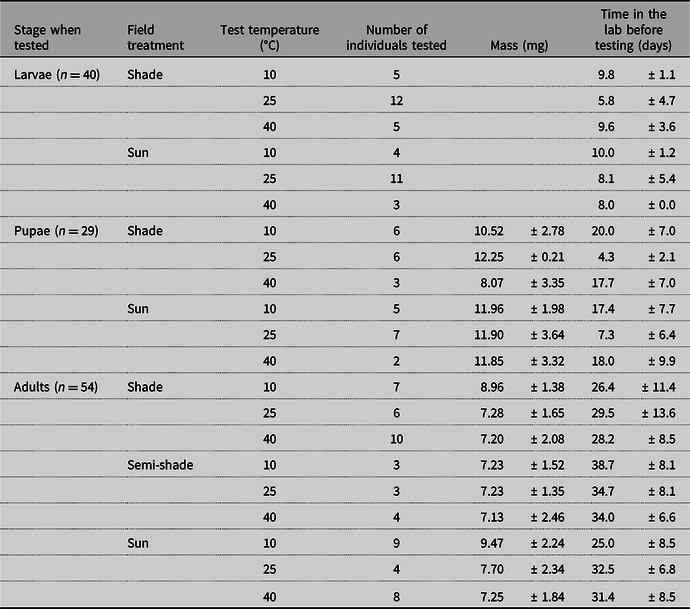
In total, we measured the metabolic rates of 60 bees from shady nests, 10 from semi-shaded nests, and 53 from sunny nests, comprising 40 larvae, 29 pupae, and 54 adults (Table 1). Each individual insect’s metabolic rate was measured at only one stage and one test temperature (10 °C, 25 °C, or 40 °C). A single individual was measured twice, but the second set of measurements was excluded from the analyses, as were the measurements for two individuals that died during testing. Data are available in Supplementary Table S1.
Descriptive information for pupae and adults whose metabolic rates were measured in the lab. Mass and time measurements are given as mean ± 1 standard deviation.

Statistical analyses
We used general linear models to compare internal nest and ambient air temperatures in sun and shade and to compare masses of pupae and adults. We also used general linear models to show variation in metabolic rate (VCO2) of larvae, pupae, and adults, both separately and together, adjusting the predictor variables according to data availability. The linear models used were of the general form VCO2 ~ mass + test temperature + field treatment + site + temperature × treatment. For larvae, we dropped the mass term, because mass was not measured. For larvae and pupae, the treatment term comprised the shade and sun levels only. In initial models, we also included a term for the number of days bees were in the lab between nest collection and metabolic testing, but this term is not independent of developmental stage (bees tested as adults on average were in the lab longer than those tested as pupae, which were in the lab longer than those tested as larvae) or mass, so was dropped from the linear models. We did not weigh larvae, so the mass term was omitted from larvae-based analyses. All linear model analyses were carried out in R, version 3.5.3, running under R-Studio, version 1.1.463 (Boston, Massachussetts, United States of America), using the lm function.
Results
Internal twig temperatures in shade and sun
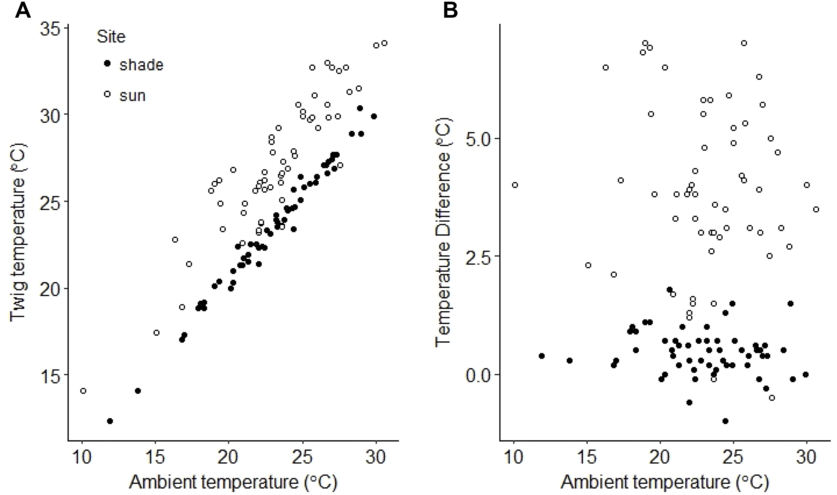
The internal temperatures of twigs in both shade and sun were strongly related to ambient temperatures (Fig. 1). Twigs in sun were about 4 °C warmer at noon than were twigs in shade (linear model: stick temperature ~ ambient temperature × treatment, R 2 adj = 0.909, partial effect of ambient temperature: estimate = 0.9835 ± 0.0460, t = 21.361, df = 1, P < 2e-16; partial effect of treatment: estimate = 4.0575 ± 1.5028, t = 2.700, df = 1, P = 0.0080; partial effect of interaction not significant). The magnitude of the temperature differential was unrelated to ambient temperature (Fig. 1B; linear model: temperature differential ~ ambient temperature × treatment, R 2 adj = 0.6368; partial effect of ambient temperature: estimate = − 0.0165 ± 0.0460, t = − 0.358, df = 1, P = 0.7213; partial effect of treatment: estimate = 4.0575 ± 1.5028, t = 2.700, df = 1, P = 0.0080 (same as above); partial effect of interaction not significant).
Comparison of twig versus ambient temperatures in shade and sun sites at Brock University, St. Catharines, Ontario, Canada, in 2018. A, Internal temperatures of twigs in sun were significantly higher than those of twigs in shade; B, there was no relationship of temperature differential (twig temperature – ambient temperature) to ambient temperature, although the differential was consistently higher for twigs in sun.

Metabolic rates of larvae, pupae, and adults
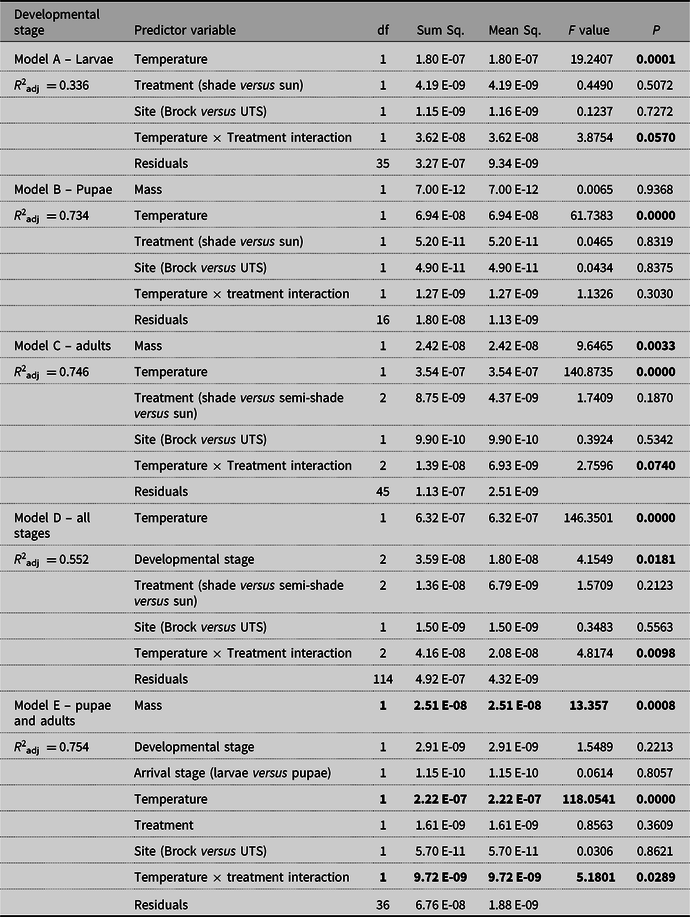
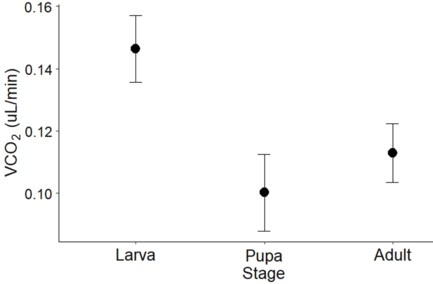
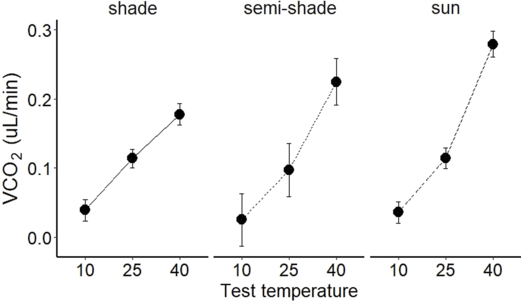
We analysed metabolic rates of bees at each developmental stage separately and together (Table 2). At all developmental stages (larvae, pupae, and adults), metabolic test temperature, but not field treatment or nest site, was significantly associated with the metabolic rate. In general, larvae had the highest metabolic rates and pupae the lowest (Fig. 2; Supplementary Fig. S1). In larvae and adults, the interaction between test temperature and field treatment was significant at P < 0.1, and when all three developmental stages were combined into a more efficient linear model, the interaction effect was highly significant (Table 2, model D). Overall, the significant interaction between testing temperature and treatment is because bees from sunny nests exhibited significantly higher metabolic rates at 40 °C than bees from shady nests, with bees from semi-shaded nests exhibiting intermediate metabolic rates at 40 °C (Fig. 3). Mass was significantly associated with metabolic rate in adults but not in pupae; in general, pupae were larger than adults (Table 1; Supplementary Fig. S2) but had lower metabolic rates (Fig. 2).
General linear models examining sources of variation in metabolic rates (VCO2) of larvae, pupae, and adult Ceratina calcarata among field treatments. Note that for the semi-shade treatment, only adults were tested. Predictor variables include metabolic test temperature, field treatment, site (Brock University (Brock) versus University of Toronto Scarborough (UTS)), the temperature × treatment interaction, and arrival stage (larvae that pupated in the lab versus pupae that had pupated in the field).

Significance for boldface values are P < 0.1.
Partial effect plot showing the influence of developmental stage on metabolic rates (VCO2 in uL/min) of small carpenter bees. The effect sizes are represented as mean ± 1 standard error, based on Table 2, model D. Pupae had the lowest metabolic rates, on average.

Partial effect plot showing the influence of field treatment and test temperature on metabolic rates (VCO2 in uL/min) of small carpenter bees. The effect sizes are represented as mean ± 1 standard error, based on Table 2, model D. Bees from different field treatments had similar metabolic rates, but at high test temperatures (40 °C), bees raised in sun had significantly higher metabolic rates than those raised in shade.

If the thermal environment experienced by developing larvae has long-lasting effects that carry over into the pupal or adult stages, then we would predict similar metabolic rates for bees that pupated in the field or in the lab. When we compared bees that arrived in the lab as larvae after they had pupated in the lab with bees that arrived as pupae, we found no difference according to the timing of pupation (Table 2, model E).
Discussion
We tested the hypothesis that developing carpenter bees (C. calcarata) adjust their metabolic rates in response to developmental temperatures. Specifically, we expected that because bees from nests in full sun develop more slowly in the lab, we would find that they have lower metabolic rates than bees from nests in deep shade (Vickruck et al. Reference Vickruck, Rehan, Sheffield and Richards2011; Vickruck and Richards Reference Vickruck and Richards2012). Instead, we found no overall treatment effect and a significant interaction between field treatment and metabolic test temperature, such that bees from nests in sun had higher metabolic rates at 40 °C than did bees from nests in shade, with bees from nests in semi-shade being intermediate.
Measurements of twig temperatures indicated that, in full sun, Ceratina twig nests heat up to temperatures that are, on average, about 4 °C above ambient air temperature but can be as high as 7 °C above ambient air temperature. In contrast, twigs in shade were on average only slightly warmer than ambient air temperatures and never heated up to more than 1.8 °C above ambient temperatures. During the unusually hot summer of 2016, bees developing in experimental nests in full sun could have experienced air temperatures as high as 34 °C and internal nest temperatures as high as 41 °C. The critical thermal maximum temperature (CTmax) for adult C. calcarata in southern Ontario is about 47 °C (J. deHaan, G. Tattersall, and M. Richards, unpublished data). Although larvae and pupae may have lower CTmax than adults do, this suggests that, even in sun, internal nest temperatures were well within the tolerance ranges of developing Ceratina larvae.
In insects, higher developmental temperatures usually result in both higher metabolic rates and faster development (Penick et al. Reference Penick, Diamond, Sanders and Dunn2017). This study suggests that Ceratina from nests in the sun have higher metabolic rates at higher temperatures, but a previous study suggested that they develop more slowly (Vickruck and Richards Reference Vickruck and Richards2012). A negative correlation between metabolic and developmental rates in Ceratina exposed to high developmental temperatures suggests decoupling of metabolic and developmental rates. The significantly higher metabolic rates of sunny-nest bees in high temperatures may indicate that the bees adapt to the high temperatures they sometimes experience, perhaps by activating biochemical pathways to produce thermal protectants, such as heat-shock proteins (Hofmann and Todgham Reference Hofmann and Todgham2010; Torson et al. Reference Torson, Yocum, Rinehart, Nash, Kvidera and Bowsher2017). Such adaptation might incur a physiological cost if it requires larvae and pupae to divert resources or energy away from development towards production of thermoprotectants, such as heat-shock proteins. Thus, juvenile bees that experience high temperatures might respond with both faster metabolism (at least temporarily) and slower development.
Countergradient variation occurs when compensatory metabolic processes during development generate phenotypes that vary in the opposite direction from those that usually result from a particular abiotic factor (Conover and Schultz Reference Conover and Schultz1995; Conover et al. Reference Conover, Duffy and Hice2009). In the case of small carpenter bees, countergradient variation would be indicated if high developmental temperatures do result in slower development. So far, we have not been able to precisely measure juvenile developmental rates under field conditions, because bee larvae and pupae do not survive outside their brood cells under field conditions (J. de Haan and M.H. Richards, unpublished data). However, countergradient variation is supported by evidence for clinal variation in developmental rate. At room temperature, egg-to-adult developmental time in southern Ontario is about 46 days (Rehan and Richards Reference Rehan and Richards2010), in New Hampshire, it is about 37 days, in Missouri, it is about 50 days, and in Georgia, it is about 57 days (Lawson et al. Reference Lawson, Shell, Lombard and Rehan2018). Thus, populations in warmer climates have slower developmental times. Countergradient variation between temperature and growth rate has also been observed in damselflies, Coenagrion puella (Odonata: Coenagrionidae); individuals adapted to warm ponds in urban areas grow more slowly overall than those adapted to cool ponds in rural areas (Tüzün et al. Reference Tüzün, Op de Beeck, Brans, Janssens and Stoks2017).
In field conditions, countergradient variation between bees raised in sunny and shady micro-environments should result in more similar egg-to-adult developmental durations than predicted based on developmental temperatures. Within populations, countergradient variation might have the effect of regulating eclosion times, such that most bees emerge as adults in late summer. If so, then not only should bees from shady and sunny nests eclose around the same time but emergence times should also be fairly similar across years, despite annual variation in local weather conditions (especially temperature). There may be a selective advantage to regulating developmental rate so that young bees eclose at the right time of year. A peculiarity of small carpenter bees is that young adults must feed themselves (or be fed by their mothers) before hibernation or they will die over the winter (Lewis and Richards Reference Lewis and Richards2017). Young bees that eclose too early, while late-summer temperatures are still warm, may waste energy stores, whereas bees that eclose too late may not find flowers on which to feed.
Conclusion
Over the years, several sets of field experiments at our sites (Vickruck and Richards Reference Vickruck and Richards2012; Lewis and Richards Reference Lewis and Richards2017; this study) have clearly shown that Ceratina mothers generally prefer sunny nesting sites but often choose shady sites. Although variation in nest thermal environments clearly influences the physiology and development of young bees, as demonstrated here, we as yet have no clear evidence that choosing to nest in sun or shade has either positive or negative fitness consequences for bee mothers or their brood. It may be that the major criterion in nest-site selection is simple availability of nesting substrate and that juvenile bees are able to cope with whichever thermal environment in which they find themselves. Such developmental flexibility might help to explain the abundance and large geographic ranges of species like C. calcarata. Developmental flexibility in response to the thermal environment might also help to explain successful host shifts to new plant-nesting substrates like teasel (Daucus carota) (Apiaceae). This biennial, which grows in full sun, has been available to North American Ceratina since being deliberately introduced to North America only several centuries ago but is now a common nesting substrate for C. calcarata and related species (Vickruck and Richards Reference Vickruck and Richards2012).
Acknowledgements
This research was supported by Natural Science and Engineering Research Council (NSERC Canada) Discovery grants to KCW and MHR, as well as NSERC Undergraduate Summer Research Awards to ACG and MS. We thank Dimitri Skandalis for setting the ball rolling, Jess Vickruck for advice with field protocols, and Travis Uhyrnuk for the collecting the 2018 temperature data, and the reviewers whose critiques helped us to substantially improve this manuscript.
Supplementary material
To view supplementary material for this article, please visit https://doi.org/10.4039/tce.2020.50.