Introduction
Older people with dementia are more prone to falls (Shaw, Reference Shaw2002; van Doorn et al., Reference van Doorn2003; Kallin et al., Reference Kallin, Gustafson, Sandman and Karlsson2004a) and they sustain more fractures (Buchner and Larson, Reference Buchner and Larson1987) than older people without cognitive impairment. Post-operative complications and mortality are also higher in this group (Baker et al., Reference Baker, Duckworth and Wilkes1978). As the group of people aged 80 years and above is the fastest growing age group in the world today, the proportion of people with dementia will increase in the future.
Intervention programs for older people living in the community can reduce the fall rate and number of persons falling (Gillespie et al., Reference Gillespie2009). However, most studies either exclude people with cognitive impairment or do not report them separately (Oliver et al., Reference Oliver2007). The few attempts that have been undertaken to prevent falls in people with cognitive impairment or dementia living in nursing homes or attending accident and emergency departments have used multifactorial fall-prevention programs. These have produced divergent and inconclusive results (Jensen et al., Reference Jensen, Nyberg, Gustafson and Lundin-Olsson2003; Shaw et al., Reference Shaw2003; Bouwen et al., Reference Bouwen, de Lepeleire and Buntinx2008; Rapp et al., Reference Rapp, Lamb, Buchele, Lall, Lindemann and Becker2008; Neyens et al., Reference Neyens2009). For example, multifactorial intervention was not effective in preventing falls in people with cognitive impairment (Shaw et al., Reference Shaw2003), while it has a beneficial effect in people with a Mini-mental State Examination (MMSE) score higher than 18 (Jensen et al., Reference Jensen, Nyberg, Gustafson and Lundin-Olsson2003), and was even more effective in people with cognitive impairment (Rapp et al., Reference Rapp, Lamb, Buchele, Lall, Lindemann and Becker2008; Neyens et al., Reference Neyens2009). Furthermore, staff-oriented interventions have equal effects in fall prevention in people with and without cognitive impairment (Bouwen et al., Reference Bouwen, de Lepeleire and Buntinx2008).
Some studies have shown that multifaceted fall prevention on hospital wards might have an effect but only one small study has indicated that such interventions reduce the number of falls and injuries among people with dementia (Oliver et al., Reference Oliver2007; Stenvall et al., Reference Stenvall2007; Coussement et al., Reference Coussement, de Paepe, Schwendimann, Denhaerynck, Dejaeger and Milisen2008). Because there are so few studies which focus on fall prevention for people with dementia, the evidence that such falls can be prevented in this population is limited.
Many factors can, separately or in combination, cause a fall and both predisposing and precipitating factors should be considered. The predisposing factors involve cognitive, medical and physical factors (for example, cognitive impairment, depression, and mobility impairments, such as gait and balance disorders). These factors are present over a long period of time and the fall risk increases with the number of factors involved (Shaw, Reference Shaw2002; Tinetti, Reference Tinetti2003). The precipitating factors are of shorter duration and can be present both within the individual, such as acute disease or symptoms of disease, and in the surroundings, such as hazards in the environment (Kallin et al., Reference Kallin, Lundin-Olsson, Jensen, Nyberg and Gustafson2002; Tinetti, Reference Tinetti2003). Similar terminology has been used regarding delirium (Laurila et al., Reference Laurila, Laakkonen, Tilvis and Pitkala2008). A predisposing factor describes the person's vulnerability and the precipitating factor is the trigger of the syndrome. Predisposing factors alone explain only a limited proportion of the variation in fall events, especially in people with dementia (Shaw, Reference Shaw2002; Eriksson et al., Reference Eriksson, Gustafson and Lundin-Olsson2007). It is thus most important to gain a deeper knowledge concerning the precipitating factors surrounding falls in order to develop fall-prevention strategies in this group of fall-prone people. The purpose of this study was to identify precipitating factors causing falls among people with dementia on a psychogeriatric ward.
Methods
The design was a prospective fall-registration study with analysis of the circumstances surrounding each fall event.
Participants and settings
Falls were registered from 1 September 2001 to 31 August 2003 for all inpatients with any form of dementia diagnosis in a psychogeriatric hospital ward located in northern Sweden. This ward specializes in specific investigation and treatment of the behavioral and psychological symptoms of dementia (BPSD). The study included patients already admitted to the ward prior to the start of the study, those who were admitted during the two-year period and those readmitted for a second time during the study period.
Baseline patient data were collected from medical records and covered physical, behavioural and cognitive areas. Dementia diagnoses were classified according to DSM-IV criteria (American Psychiatric Association, 1994). Cognitive function was rated using the Mini-mental State Examination (MMSE; Folstein et al., Reference Folstein, Folstein and McHugh1975); BEHAVE-AD was used to describe behavioral symptoms (Reisberg et al., Reference Reisberg, Borenstein, Salob, Ferris, Franssen and Georgotas1987); and functional capability was classified using the Functional Assessment Staging Scale (FAST; Reisberg.Reference Reisberg1988). A more thorough description of baseline measurements and characteristics of the patients, including the patients who did not fall, has been reported previously (Eriksson et al., Reference Eriksson, Gustafson and Lundin-Olsson2007).
This study included 298 falls sustained by 91 (41%) of the 223 inpatients, 46 women and 45 men. The patients who fell had, on admission, a mean age ± SD (range) of 80.3 ± 7.4 (60–94) years, a mean MMSE score of 15.7 ± 6.1 (0–29) and a mean BEHAVE-AD score of 10.1 ± 6.3 (1–32). Thirty-six (40%) patients had Alzheimer's disease (AD), 24 (26%) had vascular dementia, 15 (17%) had dementia with Lewy bodies (DLB), 9 (10%) had AD with cerebrovascular lesions, and 7 (8%) had other types of dementia. Forty-six of the patients (51%) were able to walk independently with or without a walking aid. FAST is divided into seven major stages and several substages, making a total of 16 successive stages in all. The median score was “6c: Inability to handle the mechanics of toileting” and ranged from “4: Decreased ability to perform complex tasks” to “7c: Non-ambulatory”.
The psychogeriatric ward had 24 beds, and was divided into three smaller units with eight beds in each, designed to be as homelike as possible. In each unit there were four single rooms and two double rooms. All rooms included a combined shower and lavatory, and all the units had a dayroom and a kitchen/dining room. The doors between the units were usually unlocked and open, but sometimes, when several patients were delirious and/or agitated, the doors were closed to prevent psychological distress. Breakfast was usually served between 8 and 9 am, lunch from 11.45 to 12.30 pm, and dinner from 5 to 5.30 pm. Coffee/tea and something light to eat were served at 2 pm and 6.30 pm. Individualized routines were common; for example, many patients rested for an hour after lunch, while those who wanted to sleep longer in the morning had their breakfast later, and patients who went to bed late could get something to eat before going to sleep. On the day shift between 7 am and 2.30 pm, each of the three units was usually staffed by three people (licensed practical nurses and nurse's aides) and between 2.30 pm to 9 pm two people worked on each unit. For the night shift, between 9 pm and 7 am, three people staffed the whole ward. Other members of the team, such as physicians, social workers, physiotherapists and occupational therapists, worked on the ward on a daily basis depending on the patients’ needs.
Data collection
Before the study started a fall-report form was developed by the research team working together with the staff of the psychogeriatric ward. A fall was defined as any event when the patient unintentionally ended up on the floor, regardless of cause. Consequently, falls caused by acute disease, syncope or being pushed were included, as well as those occasions when a patient was found on the floor by the staff with symptoms or signs that indicated a fall had occurred. Each time a patient sustained a fall the staff were instructed to fill in the fall-report form. The form included questions about who fell, when and how, and whether there were any witnesses. Any environmental circumstances existing at the time of the fall or signs and symptoms of diseases or acute drug side effects preceding the fall were noted on the form. Consequences subsequent to the fall event as well as any prevention, detection or treatment of post-fall complications were also registered. The last part of the form was completed after evaluation of possible causes of the fall, by the nurse, the physician, the occupational therapist and the physiotherapist responsible for the specific patient. To further improve documentation, a physiotherapist from the research team visited the ward every week to follow up documented falls.
Subsequent to the fall data collection period, additional information was gathered retrospectively regarding the circumstances surrounding the fall from the extensive systematic documentation available in the patient's medical and nursing records. At the end of each work shift the staff members would routinely evaluate and document each patient's symptoms and behavior. Medications were often adjusted during the patient's stay on the ward and medication effects and side effects were therefore also well documented in these records. To form a consensus about the most probable precipitating factors associated with each fall, two members of the research team (one specialist physician in geriatric medicine (YG) and one physiotherapist (ST), both with many years experience of working with people with dementia) independently of each other reviewed the fall reports and all medical and nursing records for each patient as well as current drug prescriptions, laboratory lists, results of blood tests and urine specimens. One third of all falls were registered only in the patient's medical records.
Possible predisposing and precipitating factors for each fall were defined using a classification similar to that used by Laurila et al. (Reference Laurila, Laakkonen, Tilvis and Pitkala2008) in their examination of the underlying cause of delirium. The reviewers in our study independently registered possible precipitating factors in a pre-printed data registration protocol as follows:
(1) Acute drug side effects were only registered as the precipitator of a fall when the drug was prescribed and symptoms were documented in records before the fall occurred, and when the side effects disappeared after discontinuation of the drug treatment (e.g. improved balance or cessation of falls after discontinuation of the drug).
(2) Acute diseases, symptoms of diseases or changes in medical condition were only registered when symptoms (e.g. impaired balance and delirium) were reported before the fall event and when it disappeared with treatment (e.g. urinary-tract infection).
(3) Delirium was only registered when the underlying cause of the delirium could not be detected.
(4) Extrinsic factors and environmental circumstances were only registered when the involvement of such a factor was stated by a witness. For example, acute drug side-effect was judged as a precipitating factor when one patient with DLB, for whom treatment with haloperidol was initiated, started to lean backwards a few days later and fell twice. The patient stopped leaning backwards and no falls occurred when the drug treatment was discontinued. Three weeks later the patient was treated again with haloperidol and after some days he leaned backwards and fell once again. Similarly, acute disease was judged as a precipitating factor when a patient showed symptoms of illness before the fall incident. One patient felt dizzy, anxious and had obvious gait and balance problems. A urinary infection was detected the next day and the patient's symptoms disappeared after treatment of the infection. The patient had recurrent urinary infections during her stay on the ward and had the same symptoms each time, which resulted in more falls.
After this registration, the two reviewers independently evaluated the documentation and determined the most probable precipitating factor for each fall. Usually agreement was reached regarding relevant factors. On five instances where there was some difference in opinion between the reviewers, the other two members (SE and LLO) of the research team were involved in reaching a consensus. This consensus procedure sometimes resulted in the decision that more than one factor most probably precipitated the fall.
The study was approved by the Ethics Committee of the Faculty of Medicine at Umeå University (§03–391).
Statistics
The calculations of proportions are based on all reported fall events, including events when information about the fall was sparse. Possible differences between falls in women and men, a younger (≤79 years) and older (≥80 years) age group and also the differences in times and dates of falls were calculated using the χ2 test. When the expected frequency in any cell was less than 5, Fisher's Exact Test was used. The data were analyzed using the Statistical Package for Social Science, SPSS®, version 14.0.
Results
Falls and fractures
In total, 298 falls were recorded, 62% of which were sustained by men. The number of falls per person for women ranged from 1 to 7, and for men from 1 to 21. Twenty-seven (59%) of the 46 women, and 25 (56%) of the 45 men, fell twice or more. Seven men fell more than seven times each.
Twenty-two (24%) of those who fell (6/39 who fell once and 16/52 who fell at least twice) sustained 26 fractures. In 25 falls causing fractures, nine were hip fractures, six rib fractures, three pelvic fractures, two fractures each of vertebrae and radius, and one fracture each of the skull base, upper arm, elbow and finger respectively. In two cases the falls were judged to be the cause of death. Nine of the 25 falls that resulted in fractures were judged to be caused by acute drug side-effects alone or in combination with acute disease or symptom of disease. In ten falls the patients were pushed by another patient and half of these resulted in fractures.
Time, location and activities
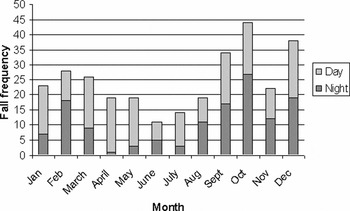
Falls and fractures occurred at all hours (Figure 1), with132 (44%) falls occurring during the night-shift (9 pm to 7 am). The fall and fracture frequency did not differ according to the time or the day of the week (data not shown). A smaller proportion of falls (20%) occurred during the night from April to July (Figure 2). Falls most frequently occurred in the patient's own room (178 falls; 60%) followed by dining room/day room with 40 (13%), the corridor with 31 (10%) and the bathroom with 15 (5%). Nineteen of the 26 fractures occurred in the patient's own room. No significant gender or age differences were found.
The number of fall events within each hour round the clock and the proportion of fall events in men and women. Missing data for nine falls during the nightshift (9 p.m. to 6 a.m.) and for 31 falls during the dayshift (7 am to 8 pm).

Distribution of fall events according to month and the proportion of falls per day and night. Data missing for one fall.

The reported physical positions preceding a fall were equally distributed between lying or sitting (100 falls, 34%) and standing or walking (114 falls, 38%). Forty-eight falls (16%) occurred when the patients were on their way to/from the bathroom and 29 (10%) when the patients had freed themselves from a physical restraint.
Factors judged to precipitate a fall
The most probable precipitating factor or combination of factors could be judged in more than four out of five falls (247, 83%) (Figure 3). Half of all falls (152, 51%) were judged to be caused by one precipitating factor, one third (92, 31%) by a combination of two precipitating factors, and six falls (2%) by three or more factors.
Factors judged to precipitate fall events, alone or in combination with other factors (n = 298 falls).

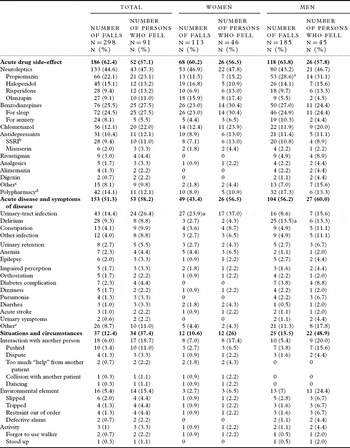
Acute drug side-effects were judged to precipitate the falls alone or in combination with other factors in more than half of all falls (Figure 3, Table 1) as follows: a single drug in 93 falls (31%); two drugs in 41 (14%); three drugs in nine (3%); and more than three drugs (polypharmacy) in 42 falls (14%). In many cases the falls were judged to be caused by treatment with, for example, several neuroleptics or several neuroleptics and benzodiazepines or by the intake of multiple psychotropic medications. Falls were most frequently precipitated by the side effects of neuroleptics, benzodiazepines, chlometiazol and antidepressants. The adverse effects of neuroleptics, revealed as extra-pyramidal symptoms with gait and balance problems, were judged to precipitate 28 out of the 59 falls (47%) that occurred in patients with DLB. Propiomazin was the only drug that was judged to cause more falls among men than women (28.6% versus 11.5%, p = 0.001). There were no differences between age groups.
Factors judged to precipitate falls

aStatistically significant difference (p < 0.05) between women and men.
bSelective serotonin reuptake inhibitors
cA single drug was judged to be the precipitating factor in each fall which occurred in these nine people. antiepileptic, Lozartan, and Detrusitol (3 falls each). Beta-blockers, laxatives, Warfarin, Rofecoxib, Levodopa, diuretics (1 fall each)
dDefinition: ≥3 drugs judged to be precipitated at the same fall incidence.
eThe same symptom or disease was judged to be the precipitating factor for each fall in that person. Ulcus (10 falls), hypothyroids (5 falls), colangit (4 falls), gout (2 falls), acute heart disease, heart failure, 2 other heart diseases, anxiety and PMR (1 fall each)
Acute disease or symptom of disease was, alone or in combination with other diseases or factors, judged to precipitate almost half of all falls (Figure 3, Table 1). Infections precipitated one out of five falls. Of these, urinary-tract infection was most common, with a larger proportion of falls among women than men (23.9% versus 8.6%, p = 0.001). Delirium was judged to precipitate 42 out of all falls (14 %), more frequently among men than women (13.5% versus 2.7%, p = 0.002). There were no differences between age groups,
Situations and circumstances were, alone or in combination with other factors, judged to precipitate one out of ten falls (Figure 3, Table 1). The most commonly reported situations were interaction with another person, particularly being pushed by another patient, together with environmental elements such as slipping or tripping during daily activities.
Discussion
The findings of this study confirm that people with dementia suffer from numerous falls and fractures. Many precipitating factors, alone or in combination, preceded the falls. Particularly common were acute drug side-effects and acute disease or symptom of disease. These were judged to precipitate more than three out of four falls.
Our findings that acute drug side-effects alone, or in combination with other factors, was judged to precipitate more than half of all the registered falls exceeds the proportion previously reported (Kallin et al., Reference Kallin, Jensen, Olsson, Nyberg and Gustafson2004b). Neuroleptics prescribed to treat BPSD symptoms, neuroleptics and benzodiazepines prescribed to aid sleeping, alone or in combination with each other or with other drugs, were the factors most frequently judged to precipitate falls. Antipsychotic drugs and benzodiazepines have been reported to increase the fall risk (Kallin et al., Reference Kallin, Gustafson, Sandman and Karlsson2004a; Hartikainen et al., Reference Hartikainen, Lonnroos and Louhivuori2007) and an intake of four or more drugs is considered to increase the risk of falling in older people (van Dijk et al., Reference van Dijk, Meulenberg, van de Sande and Habbema1993; Jensen et al., Reference Jensen, Lundin-Olsson, Nyberg and Gustafson2002; Kallin et al., Reference Kallin, Lundin-Olsson, Jensen, Nyberg and Gustafson2002; Sterke et al., Reference Sterke, Verhagen, van Beeck and Van Der Cammen2008). People with dementia are often more frail and more sensitive to any adverse consequences of medications. A mandatory and systematic follow-up of the effects and side effects of all drug treatment seems to be particularly important in people with dementia.
Another common precipitating factor for falls was acute disease or symptom of disease. Hence, our results suggest that it is necessary to detect and treat both of these immediately. In addition, a symptom of delirium always needs to be assessed regarding its underlying cause, for example urinary retention, constipation, or anemia. Most prevalent were urinary-tract infections and delirium, even though delirium alone was registered when the underlying cause could not be detected from examination of the patient's nursing and medical records. Previous research has identified that urinary tract infection often precipitates delirium (Laurila et al., Reference Laurila, Laakkonen, Tilvis and Pitkala2008). A vicious circle can thus emerge, a circle that also includes falling.
Situations and circumstances were judged to be precipitating factors alone or in combination with other factors in 13% of all falls. Interaction with another person, in particular when pushed (10 falls), was judged to result in five fractures. To our knowledge no study has previously reported interaction with others as a precipitating factor for falls and fractures. It is likely that individuals with BPSD symptoms are at greater risk of becoming physical when involved in a conflict; it is also possible that, in other studies, these events are not defined as falls.
In accordance with earlier similar studies, men fell more frequently than women (van Dijk et al., Reference van Dijk, Meulenberg, van de Sande and Habbema1993; Nyberg et al., Reference Nyberg, Gustafson, Janson, Sandman and Eriksson1997). One may speculate that men in our study were more prone to risky behavior, had more medication problems and a lower threshold for complications such as delirium than the women. The women on the other hand had more urinary-tract infections.
The fewest fall events occurred in June and July. From April to July only 20 % of the fall events occurred at night. One explanation could lie in the association with the 24 hours of daylight in the north of Sweden during this season. Adaptation to darkness deteriorates with age (McMurdo and Gaskell, Reference McMurdo and Gaskell1991), which may enhance the risk of falling during the darker months of the year. Many falls occurred during the evening and night shift when the staffing level was at a minimum and thus assistance and supervision was limited. Periods of low fall incidence coincided with periods when most of the patients and the staff were together in the same place on the ward, for example eating breakfast or lunch.
This study had certain limitations. First, the relatively small sample size gives rise to the risk that a single patient with many falls and the same fall pattern may influence the result. Secondly, even with the high number of falls and the careful follow-up in our study, the rate of falls may still be under-reported. Thirdly, we did not systematically follow up the documentation of patients who did not fall and their prevalence of acute disease or symptom of disease and drug side-effects for comparison. However, the informative documentation in the fall reports and in the medical and nursing records made it possible to identify the most probable precipitating factors in 83% of the registered fall events. One explanation for the high proportion of acute diseases, symptom of disease and drug side effects, seen as precipitating factors in this study, was probably that the staff were engaged in developing the fall report form before the study started and so were conscientious in keeping daily notes of patients’ symptoms and behavior. But drug side-effects can be delayed, and the association between the fall events and the specific drug is therefore difficult to state with certainty. This could, in turn, indicate an underestimation of drugs as precipitating factors for falls. Previous analyses of the present data set, in which time to first fall was the outcome variable in a regression tree analysis and drug side-effects were not used as a possible factor, showed that darkness and not wearing shoes were circumstances associated with short time to the first fall (Eriksson et al., Reference Eriksson, Strandberg, Gustafson and Lundin-Olsson2008). Using the reviewing methodology with independent evaluation of each fall, environmental circumstances were less frequently judged to precipitate the falls than acute disease and acute drug side effects.
The clinical implications arising from this study are the need for increased awareness of the potential consequences of drug side-effects and of the changes in health status in people with dementia, as well as the need to communicate consistently the requirement for a tailored fall prevention program for every patient. It is important to scrutinize the fall-report form and to ensure systematic documentation in the medical and nursing records in order to provide the multidisciplinary team with essential information. Information and analysis of the fall history can enable the team members more easily to understand the factors that caused the fall event for each patient and thereby be better equipped to design individual intervention strategies (Jensen et al., Reference Jensen, Nyberg, Gustafson and Lundin-Olsson2003; Neyens et al., Reference Neyens2009). Fall prevention probably also needs to include improvement in gait and balance to improve the capacity to better withstand acute symptoms of diseases and acute drug-side effects. A team applying comprehensive geriatric assessment and rehabilitation, including prevention, detection and treatment of fall risk factors, can successfully prevent falls in patients with dementia (Stenvall et al., Reference Stenvall2007). It has also been shown that exercise programs are applicable to people with dementia and to have positive effects on balance, gait and independence in the activities of daily living (Littbrand et al., Reference Littbrand, Rosendahl, Lindelof, Lundin-Olsson, Gustafson and Nyberg2006). Psychiatric and behavioral symptoms also need to be focused on (Pellfolk et al., Reference Pellfolk, Gustafsson, Gustafson and Karlsson2009). Meaningful individual activities and a balance between activity, rest and sleep can create conditions under which patients retain a normal diurnal rhythm. Individualized supervision could be another important measure for preventing accidental falls. In addition, a properly designed environment can support intact functions and contribute to a sense of security and well-being.
In conclusion, it is possible to identify many precipitating factors that may contribute to a fall. Falls in people with dementia should be regarded as a symptom of acute disease or as a drug side-effect until proven otherwise. Prompt detection of these relevant factors is therefore an essential prerequisite for fall prevention in people with dementia.
Conflict of interest
None.
Description of authors' roles
S. Tängman, S. Eriksson, Y. Gustafson and L. Lundin-Olsson made substantial contributions to the concept and design of the study. S. Tängman, S. Eriksson and Y. Gustafson collected the data and performed most of the data analyses, and all authors interpreted the data. S. Tängman wrote the first draft and all authors commented critically on the draft and contributed important intellectual content. All authors approved the final version.
Acknowledgments
The study was supported by the King Gustav V and Queen Victoria Freemason's Foundation, the Swedish Dementia Foundation, the County Council of Västerbotten (“FoU” and “Äldre Centrum” Västerbotten) and “Legitimerade Sjukgymnasters Riksförbund, sektionen för Gerontologi och Geriatrik – Äldres hälsa”
The authors thank the staff at the psychogeriatric ward at Norrlands University Hospital for their valuable contribution to the study.