Introduction
Cultivated sunflower (Helianthus annuus L.) is an important oilseed crop grown in warm to moderate semi-arid climatic regions of the world. It ranks fourth among the major oilseed crops in terms of total global production (FAO Statistics, 2013). The wide spread occurrence of broad leaved weeds and broomrape parasite necessitate vast use of broad spectrum herbicides like imidazolinone (IMI) and sulfonylurea (SU) by sunflower growers. These herbicides control weed growth by inhibiting acetohydroxyacid synthase (AHAS; EC 2.2.1.6) enzyme, which is involved in branched chain amino acid biosynthesis and a single point mutation in the gene is sufficient to cause resistance (Sebastian et al., Reference Sebastian, Fader, Ulrich, Forney and Chaleff1989; D'Halluin et al., Reference D'Halluin, Bossut, Bonne, Mazur, Leemans and Botterman1992; Rajasekaran et al., Reference Rajasekaran, Grula and Anderson1996). These herbicides became popular among growers owing to low use rates, flexibility in application timing and very low animal toxicity due to the absence of this enzyme in animals (Brown, Reference Brown1990).
The mechanism of resistance in most cases is inhibition of the enzyme by mutating herbicide binding sites in the large catalytic subunit of AHAS enzyme preventing the herbicide molecules from accessing the active site (Tranel and Wright, Reference Tranel and Wright2002; McCourt et al., Reference McCourt, Pang, King-Scott, Guddat and Duggleby2006). Discovery of IMI-resistant lines namely IMISUN (Al-Khatib et al., Reference Al-Khatib, Baumgartner, Peterson and Currie1998) and CLHAPlus (Sala et al., Reference Sala, Bulos, Echarte, Whitt, Budziszewski, Howie, Singh and Weston2008a) and SU-resistant line, SURES (Al-Khatib et al., Reference Al-Khatib, Baumgartner and Currie1999; Miller and Al-Khatib, Reference Miller and Al-Khatib2004) facilitated commercialization of herbicide-tolerant lines and hybrids in sunflower.
The number of Ahas genes varies in crops. Detailed molecular analysis of herbicide-tolerant lines identified three Ahas genes (Ahas1, Ahas2 and Ahas3) and five haplotypes within Ahas1 gene in sunflower (Kolkman et al., Reference Kolkman, Slabaugh, Bruniard, Berry, Bushman, Olungu, Maes, Abratti, Zambelli and Miller2004). Sequencing and characterization of alleles of Ahasl1 from herbicide-tolerant and -susceptible sunflower lines determined that the point mutation C-to-T in codon 205 of Ahasl1-1 allele and in codon 197 of Ahasl1-2 allele (Hawley, Reference Hawley2005) conferred moderate resistance to IMI-herbicides and high-level resistance to SU herbicides, respectively. The source of CLHAPlus was a point mutation G-to-A in Ahasl1-3 allele (Sala et al., Reference Sala, Bulos, Echarte, Whitt, Budziszewski, Howie, Singh and Weston2008a). Ahasl1-4 harbours a G-to-T mutation in codon 574 and imparts broad range tolerance to four families of AHAS targeting herbicides (Sala and Bulos, Reference Sala and Bulos2012). Interestingly, Ahasl1 alleles are characterized by an [ACC] n repeat of variable length in the transit peptide-encoding region of the gene. The single nucleotide polymorphisms (SNPs) and simple sequence repeat (SSR) at Ahasl1 locus have been used in developing suitable marker systems in sunflower for selection of herbicide-resistant lines (Kolkman et al., Reference Kolkman, Slabaugh, Bruniard, Berry, Bushman, Olungu, Maes, Abratti, Zambelli and Miller2004; Bulos et al., Reference Bulos, Sala, Altieri and Ramos2013).
Several useful traits have been identified from wild Helianthus species and utilized in breeding programmes (Seiler, Reference Seiler1992). The genus Helianthus includes 51 species consisting of 14 annual and 37 perennial species encompassing diploids, tetraploids and hexaploids (Schilling and Heiser, Reference Schilling and Heiser1981). To prove resistance or susceptibility to herbicides, molecular markers are reliable, efficient and fast, but verification at the phenotypic level is indispensable. Here, we screen wild and cultivated Helianthus species for IMI and SU resistance at whole-plant level using herbicide spraying and investigate potential allelic variations at Ahasl1 gene locus using SSR and SNP analyses.
Materials and methods
Plant materials
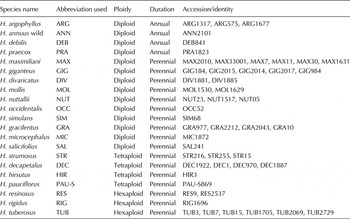
Fifty accessions of 21 wild Helianthus species were included in the study. Table 1 provides the details of wild species and accessions of each species used, their ploidy level and growth habit. Cytoplasmic male sterile (CMS) lines and restorer (R) lines (29 of them) of commercial sunflower hybrids were also evaluated for the allelic variation in Ahasl1 gene. These include CMS2A, CMS10A, CMS17A, CMS103A, CMS207A, CMS234A, CMS243A, ARM243A, CMS335A, CMS338A, CMS851A, CMS7-1A, CMS2023A, E00291A, E00292A, IMS850A, FMS853A, RHA1-1, mRHA2, RHA6D-1, RHA95-C-I, RHA271, RHA272, RHA274, RHA298, RHA857, RHA859, P61R and R64NB. A released sunflower hybrid, DRSH-1 (ARM243A X RHA6D-1) was also included in the study.
Wild Helianthus species along with their ploidy, habit and accessions used in the study

Whole-plant spraying to check for herbicide resistance
The 15-day-old-seedlings of cultivated sunflower, DRSH-1 and transplanted suckers of wild Helianthus species were sprayed to know their reaction to IMI herbicide application. The seedlings and suckers were raised in pots and also in field and a single round of spray was carried out. Each treatment included five plants and was replicated three times. The recommended field dose (referred to as 1X) of IMI herbicide belonging to the class imazethapyr (Pursuit®: 100 g ai/ha) was used. The IMI herbicide was sprayed on all the wild Helianthus species and IMI-resistant sunflower line, SCG101 (PI 617099) served as the resistant control. SU-based herbicides belonging to the classes, ethoxysulfuron (Sunrice: 50 g ai/ha), pyrazosulfuron ethyl (Saathi: 80 g ai/ha) and sulfosulfuron (Fateh: 13.5 g ai/ha) were used for spraying at three different concentrations of 0.5X, 1X (field dose) and 2X. Each of these concentrations were used on 15, 30 and 45 day-old seedlings. SU based herbicides were sprayed on all the Helianthus species with cultivated hybrid (DRSH-1) as check. Later, detailed investigations were carried out on Helianthus praecox (PRA1823) by spraying the SU based herbicides at different crop growth stages till flowering and cultivated sunflower served as the control. From the day of spray, plants were observed regularly up to a month for toxicity symptoms such as wilting, drooping of leaves, yellowing and browning of younger leaves and complete drying for both the herbicides.
DNA extraction
DNA was extracted using CTAB method (Doyle and Doyle, Reference Doyle and Doyle1990). The quality of the DNA was checked on a 0.7% agarose gel and it was quantified using NanoVue™ (GE Healthcare). DNA was diluted to a final concentration of 100 ng/μl and was used for PCR. As a reference SCG101 with the allele type Ahasl1-1 was included (Miller and Al-Khatib, Reference Miller and Al-Khatib2002).
SSR marker analysis
The forward (AHAS16- 5′CCCCGTTTCGCATTACCCATCACT3′) and reverse primers (AHAS17-5′ACCAACACGTCTGCGCCTTTTCTC 3′) that would amplify the ACC repeat region in the transit peptide of Ahasl1 gene were custom synthesized (Kolkman et al., Reference Kolkman, Slabaugh, Bruniard, Berry, Bushman, Olungu, Maes, Abratti, Zambelli and Miller2004). This primer pair would amplify a 186 bp fragment in the wild-type plants and also in plants with Ahasl1-3 allele, while it would amplify a 177 bp fragment (9 bp deletion) and 195 bp fragment (9 bp addition) in Ahasl1-1 (IMISUN) and Ahasl1-2 (SURES) alleles, respectively (Bulos et al., Reference Bulos, Sala, Altieri and Ramos2013).
SNP analysis
SNP analysis was carried out in order to detect Ahasl1-3 allele (CLHAPlus) type among the wild species accessions. For the detection of Ahasl1-3 allele that fails to show any size distinction from the wild-type allele on amplification with AHAS16/17 primer pair, another combination of primers consisting of AHASNidF (5′ TGTTCTCTCCGACTCCAAA 3′) and AHAS122TMU (5′ TGGTGGATCTCCATTGAGTT 3′) were used. There will be an amplicon for this primer pair only if the allele is CLHAPlus type (Sala et al., Reference Sala, Bulos and Echarte2008b; Bulos et al., Reference Bulos, Sala, Altieri and Ramos2013). This combination utilized the SNP at codon 122 of Ahasl1 gene. The remaining alleles were amplified using AHASNidF as the forward primer and AHAS122TWT (5′ TGGTGGATCTCCATTGAGTC 3′) as the reverse primer. SNP marker analysis was carried out with DNA from all the species.
PCR amplification of genomic DNA using SSR and SNP primers
Ahasl1 alleles were amplified in a 15 µl PCR reaction mixture containing 0.6 U Taq DNA polymerase, 100 ng DNA, 5 pmoles each of forward and reverse primer and a final concentration of 100 µM of each dNTP using a programme that consisted of an initial denaturation of 2 min at 94°C followed by 40 cycles of 30 s at 94°C, 30 s at 57°C and 30 s at 72°C and finally an extension of 10 min at 72°C. The products of amplification were separated in a 4% agarose gel and the gel was stained with ethidium bromide (0.5 µg/ml concentration).
Sequence analysis
The PCR products from simple sequence repeat analysis were sequenced directly using the corresponding primers in ABI3130 Genetic Analyser sequencer. The chromatograms were read and analysed employing Chromas Lite2.1.1 software. Similarity search of the sequences was performed using NCBI BLAST (http://blast.ncbi.nlm.nih.gov/Blast.cgi) and multiple sequence alignment was done using ClustalW (http://www.genome.jp/tools/clustalw/).
PCR amplification and sequencing of Ahasl1 full-length gene from NUT05 and PRA1823 and sequence analysis
Whole gene sequence of Ahasl1 from NUT05 and PRA1823 were amplified in three parts using the following primers: p-AHAS2, p-AHAS8, p-AHAS5, p-AHAS10 (all from Kolkman et al., Reference Kolkman, Slabaugh, Bruniard, Berry, Bushman, Olungu, Maes, Abratti, Zambelli and Miller2004), FP1 (5′ ATGGCGGCTCCTCCCAAC 3′) and RP1 (5′ CCGAATTCAAACACCCACCACC 3′). The sequences were amplified in a 30 µl PCR reaction mixture containing 0.6 U Taq DNA polymerase, 100 ng DNA, 10 pmoles each of forward and reverse primer and a final concentration of 100 µM of each dNTP. The programme consisted of an initial denaturation of 4 min at 94°C followed by 35 cycles of 30 s at 94°C, 60 s at 57°C and 60 s at 72°C and finally an extension of 10 min at 72°C. PCR products were sequenced using the corresponding primer pairs. The gene sequences were translated using ExPASy translate tool (http://web.expasy.org/translate/) and the deduced amino acid sequences were aligned with Ahasl1 sequences from H. annuus (AY541451.1) and Arabidopis thaliana (P17597) using ClustalW programme.
Results
Whole plant herbicide spraying
Imidazolinone- and SU-based herbicides are easily transported to the areas of new growth through vascular tissues and hence, symptoms were most obvious in the growing tips of the plants. Most of the susceptible lines showed initial wilting and browning of the growing leaf tip and lower leaves within 2-3 d of imazethapyr spraying. Leaves exhibited chlorosis of different degrees. The wild species were generally late in responding to herbicide application and the symptoms started as drying of growing tips followed by yellowing of leaves. All Helianthus maximiliani accessions were prone to imazethapyr injury. We observed that among the accessions of Helianthus nuttallii, accession 1517 plants were susceptible to imazethapyr as they became wilted and dried within five days of spraying. However, NUT05 plants were more resistant to imazethapyr herbicide than the wild-type plants and they remained healthy even at 30 d after spraying, but wilted off and died there after. The parental lines E00292A and ARM243A were susceptible to imazethapyr spray in the field. SCG101 sprayed with imazethapyr was found completely resistant to the herbicide and produced normal sized capitula with fertile pollen.
All the three SU-based herbicides caused severe phytotoxicity in cultivated sunflower and the symptoms included yellowing of leaf, browning of mid-veins on the abaxial leaf surface followed by browning of petioles and stems which ultimately spread to the whole plant. The herbicides were tested at 15, 30 and 45 DAS and all the species at all crop stages were vulnerable to the herbicide. However, interestingly, H. praecox PRA1823 plants showed complete resistance to all three different SU-based herbicides and remained green regardless of the type of the herbicide and the concentrations used. In order to check for cross-resistance to IMI and SU-based herbicides, PRA1823 plants were sprayed with imazethapyr also. But it failed to show cross-tolerance and showed herbicide toxicity symptoms when subjected to imazethapyr spray.
SSR marker analysis
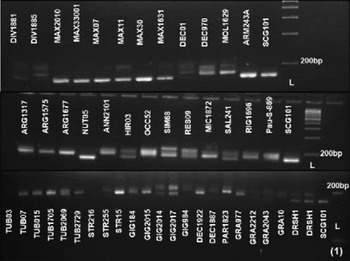
DNA amplification from all the wild species accessions using AHAS16 and AHAS17 primers revealed SSR size variation at Ahasl1 locus (Fig. 1). The size of the amplicons was compared with that of the IMI-resistant line, SCG101 which is Ahasl1-1 allele type. There was distinct size variation among the amplified fragments in the accessions and some of the lines with SSR size differences were sequenced using the same primer pair. The wild species accessions, MAX07, MAX11, MAX1631, MAX2010, MAX30, MAX33001 (all belonging to H. maximiliani), H. nuttallii accessions NUT05 and NUT1517 and H. praecox 1823 (PRA1823) accession along with SCG101 were sequenced to identify the sequence variation at the SSR locus. CMS and R line parents of commercial sunflower hybrids were also subjected to SSR marker analysis to inspect for herbicide tolerance alleles (online Supplementary Fig. S1). Among these, CMS7-1A, RHA6D-1, ARM243A and E00292A with distinct size variations were also sequenced. Fifteen sequences were submitted to NCBI GenBank and were assigned accession numbers from KM 495582 to KM 495596.
Amplification of Ahasl1 gene fragment using AHAS16 and AHAS17 primer pair. Name of the accession is shown against the band in the gel. Band size is compared with a 100 bp DNA ladder (L).

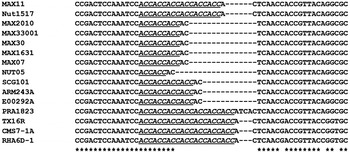
SCG101 reference line carrying Ahasl1-1 allele (IMISUN type) showed a 9 bp deletion in the SSR region, as already reported (Miller and Al-Khatib, Reference Miller and Al-Khatib2002; Bulos et al., Reference Bulos, Sala, Altieri and Ramos2013) compared to the wild-type allele in CMS7-1A and RHA6D-1. Sequence of H. praecox accession PRA1823 showed an insertion of 3 bp in the SSR region (Fig. 2). SU-resistant allele, SURES (Ahasl1-2) is reported to have a 9 bp sequence insertion in this region.
Multiple sequence alignment of SSR variation at Ahasl1 locus in cultivated and wild Helianthus species (ACC repeat sequences are italicized and underlined. * indicates conserved sequences).

A total of five haplotypes have been reported in Ahasl1 so far. NCBI BLAST similarity search was used to study the similarity of the partial SSR sequences obtained from this study to Ahasl1 haplotypes. IMI-resistant SCG101 sequence showed maximum identity to haplotype 5. Accessions of both H. nuttallii and H. maximiliani showed inter-accessional allelic variation. H. nuttallii accession 1517 had a 3 bp deletion at the SSR region compared with the wild type. Helianthus nuttallii 05 had a 15 bp deletion and was most similar to haplotype 5. Five of the six H. maximiliani accessions had 12 bp deletion each when compared with the wild-type allele, while MAX11 had a 3 bp deletion. MAX11 and NUT1517 were similar in the size of their repeat regions. All MAX accessions except MAX11 showed maximum sequence similarity to haplotype 5. The accessions MAX11, NUT1517 and PRA1823 were similar to haplotype 2, which is associated with SU resistance.
SSR marker analysis identified many CMS and R lines possessing IMISUN-type allelic pattern and among them ARM243A and E00292A were confirmed through sequencing. They showed the maximum similarity to haplotype 5 (IMISUN type) of sunflower Ahasl1 gene on similarity search. CMS7-1A and RHA 6D-1 showed maximum homology to haplotype 1 (wild type). Figure 2 shows the multiple sequence alignment of all the sequences using ClustalW.
SNP marker analysis
The SNP analysis revealed that there is no CLHAPlus-type allele in any of the accessions studied as none of the genotypes studied gave amplification with NidF/AHAS122TMU primer pair.
PCR amplification and sequencing of Ahasl1 full-length gene from NUT05 and PRA1823 and sequence analysis
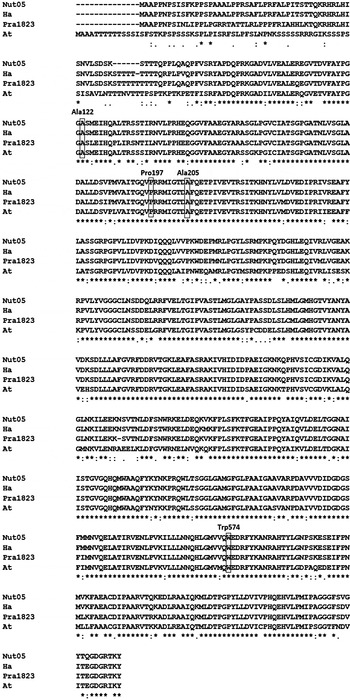
In order to see whether any of the reported herbicide resistance mutations have any role in the resistance shown by PRA1823 and NUT05 to SU and IMI herbicides, respectively, the whole Ahasl1 gene was amplified and sequenced. The sequences from the three sets of PCR primers were aligned to get the full-length sequence of NUT05 and PRA1823. The sequences were submitted to NCBI (accession numbers KU 524884 and KU 524885). The gene sequence was 1953 bp long in NUT05 and 1968 bp in PRA1823. The peptide sequences were 650 and 655 amino acids long in NUT05 and PRA1823, respectively. The peptide sequences were aligned with H. annuus and Arabidopsis thaliana AHASL1 peptide sequences using clustal W to identify herbicide resistance mutations, if any. But no mutations could be observed in any of the four sites that are already reported in sunflower for herbicide resistance, namely Ala-122, Pro-197, Ala-205 and Trp-574 (Fig. 3).
Multiple sequence alignment of deduced amino acid sequences of Ahasl1 proteins from A. thaliana (At), H. annuus (Ha), H. praecox 1823 (Pra1823) and H. nuttallii 05 (Nut05). Mutations in Ahasl1 that have been shown to confer herbicide resistance are shown in boxes and the amino acids numbers marked.

Discussion
In addition to their use in detecting the origin of cultivated crops, wild species serve as rich sources of alleles for many important attributes that can be exploited as prized tools in crop improvement programmes. Many of the novel genes and/or alleles governing diverse traits from wild Helianthus species have been successfully identified and introgressed into the background of elite lines in sunflower, which provides a non-Genetically Modified Organism (non-GMO) way of crop engineering (Vranceanu et al., Reference Vranceanu, Pirvu and Stoenescu1981; Jan and Chandler, Reference Jan and Chandler1985; Miller and Gulya, Reference Miller and Gulya1991; Seiler et al., Reference Seiler, Christie and Choo1991; Seiler, Reference Seiler1992, Reference Seiler2007; Tikhomirov and Chiryaev, Reference Tikhomirov and Chiryaev2005; Sujatha, Reference Sujatha2006; Liu et al., Reference Liu, Wang, Feng, Seiler, Cai and Jan2013).
Several herbicide tolerance traits have been identified in sunflower in the past decade and they have helped in the development of technologies for effective weed control in the crop. Identification of wild H. annuus population resistant to IMI herbicides led to the identification of many more herbicide-tolerant lines in sunflower and this enabled the application of broad spectrum herbicides in sunflower. Following this, similar traits were developed through ethyl methanesulfonate (EMS) mutagenesis and were commercialized. There were continued efforts to identify herbicide resistance trait from wild Helianthus species. Resistance to tribenuron, an SU herbicide was identified in wild Helianthus species at the phenotypic level whose molecular basis is yet to be understood (Miller and Seiler, Reference Miller and Seiler2005; Terzic and Atlagic, Reference Terzic and Atlagic2008). Some level of tolerance to IMI herbicide has been reported earlier in a few Argentine wild H. annuus populations at 0.5× dose of the herbicide, which did not prevail at higher doses (Cantamutto et al., Reference Cantamutto, Poverene, Presotto, Alvarez, Lenardon, Rodriguez, Martin, Fernandez, Giolitti, Garayalde, Haucke, Bellido and Fraysse2010). F 1 individuals from a cross of wild H. annuus populations and IMI-resistant commercial hybrid showed more resistance to imazapyr even at 2× concentration than their wild ancestors though they were less tolerant than the commercial hybrid (Presotto et al., Reference Presotto, Ureta, Cantamutto and Poverene2012). There is much scope for identification of alleles governing herbicide resistance trait from wild species of Helianthus that are naturally adapted to diverse habitats and their use for introgression into cultivated lines. Phenotypic screening of 50 wild Helianthus species in our study has identified NUT05 as a source of intermediate resistance to IMI and PRA1823 as a resistant source to a wide range of SU herbicides. Although in previous studies, H. praecox is identified as a source of genes offering resistance or tolerance towards downy mildew (Miller and Gulya, Reference Miller and Gulya1988), Alternaria leaf spot (Block, Reference Block1992), powdery mildew (Saliman et al., Reference Saliman, Yang and Wilson1982; Prathap Reddy et al., Reference Prathap Reddy, Chander Rao, Kirti and Sujatha2013) and sunflower beetle (Rogers and Thompson, Reference Rogers and Thompson1978, Reference Rogers and Thompson1980), its SU resistance trait has not been explored before.
SSR marker for Ahasl1 locus was first described by Kolkman et al. (Reference Kolkman, Slabaugh, Bruniard, Berry, Bushman, Olungu, Maes, Abratti, Zambelli and Miller2004). The usefulness of this marker for phenotypic selection of herbicide tolerance was recently demonstrated using a set of IMI and SU-resistant and -susceptible sunflower inbred lines (Bulos et al., Reference Bulos, Sala, Altieri and Ramos2013). Based on the size variation in the amplified fragment, SURES and IMISUN types could easily be distinguished from the wild-type plants. The SNP marker described by them facilitated easy identification of CLHAPlus type. Five haplotypes have been described for Ahasl1 gene and resistance to IMI herbicides correlates to haplotype 5 and resistance to SU correlates to haplotype 3 (Kolkman et al., Reference Kolkman, Slabaugh, Bruniard, Berry, Bushman, Olungu, Maes, Abratti, Zambelli and Miller2004). In this study, screening of allelic variation at Ahasl1 locus was done in wild Helianthus species. Allelic variation was found between species as well as between accessions within the same species. Inter-accessional allelic variation was observed in H. nuttallii and H. maximiliani. Among the parental lines of commercial hybrids, ARM243A and E00292A had exactly the same sequence at the SSR region as that of SCG101 (IMISUN type). But both of them failed to show resistance to imazethapyr. This can be expected as IMI resistance is a trait that is controlled additively by a semi-dominant gene and a modifier gene and true resistance for such a character is achieved only with complete homozygosity of both genes in the inbred line or hybrid (Bruniard and Miller, Reference Bruniard and Miller2001). This digenic model supports the susceptibility of DRSH-1 hybrid to imazethapyr. Though one of its parents, ARM243A, was found to carry IMISUN-type allele at the Ahasl1 locus, the other parent RHA6D-1 is of wild type and the herbicide resistance trait is expressed only in homozygous condition. The repeated sequence at Ahasl1 locus of PRA1823 revealed a 3 bp addition and NUT05 had a 15 bp deletion. The resistance allele, Ahasl1-2 in ‘SURES’ is identified by a 9 bp addition at the SSR region when compared with the wild-type plants, while in PRA1823, there is only a 3 bp addition. Similarly, IMISUN-type plants were proposed to have a 9 bp deletion. In our study, the variations at Ahasl1 found among wild accessions did not explain the observed phenotype. These results imply that the SSR marker may not be an appropriate selection tool for herbicide resistance.
The result of detailed investigations through sequencing of full-length Ahasl1 gene from NUT05 and PRA1823 could not comply with the previously reported mutations that confer resistance to IMI and SU herbicides. The amino acid sequences of Ahasl1 gene from PRA1823 and NUT05 were compared with that of wild-type H. annuus and A. thaliana. None of the resistance-conferring mutations that were reported in sunflower could be identified in these sequences. The absence of resistant mutations opens the possibility of further studies on resistance mechanisms. For Ahas-inhibiting herbicides, both target site and non-target site mutations have been reported (Saari et al., Reference Saari, Cotterman, Thill, Powles and Holtum1994; Breccia et al., Reference Breccia, Gil, Vega, Zorzoli, Picardi and Nestares2012). This points to the possibility of non-target-site herbicide tolerance mechanisms in the resistant Helianthus genotypes (Sala et al., Reference Sala, Bulos, Altieri and Ramos2012). Further understanding of the resistance mechanism demands a detailed functional characterization of the target gene, investigations on non-target-site mechanisms and additive interactions between these two.
In the present study, IMISUN, SURES and CLHAPlus allelic types could not be observed in any of the 50 wild accessions screened and the majority showed wild-type allele. Being a diploid annual already exploited for various traits and which is crossable with cultivated sunflower, the SU resistance exhibited by H. praecox is of high practical utility for breeders. Increasing emergence of herbicide-resistant weeds is a major problem worldwide and identification of new sources of resistance has become necessary. The sources of herbicide resistance identified in the wild species is vital for genetic improvement of this important oilseed crop and this study assumes importance for sunflower growers worldwide as there are only a few existing post-emergence herbicides for effective weed control.
Supplementary material
The supplementary material for this article can be found at https://doi.org/10.1017/S1479262116000095.
Acknowledgements
We extend our gratitude to Institute of Field and Vegetable Crops (IFVCNS), Serbia and USDA-ARS, Ames, USA for sparing the seeds/propagules of wild Helianthus species.