

Introduction
Different whole crop cereal silages are increasingly being used for growing cattle feeding in temperate climates due to their potentially lower costs compared with grass silage (GS) (Huuskonen, Reference Huuskonen2013; Huuskonen et al., Reference Huuskonen, Pesonen and Honkavaara2016). In Finland, barley (Hordeum vulgare) is the dominant small-grain species utilised for whole crop production. The digestibility of whole crop silages is highly dependent on the proportion of straw and is often lower than that of good-quality GS but the lower digestibility is largely compensated for by higher dry matter intake (DMI) (Huhtanen et al., Reference Huhtanen, Rinne and Nousiainen2007). In a review of seven experiments with finishing beef cattle Keady et al. (Reference Keady, Hanrahan, Marley and Scollan2013) concluded that the inclusion of whole crop wheat silage in GS-based diets increased forage intake by 1.4 kg dry matter (DM)/day, but did not alter animal performance. However, compared with dairy cows there is limited information available on the effects of barley-based whole crop silages on the performance of growing cattle relative to GS-based diets.
Rapeseed meal (RSM) is the most important supplementary protein feed for cattle in Finland. Huuskonen et al. (Reference Huuskonen, Huhtanen and Joki-Tokola2014) concluded that because of limited production responses, high prices of protein supplements and increases in nitrogen and phosphorus emissions, there is generally no benefit from using protein supplementation for growing cattle fed GS-based diets. However, whole crop silages typically contain less CP than GS (Huuskonen, Reference Huuskonen2013), and therefore Finnish protein feeding recommendations for growing cattle are not usually fulfilled if whole crop silage-based rations are fed without protein supplementations. The present experiment was conducted to determine performance of growing Hereford bulls offered diets based on whole crop barley silages harvested at either the milk stage or at the dough stage relative to a moderate digestible GS-based diet with or without RSM supplementation.
Material and methods
Animals, management and experimental design
A feeding experiment was conducted in the experimental barn of Natural Resources Institute Finland (Luke) in Ruukki. Animals were managed according to the Finnish legislation regarding the use of animals in scientific experimentation. The experiment comprised in total 30 Hereford bulls. All the animals, initial BW 366±34.7 kg, on average, were spring-born calves purchased from commercial suckler herds.
During the feeding experiment the bulls were placed and fed individually in an insulated barn in adjacent tie-stalls. A 3×2 factorial design was used to study the effects of (1) forage type, (2) inclusion of RSM and (3) their interactions. At the beginning of the experiment the bulls were divided into five blocks of six animals by BW. Within the block, the bulls were randomly allotted to one of the six treatments:
-
1. Grass silage plus rolled barley without RSM supplementation (GS RSM−)
-
2. Grass silage plus rolled barley with RSM supplementation (GS RSM+)
-
3. Whole crop barley silage harvested at the milk stage (BSM) plus rolled barley without RSM supplementation (BSM RSM−)
-
4. Whole crop barley silage harvested at the milk stage plus rolled barley with RSM supplementation (BSM RSM+)
-
5. Whole crop barley silage harvested at the dough stage (BSD) plus rolled barley without RSM supplementation (BSD RSM−)
-
6. Whole crop barley silage harvested at the dough stage plus rolled barley with RSM supplementation (BSD RSM+)
Feeds and feeding
All silages were produced at the experimental farm of Natural Resources Institute Finland (Luke) in Ruukki (64°44'N, 25°15'E). The GS used was the primary growth from a timothy (Phleum pratense) and meadow fescue (Festuca pratensis) sward, cut using a mower conditioner, wilted for 24 h, and then harvested using a precision-chop forage harvester. The BSM was harvested at the early milk stage (growth stage Z73 on Zadoks scale; Zadoks et al., Reference Zadoks, Chang and Konzak1974) and the BSD at the early dough stage (growth stage Z83 on Zadoks scale) of the cereal using a direct-cut flail harvester. Harvest dates of GS, BSM and BSD were June 18, August 7 and August 19, respectively. All silages were treated with a formic acid-based additive (AIV-2 Plus; Eastman Chemical Company, Oulu, Finland: 760 g formic acid/kg, 55 g ammonium formate/kg) applied at a rate of 5 l/t of fresh forage and ensiled in bunker silos.
The feeding experiment lasted 231 days and during the experiment the bulls were offered silages ad libitum (proportionate refusals as 5%). In all three forage diets the concentrate used was either rolled barley alone or rolled barley plus RSM. The amount of the concentrate supplementation was 37 g/kg metabolic BW/animal per day for all treatments, and the target for the average concentrate level during the experiment was 450 g/kg total DM. The amount of the concentrate allowance was adjusted to reflect the change in weight of bulls every 2 weeks. The CP content of the rolled barley was 119 g/kg DM and RSM was added so that the CP content of the concentrate was raised to 140 g/kg DM. The daily ration for the bulls included also 100 g of a mineral–vitamin mixture.
Chemical analyses and calculations
During the feeding experiment silage sub-samples were taken twice a week, frozen, pooled over periods of 4 weeks and stored at –20°C before analyses. Thawed samples were analysed for DM, ash, CP, starch, silage fermentation quality (pH, lactic and formic acids, volatile fatty acids, soluble and ammonia N content of total N) and digestible organic matter (DOM) in DM (D-value). Barley and RSM sub-samples were collected weekly, pooled over periods of 8 weeks and analysed for DM, ash, CP and starch. Analyses were performed as described by Huuskonen et al. (Reference Huuskonen, Pesonen and Honkavaara2016).
Apparent diet digestibility was determined for all animals when the bulls were 610 kg BW, on average. Feed and faecal samples were collected twice a day (at 0700 and 1500 h) during the 5-day collection period and stored frozen before analyses. The samples were analysed for DM and ash as described by Huuskonen et al. (Reference Huuskonen, Pesonen and Honkavaara2016). The diet digestibility was determined using acid-insoluble ash as an internal marker (Van Keulen and Young, Reference Van Keulen and Young1977).
The metabolisable energy (ME) concentration of the GS was calculated from the concentration of DOM using the equation: ME (MJ/kg DM)=16.0 (MJ/kg DM)×DOM (kg/kg DM) (MAFF, 1984). For the whole crop silages a coefficient of 15.5 instead of 16.0 was used (MAFF, 1984). The ME concentrations of the concentrate feeds were calculated based on concentrations of digestible crude fibre, CP, crude fat and nitrogen-free extract as described by MAFF (1984). Crude fibre and crude fat concentrations and the digestibility coefficients of the concentrates were taken from the Finnish Feed Tables (Luke, 2017). The values of metabolisable protein (MP) and the protein balance in the rumen (PBV) were calculated according to the Finnish feed protein evaluation system (Luke, 2017) in which MP describes the amount of amino acids (AA) absorbed from the small intestine and PBV describes the balance between the dietary supply of rumen-degradable protein (RDP) and the microbial requirements for RDP.
Slaughter procedures and carcass measurements
The bulls were weighed on 2 consecutive days at the beginning and at the end of the experiment. The BW gain (BWG) was calculated as the difference between the means of the initial and final BW divided by the number of growing days. The estimated rate of carcass gain was calculated as the difference between the final carcass weight and the carcass weight at the beginning of the experiment divided by the number of growing days. The carcass weight at the start of the experiment was assumed to be 0.52×initial BW based on earlier studies (unpublished data).
The bulls were slaughtered in the Atria Ltd. commercial slaughterhouse in Kauhajoki, Finland. After slaughter the carcasses were weighed hot. The cold carcass weight was estimated as 0.98 of the hot carcass weight. Dressing proportions were calculated from the ratio of cold carcass weight to final BW. The carcasses were classified for conformation and fatness using the EUROP quality classification (EC, 2006).
Statistical analysis
The data were subjected to ANOVA using the SAS GLM procedure (version 9.4; SAS Institute Inc., Cary, NC, USA). The statistical model used was:
 $$y_{{ijkl}} \,{\equals}\,\mu {\plus}\gamma _{k} {\plus}\alpha _{i} {\plus}\beta _{j} {\plus}\left( {\alpha {\times}\beta } \right)_{{ij}} {\plus}e_{{ijkl}} $$
where μ is the intercept and e ijkl the random error term associated with i th bull. α i and β j are the fixed effects of i th forage type (GS, BSM, BSD) and j th protein supplementation (RSM−, RSM+), respectively, whereas γ k is the random effect of the block (k=1, … ,5). Differences between the treatments were tested using orthogonal contrasts: (1) RSM+ v. RSM−, (2) GS v. whole crop silages, (3) BSM v. BSD, (4) interaction between contrasts 1 and 2 and (5) interaction between contrasts 1 and 3.
Results
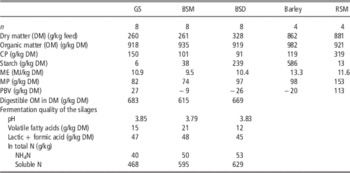
The GS used in the present experiment was of good nutritional quality as indicated by the high D-value as well as the high CP content (Table 1). The GS had a clearly higher CP concentration than BSM and BSD silages. Further, GS had a 15% and 5% higher ME content compared with BSM and BSD silages, respectively. The fermentation characteristics of all silages were good as indicated by the low pH value and the low concentrations of ammonia N in total N and total fermentation acids. The barley grain had typical chemical composition and feed values, corresponding to the average values in the Finnish Feed Tables (Luke, 2017).
Chemical composition and feeding values of the feeds used in the feeding experiment

GS=grass silage; BSM=whole crop barley silage harvested at the milk stage; BSD=whole crop barley silage harvested at the dough stage; RSM=rapeseed meal; ME=metabolisable energy; MP=metabolisable protein; PBV=protein balance in the rumen.
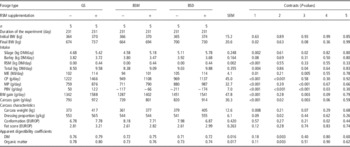
The interaction between the forge type and RSM supplementation was not statistically significant for any intake parameters (Table 2). Mean silage DMI for the GS, BSM and BSD bulls were 5.05, 4.88 and 5.45 kg/day, and total DMI were 9.04, 8.74 and 9.46 kg/day, respectively. Replacing GS by whole crop barley silages had no significant effect on silage intake or total DMI. However, both silage intake and total DMI were higher (P<0.05) in the BSD bulls compared with the BSM bulls. In addition, silage intake and total DMI of the bulls increased by 14% and 10%, respectively, when RSM was included in the diet (P<0.01).
Effects of forage type and rapeseed meal (RSM) supplementation on intake, growth and carcass traits of growing Hereford bulls

GS=grass silage; BSM=whole crop barley silage harvested at the milk stage; BSD=whole crop barley silage harvested at the dough stage; DM=dry matter; ME=metabolisable energy; MP=metabolisable protein; PBV=protein balance in the rumen.
Contrasts: 1=RSM+ v. RSM−; 2=GS v. whole crop silages; 3=BSM v. BSD; 4=interaction between contrasts 1 and 2; 5=interaction between contrasts 1 and 3; fat score (1=leanest, 5=fattest).
Replacing GS by whole crop barley silages had no effect on ME intake but it clearly decreased CP intake of the bulls (P<0.001). The BSD diet increased ME intake by 12% when compared with the BSM diet (P<0.01) but there was no difference in CP intake between these two diets (Table 2). Energy and CP intakes increased by 9% and 18%, respectively, when RSM was included in the diet. Replacing GS by whole crop silages decreased DM and organic matter digestibilities (OMDs) but RSM supplementation had no significant effect on the digestibility coefficients (Table 2).
Mean BWG for the GS, BSM and BSD bulls were 1465, 1345 and 1496 g/day, and carcass gains were 883, 770 and 867 g/day, respectively (Table 2). Both BWG and carcass gain of the BSD bulls were significantly higher (P<0.01) than those of the BSM bulls. Rapeseed meal supplementation increased both BWG (1360 v. 1510 g/day) and carcass gain (784 v. 896 g/day) of the bulls (P<0.001). The interaction between the forge type and RSM supplementation was not statistically significant for growth variables but there was a tendency (P<0.1) for RSM supplementation to increase growth performance more in the GS diet than in the whole crop diets.
Mean carcass weights of the GS, BSM and BSD bulls were 395, 369 and 392 kg, respectively, and tended to be lower in the BSM bulls compared with the other forage types. Forage type had no effect on carcass conformation or fat score but replacing GS by whole crop barley silages decreased the dressing proportion by 2% (P<0.05). Rapeseed meal supplementation increased carcass weight (P<0.01) and tended to increase dressing proportion (P<0.1) but had no effect on carcass conformation or fat score (Table 2).
Discussion
Based on the present and earlier experiments (e.g. Huuskonen, Reference Huuskonen2013; Keady et al., Reference Keady, Hanrahan, Marley and Scollan2013; Huuskonen et al., Reference Huuskonen, Pesonen and Honkavaara2016), it can be concluded that the effects of replacing GS by whole crop silages on the performance of growing cattle differs depending on the stage of maturity of the plants at harvest, cutting height, plant species and variety, growing and harvesting conditions as well as harvesting and storage techniques, which all affect the chemical composition, preservation quality and relative proportions of the different crop components, that is grain and straw. In the present study, the higher energy content and DMI of the BSD diet compared with the BSM diet was reflected as larger daily ME intake of the bulls. This difference in ME intake is probably a crucial explanation for the improved growth rate of the BSD bulls compared with the BSM bulls.
The high growth rates measured in the present study indicate that GS could be totally replaced by whole crop barley silage in the diet of finishing bulls when the concentrate constitutes 0.4 of the diet. If production costs of whole crop cereals are lower than those of GS and including them in the crop rotation brings benefits, using them may increase the overall profitability of the farm.
In the present study, RSM supplementation increased feed and nutrient intake and improved gain on all diets. A meta-analysis of the data from feeding trials in growing cattle (Huuskonen et al., Reference Huuskonen, Huhtanen and Joki-Tokola2013) indicated that increasing the concentration of CP in the concentrate by replacing energy supplements with protein supplements had a positive effect on DMI. However, intake response to protein supplementation reported by Huuskonen et al. (Reference Huuskonen, Huhtanen and Joki-Tokola2013) was small with a maximum predicted response <2% which is much smaller than the corresponding response in lactating cows (Huhtanen et al., Reference Huhtanen, Rinne and Nousiainen2008) or the responses in the present experiment.
Intake responses to protein supplementation in ruminants have been suggested to be associated with improved OMD related to (1) overcoming deficiency of rumen-degradable N, (2) higher intrinsic rate and potential extent of fibre digestion of protein supplements, (3) better rumen conditions for fibre digestion due to reduced dietary starch content and (4) stimulation of cellulolytic bacteria by AA and peptides derived from supplementary protein (Huuskonen et al., Reference Huuskonen, Huhtanen and Joki-Tokola2013). However, RSM supplementation did not affect OMD in the present experiment which does not support any of these mechanisms mentioned above. Increasing intake responses to supplementary CP observed in the present experiment support the concept that other factors, such as improved AA to ME balance at the tissue level, can also be involved. Huuskonen et al. (Reference Huuskonen, Huhtanen and Joki-Tokola2013) suggested that a possible explanation could be an increased and/or more balanced supply of AA with protein supplementation which improves the performance and as a result of increased energy demand, DMI is increased. Such a ‘pull effect’ could explain intake responses in the present experiment as supplementary protein increased BWG of the bulls.
Acknowledgements
This study was partially funded by the Centre for Economic Development, Transport and the Environment for Northern Ostrobothnia, Oulu, Finland. We wish to express our gratitude to Mr. Matti Huumonen and his personnel for technical assistance and their excellent care of the experimental animals.