Introduction
A new potassium vanadyl sulfate, K4(VO)3(SO4)5, was found in sublimates of a fumarole with highly oxidising environments at the tract of Kukhi-Malik, Fan-Yagnob coal deposit, Central Tajikistan. The new mineral is named falgarite after the Falgar, an ancient Sogdian name for an area around the Zeravshan riverhead. The Fan-Yagnob lignite deposit and Iskanderkul lake are located in the Ayninsky district of the Republic of Tajikistan. The mineral has been approved by the Commission on New Minerals, Nomenclature and Classification of the International Mineralogical Association (IMA2018-069, Pautov et al., Reference Pautov, Mirakov, Siidra, Nazarchuk, Faiziev and Karpenko2018). Type material is deposited in the collections of the Fersman Mineralogical Museum, Russian Academy of Sciences, Leninskiy Prospekt 18-2, Moscow 119071, Russia, under catalogue number 5234/1.
Occurrence and association
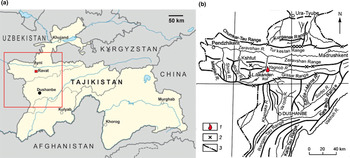
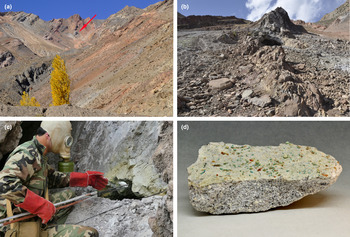
Falgarite was collected by the authors in 2016 in sublimates of a high-temperature fumarole of the natural underground coal fire at the tract of Kukhi-Malik (39°18′39″N, 68°58′64″E) near the abandoned Ravat village in the area of the Fan-Yagnob coking coal deposit. The latter is located within the Zeravshan–Gissar mountain ridge (Fig. 1) in the Yagnob river valley, Ayninsky district, Tajikistan, ~75 km north of Dushanbe. The Fan-Yagnob deposit is related to the Fan-Yagnob syncline, consisting of Triassic sedimentary rocks, coal bearing series of the Jurassic age and sedimentary rocks of the Cretaceous, Paleogene and Neogene age (Ermakov, Reference Ermakov1935; Okhunov, et al., Reference Okhunov, Yorov and Negmatov2017). There are both active and extinct underground coal fires in the area. The date of the first fires is not known for certain but is believed to be more than several thousand years ago (Ermakov, Reference Ermakov1935; Vadilo, Reference Vadilo1958; Smirnov, Reference Smirnov2011). From the Middle Ages to the 20th century, coal fire sublimates were mined for the extraction of ammonia and alum for export to other countries in Central Asia and Europe (Ermakov, Reference Ermakov1935; Vadilo, Reference Vadilo1958; Sharygin et al., Reference Sharygin, Sokol and Belakovski2009; Smirnov, Reference Smirnov2011; Okhunov et al., Reference Okhunov, Yorov and Negmatov2017). To date, more than 30 minerals are known from fumarolic sublimates and paralavas, represented mostly by sulfates, chlorides, sulfides, nitrates, silicates, native elements and organic compounds (Ermakov, Reference Ermakov1935; Vadilo, Reference Vadilo1958; Novikov et al., Reference Novikov, Suprychev and Babaev1979; Novikov and Suprychev, Reference Novikov and Suprychev1986; Belakovskiy and Moskalyov, Reference Belakovskiy and Moskalev1988; Belakovskiy et al., Reference Belakovskiy, Novikov, Pautov and Suprychev1988; Novikov et al., Reference Novikov, Suprychev and Salikhov1989; Belakovski, Reference Belakovski1990; Nasdala and Pekov, Reference Nasdala and Pekov1993; Sokol et al., Reference Sokol, Maksimova, Nigmatulina, Sharygin and Kalugin2005; Sharygin et al., Reference Sharygin, Sokol and Belakovski2009; Sharygin et al., Reference Sharygin, Sokol, Belakovsky, Stracher, Prakash and Sokol2014; Mirakov et al., Reference Mirakov, Faiziev and Pautov2017, Reference Mirakov, Pautov, Karpenko, Faiziev and Mahmadsharif2019; Pautov et al., Reference Pautov, Mirakov, Mahmadsharif, Karpenko and Faiziev2019). The new mineral was found in a fumarole with gases measuring temperatures >300°C. The fumarole with falgarite is located in a zone formed by the brecciation and collapse of burnt red–brown gritstone in a rocky outlet in the upper reaches of the Kukhi–Malik tract (Fig. 2). The air in the area is characterised by a strong smell of SO2. Sublimates with falgarite are deposited mostly on the inner side of the roof of the collapsed fumarolic cavity.
(a) Map of Tajikistan, highlighting the position of Ravat (red square). (b) Orography of Northwestern Tajikistan (after Shchukin, Reference Shchukin1936) Key: 1 – Active underground coal fires at Fan-Yagnob coal deposit; 2 – Mountain passes; 3 – Border of the republic of Tajikistan.

(a) The Kukhi–Malik area with underground coal fires with the red arrow pointing to the fumarole where falgarite was found. (b) The upper reaches of the Kukhi–Malik tract with rocky outcrops and high-temperature fumaroles. (c) Collection of the samples with fumarolic exhalative mineralisation. (d) Spherolites of falgarite (bluish-green) on the crust of sulfate sublimates on the burnt gritstone, field of view is 15 cm.

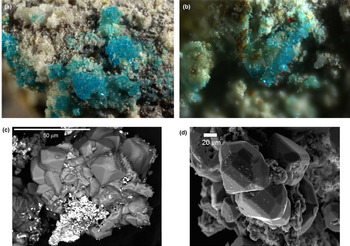
Falgarite forms small isometric or pseudo-octahedral individual crystals (10–60 μm) of turquoise colour and spherical aggregates up to 0.5 mm in diameter and overgrown on the white sulfate crusts (Figs 2, 3). Falgarite closely associates with anhydrite, baryte, molybdite, anhydrous Mg sulfates, and a number of poorly identified phases of Tl, V, K and Al. All the recovered samples were immediately packed and isolated when collected to avoid any contact with the external atmosphere.
(a, b) Falgarite (blue) in association with Mo oxides (olive), field of view is 1.2 mm. Back-scattered electron image (c) and secondary electron image (d) of falgarite crystals (grey) with small grains of Mo-oxide minerals (white).

Physical properties
Falgarite has a white streak and vitreous lustre. Cleavage and parting were not observed. The mineral is transparent. Hardness corresponds to 2–3 on the Mohs’ scale.
The density of falgarite was measured using immersion liquids under a microscope by equilibration of grains in a mixture of tribromomethane with dimethylformamide. D meas = 2.87(2) g/cm3 is in a good agreement with the calculated density D calc = 2.89 g/cm3, based on the empirical formula.
Optical properties
The optical properties of falgarite were studied in immersion liquids using polarising microscopes MIN-8 and POLAM R-213. Refractive indices of falgarite were measured using a Na-lamp with monochromatic light (589 nm). All of the used immersion liquids were previously checked using an IRF-454B refractometer. Measurement of the 2V angle was performed using Fedorov's stage with interference filters (maxima of the blue filter transmission = 440 nm, yellow = 589 nm and red = 650 nm).
In transmitted light falgarite is transparent, green with a weak pleochroism. Colour varied from bluish-green (Z) to light-green (X and Y). The absorption formula is Z > Y ≥ X. Measurements using Fedorov's stage in monochromatic light on eight grains in yellow light gave 2V(average) = +84(2) and variation from 76 to 90°, in blue light –2V = –88(2)° with variation from 88 to 87° and in red light 2V = +73(3)° with variations from from 68 to 78°. Thus, the optical sign changes from positive in yellow and red light to negative in blue. Dispersion is strong, v > r. Refractive indices are: α = 1.588(3), β(calc.) = 1.600(3) and γ = 1.609(2) (590 nm). For calculation of compatibility a corrected K p value of 0.253 for vanadyl was used (Mandarino, Reference Mandarino2005), which provides 1 – (K p/K c) = 0.033 (excellent).
In a short-wave and long-wave ultraviolet light falgarite does not show luminescence.
Infrared spectroscopy
In order to obtain an infrared absorption spectrum (IR), a powdered sample of falgarite was mixed with dried KBr, pelletised, and analysed using a Shimadzu IR-Fourier spectrometer with a resolution of 2 cm–1 and 150 scans at the Fersman Mineralogical Museum. The IR spectrum (Supplementary Fig. S1) of an analogous pellet of pure KBr was used as a reference.
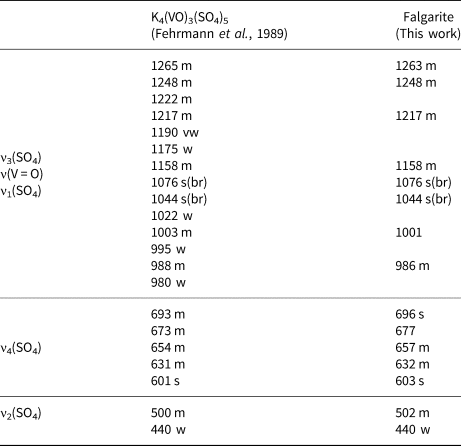
The infrared spectra of falgarite (Table 1) are similar to those of synthetic K4(VO)3(SO4)5 (Fehrmann et al., Reference Fehrmann, Boghosian, Papatheodorou, Nielsen, Berg and Bjerrum1989).
Infrared data for falgarite and synthetic K4(VO)3(SO4)5 (400–4000 cm–1 range)*.

* w = weak, m = medium, s = strong, vw = very weak, br = broad.
Chemical composition
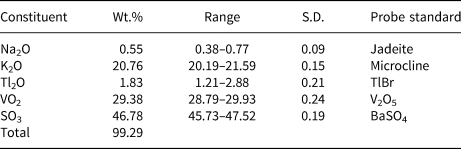
The chemical composition of falgarite (12 points) was studied using Si(Li) – energy-dispersive spectrometer (EDS) with ultrathin ATW-2 window and INCA Energy 350 (Oxford Instruments) at the accelerating voltage of 20 kV and probe current 1 nA with a 5–15 μm beam diameter at the Fersman Mineralogical Museum. The following standards were used: V(Kα) – V2O5; S(Kα) – BaSO4; Na(Kα) – jadeite; K(Kα) – microcline 107; and Tl(Lα) – TlBr. Wavelength dispersive spectroscopy could not be used because of the low stability of the mineral.
Analytical results are given in Table 2. The empirical formula (based on 23 O atoms per formula unit) is: (K3.76Na0.15Tl0.07)Σ3.98V3.02S4.99O23.0. The ideal formula is K4(VO)3(SO4)5. The mineral is non-soluble in H2O, ethanol and 5% HNO3 at room temperature; soluble in warm 5% HNO3 and in concentrated HNO3 at room temperature.
Chemical composition (wt.%) for falgarite.

S.D. = standard deviation.
X-ray crystallography
Powder X-ray diffraction
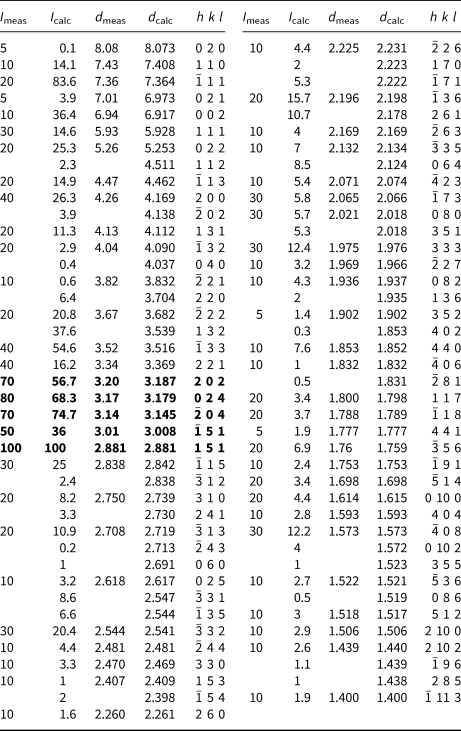
Powder X-ray diffraction data were collected using FeKα radiation and a Mn-filter in a RKU-86 camera; Ge was used as an internal standard. The results (in Å for FeKα) are given in Table 3. Unit-cell parameters refined from the powder data are as follows: monoclinic, a = 8.7109(4), b = 16.1411(2), c = 14.4436(6) Å, β = 106.688(4)° and V = 1945.2(1) Å3.
Powder X-ray diffraction (d in Å) data for falgarite.

The strongest lines are given in bold
Single-crystal X-ray diffraction
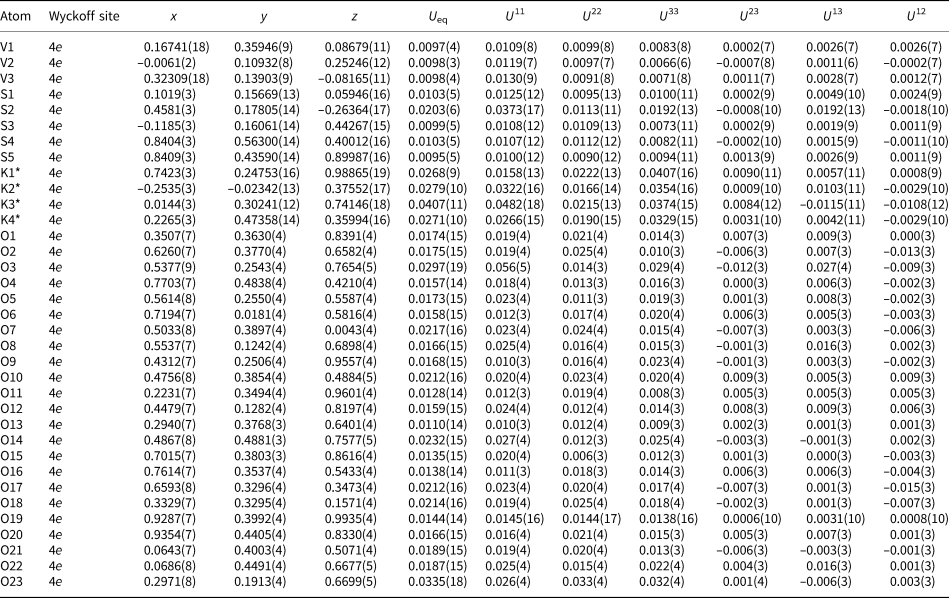
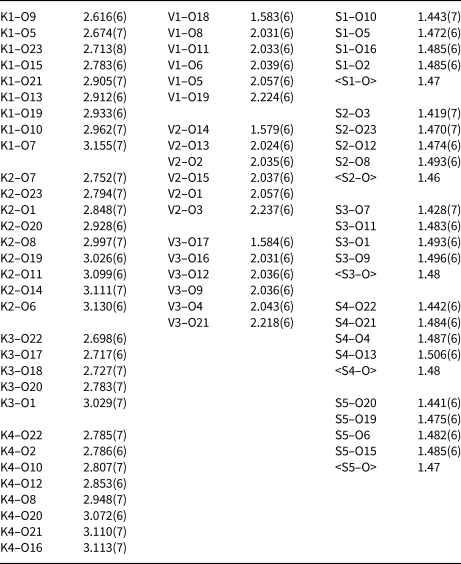
A transparent isometric crystal fragment of falgarite was mounted on a thin glass fibre for X-ray diffraction analysis using a Bruker APEX II DUO X-ray diffractometer with a Mo-IμS microfocus X-ray tube (λ = 0.71073 Å) operated at 50 kV and 0.6 mA at the Department of Crystallography, St. Petersburg State University. More than a hemisphere of three-dimensional XRD data was collected with frame widths of 0.5° in ω, and a 40 s count time for each frame. Then the collected data were integrated and corrected for absorption using a multi-scan type of model using Bruker software. Initial atomic coordinates for the crystal structure of falgarite were taken from the structure of the previously reported synthetic phase K4(VO)3(SO4)5 (P21/n, a = 18.746(2), b = 16.142(2), c = 14.416(2) Å, β = 106.81(1)° and V = 1948.25 Å3: Fehrmann et al., Reference Fehrmann, Boghosian, Papatheodorou, Nielsen, Berg and Bjerrum1989). The crystal structure was further refined (Table 4) in the P21/n space group to R 1 = 0.05 by using the SHELXL program (Sheldrick, Reference Sheldrick2015). The structure was refined as a 2-component perfect inversion twin. Occupancies of K sites were refined. During the refinement, it was found that Na is restricted mainly to the K1 site, whereas Tl is distributed over K2, K3 and K4 sites (Table 5). The resulting formula obtained during the structure refinement of the studied crystal of falgarite is (K3.90Na0.07Tl0.03)(VO)3(SO4)5. It is in a good agreement with the formula obtained by microprobe analysis (Table 1) and differs slightly in the amount of Tl and Na. However, the density calculated on the basis of structural data (Table 4) is nearly identical with the measured value of 2.87(2) g/cm3 reported above. Fractional atomic coordinates and atomic displacement parameters are listed in Tables 5. Selected interatomic distances are given in Table 6. The crystallographic information files have been deposited with the Principal Editor of Mineralogical Magazine and are available as Supplementary material (see below).
Crystallographic data and refinement parameters for falgarite.

Coordinates, isotropic and anisotropic displacement parameters (Å) of atoms in falgarite.

*Occupancies: K1 – K0.93(2)Na0.07(2); K2 – K0.992(2)Tl0.008(2); K3 – K0.983(2)Tl0.017(2); K4 – K0.994(2)Tl0.006(2)
Selected interatomic distances (Å) in falgarite.

Discussion
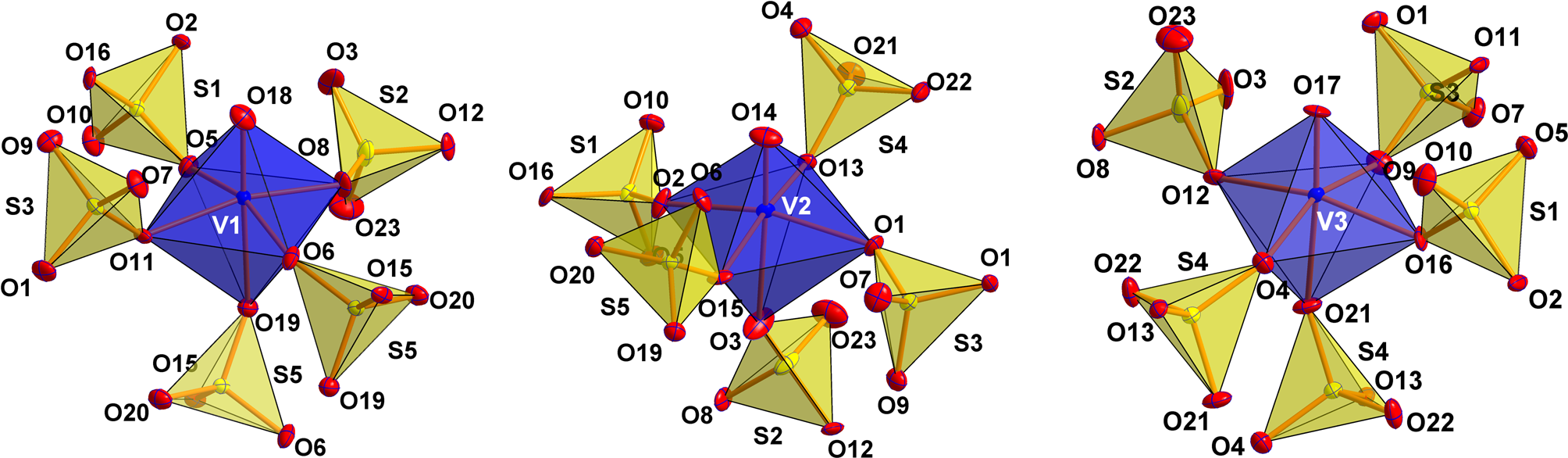
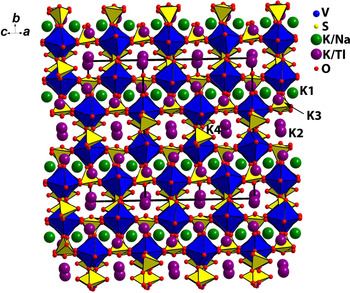
The structure of falgarite contains four symmetrically independent K sites, three V4+ sites and five S6+ sites (Table 6). K sites have mixed occupation (Table 5) and variable coordination environments. Three symmetrically independent V sites are each octahedrally coordinated by six O atoms. Each of the VO6 coordination polyhedra contains one short vanadyl V=O bond of ~1.60 Å, four intermediate V–O bonds in the range of 2.02–2.06 Å and one long V–O bond of ~2.2 Å, which is opposite to the vanadyl bond. The coordination of V4+ in falgarite is very typical for vanadium oxysalts (Schindler et al., Reference Schindler, Hawthorne and Baur2000). VO6 octahedra and SO4 tetrahedra link together by sharing corners (Fig. 4) thus forming the framework shown in Fig. 5. This [(VO)3(SO4)5]4– framework has not been observed previously in mineral crystal structures. However, the topology of framework in falgarite is simple. K+, Na+ and Tl+ cations are located in the channels of the framework.
Coordination environments of V and S atoms in the structure of falgarite.

General projection of the heteropolyhedral [(VO)3(SO4)5]4– framework with K sites in the channels in the structure of falgarite (K1 sites = green balls; K2, K3 and K4 sites = violet balls; VO6 polyhedra = blue; SO4 tetrahedra = yellow). Site-occupation factors for K sites are listed in Table 5.

Natural vanadyl sulfates of potassium are unknown but falgarite has a synthetic analogue: K4(VO)3(SO4)5 (Fehrmann et al., Reference Fehrmann, Boghosian, Papatheodorou, Nielsen, Berg and Bjerrum1989). Falgarite is the second known to date anhydrous vanadyl sulfate mineral after pauflerite VO(SO4) (Krivovichev et al., Reference Krivovichev, Vergasova, Britvin, Filatov, Kahlenberg and Ananiev2007). Recently, pauflerite was described from the same locality and another fumarole (Mirakov et al., Reference Mirakov, Pautov, Karpenko, Faiziev and Mahmadsharif2019). Currently, a novel anhydrous thallium vanadyl sulfate from the Kukhi–Malik tract is under study. An admixture of vanadium is often fixed in iron sulfates, which are widespread among sublimates of Kukhi-Malik, The vanadium source in the sublimates are both coals and host rocks – coal-bearing strata at Fan-Yagnob deposit are characterised by an approximately 5 times higher concentration of V in comparison to average values typical for the region (Okhunov et al., Reference Okhunov, Yorov and Negmatov2017). The crystallisation of anhydrous sulfates occurs in fumaroles in the Kukhi–Malik area in relatively high-temperature environments with gas temperatures >300°C. Oxidation of sulfur from SO2 to SO3 might be facilitated by the catalytic role of the molybdenum oxides widespread in fumarolic high-temperature assemblages.
Acknowledgements
We thank S.Yo. Yorov and R.U. Sobirova for their help in organising the fieldwork and M.A. Shodibekov and P.V. Khvorov for their help with the investigations. We are grateful to two anonymous reviewers and Peter Leverett for valuable comments. This work was financially supported by the Russian Science Foundation, grant no. 16-17-10085. Technical support by the SPbSU X-ray Diffraction Resource Centre is gratefully acknowledged.
Supplementary material
To view supplementary material for this article, please visit https://doi.org/10.1180/mgm.2020.22.