“In all of economic history, the foreigner appears everywhere as the trader, or the trader as foreigner.”Footnote 1
Hostile Exchanges
In January 1972, the German Democratic Republic (GDR) and Poland agreed to relax travel restrictions for ordinary citizens in an effort to “deepen the strength of fraternal relations between our neighboring countries, which are bound together by friendship.”Footnote 2 Inspired by the tradition of socialist internationalism, the new regulations were embedded in a broader attempt by eastern European countries to expand ties among their citizens.Footnote 3 This liberalization, which was unprecedented in the history of the Soviet Bloc, promised to improve relations among East Germans and Poles from the ground up, as personal encounters promoted cultural understanding and individual friendship.Footnote 4
If the numbers of tourists are any indication, the scale of cross-cultural exchange was breathtaking. In the first eleven months of 1972, the East German border police recorded more than 9 million Polish visitors to the GDR and 6.5 million East Germans to Poland.Footnote 5 In the course of nearly twenty years, congress between East Germans and Poles led to many friendships and about 10,000 marriages.Footnote 6
Yet this experiment in socialist internationalism failed dramatically. Although large numbers of East Germans and Poles took advantage of their new freedom to travel, tourism did not foster mutual understanding. Instead, it exacerbated longstanding animosities. Normally discreet within earshot of the police, East Germans were surprisingly vocal in their criticism of Polish tourists. Emotions ran high wherever East Germans encountered Poles, but especially at department stores in border cities such as Frankfurt an der Oder, Dresden, and Pasewalk.Footnote 7 Angry that millions of Poles were engaging in a kind of consumer tourism, traveling to the GDR in search of food and clothing that was difficult to find in their own country, many East Germans complained, as one man did, that the Poles “are buying everything out from under us.”Footnote 8
Of course, there was nothing sinister about the Polish demand for East German products. Although the GDR suffered, as did all Soviet-style economies, from chronic shortages of consumer goods, it was able to supply its population with comparatively more commodities than other planned economies could. Now that constraints on their mobility had fallen away, individual economic actors were free to respond to the asymmetry between East German supply and Polish demand. An analysis of net currency flows between the GDR and Poland confirms that most Poles were traveling to the GDR with the primary purpose of shopping, rather than for rest and relaxation.Footnote 9 Economic data collected by the Socialist Unity Party (SED), moreover, reveals that aggregate demand for a variety of East German consumer goods soared in the wake of the travel agreement—something that can only be explained by the addition of new consumers to the East German market.Footnote 10
In a capitalist economy, a comparable influx of tourists would most likely be welcomed as representing an increase in sales and therefore a stimulus to economic growth. After all, the political legitimacy of the market rests on the notion that trade is not a zero-sum game in which one participant wins at the expense of others, but rather that “voluntary exchange is always mutually beneficial” and therefore welfare-enhancing.Footnote 11 In contrast, the planned economy was constructed on the proposition that market transactions entail the exploitation of one party by another, not the least because capitalist exchange occurs under coercive circumstances. Against the background of relative economic deprivation and the state censure of market approaches to allocating resources, Polish purchases of East German goods were perceived by ordinary East Germans as depleting already short supplies and therefore threatening East German living standards.
Rather than celebrating Polish tourists as good neighbors, much less as good customers, then, East Germans treated Poles as economic interlopers. Many East Germans reacted to the contrast between the deficit of consumer goods and the “surplus” of Polish consumers by urging the SED to close the border again. One letter-writer argued for a closed national economy, saying that it was not “normal” for Poles to be able to buy such large quantities of consumer goods in the GDR. A man from Cottbus went a step further, moving from the category of the nation-state to the language of nationalism to register his protest: “We're experiencing a time when non-Germans are buying up all kinds of products of great value and then exporting them out of the country.”Footnote 12
In personal encounters with Polish tourists, East Germans were far less circumspect. GDR officials recorded numerous instances of East Germans insulting Polish tourists to their faces, screaming abuse at them, and using racialized language to denigrate them.Footnote 13 Some East Germans depicted Polish purchasing patterns as a form of looting, accusing the Poles of being a nation of thieves and comparing them to “hordes of locusts” who were stripping the GDR of everything of value. Other East Germans likened the “Polacks” to animals—“dogs,” “swine,” and “scum” who were “fouling up the place.” Still others physically assaulted their Polish guests.Footnote 14
One possible explanation for the hostile East German response lies in the vexed history of German-Polish relations. After all, the portrayal of Poles as a demographic inundation that threatened to leave nothing of value in its wake was not without historical precedent. East German fears of Poles “flooding” across the border recall similar anxieties about Polish mobility expressed in Imperial Germany. The labor migrations of the late nineteenth century, in which Poles from Russia and Austria sought seasonal employment on East Prussian estates, stimulated concern over the cultural integrity of the German East,Footnote 15 prompting prominent Germans, including the sociologist Max Weber, to demand state intervention in the labor market to “stem the Slavic tide.”Footnote 16
If some Germans were disturbed by Polish industriousness, others felt threatened by what they perceived as Polish indolence. Images of Poles as lazy yet cunning originated in the confessional tensions between Protestant Prussians and Catholic Poles. Even before Prussian participation in the dismemberment of Poland placed Poles under German administration, for example, we find mention of the derogatory phrase “Polish economy” (polnische Wirtschaft), which continues to be used by Germans to depict Poles as incapable of engaging in orderly and legitimate economic activity.Footnote 17 These accusations of lassitude were lent intellectual authority by scholars during the Enlightenment, such as the liberal philosopher Johann Gottfried Herder and the explorer Georg Forster, whose account of his voyages with Captain James Cook helped to popularize travel literature.Footnote 18 After the defeat of Napoleon, moreover, anti-Polish images also took on anti-Semitic associations, reflecting German anxieties about both Eastern Europe and the economic rationality embodied by capitalism.Footnote 19
Portraying Poles as shiftless yet shifty helped to justify German domination in the struggle over political and cultural boundaries between the two peoples. The task of constructing a German national state, for example, generated increasing support for what some historians have called “negative Polish policies,” or state-sponsored measures designed to deny Poles legal equality and impede their acculturation.Footnote 20 Given the colonialist attitude toward Eastern Europe that permeated political culture in Imperial Germany, moreover, it is not surprising that the Allied decision after World War I to resurrect the Polish state was met with widespread incomprehension and anger in Germany. Many agreed with the 1922 assessment of Army Chief of Staff Hans von Seeckt that “Poland's existence is unsupportable, incompatible with the conditions of Germany's survival.”Footnote 21 If Weimar politicians worked through diplomatic channels to undermine the post-war settlement in the East, the Nazis, whose path to power von Seeckt helped to pave, adopted a grotesquely violent approach to this rivalry over territory and identity. In particular, the Nazis drew on associations of race with economy to justify the brutal occupation of Poland during World War II, in which German forces murdered millions of Catholic and Jewish Poles.Footnote 22 A Wehrmacht pamphlet entitled German Order and Polish Economy, for example, legitimated German domination of Poles in colonial terms, arguing that the Poles have “a tendency toward kleptomania” and thus require a firm and disciplined German hand.Footnote 23 In keeping with this tradition of contempt for their eastern neighbors, it seems that many East Germans insisted on portraying Poles as lazy freeloaders who engaged in illegal economic activity while avoiding “real” work.Footnote 24
If East Germans were partaking of a discriminatory vernacular that had been in currency for some 200 years, recent history had greatly reinforced resentment toward Poles. Although German atrocities committed against Polish civilians during World War II provided the pretext, Germans on both sides of the Iron Curtain were incensed by the expulsion of some 8 million Germans from Polish territory. And while the integration of 4.3 million expellees in the GDR proceeded more smoothly than it did in the West, state censorship could only gloss over the smoldering resentments many East Germans nurtured against Poles.Footnote 25 Nor did the post-1945 “theft” of German territory by the Polish communist state endear Germans to their eastern neighbors. Indeed, Stalin's imposition of a territorial solution to Germany's unsettled eastern borders only fueled German irredentism and Polish anxiety. Thus, the new border was a target of popular criticism among East Germans during the uprising of June 17, 1953, and appears to have remained unpopular through the 1960s.Footnote 26 The SED's rather forced defense of the Oder-Neisse line only encouraged popular perceptions of the GDR as a foreign entity, imposed on Germany because of the outcome of World War II.Footnote 27
Even official relations between the SED and the Polish United Workers Party showed signs of strain, leading some observers to refer privately to what Polish leaders publicly termed the “house of friendship and cooperation” as a “compulsory friendship.”Footnote 28 Although Erich Honecker and Edward Gierek enjoyed more cordial relations than their predecessors, the legacy of German hostility toward Poles remained close to the surface. In the midst of celebrating Honecker's installation as First Secretary at the SED's VIII Party Congress in June 1971, for example, Gierek could not refrain from reminding his East German comrades that the Poles “have been struggling for more than one hundred years against the addiction to conquest and expansion of German militarism and imperialism.”Footnote 29
Given this history, it is possible to view expressions of East German hostility toward Polish tourists as overdetermined by the durability of anti-Polish sentiment. At any rate, East Germans seem to have interpreted the pattern of Polish commercial activity as revealing more about Polish disrespect for honest work than market forces or German prejudices. The power of ethnic hatred to affect the perception of economic reality is illustrated by East German anger over Polish smuggling: even though the disequilibrium between East German supply and Polish demand had created strong incentives for Poles to risk criminal charges and move East German merchandise into Poland, East Germans perceived it as a form of “Polish economy.” The precise amount of commodities smuggled over the border is difficult to determine, but indirect evidence based on items confiscated by East German customs officials hints at a remarkable scale of commercial activity. Nearly every one of the weekly reports compiled by the East German border police during 1972 contains examples of Polish citizens caught with surprisingly large quantities of consumer goods. One Polish tourist, for example, was caught trying to smuggle 103 kilos of raisins into Poland, while another was apprehended with 45 kilos of margarine, a product always in demand because of chronic butter shortages. Although most Poles were engaged in one-off attempts to supply their domestic market with scarce goods, some cases of smuggling appear to have involved more organized efforts to start up small businesses. One Pole, for example, tried—and failed—to sneak 2,325 artificial flowers past the border guards. Another Polish tourist was apprehended with 95 meters of fabric for men's suits, while a group of three tried to smuggle 145 kilos of grated coconut out of the GDR. Most impressively, one man was caught with 15 kilos of frosting, 1,700 ice cream cones, and 1,200 Belgian waffles—enough to open his own ice-cream store. Other smugglers tried to transport proscribed items out of the GDR, such as “cultural treasures.” In one case, the East German police intercepted 21,375 marks worth of antiques on their way to Poland, most likely for sale to third parties at a nice profit.Footnote 30 To fund this illegal trade, a black market for East German marks quickly emerged.Footnote 31
The impression that Poles were engaged in crooked behavior at the expense of East Germans was lent superficial credibility by the fact that Polish purchasing patterns focused on specific consumer goods. To give just one example among many, the sales staff at a lingerie store in the East Berlin neighborhood of Köpenick estimated that sales to Polish citizens accounted for nearly twenty-five percent of total turnover for 1972.Footnote 32 Yet the entrepreneurial spirit of their Polish neighbors, who were struggling with similar problems of supply and demand, evoked no sympathy from East Germans. Instead, Polish shopping sprees fueled fears that the trickle of consumer goods for sale in the GDR would be exhausted before it reached East German hands.
Of course, Polish consumers were not the only ones responding to the opportunities created by the asymmetry between supply and demand. East Germans were also attracted by the prospect of profit across national borders. One East German woman, for example, was apprehended at the border with forty-seven thermometers and twenty-five bicycle locks, which she was trying to sell to finance her vacation. Other East German smugglers tried to move small amounts of jackets, sweaters, electric heaters, and even toilet bowls into Poland.Footnote 33 Like their socialist neighbors, moreover, East Germans also engaged in consumer tourism, traveling to Poland in search of consumer durable goods, such as car parts, that were difficult to obtain in the GDR.Footnote 34 Price and exchange rate differentials, moreover, meant that some Polish goods, such as gasoline, were cheaper for East Germans than for Poles.
While specific traditions of ethnic animosity varied from country to country and region to region, the distributional conflicts engendered by the planned economy were similar across Soviet-style regimes.Footnote 35 The Polish reception of East German tourists, for example, was no less hostile than the welcome East Germans extended to Poles, and was lodged in similar anxieties about the competition for scarce resources. In response to taunts about Polish binge buying, for example, one Polish visitor to the GDR reprimanded his East German hosts for their hypocrisy. “You aren't any better,” he observed. “You come in with whole fleets of empty gas tanks and buy up all of the gas.”Footnote 36 Given that the memory of World War II remained uppermost in people's minds, it is not surprising that his comment portrayed the stream of German tourists into Poland as a military invasion.
Although the source of this conflict lay in the shortages of consumer goods created by economic planning, cultural perceptions mattered more than material reality. It is clear, for example, that the economic meaning of smuggling was lost on East Germans. Liberal economic theory accounts for smuggling by pointing out that traders will always take advantage of unequal prices in different markets. On this interpretation, these Polish smugglers were reducing transaction costs across markets, and thus engaged in a form of market integration—an emerging common market that appalled many East Germans. Ironically, the ideological climate of the GDR—a political culture that presented trade as exploitation and merchants as parasites—provided convenient cover for traditional prejudices against Poles.Footnote 37
The depth of attachment to the German national state as well as the ethnic hatred revealed in the abuse East Germans heaped on Polish tourists represented an important challenge to communist authority. According to an official East German handbook, the phenomenon of racism was confined to capitalist societies, which “justify the barbaric oppression, plundering, and extermination of specific classes, political groups, and entire peoples by using the non-scientific methods of biologicalism [Biologismus].”Footnote 38 As proof of this premise, the East German press constantly represented West Germany as a haven for fascists and racists.Footnote 39 In contrast, the organization of the East German economy according to socialist principles had allegedly removed the grounds for discrimination of all kinds, prompting the SED to claim that socialist internationalism had triumphed over local prejudice.Footnote 40 As Wolfgang Kirkamm, a leader of the communist youth movement, declared in September 1989, “the social roots of fascism and anti-Semitism, racial discrimination, and xenophobia have been eliminated in the socialist German Republic, forever, once and for all.”Footnote 41
Of course, the violence directed at foreigners by East Germans during the 1980s and 1990s has cast a pall of doubt on this claim. Scholars have advanced a variety of arguments to explain the persistence of racism and xenophobia among East Germans, most of which emphasize ideology and politics. Some commentators locate the source of the SED's failure to supplant older traditions of ethnic hatred with a more internationalist outlook in its autocratic appropriation of anti-fascist thought.Footnote 42 Thus, the lack of debate in the GDR permitted a variety of prejudices to churn just below the apparently placid surface of the communist regime's anti-racist rhetoric.Footnote 43 Other observers argue that the tendency of East Germans to identify foreigners with communist authority helped legitimate xenophobic attitudes.Footnote 44 Popular perceptions of the GDR as a Russian imposition, for example, facilitated a tendency to view all foreigners as suspect.Footnote 45 Nor did the fact that Poles owed their ability to visit the GDR to the SED, which had certainly not consulted with ordinary East Germans about opening the borders, do much to endear them to the populace.Footnote 46 To this list of ethnic and national rivalries, one might add the category of confession, since the incomplete de-Christianization of Eastern Europe under communist control did little to mitigate residual antipathies between the primarily Protestant East Germans and the primarily Catholic Poles. Given the paucity of contact between East Germans and foreigners, then, the possibility of breaking though such stubborn prejudice was severely constricted. In an environment so hospitable to intolerance, a brief encounter at the cash register was hardly likely to promote solidarity among peoples.
Market Failure
While these and other arguments have made short shrift of the facile explanations of East German xenophobia circulated by West German journalists and politicians, they overlook another source of hostility toward foreigners, one that helps to distinguish the culture of economic activity in Soviet-style regimes from that of their liberal democratic competitors.Footnote 47 In both planned and market economies, enmity toward “outsiders” derives its specificity from local histories of ethnic conflict, which may be instrumentalized by social groups or the state to further other ends. What differs is the source of economic friction that serves to provoke or legitimate ethnic hatred.
In capitalist economies, competition on tight labor markets aggravates xenophobic tendencies among the ethnic majority. Far from creating working class solidarity, as Marx and Engels had predicted, the process of industrialization encourages even the most “progressive” elements of society to view foreigners as economic competitors.Footnote 48 At the SPD's 1907 Party Congress, for example, delegates demanded legislation designed to prevent the importation of “workers from backward races”—that is, Polish migrant laborers—because they allegedly depressed wages.Footnote 49 Similarly, the influx of Chinese laborers to the United States in the nineteenth century gave rise to repeated calls for state intervention in the labor market to prevent jobs from being “stolen” by Asian immigrants.Footnote 50
A more recent example involves West German resentment of foreigners during the economic slowdown of the 1970s and 1980s. Ordinary West Germans wrote hundreds of thousands of letters to their political representatives, often indulging in racist invective to protest the presence of so-called “guest workers,” as well as Poles of German descent, on the grounds that they were “stealing” jobs from West Germans.Footnote 51 In other words, unemployment gave rise to criticism of state strategies for offsetting the effects of market failure and to calls for the redistribution of scarce resources, from jobs to subsidized housing, along ethnic lines. Rather than explaining the benefits of labor migration, West German governments tried to appease racist sentiment without intervening in the labor market. The Social Democratic chancellor Helmut Schmidt, for example, introduced legislation in 1981 aimed at reducing the birth rate of resident foreigners by preventing marriage among them.Footnote 52
Similarly, the competition for scarce resources in Soviet-style regimes provided political cover for xenophobic solutions to economic problems. In the East, however, these anxieties focused not on production, but on consumption—not on labor, but on retail markets. The chronic excess demand for consumer goods characteristic of planned economies heightened the sense among local populations that foreigners were economic interlopers, competing with them for scarce resources.Footnote 53 Thus, local objections to the workers imported from socialist allies in the developing world (which in the GDR included more than 90,000 Vietnamese, Cubans, Mozambicans, Algerians, Angolans, and Namibians during the 1980s) focused on the failure of the retail market: not on competition for jobs, but on the consumer privileges foreign workers were alleged to enjoy.
At times, the ruling communist party would exploit the structure of these resentments to displace popular anger over enforced underconsumption onto unpopular ethnic groups, especially Jews, gypsies, and Muslims.Footnote 54 For this reason, some authors have attributed a cynical manipulation of popular racism to the SED under Erich Honecker.Footnote 55 In fact, however, the East German party did not begin to exploit xenophobia as a force for political integration until the 1980s.
Indeed, the SED leadership was surprised by the uniformly hostile welcome that the East German populace extended to their socialist allies in 1972. In a closed meeting with senior party members, Horst Sindermann, who was then Chairman of the Council of Ministers, conceded that “we were not prepared for this and did not demonstrate that we were able to handle this situation. There are resolutions with anti-Polish tendencies.”Footnote 56 He warned that the new travel policy had compromised what little support the new SED leadership might enjoy, saying “it is unsettling that the mood is getting worse in the districts and that the population [has little] understanding for the government.” Something had to be done to reduce tensions, he concluded, because “we cannot afford a political demonstration.”
While his analysis of the crisis reveals no sympathy for the East German population's conflation of ethnicity with economy, Sindermann's comments did echo popular fears about the material ambitions of Polish tourists. In a peculiarly German insistence on the difference between Schein und Wirklichkeit (appearance and reality), Sindermann expressed the concern that Polish tourism was encouraging East Germans to value the GDR's material wealth over its cultural treasures. He became particularly indignant, for example, over an official East German guide for Polish tourists because it failed to mention “the Pergamon altar and other museums in the capital, but instead it lists shops that sell fabric.”
Despite Sindermann's concerns, however, the party leadership took no immediate action. In the absence of clear signals from above, lower-ranking representatives of the East German state introduced measures aimed at constraining Polish tourists. One store manager in Köpenick, for example, confined Polish tourists to purchases of a maximum of forty marks.Footnote 57 Other stores simply refused to sell any merchandise to Poles. At the Centrum Warenhaus, one of the largest department stores in East Berlin, the sales personnel
no longer … leave industrial products of high quality out on the sales floor because they immediately disappear. They leave some [consumer goods] in the stockroom and only retrieve them when they need to and for clients they already know.Footnote 58
Ironically, East German retailers responded to Polish demand by reinforcing the very system of distributing consumer goods via privilege and personal ties that many East Germans viewed as the main source of social injustice in the GDR.Footnote 59 Rather than holding the communist leadership responsible for the consequences of its economic mismanagement, however, East German shopkeepers chose to single out an ethnic group for blame. That is, they misidentified the disequilibrium between supply and demand with cultural difference.
In discussions with party officials, service sector personnel sought to justify their hostility to Poles by cloaking it in the mantle of communist ideology. The store manager in Köpenick, for example, rationalized his boycott of Polish customers by assuring the representative of the Central Committee interviewing him of his “basically positive attitude toward tourism.” He then proceeded to castigate Poles for indulging in “uninhibited buying sprees.”Footnote 60 It was this lack of control, he argued, that elicited “anti-Polish statements,” rather than popular racism or the party's economic mismanagement. Not content with blaming the victims for provoking the economic discrimination directed at them, the manager suggested that the Poles, who were too primitive to control their appetites, had transgressed against the egalitarian ideals of the planned economy.Footnote 61 Derogatory statements about Poles were understandable because East German
customers, who have been looking for specific goods for a long time, do not receive them, and then see the purchases of Polish tourists that clearly exceed the needs of one person.Footnote 62
In an economic environment marked by shortage, the “excessive” act of purchasing more goods than one individual requires appears as socially unjust because it disturbs the equitable distribution of deprivation.Footnote 63 Rather than define this community of need along racial lines and risk censure, however, the store manager invoked the socialist state's suspicion of the sales act to deny Polish participation in the (East German) circulation of goods.
Forced into action by an alarming loss of control over events, SED leaders responded, as they often did, by combating the symptoms of the problem rather than addressing its causes. In the border city of Görlitz, party officials ran a pilot project that put key East German commodities beyond Polish reach by selling them through factory stores. But the project was dropped when the inhabitants of Görlitz, who feared it would provide the state with an excuse for further reductions in the supply of consumer goods, greeted the measures with hostility. As a Central Committee report paraphrased the population's response, “better you should check the Poles carefully so that they do not cart everything away.”Footnote 64
True to its authoritarian instincts, the SED took this advice and turned to the police to crack down on Polish economic activity. Beefing up border security, however, did little to address the cause of smuggling, which lay in the shortages of consumer goods. The effectiveness of East German police work, moreover, was contingent on the vigilance of their Polish comrades. To increase cross-border cooperation, the SED began teaching Polish to East German guards and even arranged soccer matches between East German and Polish patrolmen.Footnote 65 But as the Chief of the Border Police reported in a remarkable understatement, work with his Polish counterparts “was not without difficulties.” The Polish police had little incentive to stop the flow of goods across the border, and instead consistently sought more generous customs arrangements for Polish tourists.Footnote 66
While much of the SED leadership was taken aback by the uniform rejection of its open border policy, the planning apparatus agreed with the popular assessment that the influx of Polish tourists represented an added economic burden. The suspicion of market mechanisms that shaped the thinking of economic planners prevented them from understanding Polish shoppers as constituting a demand-pull that might contribute to East German economic growth. Instead, planners objected to the strain Polish tourists placed on the GDR's method of redistributing social wealth. At issue were the subsidies used by the SED to make a variety of consumer goods available to East Germans at low prices, such as food. On this view, Polish tourists were benefiting from an economic policy that was not intended for them, since they had not helped to create the social wealth that paid for the subsidies.Footnote 67 As free riders in the East German economy, Polish shoppers revealed the limitations of the party's policy of subsidizing goods instead of people.Footnote 68 Economic planners, however, argued that additional Polish demand transformed every sale into a fiscal burden that impoverished the East German state.Footnote 69 According to Economic Secretary Günter Mittag, for example, the “losses of commodities because of visitors and tourists” cost the GDR 1.1 billion East German marks a year.Footnote 70 Mittag's solution was not to discipline Polish demand, but to punish it. When the GDR experienced a shortage of sugar during the summer of 1976, he responded by criminalizing Polish purchases of sugar.Footnote 71 It was only after the border was closed in response to popular unrest in Poland during 1980 that the pressure of Polish demand on East German supplies let up. As the Institute for Market Research in Leipzig noted with relief in 1981, “more merchandise is available for supplying the population as a result of the decline in purchases by Polish tourists.”Footnote 72
Most party leaders—including Honecker himself—resisted employing ethnicity as a category of analysis. At a meeting with his advisors in September 1988, Honecker interrupted former Economic Secretary Werner Krolikowski, who had suggested that retailers refuse to serve foreigners, to point out that “one cannot tell the difference between foreigners and citizens of the GDR in department stores.”Footnote 73 Nevertheless, the climate of economic austerity that prevailed in the Politburo during the 1980s, when the GDR would nearly default on its debts to the West, reinforced the arguments of the party's economic wing, which increasingly sought to blame foreigners for its own failures.
In addition to economic leaders, security officials indulged in xenophobic argumentation to disclaim responsibility for their inability to prevent smuggling. In one particularly egregious instance, the Stasi painted a lurid portrait of international Jewish conspiracies seeking to subvert communist power with the help of finance capital, while “bands of gypsies” roamed the GDR selling capitalist contraband, exploiting their deviousness by day and their darkness by night to confound Stasi agents.Footnote 74 Of course, smuggling could not have existed without East German customers, but this uncomfortable fact posed an insurmountable interpretive impediment for security officials. After all, the security apparatus could hardly attribute East German participation in black markets to economic opportunity. Such an analysis would have constituted an admission that trade driven by the profit motive existed in the GDR, and, worse still, that the police could not control it. Instead, the police once again looked to character traits to explain economic behavior, dismissing hundreds of thousands of East Germans involved in smuggling as marginal personalities marked by “profit-seeking, unstable, criminal, and in part asocial” qualities.Footnote 75
By the mid-1980s, however, xenophobic explanations for the GDR's economic instability had found their way into mainstream party discourse. Party leaders increasingly disregarded their own protestations of international solidarity with other peoples and, taking a page from the economic experts, began blaming them for the shortages of consumer goods. The party's internal correspondence reflected this shift in thought, as reports increasingly argued that purchases by foreigners were “endangering” the supply of various goods. More importantly, party officials began making these arguments in front of East Germans, who continued to complain about Polish “rings of swindlers” (Schieberringe)—despite the fact that the SED had closed the GDR to Polish tourism after the Polish party's declaration of martial law in December 1981.Footnote 76 In the months before Christmas of 1988, for example, the Central Committee issued a directive to retail stores located near border areas to restrict their sales to foreigners, and even sent party officials to assist stores in refusing to serve foreigners.Footnote 77
Nor did the new SED leadership under Egon Krenz, which ousted Honecker in October 1989 under the pretext of liberalizing the GDR, shrink from using prejudice to prop up the failing regime in the winter of 1989. Even before the collapse of the Berlin Wall on November 9, these “reform communists” held foreigners—and Poles in particular—responsible for the rapid deterioration of the East German retail market, rather than the SED's economic mismanagement.Footnote 78 To shore up support for the SED's rapidly disintegrating authority, the new leadership ran articles in Neues Deutschland, the main party newspaper, simultaneously decrying the signs of xenophobia accompanying the revolution while fueling fears of foreigners by suggesting that tourists were plundering the GDR and that thousands of Poles were seeking to settle in East Germany.Footnote 79
Foreign Exchange
The conflation of ethnicity with economy intensified during the 1980s, when xenophobic sentiment, now directed primarily at the tiny minority of non-Europeans living and working in the GDR, took on increasingly violent expression. In contrast to the history of friction with their eastern European neighbors, Germans had little direct experience with the Mozambicans, Namibians, Cubans, and Vietnamese who by the 1980s made up the bulk of the foreign labor force. This is not to argue that African, Afro-Caribbean, and Asian migrant workers arrived in a land without preconceptions about people of color. On the contrary, the legacy of the German colonial past, which consistently cast blacks and Asians in positions of subservience based on their alleged cultural and material inferiority, continued to thrive well after the Treaty of Versailles stripped Germans of their colonial possessions.Footnote 80 In the GDR, racialized clichés of black sexual potency and laziness and Asian economic discipline and deviousness continued to circulate below the regime's patina of internationalist rhetoric. And although these non-Europeans came to work in the GDR, it was competition for scarce consumer goods, rather than competition for jobs, which were hardly in short supply, that mobilized popular resentment.
If the economic sources of ethnic tension were similar, however, the non-European case differs from the Polish case in several respects. First, the statistically negligible number of Africans, Afro-Caribbeans, and Asians living in the GDR, in contrast to the millions of Poles who came and went, only rendered these migrant workers more vulnerable to the fears and resentments of East Germans, which had little to do with their foreign guests and everything to do with East German identity and economy. Second, the invitation extended to Mozambicans, Namibians, Cubans, and Vietnamese to work in East Germany was not cultural in nature or political in aim, nor was it an exchange of equals. Rather, it was motivated by the GDR's increasingly desperate need for surplus labor, and the official treatment of non-Europeans bears all the marks of a ruthless bureaucratic parsimony. Finally, what facilitated popular violence against blacks and Asians was the way in which the party's economic cynicism converged with its barely concealed disdain for people of color. Whereas the party initially steered clear of past prejudice in the Polish case, the SED's approach to its non-European allies was condescending and exploitative from the start. The party's discursive condemnation of imperialism, for example, hardly prevented it from adopting an explicitly paternalist attitude toward developing nations. As Anna Saunders has pointed out, “the GDR saw itself as a big brother helping less fortunate countries in the struggle for socialist freedom, and presented itself at least implicitly as superior to these states.”Footnote 81 To this specifically East German dimension we might add the paternalism at the heart of Marxist-Leninist economic theory, whose notion of developmental progress necessarily views non-capitalist societies as “backward” and in need of European tutelage.
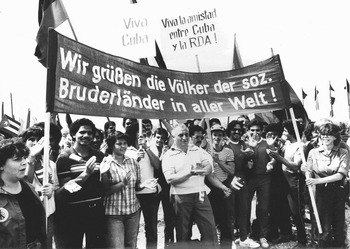
As it had in the travel agreement with Poland, the SED couched its attempts to recruit labor from the GDR's socialist allies in the Third World in internationalist terms (Figure 1). In 1980, for example, the GDR and the People's Republic of Vietnam signed a treaty aimed at transferring people and ideas from the First to the Third World. “Impelled by the wish to deepen the fraternal cooperation between both states,” the agreement provided for several thousand Vietnamese to receive training in the GDR for a period of up to five years.Footnote 82 Formulated “on the basis of mutual interest,” the treaty claimed that both socialist states would benefit from the arrangement—Vietnam from the transfer of knowledge and skills key to its industrial development and the GDR from strengthening ties between socialist states. The agreement offered an alternative to integration in the capitalist trading system, which seemed to promise both economic servitude and developmental stagnation. According to one political handbook, for example,
the imperialist so-called development aid policy, which aims to solidify the economic dependence of developing countries on capitalist industrial states, often former colonial masters, helps maintain the relation between exploitation and discrimination, and thereby the most important socio-economic basis of racism. Racism is now, as it was before, a part of the aggressive imperialist ideology and war policy as well as an instrument of class domination.Footnote 83
In contrast, integration into the socialist world precluded the predatory extraction of economic resources, since it was “based on the principles of equality and observation of national independence, on the principles of socialist internationalism, mutual aid, and fraternal cooperation.”Footnote 84
More than 3,000 East German and Cuban workers proclaimed “their indissoluble friendship with the Cuban people” on July 26, 1983, in Halle (Bundesarchiv Koblenz, Bildarchiv, 183/1983/0726/33).

In fact, however, Marxist-Leninist practice revealed itself to be every bit as rapacious as its capitalist competitors. Rather than displaying solidarity with their socialist allies, the East German authorities sought to exploit the asymmetries of power inherent in these relationships for economic gain. To take up the example of “development aid,” the GDR did provide some financial assistance to developing countries in the socialist camp in the form of direct payments, loans, and price discounts.Footnote 85 Despite the SED's protestations of moral and financial support, however, most of this aid was constructed so as to improve the GDR's balance of payments.Footnote 86 The loans granted to developing countries, for example, were often earmarked for the purchase of East German products that East German consumers had refused to buy. In contrast, when the GDR purchased raw materials from its allies, it sought to pay in non-convertible currency, which was worth far less than hard currency, especially to developing nations. These transactions benefited the GDR, which was strapped for western cash, while tying its business partners more tightly to the commercial and political interests of the Soviet Bloc. Because the Cuban government was willing to accept payment in non-convertible currency, for example, the SED imported oranges from Cuba, even though most East Germans preferred the taste of North African oranges.Footnote 87 Particularly attractive to East German economic experts were barter arrangements because they sidestepped monetary transactions entirely while preserving the gap in economic development in the GDR's favor. In this manner, the GDR could press its technological advantage and exchange its machines for raw materials at great savings.Footnote 88
Even the financial arrangements governing the transfer of labor between developing countries and the GDR reflected an imperialist posture. Rather than ensuring “trust and equality between the workers of different nations and countries, the unity of their actions, and solidarity, mutual aid, and support in struggle,” for example, the GDR refused to compensate non-European states for the transfer of labor at the same level as European states.Footnote 89 In fact, the SED viewed foreigners working in the GDR as an opportunity to make money. In 1989, a report to the Secretariat of the Politburo estimated that the GDR earned an average of 6,500 East German marks annually on each Vietnamese worker. Given that there were more than 60,000 Vietnamese migrant workers in the GDR by 1988, this was a tidy sum.Footnote 90
East German planners earned this money by shortchanging foreign workers in a variety of ways. The terms of the treaty with Vietnam, for example, provided for the GDR to ship the belongings of Vietnamese migrant workers at no charge when the time came for them to return home. In the summer of 1989, the Office of Labor and Wages found an ingenious way to circumvent the treaty and recoup the shipping costs: it required returning Vietnamese workers to purchase special shipping boxes at a cost of between 350 and 500 marks, or nearly a month's wage.Footnote 91 The East German state also cut corners by providing foreign workers with cramped quarters in low-quality housing units.Footnote 92 Even after the Vietnamese government intervened to negotiate improvements, East German authorities continued to house Vietnamese workers in overcrowded conditions, with five people to a room twenty-five square meters in size.Footnote 93 Forced to live at close quarters, foreign workers suffered from a lack of privacy. In one housing unit, for example, forty Cuban women lived on top of each other, sharing five stoves and trying to create the illusion of privacy by dividing their space with cloth curtains.Footnote 94 Nor did East German authorities expend resources to maintain the residences. As a result, living conditions deteriorated, eventually prompting the Cuban government to refuse to send workers to the GDR because the dormitories posed a danger to the health of its citizens.Footnote 95
But East German leaders did not import labor from the developing world simply because they could bend political power to financial advantage. Rather, the SED recruited foreign workers in the hopes of relieving the tight East German labor market. Like other Soviet-style regimes, the GDR suffered from chronic labor shortages because the planned economy created incentives to hoard labor rather than invest in labor-saving devices. On the one hand, the ideological imperative of full employment encouraged managers to ignore the cost of surplus labor to the production process. On the other hand, managers found additional workers a valuable resource when production deadlines imposed by the center had to be met, deploying all available labor, often around the clock, to fulfill the plan.Footnote 96
By the 1980s, Soviet-Bloc countries had discovered in their non-European allies a source of surplus labor.Footnote 97 In East Germany, the decision to import foreign workers on a large scale was reinforced by the parlous state of the GDR's capital stock. Because the SED under Honecker preferred the short-term strategy of relieving shortages by purchasing consumer goods to the long-term strategy of investing in capital goods, East German industry had aged terribly. By 1989, seventy-five percent of all equipment in the East German manufacturing, mining, and energy sectors was more than twenty years old.Footnote 98 Employing migrant workers seemed an attractive stop-gap measure to compensate for the GDR's aging fixed capital. After tentative efforts to import foreign labor in the 1960s and 1970s, Economic Secretary Günter Mittag conceived a more aggressive plan in 1987 for conscripting a more substantial number of foreign workers to prop up the ailing East German economy.Footnote 99 While there were 24,098 foreigners working in East Germany in 1981, the number had soared by 1989 to 93,562.Footnote 100
Perhaps more importantly, however, the GDR's declining economic fortunes transformed the pool of migrant labor from a European to a non-European workforce. Labor transfers to the GDR began with small numbers of Polish and Hungarian workers in the 1960s. By the mid-1970s, however, it had become increasingly difficult for the GDR to recruit Polish and Hungarian workers, not least because the GDR's deteriorating industrial infrastructure made working conditions comparatively harsh.Footnote 101 To satisfy its growing appetite for labor, the GDR was forced to cast a wider net. Because of the larger disparity in per capita income, the GDR was able to attract large numbers of workers from its allies in the developing world. By 1988, not only were most migrant workers non-European, but most of them were Vietnamese.Footnote 102
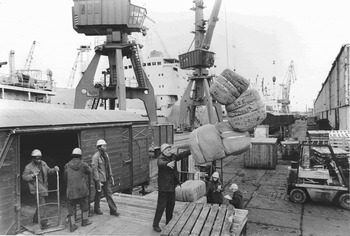
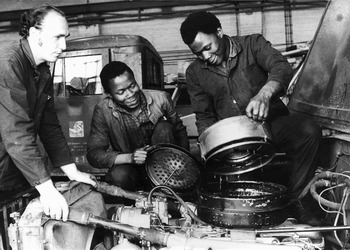
Despite its avowed internationalism, moreover, the SED allowed the needs of East German industry to take precedence over its anti-imperialist mission, which included narrowing the developmental disparity by transferring knowledge to its non-European allies through technical training. Although the agreements signed by the GDR with developing nations stipulated that migrant workers were supposed to receive vocational training, East German factories needed manual laborers to replace moribund machines. Most foreign workers were used by managers for unskilled jobs, such as unloading shipsFootnote 103 (Figure 2). Exceptions to this rule were also dictated by the needs of East German industry. Thus, some non-Europeans were put to work as mechanics by the automobile industry because of a shortage of skilled workersFootnote 104 (Figure 3).
Mozambican workers being “trained” as dockworkers in Wismar, December 6, 1983 (Bundesarchiv Koblenz, Bildarchiv, 183/1983/1206/2).

Mozambican workers at VEB Braunkohlenkombinat Senftenberg, near Cottbus, July 11, 1983. The official caption read, “The experienced machinist Horst Grosa gives Eugenio Pelemebe and Bernado Muchanga advice on maintaining automobiles. At the end of August, the young men will return to their homeland with the thorough knowledge and abilities of skilled workers” (Bundesarchiv Koblenz, Bildarchiv, 183/1983/0711/7).

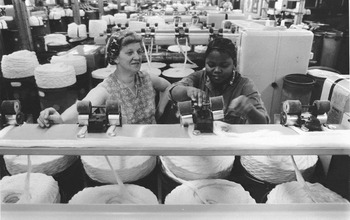
Moreover, the work migrant laborers were asked to perform can only be described as arduous and socially unattractive—precisely the kind of work that East Germans were keen to avoid. Often, their workplace was characterized by unhygienic conditions and defective or broken machines. In the automobile industry, for example, many Vietnamese were put to work painting new cars, a low-skill job that exposed them to noxious fumes. In the mid-1980s, moreover, Dresden requisitioned Polish, Vietnamese, and Mozambican workers to staff the meat processing industry. Unsanitary conditions and a lack of equipment, from refrigerated trucks to butcher's knives, had made the work so unpleasant that the industry was unable to retain East German workers.Footnote 105 The SED's apportioning of jobs also reinforced gendered work roles. Despite the socialist state's emancipatory rhetoric, East German officials did not hesitate to place women in work environments that were identified in industrialized nations with traditionally female occupations, such as the textile industry, and men in male-identified jobs, such as the auto industry (Figure 4).
“Here in the spinning division at the Leipziger Baumwollspinnerei, knitter Martha Hörig supervises the Mozambican Aeziro Francisco from Maputo,” Leipzig, May 2, 1981 (Bundesarchiv Koblenz, Bildarchiv, 183/Z0502/3).

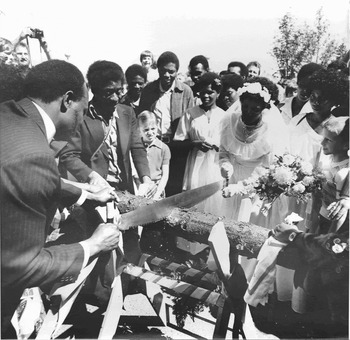
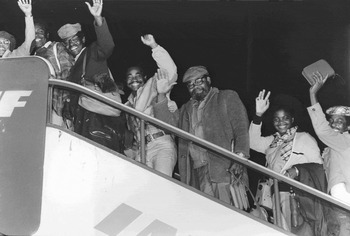
The party's deployment of migrant labor in low-status jobs fit in well with colonialist associations of dark skin color with unskilled labor in service to white culture. Nor did the SED's unwillingness to integrate foreigners into East German society do much to acquaint East Germans with the workers living in their midst, with their culture, or with the reasons they had come to the GDR. The East German press, for example, rarely mentioned the presence of foreigners in the GDR. The few reports that did appear only reinforced various stereotypes, such as the alleged discipline of Asian workers, or emphasized the superiority of German culture, such as depictions of Africans eagerly imitating German wedding customs (Figure 5).Footnote 106 Where the media did not try to diminish cultural difference to render non-Europeans less threatening, it pandered to popular resentments against outsiders. One photograph carried by Neues Deutschland, for example, reassured East Germans that all foreigners would eventually leave the GDR (Figure 6).
“A little while ago, tourists in the Thuringian spa of Oberhof experienced a wedding—Namibian style (eine Hochzeit auf namibisch). Berta Ita and Sacky Shilongo exchanged the yes-word at the courthouse where they are temporarily living and learning. As a sign of togetherness, the newly minted couple (das frisch gebackene Ehepaar) had to saw through a log on a sawhorse in keeping with Thuringian tradition,” Oberhof, Suhl district, August 3, 1981 (Bundesarchiv Koblenz, Bildarchiv, 183/Z083/31).

“Berlin: Solidarity. More than 100 Namibian patriots returned to their homeland after three years of vocational training in the GDR. In numerous educational facilities throughout the Republic, they received thorough vocational training that was denied them in Namibia, which is illegally occupied by the South African racist regime,” Berlin, August 28, 1981 (Bundesarchiv Koblenz, Bildarchiv, 183/Z0828/24).

Despite their low public profile, foreigners living in the GDR were subjected to an intense and intrusive surveillance by a variety of authorities. On the one hand, they lived under the rigorous control of supervisors, translators, and secret police officers from their home countries, whose watchful gaze was intended to encourage ideological conformity. Mozambican officials, for example, used the East German sojourn of their citizens to enforce national loyalties over tribal affiliations and to instill suspicion of local custom as mere superstition. Thus, teenagers from different regions and tribes were forced to live at close quarters in the “School of Friendship” in Staßfurt to “nurture Mozambican citizenship.”Footnote 107 Mozambican officials also exhibited a prurient interest in the sexual activities of their citizens. Even at such a distance, the Mozambican government sought to control the cultural meaning of sexual practices, in part because it perceived some rituals, such as circumcision, as irrational and superstitious, and therefore an obstacle to industrial development.Footnote 108 Similarly, Vietnamese security officials expressed concern about the political reliability of workers from the formerly capitalist south. In particular, they viewed trade on the black market and the organization of social groups along Christian lines as revealing anti-communist attitudes.Footnote 109
On the other hand, migrant workers and foreign students had to contend with the strict supervision of East German officials.Footnote 110 East German overseers monitored the cleanliness of the dormitories, restricted the ability of foreigners to visit each other, kept tabs on the mail that workers received and sent, informed East German customs officials of their consumer habits, and tried to disrupt smuggling operations and drug-running.Footnote 111 Ironically, however, making the behavior of migrant workers more visible in an effort to render them more manageable often failed to work because of racism: to their East German supervisors, all Vietnamese looked the same.Footnote 112
Both the East German authorities and their socialist allies also shared an economic interest in keeping the two populations segregated. Developing countries discouraged romantic relationships because they were eager to have their workers return home and be productive, especially if they had indeed acquired technical training. Likewise, East German authorities viewed the potential outcome of sexual relations among foreign workers, such as pregnancy and childbirth, as an unnecessary financial burden for the East German state.Footnote 113 The archives contain many heartbreaking cases in which officials from both sides did their best to split up inter-ethnic relationships.Footnote 114 These economic concerns, moreover, provided convenient political cover to ordinary East Germans, who could cloak their hostility to miscegenation by citing financial concerns.Footnote 115
The socialist state's naked exploitation and outright abuse of non-Europeans facilitated popular racism. If the association between socially unattractive work and people of color appeared to confirm European fantasies of cultural superiority, East German grievances against migrant laborers nevertheless took aim at the perceived competition for scarce consumer goods. The anger aroused by the presence of foreign workers in the GDR did not derive from the fear of unemployment, as did it did in West Germany.Footnote 116 In the planned economy, which was committed to the goal of full employment, hostility to foreigners was exacerbated by enforced underconsumption.
In fact, popular resentments against migrant workers often resembled the allegations made against Poles. One East German, writing as communist power was collapsing in 1989, lumped Polish and Vietnamese smugglers together, complaining that both peoples were involved in a form of economic exchange that “generates difficulties with the supply of goods and reduces living standards.”Footnote 117 In contrast to the Polish tourists, however, foreigners working in the GDR were rumored to enjoy privileged access to scarce consumer goods as a result of agreements between communist parties. Typical was the complaint of one woman from Rügen that Vietnamese and Africans “went shopping in the Intershops [hard currency stores] and then sold the merchandise they purchased there at usurious prices in East German money in the streets.”Footnote 118 Rage against Vietnamese consumers led East Germans to spit on them in department stores and remove products from their shopping carts and put them back on the shelf.Footnote 119
If the SED's approach to the economic envy East Germans directed at Polish tourists changed slowly and only under economic duress, the party's approach to East German resentment of non-Europeans was decidedly more opportunistic. In contrast to 1972, East German officials responded rapidly to popular complaints by restricting the ability of foreigners to consume East German goods. To reduce the disposable income of migrant workers, GDR officials withheld a portion of their wages until they returned home.Footnote 120 The party also tried to prevent East German products from leaving the country by limiting the number of packages foreign workers could send overseas.Footnote 121 In addition, economic officials placed restrictions on the kind and amount of consumer goods migrant workers were permitted to take back to their home countries. Vietnamese workers, for example, were allowed to spend no more than fifty percent of their net income on the purchase of up to five bicycles, two motorcycles, two sewing machines, one radio, and 300 pieces of soap.Footnote 122
Once again, however, administrative restrictions did little to resolve the conflicts produced by the asymmetry between supply and demand. In this particular case, official attempts to restrict foreign spending had the unintended consequence of rendering purchases by foreigners more visible to East Germans. As Vietnamese workers neared the end of their stay in the GDR, they rushed to purchase the allotment of commodities officially permitted them. A municipal official from Berlin noted that East Germans complained about the Vietnamese who waited in front of stores to buy up sewing machines
on a scale such that our citizens have no chance of getting one. The proposal has been made to sell sewing machines (and bicycles) in factories where Vietnamese work. … The mood of the population, which is not good at the moment, would improve again.Footnote 123
In a Politburo meeting that dealt with this complaint, party chief Honecker could only respond plaintively that “I don't understand the whole discussion. They should be able to buy a sewing machine if they work here.”Footnote 124 Honecker's reaction suggests that ethnic hatred remained unintelligible to a leadership steeped in traditional categories of class conflict. In castigating racism as a form of false consciousness that could not exist in socialist society, the SED had removed the grounds for any theoretical understanding that might have guided party officials when confronting hostility toward foreigners in the GDR.
The helplessness of communist officials is highlighted by a series of violent episodes in the mid-1980s. In 1986, a fight broke out between eighty East German youths and fifty Mozambicans outside a disco in the town of Staßfurt.Footnote 125 SED officials blamed the riot in part on the “negative attitude of GDR youths toward Mozambican apprentices” but also on the “incorrect behavior of Mozambican apprentices at disco events—drinking alcohol, conspicuous clothing.”Footnote 126 But it is unclear what exactly was “incorrect” about Mozambican behavior, given that the point of going to discos, in the GDR as elsewhere, included consuming alcoholic beverages and wearing eye-catching clothing—unless it was unfair competition. In fact, the official distribution of blame made use of traditional stereotypes of blacks, which depict them as sexually potent and promiscuous, as a way of absolving East German youths of responsibility for the violence. Moreover, the report discloses more than a hint of competition with and resentment of the Mozambicans as consumers—as people who wore nice clothes, consumed alcohol, and used their power to unfair advantage in the competition for East German women.
Given that East German authorities obviously sympathized with popular prejudices against blacks, it is not surprising that they chose to resolve the conflict by shipping “conspicuous Mozambican youths” back to their own country. If party officials hoped this measure would reduce tensions, however, they were disappointed, since they had set a clear precedent that was not lost on East Germans unhappy with the presence of the “guests” from Mozambique: when confronted with physical violence, the SED would force its “guests” to return home. Predictably, the attempts of ordinary East Germans to influence the regime's policy toward foreigners through the use of violence increased. In September 1987, a young Mozambican was killed in “a dispute over the presence of foreigners in the GDR.”Footnote 127 East German party officials rushed to reassure Mozambican representatives that the murder was “the act of a lone GDR youth” rather than the logical outcome of widespread racism. Yet the party's actions belied its anti-racist rhetoric. Although the SED vowed that the murder would “in no way disturb the close solidarity of both countries,” it believed that the best way to reduce tensions was to separate the two groups. Worse still, party officials punished the Mozambicans for their victimization by segregating them from the East German population, restricting the number of day trips and cultural events planned for them. In contrast, the SED rewarded local toughs by building a larger youth center for them. Not only had these young men seen to it that the Mozambican presence was reduced, but they had also forced the communist state to redistribute scarce resources in their favor. The incident makes clear that by the 1980s the SED was willing to tolerate and even reward racism rather than risk confrontation with a recalcitrant population by promoting cultural understanding through open discussion and personal encounters with the foreigners it had invited to work in the GDR.
Unfortunately, the democratization of East German society during the revolution of 1989/90 led not to greater tolerance for cultural diversity, but to increasingly open expressions of aggression toward foreigners. In fact, East Germans included xenophobic and racist demands in the catalog of revolutionary grievances against the communist dictatorship. A letter signed by 335 people from the village of Nachterstedt, for example, accused local Mozambican and Angolan workers of raping their women and assaulting their men, then used the widespread call for greater transparency to demand that the authorities make these allegations public rather than “cloak them in silence as was the case up to now.” Others threatened to employ their newly won right to strike to compel the state to enact tough measures against foreigners. In the town of Mühlhausen, for example, 108 factory workers scheduled a warning strike aimed at revoking vacation time for their Vietnamese colleagues. Some East Germans even argued that the reconstitution of the state along democratic lines offered an opportunity to deport foreigners, while others hinted darkly at a willingness to take justice into their own hands. A small minority did criticize the aggression directed at foreigners by the party and the population. One woman, for example, deplored the SED's treatment of black Africans as “incompetent children,” while a pastor warned East German authorities that “racism, which has existed latently for a long time, has now surfaced.” More representative, however, were the sentiments expressed by a woman from the town of Waren that “the Poles are a nation of traders who just cannot leave well enough alone.” She ended her letter by opposing self-determination to international solidarity, as if one ruled out the other: “No proletarian internationalism at the expense of our own people.”Footnote 128 Once the SED's heavy hand was lifted by the upsurge of popular protest in early 1990, East Germans felt free to express pent-up demands for civil rights, economic prosperity, and an end to the presence of foreigners in the GDR.
The SED's selective relaxation of national boundaries provides a cautionary tale of the stubborn persistence of cultural prejudice and the creation of new animosities through enforced underconsumption. On the one hand, the SED's emphasis on social solidarity at home and abroad both encouraged and masked the transformation of economic into ethnic conflict. In his infamous Monday night television show “The Black Channel,” for example, the East German propagandist Karl Eduard von Schnitzler frequently argued that “racism is not a question of race, but rather a question of class.”Footnote 129 By opposing the “reality” of class conflict to the “fiction” of racial conflict, the SED claimed to reveal what capitalism conceals: that race is really economy. In this, the party was doubly wrong. Liberal democracies do not have a monopoly on racism, nor do ordinary people simply misidentify class with race. East Germans not only seized upon conflicts with foreigners to express fantasies of cultural superiority, but also voiced a defiant continuity with a historical racism rendered taboo by a repressive regime.
On the other hand, East German chauvinism was also a manifestation of class conflict in an allegedly classless society. The hostility with which East Germans greeted Polish tourists and non-European migrant workers illustrates the tendency of economic scarcity to sharpen divisions between “insiders” and “outsiders.” It should not surprise us, for example, that tourism does not break down the walls between people, but instead reinforces cultural prejudice. But enforced underconsumption did not only serve to justify pre-existing ethnic hatreds; it was also harnessed to affect economic outcomes. Competition for economic resources in short supply elicited popular demands for state intervention on the side of the local community, which East Germans were quick to define in ethnic terms. Eventually, state actors mobilized xenophobic resentments in order to obscure economic causality, deflecting their responsibility for the mismanagement of the East German economy onto foreigners in a way that converged conveniently with the xenophobic and racist undercurrents of German culture to overwhelm its internationalist impulses.
Focusing on market failure thus provides scholars with a valuable tool for understanding the material sources of xenophobia. Viewing ethnic tensions through the lens of enforced underconsumption, for example, suggests important distinctions between the history of East and West German xenophobia, since the array of prejudices shared by Germans in 1945 was eventually inflected by shortages of different economic goods and the political ideologies justifying those shortages. An economic approach to cultural resentment, moreover, may stimulate interest in the history of minorities and migrant workers in Eastern Europe and Russia between 1945 and 1991, topics that have been neglected by scholars of Soviet-style regimes. Most importantly, however, exploring distributional conflicts in a zero-sum context reveals just how much culture shapes economic perception, and how hostile the exchange of goods and ideas can be.