Introduction
Previous studies have shown that more frequent engagement in social relationships is associated with better mental and physical health (Tay et al., Reference Tay, Tan, Diener and Gonzalez2013) as well as reduced risk of mortality (Barger, Reference Barger2013). Furthermore, there are indications that having social resources, such as a larger friendship network, is related to better memory functioning in older adults (e.g. Giles et al., Reference Giles, Anstey, Walker and Luszcz2012).
Several studies have also suggested that certain structural aspects of social relationships are protective against dementia and AD. More specifically, it has been reported that not living with a partner (Håkansson et al., Reference Håkansson2009), never having been married (Helmer et al., 1999), being single or divorced (Bickel and Cooper, Reference Bickel and Cooper1994), being widowed (Sundström et al., Reference Sundström, Westerlund, Mousavi-Nasab, Adolfsson and Nilsson2014), living alone, or being single, and living alone combined (Fratiglioni et al., Reference Fratiglioni, Wang, Ericsson, Maytan and Winblad2000) are associated with increased risk of dementia. However, lack of an association has also been reported regarding, for instance, marital status (Beard et al., Reference Beard, Kokmen, Offord and Kurland1992; Amieva et al., Reference Amieva, Stoykova, Matharan, Helmer, Antonucci and Dartigues2010), living alone, and not/no longer being married (Holwerda et al., Reference Holwerda2012). Moreover, having limited social networks, for example less contact with relatives and friends, has also been related to increased risk of incident dementia (Fratiglioni et al., Reference Fratiglioni, Wang, Ericsson, Maytan and Winblad2000; Wilson et al., Reference Wilson2007; Crooks et al., Reference Crooks, Lubben, Petitti, Little and Chiu2008; but see Amieva et al., Reference Amieva, Stoykova, Matharan, Helmer, Antonucci and Dartigues2010). Fratiglioni et al. (Reference Fratiglioni, Wang, Ericsson, Maytan and Winblad2000), however, reported that infrequent contact with close relatives and friends is not necessarily related to an increased risk as long as persons are satisfied with their situation. Thus, although the outcomes are mixed, there are findings supporting the notion that engagement in social relationships (e.g. living with someone) may serve to reduce the risk of dementia.
Potential explanations for the link between social resources and dementia include the possibility that relationships increase chances of receiving social support (Holt-Lunstad et al., Reference Holt-Lunstad, Smith and Layton2010), which, in turn, may be helpful in regulating moods, emotions, and feelings (Uchino, Reference Uchino2006). Hence, social relationships may prevent cognitive alterations caused by, for instance, depressive symptoms and stress, factors suggested to be associated with cognitive impairment and dementia (for depression see, e.g. Diniz, et al., Reference Diniz, Butters, Albert, Dew and Reynolds2013; Gao et al., Reference Gao2013; for stress see, e.g. Johansson et al., Reference Johansson2010). Social relationships may also, through social interaction, benefit cognition by increasing stimulation across several sub-domains, including memory and attention (Ybarra et al., Reference Ybarra2008) and furthermore create a cognitive reserve (e.g. better use of cognitive networks) that may compensate for age- or dementia-related changes in structure and function and thus protect against, or at least postpone, dementia diseases. Hence, individuals with similar dementia-related brain pathology may differ substantially in cognitive performance and functional status depending on their reserve capacity (Stern, Reference Stern2002; Scarmeas and Stern, Reference Scarmeas and Stern2003). In accord with this line of reasoning, persons with larger social networks, compared to those with smaller social networks, have been shown to exhibit less cognitive impairment even at severe levels of pathology (Bennett et al., Reference Bennett, Schneider, Tang, Arnold and Wilson2006).
On the other hand, reduced engagement in social relationships may be a consequence, rather than an antecedent, of cognitive impairment. More specifically, cognitively impaired individuals may become less interested in engaging, or less able to engage, in cognitively demanding activities, including situations involving social interactions (e.g. Hertzog et al., Reference Hertzog, Hultsch and Dixon1999). In this connection, reduced social engagement in individuals with impending dementia could, at least partly, reflect cognitive deterioration in the prodromal phase of the disease (Sörman et al., Reference Sörman, Sundström, Rönnlund, Adolfsson and Nilsson2014), a phase known to be long in AD (Amieva et al., Reference Amieva2008). At this point, it is important to note that most previous studies have used relatively short follow-up periods and/or do not have an extended time frame between baseline measurement of social relations and first diagnosis of dementia (for exceptions, see Saczynski et al., Reference Saczynski2006; Håkansson et al., Reference Håkansson2009; Amieva et al., Reference Amieva, Stoykova, Matharan, Helmer, Antonucci and Dartigues2010). Thus, many of the reported associations between social relationships and incident dementia may have been biased toward detecting a relationship based on reverse causality (Pillai and Verghese, Reference Pillai and Verghese2009).
With these considerations in mind, the objective of the present study was to examine associations between aspects of social relationships (living status, contact/visit frequency, satisfaction with contact frequency, and having/not having a close friend) at baseline and incident dementia (all-cause dementia and AD) in a population-based sample of adults aged 65 years or older. The study involved long-term follow-up (up to 16 years) and adjustment for major potentially confounding variables. To control for the potential influence of reverse causality and to identify possible long-term effects, we employed analyses with delayed entry, in which entry time following assessment of social relations was moved forward in a stepwise fashion, one year at the time.
Methods
Study population
The Betula prospective cohort study (Nilsson et al., Reference Nilsson1997; Reference Nilsson, Adolfsson, Bäckman, de Frias, Molander and Nyberg2004) is an ongoing study on aging, cognition, and health that started in 1988 and is conducted in Umeå, Sweden. The participants were selected from the population register using stratified (age, sex) randomized sampling. Previous comparisons between participants and nonparticipants with regard to several demographic variables (e.g. education, income, marital status) have suggested adequate population validity (Nilsson et al., Reference Nilsson1997). Data have been collected on six test occasions (T): 1988–90 (T1), 1993–95 (T2), 1998–00 (T3), 2003–05 (T4), 2008–10 (T5), and 2013–14 (T6). On each test occasion, the participants were invited to two sessions, about one week apart. The first session focused on assessment of health, and the second mainly involved cognitive testing.
Participants
A total of 1,769 participants, 65 years or older on the test occasion when they first responded to questions concerning social relationship (S1–S3 = test occasion 2, S4 = test occasion 3, and S5 = test occasion 4), were enrolled in the study. Of these, a few participants (n = 19) had missing information on social relationships and were therefore excluded. In addition, participants with missing information on Mini-Mental State Examination (MMSE, n = 2), Body Mass Index (BMI, n = 10), and a survival time of less than one year (n = 23) were excluded. Thus, the final sample included 1,715 participants, 958 women and 757 men, from S1 (baseline ages: 65, 70, 75, 80, and 85 years, n = 382), S2 (65, 70, 75, and 80 years., n = 382), S3 (65, 70, 75, 80, and 85 years., n = 448), S4 (65, 70, 75, 80, 85, and 90 years., n = 249), and S5 (65, 70, 75, 80, 85, 90, and 95 years., n = 254). There were in addition a few missing values for years of education (n = 15) that were replaced by the mean for the age group. Mean baseline age was 74.20 (SD = 7.01) overall, and 74.51 (SD = 7.11) and 73.80 (SD = 6.87) for women and men, respectively.
Diagnosis of dementia
One criterion for inclusion in the Betula project is not having a dementia disease. Dementia was diagnosed using criteria from the Diagnostic and Statistical Manual of Mental Disorders, fourth edition (American Psychiatric Association, 2000). Diagnosis of Lewy body dementia (DLB), Parkinson dementia (PPD), and frontal lobe dementia (FTD) were based on symptomatology and disease progress that are distinct from AD and Vascular dementia (VaD) (for summary regarding DLM, see McKeith et al., Reference McKeith2005; for PPD, see Goetz et al., Reference Goetz, Emre and Dubois2008; for FTD, see Rascovsky et al., Reference Rascovsky2011). The analyses, performed by a research psychiatrist specialized in general and geriatric psychiatry, included information from extensive neuropsychological testing, structured interviews conducted by trained nurses, and examination of the course of clinical symptoms, which is often specific to each dementia disorder. In addition, evaluation of medical records, which cover, for instance, information from visits to the doctor, was performed on each test occasion throughout the course of the Betula study until 2010. The data were blindly assessed with the purpose to increase the validity of cognitive status. The psychiatrist also evaluated participants with cognitive deviations in order to diagnose dementia, including participants with an MMSE score below 24 and/or based on subjective observations associated with an assessment in Betula. To further strengthen the validity of the diagnoses, additional prospective and retrospective measurements were performed in 2010–2011; these included repeated analyses and re-evaluation of data from the above-mentioned records, covering the years 1989–2010. The re-evaluation showed that only 19 (0.4%) of all 4,445 Betula participants were improperly included, i.e. were in a dementing process at the time of inclusion. Based on this comprehensive evaluation, year of dementia onset was determined.
In the present study, we included all participants who were diagnosed with any type of dementia disease (n = 373) during the follow-up period of interest. This includes AD (n = 207), VaD (n = 134), DLB (n = 8), PPD (n = 8), FTD (n = 3), and unspecified dementia (n = 13). We also included ten participants who were diagnosed with dementia shortly after the final follow-up examination. All cases of dementia, but also AD alone (both coded as 1), were compared to the non-dementia cases (coded as 0) in the analyses.
Measures
Social relationships
The data on social relationships were obtained through questionnaires and interviews conducted by nurses. Living status (living with: wife/husband/common law spouse; children; wife/husband/common law spouse and children; other person; other person and children; sibling; “other answer,” or living alone) was coded as living with someone (coded as 1) or living alone (coded as 0). Participants were also asked: (1) “Do you have any really close friend whom you can contact and talk to about anything?” (yes, coded as 1/no, coded as 0); (2) “Do you think you see your friends and acquaintances often enough?” (yes, coded as 1/no, coded as 0); (3) “How often do you visit or are visited by your friends and acquaintances?” (daily, several times a week, weekly, once a week to once a month, once a month to once a quarter, less than once a quarter, or never); and (4) “How often do you have contact with your friends and acquaintances in other ways that visits?,” e.g. by telephone (daily, several times a week, weekly, once a week to once a month, once a month to once a quarter, less than once a quarter, or never). To obtain a meaningful number of observations for the latter two questions, dichotomous coding was used so that once a week or more was coded as 1, and less than once a week was coded as 0. Finally, an index was computed as the sum score of all relationship variables (maximum = 5 points).
Covariates
Age, gender, years of education, and MMSE scores, as an index of global cognitive status, were included as covariates. In addition, alcohol use (yes, no – never drank, or no – have quit), smoking status (yes – currently smoking or used to almost daily, or no), obesity (BMI ≥ 30 coded as 1, and BMI < 30 coded as 0), and a sum of four self-reported diseases/conditions (heart attack/cardiovascular problems, stroke, high blood pressure, or diabetes), all known to be cardiovascular risk factors, were included. Also included were perceived general stress (yes/no) and an index of depressive symptoms, calculated as the sum of the following six self-reported symptoms: feeling anxious, loss of appetite, often feel dispirited, often feel lonely, sleeping problems, or fatigue. The depression index has been shown to correlate reasonably well (r = 0.57, Rönnlund et al., in press) with the Swedish version of the Center for Epidemiologic Studies Depression Scale (Radloff, 1977).
Statistical analyses
First, we tested potential differences in baseline characteristics between those who developed dementia or AD and those who remained dementia-free over the follow-up period. For categorical variables we used χ2 test and for the continuous variables Student's t-test. Next, we used Cox proportional hazards regression models with dementia or AD as dependent variables to investigate the association between the social relationship variables and risk of incident dementia. The assumption of proportional hazards was examined using a graphical method and was satisfied in all models. The results from the Cox regressions are presented as hazard ratios (HR) with a 95% confidence interval (CI). Time to event was calculated from baseline assessment (S1–S3 = T2, S4 = T3, S5 = T4) to the year of dementia diagnosis, date of being lost to follow-up, death, or date of study end (2010), depending on which came first. We analyzed each social relationship variable separately and the sum-index as predicators of future dementia. In Model 1 age, gender, years of education, and MMSE were entered as covariates. Model 2 additionally included alcohol use, smoking status, and cardiovascular risk factors. Finally, in Model 3, stress and depressive symptoms were also included. The same procedure as described above was performed with AD as the dependent variable. All statistical analyses were performed using SPSS version 22 (IBM Corp.).
Results
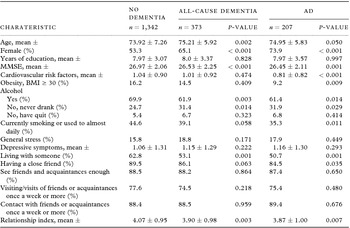
Within the study sample of 1,715 participants, 373 incident cases of dementia (AD, n = 207) were identified during the study period. Mean survival time was 8.90 years (SD = 4.90). For all-cause dementia, mean time to onset was 6.50 years (SD = 3.79), and 6.23 years (SD = 3.36) for AD. Participant characteristics, as a function of dementia status, are provided in Table 1.
Baseline characteristics of the sample as a function of dementia status. Participants with all-cause dementia and AD were compared to those with no dementia

Compared to participants who remained free of dementia during follow-up, among those who developed all-cause dementia or AD, a higher proportion were women and a higher proportion lived alone; these participants also had a lower mean value on MMSE and the relationship index (p < 0.01 for all aforementioned variables) and were older (all-cause dementia: p = 0.002; AD: p = 0.050) at baseline. Further, among participants who developed dementia or AD, a higher percentage reported not consuming (all-cause dementia: p = 0.003; AD: p = 0.014) or never having consumed alcohol (all-cause dementia: p = 0.014; AD: p = 0.029). Finally, participants with a future AD diagnosis had a lower sum of cardiovascular risk factors (p < 0.001), a lower frequency of obesity (p = 0.009), and more often reported not having a close friend (p = 0.035) compared to participants who remained free from dementia.
Next, we performed Cox regression analyses to investigate associations between the social relationship variables and all-cause dementia. We investigated the association between each variable pertaining to social relationships (and the sum-index) and dementia in separate analyses. In Model 1, adjusted for age, gender, education and MMSE, results showed that the variable visiting/visits from friends and acquaintances more than once a week was associated with a decreased risk of all-cause dementia (HR 0.77, 95% CI = 0.61–0.97, p = 0.029). Further, a higher value on the relationship index was associated with decreased dementia risk (HR 0.87, 95% CI = 0.79–0.97, p = 0.010). None of the other relationship variables was associated with dementia. After including additional covariates in the analyses in Model 2 (alcohol use, smoking status, cardiovascular risk factors, and obesity), both visit frequency (HR 0.77, 95% CI = 0.61–0.98, p = 0.031) and the relationship index (HR 0.87, 95% CI = 0.78–0.97, p = 0.014) remained significant. The same pattern was found in Model 3, after including stress and depressive symptoms (for visit frequency; HR 0.78, 95% CI = 0.61–0.99, p = 0.037, for the index; HR 0.88, 95% CI = 0.79–0.98, p = 0.019).
Next, we performed analyses with AD as the dependent variable, excluding participants with any other type of dementia from the analyses. In analyses adjusted for age, gender, years of education, and MMSE (Model 1), the relationship index (HR 0.86, 95% CI = 0.75–0.99, p = 0.032) was the only variable associated with AD, demonstrating a decreased risk associated with higher values on the index. The significant association persisted following adjustment for additional covariates in Model 2 (HR 0.85, 95% CI = 0.74–0.98, p = 0.024), and stress and depressive symptoms in Model 3 (HR 0.85, 95% CI = 0.73–0.98, p = 0.025).
Associations between the social relationship variables and dementia and AD in the aforementioned analyses including all covariates (Model 3), and in analyses with delayed entry, in which entry time after assessment of social relations was moved forward in a stepwise fashion, one year at the time, are provided in Table 2.
Associations between social relationship variables and all-cause dementia and AD in analyses adjusted for all covariates, presented as hazard ratios. Each variable pertaining to social relationships was analyzed separately

All analyses adjusted for age, gender, years of education, MMSE, cardiovascular risk factors, obesity, alcohol use, smoking status, stress, and depressive symptoms.
Following entry of all covariates, the analyses with a survival time set to at least two years after assessment of social relations (cases of dementia included in analyses, n = 346; AD, n = 192; without dementia, n = 1,288) showed that the relationship index was still significant for all-cause dementia (HR 0.89, 95% CI = 0.79–0.99, p = 0.044), although no longer significant for AD (HR 0.86, 95% CI = 0.74–1.00, p = 0.056). Further, visit frequency was no longer significant for all-cause dementia (HR 0.82, 95% CI = 0.64–1.05, p = 0.119). When entry was set at three years (cases of dementia, n = 317; AD, n = 181; without dementia, n = 1,228), no variables pertaining to social relations were significant, for either dementia or AD.
Discussion
The purpose of the present study was to investigate associations between aspects of social relationships in old age and incident dementia. The results based on the entire follow-up period showed that a higher value on the relationship index was associated with reduced risk of all-cause dementia and AD, both before and after controlling for the full set of covariates, including stress and depressive symptoms. Further, the variable visiting/visits from friends and acquaintances once a week or more was related to lower risk of all-cause dementia. These results are in accordance with previous studies showing that visit frequency (e.g. Crooks et al., Reference Crooks, Lubben, Petitti, Little and Chiu2008) and having a more extensive social network (e.g. Fratiglioni et al., Reference Fratiglioni, Wang, Ericsson, Maytan and Winblad2000) are associated with decreased risk of dementia.
Whereas analyses of data for the entire follow-up period appear to provide support for the notion that an engagement in social relationships reduces the risk of dementia, only one association (between social index and all-cause dementia) remained significant following exclusion of participants with a survival time of less than two years. When participants with a survival time of less than three years were excluded, all of the previously significant associations disappeared, suggesting that the observed results for the entire follow-up period may have been driven by reverse causality.
The fact that the variable visiting/visits from friends and acquaintances was associated with all-cause dementia in analyses of the data for the entire follow-up period, but not in analyses with delayed entry, would seem reasonable, as social withdrawal may be a prodromal sign of dementia (Pillai and Verghese, Reference Pillai and Verghese2009). Such a factor may be less stable prior to dementia, compared to, for example, living status, and thus may influence the outcomes of analyses over the entire time period. The fact that there was no significant association observed for visiting/visits from friends and acquaintances in the entire time period for AD may be due to the reduced sample size, as HR values were similar.
The lack of associations between social relationships and dementia when near-onset dementias were removed from the analyses is consistent with the findings of two previous studies using delayed entry. One of these studies (Saczynski et al., Reference Saczynski2006) reported an association between social engagement and dementia when social engagement was measured close to dementia onset (mean 4.6 years to dementia diagnosis), but no association when it was measured earlier in life (mean 27.5 years to dementia diagnosis). The other study (Amieva et al., Reference Amieva, Stoykova, Matharan, Helmer, Antonucci and Dartigues2010) used a delayed entry of five years, and found no association with any structural aspects of social relationships, such as the number of social ties, and dementia. However, the above study reported that qualitative aspects of social relations (e.g. felt satisfied with their relationship, and reported receiving more support than they gave) were significantly related to dementia, suggesting that qualitative aspects of social relationships are more beneficial than quantitative/structural aspects. In the present study, we lacked measures of the quality of social relationships. Future research should explore the role of qualitative measurements of social relations.
Notwithstanding the lack of an evidence of long-term associations between structural aspects of social relationships and dementia in the present study and the study by Amieva et al. (Reference Amieva, Stoykova, Matharan, Helmer, Antonucci and Dartigues2010), a third study (Håkansson et al., Reference Håkansson2009) found that individuals not cohabiting with a partner in midlife had a higher risk of cognitive impairment later in life. They also found that those not living with a partner both in midlife and later in life had an increased risk of AD. Thus, given the mixed findings, the potential influence of social relationships in midlife on dementia risk may be of special interest for future research. This is of concern not only from a life course perspective, but also considering that pathological changes in the hippocampus and nearby brain regions can be identified long before the dementia diagnosis (Small et al., Reference Small, Perara, DeLaPaz, Mayeux and Stern1999). For this reason, it may be necessary to investigate potential influences of social relationships before individuals enter the higher age range.
Although reverse causality is a reasonable explanation for the present results, we cannot rule out the possibility that previous social relationship factors may have had a protective short-term effect. In addition, the results of the analyses with delayed entry may have been blurred by the reduced sample size compared to the full-period analyses. It should be noted, however, that the HR did change over the time for the previously significant variables in the direction of being less favorable. Even if these changes were small, they may indicate a reduced association between the social relationship factors and dementia over the time.
The present study has several strengths, including a long follow-up period, which allowed us to analyze the data using delayed entry and to control for a variety of potentially confounding factors. An additional strength is the large, randomized, population-based sample. Whereas the available evidence suggests that the Betula sample has an adequate population validity with regard to several factors, including gender, marital status, employment, education, income, and number of persons in the household (Nilsson et al., Reference Nilsson1997), ability to participate in population-based studies tends to be affected by health status (Drivsholm et al., Reference Drivsholm2006). Although at least one structural aspect of social relationships (marital status) showed no recruitment bias, we cannot exclude the possibility that there was a bias toward recruitment of more socially active individuals into the study, which may have affected the outcome.
One major limitation of the study is that it did not cover certain aspects of social relations, for example, social support. Second, the present summary index may be a rather coarse measure and not optimal from a psychometric point of view, potentially reducing the chances of observing significant associations with the dependent variables. Further, regarding the covariates, using a single-question assessment of stress and a checklist measure of selected depressive symptoms has obvious limitations. Finally, although we made an effort to control for several potentially confounding variables, we lacked information on factors that could potentially modify the association between social relationships and dementia, such as physical activity, and such factors should be included in future studies.
In conclusion, the present results showed that certain aspects of social relationships were associated with all-cause dementia and AD in a full-period follow-up analysis. However, in the analyses with delayed entry, none of the previously significant social relationship variables remained as a predictor of incident dementia or AD. Thus, the present findings do not support the hypothesis that social relationships in an old age protect against dementia over a longer time frame. Instead, they suggest that future studies should carefully consider the potential effects of reverse causality.
Conflict of interest
None.
Description of the authors’ roles
Daniel Eriksson Sörman designed the study, preformed the statistical analysis, interpreted the data, and wrote the first draft. Michael Rönnlund and Anna Sundström were involved in data interpretation and performed critical revision of the manuscript. Rolf Adolfsson was responsible for the diagnosis of dementia and interpreting the data. Lars-Göran Nilsson provided overall supervision of the study and revised the manuscript.
Acknowledgments
The Betula project is supported by grants from the Swedish Science Council. Daniel Eriksson Sörman is affiliated with the Graduate School of Population Dynamics and Public Policy, Umeå University, Sweden. Anna Sundström is supported by a grant from Riksbankens Jubileumsfond (RJ). The funding agencies played no role in the study design, data collection and analysis, decision to publish, or preparation of the manuscript.