Introduction
Over the past 50 years, interest in the prenatal determinants of neuropsychological function has flourished. Indeed, a substantial literature links birth weight, as an indicator of the intrauterine environment, with deficits in overall cognition during childhood and in early adolescence. Reductions in birth weight are related to fetal growth restriction and to preeclampsia (PE). Collectively, studies of low birth weight (LBW; <2500 g) children compared with those of normal birth weight find small decrements in overall cognition (measured using tests of intelligence, IQ). A summary of 10 studies concluded that at age 6–14 years, LBW children had lower mean IQ scores compared with normal birth weight children, after adjustment for demographic and socioeconomic variables.Reference Breslau 1 In an early analysis from the New England (NE) cohort of the National Collaborative Perinatal Project (NCPP),Reference Rieder, Broman and Rosenthal 2 LBW was the strongest predictor, compared with other perinatal factors, of IQ at age 7 years. Reductions in cognitive scores are also found for children of preeclamptic mothers, although less consistently than for LBW children.Reference Many, Fattal, Leitner, Kupfermine, Harel and Jaffa 3 – Reference Seidman, Laor and Gale 8 Thus, the sum of the evidence suggests that both LBW and PE are associated with reductions in IQ.
Although these data are compelling, several questions remain regarding the impact of fetal growth on cognitive abilities, other than IQ. First, are reductions in birth weight related only to IQ or to other cognitive tasks such as attention, vigilance and verbal fluency? Previous studies suggest that LBW is associated with equal decrements in verbal and performance IQ.Reference Breslau 1 , Reference Klein, Hack and Breslau 9 , Reference Breslau, Delrotto and Brown 10 Children with LBW scored lower on tests of language, spatial, fine motor, tactile, visual motor and dexterity abilities,Reference Klein, Hack and Breslau 9 , Reference Breslau, Chilcoat, DelDotto, Andreski and Brown 11 – Reference Roth, Baudin and McCormick 15 suggesting that a wide range of abilities are influenced by LBW. However, few data are available on attention or verbal fluency tasks. Second, are associations between birth weight and cognitive abilities other than IQ confounded by variables in the social and familial environment? Matte et al.Reference Matte, Bresnahan, Begg and Susser 16 used a powerful same-sex sibling design to evaluate the associations between birth weight and IQ; in boys, they found a 0.5 point reduction in IQ for each 100 g decrement in birth weight and no association in girls. The same-sex sibling design is used in this study and substantially reduces confounding because of early socioeconomic and familial factors. Third, are associations between birth weight and cognitive abilities other than IQ only for children with LBW or do they persist across the range of birth weights (i.e. from 2500 to 4000 g)? If the associations between fetal growth and cognitive abilities are mediated by subtle impairments in brain growth and development, then it is entirely plausible that associations would persist across this range. Early analyses of the NCPP found monotonic increases in IQ over the birth weight range from 1500 to greater than 3500 g;Reference Hardy and Mellits 17 however, these analyses did not adjust for potential confounders. Other studies report differences in age 6 IQ of approximately 4 points comparing children with birth weights greater than 3300 g with those weighing 2201–3300 g.Reference Breslau, Chilcoat, DelDotto, Andreski and Brown 11 Again, few data are available for cognitive tasks other than IQ. Fourth, do the associations between birth weight and measures of cognition persist into adulthood? A study of Danish conscriptsReference Sorensen, Sabroe and Olsen 18 found an increase in cognitive test scores with increasing birth weight (up to 4200 g). Richards et al.Reference Richards, Hardy, Kuh and Wadsworth 19 also found a positive gradient between birth weight and cognitive scores through age 26 years, suggesting persisting associations albeit at reduced magnitudes compared with analyses performed earlier in childhood. Indeed, associations were completely absent for cognitive scores at age 43 years. Finally, are these associations sex specific? A large literature suggests sex-specific differences in cognitive function (reviewed inReference Collaer and Hines 20 , Reference Goldstein, Seidman and Goodman 21 ). In general, females perform better on tests of verbal fluency and perceptual speed, and males perform better on tests of spatial perception and quantitative problem solving. Further, both animal and human studies suggest that the developing male brain may be more susceptible to insults.Reference Goldstein, Seidman, Santangelo, Knapp and Tsuang 22 – Reference Lauterbach, Raz and Sander 26 The earlier analysis of the NCPP data found stronger associations in boys compared with girls for within-family variation in birth weight; however, the between-family variation in birth weight did not significantly differ between boys and girls.Reference Matte, Bresnahan, Begg and Susser 16 , Reference Clark and Goldman-Rakic 27
We have the opportunity to examine several of these open issues within the context of the Early Determinants of Adult Health (EDAH) project and its extension, Fetal Antecedents of Major Depression and Cardiovascular Disease (MDCVD). Design considerations from these studies address many of the open issues including measurement of a variety of cognitive tasks specifically chosen to address differences in sex-specific cognitive functions; the powerful same-sex sibling design to control for early life and familial confounding; and for those participants not in a sibship, careful measurement of a wide variety of socioeconomic and demographic factors in early life and in adulthood; a wide range of birth weights; and follow-up until midlife. On the basis of the earlier studies, which suggest that the associations between reduced fetal growth and cognition in late adolescence and adulthood are small, we predict that associations between birth weight adjusted for gestational age, PE and specific cognitive functions in adulthood will also be small.
Methods
Sample ascertainment
Data for these analyses include participants in the EDAH project and in the Shared Fetal Antecedents of MDCVD project. Briefly, for the core EDAH sample (see Susser et al., this issue) from the New England Family Study (NEFS) and from the parallel Child Health and Development Study (CHDS) in Oakland, California, we identified all same-sex sibling pairs who met the following criteria. Eligible sibling sets included those where two or more members were discordant on birth weight, adjusted for gestational age. In NE, the LBW proband was below the lowest 20th percentile of the sex-specific birth weight for gestational age distribution and the higher birth weight sibling was at or above the 20th percentile and at least 10 or more percentile points higher. These criteria applied to approximately half of the CHDS sibling sets; the remainder included sibling sets in which the two siblings differed by at least 10 percentile points on the birth weight for gestational age distribution, but where the lower birth weight sibling was not in the lowest quintile of the birth weight for gestational age distribution. Further, both siblings had to be between 38 and 43 completed weeks of gestation. Siblings were required to live within commuting distance of the clinics in Boston or Oakland.
In the NEFS for the MDCVD study, we extended the size of the cohort and included sibling pairs discordant on maternal PE (defined under exposure ascertainment). These sibling pairs were, as above, required to be between 38 and 43 completed weeks of gestation. Among the same-sex sibling sets discordant for PE, there were 425 subjects (females, n = 188; males, n = 237) identified from 196 families. All participants recruited from PE families underwent the same assessment as did those from the Early Determinants of Health Study. We excluded participants with a history of bipolar or other psychotic disorders (15 from the NE-NCPP and 4 from the CHDS).
We restricted the sample for this analysis to those who had data on any of the cognitive assessments and complete data on relevant covariates. Thus, a total of 474 participants were studied: 247 from the NE-NCPP and 227 from the CHDS. There are 213 males, 108 of whom are in same-sex sibling sets discordant for fetal growth and/or PE (54 sibling sets total). There are 261 females, 174 of whom are in same-sex sibling sets discordant for fetal growth and/or PE (87 sets total). In all, 20 participants were from mixed male–female sibling sets (10 sets in total). The siblings of the remaining participants did not participate in this study.
Exposure ascertainment
Exposure was defined in three ways. First, we dichotomized fetal growth as birth weight below the sex-specific 20th percentile for gestational age based on the 2000–2001 US Natality Dataset;Reference Oken, Kleinman, Rich-Edwards and Gillman 28 we call this variable reduced fetal growth. We also considered the birth weight percentile for gestational age as a continuous variable; results were essentially the same. Second, exposure to PE was defined according to the National High Blood Pressure Education Program Working Group Report on High Blood Pressure in Pregnancy. 29 Mild PE was defined if after the 20th completed gestational week there was evidence of systolic blood pressure ⩾140 mmHg or diastolic blood pressure ⩾90 mmHg, and proteinuria 1+ in a clean void on at least two occasions and in the absence of a urinary tract infection, or persistent edema of hands and face. Severe PE was defined if after the 20th completed gestational week there was evidence of systolic blood pressure ⩾160 mmHg or diastolic blood pressure ⩾110 mmHg on at least two occasions, 6 h apart at bed rest, and either proteinuria 5 g in 24 h in a clean void, oliguria (⩽400 excreted urine in a 24 h period), or cerebral or visual disturbances, retinopathy, headache, right upper quadrant or epigastric pain, pulmonary edema or cyanosis or laboratory abnormalities (increased liver enzymes or decreased platelets). Chronic hypertensive disease with superimposed PE after the 20th gestational week was defined as an elevation of at least 30 mmHg in systolic or 15 mmHg in diastolic blood pressure and the development of a significant degree of proteinuria. Mild PE, severe PE and PE superimposed on chronic hypertension were collapsed for these analyses. Finally, we created a summary dichotomous variable with exposure as either reduced fetal growth and/or PE.
Neurocognitive tests
Our measures included attention, learning and executive function.
Attention/vigilance: Attention was assessed using the Seidman Continuous Performance Test (CPT).Reference Seidman, Breiter and Goodman 30 This test requires the subject to listen to a series of letters read aloud and to tap a pencil on the desk when certain criteria are met. In the vigilance section of the test, subjects tap after the letter ‘Q’ when it follows from the letter ‘A’. In the attention section of the test, subjects tap after hearing a ‘Q’ that comes four letters after hearing an ‘A’. This latter section has an interference section imbedded as additional distracter; ‘Q's are included in the letter string. As in previous work, we use the following scores based on omission errors from the Seidman CPT: vigilance (total number of omissions in two trials) and interference-attention (total number of omissions).
Verbal learning: Verbal learning was assessed using a modification of the California Verbal Learning Test (CVLT).Reference Delis, Kramer, Kaplan and Ober 31 This test consists of a list of 16 words, which are read to the subject at 1 s intervals. The subject is asked to recall as many of the words that he/she can. The major feature of the CVLT is that the words are drawn from semantic clusters, which may aid recall. The usual administration is five trials; however, in the interests of time, we only administered three trials. The sum of correct recalled words over the three trials gives the total recall score. We also asked the subject to recall as many words as possible after a 10 min delay (delayed recall).
Verbal fluency: Verbal fluency was assessed using the FAS Test.Reference Bolla, Lindgren, Bonaccorsy and Bleecker 32 In this task, the subject is asked to say as many words as he/she can in 1 min that begin with a given letter. The test is repeated for each letter: F, A and S. Responses are recorded as the words in 15 s intervals. For this analysis, we sum the correct words over all intervals and letters.
Processing speed: We used the Wechsler Adult Intelligence Scale Digit Symbol TestReference Wechsler 33 to identify subtle brain dysfunction. This test requires the participant to encode a series of letters with symbols, presented in a key on the top of the test form. The participant is given 90 s to complete this task, and must encode the numbers in the order on the page. The score is the number of correct encoded numbers in the given amount of time, and is converted to a standard score. On the basis of new findings from brain imaging, it is thought that the Digit Symbol Test is most sensitive to the processes of visual search, associative learning and working memory.Reference Usui, Haji and Maruyama 34
Measurement of covariates
In both the NCPP and the CHDS, mothers were administered structured interviews at the time of study entry. At the adult follow-up visit, participants were administered structured interviews by trained personnel. Data were obtained regarding demographic and socioeconomic variables, life style characteristics (smoking, alcohol use, sleep, physical activity), self-rated health status, family health history and major depressive disorder using the depression module of a structured psychiatric interview (the Structured Clinical Interview for Diagnostic and Statistical Manual of Mental DisordersReference First, Gibbon, Spitzer, Williams and Benjamin 35 ). For the latter, all clinical interviewers were trained by expert psychometricians, and quality was continually checked by the team supervised by JG. All diagnostic material and test scores were reviewed by JG and diagnoses assigned by consensus. For the few disagreements among the diagnostic team, a third clinician reviewed the material. A measure of socioeconomic status (SES) was developed using the methods outlined by Myrianthopoulos and FrenchReference Myrianthopoulos and French 36 to construct the SES index used in the NCPP, operationalized as the combination of scores for education, occupation and family income to derive a composite numerical index. Low SES is an important modifier of the impact of fetal risk factors on our outcomes of interest. We categorized low SES as the bottom tertile of the distribution.
Statistical analysis
Summary statistics were calculated for sample characteristics. Chi-square tests were used to detect group differences for categorical variables.
The percentile birth weight for gestational age, used as both a continuous variable and dichotomized as reduced fetal growth, PE and the dichotomy of reduced fetal growth and/or PE were the main predictors of interest. To examine the associations between a predictor and the cognitive test scores, we used mixed linear models,Reference Gelman and Hill 37 which account for the within-sibling correlation in the outcome measures of test scores. Model parameters were estimated using the maximum likelihood method. All models were adjusted for age at the time of testing, race (white v. other), a summary index of SES and smoking (never, former, current, unknown). Because most of the sample obtained either perfect or near-perfect (i.e. one incorrect) scores on the test of attention/vigilance, we applied logistic regression models with repeated binary measures, perfect v. less than perfect scores to examine the associations with exposures. Model parameters were estimated using generalized estimating equations, which accounts for within-sibling correlations in outcome measures, and all models were adjusted for the same variables as above.
All analyses were stratified by study site (Boston, Oakland) and sex. We stratified by site because of large differences between the CHDS and NEFS on demographic variable, exposures and outcome; this indicated possible unmeasured confounding. We also conducted secondary, post hoc stratification by SES, classified in tertiles. The Wald statistic was employed to assess whether the parameter estimate for the exposure measures differed between men and women and between Boston and Oakland.
Results
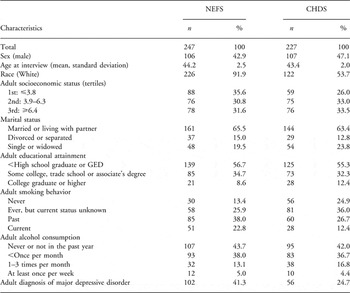
Participants in the NEFS and the CHDS were different in terms of several sociodemographic variables (Table 1). In the NEFS participants were more likely to be white, have lower educational attainment and be in the lowest tertile of SES compared with those in the CHDS. In addition, NEFS participants were more likely to be current smokers and to have a diagnosis of major depressive disorder. These differences held for men and women separately (data not shown).
Demographic characteristics of participants in the EDAH-MDCVD project

EDAH, Early Determinants of Adult Health; MDCVD, Major Depression and Cardiovascular Disease; NEFS, New England Family Study; CHDS, Child Health and Development Study; GED, General Educational Development.
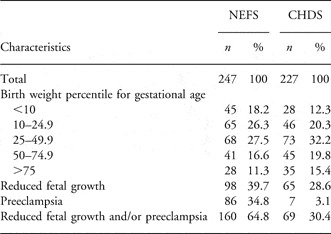
The distribution of birth weight percentile for gestational age differed in the total NEFS and CHDS samples. By design, participants in the NEFS tended to be of lower birth weight for gestational age and were more likely to exhibit reduced fetal growth compared with participants in the CHDS (Table 2). These differences were more pronounced among the men (data not shown); in the NEFS 49% of men were <25th birth weight percentile for gestational age compared with 28% of men in the CHDS, and 35% of men had reduced fetal growth compared with 22% in the CHDS. For women, in the NEFS, 48% were <25th birth weight percentile for gestational age compared with 34% in the CHDS, and 42% of women had reduced fetal growth compared with 33% in the CHDS. By design, the mothers of participants in the NEFS were more likely to have PE than those in the CHDS.
Markers of fetal growth and inflammation of participants in the EDAH-MDCVD sample

EDAH, Early Determinants of Adult Health; MDCVD, Major Depression and Cardiovascular Disease; NEFS, New England Family Study; CHDS, Child Health and Development Study.
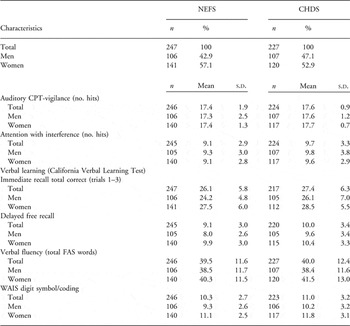
The overall mean scores on the neurocognitive battery were in the expected range (Table 3). In both sites, women performed better than men on the test of verbal learning and on coding (P < 0.01 for all). Women in the NEFS performed better on delayed free recall (P < 0.01) compared with men, whereas they did so only marginally in the CHDS (P = 0.13). Women in the CHDS performed better on the test of verbal fluency (P = 0.06) compared with men. Compared with men in the NEFS, those in the CHDS performed better on both tests of verbal learning (for immediate free recall P = 0.02, for delayed free recall P = 0.01). Both men and women in the CHDS performed better on the coding task compared with those in the NEFS (P = 0.025 and P = 0.05, respectively).
Neuropsychological outcomes of participants in the EDAH-MDCVD sample

EDAH, Early Determinants of Adult Health; MDCVD, Major Depression and Cardiovascular Disease; NEFS, New England Family Study; CHDS, Child Health and Development Study; CPT, Continuous Performance Test; WAIS, Wechsler Adult Intelligence Scale.
Overall mean scores on the neurocognitive battery increased with increasing adult SES (available in supplementary material). This held for both men and women and in the NEFS and the CHDS. For example, in the NEFS men, immediate recall on the CVLT increased from 22.9 to 23.6 to 26.7 for tertiles 1,2 and 3 of adult SES. In CHDS men, immediate recall scores were 24.0, 24.6 and 30.4 for tertiles 1,2 and 3, respectively. A similar increasing trend was found for women: in the NEFS, the scores were 25.5, 27.5 and 30.0, and in the CHDS, scores were 26.8, 29.0 and 29.9 for tertiles 1,2 and 3, respectively.
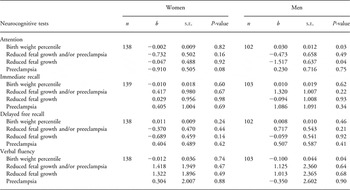
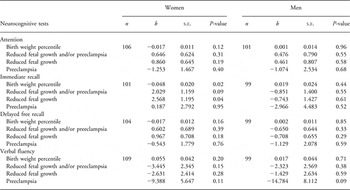
Excepting attention, the relationships between birth weight adjusted for gestational age, PE or the summary dichotomous variable in the NEFS and neurocognitive performance were not significant (Table 4a). In the NEFS, a significant decrement in working memory score was found in male participants, such that for every 10-percentile increase in birth weight for gestational age, the score increased by 0.3 points [95% confidence interval (CI) 0.068, 0.54]. Similar results were found using birth weight percentile for gestational age as a continuous variable. No decrements were found in women, and the difference in the association between men and women was statistically significant (Wald statistic = −2.14, P = 0.03). Further, for males who had reduced fetal growth, the attention score declined by 1.5 points (95% CI −2.4, −0.27) compared with men who did not have reduced fetal growth. No significant decrement in attention score was found in women, and the differences between the associations in men and women seemed different (Wald statistic = 1.83, P = 0.06).
Markers of fetal inflamation as predictors of adult performance on neurocognitive tests stratified by sex in NEFS sample (controlled for age, race, tertiles of socioeconomic status, adult smoking behavior, sibships)

NEFS, New England Family Study; b, estimated regression coefficient.
Few associations were found between birth weight adjusted for gestational age, PE or the summary dichotomous variable in the CHDS and neurocognitive performance (Table 4b). In women, we found significant increases in immediate recall related to the dichotomous variable; the estimated regression coefficients were significantly different from those in men for birth weight percentiles and reduced fetal growth (Wald statistics = −2.12 and 1.78, respectively, and P = 0.03 and 0.08, respectively).
Markers of fetal inflamation as predictors of adult performance on neurocognitive tests stratified by sex in CHDS sample (controlled for age, race, tertiles of socioeconomic status, adult smoking behavior, sibships)

CHDS, Child Health and Development Study; b, estimated regression coefficient.
In secondary analyses, we found no associations between any exposure variable and neurocognitive function for participants in the lowest SES tertile. In the higher two SES tertiles, we found small, but significant associations between markers of fetal growth and verbal fluency. Women who experienced reduced fetal growth scored approximately 4 points lower on the test of verbal fluency (95% CI −7.7, −0.20). Consistent results were found for percentile birth weight for gestational age.
Discussion
In our study of midlife cognitive function in relation to birth weight and PE, we found few associations that were significant at conventional levels. In male participants from the NEFS, we found significant associations between percentile birth weight for gestational age and reduced fetal growth, categorized as the lowest 20th percentile birth weight for gestational age and working memory. We note that percentile birth weight for gestational age is a particularly good measure of fetal growth in term or near term births.Reference Hutcheon and Platt 38 We also found associations between reduced fetal growth and immediate recall in CHDS women, such that reduced fetal growth was associated with better functioning. In secondary analyses, we also found an association between reduced fetal growth and verbal fluency among women in the upper two SES tertiles. That we find only 4 statistically significant findings in 64 comparisons may be indicative of a type II error. However, there may be other explanations for the lack of findings.
First, the births in this study were term. Previous studies suggest that decrements in childhood and adolescent IQ were related to LBW (i.e. <2500 g), and that these decrements declined in magnitude with postnatal experienceReference Richards, Hardy, Kuh and Wadsworth 19 and may disappear in middle age. A systematic review of the literatureReference Shenkin, Starr and Deary 39 relating birth weight to cognitive ability in childhood suggests small but consistent positive associations between birth weight and childhood IQ, not confined to births <2500 g. However, as depicted in figure 3 of Shenkin et al.,Reference Shenkin, Starr and Deary 39 after adjustment for potentially confounding variables, the steepest declines in childhood IQ occurred below a threshold of 3000 g and leveled off above 3500 g.
Second, we only obtained a cross-sectional depiction of brain functions at age 43 years. Much has been written concerning the ability of the brain to recover from early insults given an enriched postnatal environment. In the 1958 British birth cohort,Reference Jefferis, Power and Hertzman 40 for example, both weight at birth and social circumstances in the postnatal environment contributed to cognitive test performance up through age 17 years, as well as to the highest qualifications achieved by age 33 years. Two studies from NorwayReference Eriksen, Sundet and Tambs 41 , Reference Eide, Oyen, Skjaerven and Bjerkedal 42 find small associations between birth weight and a proxy measure of IQ in young adults; one of these studies used sibship controls. Birth weight, however, was not a significant predictor of cognitive function later in life,Reference Martyn, Gale, Sayer and Fall 43 and social circumstances in childhood remained a strong predictor of cognitive function among a cohort of Finnish men after adjustment for adult social circumstances.Reference Kaplan, Turrell and Lynch 44 We note that our use of sibship controls reduces the impact of confounding by early familial and genetic factors.Reference Susser, Eide and Begg 45 Thus, it is not surprising that men in the NEFS performed worse than men in the CHDS on the test of attention given the sociodemographic differences both in childhood and as adults. Offspring of CHDS mothers were more likely to be of higher SES in childhood, as the Kaiser Health Plan required at least one adult in the home to be employed (see Susser et al., this issue), and thus were more likely to be from more enriching environments. Men in the NEFS, on the other hand, were less likely to graduate from college, were more likely to be classified in the lowest tertile of SES and were more likely to smoke compared with those from the CHDS.
Third, the association in the data was specific to men. The incidence of a number of neurodevelopmental disorders is greater in men,Reference Schendel, Rice and Cunniff 46 , Reference Goldstein and Lewine 47 including autism, schizophrenia, learning disabilities and mental retardation. Although the underlying reason for such a difference remains unknown, there is increasing evidence, including some from our team, that sex differences in the development of specific brain regions place the male and female offspring at differential risks for the expression of different disorders in adulthoodReference Goldstein and Walder 23 , Reference Goldstein, Seidman and O'Brien 48 , Reference Anastario, Salafia, Fitzmaurice and Goldstein 49 (see also Goldstein et al., this issue). In particular, there is a large literature suggesting that sex differences in the associations between birth weight and later cognitive and behavioral outcomes may be due to the differential impact of sex steroid hormones.Reference Goldstein, Seidman and Horton 24 , Reference De Courten-Myers 50 – Reference Schumacher, Legros and Balthazart 53 Studies in animal models, as well as humans, find associations between sex steroid hormones on the development of gray and white matter and on the pace and asymmetry of brain development, both of which vary by sex with the male brain lagging behind the female brain.Reference Raz, Lauterbach and Hopkins 54 – Reference Zhang, Konkle, Zup and McCarthy 56 Indeed, a large literature in animal models and in humans suggests a greater vulnerability of males to fetal or early postnatal insults on cognitive outcomes, with males having greater defects in general cognitive ability, language, memory and attention.Reference Goldstein, Seidman and Goodman 21 , Reference Goldstein, Seidman, Santangelo, Knapp and Tsuang 22 , Reference Benes, Turtle, Khan and Farol 57 – Reference Witelson 60
In secondary analyses, we found an association between reduced fetal growth and verbal fluency in women in the higher adult socioeconomic strata. Most literature finds that women outperform men in tests of verbal fluency.Reference Saykin, Gur and Gur 61 – Reference Harasty, Double, Halliday, Kril and McRitchie 63 As suggested by Singh-Manoux et al.Reference Singh-Manoux, Richards and Marmot 64 and others, adult socioeconomic position is one of the proximal determinants of cognition, with socioeconomic position in earlier life, as well as educational attainment, having more distal, indirect effects. One might expect the most vulnerable subgroup to be men in the lower socioeconomic strata. However, it may be that men in the lower socioeconomic strata are already functioning at a nadir, and that associations are found in the group with the highest potential functional capacity.Reference Goldstein, Seidman and O'Brien 48
We chose our cognitive battery to represent a broad range of function. We do note, however, that some literature suggests associations between extremely LBW (i.e. <1500 g) and particular cognitive domains in childhood and adolescence. For example, Grunau et al.Reference Grunau, Whitfield and Fay 65 find reduced performance on tests of cognition (vocabulary, block design, digit symbol) and academic skills in extremely LBW adolescents born without major impairments compared with normal birth weight controls. Other studies of extremely LBW infants find attention deficits in childhood, particularly among boys.Reference Taylor, Hack and Klein 66 – Reference Martel, Lucia, Nigg and Breslau 68 We note, however, that some of these deficits may be due to prematurity.
This study had several strengths over previous research. First, we selected all subjects from two comprehensive birth cohorts with well-defined exposure measures and comprehensive data on social circumstances at birth. Second, we selected sibling pairs and although not all members of a sibship agreed to participate, we were able to control for early environmental conditions. Third, we employed a comprehensive battery of neurocognitive tests, which were designed to measure a wide range of functions. Finally, the adult assessment battery collected a rich set of variables to control for possible confounding. Unfortunately, we do not have data on social circumstances and educational attainment over the period from birth to approximately age 43 years, and cannot test whether such variables mitigate any possible effects of fetal growth restriction.Reference Factor-Litvak and Sher 69 Further subtle effects of fetal risk factors may be more evident at the level of the brain than at the level of cognitive performance.
In summary, only small effects in cognition were found 45 years after in utero exposure to reduced fetal growth and PE for term infants. The effects were limited to the adult sons of NEFS participants, who were, in both childhood and adulthood, of lower socioeconomic circumstances compared with the adult sons of CHDS participants. These results suggest that, in term infants, cognitive performance in adulthood is only partly a result of fetal circumstances and that the postnatal environment throughout the life course may mitigate any subtle brain abnormalities from minor fetal insults that do not lead to prematurity.
Acknowledgments
This work was supported by NIMH-NHLBI RO1 MH074679 (Goldstein, P.I.) and NIA P01 AG023028 (Susser, overall PI) and, partly, by ORWH-NIMH P50 MH082679 (Goldstein, P.I.). The authors thank Harlin Aizley, Ed.M. for her clinical diagnostic interviewing expertise and collection of RRV data, Jo-Ann Donatelli, Ph.D. for her clinical expertise in training and quality control of psychiatric and cognitive data, Christiana Provencale, M.A. for her efforts in managing the recruitment team at Brown, Barbara Cohn, Ph.D. and Piera Cirillo M.P.H. for providing access to the CHDS archived data and for providing the sample from the CHDS, Howard Andrews, Ph.D. for his contribution to data management, Catherine Schaefer, Ph.D. for overseeing the original NIA work in California and Kim Fader, M.A. for her administrative help in maintaining connections between multiple sites involved in this work.
Supplementary material
The supplementary material referred to this article is available online at http://www.journals.cambridge.org/doh