Background
Hip fracture is a common and potentially devastating injury that occurs mainly in older people. There are approximately 75,000 hip fractures per year in the UK, at an estimated annual cost, including medical and social care, of £2 billion.1 These numbers will rise to 91,500 by 2015 and 101,000 by 2020.2 Many of those who recover suffer a loss of mobility and independence – the impact on the individual is life changing.
Over three-quarters of these fractures occur in women, with more than two-thirds in people aged over 80.3 Frail older people with multiple pre-existing medical conditions are at greatest risk of suffering from the consequences of hip fractures. About 10% of these patients die within 1 month, and one-third within 1 year.Reference Roche, Wenn, Sahota and Moran4 They also suffer from significant risk of long-term disability, which seems to be greater than that explained purely by ageing.Reference Magaziner, Fredman and Hawkes5 Up to half of these patients do not return to their pre-fracture level of mobility, and 35% cannot walk independently at 1 year.Reference Bertram, Norman, Kemp and Vos6 It is therefore not unexpected that many require a change in abode to facilitate their post-acute and long-term care. Figures from the National Hip Fracture Database have shown that half of those admitted from their own home return within 30 days,3 and as many as 30% are permanently institutionalized in the following year.Reference Marks7
Formulating a streamlined and integrated care pathway for hip fracture patients is challenging, especially for patients with co-existing cognitive impairment. The introduction of the Best Practice Tariff (BPT) in England by the Department of Health in 2010 has, however, seen a significant improvement in hip fracture care.8 This is a scheme that financially rewards hospitals when certain patients’ targets are achieved. Nationally there has been a reduction in the mean combined length of stay in acute and post-acute hospital beds by 2 days, representing a cost saving of almost £14.4 billion in hospital bed days.3 Yet the rising demand for beds in acute hospitals nationwide signals a need for improvement and innovation in the care of hip fracture patients.
In this review we will discuss existing recommendations and practice, and consider potential areas of development, adhering to the framework of an ‘Enhanced Recovery after Surgery’ (ERAS) pathway.Reference Ljungqvist9, 10
Search strategy
Suitable subjects for inclusion were selected by the authors. A search for review articles was made in specialist peer-reviewed journals and general medical journals. We have focused on seminal papers in each topic published after 2003, and expanded our search from cited references according to scientific quality, journal impact and relevance. We have included up-to-date UK national guidance documentation and recommendations where appropriate.
National guidelines and current practice
Evidence from the National Hip Fracture Database shows considerable variation in the provision of care to hip fracture patients across the country.3 Most concerning was the delay in surgery in some centres, and a general lack of clarity over the structure and organization of the key elements important to providing effective acute and rehabilitative care to hip fracture patients. The ‘Blue Book’ on care of patients with fragility fractures, a collaborative work by the British Orthopaedic Association and British Geriatric Society, suggested a nationwide implementation of a systematic approach to hip fracture care and prevention.2
The BPT8 focuses on a few indicators of hip fracture care; hospitals that adhere to these standards are incentivized:
• Surgery within 36 hours from diagnosis or presentation to an emergency department;
• Admission of patients under joint care of consultants in orthopaedic surgery and orthogeriatrics, using an assessment protocol agreed by geriatrician, surgeon and anaesthetist;
• Assessment by a geriatrician during the peri-operative stage, i.e. within 72 hours of admission;
• Geriatrician-led post-operative care co-ordinating the multidisciplinary rehabilitation team and fractures prevention assessments.
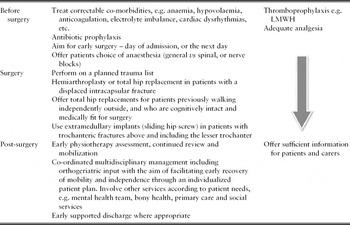
In 2011 NICE published evidence-based guidelines on the management of hip fractures from admission to secondary care through to discharge to the community and specific follow-up (Table 1).1 Timing of surgery is a prognostic marker for the outcome of hip fracture patients. Delaying surgery carries increased risk of complications such as prolongation of pain and often unnecessary repetitive fasting. Additionally, surgery is considered to be the best form of analgesia. The guidance therefore clearly advocates early surgery, on a planned trauma list, whilst recognizing the importance of optimizing patients’ condition prior to the surgical insult. Additionally, in recognition of the complex medical conditions that may affect hip fracture patients, several related areas of NICE guidance have been published (see Related NICE guidance section).1 These cover a range of areas such as falls, delirium, bone protection and nutritional support in adults; all of these help in delivering comprehensive management to hip fracture patients.
Main recommendations from NICE Hip Fracture Guideline (2011)1

The NICE Quality Standard (QS 16) published in March 2012 further defines clinical best practice in hip fracture care.11 QS 16 provides specific, concise quality statements, measures and audience descriptors to provide the public, health and social care professionals, commissioners and service providers with definitions of high-quality care. There has been an emphasis on enhancing patient experience, improving quality of life and preventing people from dying prematurely.
Additionally, a further resource to support commissioners was published by NICE (CMG 46), providing advice on the organizational framework that needs to be put in place to provide good care to hip fracture patients, including services for the ongoing secondary prevention of fragility fractures.12 The guidance assists local service providers to meet outcomes set out in the Public Health,13 NHS14 and Adult Social Care Outcomes Framework,15 as well as the Commissioning Outcomes Framework (COF)16 and the Quality and Outcomes Framework (QOF).17
The main components of CMG 46 are:
• The case for commissioning services for the management of hip fracture in adults;
• Development of an integrated approach to commissioning high-quality care for the management of hip fracture;
• Assess local service needs through knowledge of the epidemiology of hip fracture, patient outcomes and quality measures;
• Specifying services for hip fracture patients, such as the Hip Fracture Programme, rapid optimization of fitness for surgery, rehabilitation and secondary prevention programmes;
• Contract specification in order to develop services for hip fracture care according to local need, which are good value for money and offer the best possible outcomes for service users;
• Commissioning, bench-marking, and the cost impact of service redesign;
• Sources of further information.
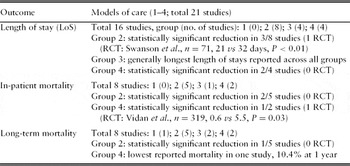
The management of in-patient hip fracture care has evolved over the years. Several models of care have been proposed. These vary in ward setting (i.e. medical versus orthopaedic) and also in the degree of consultant geriatrician and multidisciplinary input. Kammerlander et al.Reference Kammerlander, Roth and Friedman18 compared the four different models of orthogeriatric care, as originally defined by Pioli et al.Reference Pioli, Giusti and Barone19 Among these were: (1) an ‘on request’ consultative geriatric service, (2) a daily consultative geriatric service, (3) an orthopaedic consultative model with patients based on a geriatric ward, and (4) the more complex ‘integrated’ model comprising a geriatrician and multi-disciplinary team incorporated within the trauma unit. Unfortunately, generalization of findings was difficult in view of the heterogeneity in the methodology of individual studies. Nonetheless, the lowest mean values in length of stay (7.93 days), time to surgery (1.43 days) and in-hospital mortality (1.14%) were to be found in the 4th model.Reference Kammerlander, Roth and Friedman18Table 2 shows a comparison of, and evidence behind, the different models.
Comparison of different models of an orthogeriatric serviceReference Kammerlander, Roth and Friedman18

There have been further studies incorporating the ‘model 4’ approach: a co-ordinated multidisciplinary model of care for hip fracture patients has been shown to reduce combined outcomes of death and admission to nursing care after discharge (10 randomized controlled trials (RCTs); n = 2029, relative risk (RR) 0.84, 95% confidence interval (CI) 0.73–0.96). However, if either of these outcomes is taken in isolation, no difference was found between a multidisciplinary rehabilitation approach and usual care (mortality: 11 RCTs, RR 0.89, 95% CI 0.74–1.07; proportion returning home: 11 RCTs, n = 1949, RR 1.07, 95% CI 1.00–1.15).Reference Oliver, Griffiths, Roche and Sahota20 The most recent Cochrane reviewReference Handoll, Cameron and Mak21 on in-patient multidisciplinary rehabilitation for hip fracture again recognized the significant heterogeneity in what was defined by the intervention and ‘usual’ care. There were also limitations in the form of incomplete data in long-term follow-up, and differences in measures of functional status. Nonetheless, the 11 trials included tended to employ a collaborative approach between the geriatricians, the other multidisciplinary team (MDT) healthcare professionals and the orthopaedic team. It found a general trend towards a reduction in ‘poor outcomes’ (n = 1633, RR 0.89, 95% CI 0.78–1.01), mortality (n = 2334, RR 0.90, 95% CI 0.78–1.07) and hospital re-admission rate (n = 1269, RR 0.99, 95% CI 0.82–1.19); but unfortunately none reached statistical significance.Reference Handoll, Cameron and Mak21
In summary, the ‘integrated’ model does seem to hold most promise. This is reflected in current NICE and BPT guidance, which emphasize the importance of joint care of hip fracture patients involving the orthopaedic surgeon, geriatrician and the MDT.
The future – Enhanced Recovery after Surgery (ERAS) pathways
Enhanced Recovery PathwaysReference Ljungqvist9, 10 are a multi-modal, evidence-based approach to improving patient care in the peri-operative period of major elective surgery. It has been shown that mortality and complications can be reduced through targeted checklists along the surgical pathway.Reference De Vries, Prins and Crolla22 Taking this one step further, grouping of specific interventions into ‘bundles’ leads to a synergistic improvement in outcomes. Bundle approach has been shown to work through fostering multidisciplinary involvement in care and improving adherence across all elements when combined into groups.Reference Ljungqvist9, Reference Resar, Pronovost and Haraden23, Reference Gillespie24 ERAS was founded upon early work by Kehlet,Reference Kehlet and Wilmore25 who termed this multimodal approach ‘fast-track’ surgery. He recognized that these pathways could help to minimize the metabolic stress associated with surgery, and in turn improve recovery time. A meta-analysis from six randomized controlled trials of ERAS in patients undergoing elective colorectal surgery has since shown a reduction in length of stay of 2.5 days and a fall in complication rate by 50% compared with traditional care.Reference Varadhan, Neal and Dejong26 There was no significant impact on readmission rate or mortality. The ERAS in this meta-analysis incorporated between 4 and 12 interventions (mean of 9), including elements such as epidural analgesia, enforced mobilization and oral feeding post-operatively.Reference Varadhan, Neal and Dejong26 It has been shown that benefits of an ERAS protocol were maintained, even when compliance across these elements was as low as 40–50%.Reference Ljungqvist9 ERAS pathways are consequently being championed by the NHS Institute for Innovation and Departmental of Health partnership, with the aim of achieving best practice in the immediate peri-operative period, but also focusing on optimizing patients for surgery and their subsequent rehabilitation.
Evidence for ERAS is predominantly in elective surgery and tends to exclude frail elderly patients. However, the prospect of translating the principles of ERAS across to hip fracture care is an attractive one. Experience from the Peterborough Hip Fracture Project certainly demonstrates how simple measures such as dedicated staff and treatment regimes can result in significant reductions in mortality and morbidity.Reference Parker, Pryor and Myles27 The average cost of a patient over 60 years old undergoing surgery for hip fracture is estimated to be in the region of £12,163.28 More recent analysis of acute hip fracture care costs in care home residents revealed a median cost of £9,429, which rises to £14,435 for those requiring an upgrade from residential to nursing home at time of discharge.Reference Sahota, Morgan and Moran29 Therefore, any means of potentially reducing length of stay in hip fracture patients could result in significant savings to the National Health Service.
The potential value of ERAS protocols in meeting the targets for the timing of hip fracture surgery is self-evident. The benefits of early surgery on short- and long-term mortality remain unsubstantiated. There is, however, robust evidence to suggest that a shorter pre-operative period (generally <24 hours) is associated with a reduction in pressure sores and infective complications, and at least a trend towards a reduced length of stay.Reference Leung, Lau and Kwan30 This is consequently reflected in current NICE guidance.1
ERAS for acute hip fracture – potential components?
Better pain control
Current methods of providing analgesia include paracetamol, non-steroidal anti-inflammatory drugs (NSAIDS), oral or parenteral opioids, nerve blocks and surgery. Paracetamol is an effective and safe analgesic,Reference Cuvillon, Ripart, Debureaux, Boisson, Veyrat and Mahamat31 but ineffective for a significant number of patients when used alone. NSAIDs are relatively contraindicated in this patient group and may increase operative blood loss. Opioids provide reasonable analgesia at rest, but are relatively ineffective for dynamic pain (pain on movement), which can be a problem post-operatively as patients often feel reassured whilst lying in bed at rest, but struggle in pain, during ambulation. Opioid-related side-effects remain the main issue, with nausea and vomiting, constipation and delayed gastric emptying common problems and infrequently but more seriously, delirium.
Regional anaesthesia offers an attractive alternative to systemic opioid use, both for pre- and post-operative use, and does not impair motor function. Evidence from the elective lower limb arthroplasty population would suggest that post-operative nerve block analgesia is beneficial overall,Reference Fischer and Simanski32, Reference Fischer, Simanski, Sharp, Bonnet, Camu, Neugebauer, Rawal, Joshi, Schug and Kehlet33 and may even enhance early mobilization.Reference Singelyn, Deyaert, Joris, Pendeville and Gouverneur34 However, to date, trials have been inconclusive regarding benefit in hip fracture patients.Reference Parker, Griffiths and Appadu35 Several factors may explain this. One reason is that the success rate of regional anaesthesia techniques appears to have been relatively low. In a recent study of effective pain relief comparing fascia iliaca compartment blockade with systemic opioid analgesia, the block was only successful in 67% of patients.Reference Foss, Kristensen and Bundgaard36 A non-randomized studyReference Hauritz, Gerlif and Rønholm37 of fascia iliaca block by emergency department physicians found adequate block at 1 hour in only 30%, although improvements in outcome (length of stay) were favourable in those with a successful block. Femoral nerve blockage may be the optimal block in the acute care setting. More recent advances in ultrasound guided approaches to the femoral nerve have demonstrated that successful nerve block can be achieved more reliably and with lower doses of local anaesthetic.Reference Marhofer, Schrogendorfer, Koinig, Kapral, Weinstabl and Mayer38 In addition, ultrasound allows high success rates for placement of peri-neural catheters, which have been used safely following various forms of lower limb surgery.
Another reason for the conflicting evidence is that most, though not all, studies have provided either nerve block on admission, or in the immediate peri-operative period. Given that the pain experienced following hip fracture persists for several days, this may essentially be thought of as an inadequate ‘dose’ of nerve block analgesia. There are two potential options to improve the continuity of analgesia. Foss et al.Reference Foss, Kristensen and Kristensen39 reported the successful use of low-dose epidural analgesia; however, this is not thought to be feasible in the UK at present. The other option is to provide initial analgesia with a single shot nerve block, followed by continuous perineural infusion. The one study that used post-operative perineural catheter infusion failed to show benefit;Reference Cuvillon, Ripart, Debureaux, Boisson, Veyrat and Mahamat31 however, the catheters appeared not to provide good analgesia and were only inserted post-operatively.
Management of anaemia
Halm et al.Reference Halm, Wang and Boockvar40 showed that anaemia (Hb < 12 g/dl) in hip fracture patients is a common occurrence. In a cohort of 550 patients, 40% were anaemic on admission, rising to 93% in the post-operative period. Surgery was associated with a mean drop of 2.8 g/dl. They were able to show that degree of anaemia at admission was an independent predictor of mortality (odds ratio (OR) 0.69 per 1 g/dl Hb change, CI 0.49–0.95), readmission (OR 0.86 per 1 g/dl Hb change, CI 0.73–1.00) and length of stay (OR –0.40, CI –0.73 to –0.10) on multivariate analysis. This is likely to reflect the fact that anaemia itself is a marker of existing co-morbid illness and corresponding disease severity. In this observational study, degree of anaemia at admission did not significantly correlate with changes in functional mobility scores.Reference Halm, Wang and Boockvar40
It is common for surgical patients to receive blood transfusion post-operatively. After accounting for pre-operative variables, Lawrence et al. were able to show an association between a higher post-operative haemoglobin level after hip fracture surgery and greater distance walked at discharge.Reference Lawrence, Silverstein and Cornell41 To determine whether a liberal versus restrictive transfusion protocol in these patients resulted in improved functional levels, Carson et al. randomized 2016 post-operative hip fracture patients to a liberal transfusion group (transfusion threshold of 10 g/dl) versus a restrictive transfusion group (threshold of 8 g/dl or symptomatic anaemia). Transfusing a median of 2 units to achieve a threshold of 10 g/dl did not result in a significant improvement in the ability to walk 10 feet at 60 days. There was also no significant reduction in mortality or cardiac morbidity during hospital admission.Reference Carson, Terrin and Noveck42 The latter mirrors the findings of an earlier observational study in 8787 consecutive hip fracture patients, which showed no significant improvement in 30-day (n = 8787, OR 0.96, 95% CI 0.74–1.26) or 90-day mortality (n = 8787, OR 1.08, 95% CI 0.90–1.29) in patients receiving post-operative transfusions with haemoglobin values of 8 g/dl or more.Reference Carson, Duff and Berlin43
Although this does not support an aggressive transfusion policy post-operatively (Hb ≥ 8), it is less clear whether ‘pre-emptive’ transfusion of anaemic patients prior to hip fracture surgery may be of value. In the same observational study, pre-operative transfusion (threshold of Hb ≥ 8), was not associated with a significant reduction in 30-day mortality (OR 1.24, 95% CI 0.81–1.90).Reference Carson, Duff and Berlin43
Setting absolute transfusion thresholds in the peri-operative setting must be weighed against the potential iatrogenic harm related to blood transfusion and the global and regional oxygen requirements of the individual patient. The latter is judged on the basis of patient characteristics (e.g. history of cardiovascular disease), clinical features, and physiological markers of oxygenation. More prospective research is required in this area, especially in terms of morbidity and mortality outcomesReference Madjdpour and Spahn44 but also whether other modes of stimulating erythropoiesis such as intravenous iron loading in the acute phase may play a role.
Improving nutrition
A significant proportion of hip fracture patients are malnourished at admission. This figure rises to up to 58% during the duration of their hospital stay. The physiological demands of surgery induce a catabolic response with associated muscle wasting. Koren-Hakim et al. classified 215 hip fracture patients into three groups by nutritional status. Readmission rate at 6 months was significantly less in the well-nourished, versus the combined malnourished and ‘at-risk’ groups (36 vs 64%, respectively, P = 0.024). Poor nutritional status was found to correlate well with higher co-morbidity indices and poor functioning, but it was only the latter two factors that were independent predictors of long-term mortality.Reference Koren-Hakim, Weiss and Hershkovitz45
Oral multi-nutrient supplementation for hip fracture patients has been shown to reduce unfavourable outcome (post-operative complications and mortality combined) (versus control; RR 0.52, n = 139, 95% CI 0.32–0.84). This was not reproducible when considering mortality in isolation (RR 0.89, n = 337, 95% CI 0.47–1.68). The results for oral protein supplementation (versus non-protein supplement) also suggest a benefit in terms of unfavourable outcome (RR 0.78, n = 223; 95% CI 0.65–0.95) but should be interpreted with caution given that this conflicts with the trend in mortality alone (RR 1.38, n = 314, 95% CI 0.82–2.34). These studies were all limited by poor participant numbers, but trends suggest potential value. The benefit of nasogastric feeding in mortality terms is less certain and again studies are limited by poor numbers and variation in baseline nutritional status (RR 0.99, n = 280, 95% CI 0.50–1.97).20
ERAS pathways in elective gastrointestinal surgery advocate the use of carbohydrate loading pre-operatively and subsequent nutritional supplementation until oral intake is established. Pre-operative carbohydrate drinks have been shown to reduce the degree of insulin resistance associated with the stress of surgery, and preserve muscle mass.Reference Yuill, Richardson and Davidson46 However, whether this translates to an improvement in functional status remains unclear. In a meta-analysis of pre-operative carbohydrate treatment versus overnight fasting in elective surgery, Ljungqvist demonstrated a 20% reduction in length of stay of 1.2 days (20%) (–1.2 days, n = 52, 95% CI –2.01 to –0.41).Reference Ljungqvist, Nygren and Thorell47 More recently, Noblett et al.Reference Noblett, Watson and Huong48 found that carbohydrate loading was associated with a reduction in length of stay from 10 days to 7.5 days when compared with fasted patients undergoing elective colorectal surgery (n = 36, P = 0.06). Evidence to support carbohydrate loading remains limited by the size of the trials conducted thus far.
Ongoing studies, such as the Oslo Orthogeriatrics Trial,Reference Togeir, Leiv and Torbergsen49 are now including use of carbohydrate-enriched drinks (up to 2 hours before surgery), as well as nutritional supplements pre-operatively and post-operatively among their interventions. Secondary end-points will include mortality and functional outcomes and so this may help to establish the benefits of nutritional support in the context of hip fracture care.
Recognizing dementia and treating delirium
Nineteen per cent of older adults with hip fracture have documented dementia on presentation, but cognitive impairment (dementia or delirium combined) is found in up to 42% of patients.Reference Seitz, Adunuri, Gill and Rochan50 People with cognitive impairment have a longer hospital length of stay by 17 days,Reference Henderson, Malley and Knapp51 suffer from a higher mortality,Reference Laditka, Laditka and Cornman52–Reference Bentler, Liu and Obrizan54 and are more likely to be institutionalizedReference Cree, Carriere, Soskolne and Suarez-Almazor55, Reference Aharonoff, Barsky and Hiebert56 compared with patients without cognitive impairment. People with cognitive impairment have an increased likelihood of both physical dependence (25–60%) and severe functional decline, and only 26% return to their pre-fracture functional level.Reference Cree, Carriere, Soskolne and Suarez-Almazor55, Reference Chen, Lee, Chau and Howe57–Reference Samuelson, Hedstrom and Ponzer59 Lastly, the incidence of fracture in the contralateral hip is 5–10% in patients without cognitive impairment, but this nearly doubles in those with this condition.Reference Mitani, Shimizu, Abo, Hagino and Kurozawa60 It is therefore recommended that staff involved in the care of hip fracture patients adopt a person-centred approach, maintaining ‘person-hood’, focusing on the remaining abilities of the patient with cognitive impairment and empowering them and their relatives.Reference McGilton, Davis and Mahomed61 Training in this regard is known to be lacking in acute hospitals.62
Dementia is also an independent risk factor for the development of post-operative delirium.Reference Morrison, Magaziner and Gilbert63 Patients who develop delirium have increased risk of complications (such as falls), have a longer length of stay, are more likely to be admitted to long-term care, and have a higher mortality.64 National audit figures report that only 39% of hip fracture patients had cognitive function testing on admission.65 This means delirium is often not identified by ward staff, and consequently opportunities to investigate and correct underlying causes are missed.2, 64, Reference Cole, McCusker and Marques Windholz66, 67
Intensive rehabilitation in patients with moderate dementia results in less dependency at discharge and shorter lengths of stay,Reference Goldstein, Strasser and Woodard68 with functional improvement maintained up to 12 months post-discharge.Reference Resnick and Daly69 A systematic review of 11 studies was limited by variations in methodology, but did show potential benefit in outcomes among cognitively impaired patients. The meta-analysis included ‘specialized geriatric rehabilitation units’, amongst other models.Reference Muir and Yohannes70 Huusko et al. showed that co-ordinated multidisciplinary input on a geriatric ward resulted in a significant increase in the proportion of patients with both mild and moderate dementia (based on MMSE score) living independently at 3 months. The intervention incorporated early mobilization, physiotherapy in familiar surroundings and collaboration with families.Reference Huusko, Karppi and Avikainen71
Stenvall et al. conducted an RCT that compared the setting of post-operative care of hip fracture patients. Patients were randomized to continue their care in an orthopaedic ward (usual care) or in a geriatric ward, the latter specializing in the delivery of comprehensive geriatric assessment (CGA).Reference Stenvall, Olofsson and Nyberg72 A subgroup analysis demonstrated benefits from CGA in terms of reduction in length of stay (20±12 vs 32.1±35.3 days; P = 0.059) and the proportion of patients with dementia walking independently at discharge (P = 0.026) and at 4 months (P = 0.005). There were also reported reductions in post-operative complications of delirium (65 vs 97%; P = 0.02), in-patient falls (4 vs 31%; P = 0.06), and urinary tract infections (21 vs 64%; P = 0.025). The mean MMSE score of participants in this subgroup analysis was below 9, suggesting that even a patient group with a level of cognition consistent with severe dementia can benefit from a CGA approach.Reference Stenvall, Berggren and Lundstrom73
Morgen et al. found an inverse relationship between the severity of dementia (according to MMSE) and achievement of walking independence at discharge. On follow-up of these patients at 1 year, a similar proportion of patients in the mild–moderate (57.7%) and moderate–severe (57.1%) patient groups retained walking independence.Reference Morghen, Gentile and Ricci74 This not only supports the value in pursuing rehabilitation in those with moderate–severe dementia, but also suggests that those patients retaining walking independence regained their function through a well-preserved ‘procedural memory’. Physiotherapists may therefore need to employ less traditional methods of rehabilitation to access this particular aspect of memory, including use of non-verbal techniques. Predictors of ‘rehabilitation potential’ could also be established by comparing the characteristics of those patients with apparently similar levels of dementia but differing achievements in functional recovery. Matching patient characteristics to specific interventions may allow us to overcome barriers posed by the behavioural and psychological symptoms of dementia.Reference Saltvedt, Prestmo and Einarsen75
It is perhaps naive to continue to treat hip fracture without due consideration to cognitive impairment. ERAS pathways advocate individualized interventions; therefore recognizing cognitive impairment in patients early and adjusting interventions accordingly may be a future area of development in hip fracture care.
Conclusion
The incidence of hip fracture is rising, with an increase of 30% predicted in the next 10 years.1 There is an associated significant cost burden to the NHS, and thus better management and earlier discharge has the potential to produce significant cost savings (estimated between £64 and 102 million per year).Reference Henderson, Malley and Knapp51
Effective ERAS pathways have hitherto been developed in elective surgery, often excluding frail elderly patients. We believe that translating these principles of targeted evidence-based care to that of acute hip fracture management has the potential to improve care in this vulnerable group of patients. It is also important to adopt a patient-centred approach to care, and in doing so adhere to the principles of ERAS in developing individualized interventions.
Pre-operative management of pain, anaemia, carbohydrate loading and identifying predictors of rehabilitation potential in cognitively impaired patients are all areas that require future research. This would help to establish the most efficacious and cost-effective components of a future dedicated ERAS in hip fracture care. Once these elements are conceptually integrated into a pathway, it must be implemented in an NHS setting. It will be imperative to understand and overcome barriers to implementation and to refine the intervention model through an extensive period of field testing.
Conflicts of interest
None