Introduction
Semantic memory and processing impairments have been established in schizophrenia (Doughty & Done, Reference Doughty and Done2009), with poorer performance observed in areas such as synonym identification (Hogben & Jacobs, Reference Hogben and Jacobs1972; Rossell & David, Reference Rossell and David2006), recognizing relationships between words (Neill & Rossell, Reference Neill and Rossell2013; Ober, Vinogradov, & Shenaut, Reference Ober, Vinogradov and Shenaut1997), animal naming (Paulsen et al., Reference Paulsen, Romero, Chan, Davis, Heaton and Jeste1996; Rossell, Rabe-Hesketh, Shapleske, & David, Reference Rossell, Rabe-Hesketh, Shapleske and David1999), and detection of word association (Rossell & David, Reference Rossell and David2006).
Semantic memory (SM) describes an individual’s store of general knowledge and information (Tulving, Reference Tulving1972), where items of information are stored across a conceptual network. These concepts are interconnected by categorical or associative links (Minzenberg, Ober, & Vinogradov, Reference Minzenberg, Ober and Vinogradov2002), and accessed through spreading of activation (Collins & Loftus, Reference Collins and Loftus1975). SM deficits have been found to be more severe among those with formal thought disorder (TD), (Goldberg et al., Reference Goldberg, Aloia, Gourovitch, Missar, Pickar and Weinberger1998), and so implicate SM deficits in the etiology of TD. TD is characterized by aberrant patterns of speech and word use in patients (detailed in Andreasen, Reference Andreasen1986) and is increasingly seen as being more of a cognitive symptom than a psychotic one (Tan & Rossell, Reference Tan and Rossell2015).
The Dyssemantic Hypothesis of TD
Bleuler (Reference Bleuler1950) originally proposed that a loosening of associations may form the basis of schizophrenia symptoms. Further observations of associative loosening in speech (Andreasen, Reference Andreasen1979), coupled with alterations in the structure of SM (Goldberg et al., Reference Goldberg, Aloia, Gourovitch, Missar, Pickar and Weinberger1998), have suggested that abnormal SM processing might underpin TD in schizophrenia. This dyssemantic hypothesis is supported by findings that semantic impairments are greater in TD patients (Barrera, McKenna, & Berrios, Reference Barrera, McKenna and Berrios2009; Jamadar et al., Reference Jamadar, O’Neil, Pearlson, Ansari, Gill, Jagannathan and Assaf2013; Tan & Rossell, Reference Tan and Rossell2014). Two main accounts have been proposed in relation to semantic processing in TD: overactivation of the SM network and disorganized storage structure.
Overactivation in SM
The overactivation theory is based on the proposition that when a piece of information is accessed (and thus activated) in SM during conversation, similarly related ideas are also primed for access. Overactivation occurs when several adjacent ideas are unintentionally engaged and intrude on intended activities like speech (Maher, Reference Maher1983; McKenna & Oh, Reference McKenna and Oh2005). Semantic activation has been most commonly examined using semantic priming tasks, with direct (e.g., LITTER-RUBBISH) and indirect (e.g., SUN-CRESCENT, linked by MOON) word pairs. Results in general schizophrenia for direct pairs are mixed, with evidence for increased (Henik, Nissimov, Priel, & Umansky, Reference Henik, Nissimov, Priel and Umansky1995; Rossell & David, Reference Rossell and David2006; Spitzer, Braun, Maier, Hermle, & Maher, Reference Spitzer, Braun, Maier, Hermle and Maher1993), decreased (Henik, Priel, & Umansky, Reference Henik, Priel and Umansky1992; Ober et al., Reference Ober, Vinogradov and Shenaut1997; Rossell, Shapleske, & David, Reference Rossell, Shapleske and David2000), and unchanged priming (Chenery, Copland, McGrath, & Savage, Reference Chenery, Copland, McGrath and Savage2004; Minzenberg, Poole, Vinogradov, Shenaut, & Ober, Reference Minzenberg, Poole, Vinogradov, Shenaut and Ober2003; Passerieux, Hardy-Bayle, & Widlocher, Reference Passerieux, Hardy-Bayle and Widlocher1995). This has been attributed to differences in task design and symptom profiles (Pomarol-Clotet, Oh, Laws, & McKenna, Reference Pomarol-Clotet, Oh, Laws and McKenna2008; Rossell & Stefanovic, Reference Rossell and Stefanovic2007).
The overactivation hypothesis in TD was supported by evidence for over-inclusiveness of categories (Brébion et al., Reference Brébion, Stephan-Otto, Huerta-Ramos, Usall, Ochoa, Roca and Haro2013) and increased direct priming in TD-specific patients (Safadi, Lichtenstein-Vidne, Dobrusin, & Henik, Reference Safadi, Lichtenstein-Vidne, Dobrusin and Henik2013; Spitzer, Braun, Hermle, & Maier, Reference Spitzer, Braun, Hermle and Maier1993), but more so from studies of indirect pairs. Indirect priming was found to be increased in patients with TD (Moritz et al., Reference Moritz, Mersmann, Kloss, Jacobsen, Wikle, Andresen and Pawlik2001; Moritz, Woodward, Küppers, Lausen, & Schickel, Reference Moritz, Woodward, Küppers, Lausen and Schickel2003; Spitzer, Braun, Maier, et al., Reference Spitzer, Braun, Maier, Hermle and Maher1993). This finding is also supported by review and meta-analyses (Minzenberg et al., Reference Minzenberg, Ober and Vinogradov2002; Pomarol-Clotet et al., Reference Pomarol-Clotet, Oh, Laws and McKenna2008) leading to the suggestion that overactive semantic links that theoretically cause indirect priming may also induce TD symptoms. Admittedly, this finding has not always been replicated (Besche-Richard & Passerieux, Reference Besche-Richard and Passerieux2003; Gouzoulis-Mayfrank et al., Reference Gouzoulis-Mayfrank, Voss, Morth, Thelen, Spitzer and Meincke2003), with some suggestions the finding may be more confined to the automatic processing level (Pomarol-Clotet et al., Reference Pomarol-Clotet, Oh, Laws and McKenna2008); a condition describing quick or unconscious processing, where the timing is such that controlled or strategic processing is unlikely. This overactivation can also be described as an ‘access’ problem—essentially, there is too much access. Other types of access problems have been identified which are characterized by inconsistent access to specific semantic categories and the ability to improve access as a result of prompting by cues (Leeson, Laws, & McKenna, Reference Leeson, Laws and McKenna2006; Rossell & David, Reference Rossell and David2006).
Disorganized SM Structure
The alternative dyssemantic explanation is that there is normal activation but a compromised knowledge or semantic store. The exact nature of this compromised state has been much debated. With reference to previous access-storage work in neurological patients (Warrington & Shallice, Reference Warrington and Shallice1979), Rossell and David (Reference Rossell and David2006) proposed that schizophrenia semantic impairments were storage based, citing consistently poor performance over time, poor recognition of low frequency words and hyperpriming. The hyperpriming argument for SM disorganization is qualified as facilitated recognition of related words due to the decreased search area when the semantic store is degraded or reduced (see Giffard et al., Reference Giffard, Desgranges, Nore‐Mary, Lalevée, Beaunieux, de la Sayette and Eustache2002; Rossell & David, Reference Rossell and David2006 for a more detailed explanation). This notably differs from the approach to hyperpriming in the overactivation theory.
There are now several studies confirming a storage-type deficit in SM in schizophrenia (Condray, Siegle, Keshavan, & Steinhauer, Reference Condray, Siegle, Keshavan and Steinhauer2010; Laws, Al-Uzri, & Mortimer, Reference Laws, Al-Uzri and Mortimer2000; Rossell et al., Reference Rossell, Rabe-Hesketh, Shapleske and David1999). However, there has been no consensus in the field when defining a pattern of performance that is consistent with “disorganized storage.”
In relation to schizophrenia TD, findings are also somewhat mixed. Some support for a semantic store problem has emerged using verbal fluency tasks, for example, category naming. Patients with TD have been shown to perform more poorly in a categorical fluency task compared to patients without TD (Barrera, McKenna, & Berrios, Reference Barrera, McKenna and Berrios2005; Goldberg et al., Reference Goldberg, Aloia, Gourovitch, Missar, Pickar and Weinberger1998; Stirling, Hellewell, Blakey, & Deakin, Reference Stirling, Hellewell, Blakey and Deakin2006), that is, produce less words during the task. The reduction is thought to be the result of words being poorly hierarchically organized, or no longer available. Conversely, DeFreitas, Dunaway, and Torres (Reference DeFreitas, Dunaway and Torres2009) demonstrated no relationship between semantic fluency impairment and TD. Improvements in semantic functioning have also been observed when TD symptoms remit (Leeson, McKenna, Murray, Kondel, & Laws, Reference Leeson, McKenna, Murray, Kondel and Laws2005), which does not support the notion of a degraded semantic network and instead suggests that overactivation/access problems are more likely involved.
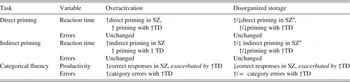
As can be seen, there are discrepancies in the literature relating to the applicability of both the overactivation/access and disorganized storage theories. It is plausible that these discrepancies could be attributed to variability between samples and type of task used. For instance, it has been suggested that length of illness may contribute (Laws et al., Reference Laws, Al-Uzri and Mortimer2000; Laws, Mortimer, & Al‐Uzri, Reference Laws, Mortimer and Al‐Uzri2004). To address these issues, we sought to investigate both these accounts in a single sample using two standard semantic tasks: semantic priming and categorical fluency. This approach is important for future interpretations of semantic task findings in schizophrenia, while facilitating an examination of the applicability of these two accounts. As we can see from Table 1, the two theories predict different patterns of performance on the categorical fluency task, whereas the semantic priming task is not so definitive: our approach will therefore assist with interpreting semantic priming data in both this study and other literature in the field.
Expected outcomes for the overactivation and disorganised storage theories by semantic tasks

a Depends on exact nature of disorganisation. Increased if connections are more abstractly linked, decreased if more randomly idiosyncractic.
Approaching the Assessment of TD
The dyssemantic hypotheses, and the growing evidence for exacerbated semantic impairment in TD, are reported against the backdrop of generally accepted SM impairments in schizophrenia. Many studies linking TD to SM deficits split their schizophrenia samples into a TD and a non-TD group (Dwyer, David, McCarthy, McKenna, & Peters, Reference Dwyer, David, McCarthy, McKenna and Peters2014; Spitzer, Braun, Hermle, et al., Reference Spitzer, Braun, Hermle and Maier1993) This dichotomy is somewhat artificial as attenuated TD symptoms are observed among schizophrenia patients without diagnostic TD (Blum & Freides, Reference Blum and Freides1995; Kiefer, Martens, Weisbrod, Hermle, & Spitzer, Reference Kiefer, Martens, Weisbrod, Hermle and Spitzer2009; Soriano, Jimenez, Roman, & Bajo, Reference Soriano, Jimenez, Roman and Bajo2008).
A more appropriate design for examining the role of TD in SM deficits would be to use a continuum approach. Such an approach reflects the position that TD is not a dichotomous but a continuous variable (Kleiger, Reference Kleiger1999; Kuperberg, Reference Kuperberg2010), which is compatible with the observed continuity of SM impairments in schizophrenia. This is further supported by the assertion that TD is associated with a degree of stable underlying neurocognitive impairments outside the acute TD stage (Subotnik et al., Reference Subotnik, Nuechterlein, Green, Horan, Nienow, Ventura and Nguyen2006). This study thus adopts the continuum approach which is perhaps better suited to developing an understanding of how underlying neurocognitive factors may contribute to severity of a TD symptom.
Additionally, TD studies often rely on a composite score for TD symptoms. This method fails to account for the recognized heterogeneity of TD symptoms (Horn et al., Reference Horn, Federspiel, Wirth, Muller, Wiest, Wang and Strik2009), with a composite score being less sensitive to possibly subtle differences in the etiology of different TD symptoms. For many years, authors have acknowledged the value of differentiating between specific symptoms of TD including separating out negative from positive TD symptoms (Tan & Rossell, Reference Tan and Rossell2015) and recognizing that specific symptoms differ in pathological severity (Andreasen, Reference Andreasen1979). As such, an examination of individual TD symptoms may provide more subtle and meaningful information on the relationship between TD and SM deficits. This method of investigation has not been commonly reported previously and will be explored in the current study.
The Current Study
This study aimed to further our current understanding of SM function in schizophrenia and its relationship to TD symptoms. Two established tasks were used: semantic priming (direct/indirect) and categorical fluency. These tasks were used to examine whether an overactivation/access or a disorganized storage account best represents the data in schizophrenia. Expected task outcomes in accordance with both theories are presented in Table 1.
Patterns of priming and categorical fluency performance were predicted for schizophrenia with anticipated associations to TD based on each model. Greater direct and indirect priming, fluency productivity and category errors were expected if the data supported the overactivation theory. Reduced fluency productivity and increased category errors would be characteristic of disorganized storage, with priming effects still inconclusive as previously explained. Priming errors were not expected to differ between the two dyssemantic theories.
In line with the continuum approach, we predicted that severity of semantic deficits should increase with TD severity, particularly if semantic processing abnormalities are an integral part of TD etiology. We also wanted to explore if these relationships would differ between individual TD symptoms.
Methods
Participants
Fifty-seven patients with DSM-IV schizophrenia/schizoaffective disorder were recruited for this study from the Alfred Hospital (3 inpatients) and surrounding community clinics (54 outpatients) in Melbourne, Australia. All patients were on stable doses of anti-psychotic medication. Forty-eight control participants (HC) without previous personal and family history of mental illness, anti-psychotic or anti-depressant medication use were also recruited from advertisements in the local community. The Mini-International Neuropsychiatric Interview (MINI500; Sheehan et al., Reference Sheehan, Lecrubier, Sheehan, Amorim, Janavs, Weiller and Dunbar1998) was used to both confirm diagnosis in patients (also confirmed by treating clinician) and to screen HCs. All participants were screened for previous traumatic brain injury, current substance abuse (previous 6 months), previous neurological illness, and proficiency in English. Relevant ethical approval was obtained and this research was conducted in accordance with the Helsinki Declaration (World Medical Association, 2008). Written informed consent was collected from all participants before assessment.
Measures
Clinical and premorbid intelligence assessment
The Positive and Negative Syndrome Scale (PANSS; Kay, Fiszbein, & Opler, Reference Kay, Fiszbein and Opler1987) was used to assess schizophrenia symptomatology. TD symptomatology was assessed post task assessment using the Thought, Language, and Communication Scale (Andreasen, Reference Andreasen1986). The Wechsler Test of Adult Reading (WTAR; Wechsler, Reference Wechsler2001) was used to assess premorbid intelligence.
Direct/indirect priming tasks
Each priming task consisted of 40 related word-word pairs and 20 word-non-word pairs. Two counterbalanced word lists were constructed (A and B). For list A, 20 of the related word-word pairs were randomly rearranged to create unrelated pairs. For list B, these 20 unrelated word pairs were presented as related, and other 20 related pairs were rearranged to become unrelated. The 20 word-non-word pairs were included in both lists A and B. To assess automatic processing, a short stimulus onset asynchrony (250 ms) was used in both tasks. Primes were presented for 200 ms, followed by a 50-ms inter-stimulus interval. The target was presented for 2000 ms. Participants were able to respond from the moment the target appeared on screen. They were asked to decide if the second word in the pair was a real word or a non-word, indicating this choice using a two-button press. The lists were matched on number of letters, syllables, and phonemes in each word, frequency, familiarity, imageability, and concreteness. Non-words were legally spelled and pronounceable letter strings (e.g., morce), excluding homophones, chosen from the ARC pseudo-word database (Rastle, Harrington, & Coltheart, Reference Rastle, Harrington and Coltheart2002). Participants were not told prior about the possible relationship between the pairs they were seeing. Instead, they were introduced to the task as one of lexical decision. Reaction times (RT) to targets and response errors were recorded.
Direct stimuli
Word pairs with both semantic (categorical relationship) and associative (frequency of common use) links were used as directly related pairs in this study (e.g., HAIL-SNOW). This was done to maximize facilitation. Semantic and associative relationships were assessed using the Semantic Space Model Demo (SSMD; McDonald, Reference McDonald2006) and Edinburgh Association Thesaurus (EAT; Kiss, Armstrong, Milroy, & Piper, Reference Kiss, Armstrong, Milroy and Piper1973), respectively.Footnote 1
Indirect stimuli
Two words that had a shared association with a mutual concept were used as indirectly related pairs (e.g., LION-STRIPES, indirectly linked by TIGER). Direct associations of the prime and target to the mediating word were screened out using the EAT.Footnote 2
Fluency tasks
Categorical and phonological fluency tasks were both used. The latter was included in line with conventional methods of assessing fluency performance in schizophrenia patients (Neill, Gurvich, & Rossell, Reference Neill, Gurvich and Rossell2013). It was not considered affected by dyssemantic processes. Categorical fluency was examined by asking participants to name as many items as they could from three categories; animals, furniture, and vegetables. Phonological fluency was assessed using the Controlled Oral Word Association Test (Benton & Hamsher, Reference Benton and Hamsher1976) using the letters F, A, and S. Participants were asked to produce as many words as possible that began with each letter, excluding places and proper nouns. Participants had sixty seconds for each category or letter; responses were recorded ad verbatim. Mean categorical and phonological scores for correct responses (productivity) were calculated. Two types of errors were recorded for both tasks; total inappropriate (i.e., wrong category or wrong starting letter) and total repeats.
Procedure
Practice items were provided for the implicit tasks. Fluency was assessed before priming.
Data Preparation
For the priming tasks, response times greater than 2 standard deviations from the mean were discarded (<5% of all trials). Participants with more than 30% erroneous responses to words (false positives and negatives) were excluded to ensure proper engagement in the tasks, resulting in one SZ participant each being removed from both the direct and indirect priming tasks.
Statistical Analyses
Pearson’s correlations were run between demographic variables and the priming effects and error rates; and fluency productivity scores and error rates. The demographic variables selected had previously been identified as impacting on performance on priming and fluency tasks, such as age (Gladsjo et al., Reference Gladsjo, Schuman, Evans, Peavy, Miller and Heaton1999; Laver & Burke, Reference Laver and Burke1993), premorbid intelligence (Spreen & Strauss, Reference Spreen and Strauss2008), length of illness (Liddle & Morris, Reference Liddle and Morris1991; Maher, Manschreck, Redmond, & Beaudette, Reference Maher, Manschreck, Redmond and Beaudette1996), and medication (Barch et al., Reference Barch, Servan-Schreiber, Steingard, Cohen, Steinhauer and Van Kammen1996; Sweeney, Keilp, Haas, Hill, & Weiden, Reference Sweeney, Keilp, Haas, Hill and Weiden1991). Independent samples t tests were also run to compare the groups on age, gender, and premorbid intelligence. Any variable identified with a significant relationship with the semantic tasks, or significantly different between the groups, will be used as a covariate in subsequent analyses. Analyses of co-variance (ANCOVA) were performed for both the priming and fluency tasks, with task type as a factor for priming to compare the overall pattern of priming performance between patients and controls.
Priming analysis
A 2×2×2 [group (SZ, HC) by relatedness (related, unrelated) by task type (direct, indirect)] repeated measures ANCOVA was conducted, co-varying for premorbid IQ. There was a significant main effect of group, F(1,100)=12.93, p<.001, illustrating increased overall RT in schizophrenia. Priming effects have been found to be artificially inflated by elevated RTs (Chapman, Chapman, Curran, & Miller, Reference Chapman, Chapman, Curran and Miller1994) therefore percentage priming was calculated, using the formula (1–related/unrelated)×100] (Spitzer, Braun, Maier, et al., Reference Spitzer, Braun, Maier, Hermle and Maher1993) to statistically control for reduced processing speed. Therefore, a 2×2 (group [SZ, HC] by task type [direct, indirect]) repeated measures ANCOVA was conducted with percentage priming scores. In line with the hypotheses in Table 1, appropriate post hoc ANCOVAs and t tests were also conducted. Error rates were analyzed using 2×2×3 [group (SZ, HC) by task type (direct, indirect) by error condition (related word, unrelated word, non-word)] repeated measures ANCOVA.
Fluency analysis
A 2×2 repeated measures ANCOVA [group (SZ, HC) by task (categorical, phonological)] was conducted for words produced. Error rates were analyzed by type (categorical, repeat) using one way univariate ANCOVAs.
After the ANCOVA analyses, correlations were also run between task performance (priming effects, fluency productivity, and fluency errors) and individual TD symptom scores on the TLC. Spearman’s correlations were used due to the ordinal nature of TD ratings (e.g., 0–3). While 31 of 57 patients had at least one symptom, only symptoms that were rated in more than 10% of patients were used to ensure the validity of correlations. These were poverty of speech (14%), tangentiality (21%), derailment (12%), circumstantiality (30%), and loss of goal (12%). Bonferroni correction for multiple comparisons was used (p<.01).
Results
Analysis with Demographic Variables
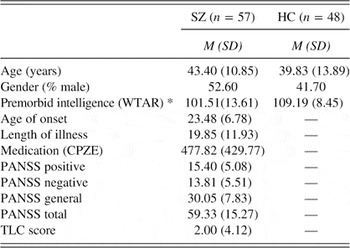
Demographic and clinical characteristics are shown in Table 2. Independent samples t test and a χ2 test for independence confirmed the groups to be well-matched on age and gender, respectively. There was a significant group difference on premorbid IQ (p<.005). Premorbid IQ was also negatively correlated with errors in both direct and indirect priming (p<.005), and positively correlated with productivity in both fluency tasks (p<.01); therefore, it was included as a covariate in all subsequent analyses. No significant correlations were observed between age, length of illness, or medication dose on priming, productivity or errors in the priming and fluency tasks.
Demographic and clinical variables of the sample

WTAR=Wechsler Test of Adult Reading; CPZE=Chlorpromazine equivalence; PANSS=Positive and Negative Syndrome Scale; TLC=Thought, Language and Communication scale (total score range from 0 to 27).
*p<.05.
Direct/Indirect Priming
Percentage priming analysis
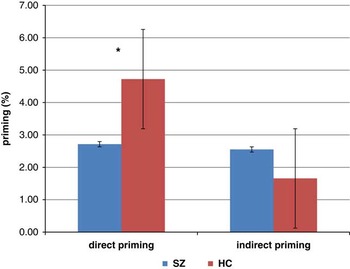
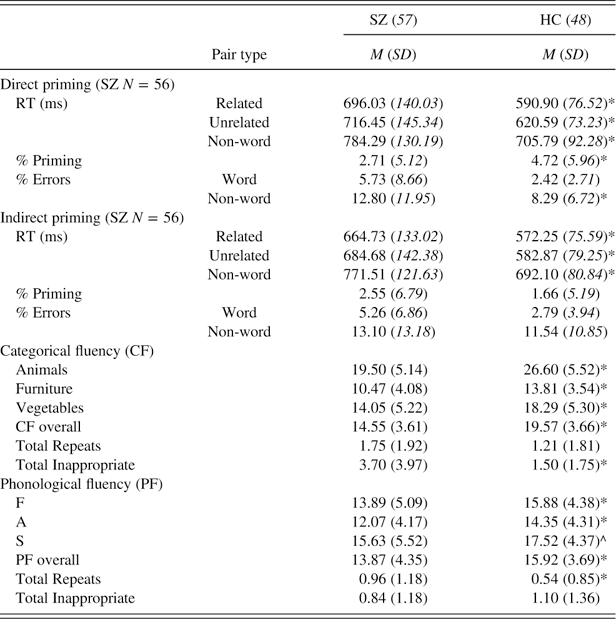
Means and standard deviations are presented in Table 3. The 2×2 repeated measures ANCOVA revealed no significant main effect. F(1,100)=0.02, p>.05, d=0.23 or interaction, F(1,100)=1.57, p>.05, d=0.25. One-way univariate ANCOVAs showed that HCs had significantly more percentage priming in the direct task compared to patients, F(1,100)=4.14, p<.05, d=0.36. Indirect percentage priming was not significantly reduced compared to patients, F(1,101)=.032, p>.05, d=0.15 (see Figure 1). Within groups, HC participants had significantly higher percentage priming in the direct compared to the indirect condition, t(47)=2.42, p<.05, d=0.55. Conversely, these rates were near identical for SZ participants, t(54)=−.053, p>.05, d=0.03.
Comparison of direct and indirect percentage priming between groups.

Results for the priming and fluency tasks
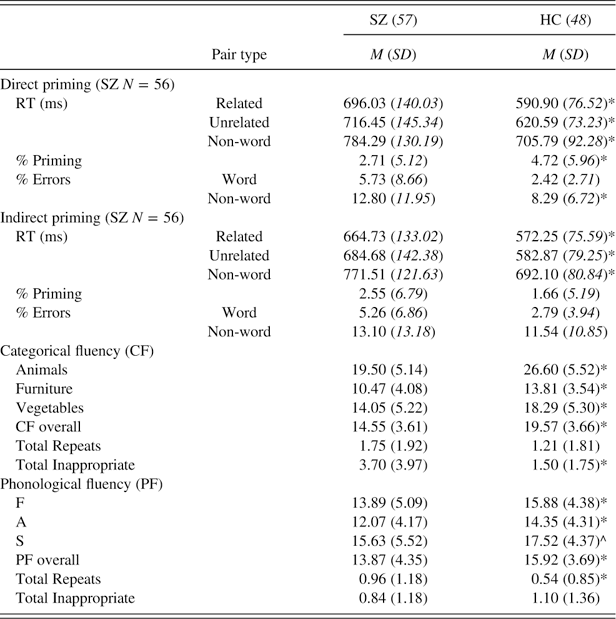
Note. All analyses in this table are direct group comparisons by one-way ANCOVA with WTAR score as co-variate.
*p<.05.
^p<.07.
Error analysis
A significant main effect of error condition emerged, F(2,200)=4.72, p=.01. Overall, the most errors were to non-words (11.47%), followed by unrelated words (5.07%) then related words (2.99%). There were no other significant main effects or interactions.
Fluency
Productivity analysis
Means and standard deviations are presented in Table 3. Repeated measures ANOVA on the overall categorical and phonological fluency scores showed a group by task interaction, F(1,102)=15.94, p<.0001. Post hoc univariate ANOVAs revealed that patients performed significantly worse than HCs on categorical fluency, F(1,102)=34.31, p<.0001, d=1.38. They also performed more poorly on phonological fluency, though not significantly so, F(1,102)=1.61, p>.05, d=0.51.
Error analysis
For the categorical fluency task, one-way univariate ANOVAs showed that patients were producing more category inappropriate exemplars compared to HCs, F(1,102)=8.69, p<.005, d=0.77, but not significantly more repetition errors, F(1,102)=.51, p>.05, d=0.29.
For the phonological fluency task, there was no significant difference in the number of inappropriate exemplars produced, F(1,102)=1.56, p>.05, d=0.21, however patients did make more repetition errors than HCs, F(1,102)=3.95, p<.05, d=0.41.
Relationship with individual TD symptoms
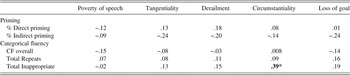
Several correlations (p<.05) were observed between TD ratings and task variables (see Table 4); although only one survived Bonferroni correction. Increasing levels of circumstantiality were associated with more category-inappropriate responses to the categorical fluency task. Tangentiality was associated with more non-word errors in the direct priming task, though this was a trend with respect to the adjusted significance level, p=.016.
Correlations with selected TD symptoms rated with the TLC in the patient cohort (N=57)

*p=.003.
Discussion
This study sought to examine semantic task performance in schizophrenia and its relationship to individual TD symptoms. There were two main findings in relation to overall task performance. First, on the priming task, patients had significantly reduced direct percentage priming compared to HCs. Second, on the category fluency task, patients showed reduced productivity and increased category errors compared to HCs. Additionally, circumstantiality was associated with more exemplar errors on the categorical fluency task. The group difference on the indirect priming task was not significant.
The pattern of direct and indirect priming results is aligned with previous evidence of decreased direct (Neill & Rossell, Reference Neill and Rossell2013; Ober et al., Reference Ober, Vinogradov and Shenaut1997; Rossell et al., Reference Rossell, Shapleske and David2000) and unchanged indirect priming (Pomarol-Clotet et al., Reference Pomarol-Clotet, Oh, Laws and McKenna2008). The latter contrasts with previous evidence for an increase in indirect priming in schizophrenia (Moritz et al., Reference Moritz, Mersmann, Kloss, Jacobsen, Wikle, Andresen and Pawlik2001; Spitzer, Braun, Maier, et al., Reference Spitzer, Braun, Maier, Hermle and Maher1993), and again points to the inconsistency of data in the field with regards to the indirect task. The pattern of fluency performance is in agreement with category-specific impairments observed in schizophrenia patients using this task (Bokat & Goldberg, Reference Bokat and Goldberg2003; Neill et al., Reference Neill, Gurvich and Rossell2013), which implicates semantic dysfunction.
Overactivation or disorganized storage?
With reference to Table 1, the pattern of results (decreased direct priming and reduced productivity and increased errors for categorical fluency) appears more indicative of disorganized storage than an overactivation problem in this sample. Additionally, the similar indirect priming performance does not provide any evidence for overactivation.
The semantic priming task is often considered to tap into unconscious semantic processing, while the categorical fluency task is associated with conscious semantic processing (Neill & Rossell, Reference Neill and Rossell2013). These indications of disorganized storage observed here were across both conscious and unconscious semantic tasks, which strengthens the notion that the SM system is indeed disorganized in schizophrenia. This may also align with evidence that the SM store is disorganized in patients with longer illness duration (Chen, Chen, Chan, Lam, & Lieh-Mak, Reference Chen, Chen, Chan, Lam and Lieh-Mak2000; Laws et al., Reference Laws, Al-Uzri and Mortimer2000), which is a feature of this sample.
SM is a dynamic construct (Coccia, Bartolini, Luzzi, Provinciali, & Ralph, Reference Coccia, Bartolini, Luzzi, Provinciali and Ralph2004) that likely continues developing after illness onset. Abnormalities in perception and comprehension could lead to atypical links and changes to SM storage patterns that feed back to semantic dysfunction. Unfortunately the chosen tasks limited our ability to clarify the exact nature of SM disorganization. For example, the naming of a fruit in the vegetable category might indicate an unconventional link formed between that word and the category (pear and vegetables). The patient might classify the pear as being a green object, vegetables being green, and thus pear being classed as a vegetable. Alternatively, it could indicate a breakdown in the stored features of the object with only the recognition of the pear and other vegetables as being associated with plants remaining intact.
Our aim was to further explore whether semantic deficits in schizophrenia are better represented as an access or storage type disorder; however, the non-significance of the indirect priming results necessitate a degree of caution in making more definitive statements. Future studies should work to clarify this. Importantly, the current data are indicative of a degree of SM disorganization in schizophrenia, which may be contributing to some TD symptoms.
SM and TD
The key finding here is the association between increased categorical fluency errors (wrong category words) and severity of circumstantiality; which aligns with the role of disorganized SM in the manifestation of specific TD symptoms. While the nature of the relationship cannot be established here, it is plausible that these two aspects may be linked by poor regulation of appropriate responses. This also confirms a negative relationship between TD severity and SM task performance, which fits with reports that SM performance is worse in patients with diagnostic TD (Goldberg et al., Reference Goldberg, Aloia, Gourovitch, Missar, Pickar and Weinberger1998; Tan & Rossell, Reference Tan and Rossell2014). Such patients have markedly more severe TD symptoms as evidenced by diagnostic criteria (Andreasen, Reference Andreasen1986). It is important to re-iterate that the analyses here were correlational so no causal conclusions can be drawn.
Given that this sample had low-levels of diagnostically significant TD, the data here support the notion that SM disorganization may underlie TD symptoms observed in schizophrenia patients without a TD diagnosis. This aligns with findings that TD is associated with a degree of stable underlying neurocognitive impairments outside the acute TD stage (Subotnik et al., Reference Subotnik, Nuechterlein, Green, Horan, Nienow, Ventura and Nguyen2006), and that semantic deficits do not completely remit outside of the acute TD state (Leeson et al., Reference Leeson, McKenna, Murray, Kondel and Laws2005). It also supports evidence that greater TD severity is associated with exacerbated SM deficits (Leeson et al., Reference Leeson, McKenna, Murray, Kondel and Laws2005). Notably, there are also indications that SM performance may be differentially related to individual TD symptoms.
From a methodological point of view, the observed correlations between TD symptoms and SM task performance also lend credence to the continuum approach as well as the examination of individual TD symptoms. This supplements and adds a new dimension to the published literature. Admittedly these observations are only rudimentary and serve to highlight a focus for future work.
Limitations
These findings come with some caveats. First, the results are limited by low levels of TD, which may have precluded further associations between semantic functioning and TD severity. This is likely related to the sample largely consisting of stable community-dwelling outpatients who commonly do not exhibit florid TD symptoms. While a sample with greater severity and spread of TD would have been ideal, we took the approach of only examining the most prevalent symptoms in this sample. We believe this alternative approach is a strength of this study, adding validity to these findings which also support future investigations of individual TD symptoms. However, future work should still assess samples with higher levels of acute TD using a similar paradigm to validate the findings reported here. Findings using the continuum approach should be complementary to the traditional approach in fine-tuning our understanding of the cognitive underpinnings of TD.
Second, the conclusion of disorganized storage may be a reflection of the lengthier illness duration in this sample. This may limit the generalizability of these findings.
Third, the contentious nature of disorganized storage somewhat limits the clarity of our conclusions. While evidence of SM disorganization in this study is sound, the nature of disorganization is definitely an area for further research. Teasing out performance differences relating to both degradation and idiosyncrasy of the semantic store is a critical next step.
Conclusions
Overall, this study provides evidence that SM is disorganized in schizophrenia and is related to TD symptoms on a spectrum. The nature of this disorganization is still to be clarified, though it appears to be linked to the manifestation of TD symptoms across both the florid and non-florid phases.
Acknowledgment
The authors report no conflicts of interest in relation to this study.