Colonization and infection with extended-spectrum β-lactamase-producing Enterobacteriaceae (ESBL-PE) have become increasingly common worldwide. 1 , Reference Nakayama, Ueda and Huong 2 In the hospital setting, ESBL-PE colonization may have an endogenous or exogenous origin, the latter mainly resulting from patient-to-patient transmission via the hands of healthcare workers (HCWs).Reference Casewell and Phillips 3 The administration of antibiotics, especially broad-spectrum antibiotics, increases the concentration of ESBL-PE in the gastrointestinal tracts of carriersReference Ruppé, Lixandru and Cojocaru 4 and decreases the barrier effect to colonization in noncarriers.
Intensive care units (ICUs) play an important role in the spread of multidrug-resistant organisms due to multiple opportunities for cross-transmission through HCW hands, confinement of high-risk patients, high workload, and high exposure of patients to broad-spectrum antibiotics. Furthermore, the movements of patients between the ICU and other wards make it a potential starting point for hospital-wide outbreaks. However, the best strategy to control ESBL-PE transmission in an ICU remains elusive.
The objective of the present study was to compare the effectiveness of different control strategies designed to reduce the transmission of ESBL-PE in the ICU setting, using a mathematical model.
METHODS
Transmission Model
We developed a compartmental, stochastic model of ESBL-PE transmission to assess, under different control strategies, the evolution of an outbreak caused by the admission of a single carrier in an ICU free of ESBL-PE.
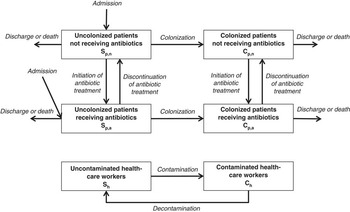
The model simulates the transmission of an ESBL-PE between patients via contact with HCWs, taking into account hospital admissions and discharges of patients, antibiotic exposure, and control interventions (Figure 1). In this model, patients can be either uncolonized receiving antibiotics (Sp,a) or not (Sp,n), or colonized receiving antibiotics (Cp,a) or not (Cp,n). HCWs were classified into 2 states: uncontaminated (Sh) and transiently contaminated (Ch). Patients and HCWs could move between these states according to an exponentially distributed transition rate. See Supplementary Text S1 for further details of the model.
Transmission model of ESBL-producing Enterobacteriaceae in a typical intensive care unit. At any time point, each patient is in 1 of 4 states defined by whether the patient is colonized and whether the patient receives antibiotics. HCWs are either uncontaminated or transiently contaminated. Transitions between states are indicated by arrows.

Input Parameters
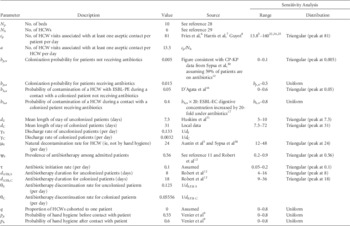
The model parameters are presented in Table 1. When possible, their values were derived from multicenter studies. We modeled a 10-bedded ICU, the average size of French ICUs. A French ICU nursing team must comprise by regulation at least 2 nurses per 5 patients and 1 nursing assistant per 4 patients. Therefore, we modeled the continuous presence of 6 HCWs in the ICU, without stratification by professional category or by shift, obtaining a HCW-to-patient ratio similar to that of previous models.Reference Austin, Bonten, Weinstein, Slaughter and Anderson 5 We assumed, for each patient each day, an average of 81 HCW visits.Reference Fries, Segre, Thomas, Herman, Ellingson and Polgreen 6 – Reference Guyot 8 In the base case scenario, with no control intervention, we considered the following conditions: 55% HCW hand hygiene compliance before patient contact and 60% after patient contact, respectively,Reference Venier, Zaro-Goni and Pefau 9 , 10 no cohorting, and 56% of patients on antibiotics at ICU admission. 11 , Reference Robert, Pean and Varon 12
Base case values and ranges for sensitivity analysis of input parameters used in the compartmental model of ESBL-PE transmission

NOTE. HCW, healthcare worker; CP-KP, carbapenemase-producing Klebsiella pneumoniae; ESBL-EC, extended-spectrum β -lactamase-producing Escherichia coli.
Exposure to broad-spectrum antibiotics has been reportedly associated with increased odds of colonization by ESBL-PE.Reference Nicolas-Chanoine, Jarlier and Robert 13 , Reference Colodner, Rock and Chazan 14 These study results can be explained by less resistance to colonization with drug-resistant bacteria in commensal flora disrupted by an antibiotic treatment.Reference Stiefel, Pultz, Helfand and Donskey 15 Consequently, we hypothesized that the colonization probability after contact with a contaminated HCW was increased 3-fold in patients on antibiotics, similar to the colonization hypothesized for VRE.Reference Austin, Bonten, Weinstein, Slaughter and Anderson 5 , Reference D’Agata, Webb and Horn 16
Finally, we assumed that the probability of contamination of an HCW through contact with a colonized patient was higher if the patient was undergoing antibiotic therapy.Reference D’Agata, Webb and Horn 16 Indeed, exposure to broad-spectrum antibiotics has been associated with higher digestive concentrations of Gram-negative–resistant bacteria.Reference Falagas, Tansarli, Karageorgopoulos and Vardakas 17 , Reference Bhalla, Pultz, Ray, Hoyen, Eckstein and Donskey 18 In particular, the relative abundance of digestive ESBL-producing Escherichia coli may be multiplied by 20 under treatment with broad-spectrum antibiotics.Reference Falagas, Tansarli, Karageorgopoulos and Vardakas 17
Infection Control Strategies
We assessed 1 base case scenario and 26 control strategies that combined different levels of 1, 2, or 3 of the following interventions: (1) improved compliance with hand hygiene, (2) cohorting, and (3) antibiotic restriction. First, compliance with hand hygiene was improved to 80%, only after patient contact or both before and after contact. Second, the cohorting level was set at 50% or 75%. Third, interventions regarding antibiotic restriction consisted in reducing by 50% the proportion of patients on antibiotics at admission and reducing by 25% the duration of antibiotic treatment.
Model Simulations
For each strategy, at time t=0, we introduced a single initial colonized patient (assumed to be under antibiotic therapy) and we simulated the resulting ESBL-PE dynamics for 1,000 days. Because we were interested in the evolution of a single outbreak, we hypothesized that only uncolonized patients were admitted following the introduction of the index case.
We used the Gillespie algorithmReference Gillespie 19 and ran 1,000 Monte Carlo simulations to account for stochastic effects, which are important in small populations.
Outcomes
The main outcome of interest was the proportion of nosocomial acquisitions among the uncolonized patients admitted to the ICU during the 90 days following the admission of the index case, averaged over the 1,000 Monte-Carlo simulations. We also estimated the median time of persistence of ESBL-PE in the ward, the proportion of simulations without any nosocomial colonization, and the proportion of simulations in which the bacteria persisted in the ward >90 days. Persistence in the ward was defined as the presence of at least 1 colonized patient or 1 contaminated HCW.
Sensitivity Analyses
We first ran univariate sensitivity analyses to estimate model outputs in a few extreme scenarios of interest, focusing on hand hygiene opportunities and compliance. We also investigated 2 modified models in which (1) the compliance with hand hygiene gradually increased with time and (2) time to decontamination of HCW hands was independent of hand hygiene frequency and compliance (see results in Supplementary Text S2).
We then ran a univariate sensitivity analysis in which the mean length of stay of colonized patients in the ICU was reduced to 7.5 days to take into account that higher mortality rates in patients developing ESBL-PE–associated infections could reduce this duration.
We ran a multivariate sensitivity analysis to quantify and rank the impact of all uncertain input parameters on the main outcome of interest. These parameters were divided into 3 categories: (1) epidemiological parameters (which can differ among ESBL-PEs), (2) healthcare organization parameters, and (3) transmission control parameters. The assumed ranges and distributions of these parameters are presented in Table 1. We used Latin hypercube sampling (LHS) to sample jointly 100 times in all parameter distributions.Reference Blower, Hartel, Dowlatabadi, Anderson and May
20
,
Reference Sanchez and Blower
21
When generating the LHS, 2 biological constraints had to be met:
 $b_{{p,a}} \gt b_{{p,n}} $
and
 $b_{{h,a}} \gt b_{{h,n}} $
. Thus, we first sampled b
p,n
and b
h,n
, then sampled b
p,a
and b
h,a
in the intervals [b
p,n
; 1] and [b
h,n
; 1], respectively, as proposed in Blower et al.Reference Blower, Hartel, Dowlatabadi, Anderson and May
20
For a better visualization of the impact of antibiotics, we present the results for rr
col (resp. rr
cont) instead of b
p,a
(resp. b
h,a
), where rr
col=b
p,a
/b
p,n
(resp. rr
cont=b
h,a
/b
h,n
). For each set of parameters, 1,000 simulations were performed, and the mean proportion of nosocomial acquisitions at 90 days was calculated. We then computed partial rank correlation coefficients (PRCC) to quantify the relationship between each parameter and this outcome.Reference Blower, Hartel, Dowlatabadi, Anderson and May
20
,
Reference Sanchez and Blower
21
We finally ran a threshold analysis to assess how variations on b p,a and b h,a impact the relative effectiveness of interventions based on antibiotic restriction compared with those targeting hand hygiene compliance (see Supplementary Text S3).
RESULTS
Base Case Scenario
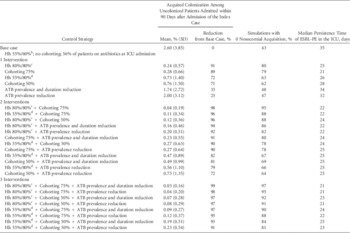
Model outputs are presented in Table 2. In the base case scenario, on average, 2.60% of uncolonized patients admitted within 90 days of the index case admission acquired colonization in the ICU. The mean number of acquisitions was 3 and the mean number of admitted uncolonized patients was 119. In 43% of the simulations, the index case caused no secondary case. ESBL-PE persisted in the ward for a median time of 35 days and were still present 90 days after admission of the index case in 29% of the simulations.
Outputs of the Stochastic Transmission Model of an ESBL-Producing Enterobacteriaceae after the Introduction of the Index Case in a 10-Bed Intensive Care UnitFootnote a

NOTE. Hh, hand hygiene; ATB, antibiotic.
a Each control strategy is simulated 1,000 times. Control strategies, grouped by number of interventions involved, are ranked by decreasing effectiveness in preventing nosocomial cases.
b 55% hand hygiene compliance before patient contact and 60% hand hygiene compliance after patient contact.
c 80% hand hygiene compliance before patient contact and 80% hand hygiene compliance after patient contact.
d 55% hand hygiene compliance before patient contact and 80% hand hygiene compliance after patient contact.
Control Interventions
Improving hand hygiene compliance was the most effective of all individual interventions. When hand hygiene compliance was set to 80% before and after contact with a patient, the mean percentage of ESBL-PE acquisitions within 90 days in the ICU was 0.24%, a reduction of 91% from the base case scenario. Cohorting was the second most effective intervention: a cohorting level of 75% reduced the mean percentage of ESBL-PE acquisitions by 89%. Finally, restricting antibiotic consumption had the lowest impact on the nosocomial spread of ESBL-PE in our model: reducing the proportion of patients on antibiotics at admission by 50% and reducing antibiotic therapy duration in the ICU by 25% reduced the percentage of ESBL-PE acquisitions at 90 days by 33%.
Strategies that combined 2 interventions were then studied. Adding a cohorting intervention (q=75%) to a hand hygiene improvement intervention (p p =80% and p h =80%) decreased the proportion of ESBL-PE acquisitions by an additional 7%. This was the most effective strategy among those that combined two interventions.
Finally, the highest impact on transmission was obtained when using all 3 interventions simultaneously, ie, improving hand hygiene compliance to 80% before and after patient contact, plus implementing a cohorting level of 75%, plus reducing antibiotic prevalence at admission by 50% and antibiotic treatment duration by 25%. But this strategy only reduced the mean proportion of ESBL-PE acquisitions by an additional 1%, compared with the most effective 2-intervention strategy, ie, by 99% vs 98%.
Univariate Sensitivity Analyses
When the number of HCW visits associated with at least 1 contact with the patient was 13.8 per patient per day (instead of 81), the mean proportion of ESBL-PE acquisition in the absence of intervention was 0.09% (instead of 2.60%). Unlike in our core analysis, the most effective intervention was to set a cohorting level of 75%, which reduced the proportion of acquisitions by 75%. Hand hygiene was the second most effective intervention, allowing a 73% reduction of the proportion of nosocomial acquisitions. Reduced antibiotic prevalence at admission associated with reduced antibiotic therapy duration only allowed an 18% reduction of the proportion of nosocomial acquisitions, while reduced antibiotic prevalence at admission alone did not allow any reduction. The results for all strategies are presented in Supplementary Table S1.
Results of sensitivity analysis for a higher number of HCW visits are presented in Supplementary Text S2.
If baseline compliance with hand hygiene was lower than in our central hypothesis, eg, 20% before and after patient contact instead of 55% before and 60% after patient contact, the superiority of interventions targeting hand hygiene compliance over those relying on cohorting was confirmed: a 99% reduction was achieved by improving hand compliance to 80% vs 86% achieved by a cohorting level of 75% (see Supplementary Table S2). A cohorting level of 95% would achieve a similar effect to that of improving hand hygiene compliance level before and after contact to 80%.
When the mean length of stay of a colonized patient was 7.5 instead of 31 days, the mean percentage of ESBL-PE acquisitions at 90 days was 0.34%, with an overall lower impact of control measures (see Supplementary Table S3). However, the relative effectiveness of control measures was the same as in baseline analysis.
Multivariable Sensitivity Analysis
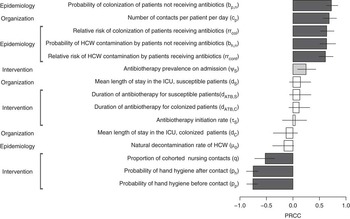
We computed PRCCs to quantify the relationships among all parameters and the outcome of interest, controlling for the effect of the other variables in the model (Figure 2). For example, the PRCC was –0.76 for the probability of hand hygiene before contact (p p ). This indicates a fairly strong inverse association between hand hygiene before contact and ESBL-PE colonization. On the other hand, the PRCC for the colonization probability for patients not receiving antibiotics (b p,n ) was 0.73. This indicates a strong positive association between b p,n and ESBL-PE colonization.
Estimates of partial rank correlation coefficients (PRCC) between uncertain input parameters and the output of interest, namely the mean proportion of exposed patients that are colonized. The assumed ranges and distributions of these parameters are presented in Table 1. Associated 95% confidence intervals are represented by thin segments. Dark grey indicates statistically significant PRCCs (P <.01), light grey statistically significant PRCCs (.01<P<.05) and white non-significant PRCC. The type of parameter (ie, epidemiological, healthcare organization or transmission control intervention) is given on the left-hand side. Positive PRCCs indicate that when the value of particular parameter increases, the mean proportion of exposed patients that are colonized increases. Negative PRCCs indicate that when the value of particular parameter increases, the mean proportion of exposed patients that are colonized decreases.

DISCUSSION
In this study, improving compliance with hand hygiene was the most effective intervention for controlling the spread of ESBL-PE in an ICU. Our model predicted that improving hand hygiene compliance from 55% before patient contact and 60% after patient contact to 80% before and 80% after patient contact reduced by 91% the proportion of patients who acquired ESBL-PE within 90 days. Cohorting was the second most effective intervention. Reduction of antibiotic use was the least effective intervention considered, despite favorable hypotheses concerning the impact of antibiotic discontinuation on transmission.
Our model depicts a situation in which the colonization status of hospitalized patients is unknown, which is frequent in the absence of routine rectal screening. Thus, control interventions apply to all patients. One reason that hand hygiene is the most effective control measure is that it acts in 3 ways: (1) it prevents colonization of patients, (2) it prevents contamination of HCWs hands, and (3) it accelerates the decontamination of HCWs hands. In contrast, the lower effectiveness of antibiotic restriction is partially explained by the intervention targeting only patients under antibiotic treatment.
Baseline compliance with hand hygiene is frequently lower than values used in our base case analysis.Reference Scheithauer, Haefner and Schwanz 22 , Reference Armellino, Hussain and Schilling 23 We showed in a sensitivity analysis that, in such cases, interventions targeting hand hygiene were even more effective in curtailing nosocomial transmission. Using a model of VRE transmission in the ICU, Austin et alReference Austin, Bonten, Weinstein, Slaughter and Anderson 5 found that improved hand hygiene compliance was the most effective intervention, followed by cohorting.Reference Austin, Bonten, Weinstein, Slaughter and Anderson 5 Although the present results are concordant with those of Austin et al, our models differ. First, they hypothesized that compliance with hand hygiene only reduced the risk of VRE transmission from HCW to patients. They did not consider that it could decrease the risk of VRE transmission from patients to HCWs and accelerate the decontamination of HCWs hands. Second, they used a lower patient-to-HCW contact rate: 13.8 vs 81 in our study, the latter being based on recent multicenter data.Reference Fries, Segre, Thomas, Herman, Ellingson and Polgreen 6 – Reference Guyot 8 Finally, as far as cohorting was considered, Austin et al applied it to only 79.4% of HCWs, namely the nurses, whereas in our model, all HCWs had an equal probability q of having cohorted contacts.
One objective of our model was to compare the impact of control measures targeting antibiotic consumption with those targeting hand hygiene and cohorting. We assumed that antibiotics acted in 2 ways: they increased the colonization probability of uncolonized patients (relative risk, 3) and the transmission probability from colonized patients to HCWs (relative risk, 20). In the absence of detailed information on the impact of antibiotics (eg, broad spectrum vs targeted antibiotics) on these probabilities, we performed an extensive sensitivity analysis (Supplementary Text S3). We showed that, in settings in which the impact of antibiotic use was maximal, interventions targeting antibiotic use worked better than improving compliance with hand hygiene to 80% after patient contact only, but these interventions never outperformed improving hand hygiene compliance before and after contact to 80%.
Multivariate sensitivity analysis showed that several parameters had a significant influence on the outbreak course. Among intervention parameters, improved compliance with hand hygiene before or after contact, and cohorting had strong protective effects. We limited compliance with hand hygiene and cohorting to 80%. Indeed, 100% compliance with hand hygiene and cohorting may be very difficult to achieve. Regarding cohorting, a 1-to-1 nurse-to-patient ratio cannot be reached because specific care such as changing bedding, toileting, or complex dressing requires mutual aid between HCWs.
The most influential organizational parameter was the number of hand hygiene opportunities per patient day. Recent publications have shown that, in ICUs, the number of HCW visits varies from 59 to 160 per patient per day.Reference Fries, Segre, Thomas, Herman, Ellingson and Polgreen 6 , Reference Harris, Pineles and Belton 7 , Reference Steed, Kelly and Blackhurst 24 , Reference McArdle, Lee, Gibb and Walsh 25 In our model, the number of hand hygiene opportunities impacts both transmission rates and the decontamination rate of HCWs. This sensitivity analysis outlines its central role in the dynamic of the outbreak: this input parameter should be carefully documented if modeling studies are to guide policies regarding infection control measures.
Our study has several strengths. First, we used input parameters estimated from recent multicenter studies, which provided realistic targets for improvement. Secondly, our model aimed to incorporate key elements of the transmission dynamics of ESBL-PE, such as the impact of antibiotic treatment. Third, we modeled precisely the hand decontamination rate using the frequency of hand hygiene opportunities and compliance with hand hygiene. Fourth, sensitivity analyses were used to assess the impact of uncertain input parameters on the outcomes of interest and to define the zones of dominance of the tested interventions.
We are also aware of several limitations of our study. First, there are uncertainties surrounding several input parameters, in particular those concerning ESBL-PE transmission probabilities and the impact of antibiotic exposure on transmission. For example, we assumed that the colonization and transmission risks of patients discontinuing antibiotherapy were immediately equal to that of patients who never took antibiotics, even if the impact of antibiotics on the gut microbiota is known to be long lasting. Even if this hypothesis favored interventions on antibiotic restriction, we failed to demonstrate an impact of antibiotic restriction on the outcome of interest.
Second, we did not take into account the quality of hand hygiene, assuming that all hand hygiene actions were correctly performed in all scenarios. Yet, badly performed hand hygiene could be less effective in curtailing transmission.Reference Widmer and Dangel 26
Third, we modeled HCWs as a homogeneous group, even if the different types of HCWs have different frequencies of contact with patients and different probabilities of bacterial transmission. Nurses have more contacts with patients than physicians and, because of the type of care they provide, are more exposed to colonizing bacteria.Reference Fries, Segre, Thomas, Herman, Ellingson and Polgreen 6 In addition, some HCWs categories (eg, those having contacts with numerous patients) are potential superspreaders.Reference Temime, Opatowski, Pannet, Brun-Buisson, Boelle and Guillemot 27 However, the transmission probabilities of ESBL-PE from patients to HCWs and vice versa remain vastly unknown. Therefore, to maintain a reasonable number of hypotheses about model parameters, we modeled HCWs as a homogeneous group.
Likewise, the probability of colonization and transmission of patients likely depend on their individual risk factors, but we did not attempt to stratify on those, for parsimony sake, and given that the tested interventions do not depend on patients’ individual characteristics.
Fourth, we studied a single outbreak, starting from the admission of a single index case in an ICU free of ESBL. In a situation with continuous admission of colonized cases, other interventions, such as screening at admission and specific cohorting (ie, cohorting of colonized patients in a dedicated ward) should be tested and modeled.
Finally, our model did not address the competing risks of discharge from and death in the ICU, with or without infection or colonization by ESBL-PE. However, we explored the impact of excess mortality due to ESBL-PE colonization on the transmission dynamics by reducing the length of stay of colonized patients in a sensitivity analysis.
In conclusion, our study suggests that improved compliance with hand hygiene is the most effective intervention to control ESBL-PE transmission in the ICU. Cohorting was the second most effective control measure, which makes cohorting worth considering if efforts to improve hand hygiene compliance are ineffective. Antibiotic restriction measures were the least effective, despite strong hypotheses regarding antibiotic impact on the risk of ESBL-PE transmission. When added to the other interventions, they only marginally improved transmission control.
ACKNOWLEDGMENTS
We thank Prof. Pierre-Yves Boëlle for useful discussion and comments on our manuscript.
Financial support: This work was supported by the French government’s PREPS program (grant no. 13-0693) and by the National Institute for Health and Medical Research (INSERM).
Potential conflicts of interest: All authors report no conflicts of interest relevant to this article.
SUPPLEMENTARY MATERIAL
To view supplementary material for this article, please visit http://dx.doi./org/10.1017/ice.2015.284