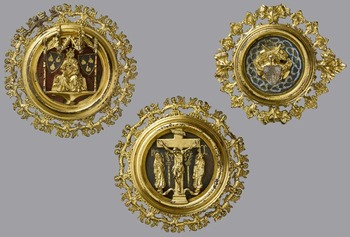
The most impressive examples of late medieval metalwork from an English Cistercian monastery are the three copper-gilt plaques with enamelled roundels and silver mounts from Warden Abbey, Bedfordshire (fig 1). They are currently on display in the medieval gallery of the British Museum. The plaques have only a brief entry in the museum's catalogue, where they are described as abbot's morses and dated to 1426–75,Footnote 1 although Marian Campbell has suggested a date of c 1400.Footnote 2 In her paper on English Cistercian metalwork published in 1986, Jane Geddes commented, ‘nothing is known about the origin and function of these enamels and they merit further investigation’.Footnote 3 Although they have occasionally received brief comment in subsequent literature,Footnote 4 a detailed art-historical analysis of these beautiful and fascinating objects is lacking, something which this paper will seek to remedy.
Three copper-gilt and enamel roundels with silver mounts from Warden Abbey, Bedfordshire (British Museum, London, MLA 53, 67, 1–3). Photograph: © British Museum

The plaques
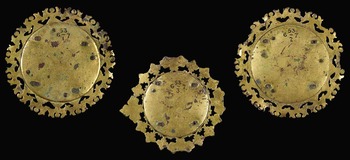
All three plaques have copper-gilt frames and back plates, which have the remains of fittings, most likely for suspension loops (fig 2). Two have outer rims decorated with angels holding hands and both have a diameter of 119mm. The third plaque is surrounded by trilobed leaves and has a diameter of 115mm. All three have a central silver relief decoration, which is set against a champlevé enamel background.
Reverse of the Warden Abbey roundels. Photograph: © British Museum

The first plaque is embellished with an elaborate canopied niche, containing an image of the seated and crowned Virgin with the Christ Child on her left knee. The red enamel background is decorated with two shields, each emblazoned with the arms of Warden Abbey, three pears or on azure. These arms were painted on a corbel in the demolished fourteenth-century transept of St Paul's church, Bedford,Footnote 5 and a variation on them, including a crozier, was used by the abbey on its counter seal in 1538.Footnote 6 The second plaque is decorated with a relief of the Crucifixion with the Virgin and St John. Christ hangs on the cross with the titulus, inscribed INRI, above him. The flanking figures stand on pedestals joined to the foot of the cross by curved brackets. The scene is set against a blue enamel background decorated with two croziers and initials. Chamot transcribed these as ‘W A’ (for Warden Abbey)Footnote 7 and this transcription has been repeated in subsequent literature. However, the correct reading of these letters, which provides evidence for the plaques’ probable patron and date, will be discussed shortly. The relief on the final roundel is of an angel holding a shield. This is emblazoned with a crozier dividing crowned Lombardic letters. Once again, these have been interpreted as reading ‘W A’. A belt of clouds, set against a blue enamel ground, surrounds the relief.
The plaques were bought by the British Museum for £30 in 1853 from H Inskip of Shefford,Footnote 8 which is approximately three miles from the site of Warden Abbey. The seller was probably Hampden Inskip, clock and watchmaker,Footnote 9 the son of the keen amateur archaeologist, Thomas Inskip (d 1849), who uncovered important Roman remains in the vicinity of Shefford.Footnote 10 There is only very vague information about the site of the plaques’ discovery. The museum's acquisitions book merely records that they were excavated at Shefford and describes them as ‘ornaments’ with decoration in the ‘Tudor’ style. Keeper Franks reported their purchase in the 1854 edition of the Archaeological Journal, and suggested they were from a shrine.Footnote 11 Two of the plaques were exhibited in Paris in 1867.Footnote 12 All three are in excellent condition and have only minor damage. Conservation work was undertaken in 1949 to stabilize the enamel on the Virgin and Child plaque, and all were conserved in 2008, on this occasion to remove surface dirt and to prepare the items for permanent display in the museum's recently refurbished medieval galleries.
The appearance of the abbey's arms on one of the roundels and the location of their discovery mean that they undoubtedly originated from Warden Abbey, a daughter house of Rievaulx Abbey, founded by Walter Espec in 1136. The monastery was provided with a generous endowment and, in 1224, housed a community of thirty monks. When the income of the abbey was assessed by the papacy in 1291, it totalled over £220.Footnote 13 This wealth was sufficient for the rebuilding of the monastery's church, which is documented in 1323 and 1366.Footnote 14 There seems to have been further building work at the abbey at the turn of the fifteenth century. In December 1400, a papal indulgence was granted to penitents who visited the abbey and gave alms for ‘its conservation and repair’.Footnote 15 Evidence of the wealth and status of the abbot of Warden is provided by the papal bull of 1429 permitting his use of the mitre and other pontificalia.Footnote 16 When the abbey was dissolved in 1537, the community consisted of the abbot and fifteen monks, who enjoyed an annual income of £389,Footnote 17 making the monastery one of the richer Cistercian houses in England.
Today, the abbey's few standing remains are incorporated into the wing of a sixteenth-century brick house, built after the Dissolution on the site of the east range of the cloister.Footnote 18 Archaeological excavations have unearthed a late thirteenth-century copper-alloy crozier, along with decorated floor tiles, painted glass, roof bosses, sculpture and evidence of the extension of the chancel in the fourteenth century. All these discoveries give an idea of the richness of the abbey and its material culture, which is demonstrated most vividly by the plaques under discussion here.Footnote 19
Cistercian metalwork
The early austerity of the Cistercians was expressed in legislation concerning its art and architecture. This included references to metalwork. The Capitula (c 1109–19), one of the Order's earliest and most important foundation documents, stated that all ornaments, goblets and utensils within a Cistercian monastery were to be without gold, silver or gems. An exception was made for chalices and the Eucharistic reed (a straw-like implement used for taking communion wine), which were to be of silver, but not gold.Footnote 20 The Exordium Parvum (c 1119) prohibited precious metal crucifixes, candelabra and thuribles.Footnote 21 A decree of the General Chapter in 1182–3 implied that enamel decoration was forbidden, instructing that candlesticks and pyxes were to be without colour. Small silver or gold altar crosses were allowed in 1157,Footnote 22 but other restrictions on luxury metalwork were repeated several times in the early thirteenth century. However, by the late thirteenth century a change is apparent in the Order's official stance on artistic matters. The codifications of its legislation in 1289 and 1316 replaced most of the specific artistic prohibitions, including those on luxury metalwork, with a general clause stating that superfluae novitates and notibles curiositates were to be avoided in the Order's art and architecture.Footnote 23
Possibly because of lay benefaction, English Cistercian houses possessed precious metal liturgical plate and brightly coloured enamels long before restrictions on their ownership were formally lifted. The early thirteenth-century foundation history of Kirkstall Abbey, Yorkshire, records that in the late twelfth century the monastery possessed a gold chalice, which Abbot Ralph (1182–c 1190) offered to King Henry ii as a gift.Footnote 24 A thirteenth-century Limoges enamel plaque, probably from a casket, was excavated at Buckfast, Devon,Footnote 25 and enamels with figurative decoration were found at Waverley, Surrey, and Hailes, Gloucestershire.Footnote 26 Moreover, the roundels decorating the late thirteenth-century reliquary of the Blessed John of Montmirail, at Longpont Abbey, Aisne,Footnote 27 suggest that heraldic enamels were a familiar sight in Cistercian abbeys long before the commissioning of the Warden plaques.
Heraldic decoration on the Warden plaques as evidence of patronage
As has been seen, one of the plaques is decorated with the arms of the abbey, the others with a monogram and crozier. It was common for patrons or institutions in the Middle Ages to decorate plate with their badge or arms. Another example of luxury metalwork decorated in this way is the mid-fourteenth-century silver incense holder from Ramsey Abbey, which was adorned with two rams’ heads, a pun on the monastery's name.Footnote 28
The arms of Warden consisted of three pears because of the monastery's association with this fruit. There are numerous fourteenth- and fifteenth-century references to warden pears,Footnote 29 which, in the late Middle Ages, cost six times more than ordinary types of pear.Footnote 30 Croziers and initials in a Lombardic script decorate the other plaques. It has already been noted that these have been interpreted as reading ‘W A’ for Warden Abbey. However, the ‘A’ is in fact a typical Lombardic ‘C’, closed with an ornamental down stroke and embellished with flourishes at the apexes. This form of ‘C’ can be see in the Litlyngton Missal of c 1383–4,Footnote 31 as well as in other media, such as the inscription in the mid-fourteenth-century stained-glass window at Aldwincle, Northamptonshire.Footnote 32 Therefore the letters on the Warden plaques read ‘W C’, a transcription which was first made by Franks in 1854, who also suggested that these were the initials of the patron, but was unable to identify him because the list of the abbots of Warden was (and remains) ‘imperfect’.Footnote 33
Nevertheless, an abbot of the monastery who is now known to have had these initials was Walter de Clyfton, or Clifton. His exact dates are uncertain. A predecessor, William of Helmsley, is last documented in 1346, and his successor, Abbot John, occurs in May 1397.Footnote 34 Clifton was abbot of Warden by 1377, when he is named twice in connection with a loan of 100 marks from John Giffard of Cotterstock, clerk, for ‘the profit of the monastery’.Footnote 35 He occurs again in the clerical subsidy of 1390–2, when the liability of Abbot Walter and the twenty-four monks of Warden was assessed at £21 11 s 4d.Footnote 36 It is likely that the abbot was from Clifton, a village close to the monastery where Warden Abbey held estates.Footnote 37 Abbot Walter was clearly an individual of some importance within his Order. In 1381, and again in 1386, the abbots of Warden and its mother-house Rievaulx were empowered by the pope to convene a general chapter of Cistercian abbeys in the British Isles.Footnote 38
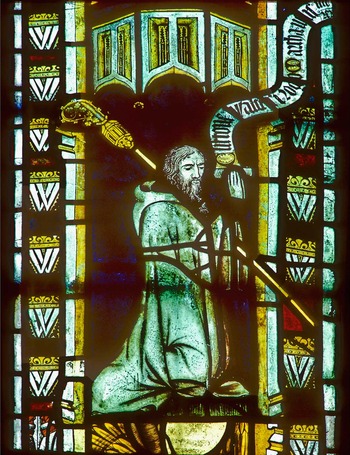
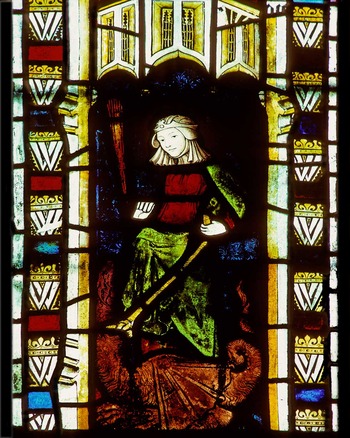
Abbot Clifton is also known to have been a patron. Stained-glass panels at the parish church of St Laurence, Old Warden, can be firmly associated with him. The church formed part of the abbey's original endowment and, in 1376, the monastery acquired a licence for its appropriation. The easternmost window in the north nave wall has two main lights with eyelets above surmounted by a quatrefoil. In the left light is an image of a Cistercian abbot (fig 3) and in the other light an image of St Martha (fig 4). The glass in the quatrefoil and the lower parts of both the main lights is modern, as are the heads of the abbot and saint.Footnote 39 The abbot is shown kneeling and facing right in the white habit of his order and carrying a crozier, a symbol of abbatial office, which also appears on the plaques. The crozier has a large architectural knop and crocketed head and is similar to the magnificent silver-gilt and enamel crozier of Bishop William Wykeham of Winchester, which is dated to c 1367.Footnote 40 The abbot's hands are clasped in prayer, from which a scroll rises inscribed ‘/CLIFTONE/WALTRE/RI : ROG/ O MARTHA : US/ AS. iiij RE’. Richard Marks suggested that the final portion of the inscription would have read ‘iiij ANNO REGIS RICARDI SECUNDI’, therefore dating the panel to 1381–2.Footnote 41
Stained-glass window at Old Warden Parish Church, Bedfordshire, depicting Abbot Walter Clifton of Warden Abbey. Photograph: © Gordon Plumb

Stained glass at Old Warden Parish Church, Bedfordshire, depicting St Martha. Photograph: © Gordon Plumb

St Martha, the sister of Lazarus and Mary (probably Mary Magdalene), can be identified by the presence of two of her traditional attributes: a broom and a dragon held by her girdle. The broom alludes to the saint's association with the active life. Her legend describes how she pacified the Tarasque, a dragon that lurked in the Rhône between Avignon and Arles, terrorizing the local population. Martha tamed the creature at Tarascon and secured it by her girdle.Footnote 42 Her feast on 29 July was not included in the medieval Cistercian calendar and was only adopted by the Order in the seventeenth century.Footnote 43 Other than the window at Old Warden, art-historical evidence of Cistercian devotion to Martha is elusive. Nevertheless, the saint features in St Bernard's Sermo de diversis (9.4), where, because of her labour, she is described as a model for officials in a monastery.Footnote 44 The few liturgical books that survive from English Cistercian houses (none of which are thought to be from Warden) indicate that ‘unofficial’ saints were occasionally adopted by some houses.Footnote 45 Evidence of her cult in the wider English Church is also limited, but she is mentioned in some late medieval East Anglian manuscripts, where she occurs with ‘helper’ saints.Footnote 46
Both Abbot Clifton and St Martha are depicted beneath elaborate three-sided canopies with battlements, with censing angels in the eyelets above. In the borders of both lights are small panels decorated with a Lombardic letter ‘W’ with a crown above. These are similar to the abbot's badge on the roundels. These crowned letters can also be compared to other contemporary abbatial monograms, for example that of Abbot Nicholas Litlyngton of Westminster (1362–86). His initials, ‘N L’ in Lombardic script with a crown above, appear in shields in the margins and base of several folios of his missal, accompanied by other shields bearing the arms of his abbey.Footnote 47
The Warden roundels provide early evidence of a Cistercian abbot deploying his badge and arms as a way of advertising his patronage and high ecclesiastical and social status, a practice that was common in the late medieval English Church.Footnote 48 The earliest surviving evidence of a Cistercian abbot in Britain leaving a visual record of his patronage dates to the mid-fourteenth century. The west gable of the church of Valle Crucis, Denbighshire, was rebuilt at this time, and an inscription states that it was the work of Abbot Adam (c 1330–40).Footnote 49 The use of both personal and institutional heraldry emerged shortly after. The seal used by Abbot John Lindley of Whalley in 1362 was decorated with the arms of his abbey.Footnote 50 The early fifteenth-century seal of Abbot Robert Gower of Jervaulx (1399–1425) features both the arms of the abbey and those of his family, and in 1417 the abbot was using a signet ring inscribed with his personal arms.Footnote 51 Further late medieval evidence of the use of heraldic enamels by Cistercian abbots is provided by a roundel excavated at Rievaulx Abbey, Yorkshire, which is decorated with the arms of Abbot John Inkeley (recorded in 1449), sable, a pastoral staff erect between six mullets or, over all a bend.Footnote 52 The composition of Clifton's badge, with his initials divided by a crozier, is an early example of a form of heraldry used by the Order's abbots in the fifteenth and sixteenth centuries. A broadly similar badge was used by Marmaduke Huby of Fountains (1495–1526), the greatest Cistercian patron of the later Middle Ages, and is illuminated in his breviary.Footnote 53
Ornament and iconography
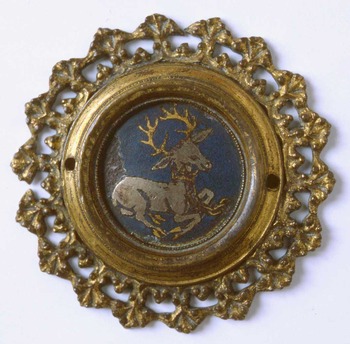
Identification of Abbot Clifton as their patron places the plaques in the final quarter of the fourteenth century and an analysis of their ornament, style and iconography also supports this date. As Marian Campbell recognized, their closest parallel is a plaque in the Musée des Beaux-Arts, Troyes (fig 5). This plaque has a copper-gilt rim and a central enamelled silver roundel with the white hart badge of Richard ii (1377–99), and was most probably a brooch of some kind.Footnote 54 Its outer rim is decorated with trilobed leaves similar to those on one of the Warden roundels. This form of ornament can also be found on other luxury English metalwork from the fourteenth century, most notably on the rim of the King John Cup of c 1340 at King's Lynn,Footnote 55 and it is possible that this form of decoration originates from ornament used in architecture and woodwork, such as the early fourteenth-century choir stalls at Hereford Cathedral.Footnote 56
Copper-gilt and enamel badge decorated with the white hart badge of Richard ii (Troyes, Musée des Beaux-Arts, 871.6.1). Photograph: Jean-Marie Protte; © Musées d'Art et d'Histoire de Troyes

Angels decorate the rims of the Warden plaques with sacred subjects as their central themes. They hold hands, an unusual iconographic detail, and emerge from clouds representing the heavens. Angels were a common form of marginal decoration in the later Middle Ages and occur in the Sherborne Missal, where they appear in the margin above a miniature of the Resurrection.Footnote 57 It is especially appropriate that angels with their hands joined, symbolizing unity and fidelity, should adorn objects associated with a Cistercian abbot. Angels were believed to be hierarchical, harmonious and co-operative; because of this, St Bernard of Clairvaux regarded them as a model for communal life within a monastery. In the sermon On Consideration (5.4.7), he stated that angels were ‘distinct persons … devoutly pious, wholly chaste, individual but unanimous, secure in peace, formed by God and dedicated to divine praise and service’. In his Second Sermon on the Octave of Easter, he commented on the unity, charity and peace of angels.Footnote 58 Moreover, Bernard believed that monasticism allowed a man to live an angelic life on earth and that monks were supported by ‘angelic hands’.Footnote 59 There are also references to angels in St Aelred of Rievaulx's treatise On Spiritual Friendship. He stated that angels provided a model for ideal friendship, which should be eternal, stable and provide a foretaste of paradise for the blessed.Footnote 60 The relief of the angel emerging from clouds and holding the shield emblazoned with Clifton's arms could suggest angelic support for the abbot during the execution of his duties. The decorative use of shield-bearing angels was an innovation of the late fourteenth century, and was associated with patrons of the very highest status, including Richard ii at Westminster Hall.Footnote 61 Half-length angels carrying shields also decorate the corbels of the abbot's hall at Westminster, which was built c 1375.Footnote 62
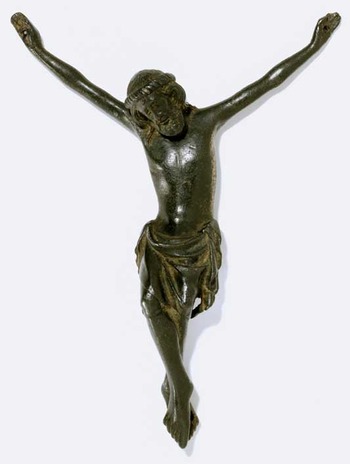
The Crucifixion scene decorating one of the plaques is largely standard and can be compared to an English enamel pendant of c 1350–70.Footnote 63 The rendering of the figure of Christ on the Warden plaque shares characteristics with English examples of the later fourteenth century, for example a bronze figure in the Victoria and Albert Museum, which Colum Hourihane has dated to c 1370–80 (fig 6).Footnote 64 Like the figure on the plaque, Christ's body is distorted in pain and his head inclined to the right, his long arms extended above his head in an open V shape. The loincloth is long, with vertical folds on either side and gentle semicircular folds in front, and the figure's right leg rests on top of the left knee, the feet pierced by one nail. In contrast, fifteenth-century English figures of Christ on the Cross have a shorter loincloth, the figure hangs in a higher position and the head is in a more upright position.Footnote 65
Late fourteenth-century bronze figure of Christ (Victoria and Albert Museum, London, M.1-1922). Photograph: © Victoria and Albert Museum

On the Warden plaque, the Virgin and St John stand on corbels that are connected to the base of the cross by curving brackets, similar to those on a now lost altar cross of c 1330, originally from Basel Cathedral.Footnote 66 Crosses with this arrangement appear to have been present at English Cistercian monasteries and the dissolution inventory from Whalley Abbey, Lancashire, lists ‘a large cross of silver and gilte with ij images of Mary and John’.Footnote 67 These curved brackets also appear on a number of late medieval English processional and altar crosses.Footnote 68 They are also present on the canopies of the tombs of Edmund Crouchback (d 1296) at Westminster and Bishop William de Luda (d 1298) at Ely and in both cases originally supported angels.Footnote 69 Such brackets may also have been used in roods. A Crucifixion group with the Virgin and St John supported by curved brackets is illustrated in the portfolio of Villard de Honnecourt of c 1230.Footnote 70 It has a sculptural appearance; and curved brackets also appear in the late medieval Crucifixion group, which was probably the head of a churchyard cross, at Sherburn-in-Elmet, Yorkshire.Footnote 71
All Cistercian abbeys were dedicated to the Virgin and it is therefore no surprise that she is depicted on one of the plaques. The presence of Warden's arms either side of the Virgin's image emphasizes the important relationship between her and the monastery. She is shown seated and has a frontal gaze with the Christ Child on her lap. The relief's rather stiff yet majestic pose recalls Romanesque and early Gothic sedes sapientiae depictions of the Virgin, such as the polychromed oak image from Langham church, Essex, now in the Victoria and Albert Museum.Footnote 72 From the mid-thirteenth century the Virgin was often represented in a softer, more empathetic fashion with her head and gaze inclined to the Christ Child on her knee.Footnote 73 Such representations of the Virgin and Child appear on the seals of English Cistercian monasteries, such as that in use at Whalley in c 1360.Footnote 74 The niche housing the Virgin and Child on the plaque has parallels in contemporary sculpture. Its slender, pinnacled shafts, projecting triple canopy and crocketed arches are similar to the niche surrounding the Virgin and Child image on the mid-fourteenth-century Sutton Valence retable in the Victoria and Albert Museum.Footnote 75
Function
The similarity between the plaques and the Troyes roundel suggests that they were brooches or another form of ornament worn on clothing.Footnote 76 Circular brooches were fashionable amongst the late fourteenth-century nobility and gentry. These were often decorated with heraldic or religious imagery and worn on the mantle,Footnote 77 and their use appears to have been adopted by the higher clergy. Illuminations in the Sherborne Missal depict Abbot Clifton's Benedictine contemporary, Abbot Brunyng (1385–1415), and some members of his community wearing badges or brooches on their habits.Footnote 78 The Cistercian General Chapter may have had such ornaments in mind when it passed statutes in the mid-fourteenth century restricting extravagance and ostentation in the personal possessions and dress of monks.Footnote 79
The current British Museum catalogue states that the plaques were morses and the evidence suggests this was indeed their function. Morses were used to secure the cloak-like copes worn by monks and priests during processions.Footnote 80 As early as the late tenth century, the community at Cluny wore copes for processions and, in the early twelfth century, Abbot Faricius gave twenty-nine copes to the Benedictine abbey at Abingdon.Footnote 81 Early Cistercian legislation contained detailed regulations concerning vestments; the Exordium Parvum proscribed the use of copes and richly embellished vestments.Footnote 82 These regulations were gradually relaxed and the codification of the Order's legislation in 1316 permitted the use of an array of vestments made of rich fabrics.Footnote 83 The late fourteenth-century inventory of the possessions of Meaux Abbey, Yorkshire, lists numerous copes or capa Footnote 84 and, shortly before it was dissolved, Fountains Abbey was in possession of eighty copes, many of them richly decorated.Footnote 85
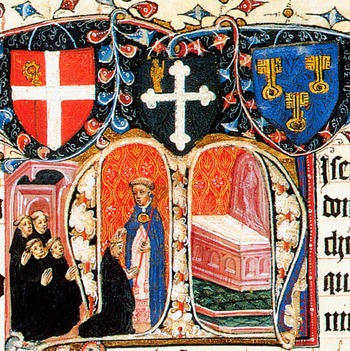
Morses were manufactured in a variety of shapes and the illuminations in the Sherborne Missal show that some, like the plaques from Warden, were circular with a central decoration and wide rim (fig 7).Footnote 86 Although morses were often made from precious metal and embellished with jewels, there are numerous surviving French fourteenth-century copper-gilt examples with enamelled religious images, typically of the Annunciation. One such morse is in the collection of the Musée National du Moyen Age in Paris. It has fittings on the back to fasten the copeFootnote 87 and it seems likely that fragmentary loops on the back of the plaques from Warden may have had a similar function.
Historiated initial from the Sherborne Missal (British Library, London, Add ms 74236, fol 78). Photograph: © British Library

The three roundels from Warden appear to have formed a set; and it is clear from inventories that great churches in England possessed a large number of morses. Numerous silver morses are itemized in the 1295 inventory of the possessions of St Paul's Cathedral, London. Also listed are two copper morses, one of which, belonging to Roger of Ferynges, was decorated with an image of a bishop.Footnote 88 Similarly, the Edwardian inventory of the vestments at Lincoln Cathedral itemizes four morses of copper and gilt, all of which were enamelled with images. It was also common for morses to be decorated with the arms or badge of their patron. At Lincoln, there were four copes of red cloth of gold with the arms of Bishop William Smith (1495–1514) ‘in their morses’.Footnote 89 Comparison with surviving Continental material also suggests that the Warden plaques were morses. A late fourteenth-century morse at Tongeren Cathedral, Belgium, has similar dimensions and decoration to the plaques from Warden. An image of the Virgin is shown beneath a canopy with the donor, Canon Johannes Cleinjans (d 1402), and an angel supporting a shield on either side.Footnote 90
Conclusion
A reinterpretation of the lettering of the Warden Abbey roundels indicates that their patron was Abbot Walter Clifton, thus re-dating them to the late fourteenth century. Their style and ornament are consistent with this period and some unusual aspects of their iconography and Clifton's personal devotions can be related to the spirituality of the Cistercian Order. It seems highly probable that they were morses, and their heraldry provides an early example of an English Cistercian abbot ostentatiously advertising his patronage and asserting his status.
Acknowledgements
I thank Dr James Robinson and Sylvie Seton of the British Museum for their assistance. I am also grateful to my PhD supervisor at the Courtauld Institute of Art, Professor David Park, Dr John Cherry, Steve Edwards and to this Journal's anonymous reviewers for their comment on earlier drafts of this paper.
Abbreviations and Bibliography
- Abbreviations
- CCR
Calendar of Close Rolls
- CPL
Calendar of Papal Registers
- CPR
Calendar of Patent Rolls
- V&A
Victoria and Albert Museum, London
- VCH
Victoria County History