INTRODUCTION
At the present time, nuclear power plants (NPPs), together with spent nuclear fuel reprocessing plants and radioactive waste repositories, form the main industrial sources of radiocarbon (14C) release into the atmosphere. Areas of maximum 14C excess are located around NPPs at a distance of 1–2 km from the ventilation pipe, however, sometimes could be traced up to a 20–30 km distance (Levin and Kromer Reference Levin and Kromer2004; Magnusson 2007).
Emissions of 14C in the form of CO2 and CnHm can occur during operation of NPPs. NPPs’ total 14C emissions are characterized by power capacity and the ratio of their forms, which determines the type of used reactors. The 14CO2 component of emissions from currently operating VVER reactors at Ukrainian NPPs is low, ranging from a few to 25% of total 14C emissions (IAEA 2004; Rajec et. al. Reference Rajec, Matel, Drahošová and Nemčovič2011), which makes it difficult to trace in the environment around facilities (Varga et al. Reference Varga, Orsovszki, Major, Veres, Bujtás, Végh, Manga, Jull, Palcsu and Molnár2020). The main form of 14C emissions of graphite reactors of the RBMK type is CO2, which allows clear retrospective studies near the NPP (Pabedinskas et al. Reference Pabedinskas, Maceika, Šapolaitė, Ežerinskis, Juodis, Butkus, Bučinskas and Remeikis2019).
The Ukrainian NPP operator is introducing current monitoring of 14C emissions, taking continuous gas samples from the ventilation pipe. As emission to the environment dilutes rapidly, 14C excess traced at a limited distance from the emission source, in particular the component corresponding to 14C emissions in the form of CO2 can be traced in biota samples.
Today, Rivne NPP has four power units (VVER type) with a total installed capacity of 2835 MW. Four RBMK-1000 reactors operated at the Chornobyl (Chernobyl) NPP until 1986, while two of them continued to operate up to shut down in 2000.
Retrospective studies of the 14C excess component in the annual tree rings caused by 14CO2 emissions while operation of post-Soviet NPP have been conducted previously: 14C emissions of the Chornobyl NPP operation for the period before 1996 and for few years operation of the Zaporizhzhya NPP (Buzinny et al. Reference Buzinny, Kovaliukh, Los and Skripkin1994; Buzynnyi and Talerko Reference Buzynnyi and Talerko2000). Those emissions rates were compared with 14C emission chronology data from a nuclear facility located near Tomsk (Russian Federation) (Buzinny et al. Reference Buzinny, Kovalyukh, Likhtarjov, Los, Nesvetajlo, Pazdur, Skripkin, Shkvorets and Sobotovich1995) together with Chornobyl NPP’s accidental emissions 14C (Buzinny et al. Reference Buzinny, Likhtarev, Los’, Talerko and Tsigankov1997). As for the Tomsk facility (Buzinny et al. Reference Buzinny, Kovalyukh, Likhtarjov, Los, Nesvetajlo, Pazdur, Skripkin, Shkvorets and Sobotovich1995), the measured 14C excess in tree rings was combined with an empirical model of 14C spatial distribution shown in McCartney and Scott (Reference McCartney and Scott1988). For the Chornobyl NPP, modeling of gas transport (Buzynnyi and Talerko Reference Buzynnyi and Talerko2000) was performed based on existing data of weather conditions and empirical 14C excess measured in annual tree rings for two locations: to the north and east direction to source (Buikov et al. Reference Buikov, Garger and Talerko1992). The annual emission values were in the range of 0.3–3.3 TBq, which for the operation of the Chornobyl NPP until 1996 accumulated to 20 TBq (Buzynnyi and Talerko Reference Buzynnyi and Talerko2000).
Annual emissions for Tomsk facility were estimated up to 30–45 TBq when total 14C discharges during of operations (Buzinny et al. Reference Buzinny, Kovalyukh, Likhtarjov, Los, Nesvetajlo, Pazdur, Skripkin, Shkvorets and Sobotovich1995) accumulated up to 450–620 TBq. Later 14C studies of the annual tree rings of a pine tree situated at another location around the Tomsk facility (Buzynnyi Reference Buzynnyi2020) clearly showed the significant role of distance and direction from the source on the chronological series of emission data and their ratios.
Another 14C distribution in the annual tree rings of pine, which corresponds to the operation of the Chornobyl NPP, was considered (Skripkin et al. Reference Skripkin, Kovaliukh, Morris and Goni2005) for a site located approximately 3.5 km south-southeast of the NPP.
14C emissions from NPPs are not limited to long-term regular emissions because an emergency situation at an NPP can lead to a significant emission produced in a short time. The accident at the Chornobyl NPP formed a significant, pronounced trace of 14C around the area. Research of this trace includes the gas component (Buzynnyi Reference Buzynnyi, Zelenskiy, Kovalyukh, Skripkin and Sanin1993; Kovalyukh et al. Reference Kovalyukh, Skripkin and Sobotovich1994b) and its spatial distribution (Buzinny et al. Reference Buzinny, Likhtarev, Los’, Talerko and Tsigankov1997). Surficial contamination of 1986 herbarium samples caused significant 14C content in them, which indicated the spread of graphite dust (Buzynnyi et al. Reference Buzynnyi, Zelenskiy, Kovalyukh, Skripkin and Sanin1993). The fate of the graphite component of the Chernobyl NPP emergency release is the subject of research in particular (Kovalyukh et al. Reference Kovalyukh, Skripkin, Sobotovich and Zhdanova1994a, Reference Kovaliukh, Skripkin and van der Plicht1997; Skripkin et al. Reference Skripkin, Kovaliukh, Morris and Goni2005). Studies devoted to distribution of radioactive graphite in the forest ecosystem (forest litter and topsoil) showed extreme contrast of the spatial distribution (Buzinny Reference Buzinny2006; Buzynnyi and Skrypkin Reference Buzynnyi and Skrypkin2018).
A study of the radiocarbon content of annual wood rings near the Fukushima Dai-ichi NPP accident site showed that the pronounced predominant direction of propagation was southwest, and the maximum excess level of 14C in the wood in 2011 was 31.2 pMC (Chen et al. Reference Chen, Xu Sh, Freeman, Hou Xi, Naysmith and Yamaguchi2017). At the same time, the extremely low levels compared to the Chernobyl NPP are related to the different principles of operation of the two nuclear plants. An assessment of the impact of emergency emissions from Fukushima Dai-Ichi, both liquid discharges and dry deposits on the content of 14C in the water column of the ocean besides 3H and 137Cs, was carried out (Povinec et al. Reference Povinec, Liong, Kaizer, Molnár, Nies, Palcsu, Papp, Pham and Jean-Baptiste2017), which made it possible to estimate the corresponding inventories of 3H and 137Cs as well.
METHODS
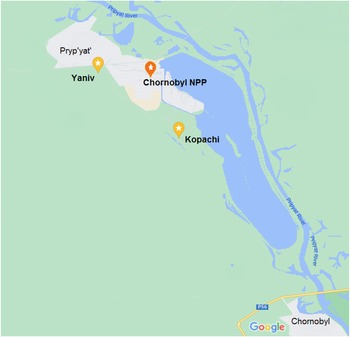
The annual wood of pine trees (Pinus sylvestris L.) was studied retrospectively with the aim to estimate the 14C excess in the air associated with 14CO2 emissions of NPPs. Samples of pine wood (1985–2019) were collected in July 2020 (the tree was cut down in the spring) 1.5 km southwest of Rivne NPP. Another studied pine wood material (1984–2021) was collected in October 2021, 3.5 km west-northwest of the Chornobyl NPP (near Yaniv railway station); see Figure 1 where we indicate the Kopachi sampling location (Skripkin et al. Reference Skripkin, Kovaliukh, Morris and Goni2005).
Locations of Chornobyl NPP and corresponding sampling sites around Yaniv railway station and Kopachi (Skripkin et al. Reference Skripkin, Kovaliukh, Morris and Goni2005).

As a background, we use values of 14C in air for the corresponding period 1985–2009, given by Hua et al. (Reference Hua, Barbetti and Rakowski2013). We continue background data with our experimental data series for pine tree for the time interval 2009–2020 (tree collected in the spring of 2021 in a rural area 60 km west of Kyiv, where industrial impact, in our opinion, is absent).
In all cases, we used a fragment of a tree trunk, about 15–20 cm long with well-defined annual tree rings. The annual tree ring material was separated and ground using a sharp knife to produce wood shavings. The shavings were soaked for 3 to 5 days to wash out the extractives in a 1:1 mixture of ethyl alcohol and ethyl acetate, after which the wood was dried and then charred. Further charcoal was fused with lithium, and then we obtain benzene by a chain of chemical transformations “coal-carbide-acetylene-benzene.” Most of the tree ring samples have initially 25–42 g of wood and only few of them about 10–15 g. To prepare a benzene sample, we had used a corresponding set of equipment. For small wood samples, we had used up to 10 g of dry wood shavings and corresponding technology of vacuum pyrolysis (Skripkin and Kovaliukh Reference Skripkin and Kovaliukh1997) to obtain maximum benzene samples. Benzene sample purification includes adding few drops of sulfuric acid, store for few hours, and final sublimation.
The specific activities of 14C in benzene were measured by liquid scintillation counting using a LS spectrometer Quantulus 1220™, Teflon vials of 7.0 or 3.0 mL, and butyl-PBD (5 g/L) as a scintillator. We preset counting time, which allows us to obtain statistical uncertainty about 1%. Because we did not measure delta 13C for our pine wood samples, we assumed delta 13C to be –25.0‰ (average for wood) and used this value to calculate the radiocarbon concentration of all samples.
RESULTS AND DISCUSSION
All the obtained experimental data are given in Table 1. The 14C data obtained for Rivne NPP together with the background data are shown on Figure 2. As a background, we use the 14C in air data of Hua et al. (Reference Hua, Barbetti and Rakowski2013) which we continue with our experimental data for the time interval 2009–2020. These two data series intersect at the interval 2000–2009, from which we argue that they correspond to each other. At the same time, in the figures, we present all the data of both series to reflect their correspondence. 14C in the annual growth of wood obtained for the vicinity of the Rivne NPP for the entire studied time interval, do not differ from the background within their uncertainty of ±1.0 pMC.
Radiocarbon concentration (±1.0 pMC) in pine annual tree rings for background site (60 km, W to Kyiv), Rivne NPP (1.5 km, S-W) and Chornobyl NPP (3.5 km, N-W-W) locations.

14С concentration in tree rings around Rivne NPP, background tree, and background (Hua et al. Reference Hua, Barbetti and Rakowski2013).

Experimental data obtained for the site located 3.5 km west-northwest of Chornobyl NPP and background data (described above) are shown in Figure 3. It can be seen that the data during the NPP operation period regularly exceed the background levels by 3.0–13.0 pMC when data for time interval 2001–2020 is indistinguishable from the background i.e., there are no further 14C emissions because of the shut down of the Chornobyl reactors. The maximum level of 14C excess agrees well with maximal levels reported for annual tree ring sampled for site 3.2 km east from Chornobyl NPP 15.9 pMC (1987) and 16.5 pMC (1990) (Buzynnyi and Talerko Reference Buzynnyi and Talerko2000). 14C data for tree rings of pine tree for Kopachi site located 3.5 km southeast-south direction to Chornobyl NPP (Skripkin et al. Reference Skripkin, Kovaliukh, Morris and Goni2005) are presented in Figure 3 as well for comparison. The general course of our Chornobyl NPP data presented here resembles the change over time of the data (Skripkin et al. Reference Skripkin, Kovaliukh, Morris and Goni2005), but in some years there is a significant deviation and in different directions. Data are lower for 1988, 1992 and higher for 1994, 1995, which can be explained by the corresponding fluctuations in the prevailing wind direction for these years.
14С concentration in tree rings around Chornobyl NPP data (Skripkin et al Reference Skripkin, Kovaliukh, Morris and Goni2005), background tree, and background (Hua et al. Reference Hua, Barbetti and Rakowski2013).

It is known that the concentration in air of 14CO2 released from the source decreases with distance from it. When considering the above-mentioned 14C spatial distribution model (McCartney and Scott Reference McCartney and Scott1988) then the expected 14C excess for the closer distance from the source (1.5 km vs. 3.5 km) is about 2.0–3.0 times higher, respectively. Accordingly, the 14CO2 emissions for Rivne NPP are still significantly lower than the corresponding Chornobyl NPP emissions, especially considering that in the case of Rivne NPP the sampling location is much closer to the source (1.5 km vs. 3.5 km in the case of Chornobyl NPP).
CONCLUSIONS
14C levels in the annual tree rings of pine at a distance of 1.5 km southwest of Rivne NPP do not differ from background levels (14CO2), which confirms that 14C emissions from this NPP are insignificant. 14C levels in the annual tree rings of pine at a distance of 3.5 km west-northwest of the Chornobyl NPP exceed the background levels by 3–13 pMC (14CO2) during the time of NPP operation, while after shutdown 14C data for time interval 2001–2020 is indistinguishable from the background. The above-mentioned maximum level of 14C excess agrees well with the maximal reported for 1987 and 1990 annual tree rings for the site 3.2 km east from Chornobyl NPP 15.9 and 16.5 pMC (Buzynnyi and Talerko Reference Buzynnyi and Talerko2000). The general course of our new Chornobyl NPP data presented here resembles the change over time of the data (Skripkin et al. Reference Skripkin, Kovaliukh, Morris and Goni2005), but in some years there is a significant deviation of our data, which can be explained by the corresponding fluctuations in the prevailing wind direction for these years. 14CO2 emissions of the Rivne NPP are significantly lower than the corresponding emissions of the Chornobyl NPP, especially considering that in this case the location of the investigated site is much closer to the source than in the case of Chornobyl NPP (1.5 km vs. 3.5 km), and expected 14C excess should be 2.0–3.0 times higher.
ACKNOWLEDGMENTS
The authors are grateful to Vadim Skripkin for his advice on selecting a tree to supplement the background and to the staff of the Radiation Monitoring Laboratory for supporting the study.