Introduction
Hereditary haemorrhagic telangiectasia, also known as Osler–Weber–Rendu syndrome, is an autosomal dominant condition characterised by multiple venous malformations (telangiectasia) of the skin and mucous membranes. Desiccating airflow through the nasal cavity causes mucosal breakdown overlying the fragile telangiectasia and hence causes recurrent epistaxis. This is treated using Young's procedure, i.e. the creation of mucocutaneous flaps to completely close the nasal cavities.Reference Young 1 Lack of airflow through the nasal cavity prevents the telangiectasia from bleeding.Reference Lund and Howard 2
Some patients unfortunately do not tolerate a Young's procedure as they have a poor quality of life without their sense of smell. One of our patients requested to have his Young's procedure reversed due to anosmia. We could find no previous reports of reversal of a Young's procedure in such a patient.
Case report
A 52-year-old man underwent a Young's procedure in May 2008 for intractable epistaxis. The operation was successful as the patient's epistaxis was completely controlled.
However, he later requested that his procedure be reversed, as he was unable to fully appreciate food due to lack of a sense of smell.
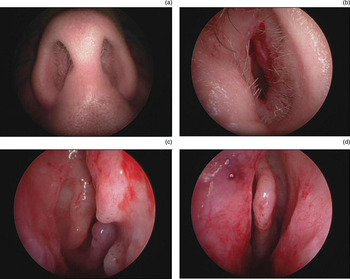
The first reversal was carried out in July 2010 by simply dividing the mucocutaneous flaps; however, these quickly restenosed (Figure 1a).
Endoscopic views showing (a) the external nose, (b) external right nostril and vestibule, (c) right nasal cavity sharing multiple telangiectasias and (d) left nasal cavity sharing the left middle turbinate covered in telangiectasias.

The method of reversing the patient's Young's procedure, and the maintenance of nasal vestibular patency whilst controlling epistaxis, were as follows.
The reversal procedure was carried out under general anaesthetic using a number 22 blade to divide the mucocutaneous flaps (Figure 1b). Multiple telangiectasia were seen on the nasal mucosa, which bled on contact. The Young's procedure does not seem to have had any long-lasting effect on the number and friability of nasal mucosa telangiectatic lesions in this hereditary haemorrhagic telangiectatic patient (Figures 1c and 1d). As the appearance was so typical of hereditary haemorrhagic telangiectasia, no biopsy was taken for histological confirmation of the diagnosis.
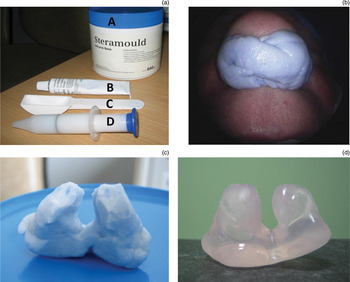
The anterior nares were stented open and the nasal vestibule patency was maintained using a custom-made silicone nasal mould created using Steramould (Siemens, Munich, German) (Figure 2a), a white, non-viscous, silicone moulding product. 3 The supplied kit consists of 660 g silicone base, 25 g catalyst paste, a plastic measuring spoon and an applicator syringe. The silicon base (A) is scooped out of the jar with the plastic spoon (C). A small amount of the blue catalyst (B) paste is mixed thoroughly with the silicone base by hand to form a uniformly coloured, soft, pale blue mixture. The mixture is quickly prepared and easily applied. The mixture is inserted into the applicator syringe (D), ensuring no air bubbles are trapped. The mixture is applied to the anterior part of the nasal cavities, with both sides connected via a bridge over the columella (Figure 2b). In our patient, the nasal mould was left to solidify for approximately 10 minutes before removal, under general anaesthetic, although the procedure can also be performed under local anaesthetic in a co-operative patient. A solid mould is produced (Figure 2c), which is sent to a medical devices company (at our hospital, Universal Aids, Stockport, UK) to produce the final nasal mould from soft, hypoallergenic silicone. 4 In our patient's nasal mould, the ‘peaks’ measured approximately 1.5 cm and fitted snugly in the anterior part of the nose (Figure 2d). The patient is encouraged to wear this nasal mould as much as possible throughout the day. It has a dual role of maintaining nasal vestibular patency (by preventing the mucocutaneous flaps from restenosing) as well as preventing desiccating airflow through the nose, hence reducing epistaxis.
(a) The Steramould kit, (b) application of the silicone moulding mixture to the nasal cavities, (c) the initial solid mould, and (d) the final, custom-made, silicone nasal mould.

Discussion
Nasal telangiectatic lesions bleed because nasal airflow tends to have a desiccating effect. The dry mucosal surfaces of these lesions are friable and bleed easily on contact. Young's procedure was initially performed for patients with atrophic rhinitis.Reference Young 1 When performed in patients with hereditary haemorrhagic telangiectasia, it aims to stop desiccating airflow from moving through the nasal cavity, and hence to prevent telangiectatic bleeding.
It is important to obtain the patient's informed consent before carrying out this life-changing procedure. The majority of patients who have a Young's procedure no longer suffer from epistaxis post-operatively, but on the other hand complain of a loss of their sense of smell, which reduces their quality of life. This can be explained by the fact that volatile odour molecules are unable to diffuse to the olfactory neuroepithelium due to anterior nasal obstruction.
The presented case demonstrates that a Young's procedure can produce the desired reduction in epistaxis so long as the mucocutaneous flaps are intact. However, this operation does not seem to have any long-lasting effect on the nasal mucosa of patients with hereditary haemorrhagic telangiectasia; in our patient, multiple nasal mucosal telangiectatic lesions were seen intra-operatively, which bled on contact as soon as the mucocutaneous flaps were divided and airflow resumed in the nasal cavity. At three months’ follow up, our patient's epistaxis had recurred, but with less than its original frequency.
Conclusion
Hereditary haemorrhagic telangiectasia is characterised by multiple venous malformations (telangiectasia) in the skin and mucous membranes, which can bleed on contact.
This condition can cause severe epistaxis. A Young's procedure is used in such cases, with the creation of mucocutaneous flaps to seal off the nasal cavities completely. This blocks the movement of desiccating airflow through the nasal cavity and thus stops the telangiectasia from bleeding, hence preventing recurrent epistaxis.
Young's procedure is reversed by dividing the mucocutaneous flaps. Nasal vestibule patency is maintained using a custom-made silicone nasal mould which blocks airflow through the nasal cavity.
Young's procedure however does not seem to have any long-lasting effect on the nasal mucosa of patients with hereditary haemorrhagic telangiectasia; in the presented patient, the multiple telangiectatic lesions present on the nasal mucosa bled on contact after the mucocutaneous flaps were divided.
Acknowledgement
Our thanks go to Mrs Alison Kennedy (Head Audiologist) and the audiology department of the New Victoria Hospital, NHS Greater Glasgow and Clyde, as well as to Universal Aids Ltd for the manufacture of the nasal mould.