Introduction
Organotin (OT) compounds have been used as active biocides since 1960, and these compounds, which have eluted into coastal waters, have exerted adverse effects on marine organisms such as oyster shell malformations, imposex and survival reduction (Laughlin & Linden, Reference Laughlin and Linden1985; Bryan & Gibbs, Reference Bryan, Gibbs, Newman and McIntosh1991; Ohji et al., Reference Ohji, Arai and Miyazaki2002, Reference Ohji, Arai and Miyazaki2003; Ohji, Reference Ohji, Arai, Harino, Ohji and Langston2009; Ohji & Harino, Reference Ohji and Harino2017). In the 1980s, the use of tributyltin (TBT) was regulated in some developed countries such as the UK, France and the USA, but TBT was still detected in the aquatic environments at levels that can cause imposex (Langston & Burt, Reference Langston and Burt1991; Page & Widdows, Reference Page and Widdows1991). In October 2001, the International Maritime Organization (IMO) adopted the International Convention on the Control of Harmful Antifouling Systems on Ships (AFS Convention), which prohibited the use of OTs as active ingredients in antifouling systems for ships. Despite the ban on OT usage worldwide, OTs are still being detected in coastal ecosystems (Langston et al., Reference Langston, Pope, Davey, Langston, O'Hara, Gibbs and Pascoe2015; Ruiz et al., Reference Ruiz, Albania, Carro and Barreiro2015).
Many alternative biocide products were developed after the implementation of international restrictions on the use of OT-based antifoulants, and they have been used worldwide. However, the biocides Sea-Nine 211, diuron, chlorothalonil, dichlofluanid and Irgarol 1051 were detected in water and sediment samples from coastal areas (Harino & Yamato, Reference Harino and Yamato2021). Coastal areas have thus been heavily contaminated by antifouling biocides even after the implementation of the international regulations, and it is important to grasp the current status of these contaminations by antifouling biocides in order to clarify the effects of those compounds on coastal ecosystems.
Coastal areas of Thailand, the Philippines and Vietnam were shown to be heavily contaminated by organochlorine compounds by several groups (Cheevaporn et al., Reference Cheevaporn, Duangkaew and Tangkrock-Olan2005; Carvalho et al., Reference Carvalho, Villeneuve, Cattini, Tolosa, Bajet and Navarro-Calingacion2009; Tham et al., Reference Tham, Anh, Trinh, Lan, Truong, Yen, Anh, Tri and Minh2019). Other surveys revealed that the coastal waters of Malaysia have been polluted by antifouling biocides (Sudaryanto et al., Reference Sudaryanto, Takahashi, Monirith, Ismail, Muchtar, Zheng, Richardson, Subramanian, Prudente, Hue and Tanabe2002, Reference Sudaryanto, Takahashi, Iwata, Tanabe and Ismail2004; Harino et al., Reference Harino, Arai, Ohji, Miyazaki, Arai, Harino, Ohji and Langston2009a, Reference Harino, Arai, Ohji, Ismail and Miyazaki2009b; Ohji et al., Reference Ohji, Harino, Hayashizaki, Inoue, Yusoff and Nishida2019, Reference Ohji, Shibayama, Harino, Hayashizaki, Yusoff and Inoue2022).
There are two large assemblages of angiosperm mangroves and seagrasses in the coastal regions of Malaysia. Mangroves and seagrasses form extensive and highly productive ecosystems that are biologically diverse (Hogarth, Reference Hogarth2015). Mangroves are dicotyledonous woody trees and shrubs that grow in saline coastal sediment habitats of intertidal zones in the tropical and subtropical regions of the world (Hogarth, Reference Hogarth2015). True mangroves comprise around 70 species in 28 genera, belonging to 20 families. The mangroves provide habitats for many aquatic organisms (Sato et al., Reference Sato, Fisseha, Gebrekiros, Karim, Negassi, Fischer, Yemane, Teclemariam and Riley2005), protect coastal areas from erosion (Mazda et al., Reference Mazda, Kobashi and Okada2005) and are considered to be sinks for carbon (Kitaya, Reference Kitaya and Tateda2007). Mangroves thus play important roles in coastal water ecosystems. Seagrasses are monocotyledonous plants, and they can be seen as more fully adapted than mangroves to a life in the sea, most being permanently submerged, although some species of Zostera, Phyllospadix and Halophila grow intertidally (Hogarth, Reference Hogarth2015). Worldwide, seagrasses do not comprise a large number of species: 58 or so species in 12 genera. Like mangroves, too, seagrasses have adapted to conditions of high salinity and living in soft sediments, and they create a habitat and represent a food source on which many other organisms depend (Hogarth, Reference Hogarth2015).
Despite their importance in the coastal ecosystems, many mangroves and seagrasses have been destroyed by pollutants derived from economic activity (Hogarth, Reference Hogarth2015). To protect these precious resources, the precise status of the pollution (including factors such as antifouling biocides) must be determined. Ohji et al. (Reference Ohji, Harino, Hayashizaki, Inoue, Yusoff and Nishida2019) reported that plants such as mangroves can be used as an indicator of the concentrations of antifouling biocides because plants concentrate or absorb the organic substances and metal and other compounds in water and sediment. However, there are very few reports on the concentrations of contaminants, such as antifouling biocides, in mangrove and seagrass plants. The accumulation profile of antifouling biocides is considered to differ between mangrove and seagrass plants since they have different exposure pathways to those biocides, i.e. seagrasses are generally submerged in the seawater while mangroves are exposed to the root systems (Hogarth, Reference Hogarth2015). However, there are no reports regarding the differences of bioaccumulation of antifouling biocides between mangroves and seagrasses in coastal waters. Furthermore, the measurement of the ratio of stable isotopes of carbon has been widely used as a technique for tracking carbon through food chains (Hogarth, Reference Hogarth2015). Although it is important to understand the pathway of uptake of antifouling biocides in mangroves, few reports are available.
The objective of the present study is to clarify the uptake and potential bioaccumulation of antifouling biocides in mangroves and seagrasses in coastal areas. To elucidate the accumulation mechanisms of antifouling biocides in seagrasses, we also discuss the differences in the concentrations of these compounds in shoots and roots. The study also characterizes the pathway of uptake of antifouling biocides in plants by examining the relationships between the compounds' concentrations and the stable isotope ratios of carbon in mangroves. Our results provide relevant information that contributes to the clarification of the bioaccumulation of antifouling biocides in mangrove and seagrass ecosystems.
Materials and methods
Sampling description
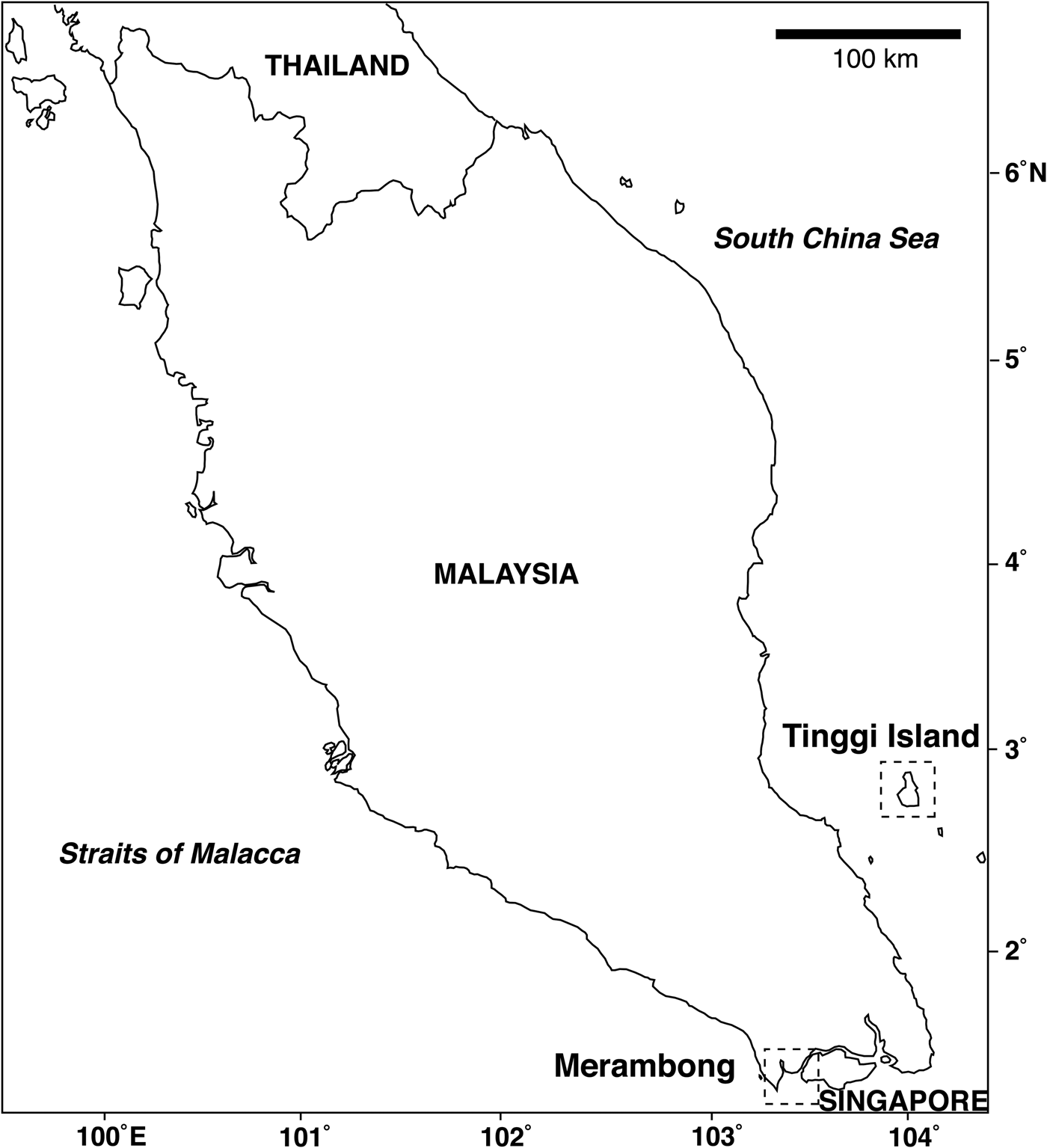
Merambong (1°26′28.79″N 103°45′7.79″E) is located between the southern part of Peninsular Malaysia and Singapore, and it has a rich natural environment with mangrove and seagrass areas. The seagrass bed was ~1.3 km in length during the study period (2012–2013), but the seagrass bed has been severely destroyed by economic development activities in the Straits of Johor. There are many factories, a large trading port, and reclamation around the Merambong area, and this region is thus suspected to be contaminated by many types of pollutants including antifouling biocides.
Tinggi Island (2°17′60.00″N 104°06′60.00″E) is ~37 km off the east coast of Johor in the South China Sea, and it has a long coastline. The island has been a resort area because there are coral reefs, mangroves, seagrass beds and fishing ports in the island's coastal area. Tinggi Island is recognized as a relatively pristine area compared with Merambong.
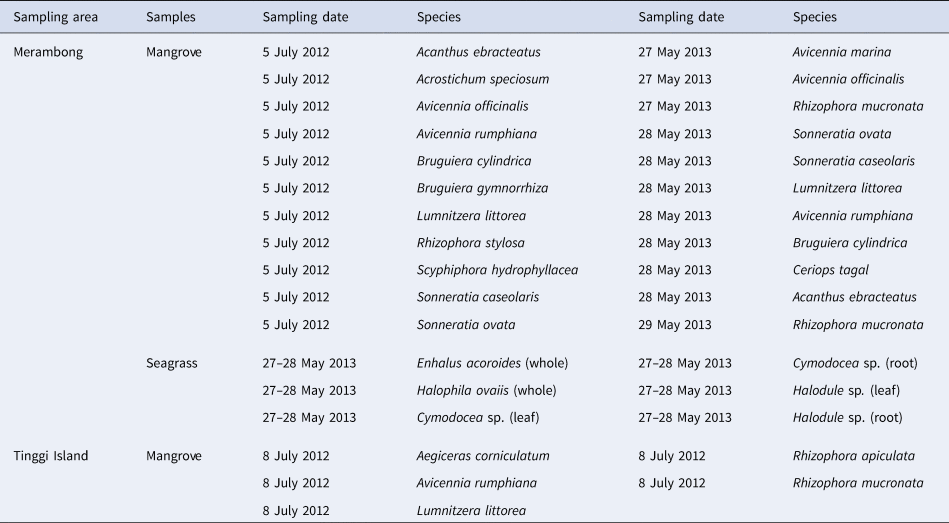
To investigate the widespread contaminations by antifouling biocides in Malaysia, we obtained samples of sediments, mangrove leaves and seagrass plants from Merambong on 5 and 8 July 2012 and on 27–29 May 2013, both of which are during the dry season (Figure 1). We collected the samples of mangrove leaves and seagrasses in mature stage by hand. Seagrass plants were divided into shoots and roots after their collection. Sediment and mangrove leaves from Tinggi Island were collected on 8 July 2012. The species of the plants collected in Merambong and Tinggi Island are given in Table 1. In the present study, at least three leaf samples from three individuals were collected in each species. All sediment samples and plants were brought back to the laboratory in a cold box, stored in a freezer at −20°C until chemical analysis. For the determination of the precise absorption and concentrations of antifouling biocides in mangrove leaves and seagrasses, the plants were rinsed with distilled water to remove all detritus before analysis.
The sampling sites of mangrove, seagrasses, and sediment in Merambong and Tinggi Island, Malaysia.

Plants collected from mangrove and seagrass area in Malaysia

Chemical analyses
Organotin compounds
The method used for the determination of OTs in plant samples was based on that of Harino et al. (Reference Harino, Arifin, Rumengan, Arai, Ohji and Miyazaki2012), with some modification. Two grams of plant sample cut with scissors were put in a centrifuge tube. As a surrogate standard, 100 μg of mixed acetone solution containing 1 μg ml−1 each of monobutyltin trichloride (MBTCl)-d9, dibutyltin dichloride (DBTCl)-d18, tributyltin monochloride (TBTCl)-d27, monophenyltin trichloride (MPTCl)-d5, diphenyltin dichloride (DPTCl)-d10 and triphenyltin monochloride (TPTCl)-d15 was added to the centrifuge tube. The mixture was shaken with 10 ml of 1 M HCl-methanol/ethyl acetate (1/1) for 10 min.
After centrifugation for 10 min, the supernatant was transferred to a separating funnel, and the residue was extracted and centrifuged again in the same way. Thirty millilitres of saturated NaCl solution was added to a separating funnel containing the combined supernatants. The analytes were extracted twice with 15 ml of ethyl acetate/hexane (3/2) solution, and the organic layer was combined. Next, 50 ml of hexane were mixed into the organic layer and left to stand for 20 min. After removal of the aqueous layer, the organic layer was dried with anhydrous Na2SO4 and concentrated up to trace level. The analytes were diluted with 5 ml of ethanol, 5 ml of acetic acid-sodium acetate buffer (pH 5.0) and 10 ml of distilled water, and subsequently ethylated by shaking with 1 ml of 5% NaBEt4 for 30 min.
The solution containing ethylated OTs was saponified with 10 ml of 1 M KOH–ethanol solution by shaking for 1 h. Forty millilitres of distilled water and 10 ml of hexane were added to the solution, and the mixture was shaken for 10 min. The ethylated OT residue in the aqueous layer was extracted again by shaking for 10 min with 10 ml of hexane. The combined organic layers were dried with anhydrous Na2SO4. After being concentrated up to 1 ml, the solution was cleaned by a Florisil® Sep-Pak column (Waters, Milford, MA, USA). The analytes were eluted with 10 ml of 5% diethyl ether/hexane. All eluting solvent was collected in a bottom flask. The solution was concentrated up to 0.5 ml after the addition of mixed acetone solution containing 1 μg ml−1 each of tetrabutyltin (TeBT)-d36 and tetraphenyltin (TePT)-d20 as an internal standard. The final solution was concentrated up to 0.5 ml.
A gas chromatograph (6890A series, Agilent Technologies, Santa Clara, CA) equipped with a mass spectrometer (5973 N, Agilent) was used for analysis of the OTs. The separation was carried out in a capillary column coated with 5% phenyl methyl silicone (30 m long × 0.25 mm i.d., 0.25 μm-thick film, J&W Scientific Co., Folsom, CA). The column temperature was held at 60°C for the first 2 min, then increased to 130°C at 20°C min−1, to 210°C at 10°C min−1, to 260°C at 5°C min−1, and to 300°C at 10°C min−1. Finally, the column temperature was held at 300°C for 2 min. The interface temperature, ion source temperature and ion energy were 280, 230°C and 70 eV, respectively. Selected ion monitoring was operated under this program. The monitoring ions of 235 (233) for MBT, 261 (263) for DBT, 263 (261) for TBT, 253 (255) for MPT, 303 (301) for DPT and 351 (349) for TPT were used to quantify the respective concentrations of OTs (the values in parentheses indicate the qualifier ions). One μl of the sample was injected with splitless injection. The concentrations of OTs in this study are expressed as Sn4+.
Alternative biocides
The method used for the determination of alternative compounds in sediment and plants was based on that of Harino et al. (Reference Harino, Mori, Yamaguchi, Shibata and Senda2005) with some modification. In the centrifuge tube, 1 g of plant was placed together with 10 ml of acetone. The mixture was shaken for 10 min by a mechanical shaker. After removal of the supernatant, the analytes were re-extracted with 10 ml acetone for 10 min, and the mixture was then centrifuged. The combined supernatants were concentrated by a rotary evaporator up to 5 ml. Forty-five millilitres of distilled water, 1 g of zinc acetate and 0.5 g of celite were added to each combined supernatant and left to stand for 20 min. After filtration, the analytes were extracted two times with 10 ml of dichloromethane. The organic layer was dried by anhydrous Na2SO4. Ten millilitres of hexane and 100 μl of 1 mg l−1 atrazine-13C3 hexane solution were added to the organic layer, and the organic layer was concentrated up to 1 ml by a rotary evaporator. The analytes were determined by gas chromatography–mass spectrometry (GC/MS).
A gas chromatograph (6890A series, Agilent Technologies) equipped with a mass spectrometer (5973 N, Agilent) was used for the analysis of the alternative biocides. The separation was carried out in a capillary column coated with 5% phenyl methyl silicone (30 m long × 0.25 mm i.d., 0.25 μm-thick film, J&W Scientific). The column temperature was held at 60°C for the first 1 min, then increased to 200°C at 10°C min−1, and to 280°C at 5°C min−1. The interface temperature, ion source temperature and ion energy were 280, 230°C and 70 eV, respectively. Selected ion monitoring was operated under this program. The monitoring ions of 169 (281) for Sea-Nine 211, 189 (159) for diuron, 224 (332) for dichlofluanid, 266 (264) for chlorothalonil, 253 (182) for Irgarol 1051 and 213 (198) for M1 were used to quantify the concentrations of alternative biocides, respectively (the values in parentheses indicate the qualifier ions). One μl of the sample was injected with splitless injection.
Stable carbon isotope (δ 13C)
The method used for the determination of stable carbon isotope (δ 13C) in the plant samples was based on that of Vu et al. (Reference Vu, Casareto, Hayashizaki, Sangsawang, Toyoda, Tran and Suzuki2017). The samples were kept frozen at ~ −20°C for a few days after collection and were moved to a lab and dried in an electric oven at 60°C for 6 h before analysis. Subsamples were placed in ultra-pure tin capsules, and the samples were burned in an elemental analyser (Flash EA, Thermo Fisher Scientific, Waltham, MA). Combustion gases continuously moved through a flow controller (ConFlo III, Thermo Fisher), and then the δ 13C compositions were detected with a mass spectrometer (DeltaplusXP, Thermo Fisher). L-alanine was used as the working standard. The δ 13C ratios are expressed in δ notation (parts per thousand, ‰) as deviations from international standards according to the following equation:

where X represents 13C, and R represents isotope ratios 13C/12C. R sample and R standard are the isotope ratios of the sample and the international standard, PDB, respectively.
Statistics
Differences between data were analysed using the Mann–Whitney U-test. The significance of the correlation coefficients and regression slopes was tested by Spearman's rank correlation coefficient (Sokal & Rohlf, Reference Sokal and Rohlf2003).
Results
Evaluation of the analytical procedure
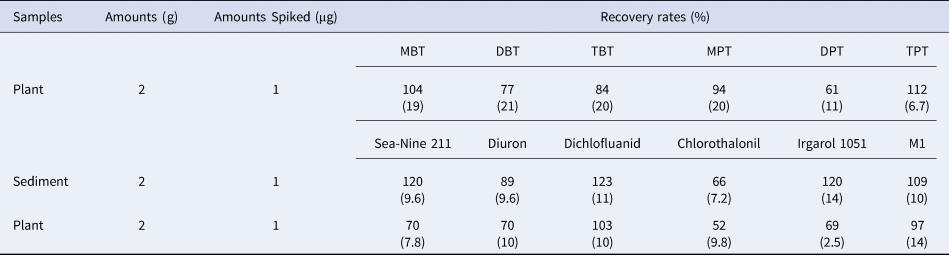
The quality of the data obtained by the analytical procedure for OTs and alternative biocides were examined. When 1 μg of OTs was spiked to 2 g of plant samples, the recovery rates of the OTs were in the range of 61–112%, and the relative standard deviations (RSDs) were in the range of 6.7–21% for the plant samples (Table 2). When 1 μg of alternative biocides was spiked to 2 g of sediment or plant samples, the recovery rates of the alternative biocides were in the range of 66–123% for the sediment samples and 52–103% for the plant samples, and the RSDs were in the range of 7.2–14% for the sediment samples and 2.5–14% for the plant samples (Table 2).
Recovery tests of organotin compounds and alternative biocides in sediment and plants collected from Malaysia. Values in parentheses indicate the coefficient of variation

The detection limits were calculated from a signal-to-noise ratio of 3. Each OT's detection limit was 0.1 ng g−1 wet weight (ww) for plant samples. The detection limits of each alternative compound in sediment and plant samples were 0.5 ng g−1 dry weight (dw) and 0.5 ng g−1 ww respectively.
Comparison of the 2012 and 2013 concentrations of antifouling biocides in the mangrove leaves from Merambong
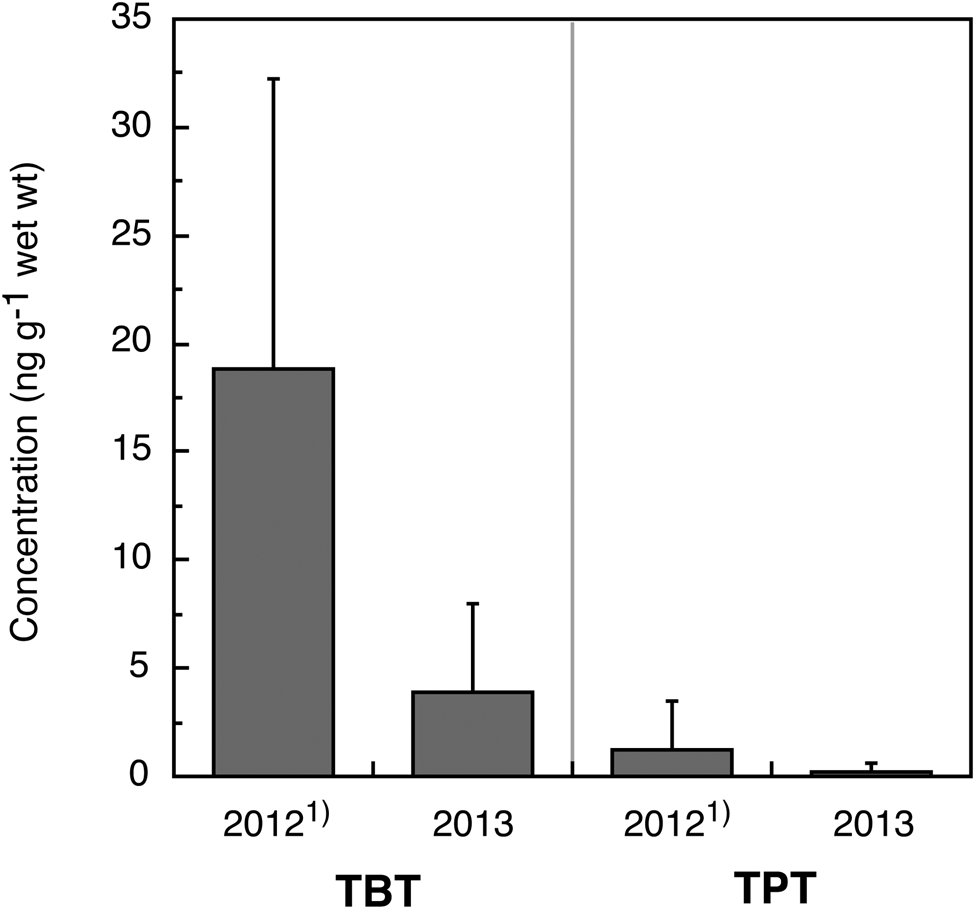
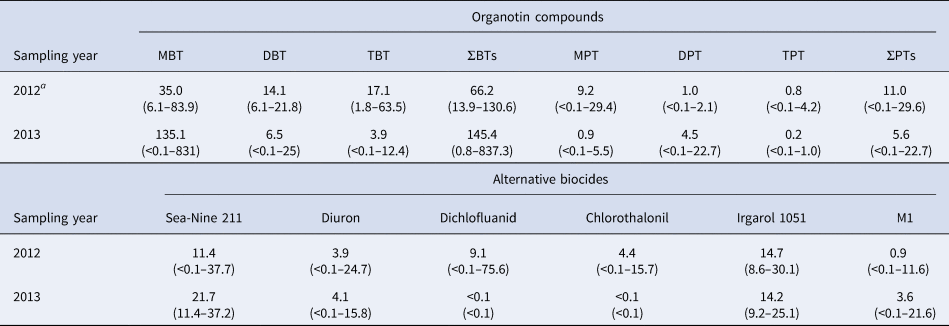
We compared the concentrations of antifouling biocides in mangrove leaves from Merambong collected in 2012 and 2013. The mean concentrations of total BTs (∑BTs = TBT + DBT + MBT) and TBT in the mangrove leaves were 145.4 and 3.9 ng g−1 ww, respectively in mangrove leaves from Merambong in 2013 (Table 3, Figure 2). Ohji et al. (Reference Ohji, Harino, Hayashizaki, Inoue, Yusoff and Nishida2019) reported that the mean concentrations of ∑BTs and TBT in mangroves from Merambong were 66.2 and 17.1 ng g−1 ww, respectively in 2012. Although we identified no significant differences in ∑BTs between 2012 and 2013 (P > 0.1), the TBT concentrations in the mangrove leaves collected in 2013 were significantly lower than those obtained in 2012 (P < 0.005) (Table 3, Figure 2).
Comparison of TBT and TPT in mangroves from Merambong between 2012 and 2013. 1Ohji et al. (Reference Ohji, Harino, Hayashizaki, Inoue, Yusoff and Nishida2019). Bars: standard deviation.

Mean concentrations of antifouling biocides (ng g−1 wet wt) in Mangroves from Merambong, Malaysia, in 2012 and 2013

Parentheses show the range of concentration of each compound.
a Ohji et al. (Reference Ohji, Harino, Hayashizaki, Inoue, Yusoff and Nishida2019).
The detection frequencies of each PT in mangrove leaves from Merambong in 2013 were low, and the mean concentrations of the detected ∑PTs and TPT were 5.6 and 0.2 ng g−1 ww, respectively, which are around the detection limit (Table 3). Ohji et al. (Reference Ohji, Harino, Hayashizaki, Inoue, Yusoff and Nishida2019) reported that the average concentrations of ∑PTs and TPT were 11 and 0.8 ng g−1 ww, respectively, in 2012. In our present investigation, no significant differences in the levels of ∑PTs or TPT between 2012 and 2013 were observed (P > 0.1) (Table 3, Figure 2).
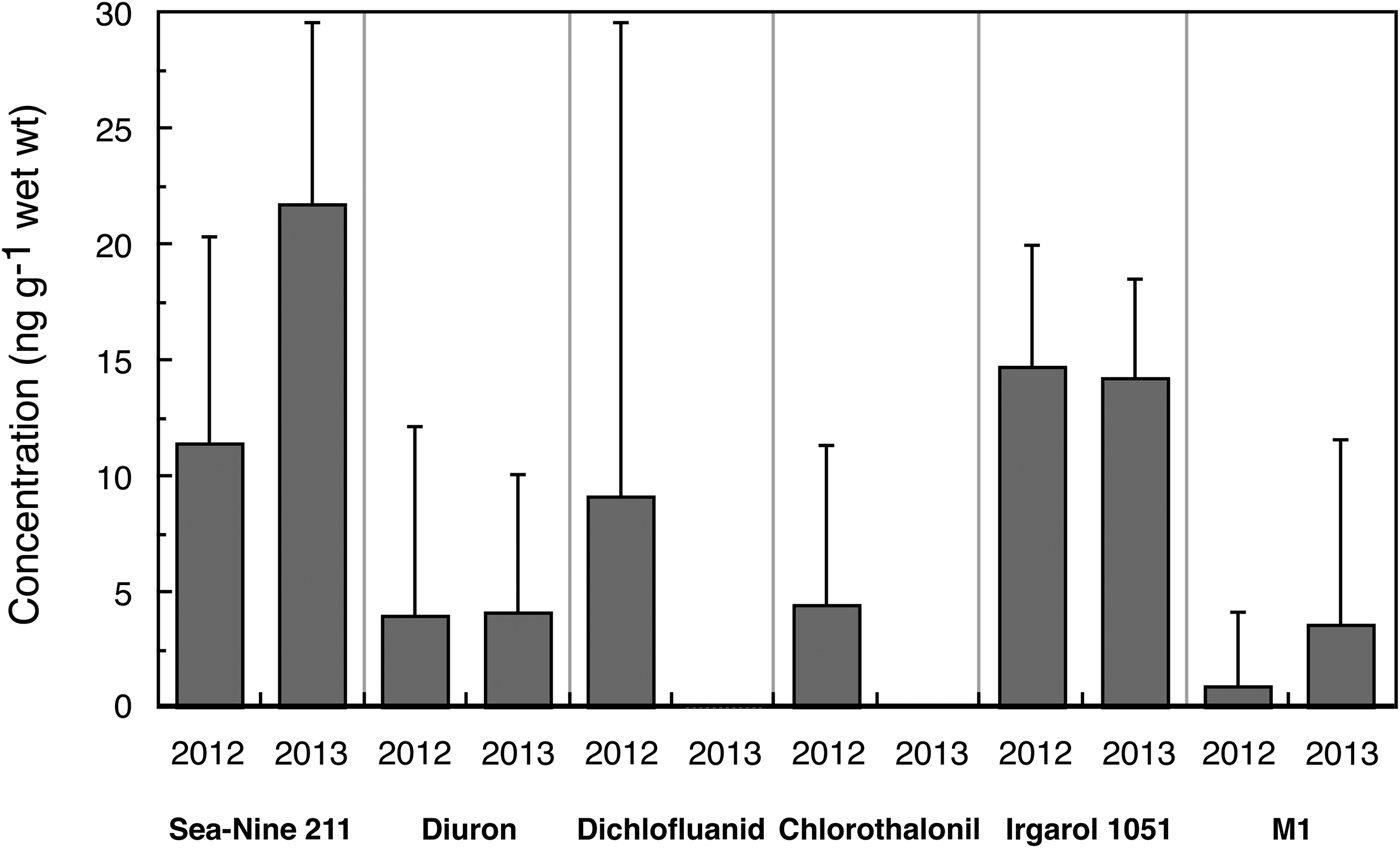
The concentrations of alternative biocides in mangrove leaves are provided in Table 3. The mean concentrations in the plants that we collected in 2012 from mangrove areas were as follows: Sea-Nine 211, 11 ng g−1 ww; diuron, 3.9 ng g−1 ww; dichlofluanid, 9.1 ng g−1 ww; chlorothalonil, 4.4 ng g−1 ww; and Irgarol 1051, 15 ng g−1 ww. Although Sea-Nine 211, diuron and Irgarol 1051 were detected at the mean concentrations of 22, 4.1 and 14 ng g−1 ww, respectively in 2013, dichlofluanid and chlorothalonil were not detected that year.
We compared the concentrations of alternative biocides in 2012 with those in 2013 (Figure 3). No remarkable differences in the 2012 and 2013 concentrations of diuron and Irgarol 1051 in mangrove leaves were observed (P > 0.3). The concentration of Sea-Nine 211 in 2013 was significantly higher than that in 2012 (P < 0.005), whereas the concentrations of dichlofluanid and chlorothalonil in 2013 were significantly lower than those in 2012 (P < 0.05). The mean concentrations of M1 (which is a derivative of Irgarol 1051) were 0.9 and 3.6 ng g−1 ww in 2012 and 2013, respectively. The values obtained by dividing M1 by Irgarol 1051 were 0.06 and 0.25 in 2012 and 2013, respectively.
Comparison of alternative biocides in mangroves from Merambong between 2012 and 2013.

Comparison of the concentrations and proportions of antifouling biocides between mangrove leaves and seagrasses from Merambong in 2013
We compared the concentrations and proportions of antifouling biocides between the mangrove leaves and seagrasses collected from Merambong only in 2013, because we could not collect seagrasses in Merambong in 2012.
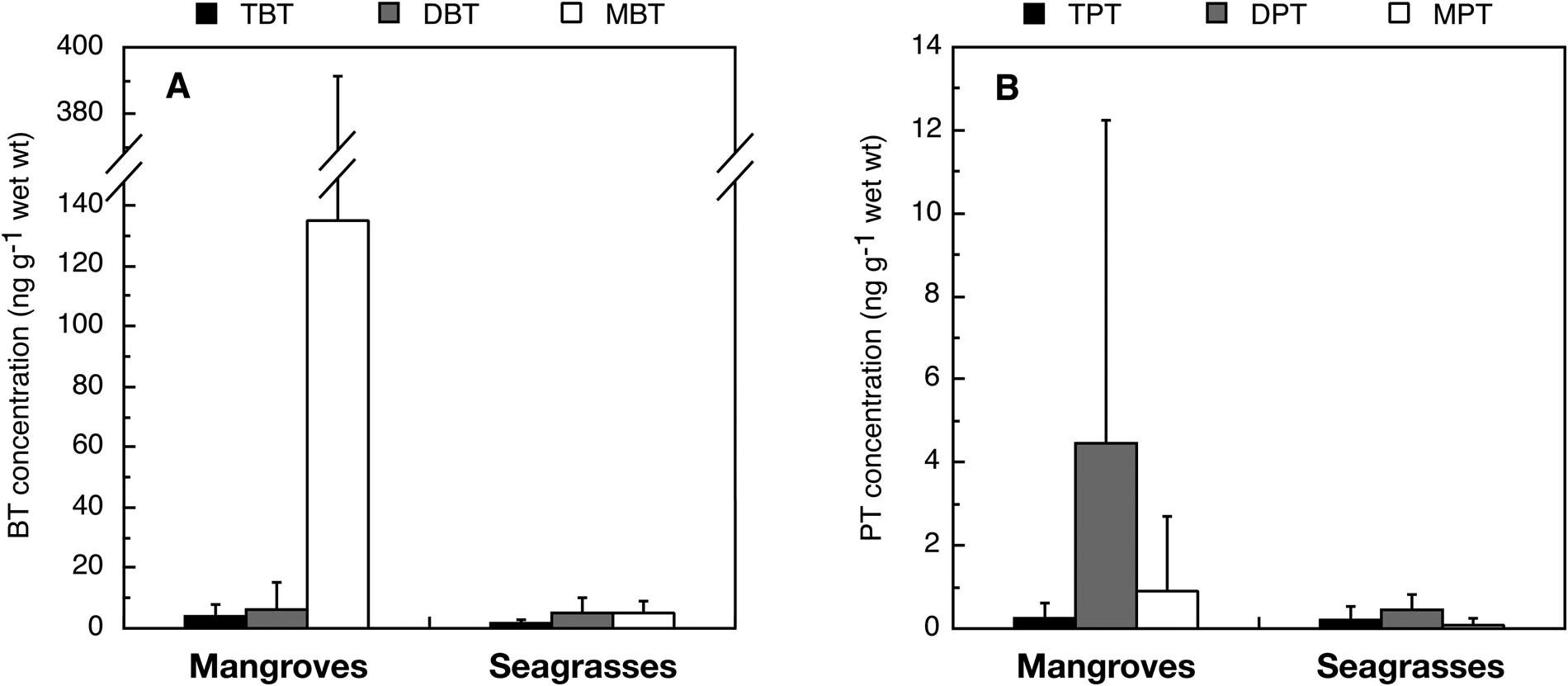
The mean concentrations in mangroves were follows: ∑BT, 145.4 ng g−1 ww; TBT, 3.9 ng g−1 ww; DBT, 6.5 ng g−1 ww; and MBT, 135.1 ng g−1 ww. In seagrasses, the mean concentrations were ∑BT, 11.3 ng g−1 ww; TBT, 1.5 ng g−1 ww; DBT, 4.9 ng g−1 ww; and MBT, 5.0 ng g−1 ww (Figure 4). The concentrations of ∑BT and MBT in the mangrove area were significantly higher than those in the seagrass area (P < 0.05). The concentrations of each PT detected in Merambong were compared between the mangrove leaves and seagrasses (Figure 4). The mean concentrations in the mangroves were ∑PTs, 5.6 ng g−1 ww; TPT, 0.2 ng g−1 ww; DPT, 4.5 ng g−1 ww; and MPT, 0.9 ng g−1 ww, and the mean concentrations of ∑PTs, TPT, DPT and MPT in the seagrass were 0.7, 0.2, 0.5 and <0.1 ng g−1 ww, respectively. No significant differences were observed in the concentration of PTs between the mangroves and seagrasses.
Concentrations of the organotin compounds (A) butyltin and (B) phenyltin in mangroves and seagrasses in Merambong, 2013.

The ratios of DBT and MBT were higher than those of TBT in the mangrove and seagrass (Figure 4). The proportions of DBT and MBT in plants were markedly different between the mangrove and seagrass areas. Although the proportions of MBT among the BTs in the mangrove leaves were higher than those of DBT, MBT in the seagrasses showed similar proportions to DBT. The proportions of MPT and DPT were 92 and 72% of the total PTs in mangrove leaves and seagrasses, respectively (Figure 4). The proportion of DPT in mangrove leaves was also high. The concentrations of TBT were significantly higher than those of TPT in both the mangroves and seagrasses in Merambong (P < 0.05, Figure 4).
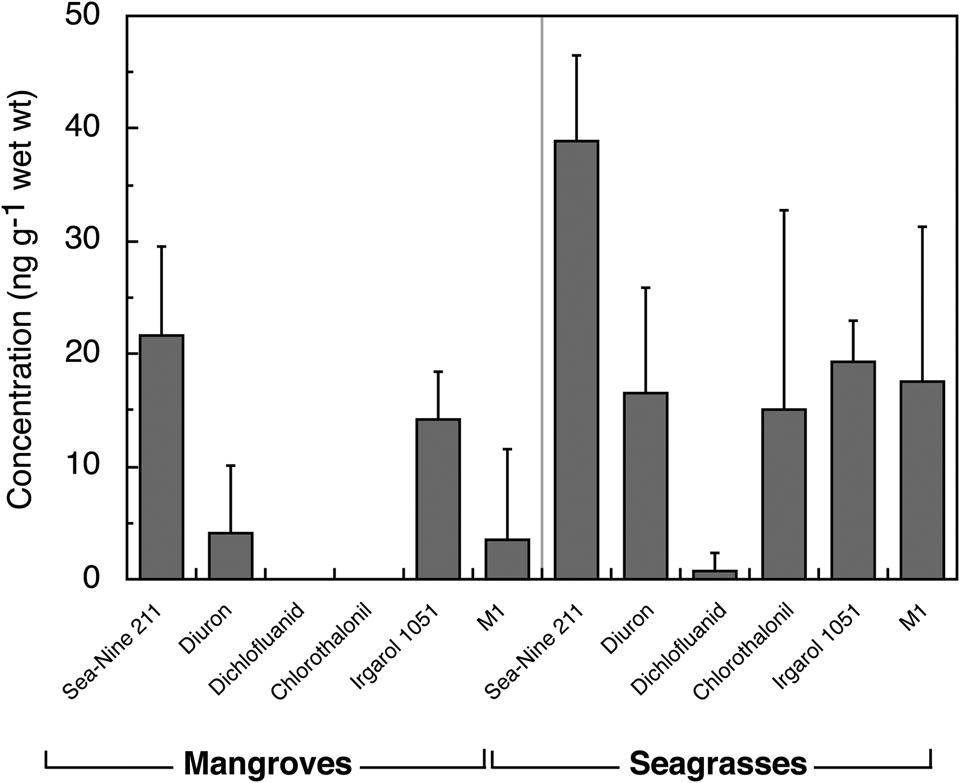
The results of our comparison of the current status of alternative biocide contaminations between the mangroves and seagrasses are depicted in Figure 5. The concentrations of Sea-Nine 211 in both the mangrove and seagrasses were the highest among the alternative biocides, followed by Irgarol 1051, diuron and chlorothalonil, with the exception of M1 (which is a derivative of Irgarol 1051). The concentrations of Sea-Nine 211, diuron, chlorothalonil, Irgarol 1051 and M1 in the seagrasses were significantly higher than those in the mangrove leaves (P < 0.005 for Sea-Nine 211, P < 0.05 for diuron, chlorothalonil, Irgarol 1051 and M1).
Concentrations of alternative biocides in mangroves and seagrasses in Merambong, 2013.

The mean proportion of M1 of the total Irgarols (∑Irgarols = Irgarol 1051 + M1) in the mangroves was 11%, and was lower than that in the seagrasses (41% of the ∑Irgarols).
Concentrations of antifouling biocides in mangrove leaves and sediment of Tinggi Island in 2012
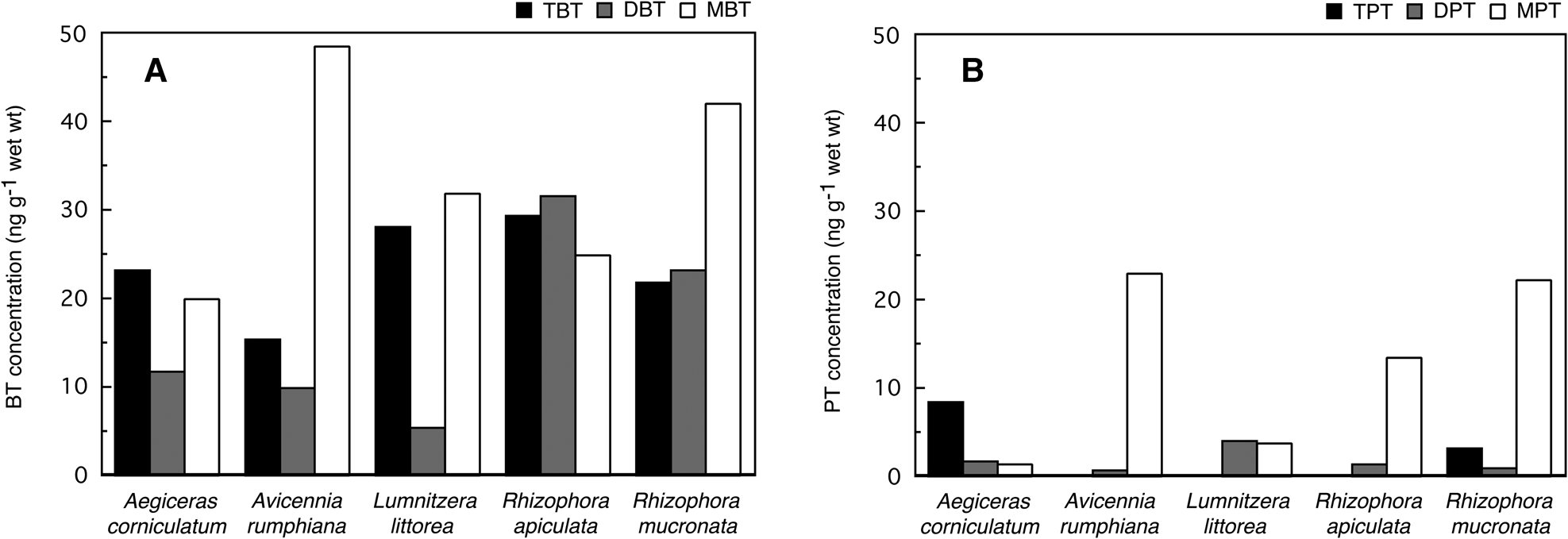
The concentrations of OTs in five species of mangrove leaves of Tinggi Island are shown in Figure 6 (Ohji et al., Reference Ohji, Harino, Hayashizaki, Inoue, Yusoff and Nishida2019). The concentrations of TBT and TPT in mangrove leaves from Tinggi Island are 24 ± 5.6 (Mean ± SD) ng g−1 ww and 2.3 ± 3.7 ng g−1 ww, respectively (Ohji et al., Reference Ohji, Harino, Hayashizaki, Inoue, Yusoff and Nishida2019). The concentrations of MBT were the highest among the BTs, at 19.9–48.5 ng g−1 ww. The concentrations of DBT and TBT were at the range of 5.4–31.6 ng g−1 ww and 15.4–29.3 ng g−1 ww, respectively. The detection frequency of TPT in Tinggi Island was low, and even when it was detected, the values were near the detection limit. However, MPT and DPT (which are decomposition products of TPT) were detected at 1.4–22.9 ng g−1 ww and 0.7–4.0 ng g−1 ww, respectively.
Concentrations of the organotin compounds (A) butyltin and (B) phenyltin in mangroves from Tinggi Island, 2012 (adapted from Ohji et al., Reference Ohji, Harino, Hayashizaki, Inoue, Yusoff and Nishida2019).

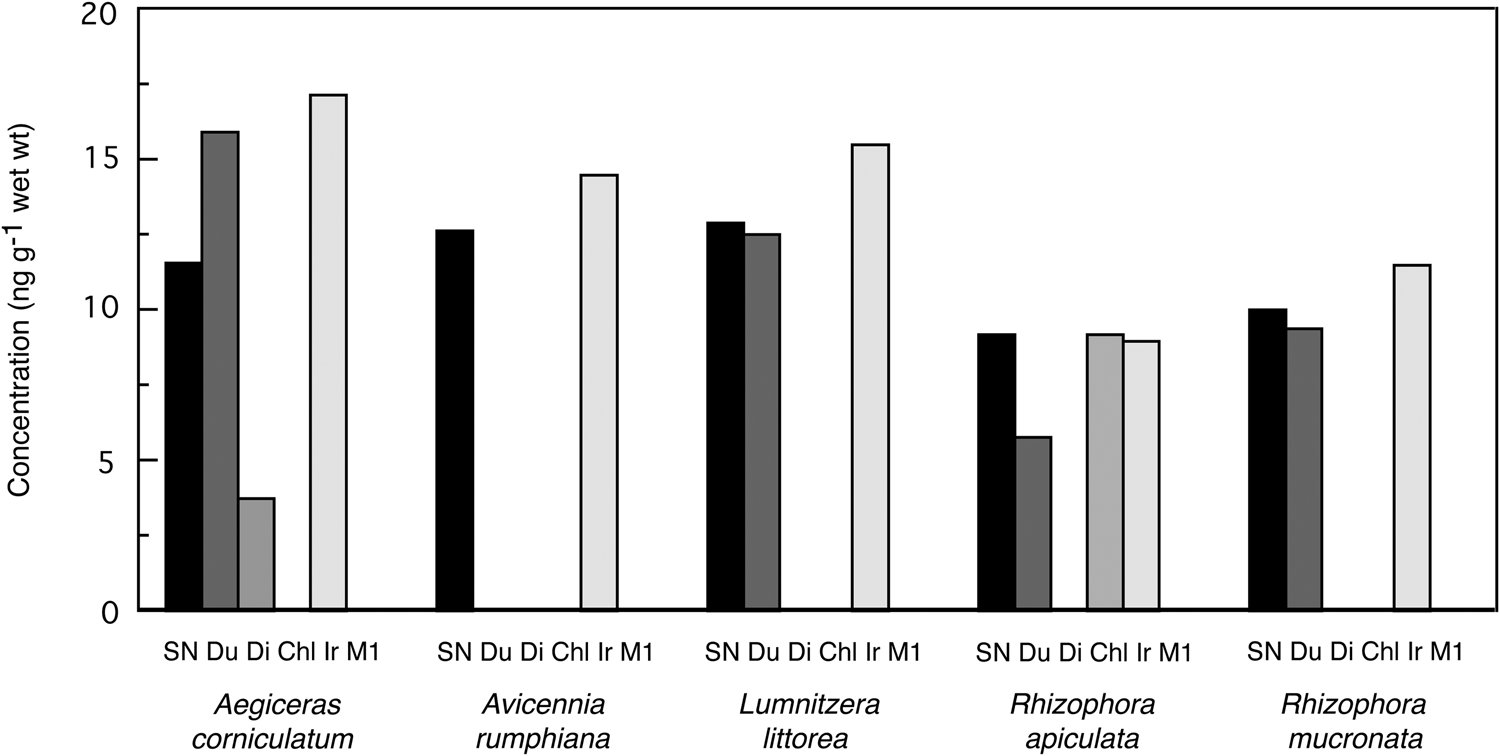
The concentrations in mangrove leaves from Tinggi Island in 2012 were as follows: Sea-Nine 211, 9–13 ng g−1 ww; diuron, <0.1–16 ng g−1 ww; dichlofluanid, <0.1–3.7 ng g−1 ww; chlorothalonil, <0.1–9 ng g−1 ww; and Irgarol 1051, 9–17 ng g−1 ww; M1 was not detected (Figure 7). No significant differences were observed in the levels of these alternative biocides in mangrove leaves between Merambong and Tinggi Island (P > 0.05).
Concentrations of alternative biocides in mangroves from Tinggi Island, 2012. SN, Sea-Nine 211; Du, diuron; Di, dichlofluanid; Chl, chlorothalonil; Ir, Irgarol 1051.

The concentrations of BTs in the sediment collected from Merambong and Tinggi Island in 2012 were 21 ± 5.6 ng g−1 dw and 12 ± 1.2 ng g−1 dw, respectively, whereas TBT concentrations in the sediment from those areas were similar at 4.5 ± 0.7 ng g−1 dw and 4.2 ± 0.1 ng g−1 dw (Ohji et al., Reference Ohji, Harino, Hayashizaki, Inoue, Yusoff and Nishida2019). The trends that we observed in the materials from Tinggi Island were similar to those from Merambong.
In the sediment collected from the mangrove areas in Tinggi Island in 2012, the concentrations of Sea-Nine 211, chlorothalonil and Irgarol 1051 were 27 ± 15 ng g−1 dw, 16 ± 23 ng g−1 dw and 19 ± 20 ng g−1 dw, respectively. Diuron, dichlofluanid and the degradation product of Irgarol 1051, i.e. M1, were not detected. The concentrations of Sea-Nine 211, diuron, chlorothalonil and Irgarol 1051 in sediment in the mangrove area in Merambong in 2012 were 8.1 ± 0.5 ng g−1 dw, 18 ± 26 ng g−1 dw, 15 ± 12 ng g−1 dw and 15 ± 13 ng g−1 dw, respectively. Dichlofluanid and M1 were not detected. The concentrations of alternative biocides detected in the sediment from Merambong were similar to or lower than those in the sediment from Tinggi Island, with the exception of diuron (the level of which in the sediment from Merambong was higher than that in sediment from Tinggi Island).
Comparison of concentrations and compositions of antifouling biocides between shoots and roots of seagrasses from Merambong in 2013
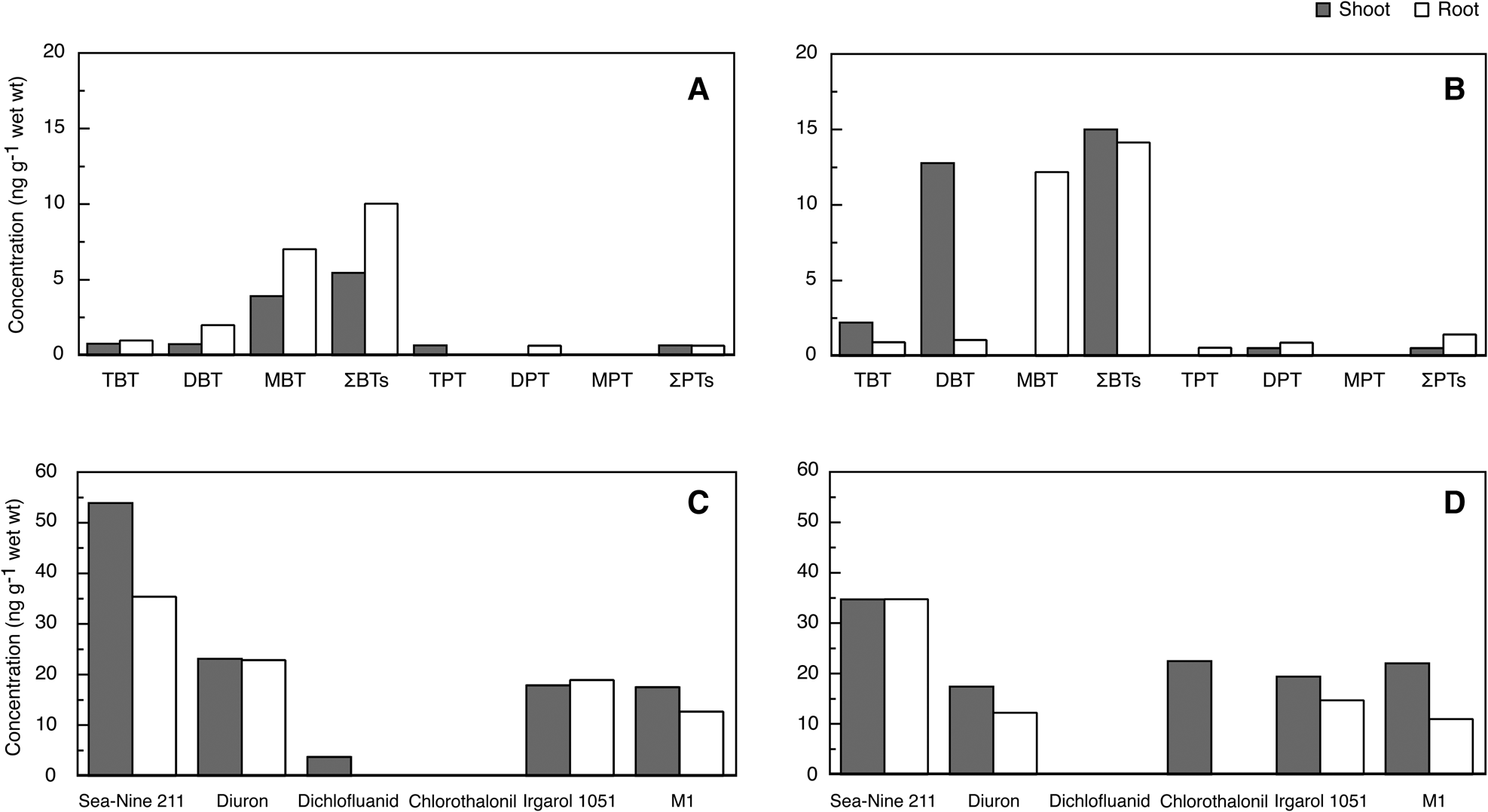
We compared the concentrations and proportions of antifouling biocides between the shoots and the roots of Cymodocea sp. and Halodule sp. collected from Merambong in 2013 (Figure 8). The ∑BT concentration in the shoots of the Halodule sp. was 15 ng g−1 ww, which is threefold higher than that in Cymodocea sp. (5.5 ng g−1 ww). The concentrations of ∑BTs in the roots of Cymodocea sp. and Halodule sp. were 10 and 14 ng g−1 ww, respectively. MBT was predominant in the shoots of the Cymodocea sp. (>70%), whereas DBT was predominant in the Halodule sp. (>80%). MBT in the roots of both species was the predominant compound, accounting for >70% of the ∑BTs.
Concentrations of antifouling biocides in shoots and roots of seagrasses collected from Merambong, 2013. Organotin compounds in (A) Cymodocea sp. and (B) Halodule sp., and alternative biocides in (C) Cymodocea sp. and (D) Halodule sp.

The levels of ∑PTs in the shoots of Cymodocea sp. and Halodule sp. were 0.7 and 0.5 ng g−1 ww, respectively (Figure 8). The concentrations of ∑PTs in the roots of Cymodocea sp. and Halodule sp. were 0.6 and 1.4 ng g−1 ww, respectively. The concentrations of TPT and DPT in Cymodocea sp. and Halodule sp. were near the detection limit, and MPT was not detected in these plants.
Sea-Nine 211, diuron and Irgarol 1051 were detected in both shoots and roots of Cymodocea sp. and Halodule sp. (Figure 8). No notable differences between the values in the shoots and roots of these plants were observed. The proportions of Irgarol 1051 were similar to those of M1 in both species (Figure 8). The proportion of Irgarol 1051 in roots (~60%) was higher than those in shoots (~50%) in both species.
Relationship between antifouling biocides and δ 13C in mangrove leaves collected from Merambong in 2012
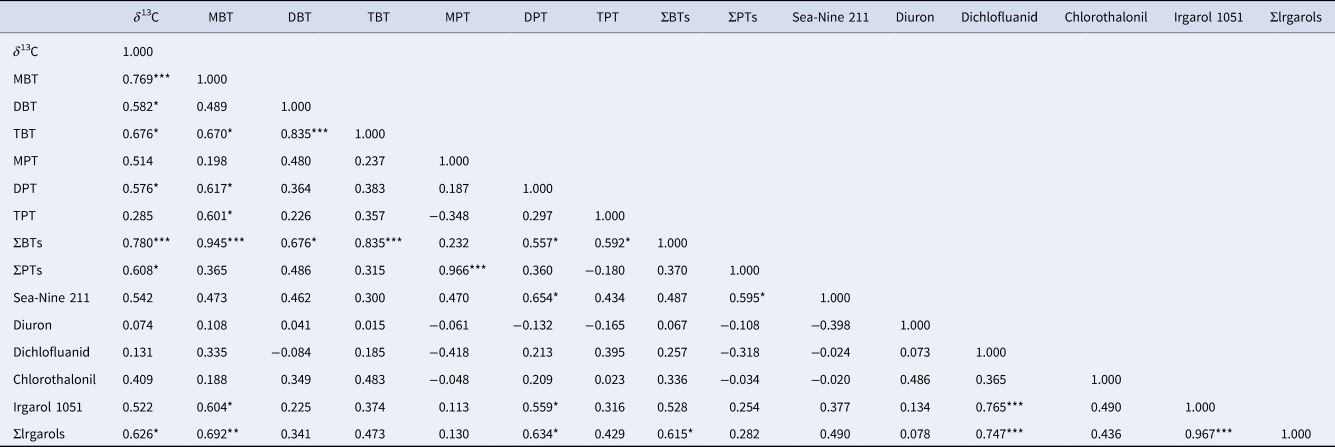
We examined the relationship between organotin compounds and alternative compounds, and between antifouling biocides and δ 13C in mangrove samples collected from Merambong only in 2012, because the other sample sizes were insufficient for a statistical analysis (Table 4). To estimate the source of alternative compounds, we calculated the correlation coefficient between organotin compounds and alternative biocides in mangroves collected from Merambong in 2012.
Correlation coefficient between each antifouling biocides and δ 13C in plants from Merambong, Malaysia in 2012

*P < 0.05, **P < 0.01, ***P < 0.005.
Significant correlation coefficients between ∑PTs and Sea-Nine 211 and between DPT and Sea-Nine 211 were revealed (P < 0.05, each). Significant correlation coefficients were also observed between ∑BTs and ∑Irgarols, between MBT and ∑Irgarols, and between DPT and Irgarol 1051 (P < 0.01–0.05). Significant correlation coefficients were also detected between MBT and Irgarol 1051 and between DPT and Irgarol 1051 (P < 0.05, each). Thus, high correlations between OTs and Sea-Nine 211 and between OTs and Irgarol 1051 were observed.
The relationships between δ 13C and antifouling biocides were studied. The levels of the stable isotope δ 13C in the mangrove plants collected in Merambong were in the range of −26 to −34‰. Significant relationships between the δ 13C values and those of the ∑BTs, TBT, DBT, MBT, ∑PTs, DPT and ∑Irgarols in the mangrove leaves were observed (P < 0.005–0.05). The concentrations of these compounds increased with the increasing values of δ 13C in the mangrove leaves.
Discussion
Comparison of the concentrations of antifouling biocides of Merambong mangrove leaves collected in 2012 and 2013
We observed that the TBT concentrations in mangrove leaves collected in 2013 were significantly lower than those in 2012 (P < 0.005), and an extremely high concentration of MBT was observed in 2013 (Table 3, Figure 2). The detection frequencies of phenyltin (PT) in mangrove leaves were low, and the concentrations of TPTs that were detected were around the detection limits. No significant differences in TPT levels between 2012 and 2013 were observed (Table 3, Figure 2). Diez et al. (Reference Diez, Abalos and Bayona2002) proposed a BT degradation index (BDI) and a PT degradation index (PDI) to quantify the degrees of the input and decomposition of BT and PT compounds by their concentrations in sediment. The calculation formulas for these indexes are:


In the case of sediment, it is considered that there has been a recent input if the values of these indexes are <1, and if they are >1, decomposition is progressing. Because it is reported that TBT and TPT were stable in sediment (Maguire & Tkacz, Reference Maguire and Tkacz1985; Dowson et al., Reference Dowson, Bubb, Williams and Lester1993; Harino et al., Reference Harino, Fukushima, Kurokawa and Kawai1997), this evaluation can be performed. Evaluations of plants with those indexes differ from those of sediment, because it is predicted that the decomposition of OTs in plants is faster than those in sediment. Therefore, in the case of plants, a higher index value would reflect a faster decomposition rate compared with the accumulation rate in plants.
The BDI values in 2012 and 2013 were 2.9 and 37, respectively. The PDI values in 2012 and 2013 were 13 and 23, respectively. Both the BDI and the PDI were >1, indicating that the degradation of TBT and TPT was progressing in the mangrove environment.
Although in 2012, the PDI was higher than the BDI, in the 2013 PDI was lower than the BDI. We thus speculate that (i) the adsorbed amount of TPT in the plants changed during this 2-year period, and (ii) the TPT in plants decomposed slowly compared with TBT. It was reported that TPT in water and sediment has been more stable than TBT (Tolosa et al., Reference Tolosa, Merlini, de Bertrand, Bayona and Albaiges1992; Stäb et al., Reference Stäb, Cofino, Van Hattum and Brinkman1994; Fent, Reference Fent1996). We suspect that TPT is as stable in plants as it is in water and sediment. Ohji et al. (Reference Ohji, Harino, Hayashizaki, Inoue, Yusoff and Nishida2019) reported that the detection frequencies of PT in both sediment and plants was low in 2012, and that the PT concentrations in plants reflected those in the sediment. We suspect that if we had measured the concentration of PT in sediment collected in 2013, the detection frequency of these compounds would be similar to those in the sediment collected in 2012.
Thus, the concentrations of OT compounds in 2013 were lower than or at the same level as those in 2012. In addition, judging from the BDI and PDI values, it is apparent that there was little new accumulation of TBT and TPT in plants, and decomposition was progressing. We thus speculate that the antifouling paints that have been used in this area of Malaysia are shifting from OT compounds to alternative substances.
The concentrations of alternative biocides that we detected in mangrove leaves are shown in Table 3 and Figure 3. The detections of alternative biocides in plants in this study are new findings. As the leaves were washed with distilled water before analysis to remove the detritus on leaf surface, alternative compounds were thus considered to be concentrated in mangrove leaves.
The concentration of Sea-Nine 211 increased but those of dichlofluanid and chlorothalonil decreased from 2012 to 2013. The concentrations of diuron and Irgarol 1051 did not change, but the rates of their decomposition products increased, as the values obtained by dividing M1 by Irgarol 1051 were 0.06 and 0.25 in 2012 and 2013, respectively. It can be inferred from this trend that the substances used as antifouling agents in this area of Malaysia have changed from organotin compounds to Sea-Nine 211 and Irgarol 1051. Diuron, dichlofluanid and chlorothalonil are used as pesticides in addition to antifouling agents. When these compounds are sprayed as a pesticide, the concentration temporarily increases and then decreases immediately, because of the higher water solubility of these compounds. This tendency might also occur in plants.
Comparison of the concentrations and compositions of antifouling biocides between mangrove leaves and seagrasses in Merambong
The concentrations and compositions of antifouling biocides in the mangrove leaves and seagrasses from Merambong in 2013 were compared, considering the different morphological appearances between mangroves and seagrasses.
The mean concentration of each BT in mangrove leaves was significantly higher than those in the seagrasses (P < 0.05). The ratios of DBT and MBT (degradation products of TBT) were higher than those of TBT in the mangroves and seagrasses (Figure 4). The proportion of MBT in particular among the BTs was higher than that of DBT in the mangrove leaves, whereas MBT showed similar proportions to DBT in the seagrasses. TBT is degraded to DBT, and DBT is further degraded to MBT. The higher proportion of MBT among BTs in the mangrove leaves compared with the seagrasses indicates that the mangrove plants have a higher metabolic capacity than the seagrasses.
The mean concentration of each PT as well as BT in the mangrove leaves was significantly higher than those in the seagrasses (P < 0.05). The proportions of the sum of MPT and DPT (degradation products of TPT) were 92 and 72% of the ΣPTs in the mangrove plants and seagrass plants, respectively (Figure 2), and the proportion of DPT in the mangrove leaves was high. TPT showed a different tendency than TBT. TPT has been reported to be more stable than TBT in the bodies of aquatic organisms (Harino et al., Reference Harino, Iwasaki, Arai, Ohji and Miyazai2009c). Our present findings suggest that the decomposition rate from DPT to MPT might be slower than the decomposition rate from TPT to DPT.
These differences in the concentrations of OTs between mangroves and seagrasses suggest that (i) the OTs might be more easily absorbed and accumulated in mangrove plants than into seagrasses, and/or (ii) the OTs might be used more frequently in the mangrove area than in the seagrasses area. Regarding the first possibility, the mangroves uptake nutrients through roots, whereas the seagrasses can take up nutrients through not only roots, but also leaves (Hogarth, Reference Hogarth2015). Since it is considered that mangroves and seagrasses have different mechanisms to take up OTs, further studies are necessary to clarify the mechanism of the uptake of OTs into these two types of plants. Concerning the latter possibility, a berth of small boats was present around the Merambong mangrove area when the samples were collected, and these could have been a source of TBT. The concentrations of TBT were significantly higher than those of TPT in both the mangrove leaves and seagrasses in Merambong (Figure 4). It is possible that the load of TPT was not the origin of antifouling biocides, and that TPT had been used as a pesticide on land. It was reported that the concentration of TBT in the environment was higher than the concentration of TPT in Japan where TPT has been used, because TPT was no longer used before TBT was banned (Harino et al., Reference Harino, Eguchi, Yamamoto, Kurokawa, Kawai, Arai, Ohji, Yamato, Kobayashi and Miyazaki2008). It can be inferred that TPT was no longer used earlier than TBT in Malaysia as well as Japan.
Our present analyses demonstrated that the mean proportions of degradation products of TBT were nearly 90% of the ∑BTs in the mangroves and seagrasses. MBT was reported to be the dominant compound among BTs in mangroves due to their ability to degrade TBT (Ohji et al., Reference Ohji, Harino, Hayashizaki, Inoue, Yusoff and Nishida2019). Francois et al. (Reference Francois, Short and Weber1989) noted that TBT was rapidly taken up by eelgrass (Zostera marina L.) and was degraded to DBT; the degradation of DBT was fast, and MBT was discharged slowly from the plants to the surrounding water. The half-lives of TBT were 6.7 and 13.8 days, under light and dark, respectively (Francois et al., Reference Francois, Short and Weber1989). Several species of algae can degrade TBT (Maguire et al., Reference Maguire, Wong and Rhamey1984; Lee et al., Reference Lee, Valkirs and Seligman1989). Metabolites produced include hydroxybutyl dibutyltins, DBT, MBT and inorganic tin. The hydroxylation of polycyclic aromatic hydrocarbons by algae appears to be due to a dioxygenase system (Warshawsky et al., Reference Warshawsky, Radike, Jayasimhulu and Cody1988). It is likely that this algal dioxygenase system oxidizes TBT (Lee, Reference Lee, Champ and Seligman1996), and mangrove and seagrass plants might have these mechanisms. We thus suspect that TBT was degraded by mangrove leaves as well as seagrasses in the present study. The MBT proportions in the seagrasses were similar to those of DBT; the ability to degrade DBT to MBT in mangrove leaves may be higher than that in seagrasses.
The high proportions of degradation products of TPT (>70% of the ∑PTs) in the mangroves and seagrasses suggested that TPT as well as TBT was degraded by mangroves. The compositions of PTs and BTs were also different between the mangrove leaves and seagrasses. Although the respective proportions of MPT and DPT were 30 and 63% in the mangrove leaves, they were 7.3 and 65% in the seagrasses. We suspect that the ability to degrade DPT to MPT in mangrove leaves was higher than that in seagrasses. Since differences in the ability to degrade pollutants such as antifoulants between mangrove leaves and seagrasses are not clear, further studies of the mechanisms underlying the degradation of pollutants are necessary.
In the present study, the concentrations of BTs and PTs in the mangrove leaves were significantly higher than those in the seagrasses, whereas degradation products of these compounds were predominant in the mangroves and seagrasses. It is considered that TBT and TPT in seawater or sediment might be taken up by the mangrove plants, and the plants' high metabolic capacity to degrade tri-organotin into di- or mono-organotin, but low capacity to degrade mono-organotin to inorganic Sn, resulted in high concentrations of degradation products in mangrove leaves. There are plants called ‘hyper-accumulators’ that accumulate extremely high concentrations of metal compounds from their surroundings, e.g. from polluted soils and industrial wastes (Krämer, Reference Krämer2010; Li et al., Reference Li, Gurajala, Wu, Van der Ent, Qiu, Baker, Tang, Yang and Shu2018). Further investigation is needed to clarify the mechanisms regarding the uptake of OTs by mangroves.
The concentrations of Sea-Nine 211 were the highest among the alternative biocides, followed by Irgarol 1051, diuron and chlorothalonil in both the mangrove leaves and seagrasses (Figure 5). The concentrations of Sea-Nine 211, diuron, chlorothalonil, Irgarol 1051 and M1 in the seagrasses were significantly higher than those in the mangrove leaves. Although the concentrations of OTs in the plants in the mangrove area were higher than those in the seagrass area, the opposite tendency was observed for alternative compounds. The seagrass area is closer to the Straits of Johor than the mangrove area, and it can thus be inferred that the concentration of substitutes was high due to poor water exchange.
These results suggest that (i) the alternative biocides might be absorbed and accumulated in seagrasses more easily than into mangrove leaves, and/or (ii) the alternative biocides might be used more frequently in the seagrass area compared with the mangrove area examined in this study. Regarding the first hypothesis, mentioned above, the mangroves take up nutrients through roots, whereas seagrasses can take up them through both roots and leaves (Hogarth, Reference Hogarth2015). It is considered that mangroves and seagrasses have different mechanisms to take up alternative biocides, as well as OTs. To test the former hypothesis, an exposure experiment should be conducted in future research. Regarding the latter hypothesis, the elution of alternative biocides from fishing boats may occur; Liu et al. (Reference Liu, Pacepavicius, Maguire, Lau, Okamura and Aoyama1999) reported that Irgarol 1051 was detected more frequently in fishery harbours. In addition, we detected M1 (a degradation product of Irgarol 1051) in both the mangrove and seagrass areas. We presume that these alternative biocides were degraded in both mangroves and seagrasses (as were TBT and TPT).
The logarithms of the octanol water partition coefficients (P ow) for alternative compounds are lower than those of OTs in general, and the low values of P ow imply a low bioconcentration potential (Harino et al., Reference Harino, Arai, Ohji, Miyazaki, Arai, Harino, Ohji and Langston2009a). Although the values of alternative compounds were low in the present study, the compounds were detected in both mangroves and seagrasses, as were OTs. The toxicity of these biocides on seagrasses has been described (e.g. Chesworth et al., Reference Chesworth, Donkin and Brown2004; Jensen et al., Reference Jensen, Holmer and Dahllöf2004), but there is no information about the effects of the biocides on mangroves, and only limited information is available about the toxicity of degradation products of TBT and Irgarol 1051 (e.g. Huang et al., Reference Huang, Bai and Xie1993; Gatidou & Thomaidis, Reference Gatidou and Thomaidis2007).
In the present study, although we collected the mangroves and seagrasses in mature stage, these plants in the early life stage may be more sensitive to pollutants than when in a mature stage (Ohji et al., Reference Ohji, Arai and Miyazaki2003). Reproduction and the early settlement stages are the most affected by environmental pressures (Hogarth, Reference Hogarth2015), including antifoulants. Since mangroves and seagrasses play an important role to provide habitats for many aquatic organisms, the biological effects of antifouling biocides to mangroves and seagrasses might lead to disturbance in the dynamics of the population in the coastal ecosystems. Furthermore, antifouling biocides may also have both acute and chronic effects not only on plants but also animals. Ohji et al. (Reference Ohji, Harino, Hayashizaki, Inoue, Yusoff and Nishida2019, Reference Ohji, Shibayama, Harino, Hayashizaki, Yusoff and Inoue2022) shows the accumulation of OTs in the various marine animals and plants, thus they may be affected by OTs in the ecosystems. Comparatively speaking, phytoremediation has been reported to be an environmentally friendly in situ approach to remediate sites with low-to-moderate pollution with trace elements, if the plants, such as grasses, have high tolerance to toxicity induced by the trace elements (Rabêlo et al., Reference Rabêlo, Vangronsveld, Baker, Van der Ent and Alleoni2021). Therefore, if there is little toxicity of antifouling biocides to mangroves and seagrasses, those plants may be useful to remove the antifouling pollution in seawater or sediment, i.e. phytoremediation, because the mangroves and seagrasses seem to have the metabolic capacity to degrade OTs and/or Irgarol 1051, and to accumulate these compounds. Additional studies are needed to examine the biological effects of antifouling biocides, including their degradation compounds, on mangroves and seagrasses, and the potential of these plants to be used for phytoremediation of antifouling biocides in coastal ecosystems.
Comparison of antifouling biocides in mangrove leaves and sediment between Merambong and Tinggi Island
We compared the concentrations of antifouling biocide in the mangrove leaves and sediment from Merambong and Tinggi Island in 2012 (Ohji et al., Reference Ohji, Harino, Hayashizaki, Inoue, Yusoff and Nishida2019). MBT is dominant among the BTs, and MPT is dominant among the PTs. The trends that we observed in the materials from Tinggi Island were similar to those from Merambong. Although we observed that the BTs concentrations in mangrove leaves in Merambong were higher than those from Tinggi Island, the concentration of TBT in mangrove leaves in Merambong was similar to concentrations in the mangrove leaves in Tinggi Island, which indicates that the mangroves degraded TBT and TPT. The BT concentrations in the sediment from Merambong were higher than those from Tinggi Island, as well as mangrove leaves. The PTs levels were under the detection limit in the sediment samples from both sites.
No significant differences were observed in the levels of alternative biocides in mangrove leaves between Merambong and Tinggi Island. The concentrations of alternative biocides detected in sediment in Tinggi Island were similar to or higher than those in Merambong, except for diuron. The concentrations in mangrove leaves and sediment in Tinggi Island were generally the same as or higher than those in Merambong, suggesting that Tinggi Island is heavily contaminated by alternative biocides compared with Merambong.
To summarize the above findings, Merambong was more contaminated by organotin compounds than Tinggi Island, while Tinggi Island was more contaminated by alternative biocides.
Comparison of the concentrations and compositions of antifouling biocides between shoots and roots of Merambong seagrasses
The ∑BT concentration in Halodule sp. was two times higher than that in Cymodocea sp., although no significant differences were observed (Figure 8). The concentrations of ∑BTs in the roots of Cymodocea sp. and Halodule sp. were almost the same or higher than those in the shoots of Cymodocea sp. and Halodule sp. MBT was the predominant compound (>70% of the ∑BTs) in the roots of both species. However, the proportions of DBT and MBT in the shoots were different between the two species. In the shoots, MBT was predominant in Cymodocea sp. (>70%), whereas DBT was predominant in Halodule sp. (>80%). Since a higher concentration of DBT in shoots was observed in Halodule sp. compared with Cymodocea sp., we speculate that the ability to degrade DBT to MBT in Halodule sp. is lower than that in Cymodocea sp.
The levels of ∑PTs in Halodule sp. were higher than those in Cymodocea sp. (Figure 8). The concentrations of ∑PTs in the roots of Cymodocea sp. and Halodule sp. were almost the same as or higher than those in the shoots in Cymodocea sp. and Halodule sp. Different profiles of the accumulation of TPT and DPT were observed. In Cymodocea sp., the proportion of TPT was 100% in the shoots, and that of DPT was 100% in the roots. This phenomenon indicates that TPT might be taken up from shoots in seagrasses, such as Cymodocea sp. It is also possible that the metabolic capacity to degrade TPT exists in roots, but not in shoots in Cymodocea sp. In contrast, in Halodule sp., the proportion of TPT was 100% in roots, and those of TPT and DPT were almost the same in the roots. We speculate that the metabolic capacity to degrade TPT in Cymodocea sp. shoots is lower than that in Halodule sp., and in contrast, the capacity to degrade TPT in Cymodocea sp. roots is higher than that in Halodule sp.
In the present study, Sea-Nine 211, diuron and Irgarol 1051 were detected in both shoots and roots of Cymodocea sp. and Halodule sp. The concentration of Sea-Nine 211 was the highest among the alternative biocides, followed by ∑Irgarols, diuron and dichlofluanid in both species. The concentrations of those alternative biocides in roots were almost the same as or lower than those in the shoots. We focused on Irgarols because the metabolic capacity to degrade Irgarol 1051 in the seagrasses could be estimated. The concentration of ∑Irgarols in Cymodocea sp. was similar to that in Halodule sp. (Figure 8). The concentrations of ∑Irgarols in the roots in Cymodocea sp. and Halodule sp. were almost the same as or lower than those in the shoots of both species. The proportions of Irgarol 1051 of the ∑Irgarols were similar to those of M1 in both species. These results suggest that the metabolic capacity to degrade Irgarol 1051 was similar in the two species. There were differences in the proportions of Irgarol 1051 and M1 of the ∑Irgarols in the two species. In roots, the proportion of Irgarol 1051 was higher than those in M1 within species. In contrast, the proportion of Irgarol 1051 in shoots was almost the same as those of M1 within species, i.e. the proportion of Irgarol 1051 in roots was higher than that in shoots in both species. This result indicates that metabolic capacity to degrade Irgarol 1051 in the roots was lower than that in the shoots.
Thus, although some differences were observed between species, the concentrations of OTs in the roots of the Cymodocea sp. and Halodule sp were almost the same as or higher than those in their shoots. In contrast, the concentrations of alternative biocides, including Irgarol 1051, in the roots were almost the same as or lower than those in the shoots in general in the present study. These differences in accumulation profile between the OTs and alternative compounds might be derived from chemical characteristics of these compounds. In coastal water environments, OTs have been reported to accumulate in the sediment, whereas alternative biocides tend to exist in the water (Harino et al., Reference Harino, Arai, Ohji, Miyazaki, Arai, Harino, Ohji and Langston2009a). The differences in the distribution between these two types of biocides depend on their sediment-water partition (K d) values. In general, the K d values of alternative compounds are lower than those of OTs (such as TBT), suggesting that these alternative compounds have a greater preference for the aqueous phase compared with TBT (Harino et al., Reference Harino, Arai, Ohji, Miyazaki, Arai, Harino, Ohji and Langston2009a).
Unlike mangroves, seagrasses can take up nutrients through not only roots but also leaves, and in some species, the importance of leaf uptake varies under some circumstances (Hogarth, Reference Hogarth2015). Therefore, as seagrasses are known to take up chemicals from both shoots and roots, the uptake routes may differ between OTs and alternative biocides. The mechanisms underlying the uptake of pollutants such as antifouling biocides into mangroves and seagrasses are not yet known, and further studies are thus necessary.
Relationships between organotin compounds and alternative biocides and between δ 13C and antifouling biocides in mangrove leaves in Merambong
We estimated the origins of alternative compounds by calculating the correlation coefficients between organotin compounds and alternative biocides in mangroves collected from Merambong. High correlations between OTs and Sea-Nine 211 and between OTs and ∑Irgarols were revealed, demonstrating that Sea-Nine 211 and Irgarol 1051 were used as antifouling biocides in the Merambong area. No significant relationships between OTs and diuron, dichlofluanid or chlorothalonil were observed, because these compounds were used as pesticides in addition to their use as antifouling biocides, and the detection frequencies of dichlofluanid and chlorothalonil were low.
The measurement of the ratio of stable carbon isotopes has been widely used as a technique to track carbon through food chains (Hogarth, Reference Hogarth2015). It is known that mangrove leaves have δ 13C values in the range −24 to −30‰ in general (Hogarth, Reference Hogarth2015), and these values are similar to our present data in the range of −26 to −34‰, suggesting that these plants are C3 (i.e. terrestrial) plants (Park & Esptein, Reference Park and Epstein1961).
Significant relationships between δ 13C and ∑BTs, TBT, DBT, MBT, ∑PTs, DPT, Sea-Nine 211 and ∑Irgarols were identified in the mangrove leaves from Merambong. The concentrations of these compounds increased as the δ 13C values of the mangroves were increased. Bicarbonate ions (in which 13C is present) accumulated in the pore waters of marine and freshwater sediment (Van der Heide et al., Reference Van der Heide, Smolders, Lamers, van Katwijk and Roelofs2010). Marine plants derive their carbon from the dissolved ocean bicarbonate, which is more enriched in 13C than atmospheric carbon (Papathanasiou et al., Reference Papathanasiou, Richards and Fox2015). Marine plants use the same processes of fixing carbon as terrestrial plants (i.e. C3 and C4 pathways), but as ocean bicarbonate is more enriched in 13C than atmospheric CO2, marine plants are about 10‰ higher in δ 13C than terrestrial plants (Papathanasiou et al., Reference Papathanasiou, Richards and Fox2015). Although mangrove plants are C3 (i.e. terrestrial) plants, it might be considered that mangrove plants derive their carbon in the pore waters of the sediment which are enriched with bicarbonate. These results suggests that mangroves take up the bicarbonate ions and nutrients in sediment and/or seawater through their roots, along with OTs, Sea-Nine 211 and Irgarols which were accumulated in sediment and/or dissolved in seawater.
We discuss the mechanism of uptake of the antifouling biocides, especially TBT, from the sediments into the roots of the mangroves. The degradation rate of TBT in the sediment is very slow (Maguire & Tkacz, Reference Maguire and Tkacz1985; Dowson et al., Reference Dowson, Bubb, Williams and Lester1993). The half-life of TBT in sediments has been reported to be tens of years (Langston et al., Reference Langston, Pope, Davey, Langston, O'Hara, Gibbs and Pascoe2015). It was also reported that TBT-based paint chips that are present in sediment degrade more slowly than TBT adsorbed by sediment particles (Stang et al., Reference Stang, Lee and Seligman1992). Most sorption isotherm models assume a condition of dynamic equilibrium and reversibility, suggesting that sorbed compounds will readily become desorbed when concentrations in the surrounding water drop below equilibrium levels (Langston et al., Reference Langston, Harino, Pope, Arai, Harino, Ohji and Langston2009). At higher concentrations, TBT sorption exhibits a Freundlich-type (non-linear) isotherm whereby the value of the partition coefficient varies with TBT concentration (K p decreases as TBT increases). Furthermore, the nature of the aqueous phase may influence sorption in several ways, and pH is one of the master variables for surface coordination reactions, reflecting solution hydrolysis, protonation of adsorbing ions and surface charge properties of the adsorbent (Langston et al., Reference Langston, Harino, Pope, Arai, Harino, Ohji and Langston2009). The effect of pH on TBT partitioning revealed highest values for K p (~107,589 l kg−1) at neutral pH (~7), and the K p decreased sharply with both increasing or decreasing pH (~19,243 and 17,667 l kg−1 at pH 4.65 and 9.19, respectively) reflecting increased solubility of TBT under these conditions (Langston & Pope, Reference Langston and Pope1995). In estuarine environments, pH is usually buffered via the seawater carbonate system to near-neutral conditions (pH ~8) but it is feasible that under low salinity conditions in the upper reaches of estuaries, or under high freshwater flow, pH could become a relevant factor in TBT partitioning (Langston & Pope, Reference Langston and Pope1995). Next to pH, competitive adsorption is probably the second most important way in which dissolved solutes affect adsorption of cations – notably bulk inorganic constituents (e.g. Ca, Mg) that mutually adsorb onto the same sites on the solid phase (Langston et al., Reference Langston, Harino, Pope, Arai, Harino, Ohji and Langston2009). The extent of competition depends upon relative concentrations of these solutes and affinities for the same sites. Ionic strength (or salinity) therefore influences sorption affecting activities in solution and surface change on particles, and increasing salinity also increases the aggregation of suspended particles, which may in turn affect pore waters (Langston et al., Reference Langston, Harino, Pope, Arai, Harino, Ohji and Langston2009). Concomitantly the total surface area, and therefore the rapidly reversible component of sorption, decrease (Langston et al., Reference Langston, Harino, Pope, Arai, Harino, Ohji and Langston2009). Thus, the mechanisms of the uptake of TBT from the sediment to the mangroves is considered to be as follows: When TBT desorbs from sediment in association with the condition of seawater, it transfers to seawater. Then the mangroves take up not only nutrients but also TBT through roots. Further studies are necessary to elucidate the mechanisms of accumulation of antifouling biocides in mangroves as well as seagrasses, with the overall goal of protecting coastal water environments.
Conclusion
Organotin compounds and alternative biocides in mangroves collected in 2012 and 2013 in Malaysia were evaluated, and the results demonstrated that the concentrations of TBT in 2013 were significantly lower than in 2012, whereas the concentration of Sea-Nine 211 increased. The concentrations of OTs in mangroves were higher than those in seagrasses, and those of alternative biocides in seagrasses were higher than those in mangroves. There were differences in the accumulation profiles of OTs and alternative biocides between the seagrass shoots and roots. The concentrations of OTs in the seagrass roots were almost the same or higher than those in the shoots; in contrast, the concentration of Irgarol 1051 in the roots was almost the same or lower than that in the shoots. Significant relationships were observed between δ 13C and the ∑BTs, TBT, DBT, MBT, ∑PTs, DPT, Sea-Nine 211 and ∑Irgarols.
These findings confirm that antifouling biocides have accumulated in both mangrove and seagrass in Malaysia, and the contamination of organotin compounds and alternative biocides is an important problem. It is necessary to monitor both old and new antifouling biocides, i.e. OTs and alternative chemicals, continuously in these ecologically important regions such as mangrove and seagrass ecosystems, to assess the precise contamination status, and to clarify the mechanisms of uptake, metabolism and the effects of antifouling biocides in these ecosystems to protect entire coastal ecosystems.
Acknowledgements
We thank the staff of University Putra Malaysia for their tremendous support during the field sampling.
Financial support
This work was supported by the Core-to-Core program of the Japan Society for the Promotion of Science (JSPS), B. Asia–Africa Science Platforms ‘CREPSUM’ (K.I., a grant number JPJSCCB20200009); Grants-in-Aid for Scientific Research from the Japan Society for the Promotion of Science (JSPS) (M.O., grant numbers JP26701008, JP19K12366).