Introduction
Aquaporins are a group of cell membrane proteins that form water channels, with some isoforms having diverse additional functions. AQP1 and AQP5 (aquaporins 1 and 5) harbour signalling properties that are of special interest in the study of neoplastic diseases. AQP1 plays a role both in cell cycle control and angiogenesis.Reference Saadoun, Papadopoulos, Hara-Chikuma and Verkman1, Reference Hoque, Soria, Woo, Lee, Lee and Jang2 Recently, our group described AQP1 as a novel biomarker for a particularly aggressive subgroup of basal-like breast carcinomas.Reference Otterbach, Callies, Adamzik, Kimmig, Siffert and Schmid3 AQP5 is related to malignant transformation and promotes cell growth.Reference Woo, Lee, Chae, Kim, Baek and Park4, Reference Kang, Chae, Woo, Kim, Park and Lee5 Ectopic expression of both aquaporins has been associated with various cancers.Reference Moon, Soria, Jang, Lee, Obaidul and Sibony6–Reference Yang, Shi, Cheng and Deng9 Aquaporins have been extensively studied in salivary glands, and in the mucosa of upper gastrointestinal and respiratory tracts.Reference Delporte and Steinfeld10–Reference Verkman12
Aquaporins can be co-expressed with other molecules that play a crucial role in tumour biology. For example, Bcl-2 (B-cell lymphoma 2), which acts as an anti-apoptotic and anti-proliferative molecule, is co-expressed with AQP1 in nasal polyps and with AQP8 (aquaporin 8) in cervical carcinoma.Reference Guan, Dong and Lu13, Reference Yao, Zhou, Wei, Wang and Shi14 We recently showed that Bcl-2 is also significantly co-expressed with p16 (cyclin-dependent kinase inhibitor) in oropharyngeal cancer.Reference Lehnerdt, Franz, Bankfalvi, Grehl, Kelava and Nuckel15 In fact, p16 is utilised as a surrogate marker for high-risk human papillomavirus (HPV) infection in this type of cancer.Reference Klussmann, Gultekin, Weissenborn, Wieland, Dries and Dienes16–Reference Weinberger, Yu, Haffty, Kowalski, Harigopal and Brandsma18
The present study aimed to elucidate the frequency and localisation of AQP1 and AQP5 expression in squamous cell carcinoma (SCC) of the oro-hypopharynx, explore their possible interaction with the expression of Bcl-2 and p16, and determine their impact on survival. Furthermore, promoter regions of BCL2 and AQP5 carry functional regulatory promoter polymorphisms that have been associated with respective expressions.Reference Lehnerdt, Franz, Bankfalvi, Grehl, Kelava and Nuckel15, Reference Adamzik, Frey, Bitzer, Jakob, Baba and Schmieder19 We investigated the putative impact of these functional polymorphisms on Bcl-2 and AQP5 expression in oro-hypopharyngeal SCC.
Materials and methods
Patients
The study cohort consisted of 107 Caucasian patients with oro-hypopharyngeal SCC who were diagnosed and treated at the West German Cancer Centre, Essen. Clinicopathological data were extracted from the patients' files or collected by telephone interviews. The study was strictly performed according to the Declaration of Helsinki and approved by the local Ethics Committee of the University Hospital Essen.
Immunohistochemistry
Tumour tissue blocks were retrieved from the files of the Institute of Pathology at the University Hospital Essen, and tissue microarray blocks were constructed from them for further investigations. In addition to the prognostic cohort, seven basaloid-type SCCs were retrieved from the pathology archives for detailed analysis of AQP1 expression within this subgroup.
Paraffin sections (4 μm thick) were serially cut from the tissue microarray blocks and mounted on SuperFrost® Plus slides (Menzel, Braunschweig, Germany). After heat-based antigen retrieval, the serial sections were immunostained and visualised for AQP1, Bcl-2 and p16, as previously described.Reference Otterbach, Callies, Adamzik, Kimmig, Siffert and Schmid3, Reference Lehnerdt, Franz, Bankfalvi, Grehl, Kelava and Nuckel15 Immunohistochemical expression of AQP5 was studied using a mouse monoclonal anti-AQP5 antibody (G-19; Santa Cruz Biotechnology, Dallas, Texas, USA) at a dilution of 1:1000. Antigen retrieval was performed in a 95 °C water bath in citrate buffer pH 6.0 for 30 minutes. Secondary immunohistochemical reaction was performed by the avidin-biotin-peroxidase technique (Dako Lsab Kit; DakoCytomation, Glostrup, Denmark). This was followed by chromogen detection with diaminobenzidine.
Immunohistochemical staining evaluation
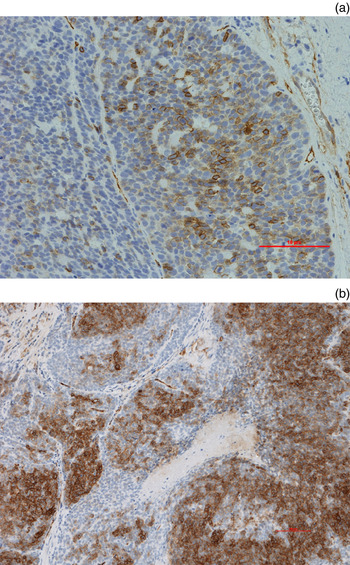
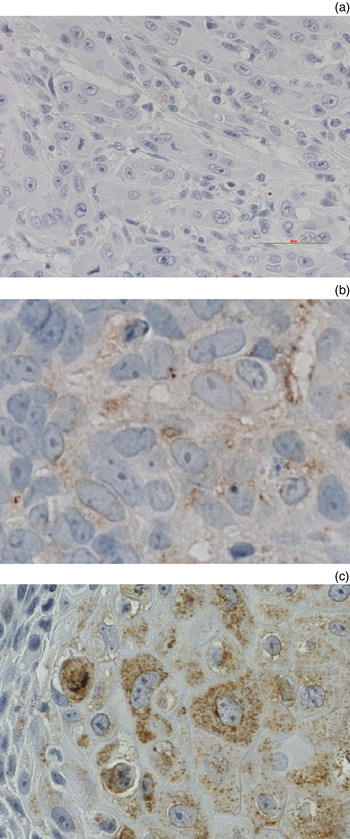
Stained sections were reviewed by one of the authors (AB). Bcl-2 and p16 were classified as previously described.Reference Lehnerdt, Franz, Bankfalvi, Grehl, Kelava and Nuckel15 AQP1 is constitutionally expressed in capillary endothelial cells; squamous epithelium of the oro-hypopharynx is completely negative. Tumours, if positive, showed a strong membranous reaction in over 30 per cent of the tumour cells (Figures 1a and b). AQP5 showed a weak, fine vesicular positive reaction in the cytoplasm of normal epithelial cells within the stratum spinosum. Tumour tissues without any staining reaction were classified as negative. Those with a weak-to-moderate fine vesicular intracytoplasmic staining in 10–30 per cent of the cells were graded as 1+. Tumour tissues with moderate-to-strong vesicular intracytoplasmic reactions were graded as 2+ (Figure 2 a–c). For further statistical analysis, grades 1+ and 2+ were combined and classified as positive.
Photomicrographs of AQP1 immunohistochemical staining pattern, showing strong membranous expression in around (a) 30 per cent and (b) 70 per cent of tumour cells in basaloid-type squamous cell carcinomas. (Anti-AQP1 immunohistochemical staining reaction; ×40 in part a and ×100 in part b).

Photomicrographs of AQP5 immunohistochemical staining pattern, showing: (a) negative control section of a squamous cell carcinoma (SCC) sample (no staining; ×100), (b) weak-to-moderate fine vesicular positivity within the cytoplasm of SCC cells (graded as 1+) (anti-AQP5 antibody; ×200), and (c) moderate-to-strong intracytoplasmic vesicular staining in more than 30 per cent of SCC cells (graded as 2+) (anti-AQP5 antibody; ×200).

BCL2 -938C>G and AQP5 -1364A>C genotype determination
The DNA was extracted from routinely processed paraffin-embedded tissue samples. Dewaxing and isolation of genomic DNA were performed using a commercially available kit (QIAamp DNA FFPE Tissue Kit; Qiagen, Hilden, Germany) following the manufacturer's instructions. AQP5 and BCL2 genotypes were obtained by pyrosequencing, as previously described.Reference Adamzik, Frey, Bitzer, Jakob, Baba and Schmieder19–Reference Bachmann, Siffert and Frey21
Statistics
Kaplan–Meier survival plots and the log-rank test were used to retrospectively evaluate the relationship between the expression of AQP5, Bcl-2 and p16, and outcome (from the time of primary diagnosis until death). The effects of age, gender, histological tumour grade, cancer stage (according to the American Joint Committee on Cancer classification system), regular alcohol intake, smoking and p16 expression on clinical outcome were analysed using univariate and backward-stepwise multiple Cox regression analyses. Hazard ratios and 95 per cent confidence intervals (CIs) were calculated from the Cox regression model. Contingency tables and chi-square tests were used to compare categorical variables. Control for deviation from the Hardy–Weinberg equilibrium was conducted using a publically available Hardy–Weinberg equilibrium calculator.22 Differences were regarded as significant at p < 0.05. All statistical analyses were conducted using SPSS software, version 17.0 (SPSS, Chicago, Illinois, USA), or GraphPad Prism software, version 4.0 (GraphPad Software, La Jolla, California, USA).
Results
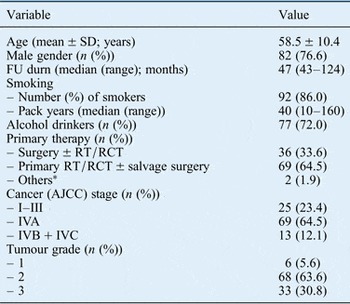
Table I shows the clinicopathological characteristics of the 107 patients in the study cohort. The cohort was representative compared to published demographic data in relation to mean age and frequencies of gender, tumour grade, cancer stage, and alcohol and nicotine intake.Reference Asper, Morrison, Rosenthal, Ahamad, Ang and Garden23, Reference Gillison24 Immunohistochemistry of AQP1, AQP5 and Bcl-2 could be conducted for the complete cohort. Analysis of p16 was available for only 105 patients because of tissue quantity limitations in 2 samples.
Clinicopathological characteristics at primary diagnosis

Total n = 107. *Radiotherapy (or radiochemotherapy) plus surgery (German-Austrian-Swiss Research Group on Maxillofacial Tumours (‘DÖSAG’) scheme) or palliative chemotherapy. SD = standard deviation; FU durn = follow-up duration; RT = radiotherapy; RCT = radiochemotherapy; AJCC = American Joint Committee on Cancer
AQP1 expression
AQP1 was detected in only 1 of 107 tumours within the prognostic group (0.9 per cent), but this specimen showed a very strong staining of more than 70 per cent of the neoplastic cells. The sample belonged to a 75-year-old male suffering from a basaloid-type SCC (International Classification of Diseases for Oncology code 8083/3) of the vallecula and tongue root (Figure 1b). The patient had cancer stage 3, with a high histological malignancy grade (grade 3), 80 per cent Ki67-positive proliferation fraction, and strong expression of Bcl-2 and p16, but not AQP5. A polymerase chain reaction based HPV test showed a negative result.
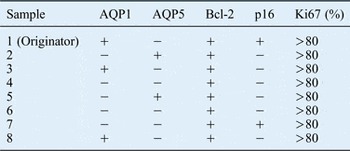
To investigate whether AQP1 expression is a particular feature of basaloid-type SCC, we retrieved an additional seven basaloid-type SCCs from the oro-hypopharynx (without clinical follow up). A further two tumours showed AQP1 positivity in at least 30 per cent of tumour cells. All tumours were strongly positive for Bcl-2 and had a Ki67-positive proliferation fraction of over 80 per cent. p16 was positive only in one additional tumour (AQP1-negative). AQP5 was weakly positive in two tumours, both of which were negative for AQP1 (Table II). All tumours were HPV-negative in polymerase chain reaction based tests.
Immunohistochemical phenotypes in subset of eight basaloid-type SCC samples

SCC = squamous cell carcinoma; + = positive; − = negative
AQP5, Bcl-2 and p16 expression
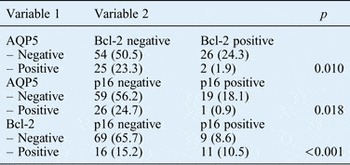
AQP5 was detected in 27 samples (25.2 per cent), Bcl-2 was positive for 28 probes (26.2 per cent) and p16 showed overexpression in 20 cases (19.0 per cent). AQP5 expression was significantly associated with the absence of Bcl-2 and p16 expression (p = 0.010 and p = 0.018, respectively). Co-expression with Bcl-2 was detectable in only two cases (1.9 per cent) and co-expression with p16 was detectable in only one case (0.9 per cent). However, p16 and Bcl-2 were significantly co-expressed in this study cohort (p < 0.001) (Table III).
Immunohistochemical expression of AQP5, BCL-2 and P16

Data represent numbers (and percentages)
AQP5 and Bcl-2 expression and promoter polymorphisms
The AQP5 -1364A>C genotype was obtainable for 100 samples (93 per cent) and the BCL2 -938C>A genotype was obtainable for 104 samples (97 per cent). The AQP5 -1364A>C genotype distribution of samples with positive AQP5 expression was 15 AA, 10 AC and 0 CC, with a C allele frequency of 20 per cent; this was not significantly different from the distribution of AQP5-negative samples (44 AA, 27 AC and 4 CC, with a C allele frequency of 23 per cent; p = 0.492).
Bcl-2 expression was significantly associated with BCL2 -938C>A genotypes (p = 0.033). Bcl-2 expression was most frequent in homozygous AA genotype carriers (positive in 14 samples (43.8 per cent) and negative in 18 samples (56.2 per cent)), intermediate in heterozygous patients (positive in 10 (20.8 per cent) and negative in 38 (79.2 per cent)) and rare in homozygous CC genotype carriers (positive in 4 (16.7 per cent) and negative in 20 (83.3 per cent)).
Genotype distributions were compatible with Hardy–Weinberg equilibrium, and corresponded to A allele frequencies of 67.9 per cent in Bcl-2-positive patients and 48.7 per cent in Bcl-2-negative patients.
Clinical outcome by AQP5, Bcl-2 and p16 expression
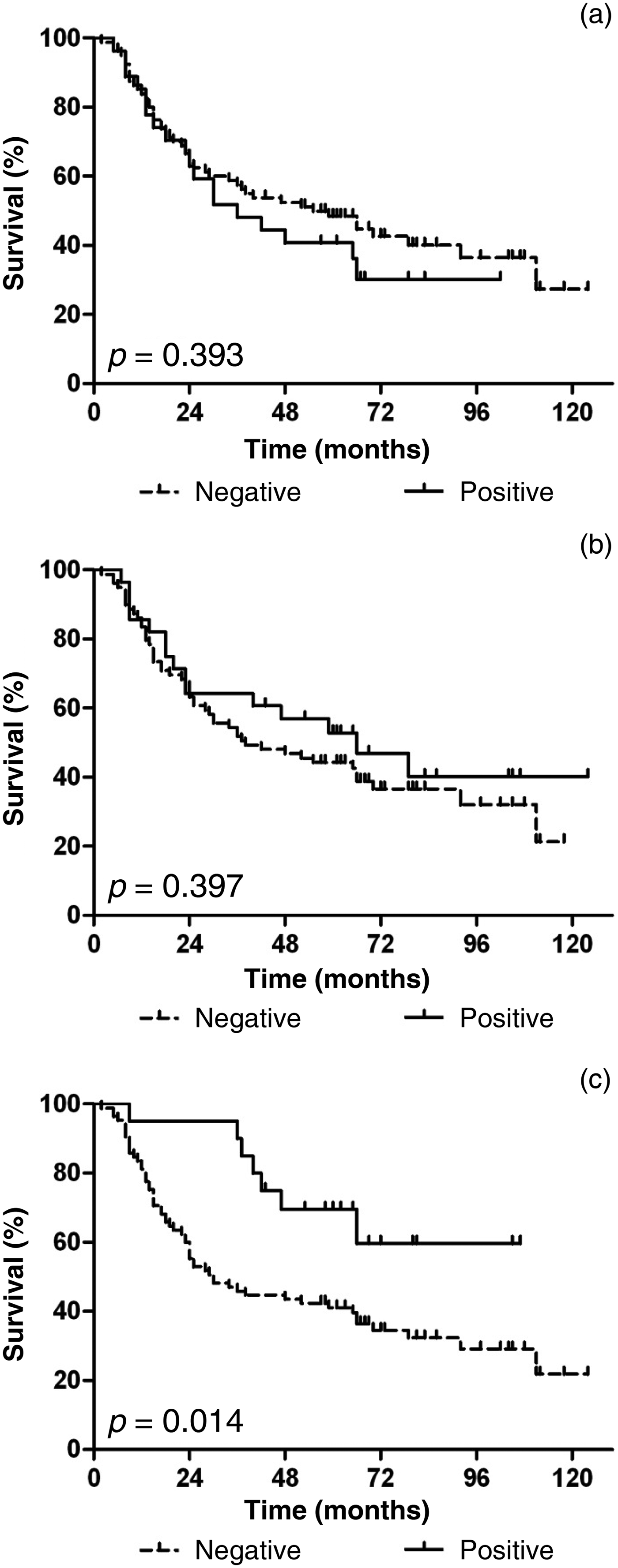
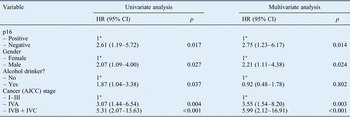
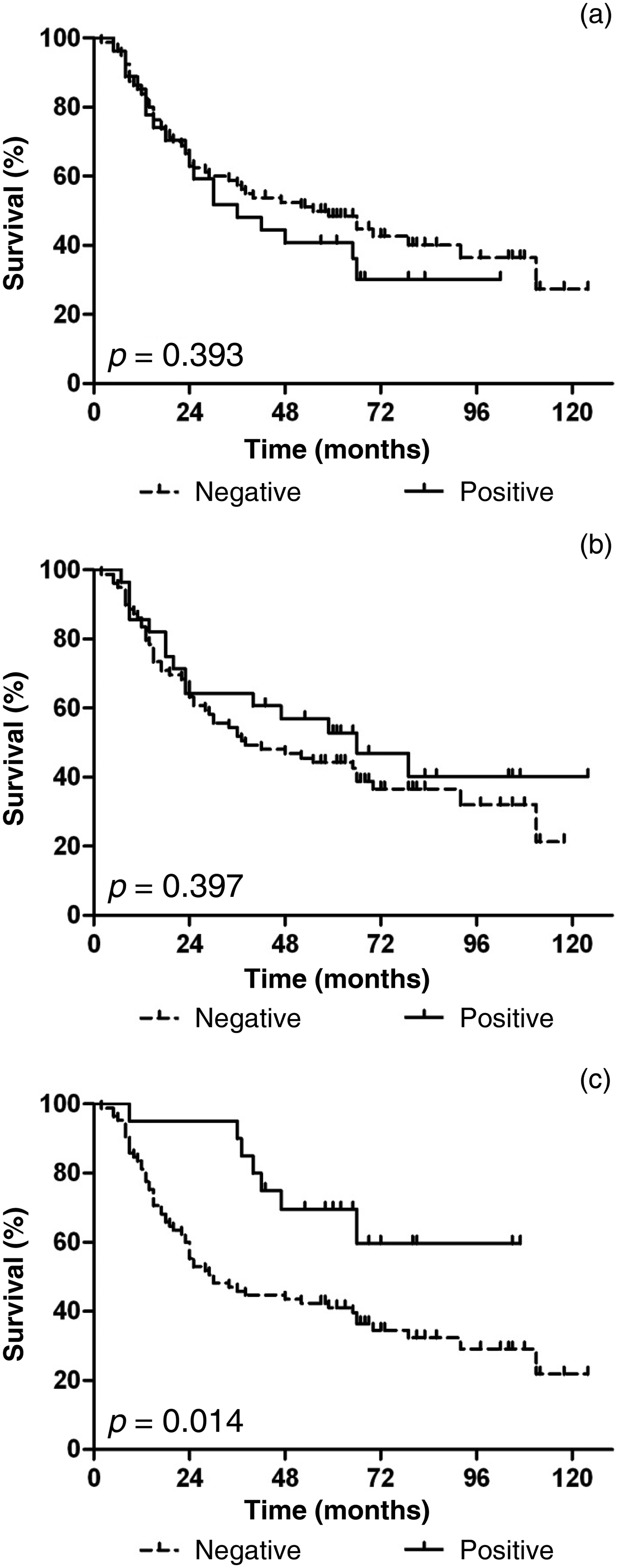
Overall survival was analysed in relation to AQP5, Bcl-2 and p16 expression using Kaplan–Meier survival curves. Overall survival lacked a statistical association with either AQP5 or Bcl-2 expression (p = 0.393 and p = 0.397) (Figures 3a and b), but was significantly related to p16 expression (p = 0.014) (Figure 3c). In univariate analysis, p16-negative patients had a higher risk of death than p16-positive patients. The hazard ratio for p16-negative versus p16-positive patients in terms of risk of death was 2.61 (95 per cent CI = 1.19–5.72; p = 0.017) (Table IV). Five-year survival rates were 69.6 per cent for p16-positive patients and 41.1 per cent for p16-negative patients.
Kaplan–Meier survival curves of 107 oro-hypopharyngeal squamous cell carcinoma patients, dependent on (a) AQP5 expression, (b) Bcl-2 expression and (c) p16 expression.
Factors influencing risk of death, determined by univariate and multivariate analyses

*Reference group. HR = hazard ratio; CI = confidence interval; AJCC = American Joint Committee on Cancer
In multivariable analysis, p16 expression was revealed to be an independent risk factor for overall survival in our cohort. Compared to the reference group, consisting of p16-positive patients, patients without p16 expression showed a significantly higher risk of death, with a hazard ratio of 2.75 (95 per cent CI = 1.23–6.17; p = 0.014) (Table IV).
Discussion
Aquaporins play an increasing but not completely understood role in tumour biology and cancer progression. In the present study, we investigated the expression of two emerging aquaporins, AQP1 and AQP5, in oro-hypopharyngeal carcinoma and explored their possible co-expression with two other well-known prognosticators, Bcl-2 and p16, in this type of cancer.
AQP1 was very rarely expressed in our cohort. Interestingly, the single case of positive AQP1 expression occurred in a basaloid-type SCC patient. Basaloid-type SCC is a rare, aggressive, high-grade variant of SCC, composed of both basaloid and squamous components. The suggested precursor is a totipotent primitive cell located in the basal cell layer of the surface epithelium or in the proximal ducts of minor salivary glands. As there was only one basaloid-type SCC case in our follow-up cohort, we analysed seven additional consecutive basaloid-type SCC samples from the pathology files. Overall, in eight cases of basaloid-type SCC, we were able to identify three (37.5 per cent) AQP1-positive samples. The restricted expression of AQP1 only in a subgroup of basaloid-type SCCs and not in other SCCs in the present study indicates that AQP1 represents a novel biomarker in an aggressive subgroup of oro-hypopharyngeal SCCs. Because of the very low prevalence of basaloid-type SCCs, larger studies are needed to assess the prognostic value of AQP1 expression in oro-hypopharyngeal SCCs. However, the present finding is concordant with the results of our previous study investigating breast carcinomas.Reference Otterbach, Callies, Adamzik, Kimmig, Siffert and Schmid3 That study showed that AQP1 expression is a novel characteristic feature of a particularly aggressive subgroup of basal-like breast carcinomas and represents an independent marker of poor prognosis in breast cancer.
Bcl-2 and p16 were significantly co-expressed. This is in line with the previous results of 54 oro-hypopharyngeal SCC patients and the principle findings in patients suffering from HPV-induced cancer of the uterine cervix.Reference Lehnerdt, Franz, Bankfalvi, Grehl, Kelava and Nuckel15, Reference Pillai, Halabi, McKalip, Jayaprakash, Rajalekshmi and Nair25, Reference Grace, Shalini, Lekha, Devaraj and Devaraj26 Recently, p16 has been found to be a powerful surrogate marker for high-risk HPV infection, and is a new important outcome parameter in oro-hypopharyngeal SCC.Reference Ang, Harris, Wheeler, Weber, Rosenthal and Nguyen-Tan17 The findings in the present cohort support the independent prognostic value of p16 overexpression. Interestingly, this was not the case with Bcl-2, although it was significantly co-expressed. This may be related to the fact that Bcl-2 expression is not only linked to p16 expression but also to genotypes of the regulatory polymorphism BCL2 -938C>T, which could bias the data. The influence of p16 polymorphism has not previously been reported. p16 expression in head and neck SCC seems to be epigenetically regulated and dependent on promoter methylation.Reference Koscielny, Eggeling and Dahse27
• AQP1 is exclusively expressed in a subgroup of basaloid-type oro-hypopharyngeal squamous cell carcinoma (SCC) cases
• AQP5 expression is significantly associated with the absence of Bcl-2 and p16 expression in oro-hypopharyngeal SCC
• Bcl-2 and p16 are significantly co-expressed
• Overexpression of p16, but not of Bcl-2 or AQP5, is linked to better survival
For AQP5, both types of regulatory influence (i.e. promoter polymorphisms and methylation) on expression have been described.Reference Adamzik, Frey, Bitzer, Jakob, Baba and Schmieder19, Reference Nomura, Hisatsune, Miyata and Isohama28 We investigated the possible influence of AQP5 promoter polymorphism 1364A>C on AQP5 expression, but AQP5 genotypes were not associated with immunohistochemical AQP5 expression. AQP5 was not significantly correlated with patients' survival either. Of note, AQP5 expression occurred particularly in Bcl-2-negative and p16-negative tumours. Therefore, AQP5 may define a subgroup with poor prognosis within p16-negative patients, and is therefore a good candidate for further evaluation both in head and neck cancer and other cancer entities. This is a significant finding, because, in contrast to cervical cancer, only a small proportion (approximately 20 per cent) of oro-hypopharyngeal SCCs express p16, which is significantly associated with high-risk HPV infection. Therefore, further investigation of p16-negative tumours is urgently needed. Our results suggest that AQP5, which is typically expressed in p16-negative cases, would be an interesting candidate for such studies.
Conclusion
Although the detailed biological function of AQP1 and AQP5 and their molecular interactions remain to be clarified, our findings further support the role of Bcl-2 and p16 in oro-hypopharyngeal carcinomas, while also highlighting the potential roles of AQP1 and AQP5 in this type of cancer.