Consumers spent US$30.4 billion on video games in 2016 (Entertainment Software Association, 2017). More than half (53%) of the most frequent gamers (who represent 65% of U.S. households) play multiplayer games at least once per week. These gamers report that video games help them to connect with their friends (54%) and their families (45%). Multiplayer games allow players to interact with others in a shared online world, creating an opportunity for both positive and negative impacts on players’ online friendships and offline romantic relationships relationships (Barnett & Coulson, Reference Barnett and Coulson2010) and providing new life experiences and aspirations for its participants (Ellison, Wohn, & Greenhow, Reference Ellison, Wohn and Greenhow2014).
Massive Multiplayer Online Games
Massively multiplayer online games (MMOs) are games that millions of people play spontaneously in the same online world (Barnett & Coulson, Reference Barnett and Coulson2010). MMOs are a form of online communication in which players form friendships, create communities, and work together. Positive social capital is crucial for making friends within MMOs in which it is necessary for successful game play. MMOs have six characteristics distinguishing them from other games: persistence (communities exist even when players are not online), physicality (somewhat realistic physical rules), avatar-mediated play (player uses character to interact with others), vertical game play and perpetuity (no discernible markers to indicate beating the game), and social interaction (communication networks are essential to game play; Chan & Vorderer, Reference Chan, Vorderer, Vorderer and Bryant2006). This characteristic of socialisation provides a unique opportunity for players to learn more about the game by asking questions and receiving answers about the game, accessing resources outside the game (such as through forums), watching others inside the game to determine how to successfully accomplish a task, and intentionally teaching other players how to successfully complete tasks (Ducheneaut & Moore, Reference Ducheneaut and Moore2005). In fact, players’ desire to chat, make friends, and provide and receive emotional support constitutes one of three main reasons players engage in MMOs (Yee, Reference Yee2006). Connection is an extremely important theme in MMO games (Jordan, Reference Jordan2014).
MMO players include both adolescents and adults (Griffiths, Davies, & Chappell, Reference Griffiths, Davies and Chappell2004; Williams, Yee, & Caplan, Reference Williams, Yee and Caplan2008). In fact, the average gamer is 35 years old (Entertainment Software Association, 2017). Moreover, both males and females participate in MMOs, although women who play report spending more time online than men who play (Williams et al., Reference Williams, Yee and Caplan2008; Williams, Consalvo, Caplan, & Yee, Reference Williams, Consalvo, Caplan and Yee2009) and they differ in their non-social gaming motivations. Specifically, female players score higher on neuroticism and immersion motivation than male players but lower on achievement motivation than male players (Coulson, Barnett, Ferguson, & Gould, Reference Coulson, Barnett, Ferguson and Gould2012)
Video games can negatively change individuals’ behaviours, especially for individuals high in moral disengagement (Gabbiadini, Riva, Andrighetto, Volpato, & Bushman, Reference Gabbiadini, Riva, Andrighetto, Volpato and Bushman2014). However, video game play predicts positive behavioural outcomes as well. For example, teachers rate students who play cooperative and competitive online games as more emotionally stable and as having better relationships with classmates than students who do not play games (Przybylski & Mishkin, Reference Przybylski and Mishkin2016). Video game play also predicts relational outcomes both inside and outside the game. Players form authentic emotional bonds with virtual characters; that is, these characters may be genuinely liked or even loved by the players who interact with them (Coulson et al., Reference Coulson, Barnett, Ferguson and Gould2012). Moreover, socialisation happens outside the realm of the game (Gray & Huang, Reference Gray and Huang2015). Players use each other for social support for offline problems, and quality online friendships are often formed (Kaczmarek & Drążkowski, Reference Kaczmarek and Drążkowski2014; Utz, Jonas, & Tonkens, Reference Utz, Jonas and Tonkens2012), although time spent gaming, gender, and age of players predict the number and quality of online friends (Utz et al., Reference Utz, Jonas and Tonkens2012). These friendships formed online — although potentially difficult to establish — are powerful (Jordan, Reference Jordan2014). Most players feel that online connections are as important to them as other long-distance relationships. Moreover, differences between the quality of offline and online friendships diminish as the duration of these friendships increases (Chan & Cheng, Reference Chan and Cheng2004). That is, long-term online friendships seem just as helpful and meaningful to players as long-term offline ones do.
Escapism, game realism beliefs, and time playing MMOs predict decreased offline social support, however (Kaczmarek & Drążkowski, Reference Kaczmarek and Drążkowski2014). In fact, online gaming might interfere with couples’ lives (Hertlein & Hawkins, Reference Hertlein and Hawkins2012). For example, time spent gaming and obsessive passion in gaming negatively predict number of offline friends, although obsessive passion in gaming accounts for time spent gaming (Utz et al., Reference Utz, Jonas and Tonkens2012). Similarly, obsessive passion in gaming — but not harmonious passion — negatively predicts quality of offline relationships. Interestingly, social motivation and achievement motivation in MMOs do not predict problematic internet use (Caplan, Williams, & Yee, Reference Caplan, Williams and Yee2009); however, adolescents with gaming problems report more interpersonal issues in parental relationships than adolescents without gaming problems (King & Delfabbro, Reference King and Delfabbro2016).
Game of War: Fire Age
Approximately 81% of households own smartphone devices (Entertainment Software Association, 2017), and gamers who play primarily on their phones comprise between 29% and 36% of the overall gaming audience (cf. bigfishgames.com as of 4/27/17; Kolker, Reference Kolker2015). Average mobile device gamers spend $86.50 per year on in-app purchases (Grubb, Reference Grubb2016). Of these games, Game of War: Fire Age (GoW) is the mobile game with the largest in-app spending, with an average of $549.69 per player, per year. GoW's daily revenue estimate is $1,142,904 (cf. ThinkGaming.com as of 4/27/17) making it the third highest grossing app game. One player even spent $1 million of the $4.8 million he embezzled from his employer on in-app purchases in GoW (Kravets, Reference Kravets2016). Machine Zone (the company that produces GoW) does not hesitate spending either. With the release of game ads run during the 2015 super bowl, GoW began a four-month spread of a $40 million advertising budget, making it the most widely marketed video game in history (Kolker, Reference Kolker2015; Tassi, Reference Tassi2015).
Attachment and Gaming
Attachment theory (cf. Bowlby, Reference Bowlby1969, Reference Bowlby1977) provides a useful context for examining both who plays (and more specifically, problematically plays) MMO games (such as GoW) as well as who — of those players — is most likely to experience negative relational outcomes associated with game play (Coulson, Oskis, & Gould, Reference Coulson, Oskis and Gould2017). Early caregiving experiences — specifically, mothers noting and attending to infants’ signals of distress and fear — become internalised as working models in children in which the children develop expectations and beliefs both about the self (as worthy or not of having their needs met by others) and others (as trustworthy or not to meet their needs; Bowlby, Reference Bowlby1969).
For more than three decades, researchers have found that individual differences in attachment predict a variety of romantic relationship outcomes. For example, individuals with secure attachment styles tend to adopt relationship-enhancing attributions for their partners’ behaviours (Karney & Bradbury, Reference Karney and Bradbury2000). Securely attached individuals also engaged in the most relaxed and responsive communication with their relationship partners (Mikulincer & Shaver, Reference Mikulincer, Shaver, Simpson and Campbell2013), showing expressive non-verbal behaviour (Tucker & Anders, Reference Tucker and Anders1998) and engaging in adequate self-disclosure (Bradford, Feeney, & Campbell, Reference Bradford, Feeney and Campbell2002). Similarly, securely attached individuals experience the highest levels of intimacy with their partners, tend to be more committed to their partners than insecurely attached individuals are, and report the most frequent, pleasurable, and satisfying sex with their partners (Mikulincer & Shaver, Reference Mikulincer, Shaver, Diamond, Blatt and Lichtenberg2007).
Attachment has also been recently linked to online gaming, although research in the area is quite limited to date. Specifically, avoidant attachment (along with social skills) negatively predicts involvement among offline exclusive players (those engaging in only offline gaming) and positively predicts involvement among online exclusive players (Kowert & Oldmeadow, Reference Kowert and Oldmeadow2015). Attachment avoidance also predicts game play for the purpose of social comfort among all players; both attachment avoidance and attachment anxiety predict playing for social comfort and not playing for entertainment among online exclusive players, especially when feeling stressed, anxious, sad, and lonely (stronger for avoidant individuals). That is, avoidant attachment may motivate players to seek comfort in a forum that accommodates the distance sought in relationships of individuals high in avoidant attachment. Avoidantly attached individuals are just as likely to disclose to online as offline friends (Buote, Wood, & Pratt, Reference Buote, Wood and Pratt2009).
Current Research
Researchers investigating gamers have emphasised the need for additional research in the area (Hertlein & Hawkins, Reference Hertlein and Hawkins2012), improving the questions asked and the methodology used. They suggest that additional research should go beyond investigating the individual characteristics of gamers to examine how gaming affects couples and relationships (Gray & Huang, Reference Gray and Huang2015; Hertlein & Hawkins, Reference Hertlein and Hawkins2012) and include a rare examination of the link between attachment and video game involvement (cf. Kowert & Oldmeadow, Reference Kowert and Oldmeadow2015). However, because gamers can be distrustful of researchers because they believe that researchers do not understand the culture of the game, researchers should take time to play the MMO they want to study and offer gift tokens to buy games or credit within the MMO as rewards for participation in research (Barnett & Coulson, Reference Barnett and Coulson2010).
Because researchers have recently proposed attachment as a mediating force (e.g., Cheng & Mallinckrodt, Reference Cheng and Mallinckrodt2009; Coulson et al., Reference Coulson, Oskis and Gould2017; El-Sheikh & Buckhalt, Reference El-Sheikh and Buckhalt2003; Givertz, Woszidlo, Segrin, & Knutson, Reference Givertz, Woszidlo, Segrin and Knutson2013; Limke, Showers, & Zeigler-Hill, Reference Limke, Showers and Zeigler-Hill2010; Lindsey, Caldera, & Tankersley, Reference Lindsey, Caldera and Tankersley2009; Squire, Limke, & Jones, Reference Squire, Limke and Jones2013) and attachment is linked to online gaming (e.g., Buote et al., Reference Buote, Wood and Pratt2009; Kowert & Oldmeadow, Reference Kowert and Oldmeadow2015), the purpose of the current study is to investigate attachment as a mediator of the link between participation in MMOs (specifically GoW) and relationship outcomes. It was expected that time spent gaming would negatively predict relationship satisfaction, sexual satisfaction, and relationship certainty. However, because recent research suggests that attachment avoidance is associated with online gaming (Kowert & Oldmeadow, Reference Kowert and Oldmeadow2015), it was expected that these links would be (at least partially) mediated by attachment avoidance.
Method
Participants
To ensure participation by active players of GoW, a new account in Kingdom 40: Odin (which, at the time of data collection, had been in progress for approximately one year) was created specifically for the purpose of soliciting participation and compensating players. Each kingdom represents a world in which players interact, gather resources, assist others in their alliance groups (or groups of players similarly aligned, ranging in size from 10 to 100 players), and engage in warfare with competing alliances. Within each kingdom (which, when newly formed, is protected such that all players have relatively similar levels of power), alliances battle for control of ‘the wonder’ — a piece of land that allows control of the rest of the kingdom. To increase chances of successful warfare, players increase their own power through the creation of traps, troops, and upgrades. Players can purchase items and opportunities for upgrades with gold, allowing them to increase power.
Six alliances in the kingdom (three high in total power of their players and three low in total power of their players) were contacted for permission to solicit participation of members. Each of these alliances allowed me to join them temporarily to solicit participation of members via alliance chat with the following message: ‘Hello everyone! I am working on a short research study about the characteristics and relationships of individuals who play online games (that has been approved by my institution's review board). If you are 18 years or older, play in Odin, and want gifts worth 3,000 gold (such as two advanced teleports), complete the surveys located at https://www.surveymonkey.com/s/FireAge. The study is completely confidential — you only need to provide your alliance tag, player name, and coordinates at the end. You will receive an in-game contact request with instructions on how to receive your gift within 24 hours of completion. Hurry! This offer is only good for the first 250 players (not accounts)!’
Within 48 hours of the start of my solicitation, 235 players of GoW from these alliances (and other alliances that learned about the study through word-of-mouth) completed a set of questionnaires about their relationships online and offline in exchange for 3,000 gold (approximately $20 worth of in-game credit). Of these, nine were removed because of suspicions that they were secondary accounts of players and six because they were in known relationships offline with other players prior to their time on GoW (and therefore, not independent data). Of the remaining 220 players, 42 (19.09%) were not currently in romantic relationships and were excluded from the analyses.
Of the 178 remaining players, 79.78% were male, 19.10% were female, and 1.12% were other/neither gender. Of the 178, 81.46% were White (non-Hispanic), 2.81% were Black or African American (non-Hispanic), 3.93% were American Indian or Alaska Native, 1.69% were Native Hawaiian or Pacific Islander, 3.93% were Asian, and 6.18% were Hispanic or Latino/a. The players ranged in age from 19 to 63 (M = 35.74, SD = 9.00).
Relationship characteristics. The majority of the 178 players identified as exclusively heterosexual (92.70%), in exclusive relationships with their partners (92.13%), and sexually active with their partners (97.18%). Of the 178 players, 60.67% were married to their partners, 8.99% were engaged and living with their partners, 16.29% were engaged and not living with their partners, 13.48% were dating and not living with their partners, and 0.56% reported another relationship status. The players reported relationships with their partners ranging from 3 months to 600 months (M = 104.09; SD = 99.10). The players also reported affection with their partners (e.g., kissing, hugging, and/or cuddling) occurring an average of 22.81 days per month (SD = 9.07) and sexual intercourse with their partners occurring an average of 10.43 days per month (SD = 8.25).
Game characteristics. Experience with GoW ranged from 21 days to 365 days (M = 116.39, SD 37.84). Players reported spending between 1 and 20 hours per day online in GoW (M = 5.00, SD 3.49). Most players (69.01%) reported sharing their identity with at least one other player (M = 8.93, SD = 20.08). Alliance ranks of players ranged from 1 (highest) to 45 (M = 17.24, SD = 15.23). Players reported a range of 1 to 20 accounts in Odin (M = 3.33, SD = 2.54) and 1 to 20 accounts in all kingdoms (M = 3.68, SD = 3.03). On average, players reported having spent $552.42 on in-app purchases in GoW (SD = $1,183.15).
Materials
Attachment. The Relationship Questionnaire (RQ; Bartholomew & Horowitz, Reference Bartholomew and Horowitz1991) includes a forced-choice question assessing participants’ general attachment style. Participants choose between four categories of attachment by picking the vignette that describes them best: secure, dismissing, preoccupied, and fearful.
The Experiences in Close Relationships scale (ECR; Brennan, Clark, & Shaver, Reference Brennan, Clark, Shaver, Simpson and Rholes1998) is a 36-item scale resulting in two dimensions of romantic attachment: avoidance (e.g., ‘Just when my partner starts to get close to me I find myself pulling away’) and anxiety (e.g., ‘My desire to be very close sometimes scares people away’). Participants respond to each question using a scale of 1 (strongly disagree) to 7 (strongly agree). Generally, low scores on both scales represents attachment security whereas high scores on either or both scales indicates attachment insecurity. In the current study, internal consistency was high for avoidance, α = .90, and moderately high for anxiety, α = .86.
Relationship satisfaction. The Relationship Assessment Scale (Hendrick, Reference Hendrick1988) is a generic measure of relationship satisfaction designed to widen the focus from marital relationships to cover all romantic relationships. The scale includes seven items assessing general relationship satisfaction (e.g., ‘In general, how satisfied are you with your relationship?’ and ‘To what extent has your relationship met your original expectations?’). Participants respond to each question on a 1 (poorly/very few/unsatisfied) to 5 (extremely well/very many/extremely satisfied) scale. Internal consistency for the RAS in the current study was high, α = .90.
Relationship certainty. The Relational Uncertainty Scales (Knobloch & Solomon, Reference Knobloch and Solomon1999) includes three subscales for which participants complete the stem ‘How certain are you about …’. Participants rate their certainty about their own feelings about their partners and relationships (e.g., ‘… how committed you are to the relationship’ and ‘… whether or not you want this relationship to last’), their perceptions of their partners’ feelings about them and their relationships (e.g., ‘… how committed your partner is to the relationship’ and ‘… whether or not your partner wants this relationship to last’), and their perceptions about the nature of the relationship (e.g., ‘… the future of the relationship’ and ‘… the norms for this relationship’). Participants rate their certainty on a scale of 1 (completely or almost completely uncertain) to 5 (completely or almost completely certain). In the current study, internal consistency was very high for all subscales: self-uncertainty α = .98; partner uncertainty α = .98; relationship uncertainty α = .97.
Sexuality. Participants completed the Multidimensional Sexuality Questionnaire (MSQ; Snell, Fisher, & Waters, Reference Snell, Fisher and Waters1993). The MSQ contains 12 subscale dimensions of the sexual self-concept. Sexual esteem refers to a general tendency to evaluate personal sexual capacity positively (e.g., ‘I am very confident about myself as a sexual partner’). Sexual preoccupation is the tendency to obsess over personal sexuality (e.g., ‘I think about sex all the time’). Internal sexual control refers to a belief that sexuality is personally controlled (e.g., ‘My sexuality is something that I am largely responsible for’). Sexual consciousness assumes a tendency to reflect on the nature of personal sexuality (e.g., ‘I am very aware of my sexual feelings’). Sexual motivation represents the desire to be in a sexual relationship (e.g., ‘I am very motivated to be sexually active’). Sexual anxiety includes the tendency to experience discomfort about personal sexuality (e.g., ‘I feel anxious when I think about the sexual aspects of my life’). Sexual assertiveness refers to the tendency to be assertive about personal sexuality (e.g., ‘I am very assertive about the sexual aspects of my life’). Sexual depression represents the tendency the feel depressed about personal sexuality (e.g., ‘I am depressed about the sexual aspects of my life’). External sexual control represents the belief that sexuality is outside of personal control (e.g., ‘The sexual aspects of my life are determined mostly by chance happenings’). Sexual monitoring refers to the awareness of the impression of personal sexuality on others (e.g., ‘I sometimes wonder what others think of the sexual aspects of my life’). Fear of sexual relationships includes the fear of engaging in sexual relations with another individual (e.g., ‘I am somewhat afraid of becoming sexually involved with another person’). Sexual satisfaction represents a tendency to be highly satisfied with personal sexuality (e.g., ‘I am very satisfied with the way my sexual needs are currently being met’). Participants answered each question using a 5-point Likert scale (0 = not at all characteristic of me; 4 = very characteristic of me). In the current study, internal consistency for all dimensions of the MSQ was moderate to high, αs = .63 (fear of sexual relationships) to .90 (sexual preoccupation).
Demographic questions. Participants answered a variety of demographic questions about themselves (such as age, gender, race, nationality), their relationships (such as length of time together, exclusivity, and relationship status), and their participation in GoW (such as alliance rank, number of days in game, number of hours online in game per day, and participation in chat conversations). Participants also rated how their time in GoW affected their time with immediate family, time with extended family, time with friends, time with colleagues, time participating in other hobbies, time participating in other online games, time spent on homework or work projects during school/work, time spent on homework or work projects outside of school/work, and time spent on social networking sites (e.g., Facebook or Twitter). Finally, participants provided the gender of and their attachment to their closest ally in the game (using a modified version of the same categorical measure of attachment; see Bartholomew & Horowitz, Reference Bartholomew and Horowitz1991).
Results
Players answered a categorical question assessing their general attachment styles. Of the 178 players in romantic relationships, 50.00% were securely attached, 29.21% were dismissing attached, 6.18% were preoccupied attached, and 14.61% were fearful attached. The number of players in each category was compared to those expected based on previously collected data from a university sample (36.55%, 20.00%, 15.17%, and 28.28% respectively), social media sample (31.15%, 20.01%, 17.62%, and 31.15% respectively), and the original Bartholomew and Horowitz (Reference Bartholomew and Horowitz1991) sample (46.75%, 18.18%, 14.29%, and 20.78% respectively). Chi-square goodness of fit analyses indicated that the frequencies of each category expected for the current sample of gamers was different from those previously reported, χ2s (3, N ≥ 77) ≥ 23.77, ps < .001. As expected, the percentage of gamers self-classifying as dismissing is higher than expected from previous studies of non-gamer participants. Similarly, more gamers self-identified as secure and fewer gamers self-identified as preoccupied and fearful than expected from previous studies.
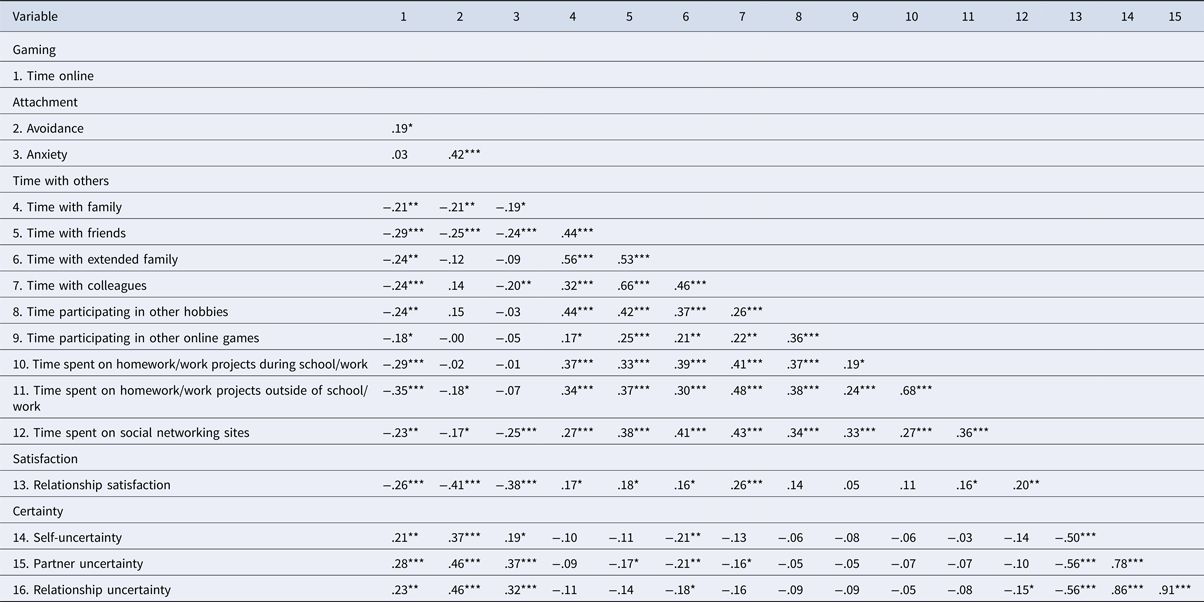
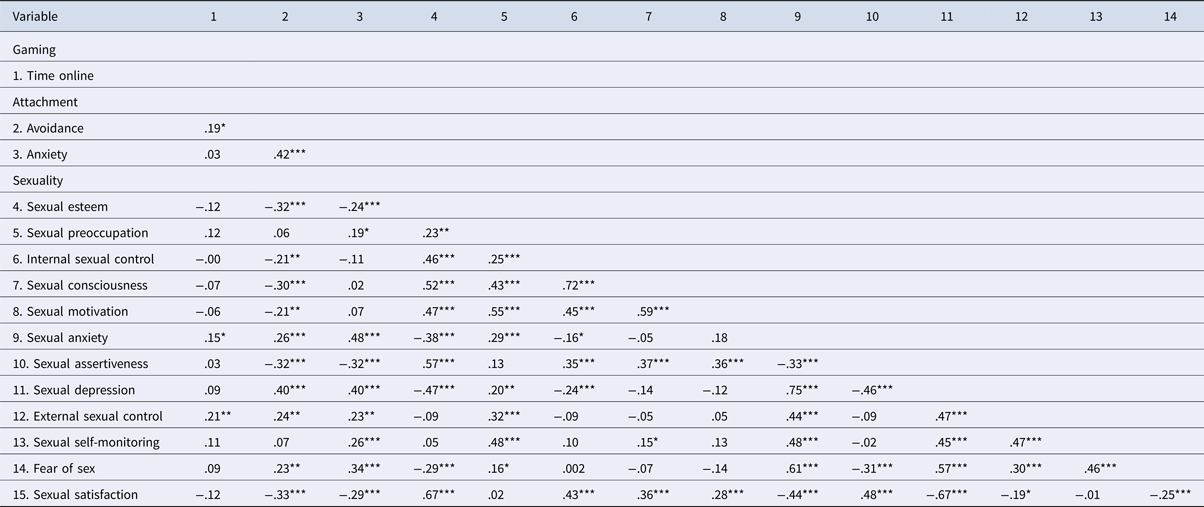
Table 1 displays the correlations between measures of gaming, relationship satisfaction, uncertainty, and attachment. Table 2 displays the correlations between measures of gaming, sexuality, and attachment. The procedures for mediational analyses (cf. Baron & Kenny, Reference Baron and Kenny1986; MacKinnon, Fairchild, & Fritz, Reference MacKinnon, Fairchild and Fritz2007) were followed to examine whether attachment avoidance accounted for the negative relationship outcomes reported by individuals spending large amounts of time playing GoW daily.
Correlations Between Time Spent Online Daily Playing GoW, Measures of Attachment, Measures of Time Spent with Others as a Result of GoW, Relationship Satisfaction, and Measures of Uncertainty

Note: N = 178.
*p < .05. **p < .01. ***p < .001.
Correlations Between Time Spent Online Daily Playing GoW, Measures of Attachment, and Measures of Sexuality

Note. N = 178
*p < .05. **p < .01. ***p < .001.
First, simple linear relationships were conducted to establish links between time playing GoW daily (in hours) and both relationship and sexuality outcomes. Time playing GoW online daily predicted less time with immediate family, β = -.21, t(172) = −2.76, p = .006, less time with friends, β = -.29, t(172) = −4.02, p < .001, less time with extended family, β = -.24, t(172) = −3.18, p = .002, less time with colleagues, β = -.24, t(172) = −3.25, p = .001, less time on hobbies, β = -.24, t(172) = −3.27, p = .001, less time playing other online games, β = -.18, t(172) = −2.42, p = .02, less time on homework or work projects during school or work, β = -.29, t(172) = −3.94, p < .001, less time on homework or work projects outside school or work, β = -.35, t(172) = −4.92, p < .001, and less time on social networking sites (e.g., Facebook or Twitter), β = -.21, t(172) = , p = .006. Time also predicted less relationship satisfaction, β = -.26, t(173) = −3.53, p = .001, more self-uncertainty, β = .21, t(174) = 2.76, p = .006, more partner uncertainty, β = .28, t(173) = 3.85, p < .001, and more relationship uncertainty, β = .23, t(173) = 3.03, p = .003. Finally, time predicted more sexual anxiety, β = .15, t(173) = 2.00, p = .05, and more external sexual control, β = .21, t(173) = 2.78, p = .006. There were no other significant effects.
Second, simple linear regressions were conducted to determine whether time (spent online daily) predicts attachment avoidance and attachment anxiety. Time predicted attachment avoidance (but not attachment anxiety), β = .19, t(176) = 2.49, p = .01, such that as time spent daily playing GoW increased, attachment avoidance increased.
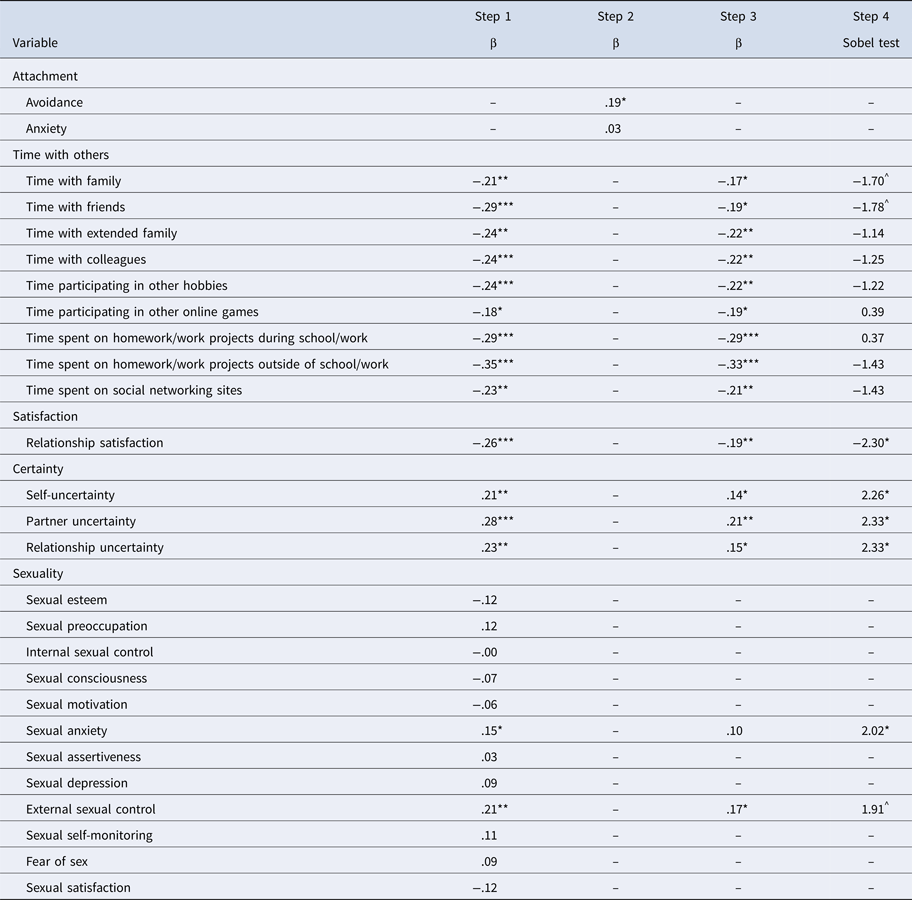
Third, multiple regressions were used to determine whether attachment avoidance (because time spent online daily predicted attachment avoidance but not attachment anxiety) predicts relationship and sexuality outcomes (for those outcomes originally predicted by time spent gaming) when time spent gaming is also included in the model. With the exception of sexual anxiety, time spent online still significantly predicted each relationship and sexuality outcome originally predicted (although many coefficients were subsequently reduced; see Table 3 for a summary).
Coefficients and Sobel Test Values for Regressions Measuring the Effects of Time Spent Online Daily Playing GoW on Measures of Time Spent With Others as a Result of GoW, Relationship Satisfaction, Measures of Uncertainty, and Measures of Sexuality With and Without Attachment Avoidance in the Regression Model

Note: N = 178
^p < .09. *p < .05. **p < .01. ***p < .001.
Finally, following the recommendations of Baron and Kenny (Reference Baron and Kenny1986), Sobel tests were conducted to test whether the indirect effect of time spent playing GoW daily on relationship outcomes (time spent with others, satisfaction, and uncertainty) through attachment avoidance is significantly different from zero (cf. Sobel, Reference Sobel and Leinhart1982. The Sobel tests were significant for relationship satisfaction (z = −2.30, p = .02), self-uncertainty (z = 2.26, p = .02), partner uncertainty (z = 2.33, p = .02), and relationship uncertainty (z = 2.33, p = .02). The Sobel tests were also significant for sexual anxiety (z = 2.02, p = .04). That is, attachment avoidance is a significant mediator of the links between time spent online gaming and relationship satisfaction; self-partner, and relationship uncertainty; and sexual anxiety.
Discussion
The purpose of the current study was to investigate attachment as a mediator of the link between participation in MMOs (specifically GoW) and relationship outcomes. The limited previous research in this area focused only on using attachment to predict motivations for and extent of involvement in offline and online gaming (Kowert & Oldmeadow, Reference Kowert and Oldmeadow2015). Results of the current study supported previous research; that is, the sample was disproportionately dismissing attached (compared to general samples of adults) and time spent playing online daily predicted level of attachment avoidance. The current study extends previous research as well. Specifically, the current study examined the role of attachment avoidance as a mediator in the link between time spent online playing GoW daily and both relationship and sexuality outcomes. That is, the current study adds to the literature by permitting examination of how attachment avoidance explains the link between online gaming and these outcomes, allowing for a more complete perspective of online gamers.
This study tested two major hypotheses. First, it was expected that time spent gaming would positively predict attachment avoidance (but not anxiety; cf. Kowert & Oldmeadow, Reference Kowert and Oldmeadow2015). Similarly, it was expected that time spent gaming would predict less time with others, lower relationship satisfaction, higher relationship uncertainty, higher sexual anxiety and depression, and lower sexual satisfaction. This hypothesis was mostly supported. Time spent gaming predicted less time with others, less relationship satisfaction, more relationship uncertainty, more sexual anxiety, and (unpredicted) more external sexual control.
It was also expected these links between time spend gaming and relationship and sexuality outcomes to be (at least partially) mediated by attachment avoidance. Again, this hypothesis was partially supported. Attachment avoidance partially mediated the relationship between time spent online gaming and relationship satisfaction; self-partner, and relationship uncertainty; and sexual anxiety.
These findings highlight the interdependent nature of online gaming relationships. It is worth noting that half of the players indicated a secure attachment style, which is associated with high levels of interpersonal trust, high levels of relationship and sexual quality, and positive evaluations of the self. In contrast, the larger than typical proportion of dismissing attached players begs the question regarding how online relationships developed by gamers high in attachment avoidance fulfill their interpersonal needs through the creation of online relationships. It may be easier to overcome their lack of interpersonal trust, which is essential in the establishment of relationship intimacy (Taylor & Altman, Reference Taylor, Altman, Roloff and Miller1987), in online formats in which there is a necessitated interpersonal distance inherent in the communication method of choice. In fact, individuals may choose to play online games to compensate for their own pre-existing interpersonal difficulties (Kowert, Vogelgesang, Festl, & Quandt, Reference Kowert, Vogelgesang, Festl and Quandt2015). Their attachment styles may also be represented in the behaviours of their avatars, such that for players high in attachment avoidance who understand little benefit in forming relationships with other players, high levels of intimacy and commitment — even within gaming relationships or team alliances — may be difficult to form (Coulson et al., Reference Coulson, Oskis and Gould2017).
Limitations and Future Directions
There are some limitations to the present study. First, it is important to note that although the current sample included participants from a single popular MMO game (Game of War: Fire Age) and were collected in-game by players trusted by other players as having a legitimate interest in the players and the game, the game still represents only one kingdom in one particular MMO and may not be generalisable to other players or games. Moreover, although consistent with other studies of online gamers, this study included a disproportionate number of men and women in the sample. Second, although preliminary measures of sexuality were included, time spent playing did not predict many dimensions of sexuality. Future studies should consider the possibility that gamers’ interest in sexual activity is no different from that of non-gamers; however, the specific interests and behaviours may vary as a result of time spent online gaming and/or attachment style (cf. Limke-McLean & Gayzur, Reference Limke-McLean and Gayzur2018). For example, it is possible that online gamers may prefer more overlap between their sexual fantasies and desires than non-online gamers do, which might suggest an inability to distinguish between schemas for online and offline behaviour.
Conclusions
The present research identifies attachment avoidance as a mediator of the link between time spent daily playing GoW and both relationship and sexuality outcomes. This is the first study to show that attachment avoidance (which includes a tendency to approach interpersonal relationships with distrust and withdrawal) can at least partially explain the negative outcomes associated with increased MMO game play. As such, these results may provide some insight regarding the potential effects of MMO game play.
Author Note
Alicia Limke-McLean is now at the Department of Psychology, University of Central Oklahoma. This research was supported in part by a Faculty Scholarship Support Grant by Southern Nazarene University.