1. Introduction
The question of how people mentally represent time and space has been a recurring theme to which cognitive scientists have devoted much work. Because the concept of time is not directly grounded on our physical experience, we may borrow spatial schemas to think about it (e.g., Boroditsky, Reference Boroditsky2000; Borodistky & Ramscar, Reference Boroditsky and Ramscar2002; Casasanto, Reference Casasanto, Evans and Chilton2010; Kövecses, Reference Kövecses2010; Lakoff & Johnson, Reference Lakoff and Johnson1980, Reference Lakoff and Johnson1999). We talk about time in terms of space, as in periods of time being long or events being ahead of us. Cross-linguistic data show that spatial metaphors to describe time are found in languages as diverse as English, Mandarin Chinese, Hindi, and Sesotho, among others, while temporal metaphors to describe space are much less frequent (Alverson, Reference Alverson1994; Kövecses, Reference Kövecses2010).
Linguistic expressions used to describe spatial motion are also imported into time, as when we say that a certain date is approaching or that a meeting has been moved forward. Interpreting spatial motion expressions in temporal statements involves adopting different frames of reference (Bender & Beller, Reference Bender and Beller2014; Boroditsky, Reference Boroditsky2000; Clark, Reference Clark and Moore1973). In the ego-moving perspective, we represent the individual moving across the timeline walking into the future (e.g., we are approaching the weekend), while in the time-moving perspective, we think about a static individual who is being ‘hit’ by the timeline – that is, events are represented as approaching the ego (e.g., the weekend is approaching). In a landmark study, Boroditsky (Reference Boroditsky2000) showed that prompting the activation of different frames of reference as spatial primes affected the way people thought about time. In contrast, temporal primes had no influence over spatial thinking.
Some studies have relied on psychophysical tasks containing no linguistic materials to show that spatial stimuli interfere significantly with temporal judgments, while temporal stimuli have no effect on spatial judgments (e.g., Casasanto & Boroditsky, Reference Casasanto and Boroditsky2008; Casasanto, Fotakopoulou, & Boroditsky, 2010; see Casasanto, Reference Casasanto, Evans and Chilton2010, for a review), suggesting that spatial and temporal mental representations are asymmetrically dependent, even in the absence of linguistic cues.
But although the same conceptual metaphor may exist in many languages, linguistic expressions may not be the same. Do specific language contingencies affect the ways people draw on competing frames of reference when thinking about time and space? Can temporal reasoning, when accessed through linguistic cues, influence subsequent spatial reasoning? One of the main findings in this paper is to answer these questions affirmatively in the case of Spanish.
Previous work has shown that language cues are important. As we gain linguistic experience, mental mappings could be adjusted according to patterns of language use. For example, in a comparative study between Greek and English speakers, Casasanto (Reference Casasanto, Evans and Chilton2010) showed that, although the asymmetric relationship showed up in both cases, the type of spatial stimuli that caused the most interference on temporal judgments was congruent with the linguistic metaphors most commonly used in the participants’ native language. Others have studied the interpretation of space/motion-metaphors to describe time, finding a fair amount of cross-linguistic variation in the way people engage in different frames of reference (e.g., Bender, Beller, & Bennardo, Reference Bender, Beller and Bennardo2010; Lai & Boroditsky, Reference Lai and Boroditsky2013; Rothe-Wulf, Beller, & Bender, Reference Rothe-Wulf, Beller and Bender2015).
Here we focus on the case of Spanish to show a phenomenon not previously observed in other languages: when certain spatial motion expressions are used in temporal sentences, different frames of reference are accessed, to the extent that they are able to prime subsequent spatial reasoning. We argue that the ego-moving or the time-moving perspectives are an integral part of the meaning conveyed by certain verbal forms in Spanish, concluding that the kind of representation accessed during metaphor processing, at least when accessed through linguistic cues, depends on the contingencies of the specific language medium.
1.1. interpreting temporal statements
Boroditsky and Ramscar (Reference Boroditsky and Ramscar2002) used ambiguous temporal questions in English to demonstrate that people use spatial information when adopting different spatial frames of reference. In the first study of their paper, they used spatial primes to get participants to think about themselves moving through space (ego-moving perspective) or making an office chair come towards them through space (object-moving perspective). Afterwards, participants were asked to solve an ambiguous temporal statement – namely Next Wednesday’s meeting has been moved forward 2 days. What day is the meeting now that it has been rescheduled? People primed to adopt an ego-moving spatial schema answered Friday more often, while those primed to think in terms of an object moving towards them answered Monday more often.
It has been argued that the locus of the ambiguity in English might be the expression move forward, which can be interpreted either as indicating the direction of motion of the ego through time or as indicating the direction of motion of time towards the ego (Boroditsky Reference Boroditsky2000; Kranjec & McDonough, Reference Kranjec and McDonough2011). Recently, Feist and Duffy (Reference Feist and Duffy2015) looked at responses to the ambiguous Next Wednesday’s meeting question to explore the role of linguistic factors in the interpretation of temporal statements. They examined a series of linguistic properties of this ambiguous utterance, finding that varying individual lexical items – using different verbs such as pull, bring, push, or carry, or adverbs such as forward and backward – constrain the way people interpret metaphorical statements about time. Moreover, they found that grammatical person, but not grammatical voice, also influences the interpretation. This suggests that linguistic cues are key to the interpretation of temporal metaphors.
Others have explored the relation between spatial frames of reference and temporal reasoning in different languages, including German, Chinese, Tongan, and Swedish (e.g., Bender, Beller, & Bennardo, Reference Bender, Beller and Bennardo2010; Lai & Boroditsky, Reference Lai and Boroditsky2013; Rothe-Wulf et al., Reference Rothe-Wulf, Beller and Bender2015), finding interesting culture-specific preferences and cross-linguistic variation that highlights the importance of the language medium. In particular, the extent to which temporal reference phrases such as ‘moving a meeting forward’ is considered ambiguous by individual speakers varies from language to language (Rothe-Wulf et al., Reference Rothe-Wulf, Beller and Bender2015).
Spanish provides an interesting case study to further explore this issue. The expression move forward can be translated into Spanish in two ways: (a) mover hacia adelante and (b) adelantar – that is, the verbalization of the adverb adelante ‘ahead’. In Spanish, however, the choice between adelantar and mover hacia adelante directly affects how people interpret statements about time. We first conduct a corpus analysis of Latin American Castilian to explore how these expressions are used. To preview, the data show that the expressions mover hacia adelante and adelantar occur in association with different frames of reference depending on whether they are used to describe time or space. When used in temporal sentences, the ego-moving and time-moving perspectives are associated with the expressions adelantar and mover hacia adelante, respectively. We then conduct a series of experiments. Experiment 1 and 2 show that the choice between perspectives (ego-moving/time-moving) differs significantly depending on which of the expressions (mover hacia adelante / adelantar) is used, showing that, unlike the case of English, these verbs are not neutral with respect to frames of reference. Second, we show that when these expressions are used in temporal sentences they are able to bias the interpretation of spatial ambiguities (Experiment 3).
2. Corpus analysis
We used the CREA corpus of Spanish (Real Academia Español, 2012), which contains over 160 million words of written texts (90%) and oral transcriptions (10%) from Spain and Latin American countries. Since our experiments were conducted in Colombia, we restricted our search to data from Colombia and its four Spanish-speaking bordering countries: Perú, Venezuela, Ecuador, and Panamá. We retrieved all sentences containing the expressions adelantar or the formula ‘VERB (V) + hacia adelante’. Phrases were then classified according to whether the target items were used to describe space or time, or had any other metaphorical meaning. Expressions used to describe time or space were classified into three categories: (i) ego-moving, (ii) time-/object-moving, and (iii) ambiguous (if the information provided was not sufficient to decide between an ego-moving and object-/time-moving interpretation).
When the target expressions were used to describe time, contextual information was taken into account to determine whether they were used to describe frames of reference consistent with ego-moving or time-moving perspectives. For example, the sentence the meeting planned for tomorrow afternoon has been moved forward to tomorrow morning would be classified as time-moving. If the target expression was used to describe fictive motion towards events located in the future, the expression was classified as ego-moving, because these cases were considered as instances of the ‘arrow of time’ metaphor which conveys directedness from the past to the future, the latter located in front of the ego (Bender & Beller, Reference Bender and Beller2014). For example, a sentence such as Let´s move forward to the next stages of life would be classified as ego-moving.
When the target expressions were used to describe space, we also used the contextual information for coding. Descriptions were coded ambiguous unless the information in the immediate discourse allowed interpretation. The speaker was taken as the point of departure of motion when the first grammatical person was used and the action was instantiated by the speaker (for discussion on the use of grammatical person in metaphorical temporal statements, see Feist & Duffy, Reference Feist and Duffy2015). For example, the phrase I moved my cup forward was coded as ego-moving. Additionally, descriptions of movement of the speaker’s body parts, such as I’m moving my head forward, were counted as instances of the ego-moving. When the second grammatical person was used, and the action was performed by the addressed person, the speaker was taken as the point of arrival of movement. For example the phrase You moved your cup forward was coded as object-moving. When the third grammatical person was used, the thematic grammatical agent of the sentence was considered as a point of reference when the direction of movement could be inferred from the context. Then, for example, the sentence John moved his mug forward towards his nose would be considered object-moving, while John moved his nose forward would be considered ego-moving. In most cases, however, the context was not sufficient for interpretation. For example, the utterance John moved the chip forward would be coded ambiguous because the direction of movement is not inferable from the description.
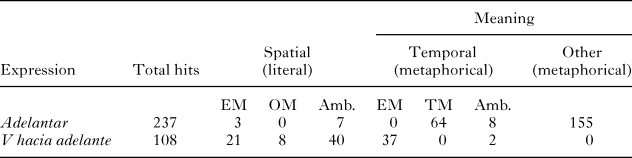
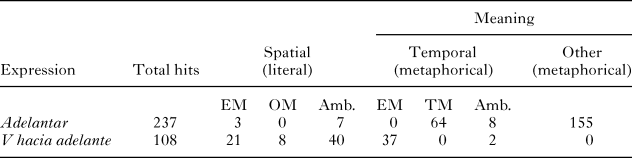
Results are displayed in Table 1. A total of 237 sentences containing the word adelantar were retrieved (117 cases distributed over 83 documents from Colombia, 4 cases in 4 documents from Ecuador, 6 cases in 5 documents from Panamá, 77 cases in 69 documents from Venezuela, and 33 cases in 25 documents from Perú). Among these, 72 (30.4%) described time, 10 (4.2%) described space, and 155 (65.4%) had a different metaphorical meaning.
Results from the corpus analysis
notes: EM = ego-moving schema; OM = object-moving schema; TM = time-moving schema; Amb. = ambiguous schema.
A total of 108 sentences containing the form V hacia adelante were retrieved (32 cases distributed over 21 documents from Colombia, 12 cases in 8 documents from Ecuador, 5 cases in 4 documents from Panamá, 33 cases in 28 documents from Venezuela, and 25 cases in 17 documents from Perú). Among these, 39 (36.1%) described time and 69 (63.9%) described space.
Among the expressions where adelantar was used in reference to time, 64 of them were tagged as time-moving and 8 as ambiguous (χ 2 (1, N = 72) = 43.65; p < .0001), and among those used in reference to space, 3 were tagged as ego-moving and 7 as ambiguous (n.s.). Among the 39 sentences where V hacia adelante was used in reference to time, 37 of them were tagged as ego-moving, and 2 as ambiguous (χ2(1, N = 39) = 31.41; p < .0001), and among the 69 spatial sentences, 21 were tagged as ego-moving, 8 were tagged as object-moving, and 40 as ambiguous (χ2(2, N = 69) = 22.5; p < .0001).
In temporal contexts, the metaphorical expression adelantar is used more often to refer to events moving in time towards the ego, while the formula ‘VERB hacia adelante’ is used more often to refer to the ego moving along the timeline. In fact, in the Latin American Castilian sample analyzed here, adelantar in mainly used metaphorically. Since the number of examples of the literal (spatial) use of adelantar is reduced, it is not clear whether there is a preference for a particular frame of reference in spatial contexts.
The patterns of use of adelantar are likely to depend on dialect. For example, in Spanish Castilian, adelantar is commonly used in spatial contexts to refer certain actions such as a car overtaking, Footnote 1 while other terms are more frequently used in Latin American Castilian for the same purpose. In fact, metaphorical uses of adelantar are extremely frequent in this sample, most of them not even temporal, as in, for example, using adelantar to convey the act of speaking.
In sum, the corpus data suggests that ‘move forward’ expressions in Spanish are significantly associated with different frames of reference (ego-/time-moving and ego-/object-moving) depending on whether they are used metaphorically to describe time or literally to describe space. Now we turn to the question of whether the choice between adelantar and mover hacia adelante affects how people interpret temporal statements.
Experiments 1 and 2 show that the verbal expression in temporal statements determines the frame of reference adopted in comprehension. But, in addition to the overwhelming effect of language, Experiment 2 shows that spatial schemas are able to prime temporal interpretation as well, as in Boroditsky and Ramscar (Reference Boroditsky and Ramscar2002). Then, on the basis that different frames of reference constitute an integral part of the verbs’ meaning, Experiment 3 explores whether their use in temporal statements activates ego-/time-moving perspectives, to the extent to prime spatial reasoning.
3. Experiment 1
Experiment 1 was designed to explore how temporal statements are interpreted when the expressions adelantar and mover hacia adelante are used. We asked participants to interpret temporal statements in Spanish based on Boroditsky and Ramscar’s (Reference Boroditsky and Ramscar2002) original question: Next Wednesday’s meeting has been moved forward two days. What day is the meeting now that it has been rescheduled? The expression move forward was translated either as adelantar (condition 1) or as mover hacia adelante (condition 2). In Spanish, the question used in our study read as follows: La reunión del próximo miércoles ha sido [adelantada / movida hacia adelante] dos días. ¿Qué día será la reunión ahora que ha sido reprogramada?
3.1. method
3.1.1. Participants
Sixty-four students (35 male, 29 female) from the Universidad de Los Andes and the Universidad Nacional de Colombia, all native Spanish speakers, voluntarily completed a one-page questionnaire.
3.1.2. Materials and procedure
Two types of paper questionnaires were created and counterbalanced across subjects: one consisted of the question phrased using the expression adelantar (condition 1), and the second one consisted of the question phrased using the expression mover hacia adelante (condition 2). Participants were asked to answer the question in writing and to provide the first answer that crossed their mind.
3.1.3. Results and discussion
Among the 32 participants exposed to the adelantar version of the question, 30 of them (93.8%) answered lunes ‘Monday’, while 2 of them (6.2%) answered viernes ‘Friday’. Conversely, among the 32 participants exposed to the mover hacia adelante version of the question, 6 of them (18.8%) answered lunes, while 26 of them (81.2%) answered viernes. The difference between conditions was highly significant (χ2 (1, N = 64) = 33.58; p < .0001).
The results align with the patterns of use revealed by the corpus analysis. When participants are asked to answer temporal questions about an event moving in time, the use of the expression adelantar is more often interpreted as the event moving in time towards the ego (consistent with the time-moving perspective), while the expression mover hacia adelante is more often interpreted as the ego-moving perspective.
Next we explore space–time priming effects in the presence of these verbs that are not neutral to frames of reference.
4. Experiment 2
Experiment 2 was a modified version of Study 1 in Boroditsky and Ramscar (Reference Boroditsky and Ramscar2002). We aimed to investigate whether spatial primes affect the interpretations of temporal statements in Spanish. We used similar spatial primes as those used in Boroditsky and Ramscar, followed by a translation to Spanish of the temporal question used in the original study. As in Experiment 1, the expression move forward was translated either as adelantar or as mover hacia adelante – expressions that, as shown, are not neutral to spatial motion perspectives. Under these conditions we ask whether spatial primes are still able to constrain temporal interpretation.
The experiment was a two-factorial (‘move forward’ wording type and spatial prime schema type) fully crossed between participants design. The first factor was the move forward translation used in the temporal question (adelantar vs. mover hacia adelante). Similar to Experiment 1, the temporal statement used in our study was the following: La reunión del próximo miércoles ha sido [adelantada / movida hacia adelante] dos días. ¿Qué día será la reunión ahora que ha sido reprogramada?
The two levels of the second factor – spatial prime schema type – were ego-moving and object-moving schema primes. Similar to Boroditsky and Ramscar (Reference Boroditsky and Ramscar2002), spatial primes were designed to get people to think about themselves moving through space in an office chair (ego-moving prime) or making an office chair come towards them through space (object-moving prime).
4.1. method
4.1.1. Participants
One hundred and eight undergraduate (42 male, 66 female) students from the Universidad de Los Andes and the Universidad Nacional de Colombia, all native Spanish speakers, voluntarily completed a two-page questionnaire.
4.1.2. Materials and procedure
Four types of questionnaires were created (adelantar / ego-moving prime; adelantar / object-moving prime; mover hacia adelante / ego-moving prime; mover hacia adelante / object-moving prime). Conditions were counterbalanced across subjects. The first page of the questionnaire depicted the spatial prime, which was similar to the one used in Boroditsky and Ramscar (Reference Boroditsky and Ramscar2002). In the ego-moving prime condition, participants were exposed to a drawing of a man sitting on a chair on one end of a track. An X was drawn on the opposite end of the track. Participants were instructed to imagine they were the man on the picture maneuvering the chair towards the X. They were instructed to draw an arrow indicating the path of motion. In the object-moving prime condition, participants were exposed to a drawing of a man next to an X, on one end of a track. The man holds a rope attached to a chair on the opposite end of the track. Participants were instructed to imagine that, with the rope, they had to maneuver the chair towards the X (that is, towards them). They were also instructed to draw an arrow indicating the path of the motion. The left–right orientation of the spatial primes was counterbalanced. In the second page of the questionnaire they were asked the question in one of the two wording conditions (‘move forward’ translated either as adelantar or as mover hacia adelante).
4.1.3. Results and discussion
Eight questionnaires were excluded from the analysis because participants either failed to complete the first page or provided nonsensical responses to the question (e.g., ‘Wednesday’), leaving a final sample of 100 participants: 48 in the adelantar condition (24 exposed to the ego-moving spatial prime and 24 to the object-moving spatial prime) and 52 in the mover hacia adelante condition (27 exposed to the ego-moving spatial prime and 25 to the time-moving spatial prime).
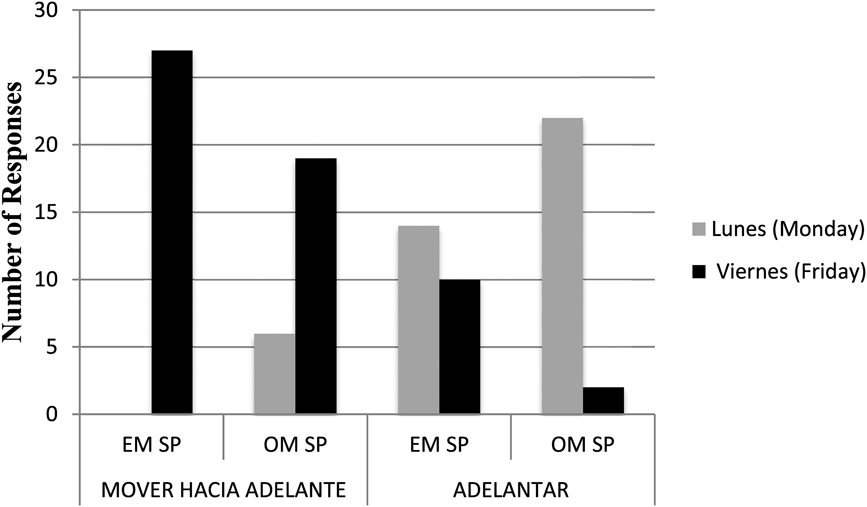
Results are summarized in Figure 1. Of the 24 participants in the adelantar / ego-moving prime condition, 10 (42%) responded viernes ‘Friday’ and 14 (58%) responded lunes ‘Monday’. From the 24 participants in the adelantar / object-moving prime condition, 2 of them (8%) responded viernes and 22 (92%) responded lunes. All participants in the mover hacia adelante / ego-moving prime condition responded viernes, and in the mover hacia adelante / object-moving prime condition, 19 (76%) responded viernes and 6 (24%) responded lunes.
Number of lunes ‘Monday’ and viernes ‘Friday’ responses shown as a function of the experimental condition. EM = Ego Moving; OM = Object Moving; SP = Spatial Prime.

As illustrated in Figure 1, participants showed a clear tendency toward responding lunes ‘Monday’ in the adelantar wording condition (75%), while in the mover hacia adelante wording condition most people responded viernes ‘Friday’ (88.5%) (χ2 (1, N = 100) = 38.7; p < .0001). A three-way contingency table analysis confirmed that the effect of wording type was significant, both among participants grouped by ego-moving prime questionnaires (χ2 (1, N = 51) = 18.9; p < .0001) and object-moving prime questionnaires (χ2 (1, N = 49) = 20.2; p < .0001). But there was also a significant effect of spatial schema primes on responses when controlling for the wording of the statement. As shown by the three-way contingency table analysis, the effect of spatial primes was significant among the pool of participants filling adelantar condition questionnaires (χ2 (1, N = 48) = 5.1; p = .017), as well as among participants filling questionnaires in the mover hacia adelante condition (χ2 (1, N = 52) = 5.44; p = .009).
Taken together, the results are twofold. First, consistent with the findings of Experiment 1, using adelantar in the probe question biases participants toward responding lunes ‘Monday’, while using mover hacia adelante biases responses toward viernes ‘Friday’, showing that the Next Wednesday’s meeting question in Spanish is not ambiguous or neutral, as is the case in English. The wording itself elicits one or the other frame of reference.
Besides the overwhelming effect of language, the spatial schema prime type still influences the way people interpret temporal questions in Spanish. The results then contribute to the accumulating cross-linguistic evidence that spatial information interferes with temporal judgments. The interpretation of adelantar appears to be more affected by the priming stimuli than the interpretation of mover hacia adelante. One reason for this could be that the semantic spectrum of the expression adelantar is quite broad. It is used to convey different metaphorical meanings in discourse, most of them referenced to non-temporal concepts. In fact, the corpus analysis revealed that the expression was used in temporal or spatial contexts less than 40% of the time.
5. Experiment 3
Previous work showed that thinking about time does not affect the solution of spatial ambiguities (e.g., Boroditsky, Reference Boroditsky2000). However, in English, motion verbs in space–time metaphors are ambiguous, while in Spanish they are not. So, it could be the case that, when accessed through non-neutral verbs, perspectives adopted during the processing of temporal statements constrain subsequent spatial reasoning. Experiment 3 was designed to assess this possibility.
5.1. experiment 3a
The priming stimuli were statements about time that were congruent with either ego-moving or time-moving perspectives. Crucially, temporal situations consistent with ego-moving perspective were described using the expression mover hacia adelante to convey ‘move forward in time’, while those consistent with time-moving perspective were described using the expression adelantar to also mean ‘move forward in time’. Participants were exposed to a series of sentences describing temporal situations and afterwards they were asked to solve an ambiguous question about space.
5.1.1. Participants
One hundred and twenty (55 male, 65 female) undergraduate students from the Universidad de Los Andes and the Universidad Nacional de Colombia, all native Spanish speakers, voluntarily completed a two-page questionnaire.
5.1.2. Materials and procedure
Two types of questionnaires were created, corresponding to the ego-moving and time-moving schema primes. Conditions were counterbalanced across subjects. The first page of the survey included the primes consisting of a set of four statements describing temporal situations, each followed by a comprehension question. The following are examples of the stimuli used (a complete description of materials is shown in the ‘Appendix’):
-
(1) Ego-moving temporal schema prime condition:
La reunión del próximo miércoles ha sido movida hacia adelante de modo que será el viernes de la misma semana.’
‘Next Wednesday´s meeting has been moved forward so it will take place on Friday of the same week.’
-
(2) Time-moving temporal schema prime condition:
La reunión del próximo miércoles ha sido adelantada de modo que será el lunes de la misma semana.
‘Next Wednesday’s meeting has been moved forward so it will take place on Monday of the same week.’
Statements in both conditions were followed by the same comprehension question: “How many days are there between the initial and final schedules?” The purpose of this question was to ensure that the participants read the statement carefully and engaged in thinking about time. However, the question did not prompt either of the two frames of reference. The other three additional prime statements were similar to the examples above but differed in that months, years, and hours were used as time units (instead of days), and a contest, a talk, and a conference were used as events (instead of a meeting). Previous work has shown that the valence of the event being moved in time influences the interpretation of temporal statements: negative events are more likely to be reported using the ego-moving perspective (as in the event departing from the person), compared to positive events (Lee & Ji, Reference Lee and Ji2014; Margolies & Crawford, Reference Margolies and Crawford2008). However, the events used in the materials are not particularly positive or negative in valence and, more importantly, they are the same in both conditions.
Temporal statements depicting ego-moving scenarios consistently contained the expression mover hacia adelante, and those depicting time-moving scenarios consistently included the expression adelantar, to convey ‘move forward in time’. Thus, the statements were consistent with the patterns of use revealed in the corpus analysis and also with the results of Experiments 1 and 2.
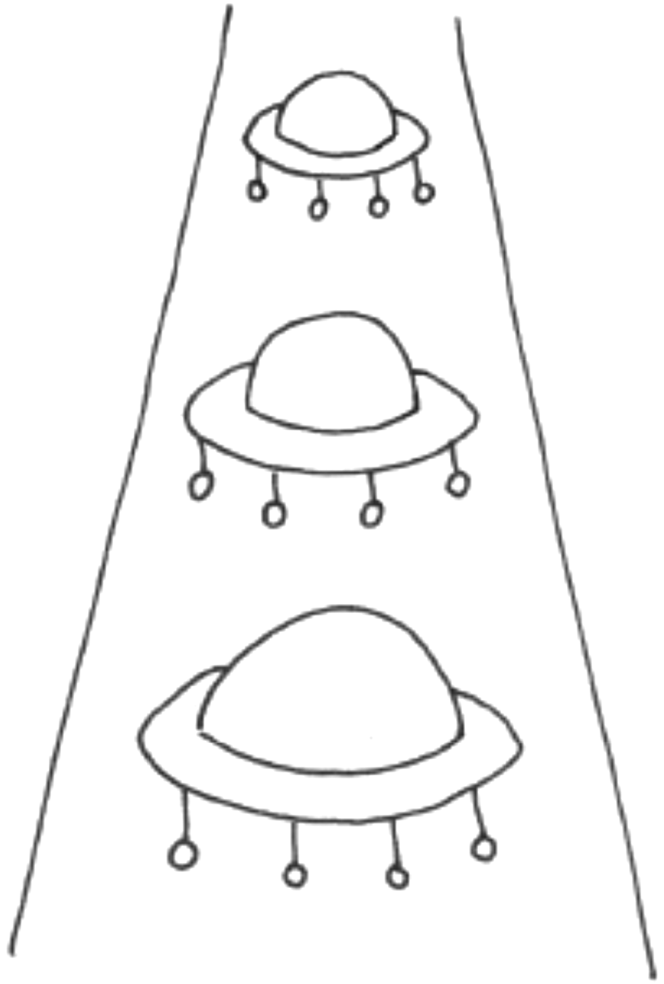
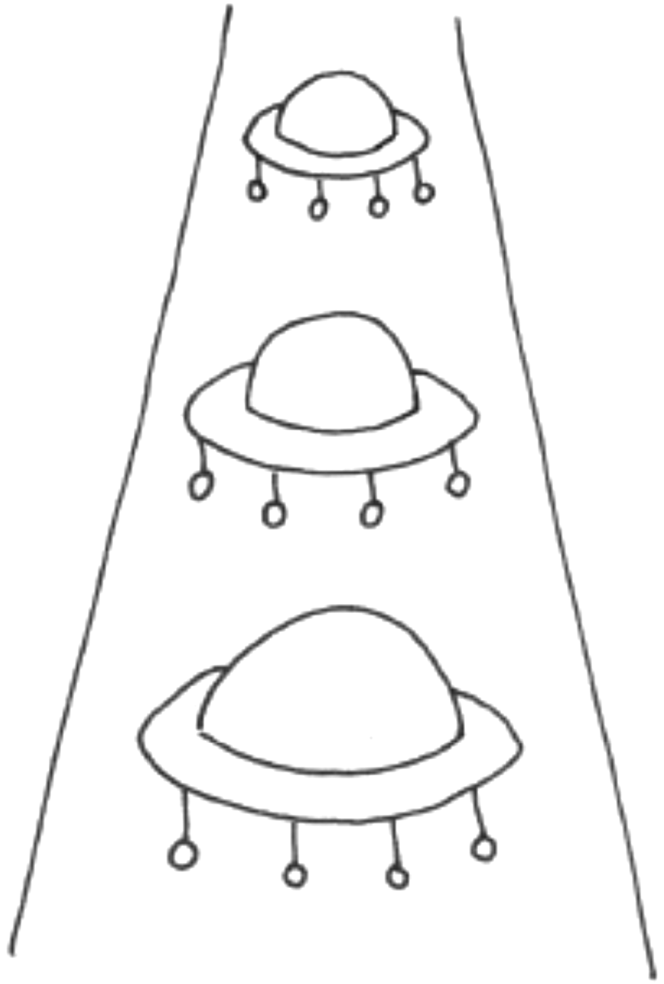
Participants were instructed to turn the page after reading the four temporal statements and to answer the comprehension questions. On the second page of the questionnaire they were asked to solve an ambiguous spatial task. Similar to Boroditsky (Reference Boroditsky2000), participants were exposed to a hand-made drawing of three equal widgets that were arranged from closest to farthest. The widget on top of the drawing was significantly smaller than the widget at the bottom, while the middle widget was intermediate in size (see Figure 2). Participants answered the following ambiguous question, written below the figure: ¿Cuál de los artefactos está adelante?(Márquelo con un círculo). This is a translation of the ambiguous spatial question used in Study 2 in Boroditsky (Reference Boroditsky2000): Which one of the widgets is ahead?(Please circle one). The intrinsic properties of the widgets did not afford participants to infer the ‘aheadness’ of the widgets, forcing them to adopt either an ego-moving perspective or object-moving perspective to solve the task.
Ambiguous spatial target used in Experiment 3A.
5.1.3. Results and discussion
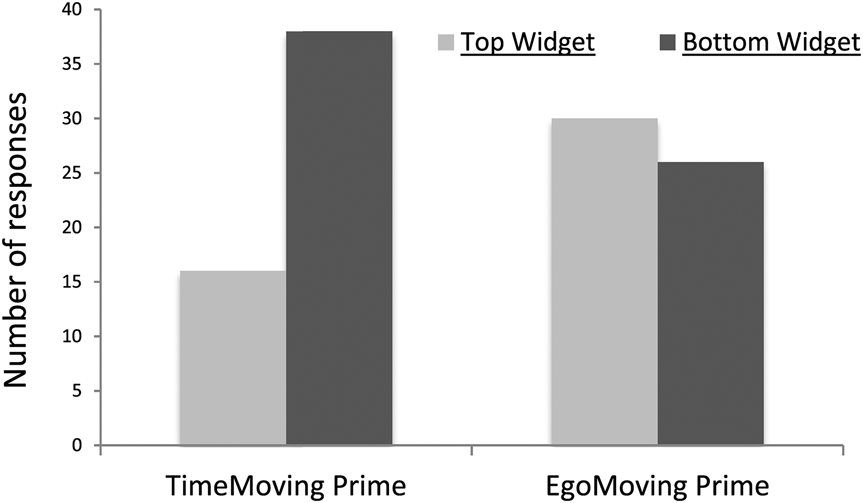
Ten questionnaires were removed from the sample either because participants failed to complete the first page or because they provided atypical responses (e.g., circling the middle widget), leaving a final sample of 110 responses. From these, 54 corresponded to the time-moving prime condition and 56 to the ego-moving prime condition. Results are summarized in Figure 3. Of the 54 participants who were exposed to the time-moving prime condition, 38 (70%) said that the bottom widget was ahead and 16 (30%) chose the one on top. On the other hand, of the 56 participants in the ego-moving prime condition, 26 (47%) said the bottom widget was ahead and 30 (53%) said the top widget was ahead. The difference across conditions was significant (χ2 (1, N = 110) = 5.5; p = .018), suggesting that people’s responses were constrained by the priming stimuli.
Results from Experiment 3A.

These findings suggest that spatial frames of reference are part of the extension of the verbs’ meaning when they are used in temporal sentences, to the extent that they are able to bias spatial reasoning. This contrasts sharply with the case of English, where motion verbs are neutral with respect to frames of reference.
We argue that the time–space priming effect observed here is contingent on the use of linguistic metaphors. But another interpretation could be that thinking about time per se constrains spatial interpretations, suggesting a direct transfer from the time domain to the space domain, regardless of the linguistic cues at play. To shed light on this matter, we explore whether the results of Experiment 3A would replicate when the temporal primes contain no metaphorical expressions as part of their wording. Control Experiment 3B was designed to do this.
5.2. experiment 3b
Experiment 3B was identical to Experiment 3A except for the wording of the temporal statements used as primes. The aim of this study was to explore whether the results of Experiment 3A do replicate when the priming materials contain no metaphorical expressions to describe the temporal situations.
5.2.1. Participants
One hundred and seventy-six undergraduate students from the Universidad de Los Andes and the Universidad Nacional de Colombia, all native Spanish speakers, voluntarily completed a two-page questionnaire.
5.2.2. Materials and procedure
Two types of questionnaires were created and counterbalanced across subjects. Similar to Experiment 2, questionnaires corresponded either to the ego-moving prime condition or the time-moving prime condition. The first page of the questionnaire included the temporal prime consisting of a set of four temporal statements describing temporal scenarios, each followed by a comprehension question. Unlike Experiment 3A, the temporal statements included no metaphorical expressions. The following is an example (see ‘Appendix’ for listing of all materials of Experiment 3):
-
(3) Ego-moving / time-moving schema prime conditions:
La reunión del próximo miércoles ha sido reprogramada de modo que será el [viernes/lunes] de la misma semana.
‘Next Wednesday´s meeting has been rescheduled so it will take place on Friday/Monday on the same week.’
The additional three statements were the same as in Experiment 3A, but differed in that the expressions adelantar and mover hacia adelante were replaced by the verb reprogramar ‘reschedule’ in both the ego-moving and time-moving prime conditions, as in the example above. All statements were followed by the same comprehension questions as in Experiment 3A. The procedure as well as the spatial target shown on the second page of the survey was the same as in Experiment 3A.
5.2.3. Results and discussion
Five atypical responses were excluded from the analysis, leaving a final sample of 171 responses, 85 in the time-moving prime condition and 86 in the ego-moving prime condition. Among participants exposed to the time-moving prime condition, 46 (54%) said that the bottom widget was ahead, while 39 (46%) chose the one on top. Similarly, among participants in the ego-moving prime condition, 44 (51%) said the bottom widget was ahead and 42 (49%) said the top widget was ahead. A chi-square analysis showed no significant difference across conditions (χ2 (1, N = 171); p > .8; n.s.), suggesting that simply entertaining different temporal frames of reference might not be sufficient to constrain the interpretation of subsequent spatial ambiguities. This indicates that, when linguistic cues are absent, transfer from temporal primes to spatial targets fails to occur, suggesting that the effect observed in Experiment 3A depends on the salience of the metaphorical expressions.
6. General discussion
The same metaphor can be expressed differently depending on dialect and culture. The main contribution of this paper is to show that the singularities of language, in particular the way meaning is conveyed through individual expressions, have a pivotal role on the inferential structure derived from mental metaphors.
Our main findings can be summarized as follows. ‘Move forward’ expressions used in space–time metaphors in Spanish are not ambiguous with respect to frames of reference, in a manner consistent with their patterns of use. These verbal forms in temporal sentences prompts the activation of the ego-moving and time-moving perspectives during temporal reasoning, to the extent that they are able to bias subsequent interpretation of ambiguous spatial targets. Crucially, such effect is contingent on the mediation of linguistic cues: when a neutral expression (‘reschedule’) is used to convey temporal frames of reference, the priming effect on spatial reasoning does not occur (Experiment 3B). Thus, our results are still consistent with the asymmetric space–time interference pattern typically found in a number of studies (e.g., Boroditsky, Reference Boroditsky2000, see Casasanto, Reference Casasanto, Evans and Chilton2010, for a review), at least when neutral language (or no language) is used to covey temporal reasoning as primes.
Overall, the data presented here align with previous work showing a great deal of cross-linguistic variability in the interpretation of space–time metaphors (e.g., Bender, Beller, & Bennardo, Reference Bender, Beller and Bennardo2010; Rothe-Wulf et al., Reference Rothe-Wulf, Beller and Bender2015). For example, Rothe-Wulf et al. (Reference Rothe-Wulf, Beller and Bender2015) explored the extent to which temporal statements such as ‘moving a meeting forward’ are considered ambiguous by individual speakers of English, German, and Swedish. They found both intra- and cross-linguistic variability, consistency, and long-term stability of the individual preferences for temporal frames of reference. Along these lines, our data show that ‘move forward’ expressions in Spanish are far from being perspective-neutral, contrasting with the case of English, where roughly one half of the speakers solve this phrase by moving the meeting “futurewards”, and the other half “pastwards” (Boroditsky & Ramscar, Reference Boroditsky and Ramscar2002).
Finally, the findings in this paper are also significant for understanding the nature of metaphorical reasoning beyond the question of language-specific effects. Experiment 2 is another example of the psychological reality of the spatial schemas underlying the TIME IS SPACE metaphor: the results in Boroditsky and Ramscar (Reference Boroditsky and Ramscar2002) do replicate even under conditions of heavy linguistic constraints. That is, on top of the overwhelming effect of language, the spatial schema primes still exerted some influence on how participants interpreted temporal questions.
To conclude, although the same metaphor – the same mapping between source (space) and target (time) domains – may exist in many languages, the corresponding linguistic expressions of the metaphor may not be identical. Importantly, the singularities of different languages constrain the ways in which we draw on competing frames of reference when thinking about time and space. We conclude that the relation between space and time, at least when accessed through linguistic cues, may depend on the realities and nature of the language medium.
APPENDIX
Priming materials used in Experiment 2
-
(1)
-
a. Ego-moving temporal schema prime condition:
La reunión del próximo miércoles ha sido movida hacia adelante de modo que será el viernes de la misma semana.
‘Next Wednesday’s meeting has been moved forward so it will take place on Friday of the same week.’
-
b. Time-moving temporal schema prime condition:
La reunión del próximo miércoles ha sido adelantada de modo que será el lunes de la misma semana.
‘Next Wednesday’s meeting has been moved forward so it will take place on Monday of the same week.’
-
-
(2)
-
a. Ego-moving temporal schema prime condition:
El concurso planeado para el mes de Septiembre ha sido movido hacia adelante de modo que será en Diciembre del mismo año.
‘The contest originally planned for September has been moved forward so that it will take place on December of the same year.’
-
b. Time-moving temporal schema prime condition:
El concurso planeado para el mes de Septiembre ha sido adelantada de modo que será en Julio del mismo año.
‘The contest originally planned for September has been moved forward so that it will take place on July of the same year.’
-
-
(3)
-
a. Ego-moving temporal schema prime condition:
La charla anunciada para las 2pm ha sido movida hacia adelante de modo que será a las 6pm del mismo día.
‘The talk announced for 2pm has been moved forward to 6pm on the same day.’
-
b. Time-moving temporal schema prime condition:
La charla anunciada para las 2pm ha sido adelantada de modo que será a las 10am del mismo día.
‘The talk announced for 2pm has been moved forward to 10am on the same day.’
-
-
(4)
-
a. Ego-moving temporal schema prime condition:
El congreso planeado para el año 2015 ha sido movida hacia adelante de modo que será en el año 2016.
‘The conference meeting planned for the year 2015 has been moved forward so that it will take place in 2016.’
-
b. Time-moving temporal schema prime condition:
El congreso planeado para el año 2015 ha sido adelantada de modo que será en el año 2014.
‘The conference meeting planned for the year 2015 has been moved forward so that it will take place in 2014.’
-