

Introduction
The Asian citrus psyllid (ACP) Diaphorina citri Kuwayama (Hemiptera: Psyllidae) is one of the most destructive insect pests in citriculture worldwide (Bellis et al., Reference Bellis, Hollis and Jacobson2005). The ACP feeds on the citrus plant by sucking the sap in younger buds and leaves. It is also an efficient vector of three plant pathogenic proteobacteria: ‘Candidatus Liberibacter asiaticus’ (Las), ‘Ca. L. africanus’ (Laf) and ‘Ca. L. americanus’ (Lam), as characterized by Batool et al. (Reference Batool, Iftikhar, Mughal, Khan and Jaskani2007). They are the causal agents of the ‘huanglongbing’ (HLB) disease or ‘greening’ or ‘yellow dragon’ disease (Subandiyah et al., Reference Subandiyah, Nikoh, Tsuyumu, Somowiyarjo and Fukatsu2000).
The infected citrus trees can live 5–8 years, but they produce deformed, unmarketable fruits with a yellow-white colour and bitter flavour (Bové, Reference Bové2006). The ACP is most often controlled using synthetic pesticides (Halbert and Manjunath, Reference Halbert and Manjunath2004); however, the excessive use of pesticides is affecting its natural enemies that may otherwise contribute to its control (McFarland and Hoy, Reference McFarland and Hoy2001). Intensive insecticidal control programmes are often economically unsustainable for the growers and will probably interfere with biological control programmes, e.g. in Florida citrus (Michaud and Grant, Reference Michaud and Grant2003). Lacey and Shapiro-Ilan (Reference Lacey and Shapiro-Ilan2008) highlighted that growing concerns about the negative effects of synthetic insecticides on workers, food supply and the environment make the microbial control of arthropod pests of tree fruit crops an attractive alternative.
The ACP has several arthropod enemies such as the eulophid parasitoid Tamarixia radiata (Waterston) and the coccinellid predatory beetles Olla v-nigrum (Mulsant) and Harmonia axyridis (Pallas) (Skelley and Hoy, Reference Skelley and Hoy2004; Grafton-Cardwell et al., Reference Grafton-Cardwell, Godfrey, Rogers, Childers and Stansly2006). Some species of entomopathogenic fungi have been reported to naturally attack the ACP: Paecilomyces fumosoroseus (Wize) ( = Isaria fumosorosea) (Subandiyah et al., Reference Subandiyah, Nikoh, Tsuyumu, Somowiyarjo and Fukatsu2000); Hirsutella citriformis Speare (Étienne et al., Reference Étienne, Quilici, Marival and Franck2001); Cephalosporium lecanii Zimm. ( = Verticillium lecanii = Lecanicillium lecanii); Beauveria bassiana (Bals.) Vuill. ( = Cordyceps bassiana) (Rivero-Aragón and Grillo-Ravelo, Reference Rivero-Aragón and Grillo-Ravelo2000); and Cladosporium oxysporum Berk. & M. A. Curtis (Aubert, Reference Aubert1987). Under laboratory conditions, H. citriformis is able to induce 100% mortality in adults (Meyer et al., Reference Meyer, Hoy and Boucias2007). The fungi Metarhizium anisopliae (Metsch.) Sor., C. bassiana and I. fumosorosea are well-known biological control agents. However, little is known on the effectiveness of entomopathogenic fungi in reducing D. citri nymph and adult densities under field conditions. Here, we report the evaluation of M. anisopliae, C. bassiana and I. fumosorosea against nymphs and adults of D. citri under field conditions.
Materials and methods
The evaluation was conducted in a Persian lime, Citrus latifolia Tanaka (Rutaceae) grove, belonging to the Universidad de Colima, located 40 km from the highway of Colima-Manzanillo, at Tecomán, Colima, Mexico.
Entomopathogenic fungi
We used the M. anisopliae isolates Ma 14 and Ma 65, C. bassiana (strain Cb 108) and I. fumosorosea (strain Ifr 4). These fungi are deposited in the entomopathogenic fungi collection of the Facultad de Ciencias Biológicas y Agropecuarias of the Universidad de Colima. Fungi were grown on Sabouraud dextrose agar, enriched with yeast extract (1%) and 500 ppm of the antibiotic chloramphenicol; they were incubated for a period of 21 days at 25 °C and a 12 h light–12 d dark photoperiod. For mass production, the fungi obtained were grown on rice grains (Prior and Jollands, Reference Prior and Jollands1988). Once the conidia were obtained, they were dried for 8 days in a hood at 25 °C and a relative humidity (RH) of 53%, and then stored at 5 °C until their use in the field. Conidial concentrations were determined with an improved Neubauer haemocytometer (Reichert Scientific Instruments, Buffalo, New York, USA).
Treatments
The treatments were as follows: treatment 1, control, 0.2% of the agricultural surfactant INEX-A® (Cosmocel SA, San Nicolás de los Garza, Nuevo León, Mexico); treatments 2, 3 and 4, a conidial suspension adjusted to 1 × 10⁸ conidia/ml of M. anisopliae, C. bassiana and I. fumosorosea with the surfactant (0.2%), respectively. Applications were conducted under field conditions using a motorized sprayer, and the treatments were applied to the plant foliage. The applications were carried out during the evening with a low wind speed. Four applications were made with an interval of 15 days between applications during a period of 64 days.
Experimental design
Treatments were distributed in a completely randomized block design with four treatments and five replicates per treatment. The experimental unit consisted of two 4-year citrus trees, planted in staggered parallel rows, 6 m apart between the plants and 8 m apart between the rows. The experimental units were situated 12 m apart.
Variables
Six buds were selected around the tree foliage to count the adult number per bud. One bud from each replication was collected and taken to the laboratory to count the number of nymphs (Tsai et al., Reference Tsai, Wang and Liu2000). Samplings were conducted every 8 days. The temperature and RH data were recorded using Data loggers U23-001 (HOBO® ProV2, Bourne, Massachusetts, USA), every 3 h during the experimental period. Analysis of variance was used to compare the nymph and adult mortalities among the different fungi strains. Data transformation was performed using √X+1 before the analysis, and means were separated using Tukey's test (P = 0.05). A regression analysis was performed between the temperature, RH and the number of nymphs and adults in each treatment (SAS Institute, 1997).
Results
Effect of entomopathogenic fungi on the density of Diaphorina citri nymphs under field conditions
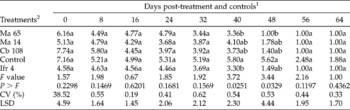
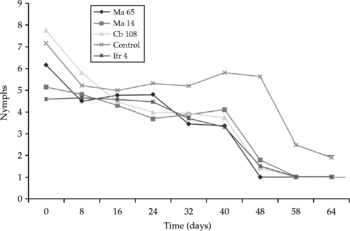
A reduction from 7.9 to 1 nymph per bud was recorded following the treatments with the entomopathogenic fungi. The control exhibited higher nymph numbers from the third to the last sampling date. Significant differences were determined after 40 (F = 3.72, P = 0.0251) and 48 days (F = 3.44, P = 0.0329), respectively, but no differences were obtained after those dates (Table 1). Overall, the treatments with the entomopathogenic fungi had lower nymph numbers in comparison with the control during all the sampling dates (Table 1).
Mean number of Diaphorina citri nymphs per bud treated with the entomopathogenic fungi Metarhizium anisopliae (Ma), Cordyceps bassiana (Cb) and Isaria fumosorosea (Ifr) under field conditions (Colima, Mexico, March–May 2009)

CV, coefficient of variation.
1 0, 16, 32 and 48 days of treatment applications.
2 All values transformed by (√X+1) before statistical analysis.
Effect of entomopathogenic fungi on the density of Diaphorina citri adults under field conditions
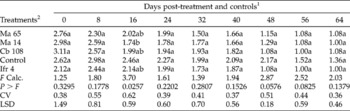
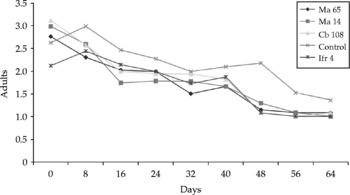
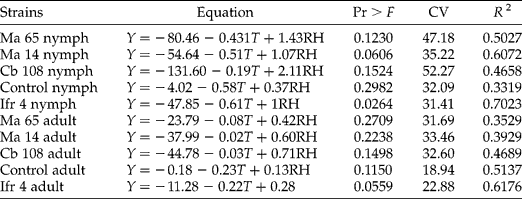
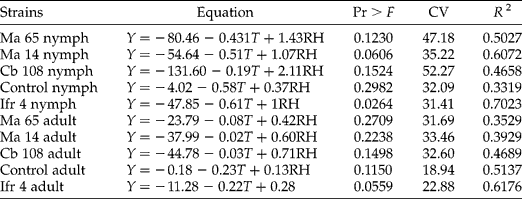
Significant differences were not obtained during the observation period of 64 days, with the exception of the second sampling date (16 days post-treatment, F = 3.70, P = 0.0257; Table 2). The entomopathogenic fungi reduced the adult numbers in a similar manner as the nymphs of D. citri, ranging from 3.0 to 1.4 adults per bud in the treatments with M. anisopliae, C. bassiana and I. fumosorosea, whereas the corresponding figures in the control varied from 2.6 to 2.0 adults per bud during the 64-day experiment (Figs 1 and 2; Table 2). The regression analysis between temperature and RH, and nymphal and adult densities revealed a lack of association except for the I. fumosorosea (If = Pfr 4) treatment and mortality in nymphs (Y = − 47.85 − 0.61T+1RH, P = 0.0264, R 2 = 0.7023) (Table 3).
Mean number of Diaphorina citri adults per bud treated with the entomopathogenic fungi Metarhizium anisopliae (Ma), Cordyceps bassiana (Cb) and Isaria fumosorosea (Ifr) under field conditions (March–May 2009)

Calc., calculated; CV, coefficient of variation.
1 0, 16, 32 and 48 days of treatment applications.
2 All values transformed by (√X+1) before statistical analysis.
Mean number of Diaphorina citri nymphs per bud, following treatment with strains of the entomopathogenic fungi Metarhizium anisopliae (Ma 65 and Ma 14), Cordyceps bassiana (Cb 108) and Isaria fumosorosea (Ifr 4) under field conditions (Colima, Mexico, March–May 2009) (transformed values by √X+1)

Mean number of Diaphorina citri adults per bud, following treatment with strains of the entomopathogenic fungi strains Metarhizium anisopliae (Ma 65 and Ma 14), Cordyceps bassiana (Cb 108) and Isaria fumosorosea (Ifr 4) under field conditions (Colima, Mexico, March–May 2009) (transformed values by √X+1)

Multiple regression analysis between temperature (T) and relative humidity (RH), number of Diaphorina citri nymphs and adults as affected by the entomopathogenic fungi Metarhizium anisopliae (Ma), Cordyceps bassiana (Cb) and Isaria fumosorosea (Ifr)
CV, coefficient of variation.
Effectiveness on the control of Diaphorina citri nymphs and adults with Metarhizium anisopliae, Cordyceps bassiana and Isaria fumosorosea under field conditions
The percentage of control of D. citri nymphs and adults varied from 60, 50, 40 to 35% in nymphs; and from 50, 50, 42 to 22% in adults for the fungal strains Cb 108, Ma 65, Ma 14 and Ifr 4, respectively.
Discussion
Meyer et al. (Reference Meyer, Hoy and Boucias2008) reported that to limit the spread of the HLB disease, suppression of D. citri populations would require a multi-tactic integrated pest management (IPM) programme. Several tactics, such as petroleum oil and systemic insecticides, are currently recommended to reduce D. citri populations, but probably do not eliminate HLB transmission. Therefore, new approaches are needed that complement existing management strategies for D. citri, such as the potential utilization or augmentation of microbial pathogens that attack the psyllid.
According to Moore (Reference Moore2008), biopesticides can be used as an alternative in a spray programme to break the cycle of harder chemicals and prevent the development of resistance. Thus, entomopathogenic fungi may be able to control the ACP with minimal effects on non-target beneficial arthropods. Our results showed that all the tested entomopathogenic fungal strains caused a reduction of 1.88–1.0 and 2.00–1.0 nymphs and adults per bud, respectively, in comparison with the control treatment during a 64-day study period under field conditions in a Persian lime grove.
In our experiments, the mean temperature and RH did not influence the reduction in the nymph and adult numbers. However, Avery et al. (Reference Avery, Hunter, Hall, Jackson, Powell and Rogers2009) discussed that high humidity is conducive for the use of I. fumosorosea as part of IPM in southern and central Florida. Similarly, diverse species of entomopathogenic fungi have been reported to suppress D. citri populations, especially during periods of high RH (Aubert, Reference Aubert1987).
Little information is available on the use of entomopathogenic fungi to control the ACP under field conditions. Avery et al. (Reference Avery, Hunter, Hall, Jackson, Powell and Rogers2009) determined the potential of I. fumosorosea to control D. citri under laboratory conditions in Florida, and they speculated that this fungus could be implemented in a field IPM programme. Our results corroborate these findings by demonstrating that this and other entomopathogenic fungi have the potential to substantially reduce both nymphs and adults of D. citri under field conditions in Mexico. However, an effective control strategy will require additional improvements of the technology such as improved formulation and/or application methods to further reduce the number of nymphs per bud below the level achieved in our study.
Conclusion
The entomopathogenic fungi M. anisopliae, C. bassiana and I. fumosorosea applied on Persian lime groves are effective in reducing high densities of nymphs and adults of D. citri, with higher control levels achieved against the nymphs than the adults. All the tested entomopathogenic strains, i.e. Cb 108, Ma 65, Ma 14 and Ifr 4, showed similar potential to control the ACP under field conditions.