Introduction
High copy number, intra molecular recombination and limited DNA repair properties cause mitochondrial genes to be vulnerable to rapid evolution (Chinnery et al., Reference Chinnery, Thorburn, Samuels, White, Dahl, Turnbull, Lightowlers and Howell2000; Burger et al., Reference Burger, Gray and Lang2003), and can lead to the occurrence of different mutants of the same gene in the same cell. The existence of such mitochondrial variants in a cell is termed heteroplasmy. These mutations may occur during gamete formation, embryonic development or through the failure of the machinery that inhibits the entry of mitochondria of the male gamete into the oocyte cytoplasm (Sutovsky et al., Reference Sutovsky, Moreno, Ramalho-Santos, Dominko, Simerly and Schatten2000), called paternal mtDNA leakage (Lansman et al., Reference Lansman, Avise and Huettel1983). If they occur within a female's germ-line cells, these novel mitochondrial haplotypes may be inherited by offspring (Chinnery et al., Reference Chinnery, Thorburn, Samuels, White, Dahl, Turnbull, Lightowlers and Howell2000; White et al., Reference White, Wolff, Pierson and Gemmell2008). Heteroplasmy has been reported across the tree of life, including arthropods (Volz-Lingenhöhl et al., Reference Volz-Lingenhöhl, Solignac and Sperlich1992; Nardi et al., Reference Nardi, Carapelli, Fanciulli, Dallai and Frati2001; Leeuwen et al., Reference Leeuwen, Vanholme, Van Pottelberge, van Nieuwenhuyse, Nauen, Tirry and Denholm2008; Magnacca & Brown, Reference Magnacca and Brown2010a ; Robison et al., Reference Robison, Balvin, Schal, Vargo and Booth2015). In humans, mitochondrial mutations and heteroplasmy have been implicated in diseases affecting the nervous system or other systems affected by mitochondrial function (Stewart & Chinnery, Reference Stewart and Chinnery2015). In pestiferous mites, Tetranychus urticae, heteroplasmy in the cytochrome b (cytb) gene has been linked to resistance to the insecticide bifenazate (Leeuwen et al., Reference Leeuwen, Vanholme, Van Pottelberge, van Nieuwenhuyse, Nauen, Tirry and Denholm2008). To date, most of the studies on heteroplasmy are related to human disease or model organisms; very few studies examine this phenomenon in other taxonomic groups and little is known about the relative frequency of mitochondrial variants within cells, individuals or among populations.
Heteroplasmy was first documented in Thrips tabaci (Insecta, Thysanoptera: Thripidae) in 2004 when Frey and Frey (Reference Frey and Frey2004) described the presence of multiple mitochondrial cytochrome oxidase sub-unit one gene (mitochondrial cytochrome oxydase I (mtCOI)) haplotypes within individuals that were not likely due to polymerase chain reaction (PCR)-related artefacts. Although T. tabaci is a putative cryptic species complex of at least three subspecies that exhibit variation in host plant preference and reproductive mode (Brunner et al., Reference Brunner, Chatzivassiliou, Katis and Frey2004; Toda & Murai, Reference Toda and Murai2007), the lineage from which heteroplasmy was reported is unknown. T. tabaci from lineages 1 and 2 follow haplodiploid sex determination system, where males are haploid and generated from unfertilized eggs through arrhenotokous parthenogenesis and females are diploid and generated biparentally. Both of them are relatively rare in most landscapes: lineage 1 is associated with tobacco crops and lineage 2 is associated with onion and leek crops (Brunner et al., Reference Brunner, Chatzivassiliou, Katis and Frey2004; Nault et al., Reference Nault, Shelton, Gangloff-Kaufmann, Clark, Werren, Cabrera-la Rosa and Kennedy2006; Jacobson et al., Reference Jacobson, Booth, Vargo and Kennedy2013a ; Kobayashi et al., Reference Kobayashi, Yoshimura and Hasegawa2013; Fekrat et al., Reference Fekrat, Manzari and Shishehbor2014). Individuals from lineage 3 are most commonly reported worldwide, and exhibit thelytokous parthenogenesis in which females are produced through unfertilized eggs (Shelton et al., Reference Shelton, Nault, Plate and Zhao2003, Reference Shelton, Zhao, Nault, Plate, Musser and Larentzaki2006; Brunner et al., Reference Brunner, Chatzivassiliou, Katis and Frey2004; Nault et al., Reference Nault, Shelton, Gangloff-Kaufmann, Clark, Werren, Cabrera-la Rosa and Kennedy2006, Reference Nault, Kain and Wang2014; Toda & Murai, Reference Toda and Murai2007; Jacobson et al., Reference Jacobson, Booth, Vargo and Kennedy2013a ; Kobayashi et al., Reference Kobayashi, Yoshimura and Hasegawa2013; Westmore et al., Reference Westmore, Poke, Allen and Wilson2013; Fekrat et al., Reference Fekrat, Manzari and Shishehbor2014; Li et al., Reference Li, Wang, Fail and Shelton2015). In T. tabaci, mtCOI sequence variation has been widely used for phylogenetic analyses conducted to identify membership of studied individuals to putative species groups/lineages within this species, and clonal groups within these different evolutionary lineages (Nault et al., Reference Nault, Shelton, Gangloff-Kaufmann, Clark, Werren, Cabrera-la Rosa and Kennedy2006; Jacobson et al., Reference Jacobson, Booth, Vargo and Kennedy2013a ; Westmore et al., Reference Westmore, Poke, Allen and Wilson2013). Genetic polymorphisms in the mtCOI have also been used to develop sequence specific primers (SSP) for a PCR assay to distinguish individuals from lineages 2 and 3 based on lineage-specific mutations in the primer binding regions that yield different sized PCR fragments (Kobayashi & Hasegawa, Reference Kobayashi and Hasegawa2012).
This study was born from the observation that both lineages 2 and 3 mtCOI haplotypes amplified in individual T. tabaci using the aforementioned SSP primers for lineage determination. This individual was ultimately characterized as belonging to lineage 3, but contained mtCOI haplotypes from lineages 2 and 3. This lead us to hypothesize that heteroplasmy in T. tabaci was due to the presence of lineage 2- and 3-associated mtCOI haplotypes in a single individual. The objectives of this study were to: (1) document the coexistence of lineage 2 and 3 mtCOI in heteroplasmic individuals; (2) examine the frequency of heteroplasmy in geographically isolated populations of T. tabaci; and (3) quantify the copy numbers and relative proportions of lineage 2 and 3 mtCOI haplotypes within and among individuals and populations. Individuals collected from nine geographically isolated locations in India were included in this study. First, a subset of individuals were characterized for lineage with the traditionally used method of Sanger sequencing mtCOI fragments, and subjecting them to phylogenetic analyses (Brunner et al., Reference Brunner, Chatzivassiliou, Katis and Frey2004). In a chromatograms generated by Sanger sequencing, double peaks were detected at nucleotide positions annotated specifically for lineage differentiation. To confirm heteroplasmy, the mtCOI gene was cloned and sequenced from a individual thrips for the presence of lineage 2 and 3 mtCOI haplotypes. The SSP-PCR-based assay (Kobayashi & Hasegawa, Reference Kobayashi and Hasegawa2012) was used to examine the field-collected thrips and identify heteroplasmic individuals. Then, an assay utilizing quantitative real-time PCR (qRT–PCR) and flow cytometry was used to determine the per cell copy numbers of lineage 2 and 3 mtCOI in field collected individuals exhibiting heteroplasmy. In this study, we report the inter-individual and inter-population variations in levels of mtCOI in heteroplasmic T. tabaci populations of India.
Material and methods
Thrips collections
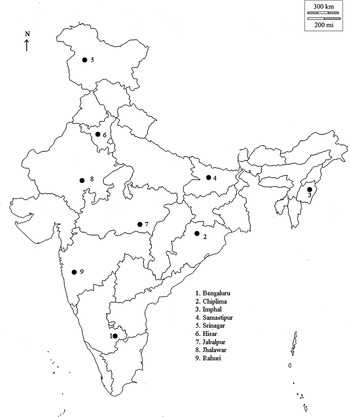
T. tabaci adults were collected from commercial and experimental plantings of onions from nine locations in nine different states of India during June 2013 to August 2014 (table 2). The locations sampled encompassed different climate zones in India, including temperate, tropical and subtropical zones of the country (fig. 1, table 2). A total of 500 thrips were collected in each of the nine states. Thrips were collected from onion fields separated by distances of 5 km from each other (50 thrips from each field, ten fields per state). Adults were removed from the onion leaves with a fine paint brush and placed into 95% ethanol. Thrips were collected from plants separated by a minimum distance of 1.5 m to ensure offspring from different adults were collected. Voucher specimens are located in Plant Protection section, ICAR-Directorate of Onion and Garlic Research, Rajgurunagar, Pune.
India map showing sites of sample collections.

Larvae from a laboratory colony of T. tabaci were used in this study to confirm heteroplasmy in immature thrips. This colony is maintained on Phaseolus vulgaris in controlled laboratory conditions at 25°C (DeGraaf & Wood, Reference DeGraaf and Wood2009) with an 8 h:16 h light:dark cycle. This colony was originally collected from an onion field from the ICAR-Directorate of Onion and Garlic Research, Rajgurunagar, Pune and maintained in culture for eight generations. Immatures were included in this study to confirm heteroplasy in individuals that are not mated and examine the persistence of heteroplasmy in this population.
DNA Extraction
For amplification of mtCOI and SSP-PCR, DNA from whole, individual adult thrips was extracted using the DNAeasy minikit (Qiagen Inc, Hilden, Germany) as per the protocol provided by manufacturer. For qRT–PCR, the head of thrips were dissected and crushed in the Galbraith buffer. The cell extract was passed through nylon sieve 253 (25 µm) to get individual cells and incubated with propidium iodide (20 µg ml−1) for 15 min. The sample was run through a flow cytometer (BD Accuri C5, USA) to obtain cell counts per unit volume (μl). After estimating cell counts, DNA was isolated by treating cell extract with proteinase K (1 mg ml−1) in the same tube. The DNA was serially diluted to cell equivalence 105–102 cell counts and used as a template for the standard curve preparation.
Amplification of mtCOI and SSP-PCR
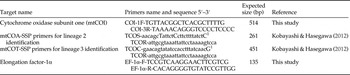
For amplification of mtCOI, primer pair COI1F and COI3R was designed from conserved regions of mtCOI and yielded an amplicon of 514 bp (table 1). For mtCOI amplification, the 25 µl reaction mixture contained 10 pmol primers, 2.5 µl of 10× Taq Buffer with 15 mM MgCl2, 1.5 U Red DNA Polymerase (Merck India Ltd, Bengaluru, India) and 100 ng template of DNA. Thermal cycling conditions were optimized at initial denaturation at 94°C for 3 min, followed by 35 cycles of 94°C for 40 s, 52°C for 50 s, 72°C for 50 s and a final extension at 72°C for 7 min. The lineage of individual thrips was determined using SSPs TCOS and TCOR for lineage 2; TCOC and TCOR for lineage 3 (Kobayashi & Hasegawa, Reference Kobayashi and Hasegawa2012) (table 1). For amplification of mtCOI and SSPs, the 25 µl reaction mixture contained 10 pmol primers, 2.5 µl of 10× Taq Buffer with 15 mM MgCl2, 1.5 U Red DNA Polymerase (Merck India Ltd, Bengaluru, India) and 100 ng template DNA. Temperature cycles for SSPs were optimized at initial denaturation for 3 min at 94°C, followed by 35 cycles of 98°C for 10 s, 1 min at 54°C and 1 min at 68°C, with a final extension for 1 min at 68°C. The SSP products were visualized electrophoretically on a 1% agarose gel; a 451 bp amplicon would indicate that the individual was from lineage 3, the 261 bp amplicon would indicate that the individual was from lineage 2 (Kobayashi & Hasegawa, Reference Kobayashi and Hasegawa2012), and both the 451 and 261 bp amplicon would indicate heteroplasmy.
Target genes and primers used in polymerase chain reaction (PCR) and qRT-PCR assays to detect heteroplasmy in T. tabaci.

1 Uppercase letters indicate the polymorphic sites in the primer sequence used to differentiate lineages 2 and 3.
Cloning and sequencing
Amplicons of 514 bp from an individual from Hisar identified as exhibiting heteroplasmy were cloned using Qiagen PCR cloning kit (Qiagen Inc, Hilden, Germany) in pDrive vector. The procedure was followed as per manufacturer instructions. Amplicons and recombinant clones were sequenced in both the directions (Eurofins Genomics Private Limited, Bengaluru, India).
Sequence analysis
The COI sequences were assembled and edited using Bioedit (Hall, Reference Hall1999). The sequences reported from Brunner et al., Reference Brunner, Chatzivassiliou, Katis and Frey2004; Asokan et al., Reference Asokan, Krishna, Kumar and Ranganath2007; Nault et al., Reference Nault, Kain and Wang2014 were retrieved from the NCBI database and included in the phylogenetic analysis employing MEGA software (Molecular Evolutionary Genetics Analysis 6.06) (Tamura et al., Reference Tamura, Stecher, Peterson, Filipski and Kumar2013). The sequences were aligned by clustalW (Larkin et al., Reference Larkin, Blackshields, Brown, Chenna, McGettigan, McWilliam, Valentin, Wallace, Wilm, Lopez, Thompson, Gibson and Higgins2007) using default parameters of MEGA 6.06. After alignment, a phylogenetic analysis using maximum-likelihood (ML) methods was conducted in MEGA. A distance matrix was estimated using the uncorrected P value in MEGA 6.06. The model test function in MEGA was used to identify the HKY + G as the best model according to Akaike Information Criterion (AIC), and this model was used for subsequent ML analysis. The ML analysis was carried out with 500 bootstrap replicates. The number of mtCOI haplotypes identified during Sanger sequencing was identified using DnaSP v5 software (Librado & Rozas, Reference Librado and Rozas2009).
Quantification of heteroplasmy
The qRT–PCR assay for mtCOT (using SSPs TCOC and TCOR) and mtCOA (using SSPs TCOS and TCOR) was prepared with LightCycler® 480 SYBR® Green I Master-Roche; each reaction contained 3 ul PCR grade water, 1 µl primer pair (10 pmol each), 10 µl master mix (contains FastStart™ Taq DNA polymerase, reaction buffer, dNTP mix, SYBR® Green I dye and MgCl2) and 5 µl template. Primers TCOS and TCOR were used for qRT–PCR lineage 2 and TCOC and TCOR for lineage 3 (table 1). The amplification conditions were as follows 95°C for 5 min; 45 cycles of 94°C for 45 s, 52°C for 45 s; and 68°C for 45 s. To assist with quantification of per cell copies of mtCOA and mtCOT standard curves were generated from serial dilutions of recombinant pDrive (Qiagen Inc, Hilden, Germany) plasmid vectors containing inserts of mtCOT and mtCOA (range of ten copies to 10,000 copies). The standard curves of CP values from these reactions were used to calculate per cell copy number of field collected T. tabaci as described in Phillips et al. (Reference Phillips, Sprouse and Roby2014). All samples were run in triplicate, and only thrips heads were used to quantify heteroplasmy.
Primers for the nuclear housekeeping gene, EF-1α, were developed (table 1), and EF-1α was included in the study as a reference for calibration of cell count because copy number is expected to be the same across individuals for this gene. Quantitative RT–PCR assay for EF-1α was performed in a reaction setup similar to mtCOT and mtCOA. The amplification conditions were as follows: 95°C for 5 min; 45 cycles of 95°C for 30 s, 51°C for 30 s; and 68°C for 30 s. The standard curve for EF-1α was generated with DNA equivalents to cell counts (obtained through flow-cytometry) and corresponding CP values. For flow cytometry the head of a thrips was dissected and crushed in Galbraith buffer (Jacobson et al., Reference Jacobson, Johnston, Rotenberg, Whitfield, Booth, Vargo and Kennedy2013b ). The cell extract was passed through nylon sieve (25 µm) to get individual cells and incubated with propidium iodide (20 µg ml−1) for 15 min. The sample was run through a flow cytometer (BD Accuri C5, USA) to obtain cell counts per unit volume (μl). After estimating cell counts, DNA was isolated by treating cell extract with proteinase K in the same tube. The DNA was serially diluted to cell equivalence 105–102 cell counts and used as template for standard curve preparation. All samples from field collected thrips and serial dilutions for standard curve preparation were run in triplicate.
Statistical analysis
The slope and intercept of the standard curves were calculated by regression analysis carried out with JMP v9.0.0 (SAS Institute Inc. Cary, NC) and used for estimation of cell count in field collected T. tabaci based on CP values. The average and standard deviations of copy numbers of mtCOA and mtCOT were divided by the number of cells to obtain per cell copies of mtCOA and mtCOT. The copy numbers estimated were calculated and analyzed using SAS base v9.3 (SAS Institute Inc. Cary, NC) to calculate means and standard deviations. The ratio and percentage of mtCOA in populations were estimated using Excel (Microsoft Corp. Redmond, WA).
Results
mtCOI sequencing and phylogenetic analysis
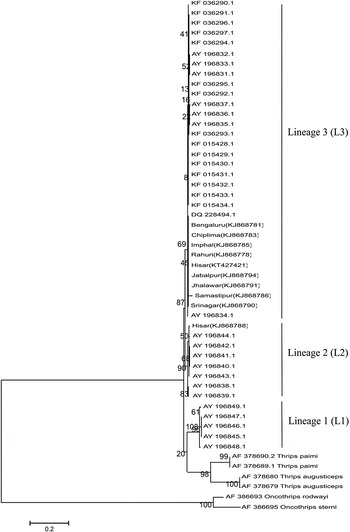
An amplicon of 514 bp was obtained from nine individual T. tabaci (one each from nine locations) using primers designed from a conserved region of mtCOI (table 1). Haplotype analysis in DnaSP v5 software, revealed a total of five haplotypes in lineage 3 of Indian T. tabaci populations collected for this study. The mtCOI sequences from Bengaluru (KJ868781), Imphal (KJ868785), Hisar (KT427421), Jabalpur (KJ868794) and Jhalawar (KJ868791) were grouped as a single haplotype, whereas sequences of Samastipur (KJ868786), Srinagar (KJ868790), Chiplima (KJ868783) and Rahuri (KJ868778) each formed unique haplotypes. Sequence analysis carried out by distance matrix using uncorrected P value in MEGA6 software revealed 0–4.3% diversity between these mtCOI sequences. An analysis of our sequences with eight previously reported sequences from India (Asokan et al., Reference Asokan, Krishna, Kumar and Ranganath2007) available in the NCBI database, revealed that seven were identical to our sequences. The ML analysis showed the same three lineages of T. tabaci that have been previously reported (Brunner et al., Reference Brunner, Chatzivassiliou, Katis and Frey2004; Toda & Murai, Reference Toda and Murai2007) with good bootstrap support for the major clades (fig. 2). All previously reported Indian mtCOI sequences clustered with lineage 3. The one haplotype identified in this study that belonged to lineage 2 (KJ868788) was recovered from a heteroplasmic T. tabaci through cloning; a haplotype from lineage 3 was the predominant haplotype recovered from this heteroplasmic individual.
Molecular phylogenetic analysis by ML method conducted in MEGA6. The evolutionary history was inferred by using the ML method based on the Hasegawa–Kishino–Yano model. The bootstrap consensus tree inferred from 500 replicates is taken to represent the evolutionary history of the taxa analyzed.

Identification of heteroplasmy in T. tabaci populations
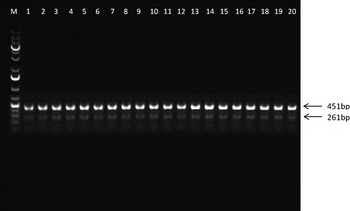
The occurrence and distribution of heteroplasmy within and among Indian T. tabaci populations was examined with a PCR-based assay employing SSPs to identify membership to lineage 2 (mtCOA) and lineage 3 (mtCOT) (Kobayashi & Hasegawa, Reference Kobayashi and Hasegawa2012). The expected amplicon of 451 bp for mtCOT and 261 bp for mtCOA was obtained in all 360 thrips tested (40 individuals from each of nine states), and the intensity of the mtCOT band was visually higher than the mtCOA band in all individuals (fig. 3).
Gel electropherogram of 20 T. tabaci individuals tested through SSP-PCR Lane M :1 kb plus DNA marker; Lane 1–20: T. tabaci samples, the fragment 451 bp indicates presence of thelytokous haplotype and fragment 261 indicates arrhenotokous haplotype.

In sequence chromatograms generated from 514 bp mtCOI fragments, secondary peaks were observed at nucleotide positions annotated specifically for lineage differentiation. Therefore, it was assumed that the presence of mixed peaks is an indication of two haplotypes, one associated with lineage 2 and the other with lineage 3, both present in an individual thrips (Supplementary fig. 1). To confirm the presence of heteroplasmy, mtCOI sequences from Hisar samples were cloned and sequenced. This yielded sequences associated with lineages 2 and 3 from a single thrips (previously mentioned in phylogenetic analyses section). The mtCOI sequence from lineage 2 obtained through cloning and sequencing was submitted to NCBI GenBank (Accession number KJ868788). In addition, the sequence analysis revealed the mtCOI haplotype from lineage 2 to be functional, i.e. devoid of deletions, stop codons and non-synonymous mutations.
Inheritance of hereoplasmy in laboratory culture
DNA from larval thrips produced in an all-female laboratory colony was amplified with mtCOA and mtCOT. Heteroplasmy was observed in these individuals due to the amplification of mtCOA and mtCOT from lineages 2 and 3, respectively. Here too, the intensity of the mtCOT band was visually higher compared with the mtCOA. This shows that heteroplasmy is detected in individuals that are not mated, and that heteroplasmy persists for multiple generations.
Quantification of heteroplasmy
The copy number of mtCOA and mtCOT per cell was quantified in heteroplasmic individuals to examine the percentage of copies associated with lineages 2 (mtCOA) and 3 (mtCOT). Melt curve analyses were conducted to rule-out non-specific binding. Standard curves of gene-copies for a known number of cells were generated for mtCOA mtCOT and EF-1α, and used to assist with calculating per cell copies in the qRT–PCR assays of heteroplasmic T. tabaci (see Methods section for details). For the qRT–PCR, the regression co-efficient was high between copy number and the threshold cycles for mtCOA (0.99), mtCOT (0.98) and EF-1α (0.99). The amplification efficiencies were similar for all three amplicons indicating slope values of 0.31, 0.33 and 0.296 for mtCOA, mtCOT and EF-1α, respectively. Low intra- and inter-assay variability of two standards in quantification cycle was obtained, indicating accuracy, repeatability and reproducibility of the qRT–PCR assay for targets.
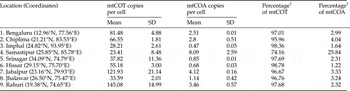
Results from the qRT–PCR confirmed the presence of heteroplasmy in all individuals tested from nine locations. The average number of copies and percentage of mtCOA and mtCOT from the ten individuals examined per location are presented in table 2. The highest level of heteroplasmy was observed in the Samastipur population, where an average of 25.84% of mtCOA was observed in individuals (table 2). For other populations, the average percentage of mtCOA varied from 1.22 to 4.04% in individuals (table 2). Per cell copies of mtCOT varied from 23.41 to 145.08, whereas only 0.47–8.09 were observed for mtCOA across all locations (table 2). These results show that high inter-population variation in the number of copies of mtCOT and mtCOA exist among heteroplasmic populations of T. tabaci examined in this study. There was also a wide range of intra-population variation of mitochondrial copy numbers reflected in the standard deviation (SD) values (table 2). The highest level of intra-population variation in the copy number of mtCOT was obtained in Samastipur population (mean copy numbers: 23.41, SD: 8.48) whereas lowest was obtained for Chiplima (mean copy numbers: 121.93, SD: 21.14). For mtCOA, the highest intra-population variation in per cell copy number was observed in Jhalawar population (mean copy numbers: 1.14, SD: 0.42), and the lowest was observed in Bengaluru population (mean copy numbers,: 2.51, SD:0.01).
Descriptive statistics for intra-population variation in mtDNA copy numbers per cell quantified for ten individual thrips from nine geographically distinct regions of India based on qRT–PCR assays with lineage 2- and 3-specific PCR primers.

1 Based on average per cell copy number of individuals in each population.
Discussion
This is the first study to examine mitochondrial sequence variants in T. tabaci, and one of few to quantify the number of copies of mitochondrial variants in heteroplasmic individuals. In this study, 100% of the T. tabaci examined exhibited heteroplasmy, which contradicts the current body of literature on heteroplasmy, which generally reports low incidence of heteroplasmy in other insect species (Volz-Lingenhöhl et al., Reference Volz-Lingenhöhl, Solignac and Sperlich1992; Leeuwen et al., Reference Leeuwen, Vanholme, Van Pottelberge, van Nieuwenhuyse, Nauen, Tirry and Denholm2008; Robison et al., Reference Robison, Balvin, Schal, Vargo and Booth2015). Heteroplasmy in T. tabaci was due to mtCOI sequence variants associated with two evolutionarily distinct lineages. In all of the individuals in this study, lineage 3 mtCOI haplotypes predominate, comprising 74.3–98.8% of the haplotypes detected in individual thrips. The number of copies of lineage 2-associated mtCOI was variable up to 25%, and at three locations the mean copy number is below one, which implies that this haplotype (mtCOA) is probably absent in some tissues of some individuals (table 2), which has been observed in other animals (Takeda et al., Reference Takeda, Takahashi, Onishi, Hanada and Imai2000; Magnacca & Brown, Reference Magnacca and Brown2010b ; Samuels et al., Reference Samuels, Li, Li, Song, Torstenson, Clay, Rokas, Thornton-Wells, Moore, Hughes, Hoffman, Haines, Murdock, Mortlock and Williams2013).
In this study, we were only able to examine heteroplasmy in one of the three reported lineages of T. tabaci. All of the individuals in this study belong to the lineage 3 as evidenced from Sanger sequencing, the higher intensity of mtCOT bands in the SSP-PCR-based lineage identification assay, and the predominance of lineage 3 haplotypes identified in the qRT–PCR assay. In this study heteroplasmy did not interfere with lineage determination using sanger sequencing of mtCOI sequences; the predominant haplotype in the sample was identified.
This study also provides evidence that the copies of mtCOA from lineage 2 are due to heteroplasmy and not NUMTs (Nuclear mitochondrial pseudogenes) which are caused by nuclear integration of mitochondrial genes. Frey and Frey's (Reference Frey and Frey2004) study could not rule-out the possibility of numts; however, the result that copy numbers below 1 are present indicate that the particular mitochondrial types may be absent in some tissues, which is not consistent with nuclear integration. Future studies are needed on larger fragments of mtCOI to further investigate the possibility of numts.
Paternal leakage is considered as the primary source of heteroplasmy in animals, flies, lizards, scorpions and humans (Schwartz & Vissing, Reference Schwartz and Vissing2002; Gantenbein et al., Reference Gantenbein, Fet, Gantenbein-Ritter and Balloux2005; Sherengul et al., Reference Sherengul, Kondo and Matsuura2006; Ujvari et al., Reference Ujvari, Dowton and Madsen2007; Wolff et al., Reference Wolff, Nafisinia, Sutovsky and Ballard2013). Up to 14% occurrence of heteroplasmy due to paternal leakage has been observed in a natural population of sexually reproducing Drosophila melanogaster (Nunes et al., Reference Nunes, Dolezal and Schlötterer2013). Recently, Li et al (Reference Li, Wang, Fail and Shelton2015), demonstrated that fertile T. tabaci offsprings were obtained from mating lineage 2 males with lineage 3 females, and documented that male nuclear DNA was present in offspring from these crosses. Jacobson et al. (Reference Jacobson, Nault, Vargo and Kennedy2016) also provide evidence for interbreeding between individuals from lineages 2 and 3 in field-collected populations. In light of these results, it is possible that the presence of the lineage 2 sequence KJ868788 detected in a heteroplasmic state in this study could have introgressed in lineage 3 through paternal leakage during hybridization between individuals from lineages 2 and 3 in the past, and not by mutation or recombination. Future studies are needed to better understand the occurrence of lineage 2 in India and paternal leakage in T. tabaci.
The stability and maintenance of heteroplasmy remains poorly understood, but recent studies have demonstrated the complex nature of mtDNA replication and inheritance that ultimately determines whether or not any given heteroplasmic state persists in offspring (Lansman et al., Reference Lansman, Avise and Huettel1983; Hill et al., Reference Hill, Chen and Xu2014; Stewart & Chinnery, Reference Stewart and Chinnery2015). Other studies have provided evidence for persistence of heteroplasmic gene duplication events in weevils, crickets and Drosophila (Boyce et al., Reference Boyce, Zwick and Aquadro1989; Petit et al., Reference Petit, Touraille, Debise, Morel, Renoux, Lécher and Alziari1998; Song et al., Reference Song, Moulton and Whiting2014). In this study, heteroplasmy was detected in larvae from a laboratory colony that had been maintained in culture for eight generations that exhibits thelytokous parthenogenesis. In some tetrapods, heteroplasmy and mtCOI changes appear to be more frequent and stable in asexual and polyploid lineages than sexual lineages. However, it was unclear whether mtCOI changes in the tetrapods arose during hybridization and polyploidization events between sexual ancestors that gave rise to the asexual lineages, or after parthenogenesis was established in the species (Moritz, Reference Moritz1991; Zevering et al., Reference Zevering, Moritz, Heideman and Strum1991). Similar events could also underlie the heteroplasmy reported here given that the asexual form of T. tabaci originated from sexual lineages (Brunner et al., Reference Brunner, Chatzivassiliou, Katis and Frey2004), polyploidy has been documented for U.S. lineage 2 and 3 populations of T. tabaci (Jacobson et al., Reference Jacobson, Booth, Vargo and Kennedy2013a , Reference Jacobson, Johnston, Rotenberg, Whitfield, Booth, Vargo and Kennedy b ), and rare hybridization between individuals from lineages 2 and 3 have been reported from a recent laboratory and field studies (Li et al., Reference Li, Wang, Fail and Shelton2015; Jacobson et al., Reference Jacobson, Nault, Vargo and Kennedy2016). T. tabaci from lineage 2 have not been reported in India, but it is possible that they may be rare in the landscape and difficult to collect. It is possible that heteroplasmy of field collected females from lineage 3 could be due to the presence of sperm from another lineage; a recent laboratory study from the U.S. reports interbreeding between males from lineage 2 and females from lineage 3 in the in the laboratory (Li et al., Reference Li, Wang, Fail and Shelton2015).
This is the first study to follow up on Frey and Frey's discovery of heteroplasmy in T. tabaci in 2004 (Frey & Frey, Reference Frey and Frey2004). Our results show that heteroplasmy in Indian populations of T. tabaci is very common (present in 100% of individuals tested), and is due to the co-occurrence of mtCOI haplotypes associated with two evolutionary lineages of this putative subspecies group. The high frequency of heteroplasmy and detection in larvae suggests that heteroplasmy is stable in this species; however, variation in the copy number of the heteroplasmic sequence was observed within and among populations. Future studies on the mechanisms regulating heteroplasmy are needed to better understand the frequency, occurrence, origins and implications of heteroplasmy on T. tabaci.
Supplementary Material
The supplementary material for this article can be found at https://doi.org/10.1017/S0007485317000025
Acknowledgement
Authors are grateful to the Indian Council of Agricultural Research (ICAR) for funding through project No. IV “Outreach Project on Sucking Pests”. Authors are thankful to Professor (Dr.). George Kennedy, North Carolina State University (NCSU) for review of manuscript and valuable suggestions.