


Under what conditions do states observe their commitments? Do states care about the international rule of law, or does their behavior merely reflect other interests? What is the influence on governments of traditional concepts of power versus commitment norms? For scholars of both international relations and law, these remain some of the most methodologically challenging and substantively interesting questions (Keohane and Martin 1995; Simmons 2000, 819).
The International Criminal Court (ICC) provides a fascinating opportunity for studying these questions, because a set of governments had committed, through their efforts, rhetoric, and ratification, to a new international treaty, but found that commitment challenged. After the Rome Treaty establishing the ICC came into force in 2002, the U.S. government pressured most of the world's countries to try to get them to sign bilateral agreements promising not to surrender Americans or U.S. employees to the newly established court. Instead of signing, however, many countries openly criticized the U.S. request. Indeed, as Table 1 shows, about half turned it down, incurring diplomatic and sometimes economic costs. Most governments, however, were highly unlikely ever to be in a situation where the United States would actually invoke the agreement, so why did they not simply sign?

From a strictly materialist or realist standpoint, if it is in a state's interest to violate a prior commitment, then it should do so. The United States exerted strong public pressure on states to sign nonsurrender agreements. It withdrew military aid from those aid recipients that refused to sign, although, for security reasons, it exempted 30 states from such sanctions. For states that were not exempt, signing nonsurrender agreements preserved access to military assistance as well as good relations with the United States. Even states that were exempt had an interest in not antagonizing their most powerful ally. Therefore, for both sets of states, and indeed for many states that were not direct aid recipients but nevertheless depend on good relations with the United States, specific self-interest seems to have counseled cooperation with the United States by signing nonsurrender agreements.
This clearly is not what happened, however. I show that some states refused nonsurrender agreements because they valued the ICC highly, defending it on moral and normative grounds. One could construe this simply to illustrate the common argument that any link between commitments and behavior merely reflect a state's underlying preferences. Dismissing the finding on such grounds would miss the point, however, that these governments prioritized human rights and justice objectives over other immediate material or security interests. In the long-standing debate between norms and other interests (Finnemore and Sikkink 1998; Katzenstein 1996), this is significant. Still, affinity for the court does not entirely explain their behavior, because not all countries that had ratified the court refused to sign nonsurrender agreements, and even efforts to control for the intensity of preferences for the court fail to explain fully which states actually refused to sign nonsurrender agreements.
I therefore make a second argument, namely, that some states prize adherence to commitment for its own sake. Such states are constrained by their commitment because, once made, their behavior is not only about the substantive issue of the commitment, in this case how highly they value the court, but also about the principle of keeping commitments. For a country that has ratified the ICC treaty, signing a nonsurrender agreement is widely perceived as inconsistent with, if not a violation of, the ICC treaty, because doing so undermines a key purpose of the treaty: to assure delivery of indicted suspects to the Court. Some governments therefore refused to sign a nonsurrender agreement, even if such signing would otherwise be in their interest.
These affinity and commitment arguments can be hard to disentangle. What is striking in this particular case, however, is that although states with a high respect for the rule of law were more reluctant to sign nonsurrender agreements, they had not been particularly prone to ratify the court in the first place.
The case also lends itself particularly well to analysis for two reasons. First, as noted, the classic difficulty with showing that legal commitments cause behavior is that if states consider compliance costs before ratifying, then the treaty itself may only falsely appear to have effects on behavior (Simmons 1998). In this case, however, it was hard for most states fully to anticipate the costs. Although states knew the Clinton administration was dissatisfied with elements of the final text of the Rome Treaty, when they ratified the treaty, they could not expect the stark United States hostility to the treaty under a future president nor did they have any precedents to suggest that the United States would confront individual countries with such specific bilateral agreements. Therefore, at least until August 2002 when the United States actually passed the legislation outlining the nonsurrender agreements, the 76 countries that had already ratified the ICC treaty could not have fully incorporated the expected costs of a future confrontation with the United States into their decision to ratify.
Second, in this case, selection was less problematic than normal because, except for the few countries that the United States does not recognize diplomatically, the United States asked practically every country in the world to sign an agreement—regardless of whether it had ratified or intended to ratify the ICC (Bolton 2002). To a question about whether the United States would continue to pursue an agreement with Colombia, which long resisted signing an agreement, President Bush replied, “Yes, we want an Article 98 [nonsurrender agreement] with all countries, absolutely” (Bush 2002). One official told the Washington Times on October 9, 2003: “If you find a rock with a flag on it, we'll negotiate an agreement.” Although there may have been variation in the pressure the United States applied, this all-encompassing approach mitigates the concern that the United States may have only pressured a particular subset of states it thought would cooperate. This case therefore provides rare insights into the reaction of what for many states was an ex post change in the cost of their ratification, and it allows comparison even with states that had not ratified the ICC.
After discussing the background and the different theoretical explanations for why states may or may not abandon their commitment to the court, I present the data and quantitative analysis. Case studies then further probe the quantitative findings.
THE BACKGROUND OF THE INTERNATIONAL CRIMINAL COURT
Based in The Hague, Netherlands, the ICC is the first permanent court with jurisdiction to try individuals accused of genocide, crimes against humanity, war crimes, and, once defined, aggression. The 1998 conclusion of the Rome Treaty creating the ICC was the culmination of decades of international efforts. Many nations viewed the ICC as a milestone in international criminal justice and in progress toward a higher level of global accountability and governance. Small countries like Trinidad and Tobago, as well as countries with a history of human rights violations, like Argentina and South Africa, were among the early proponents of the court. U.S. support for the ICC was also initially quite high (Scheffer 1999). Along with Canada and the European countries, the United States strongly supported the international criminal tribunals for the former Yugoslavia and Rwanda, both of which were precursors of the permanent ICC.
Nevertheless, toward the end of the 1990s, sharp division remained between the United States and the so-called group of like-minded states. Among several concerns, the key issue was jurisdiction, because the treaty granted the court jurisdiction over offenses committed on the territory of a member state, even if the suspect was a national of a state party that had not ratified the treaty. The United States therefore insisted that jurisdiction should depend on the consent of the state of the nationality of the accused. Critics of the U.S. position, however, feared this would paralyze the court (Arsanjani 1999, 26). They pointed out that the ICC had numerous safeguards to prevent political misuse of the court, such as its primary safeguard of allowing the court to proceed with a case only if the state of the nationality of the accused had itself failed to carry out an acceptable trial. Unconvinced, because such judgment would ultimately rest with the ICC, the United States continued efforts to constrain jurisdiction until the final day of negotiations when the conference rejected yet another U.S. proposal and approved the court in a final 120 to 7 vote. Passage of the act raised U.S. concerns that, although the United States was not a party to the treaty, a powerful and, in the U.S. view, unaccountable ICC could be misused for politically motivated prosecutions.
After President Bush took office, the United States “un-signed” the ICC treaty by officially communicating its intent not to be bound by it (U.S. Department of Defense 2002). In August 2002, a month after the Rome Statute establishing the ICC came into effect, the United States passed the American Service-Members Protection Act (ASPA), restricting U.S. cooperation with the ICC and, outside of specified exempted countries, making U.S. support of peacekeeping missions and U.S. military aid conditional on the conclusion of bilateral nonsurrender agreements.1
In December 2004, the United States passed the Nethercutt Amendment, which authorizes the loss of Economic Support Funds to all countries, including many key U.S. allies, which have ratified the ICC treaty but have not signed a bilateral immunity agreement with the United States. This article only considers the ASPA.
It is important to note that although the EU strongly discouraged states from signing nonsurrender agreements, there was no direct economic pressure, nor has there been any record of the EU punishing a country for signing such an agreement. Thus, although EU pressure likely influenced some states such as Bulgaria, it was not of the same caliber as U.S. pressure. Indeed, during a Joint Parliamentary Assembly of the EU and the African, Caribbean, and Pacific countries on November 24, 2004, in The Hague, some governments asked the EU to compensate them for lost U.S. aid if they resisted pressure from Washington. The EU, however, although generally supportive, specifically refused to provide such guarantees. Similarly, as aspiring EU members, the Balkan countries certainly expressed concerns that signing nonsurrender agreements would draw EU disapproval, but when several Balkan countries nevertheless signed nonsurrender agreements, their relationship with the EU did not suffer. After Bosnia-Herzegovina signed, British Ambassador to Bosnia-Herzegovina Ian Cliff explained in a radio interview: “The agreement Bosnia-Herzegovina signed with the USA does not follow the [EU] guidelines fully, but this is a problem your country should resolve itself. It is your decision and we shall not bring any pressure to bear to force you to act one way or another” (Coalition for the International Criminal Court 2006). Such a statement was consequential, because the government could hold it up against possible future criticism by the EU Commission in its annual reports to assess progress toward membership. It is also important that the EU guidelines, once issued, did create a way for EU countries and candidates to cooperate with the United States if any country considered that warranted.
The US administration, on the other hand, was emphatic about getting nonsurrender agreements with as many countries as possible to prevent the politically motivated prosecution and surrender of U.S. citizens or employees to the court. The U.S. effort presented the rest of the world—and ICC state parties in particular—with two strongly interrelated principled concerns. The first concern was to maintain the momentum for the successful launch of the court that countries viewed as a landmark achievement in both international and criminal law. The second concern spoke to consistency: could countries that had ratified the court sign nonsurrender agreements and still uphold their obligations to the court? Contrary to the U.S. position (Bolton 2003), most international actors argued that nonsurrender agreements run counter to the objective and purpose of the ICC statute.2
The issue therefore was how states responded to U.S. requests for non- surrender agreements, given that they widely perceived such agreements as inconsistent with ratification of the ICC.RESPONSES TO U.S. REQUESTS: THEORETICAL EXPECTATIONS
One of the most enduring questions for both international legal scholars and political scientists is whether states care about the rule of law internationally (Keohane and Martin 1995; Simmons 2000, 819). In particular, realists have long asserted that normative commitments will collapse if they become inconvenient (Mearsheimer 1994–1995). As Strange has put it, international agreements enable “everybody to declare themselves in favor of truth, beauty, goodness, and world community, while leaving everyone free to pursue national self-interests and to do exactly as they wish” (1982, 484).
I argue that normative commitments do not always collapse when they conflict with other interests, and that in the ICC case, many states based their decisions primarily on normative considerations. I propose that two sets of norms were particularly important in dissuading states from signing nonsurrender agreements. The first set of norms concerned the affinity for the international criminal court itself and everything that the court stands for in terms of international justice and governance. The second set of norms concerned respect for the rule of law based on the principle that “pacta sunt servanda” or “commitments must be observed.” I discuss these two propositions in turn.
The affinity proposition is that governments refused to sign nonsurrender agreements because they believed in the court and wanted to continue to support it. Skeptics may dismiss this argument as merely affirming the standard criticism that if states do keep their international commitments, this merely reflects prior state preferences and expectations about future behavior (Downs, Rocke, and Barsoom 1996; Mearsheimer 1994–1995). Technically, they would be right, but in light of the long-standing efforts to demonstrate that norms influence state decision making (e.g., Finnemore and Sikkink 1998; Katzenstein 1996; Klotz 1995), such dismissal would be too hasty because the court has embodied crucial arguments about international norms.
Unlike most international cooperation, participation in the court was not a classic effort by states to maximize concrete payoffs. Indeed, just as with external democracy promotion (de Mesquita and Downs 2006, 631), it is difficult, if not impossible, for any given state to assess whether the court may ever benefit it directly. At the creation of the court, there were even doubts as to whether it would ever be effective. Rather, the broader ICC debate has largely been about justice and norms of global governance. Advocates of the court, such as United Nations (UN) Secretary General Kofi Annan, praised the newly created ICC as “a monumental step forward in the march toward universal human rights” (1998, 13). Legal scholars have also drawn out its symbolic significance. Schabas, an expert in international human rights law, for example, notes in reference to the court that “without a doubt its creation is the result of the human rights agenda that has steadily taken center stage within the United Nations” (2001, 23). Weller, likewise, has described the entry into force of the ICC treaty as “ … the culmination of the creation of international law and as marking the emergence of a global constitutional order” (2002, 693). Even the US has partly cast the ICC debate in normative terms, protesting that the court's move towards an increasingly legalized global governance system could gradually erode American sovereignty and that the ICC treaty raises “macro-constitutional” issues (Bolton 2002). The United States therefore wanted nonsurrender agreements not only as practical arrangements but also as an expressive opposition to the court's extensive jurisdiction, whereas the proponents of the court saw the ICC as a landmark achievement in creating a level of international accountability for heinous crimes. Dismissing the affinity argument on grounds that it merely reflects preferences would therefore miss the point: if states did turn down the U.S. requests because they value the court, this would demonstrate that some governments do prioritize human rights and international justice above more immediate concerns.
If affinity for the court drives refusals to sign nonsurrender agreements, we should expect those states that value the court most to refuse to sign these agreements. The most natural indicator of affinity for the court is whether states actually ratified the Rome Statute. However, this does not measure intensity of preferences effectively because some states may ratify the ICC statute merely as a cheap signal (Hathaway 2003). Rather, the states that refused to sign nonsurrender agreements due to their strong commitment to the court should be the hard-core backers of the court, not merely all states, which may have ratified the statue for a variety of reasons. Fortunately, the historical records of negotiations provide a useful identifier. A group of so-called like-minded states identified themselves as the strongest backers of the court (Human Rights Watch 1999). Further, given the mandate of the court to prosecute international war crimes, countries with impeccable human rights records would be much more likely to favor the creation of a court that can prosecute fundamental violations of human rights and help hold governments accountable for their crimes. Similarly, we may also expect democracies to be more likely to have strong preferences for a court that is created to punish offenders of democracy itself: those who dictate viciously and who violently oppress the freedom of their people. Last, Struett and Weldon (2006) suggest that because militarily weak states are less likely to become involved in activities that fall under ICC jurisdiction, they should value the court higher and be more likely to ratify the ICC. To the extent these variables are strong predictors of initial ratification of the ICC Statute and therefore demonstrate affinity for the court, they should correlate inversely with signature of nonsurrender agreements. In sum, if it is true that states refuse to sign nonsurrender agreements with the United States because they value the court, we can hypothesize that:
H1a: States belonging to the likeminded group should be more likely to ratify the ICC Statute and therefore less likely to sign nonsurrender agreements.
H1b: States with strong human rights records should be more likely to ratify the ICC Statute and therefore less likely to sign nonsurrender agreements.
H1c: Democracies should be more likely to ratify the ICC Statute and therefore less likely to sign nonsurrender agreements.
H1d: Militarily weak states should be more likely to ratify the ICC Statute and therefore less likely to sign nonsurrender agreements.
The second proposition is that states refused nonsurrender agreements because they price adherence to the rule of law. That is, they stuck with their commitment to the court in part because they dislike breaking commitments. Although governments do sometimes abandon or violate their obligations, Henkin (1979) has long since observed that most governments keep most of their commitments most of the time. Chayes and Chayes (1993) have also argued that governments take their commitments seriously and make a good faith effort to comply with them. The desire to keep commitments may thus derive from a deep-seated respect for the rule of law as an essential organizing principle of human interaction. Indeed, Pacta Sunt Servanda—the notion that treaties must be obeyed—is one of the oldest norms of the international system of law. Governments and their citizens may hold meta-beliefs about the legitimacy of the rule of law and see this as integral to the state's identity (Finnemore and Sikkink 1998, 903–904). Efforts to justify violations of international law may therefore create “cognitive dissonance” such that citizens, and therefore there states, have “distaste for breaking the law” (Abbott and Snidal 2000, 428). In sum, if the government and citizens of a state believe in the rule of law (Hurd 1999; Trimble 1990) this creates what Franck (1990) has called an independent “compliance pull.” Following the rule of law is then seen as both as a duty and a responsibility and therefore as the appropriate action (March and Olsen 1984).
Governments may also keep commitments because of practical self-interest or consequences (Hurd 1999; March and Olsen 1984). Perhaps states are seeking gains from iterated cooperation with other states (Mercer 1996; Schelling 1960). As noted, however, it is not very clear what concrete gains any one state can anticipate from supporting the ICC, and the case is so unique that it is unlikely that states will link it to other cooperation areas (Keohane 1997). It is more likely that governments are concerned about domestic consequences of breaking commitments. Politicians may have worried about losing the support of citizens who would think the government was disregarding the rule of law and fear that this could spill over into domestic governance (Dixon 1993; Slaughter 1995). As Finnemore and Sikkink have argued, international behavior reflects on a government's domestic legitimacy and ultimately on its ability to stay in power (1998). Tomz (2005) has corroborated this in experimental surveys showing that ordinary citizens are more likely to oppose policies that they think would violate international law. Fearon (1994) has argued more generally that leaders fear that their constituents may punish them for deviating from their public announcements. The ICC treaty was one of the more high-profile international agreements concluded in recent years, and in many countries, domestic groups had attracted attention to the court. Citizens naturally base their votes on a larger set of issues, but negative sentiment adds up, and governments therefore want their citizens to believe that they take international commitments seriously and stick by their rhetoric.
If this logic is at play, which states may we expect to care most about upholding the rule of law and acting in ways consistent with their previous commitments? Because democracies are founded on a belief in the rule of law and because their citizens are in the best position to punish their leaders, we may expect democracies to be more likely to respect their international commitments. However, although scholars increasingly agree that compliance with international law depends on domestic institutions (Dai 2006; Milner 1997), they disagree about whether democracies are more likely to observe their international commitments (Gaubatz 1996; Raustiala and Victor 1998), with some scholars finding specific cases where democracies observed their international commitments less than nondemocracies (Busch and Reinhardt 2002; Simmons 2000). Further, if being a democracy, as discussed earlier, predicts ratification of the ICC statute, then any effect of a democracy variable could be capturing a country's affinity for the court rather than a rule of law-inspired aversion to a nonsurrender agreement.
Independent of whether a country is a democracy, however, both the normative and the instrumental arguments suggest that states with strong domestic rule of law should be more likely to refuse nonsurrender agreements. As Simmons (2000b, 822) notes, “governments that have invested in and rest on a stable legal framework at home are unlikely to jeopardize this reputation by lightly flouting international legal obligations.” This is also consistent with arguments by Slaughter (1995) that governments based on the rule of law, and particularly governments with independent judiciaries, are more likely to comply with international law. States with low domestic rule of law, in contrast, have little to lose in terms of their reputation for upholding the rule of law and have displayed little belief in the principle of the rule of law (Simmons 1998; Slaughter). States with a low rule of law should also be in a better position to silence domestic criticism, because they can use methods outside the law. It is important to note, however, that not all states with a high domestic rule of law should necessarily refuse to sign nonsurrender agreements. States that are not party to the ICC do not have an obligation under the Rome Statute to surrender requested persons to the court. It is therefore only truly inconsistent to both ratify the ICC treaty and to sign a nonsurrender agreement on U.S. terms. Subsequently, we should expect an interactive effect:
H2: States with a high domestic rule of law should be less likely to sign nonsurrender agreements if they have ratified the Rome Statute than if they have not done so.
The strongest challenge to these hypotheses is clearly the standard realist claims that states always prioritize material and security concerns (Morgenthau 1948; Oppenheim 1912). Because the United States leveraged economic, military, and diplomatic pressure on states, realists would thus expect that such factors could account for the pattern of states' responses to the nonsurrender agreements. I therefore control for a wide set of such factors. First, states facing a military aid sanction should be more likely to sign nonsurrender agreements, and this tendency should increase the greater the size, degree, and type of the sanction. Economically weaker states, which are more vulnerable to the possible effects of U.S. pressure, should also be more likely to sign nonsurrender agreements. Similarly, the Generalized System of Preferences (GSP) provides preferential duty-free entry for thousands of products to the United States. Because the U.S. grants this preferential trade access on a unilateral voluntary basis, countries may be more likely to submit to U.S. requests from fear of losing this benefit. Thus, states that enjoy or desire to gain GSP Status with the United States may be more likely to sign nonsurrender agreements. Further, weak military nations should value U.S. relations higher and therefore be more likely to sign nonsurrender agreements.3
The contradictory expectation about the effect of military prowess in H1d shows that it is unclear whether weak military powers are conversely less likely to sign nonsurrender agreements, given that military weakness may also make them more vulnerable to U.S. pressure. Here both arguments are included for completeness.
There are clearly other plausible alternative explanations for why states may sign or not sign nonsurrender agreements, and I discuss these more fully in the section on robustness and alternative explanations. After briefly description of the data, however, I now turn to examining the evidence for the above hypotheses.
DATA
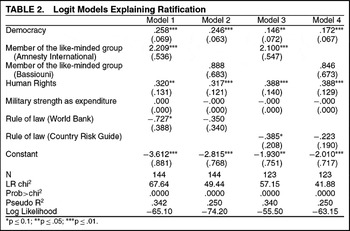
Following Table 1, I construct a dummy variable for signing a nonsurrender agreement with the United States and a second dummy variable for ratification of the Rome Statute based on the database of multilateral treaties deposited with the Secretary General as of August 8, 2006. To capture affinity for the court, I use the historical record to construct a dummy variable for whether a country was a member of the like-minded group. I base this on a list assembled by Amnesty International (2003, n. 43). I also apply an alternative measure based on Bassiouni (1998) in Table 2 and discuss it under the section of robustness checks. The human rights measure comes from the Cingranelli-Richards Human Rights Dataset based on U.S. State Department and Amnesty International reports (Cingranelli and Richards 2004). I use their measure of physical integrity, which codes the most violent physical offenses. On a 0 to 8 scale, an 8 represents full respect for human rights. I consider the level of democracy based on the democracy variable from the Polity IV dataset (Marshall and Jaggers 2003). This variable is a 0- to 10-point scale (10 being high) that measures the general openness of political institutions.

Because rule of law is a variable of prime interest to me, I use two measures. The first is from the International Country Risk Guide (PRS Group 2004) rating of “Law and Order” in 2002. This variable, produced for academics and foreign investors, ranges from 0 to 6, with 6 reflecting the highest respect for law and order. It measures the peaceful implementation and use of adjudication through law and established institutions. High scores indicate good legal systems, orderly transfers of power, and sound political institutions; whereas low scores indicate frequent use of extralegal activities, physical force, or other illegal means for settling claims. It assesses “the strength and impartiality of the legal system” and “popular observance of the law” (PRS Group 2004, Part II, 33). I also use an alternate measure for rule of law based on an indicator ranging from − 2.04 to 2.05 from the World Bank's Worldwide Governance Research Indicators Dataset for year 2002. This indicator measures “the quality of contract enforcement, the police, and the courts, as well as the likelihood of crime and violence” (Kaufmann, Kraay, and Mastruzzi 2005, 4).
Next, I create two variables about U.S. sanctions based on the 2003 Congressional Budget Justification for Foreign Operations, Fiscal Year 2003 Requested Military Assistance. I use the year 2003 because requests for later years begin to reflect the countries' nonsurrender agreement status. A country faced a sanction if it had been allotted U.S. military aid but had ratified the ICC treaty and was not exempted from the provisions of the ASPA. The 36 countries facing a cut had a mean aid provision of US 9.2 million, but a median of only about $1 million. There were serious outliers such as Afghanistan, with $150 million, and Columbia, with $98 million. I therefore create a dummy variable if a country faced military aid sanctions from the United States, and a second variable for the size of the sanction.
Although it was seeking nonsurrender agreements, the United States was part of both formal security alliances, but it also led the ad hoc “coalition of the willing” that formed around the U.S.-led Iraq war. I therefore create a dummy variable to capture the White House's listing a country as a member of the Iraq “coalition of the willing” in a February 4, 2004, press release. I also created a basic treaty alliance variable, including NATO members as well as Australia and Japan. Further, based on the World Fact Book (Central Intelligence Agency [CIA] 2004), which has data even for small countries, I created a log of GDP variables. Similarly, based on information from the Office of the U.S. Trade Representative (2006), I created a dummy variable to capture whether a country has GSP status with the United States. I measure relative military power as military spending in millions of dollars according to the World Fact Book (CIA 2003).4
Struett and Weldon (2006) use military spending as share of world military spending, but essentially this is just a scale transformation. Since several countries have zero spending, a log transformation is problematic.
QUANTITATIVE ANALYSIS
The quantitative analysis proceeds in two stages. The first stage is a preparatory step to establish how well human rights, democracy, membership in the like-minded group, and military expenditure capture affinity for the ICC. This stage therefore is a logit model that examines the binary choice of ratification of the ICC statute. Because it is important for the inferences in the second stage, I also examine whether rule of law predicts ratification. The second stage focuses on the actual inquiry of interests: the logit analysis of nonsurrender agreements. After examining the significance of the control variables, the second stage incorporates the significant measures of affinity for the court (from the first stage) and then tests two measures of rule of law interacted with ratification. I then check the robustness of the model against alternate measures and other statistical models and examine some alternative explanations.
The first set of models in Table 2 examines which variables capture affinity for the court. Models 1 to 4 all show that democracy and human rights are significant and positive predictors of ICC ratification. Contrary to the findings of Struett and Weldon (2006), military expenditure is insignificant. The Bassiouni measure of membership in the like-minded group is not significant, whereas the Amnesty International measure is. As measures of affinity, I therefore retain the Amnesty International measure of membership in the like-minded group, along with democracy and human rights.
The question is not just which variables are significant predictors of ratification, however, but whether the variables of democracy, human rights, and membership in the like-minded group capture the affinity for the court well. They clearly do not explain all the variation in reasons for countries' ICC ratification, but they do seem to capture the part of ratification that is relevant for understanding signature of nonsurrender agreements. This is evident if we enter these variables alone in a logit (not shown) to explain nonsurrender agreements, and then compare the model with an expanded model that adds the actual variable for ICC ratification. In the expanded model, democracy, human rights, and membership in the like-minded group all remain significant, whereas the ratification variable is not significant. Further, adding the ratification variable does not improve the model's goodness of fit.5
When one compares the expanded model with the reduced model, there is no significant difference for the log likelihood ratio test (Prob >,χ2 = 0.5511).
The models in Table 2 also serve a second function, namely, to make sure that rule of law is not a strong predictor of ICC ratification. This is important, because if rule of law strongly predicts ICC ratification, then any effect of a rule of law variable on nonsurrender agreements could merely be capturing a country's affinity for the court rather than a rule of law-inspired aversion to a nonsurrender agreement. Table 2, however, shows that higher rule of law states are not more likely to ratify the ICC statute. The relationship between rule of law and ratification of the ICC is not robustly significant, and the effect is in the opposite direction of the analytical concern: higher rule-of-law countries actually appear not more but less likely to become ICC members. The basic correlation between ratification and the Country Risk Guide rule of law, although positive, is very low (Pearson correlation = .0693) and only moderate for the World Bank rule-of-law measure (.2489). Even if entered alone into a logit model of ratification, the Country Risk Guide rule-of-law measure is insignificant, and the World Bank rule-of-law measure is significant but explains little of the variation. Although one might expect high rule-of-law states to favor the establishment of an International Criminal Court, they do not really appear to do so more than other states. Perhaps some high rule-of-law states indeed like the court but do not ratify its statute precisely because they take their commitments seriously and fear that some later development could make their commitment costly.
Table 3 moves onto the second stage of the analysis aimed at explaining nonsurrender agreements. Because the standard argument is that norms do not matter when we account for the basic realist variables, Model 5 in Table 3 first examines the basic realist control variables to see which are significant. Some variables such as the military expenditure are not significant. Moreover, states facing an aid cut if they did not sign a nonsurrender agreement were actually less likely to sign such an agreement. This is noteworthy, because countries can only face a cut if they receive U.S. military aid and therefore must be on good terms with the United States. However, given the more complicated issues surrounding who faces a cut, one should not overemphasize this finding. The size of the military aid sanction is also not significant. The alliance variable is not even included because only one U.S. ally, Romania, actually signed a nonsurrender agreement, and that was before becoming a formal ally. This lack of loyalty is probably misleading, however, because U.S. allies were also highly democratic, rule-of-law states, and because it partly reflects the U.S. respect for its allies in exempting them from sanctions. Thus, U.S. allies could feel freer to rebuff the United States on a normative issue like the ICC exactly because they were engaged in deep security cooperation and did not face a threat linking theses issues. Nevertheless, we know that the United States pressured even its allies considerably on the ICC issue. Finally, the rest of Model 5, however, corroborates some basic realist arguments. States that have GSP status with the United States are more likely to sign nonsurrender agreements, as are poor states and states that were allies in the war in Iraq. Some of the findings are thus consistent with basic realist expectations, but as the next models show, there is more to understanding the behavior of states.

Model 6 in Table 3 combines the significant affinity and realist variables to see if the affinity variables add any explanatory power to the question of nonsurrender agreements. Model 6 shows that even when accounting for the realist variables, countries with stronger affinity for the court, namely, democracies and members of the like-minded group, were indeed less likely to sign nonsurrender agreements. Respect for human rights is not significant, but the effect is in the expected direction. Moreover, the addition of the affinity variables is a statistically significant improvement on the goodness of fit.6
If we restrict Models 5 and 6 to the same observations, the expanded Model 6 differs significantly for the log likelihood test (Prob$ > χ2 = 0.0005).
The last step is to examine whether respect for the rule of law accounts even further for countries' decisions whether to signing nonsurrender agreements. I have argued that high rule-of-law states may refuse to sign nonsurrender agreements either our of purely normative respect for the rule of law or because they fear domestic repercussions for violating the rule of law. As noted, however, it is only inconsistent to both ratify the ICC treaty and to sign a nonsurrender agreement on U.S. terms. We should therefore expect an interactive effect: states with high rule of law should be less likely to sign nonsurrender agreements if they have ratified the ICC treaty than if they have not. Descriptively this is clearly the case. Remarkably, if we look at the Country Risk Guide rule-of-law scores, of the 27 state parties with a high score of five or six not even one has signed an agreement. This is not the result of high rule-of-law states categorically rejecting nonsurrender agreements. Indeed, among the countries that had not ratified the ICC treaties, half of the 18 countries with a high score did sign nonsurrender agreements. Using the World Bank measure of rule of law, the same pattern emerges. Of the 30 state parties to the ICC treaty rated in the top 25% of rule-of-law rankings, only Mauritius and Antigua had signed a nonsurrender agreement.
Does the descriptive interaction-effect hold when we control for both realist and affinity variables? This is a conservative test because it not only requires that these terms are significant if entered alone but also that they provide explanatory power while controlling for the realist and affinity variables which have already been established as significant and which are therefore already accounting for a great deal of the variation. Models 7 and 8 introduce interaction terms between rule of law and ratification along with both of the constitutive terms as recommended for testing interactive relationships, because these terms must be interpreted as a package (Brambor, Clark, and Golder 2006). The two models examine this for the two alternative measures of rule of law. As expected, due to the correlation between the affinity variables and the ratification, the introduction of the interaction term and the constitutive terms alters the significance of some of the other variables. This merely shows that the variables indeed capture the affinity for the ICC.
It is noteworthy, however, that the interactive components of rule of law and ratification are highly significant in both Models 7 and 8. The rule-of-law variable separately is positive in both models, but it must be interpreted jointly with the much larger negative coefficient of the interaction term, showing that among states that ratify the ICC, rule of law has a negative effect. The consistent significance of the interactive term in both models shows that state parties with a high rule of law are likely to refuse to sign nonsurrender agreements. Because previous analysis in Model 3 and 4 showed that high rule-of-law countries did not value the court more, the interaction effect cannot simply be dismissed on those grounds. In terms of goodness of fit, Models 7 and 8 are also both improvements on Model 6, which accounted only for affinity and realist variables.7
If we restrict the models to shared observations and compare each of the expanded Models 7 and 8 to the reduced Model 6, then each of these models are significantly different from Model 6 in terms of log likelihood tests (Model 7: Prob > χ2 = 0.0014, Model 8: Prob > χ2 = 0.0239).
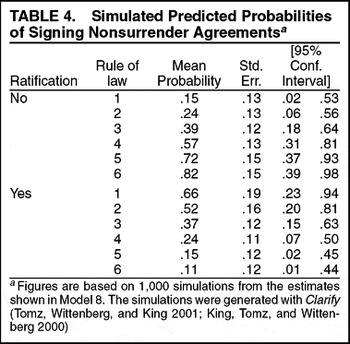
Both logit results and interactive effects are difficult to interpret. Table 4 illustrates the predicted probabilities based on Model 8. The probabilities are based on simulations generated with Clarify (King, Tomz, and Wittenberg 2000; Tomz, Wittenberg, and King 2001). Holding all other variables at their mean, it shows the predicted probability of signing nonsurrender agreements for different levels of rule of law, conditional on the country having ratified or not ratified the Rome Statute. Again, states with high rule of law are much less likely to sign nonsurrender agreements when they have ratified the Rome Statute. Although a state with the highest rule of law score is 82% likely to sign a nonsurrender agreement, for a state that has both the highest rule of law score and has ratified the ICC, this probability drops to 11%. Furthermore, for a state that has ratified the ICC but has the lowest rule of law score the probability of signing a nonsurrender agreement increases to 55%. Paradoxically, low rule of law states are actually more likely to sign nonsurrender agreements if they have ratified the ICC statute, suggesting that these states are happy to sign agreements but that they do not take any of their commitments very seriously.

FURTHER ROBUSTNESS CHECKS AND ALTERNATIVE EXPLANATIONS
In addition to two different measures for the rule of law, I explored alternate measures for other variables of concern. For example, I tested Models 5 to 8 for membership in the like-minded group based on the Bassiouni (1998) measure discussed under the data section. This measure yielded similar results to the applied measure from Amnesty International. The combined democracy and autocracy variable from the Polity dataset that ranges from −10 to 10 also yields similar results to the applied democracy variable. Using population size instead of log of GDP as an indicator of state weakness also does not change the core findings. I considered several models. A natural way to join the questions of ICC ratification and nonsurrender agreements would be to use a Heckman selection model. Its usefulness is doubtful, however, because there is no reliable indicator that predicts ratification but is unrelated to signing nonsurrender agreements (Simmons and Hopkins 2005). The problem was also not well suited to a nested logit analysis. However, it is possible to do the analysis in a model including only state parties. When so done, rule of law remains significant.
There is a potentially confounding issue that I call “concealed cooperation.” In their classic article about decision and nondecision, Bachrach and Baratz (1963, 641) note that actors may circumvent confrontational decisions by choosing a path where the decision is avoided. Translated to this study, their concern might mean that states that had not ratified the ICC when the United States passed the ASPA might therefore appease the United States by not ratifying the ICC instead of signing a nonsurrender agreement. By August 2002 when the United States passed the ASPA, there were already 76 ratifications and 63 signatories. Thus, only some countries retained an option to appease the United States through nonratification. By June 2003, when ASPA entered into effect, there were 90 ratifications and 49 signatories. Between then and August 8, 2006, only 10 more countries ratified the ICC statute. The decline in ratifications is a natural slowdown in ratifications over time, but it could also demonstrate some concealed cooperation with U.S. efforts to undermine state cooperation with the ICC. The most obvious instance where U.S. efforts stopped a country from signing on to the ICC statute was probably Iraq: On March 2, 2005, Iraq's new interim government canceled a decision made on February 17 to sign the Rome Statute of the ICC. Although it is possible that the United States slowed down ratification, two-thirds of the countries that have not ratified the ICC statute have signed article 98 agreements anyway, so they are not concealing cooperation, and the remaining nonratifiers (countries such as China, Russia, Sudan, Zimbabwe, Syria, and Libya) may well have other reasons for their nonratification. In short, if nonratification concealed cooperation, it did so for only a few states.
Finally, there are a number of alternative explanations. For example, because making concessions under pressure damages states' honor (O'Neill 1999, 140) and hurts their “personal prestige or bargaining reputation” (Schelling 1960, 25), states may have refused to sign agreements with the US to avoid this embarrassment and cost (Kelley 2005; McGinn 1971). This argument is hard to assess when looking only at the ICC case. Not examining “embarrassment costs,” however, should not introduce any systematic bias because all states want to avoid looking weak.
It is possible to examine other alternative hypotheses, however. For example, Simmons has found strong regional effects in her work on monetary affairs (2000; Simmons and Elkins 2004). I therefore tested robustness of the results to regional variables. Foremost, lest the argument should rest entirely on the EU (although that would not disqualify the results), I conducted the analysis without the EU countries. The findings are robust, and they hold for the inclusion of regional controls generally. African and Asian countries are most likely to sign nonsurrender agreements, but even when these regional controls are included, the relationship between rule of law, ratification, and nonsurrender agreements is robust. Another alternative hypothesis might be that the decision to refuse nonsurrender agreements is driven by anti-Americanism (Katzenstein and Keohane 2006). I therefore explored the Pew Global Attitudes Project data from 2003.8
Q61, b: “Please tell me if you have a very favorable, somewhat favorable, somewhat unfavorable or very unfavorable opinion of the United States?”
CASE STUDIES
The quantitative analysis shows that even when we consider security and material factors, some countries refuse to sign agreements because they value the court highly or because they care about the rule of law. The case studies in this section probe these causal mechanisms based on parliamentary debates, news accounts, legal opinions, NGO reports, official government statements, and interviews with government officials and other national experts. It would be straightforward to recount several cases of weaker, low rule of law states that depend on the United States for security and therefore sign nonsurrender agreements. Countries like Albania and Djibouti, for example, stated clearly that they cooperated with the United States to avoid a sanction or to appease the United States. These cases are not interesting because this behavior is expected, and the main purpose of my argument is not to disprove that states yield to traditional pressure. Rather, I am interested in exploring the causal mechanisms that I have articulated. For reasons of space, I therefore focus on state parties to the ICC with higher rule of law to see whether they acted out of affinity for the court and respect for the rule of law.
I examine the European Union (focusing on Estonia), Botswana, Australia, and Costa Rica. The cases are geographically diverse. In addition, Australia represents a strong non-European U.S. ally, Botswana represents a democracy with moderate-to-high rule of law that nevertheless signed a nonsurrender agreement, and Costa Rica represents a small state in the regional shadow of the United States. In this diverse set of state parties, is there evidence that respect for the principle of the rule of law or that high regard for the Court influenced decisions to reject the U.S. request? How is the discourse different in countries that are under threat of an aid cut? Does a government such as Botswana's defend its signature with a legal argument?
Botswana
Botswana did not sign the Rome treaty until the Millennium Summit of the UN, but because President Festus Mogae also ratified the treaty at the same time, Botswana was among the first to become party to the ICC. After U.S. passage of the ASPA a few years later, the United States and Botswana began to negotiate the possibility of the latter's signing a nonsurrender agreement. Botswana had reasons to listen to the United States: Its U.S. military assistance of about U.S. $1 million was under threat, the United States had funded an important antiretroviral therapy program in Botswana, and it bought about 70% of Botswana's diamonds. Negotiations were nevertheless slow, but they intensified just before a visit by President George W. Bush to Botswana in 2005. On June 30, ten days before the visit, Botswana signed a nonsurrender agreement, helping to make Bush's tour of Africa rather productive in yielding agreements.
Perhaps anticipating domestic protest, the government did not publicize the agreement. When the news got out, controversy arose both locally and within the wider region of the Southern African Development Community, because Botswana's government was also under suspicion of hosting a U.S. military base and had only recently issued a statement denying that such a base existed. The Ministry of Foreign Affairs and International Cooperation issued a statement on July 9, the day before Bush's visit, explaining its agreement with the United States. The statement, which both newspapers and radio covered, stressed Botswana and America's “excellent relations” that had brought many “tangible benefits to the people of Botswana” (Mukumbira 2003). Just after Bush left Botswana, however, “Ernest Mpofu, the permanent secretary of the foreign affairs ministry, admitted [in a national newspaper] that the government had misgivings about the agreement” but that it needed to sign to protect its interests and avoid losing military aid (Mukumbira).
The domestic criticism was immediate. Lebang Mpotokwane, a former administrative secretary in the President's Office, accused the government of placing material benefits before principles. The Mmegi newspaper of July 11–17, 2003, published an editorial entitled “This agreement is a disgrace.” The government defended itself against the accusations in the editorial through a series of arguments, the most notable one being a claim that the agreement did not actually violate Botswana's obligations under the ICC treaty. A statement from the Ministry of Foreign Affairs and International Cooperation said that “[O]ur agreement with the US … was carried out in accordance with our own obligations under Article 98 (2) of the ICC Statute” (“Mmegi editorial angers government,” 2003). The newspaper was apparently not convinced, however, and published a commentary arguing that the agreement was illegal not only because it was signed under threat from the United States, but also because it “undermines the ICC statute and the international legal and judicial systems” (“USA, Botswana agreement is invalid,” 2003).
The opposition parties also complained. The Botswana National Front (BNF) was angry because the government made the decision without consultation. The leader of Botswana People's Party (BPP), Motlatsi Molapisi said that, “We cannot compromise our democracy because we want aid,” and the Botswana Congress Party (BCP) accused the administration of “auctioning Botswana to the highest bidder” (“Opposition Says State ‘Sucking Up’ to United States over War Crimes Treaty,” 2003). DITSHWANELO (2003), The Botswana Centre for Human Rights, also issued a statement saying, “[T]he agreement signed between Botswana and the United States dangerously undermines the commitments which Botswana made by joining the ICC.”
Botswana clearly yielded to traditional realist concerns. However, although Botswana's rule of law is better than most other state parties that cooperated with the United States, it is still not strong. Further, the case of Botswana illustrates that it is reasonable to theorize that the domestic reaction is a viable concern: when a country like Botswana with reasonable democracy and rule of law evades its international obligations, there actually is a domestic reaction. Furthermore, it is interesting that the government tried to argue that the agreement did not violate Botswana's obligations under the ICC treaty. The government nevertheless revealed its concern by not at first acknowledging the agreement's existence and then by some officials’ admitting that they were ambivalent about the agreement and had signed it primarily to retain U.S. funding and good relations.
Costa Rica
Although it stood to lose only about half a million U.S. dollars, the symbolic value of the U.S. sanction was important enough for Costa Rica to try to avoid it. “It is the principle of the matter,” foreign minister Roberto Tovar stressed (“Costa Rica Wants to be Spared from a US Freeze on Military Aid,” 2003). Thus, immediately after the United States listed Costa Rica on the roster of sanctioned countries, Tovar sent a letter to U.S. Secretary of State Colin Powell to request an exemption. The foreign ministry explained that a nonsurrender agreement would contradict Costa Rica's efforts regarding the adoption and development of the ICC, and run counter to the country's long-standing commitment to human rights and international law. Costa Rica therefore refused to sign a nonsurrender agreement based both on legal principles and on ethical reasoning. Tovar also stressed both the normative value of the court and the legal commitment taken on by Costa Rica. The ICC, he noted, was “a fundamental step towards fulfilling the aspiration for universal justice”that had been “incorporated into our domestic judicial arrangement with, by virtue of its nature as a treaty, authority superceding [sic] that of our laws” (“Costa Rica Wants to be Spared from a United States Freeze on Military Aid,” 2003).
A senior advisor in the Ministry of Foreign Affairs echoed this logic. “Costa Rica,” he noted,
… is a strong supporter of the ICC, an institution that we consider to be of the utmost importance for the achievement of International Criminal Justice and as a mechanism for the promotion of human rights. Although we understand and respect the United States’ initiative, our compromise and commitment to the charter of the ICC legally binds us not to act in a way that may undermine the ICC. As an international instrument ratified by the Costa Rican Congress, the charter of the ICC has become part of Costa Rican Law, and therefore, of mandatory application. (Ugalde 2003)
Domestic accountability was also very important in Costa Rica because Costa Rica's former vice-president Elizabeth Odio-Benito had become an ICC judge and vice-president. Her appointment had heightened domestic cognition about the ICC, especially because the president had vetoed her nomination to the court (possibly because Odio-Benito had been a former political opponent). Sonia Picado, a prominent politician and former Costa Rican ambassador to the United States, explained that the domestic support for the ICC tied the government's hands:
People had been outraged when …, the president vetoed the nomination of Costa Rican Judge, Elizabeth Benito, to the ICC. … People wrote letters and made public statements in Benito's support, and she eventually did become an ICC judge through the nomination by Panama. Her election resulted in public displays of joy and praise for Costa Rica's support for human rights. … Given that the public is very pro ICC, the president could not afford to cause another public uproar. (Kelley 2006)
The European Union
When the U.S. campaign began, the EU took the unusual step of issuing an official demarche toward Washington. The Troika of the European Union, composed of the past, present, and future holders of the EU presidency, reiterated that “[t]he EU will continue to oppose efforts that would undermine the ICC. The EU … expects State Parties to comply with their obligations under the Rome Statute. In this respect, the EU cannot support bilateral Nonsurrender Agreements that do not conform with the Rome Statute in the way indicated by the Guiding Principles, as endorsed by the EU with regard to these agreements” (EU presidency 2004; see also ACP-EU Joint Parliamentary Assembly 2003). The EU position angered the Bush administration, which charged the EU with undermining the protection of Americans from prosecution and warned of “very damaging” repercussions (Lynch 2003).
Although some governments such as the Dutch and the Swedish adamantly refused ever to sign an agreement that would undermine the ICC statute, several EU countries such as Italy and Poland seriously sought a way to sign nonsurrender agreements. Indeed, John Bolton, the U.S. Undersecretary for Arms Control and International Security, noted in November 2002, “Since the European Union's decision in September to permit its member states to conclude Article 98 agreements with the United States, our negotiators have been engaged in bilateral discussions with several EU countries” (Bolton 2002). Member states were nevertheless unable to negotiate agreements that were acceptable to them. For example, the Estonian Foreign Minister was initially open to an agreement and stressed the need for a legally permissible solution: “We are considering very thoroughly our possibilities as to whether it is possible to find a certain resolution to what the US side has offered. The legal analysis under way at present will definitely not be quick, since we are talking about a highly complicated matter within the international law” (Coalition for the International Criminal Court, 2006). Although Prime Minister Siim Kallas and other politicians continued to express their desire to be a good U.S. ally, Estonia did not sign. In 2003, the Foreign Ministry said that it had reached its decision based on hours of analytical work. A statement explained: “In its decision not to sign the agreement, Estonia has proceeded from a thorough legal analysis conducted by both Estonia and the EU, which highlighted the conditions under which the agreement in question might be signed.” The new Prime Minister Juhan Parts added: “Stopping military aid to Estonia has been a factor in the talks that have lasted for more than a year, which we have had to consider all along. As a founding member of the International Criminal Court, however, we do not consider it possible to sign a bilateral agreement with the U.S.A. under such conditions” (Coalition for the International Criminal Court, 2006).
Issues of consistency, such as those voiced by Estonia, was the general tone across European organizations. The General Secretariat of the Council of the European Union noted: “Entering into United States agreements—as presently drafted—would be inconsistent with ICC States Parties’ obligations with regard to the ICC Statute and may be inconsistent with other international agreements to which ICC States Parties are Parties” [emphasis added] (European Union, 2002). The Council of Europe Parliamentary Assembly, not an EU body, but dominated by the EU members, used similar wording. It noted:
[T]he Assembly is greatly concerned by the efforts of some States to undermine the integrity of the ICC Treaty and especially to conclude bilateral agreements aiming at exempting their officials, military personnel and nationals from the jurisdiction of the Court (‘exemption agreements’). The Assembly considers that these ‘exemption agreements’ are not admissible under the international law governing treaties, in particular the Vienna Convention on the Law of Treaties, according to which States must refrain from any action which would not be consistent with the object and the purpose of a treaty. (Parliamentary Assembly of the Council of Europe 2003a and 2003b)
Australia
Australia was quick to sign the Rome Treaty, but the ratification process was quite divisive, partly because the United States was pressuring Australia not to ratify. However, Australia eventually did so on July 1, 2002. Even though Australia ratified only a month before the United States passed the ASPA, Australia had not been able fully to analyze its options vis-à-vis the United States. When ASPA passed, Australia therefore still considered signing a nonsurrender agreement. In a visit to Washington right before the ICC ratification, the press described Prime Minister John Howard as moving toward the U.S. position. Foreign Minister Alexander Downer also said, “We need to work through this a little bit, but our inclination is to support America's request for an Article 98 agreement” (Coalition for the International Criminal Court, 2006). He stressed that Howard's government was “sympathetic to the idea of entering into an Article 98 agreement with the US” and that, “I don't want this issue to mean that the United States will no longer participate in peacekeeping operations anywhere in the world” (Stewart 2002).
There was strong domestic opposition to such an agreement, however. Although the opposition foreign affairs spokesperson, Kevin Rudd, said that Australia should help ease U.S. fears over ICC, he noted that a nonsurrender agreement would undermine the ICC's integrity and weaken the resolve of new countries to join the Court (Stewart 2002). He stressed that, “We see no logical basis for there to be a US exception or any other national exception” (“Fed: Labor says reject US pressure for ICC deal” 2002). The Human Rights Council of Australia criticized an agreement (Stewart). Domestic criticism also reflected resentment that the United States was holding an Australian citizen as a terror suspect at the Guantanamo Bay, Cuba, facility. Justice John Dowd of the Supreme Court of New South Wales, a former state Liberal Party leader and the president of the International Commission of Jurists, voiced strong support for the ICC and criticized the government's failure to nominate an Australian judge for the court as submission to United States pressure. Shortly thereafter, the Senate supported an urgency motion expressing strong opposition to any agreement. The senator who initiated the motion said in a press statement that such an agreement would weaken the effectiveness of the ICC and contravene Australia's international obligations. He noted that Amnesty International had declared that the agreements are “… contrary to the overriding principle of treaty interpretation under international law” (Greig 2002). He specifically stressed his outrage at the official government position: “What is extraordinary is the Australian Government's announcement that it has no objection in principle to such an arrangement.” He continued: “Australia should continue to be a good international citizen and not go back on our good work in the development of the ICC, at the request of the United States” (Greig).
There were still hopeful signs for the United States, however. Richard Rowe, Advisor, Australian Mission to the UN, addressing the 6th Committee of the UN General Assembly on October 15, 2002, noted, “Australia, while fully supporting the ICC, acknowledges that some States have chosen not to become Parties to the Statute. Australia believes States Parties should take what steps they can to ensure such States are able to accommodate the Court's existence.” The following summer, Attorney-General Daryl Williams’ office confirmed on July 9 that the Government was still negotiating with the United States.
In spite of these long negotiations and even reports at a time that an agreement was near, Australia ultimately did not sign. In December 2004, the Howard Government said that in its deliberations Australia had given top priority to its ICC obligations. A representative for the Department of Foreign Affairs said, “Australia views its obligations as a party to the ICC statute as paramount, and, although aware of US concerns, would not conclude any agreement that is inconsistent with Australia's ICC obligations” [emphasis added] (Stewart 2004).
CONCLUSION
Do states care about the rule of law internationally, or does their behavior merely reflect other interests? Do states ever respect agreements that are essentially about human rights and justice, or do they evade or abandon them when there are other strong incentives to do so? For both international relations and legal scholars, these remain some of the most difficult and enduring questions (Keohane and Martin 1995; Simmons 2000, 819). This article has contributed to the debate by showing that many states rejected nonsurrender agreements because of their affinity for the court or because of their respect for the rule of law. It thus provides rare empirical support that states do at times prioritize normative goals and care about the rule of law.
This is not to say that traditional interests did not matter in this case. States clearly were more likely to sign nonsurrender agreements if they were poor and more United States dependent. It is interesting, however, that for some states the sanctions produced more consternation than cooperation. Indeed, the campaign for the nonsurrender agreements might have undermined faith in the rule of law in developing countries such as Botswana whose contradictory behavior was largely an artifact of their weakness and depen- dence.
Even accounting for such pressures, however, many states rejected nonsurrender agreements for two other reasons. First, some states rejected the nonsurrender agreements because they valued the court. Because the benefits of the court are arguably quite intangible, uncertain and only possibly realizable in the long-term, this runs counter to the argument that governments foremost seek to maximize their material and security interests. Indeed, the global debate over the ICC and the nonsurrender agreements was extensively about principles. The government of Trinidad and Tobago, for example, did not really fear that the United States would ever invoke a nonsurrender agreement and actually prevent it from surrendering an American to the ICC. Rather, the concern about surrender represented an even larger global debate about sovereignty, accountability, justice and human rights norms, and preferences for a particular form of global governance. In the case studies, several policy-makers argue in terms of their country's moral commitment to the court. Since the stakes consist of such principles, states’ rebuff of the strong U.S. pressure is a remarkable demonstration of a case where states value norms higher than they do other more concrete interests.
Second, states refused to sign nonsurrender agreements specifically because they valued the rule of law. Although some states with a high rule of law signed nonsurrender agreements with the United States, they did so only if they had not ratified the ICC statute and therefore had no legal conflict. High rule-of-law states that had ratified the ICC statute largely refused nonsurrender agreements. Although it is very difficult to disentangle adherence to rule of law from arguments about substantive preferences, it is easier in this case because high rule-of-law states did not just reject nonsurrender agreements because they valued the court more. Statistically, high rule of law did not predict ratification, but it did predict rejection of nonsurrender agreements. Thus, rule of law likely had an independent effect on the decision to keep commitments.
The case studies supported this logic because governments also justified their decisions with arguments about keeping obligations. Politicians and experts said that their governments rejected the U.S. request because it would violate their obligations to the ICC. Policymakers in both the EU and Australia stressed the need to keep the commitment to the ICC and act “consistently” with the provisions of the ICC treaty. Costa Rica emphasized its legal obligation to do so. Interestingly, Botswana actually tried to justify the legality of its actions to its citizens.
The debate over the ICC has been intense and has reflected widely diverging perspectives on the direction of the international global legal system. The existence of the ICC and the U.S. efforts to create nonsurrender agreements has forced many states to ask themselves what a commitment to international law or international criminal justice means. Contrary to the argument by Strange (1982, 484), the case has demonstrated that multilateral human rights institutions can represent strong commitments. Not only did states greatly value human rights and international justice as represented by the ICC, but also for many states, this also outweighed other strong incentives to deemphasize such goals. Moreover, states with a high domestic rule of law were specifically concerned about violating their international commitment. By the end of 2006, U.S. efforts had therefore largely faded.
Although future research should further probe the propositions resulting from this case, they suggest that international agreements can be effective across a broad spectrum of issue areas, not just in cases with clearly identified material payoffs of iterated cooperation. States also seek cooperation on human rights and international justice issues, and many are willing to stand by such cooperation when challenged. Furthermore, if individual states move toward greater respect for the rule of law domestically, this may also improve their respect for international rule of law.
I wish to thank Karen Alter, Curtis Bradley, Allan Buchanan, Tim Büthe, Xinyuan Dai, Mark Drumbl, Bruce Jentleson, Robert Keohane, Darren Hawkins, Ian Hurd, Layna Mosley, Fritz Mayer, Lisa Martin, Eric Posner, Kal Raustiala, Thomas Risse, Lee Sigelman, Kendall Stiles, Mike Tierney, and the anonymous reviewers for their very helpful comments on earlier version of this article. I also thank Madeline Morris and Leila Sadat for insightful discussions and assistance. Earlier versions of the article were presented at the College of William and Mary and at Brigham Young University; the Fifth Pan-European International Relations Conference in The Hague, September 9–11, 2004; the Vanderbilt Law School International Law Roundtable on International Criminal Law and International Human Rights Law, January 27–29, 2005; and the annual meeting of the American Political Science Association, Washington, DC, September 1–4, 2005.




Comments
No Comments have been published for this article.