High forage diets may help to increase the concentrations of rumenic acid (18 : 2 c9, t11), a conjugated-linoleic acid isomer, and α-linolenic acid (18 : 3 n − 3) in the milk fat of dairy cows (Dewhurst et al. Reference Dewhurst, Shingfield, Lee and Scollan2006). Both fatty acids (FA) are considered to be beneficial for human health (Barceló-Coblijn & Murphy, Reference Barceló-Coblijn and Murphy2009; van Wijlen & Colombani, Reference Van Wijlen and Colombani2010). An elevated content may, therefore, add to the nutritional value of dairy foods. Diets rich in herbs seem to increase the recovery of dietary 18 : 3 n − 3 in milk (Leiber et al. Reference Leiber, Kreuzer, Nigg, Wettstein and Scheeder2005a; Petersen et al. Reference Petersen, Søegaard and Jensen2011), an attribute where phenolic compounds might be involved (Cabiddu et al. Reference Cabiddu, Salis, Tweed, Molle, Decandia and Lee2010; Jayanegara et al. Reference Jayanegara, Kreuzer, Wina and Leiber2011). Results from feeding flowering dicotyledons as whole plant forage support this hypothesis (Cabiddu et al. Reference Cabiddu, Decandia, Addis, Piredda, Pirisi and Molle2005; Kälber et al. Reference Kälber, Meier, Kreuzer and Leiber2011).
Buckwheat, a herb known for producing high levels of various plant secondary compounds (Wijngaard & Arendt, Reference Wijngaard and Arendt2006), could act as a functional forage to manipulate ruminal fermentation (Amelchanka et al. Reference Amelchanka, Kreuzer and Leiber2010; Leiber et al. Reference Leiber, Kunz and Kreuzer2012) and, subsequently, milk quality and especially milk FA profile (Kälber et al. Reference Kälber, Meier, Kreuzer and Leiber2011). Chicory forage may promote performance of ruminants and is known for its anti-parasitic properties (Ramirez-Restrepo & Barry, Reference Ramirez-Restrepo and Barry2005). Like buckwheat, chicory contains specific phenols, but its effect on milk fat composition was smaller when fed as harvested (Kälber et al. Reference Kälber, Meier, Kreuzer and Leiber2011).
To the knowledge of the authors, these plants have never been compared with more common forages for their effects on milk quality after having been ensiled. This may be important as conservation affects milk fat composition (Elgersma et al. Reference Elgersma, Ellen, van der Horst, Muuse, Boer and Tamminga2003). For that reason, results from feeding fresh whole buckwheat and chicory (Kälber et al. Reference Kälber, Meier, Kreuzer and Leiber2011) may not be applicable to situations where these herbs are fed as silages. Further, even though rennet coagulation properties seem to be only slightly different between cows fed the same forage conserved as silage or hay (Verdier-Metz et al. Reference Verdier-Metz, Coulon, Pradel, Viallon and Berdague1998), there are losses taking place after cutting in terms of easily-fermentable carbohydrates and of polyunsaturated FA (PUFA) due to lipolysis (Boufaied et al. Reference Boufaied, Chouinard, Tremblay, Petit, Michaud and Bélanger2003). This may affect the nutritive value of the forage and, consequently, cheese-making properties, as these are dependent on energy supply (Martin & Coulon, Reference Martin and Coulon1995; Leiber et al. Reference Leiber, Nigg, Kunz, Scheeder, Wettstein and Kreuzer2005b) and other dietary factors (Abilleira et al. Reference Abilleira, Virto, Najera, Salmeron, Albisu, Perez-Elortondo, de Gordoa, de Renobales and Barron2010). The cheese-making properties are important for both quality and yield of cheese (Ikonen et al. Reference Ikonen, Ruottinen, Syväoja, Saarinen, Pahkala and Ojala1999).
Therefore, the hypotheses tested in the present study were (i) that feeding ensiled whole buckwheat and chicory results in a milk FA profile and a recovery of dietary 18 : 3 n − 3 in milk different from common ryegrass silage due to higher concentrations of phenolic compounds and (ii) that ingesting these silages impairs cheese making properties through causing milk protein content to decline. For this purpose, milk samples obtained from an experiment described previously by Kälber et al. (Reference Kälber, Meier, Kreuzer and Leiber2012) with respect to conservation quality, feeding value and nitrogen utilisation, were analysed for various quality traits.
Materials and methods
Experimental feeds and animals
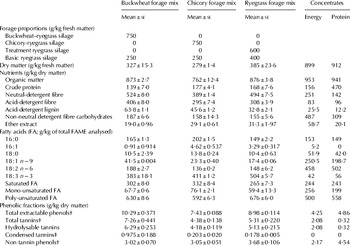
The experimental plants included the flowering catch crop plant buckwheat (Fagopyrum esculentum var. Lileija), the biennial forage herb chicory (Cichorium intybus var. Puna) and Italian ryegrass (Lolium multiflorum ssp. Westerwoldicum var. Saproso). Ryegrass was cultivated alone. Buckwheat and chicory were sown in mixture with ryegrass. This was done to reduce the risk of ensiling failure by having a certain proportion of well ensilable forage (ryegrass) in the sward since reliable information on ensilability of the two catch crops was lacking. Harvest (buckwheat cut in its flowering stage) from all cultures was wilted for 2 d after cutting and ensiled in small bales (average weight of 57 kg per bale) without additives. At harvest, the proportions of buckwheat and chicory (wet weight) were 0·69 and 0·51, respectively. As the plants tested have not yet been intensively investigated and a very high intake may have unwanted side-effects like low palatability or even impairment of health, the harvests were blended with additional ryegrass silage in the buckwheat and chicory treatments in a ratio of 3 : 1 for experimental feeding (Table 1). After making this second dilution, the pure plants in the diets still made up a major proportion of the diet (final proportions of 0·46 of the total diet for buckwheat and 0·34 for chicory; see also Kälber et al. Reference Kälber, Kreuzer and Leiber2012). Two concentrates were fed at 1 kg/d per cow each. One, mostly consisting of maize (0·35 of total), wheat bran (0·31) and wheat (0·25), was providing energy, the other provided protein mainly from soybean meal (0·79) and maize gluten (0·11). Furthermore cows were supplemented with 150 g/d of a vitamin-mineral premix. Prior to the experiment cows had received a mixed ryegrass–maize–silage–hay diet. Concentrate had been offered in amounts covering requirements for milk yield. More details on cultivation, silage quality and composition of the mixed forages, concentrates and mineral–vitamin premix are given in Kälber et al. (Reference Kälber, Meier, Kreuzer and Leiber2011, Reference Kälber, Kreuzer and Leiber2012), while the chemical composition of forage mixtures and concentrates is specified in Table 1.
Composition of the experimental forage mixtures (n = 2) and concentrates (n = 1)

† Expressed as gallic acid equivalents
‡ Expressed as leucocyanidin equivalents
Eighteen late-lactating dairy cows mostly of Holstein-Friesian breed were used. On average cows weighed 659 ± 49 kg (mean±sd), were lactating for 233 ± 64 d and yielded 21·4 ± 4·2 kg milk/d. Average initial fat and protein concentrations in fresh milk were 47·4 ± 6·8 g/kg and 36·1 ± 2·2 g/kg, respectively. In a complete randomised design, six animals were allocated to each of the three dietary treatments (buckwheat, chicory and ryegrass control) by balancing for milk yield, stage of lactation as well as milk fat and protein contents. During the 15 d of experiment, 9 d served for adaptation to the diet (which is sufficient for persistent changes in the fatty acid profile; Coppa et al. Reference Coppa, Gorlier, Lonati, Martin, Russo and Lombardi2012) and 6 d for milk collection and intake recording. The experiment was conducted gradually with two animals from different treatments being tested at the same time. For sample collection, cows were moved from a free-stall barn, where cows had sufficient access to feed bins (cow : bin ratio, 1 : 1; bin width 1·0 m), to a tie-stall barn, where bins equipped with automatic balances were refilled with the experimental forages at 06:45 and 11:00 a.m., and 2:30, 5:30 and 7:30 p.m. to allow ad libitum access to the forages. Concentrates and mineral premix were fed in separate bins after milking. Cows were milked at 5:00 a.m. and 3:40 p.m. Milk amounts were registered at each milking. The experiment was approved by the cantonal veterinary office of Zug, Switzerland (approval no. ZG 48/07).
Sampling and laboratory analysis
On two dates during the experiment samples mixed from two bales per silage were taken. Concentrate was sampled once. Feed dry matter and proximate composition were determined using standard procedures (Kälber et al. Reference Kälber, Kreuzer and Leiber2012). Total extractable phenols (TEP), non-tannin phenols and condensed tannins were analysed following Makkar (Reference Makkar2003). Different from that, gallic acid replaced tannic acid as reference standard and polypyrrolidone was used to separate non-tannin phenols from total tannins. Condensed tannins were analysed using the butanol–HCl–iron-method and expressed as leucocyanidin equivalents, whereas all other phenols were expressed as gallic acid equivalents. Total tannins were calculated from the difference between TEP and non-tannin phenols. Soluble carbohydrates (without neutral detergent fibre [NDF]) were computed by the following equation:
 $$ {\rm Non \hbox{-} NDFcarbohydrates} = \cr \tab \quad{\rm organic}\;{\rm matter} - {\rm NDF}-{\rm crude}\;{\rm protein}-{\rm ether}\;{\rm extract}-{\rm TEP}.}$$
Dietary lipids were extracted from the dry feeds using accelerated solvent extraction (ASE 200, Dionex Corp., Sunnyvale, CA) with hexane:propane-2-ol (3 : 2 vol/vol). Fatty acids were transformed into FA methyl esters (FAME) following Khiaosa-ard et al. (Reference Khiaosa-ard, Bryner, Scheeder, Wettstein, Leiber, Kreuzer and Soliva2009). As internal standards, C11:0 and C21:0 (Fluka, Steinheim, Germany) were added. The FAME were analysed with a gas chromatograph (model HP 6890, Hewlett-Packard, Palo Alto, CA) equipped with a flame ionisation detector on a Supelcowax-10 column (30 m × 0·32 mm, 0·25 μm; Supelco Inc., Bellefonte, PA) after split injection (1 : 30) at 270 °C. The injection volume amounted to 2 μl. Hydrogen flow was 2·2 ml/min. The temperature program was taken from Leiber et al. (Reference Leiber, Kreuzer, Nigg, Wettstein and Scheeder2005a). Sunflower oil was used as external standard to calculate the response factor.
During 5 d prior to the experiment (baseline) and during the collection period milk samples were taken for each cow at each milking. One aliquot was preserved with 2-bromo-2-nitropropane-1,3-diol (Bronopol; D and F Inc., Dublin, CA, USA) and stored at 4 °C for later analysis of fat, protein and lactose by near-infrared technique (MilkoScan 4000, Foss Electric, Hillerød, Denmark). Another aliquot was stored at −20 °C without additives and later pooled by milk amounts for baseline and collection period. For FA analysis, 5 ml of the defrosted and gently mixed samples were diluted in 5 ml of 1,4-dioxan containing triundecanin, tetradecenoic acid and trivalerin as internal standards. After transesterification (Suter et al. Reference Suter, Grob and Pacciarelli1997), FAME were injected into the same gas chromatograph as used for feeds (split of 1 : 30; injection volume: 1 μl; flow of hydrogen carrier gas: 1·5 ml/min), but equipped with a SIL88 column (100 m × 0·25 mm, 0·2 μm; Varian Inc., Darmstadt, Germany). The temperature program was adopted from Leiber et al. (Reference Leiber, Kreuzer, Nigg, Wettstein and Scheeder2005a). The FA were identified based on a FAME standard (Supelco 37 Component, Supelco Inc.) and by comparison with chromatograms of milk lipids from similar approaches (Collomb & Bühler, Reference Collomb and Bühler2000; Kramer et al. Reference Kramer, Blackadar and Zhou2002). The mass of individual FA was calculated by integrating the respective peak areas and applying an external response factor (correcting for the differing area response of different chain-lengths) and the internal standard 11 : 0.
Renneting properties were determined in 50-ml aliquots of milk from the collection period pooled from morning and evening milking of days 12 and 13 according to milk yield. Skimmed milk was obtained by centrifugation (1000 g, 4 °C, 30 min), whereof 10 ml were preheated for 30 min to 32·5 °C and then mixed with 200 μl of chymosin solution (Maxiren 180, DSM, Cedex, France; diluted at 1 : 20 in aqua bidest.). Using a Lattodinamografo (Foss, Padua, Italy), rennet coagulation time (RCT, min from adding chymosin), coagulation dynamics (K 20; min from start to 20 mm of amplitude in curd firmness) and curd firmness after 30 min (A 30; amplitude in mm) were measured. The cows’ κ-casein genotypes were determined in milk by PCR of restriction fragment length polymorphism following Schlieben et al. (Reference Schlieben, Erhardt and Senft1991). The κ-casein allele (A, B, and E) frequencies found were: buckwheat group, 0·70, 0·20, 0·10; chicory group, 0·63, 0·12, 0·25; ryegrass group, 0·67, 0·33, 0, respectively. In three cows, the genotype could not be determined; probably because of being from twin births. No data were available from one cow in cheese-making properties due to a lack of coagulation. This had probably been a result of high somatic cell counts (263 000/ml), measured as a standard trait along with the infrared analysis of the milk (data not shown).
Statistical evaluation
Data was subjected to ANOVA using the GLM procedure of SAS (version 9.2, SAS Institute Inc., Cary, NC) with treatment as fixed factor. Milk yield and composition data from the baseline period served as covariates. Multiple comparisons among the treatment means were carried out by Tukey's method. Differences were considered as significant at P < 0·05.
Results
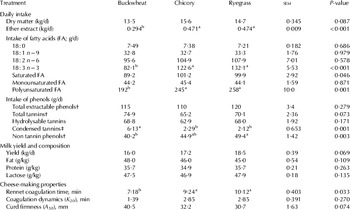
Dry matter intake did not differ between groups, but was rather low considering the body weight of the cows. Consequently, the body weight declined during the adaptation period in all groups (−3·6, −4·4 and −3·5 kg/d for buckwheat, chicory and ryegrass, respectively; P = 0·95). The intake of lipids (ether extract) was lower in the buckwheat compared with the chicory and the ryegrass group (P < 0·05; Table 2). The low 18 : 3 n − 3 concentrations in the buckwheat-containing silage resulted in lower 18:3 n − 3 intakes compared with chicory and ryegrass (P < 0·05). Intakes of 18 : 0, 18 : 1 n − 9 and linoleic acid (18 : 2 n − 6) did not differ among groups. At similar TEP intake, intakes of total tannins were numerically (P = 0·07) higher in the buckwheat group than in the chicory (0·87 of that found with buckwheat) and ryegrass (0·94) groups. For condensed tannins the intake was three times higher (P < 0·05) from the buckwheat than from the other two diets.
Intake from the total diets, milk yield and cheese-making properties (n = 6 per diet). Values without a common superscript are different at P < 0·05

† Expressed as gallic acid equivalents
‡ Expressed as leucocyanidin equivalents
Milk yield and its gross composition did not differ among groups (Table 2). With buckwheat, RCT (P < 0·05) was shortest (0·78 and 0·71 of the time found with the chicory and ryegrass groups, respectively). Firmness of the curd (A 30) and coagulation dynamics (K 20) were not significantly different between treatment groups.
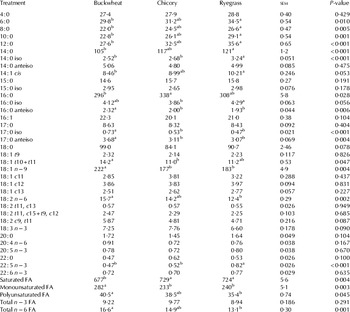
Milk fat from the chicory and ryegrass treatments was richer in saturated FA (Table 3), whereas cows fed on buckwheat silage produced milk fat with about 1·2-fold higher proportions of monounsaturated FA (P < 0·05). The proportion of polyunsaturated FA was higher (P < 0·05) in the buckwheat than in the ryegrass treatment. In case of the saturated FA, this was obvious in almost all short- and medium-chain FA up to 16 : 0 (an exception was 4 : 0). The concentrations of total n − 6 and 18 : 2 n − 6 were about 27% higher (P < 0·05) with buckwheat compared with the ryegrass treatment while the chicory treatment ranged in between. The concentration of 22 : 5 n − 3 was elevated (P < 0·05) with the ryegrass treatment. No treatment differences occurred regarding the proportions of total n − 3 and 18 : 3 n − 3 and most of the intermediates of ruminal biohydrogenation, namely 18 : 2 c9, t11, 18 : 2 t11, c13 and 18 : 2 t11, c15 (co-eluting in the chromatogram with 18 : 2 t9, c12). Only 18 : 1 t11 (co-eluting with 18 : 1 t10) was higher (P < 0·05) in the buckwheat than in the chicory treatment. The proportion of the branched chain FA was higher (P < 0·05) in milk fat from the buckwheat than that from the chicory treatment while values were intermediate in the ryegrass group.
Profile of milk fatty acids (FA, g/kg total FAME) from cows fed on buckwheat silage, chicory silage and ryegrass silage (n = 6 per treatment). Values without a common superscript are different at P < 0·05

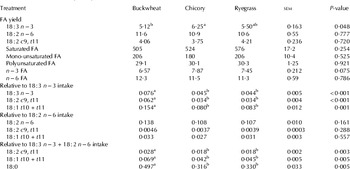
Yields of groups of FA and selected individual FA did not differ (P > 0·1) among treatments except for 18 : 3 n − 3 yield being lowest (P < 0·05) with buckwheat, intermediate with ryegrass and highest with chicory (Table 4). The ratio of 18 : 3 n − 3 secreted with milk to 18 : 3 n − 3 ingested with feed (apparent recovery) was highest (P < 0·05) with buckwheat. The same was true for the ratios of 18 : 2 c9, t11 and 18 : 1 t11 (+t10) to dietary 18 : 3 n − 3. The apparent recovery of dietary 18 : 2 n − 6 in milk did not differ (P > 0·1) among treatments, as was also the case for the ratios of 18 : 2 c9, t11 and 18 : 1 t11 (+t10) to dietary 18 : 2 n − 6. In relation to the ingestion of both major PUFA, the appearance of 18 : 2 c9, t11 and 18 : 1 t11 (+t10) and 18 : 0 was always highest (P < 0·01) with buckwheat.
Milk fatty acid yield (FA, g/d) and ratios of the secretion of key fatty acids to intake of 18 : 3 n − 3 and 18 : 2 n − 6 (n = 6 per treatment). Values without a common superscript are different at P < 0·05

Discussion
Effects on milk fatty acid profile
One aim of the present study was to investigate whether silages with high proportions of buckwheat and chicory affect the milk FA profile of dairy cows in a direction considered favourable for human health. This had been demonstrated to some extent before when feeding fresh buckwheat and, less clearly, when feeding fresh chicory (Kälber et al. Reference Kälber, Meier, Kreuzer and Leiber2011).
When replacing ryegrass silage, the buckwheat-containing silage had clear effects on milk FA profile while effects of chicory silage were minor. With buckwheat, the milk fat was richer in PUFA, especially 18 : 2 n − 6, and in 18 : 1 n − 9; this especially at the expense of the less desired medium-chain (and short-chain) FA, i.e. FA resulting exclusively or mainly from de novo synthesis. As expected from previous findings (Kälber et al. Reference Kälber, Meier, Kreuzer and Leiber2011), the lower 18 : 3 n − 3 intake in the buckwheat treatment was not accompanied by a lower 18 : 3 n − 3 concentration in milk fat compared with the other treatments. The apparent recovery of dietary 18 : 3 n − 3 in milk was correspondingly increased. This may mean that there was a certain inhibition of the first step of ruminal 18 : 3 n − 3 biohydrogenation by the buckwheat silage (Cabiddu et al. Reference Cabiddu, Decandia, Addis, Piredda, Pirisi and Molle2005). At the same time, the secretion of biohydrogenation products with the milk was also elevated in relation to PUFA intake, indicating that the subsequent steps in the biohydrogenation pathway, including the last one from 18 : 1 t11 to 18 : 0, might have been partially inhibited when feeding buckwheat silage (Khiaosa-ard et al. Reference Khiaosa-ard, Bryner, Scheeder, Wettstein, Leiber, Kreuzer and Soliva2009). Under physiological conditions always a very large part (>90%; Vasta et al. Reference Vasta, Mele, Serra, Scerra, Luciano, Lanza and Priolo2009) of the 18 : 3 n − 3 ingested is biohydrogenated. Thus, even small changes in the biohydrogenation rate of 18 : 3 n − 3 lead to large differences in the accumulation of this PUFA (Jayanegara et al. Reference Jayanegara, Kreuzer, Wina and Leiber2011). Consequently, also the accumulation of biohydrogenation intermediates may largely differ (Leiber et al. Reference Leiber, Tsvetkova, Petrova, Kreuzer and Scheeder2010) in cases where the subsequent steps are inhibited, too. However, as 18 : 2 c9, t11 is not only a ruminal biohydrogenation product of 18 : 2 n − 6, extra 18 : 2 c9, t11 could also have been synthesised endogenously in the mammary gland (Griinari et al. Reference Griinari, Corl, Lacy, Chouinard, Nurmela and Bauman2000) in the presence of larger amounts of 18 : 1 t11. This complexity makes the interpretation with regard to ruminal biohydrogenation rather difficult with this FA.
Plant secondary compounds, especially phenols, are known to act as inhibitors of ruminal biohydrogenation (Vasta et al. Reference Vasta, Mele, Serra, Scerra, Luciano, Lanza and Priolo2009; Cabiddu et al. Reference Cabiddu, Salis, Tweed, Molle, Decandia and Lee2010; Jayanegara et al. Reference Jayanegara, Kreuzer, Wina and Leiber2011). As elevated TEP concentrations (g/kg dry matter) had been found in green buckwheat (26) and chicory (18) relative to ryegrass (13) (Kälber et al. Reference Kälber, Meier, Kreuzer and Leiber2011), a higher extent of protection of 18 : 3 n − 3 and of formation of 18 : 1 t11 (Khiaosa-ard et al. Reference Khiaosa-ard, Bryner, Scheeder, Wettstein, Leiber, Kreuzer and Soliva2009) had been expected with the silages as well, especially as Nishino et al. (Reference Nishino, Kawai and Kondo2007) stated that the process of ensiling does not affect TEP content. Actually, although being harvested from the same cultivations as those fed green, contents of TEP were even slightly lower in chicory silage (7 g/kg dry matter) than in ryegrass silage (9). In buckwheat (10 g/kg dry matter), a difference in TEP to the ryegrass was given, but it was much smaller than that found in the green harvests. Therefore, it seems as if ensiling caused substantial phenol losses in all three forages especially with chicory, which might explain the lack of response of milk FA profile to this forage. Modes of action of tanniferous phenols, being elevated in buckwheat silage, could consist of direct inhibitory effect on ruminal microbes (Cabiddu et al. Reference Cabiddu, Salis, Tweed, Molle, Decandia and Lee2010) or protecting dietary FA by binding to the lipids (He et al. Reference He, Shi and Yao2006). Condensed tannins have been shown to inhibit the first step (Jayanegara et al. Reference Jayanegara, Kreuzer, Wina and Leiber2011) but also the last step of biohydrogenation (Khiaosa-ard et al. Reference Khiaosa-ard, Bryner, Scheeder, Wettstein, Leiber, Kreuzer and Soliva2009). Vasta et al. (Reference Vasta, Mele, Serra, Scerra, Luciano, Lanza and Priolo2009) provided in vitro evidence that tannins may enhance 18 : 1 t11 as well. It can, however, not be excluded that other, non-phenolic, plant secondary compounds prevalent in buckwheat (Wijngaard & Arendt, Reference Wijngaard and Arendt2006) or more general nutritional factors have been responsible for this activity.
A completely different explanation for the apparently high recovery in milk of 18 : 3 n − 3 and 18 : 2 n − 6 at low intakes, as it was the case for buckwheat, was provided by Khiaosa-ard et al. (Reference Khiaosa-ard, Klevenhusen, Soliva, Kreuzer and Leiber2010). They stated that an underlying homoeostatic-type of effect ensured a sufficient occurrence of these FA in milk. Mobilisation and preferential oxidation of different FA in metabolism might be control factors here. However, as proportions of these FA in milk differed from green forage feeding (Kälber et al. Reference Kälber, Meier, Kreuzer and Leiber2011), this mechanism, if existing, does not seem to aim at maintaining one fixed threshold level.
From a human nutritional point of view, the increase of 18 : 1 t11 in milk fat when feeding buckwheat silage can be considered as relevant and desirable (van Wijlen & Colombani, Reference Van Wijlen and Colombani2010).
Effects on cheese-making properties
In milk used for hard cheese production, a high curd firmness (A 30) is of great importance. Producers additionally try to decrease rennet coagulation time and to improve coagulation rate (K 20). The buckwheat and chicory silages had clearly lower energy contents than the ryegrass silage (Kälber et al. Reference Kälber, Kreuzer and Leiber2012). Expected consequences of this would have been a lower milk protein (casein) content and impaired coagulation and curd firmness (Clark & Sherbon, Reference Clark and Sherbon2000). This has been observed before, irrespective of whether reductions in energy supply were resulting from different forages (Leiber et al. Reference Leiber, Nigg, Kunz, Scheeder, Wettstein and Kreuzer2005b) or less concentrate (Berry et al. Reference Berry, Büeler, Jewell, Sutter and Kreuzer2001; Bovolenta et al. Reference Bovolenta, Saccà, Corrazin, Gasperi, Biasioli and Ventura2008). However, in the present study, milk protein content (4/5 of which is casein) did not differ among treatments (initial differences were adjusted by covariance analysis) and coagulation time was even shorter with the buckwheat treatment. This suggests some potential of the buckwheat diet to improve rennet coagulation. The milk protein genotype of the cows, especially the κ-casein variants, may play an important role (Pagnacco & Caroli, Reference Pagnacco and Caroli1987). However, the A allele, less favourable than B and E in terms of rennet coagulation properties, always made up about 2/3 of total on average of the cows of the present treatment groups. Verdier-Metz et al. (Reference Verdier-Metz, Coulon, Pradel, Viallon and Berdague1998) demonstrated that there is no substantial difference in rennet coagulation properties between milk of cows fed silage and hay produced from the same sward, suggesting that the process of ensiling does not generate specific properties of the forage either. To a limited degree, dietary effects on the milk protein composition are possible (Leiber et al. Reference Leiber, Nigg, Kunz, Scheeder, Wettstein and Kreuzer2005b), which might also influence the coagulation properties and, consequently, cheese yield (Ikonen et al. Reference Ikonen, Ruottinen, Syväoja, Saarinen, Pahkala and Ojala1999). However, the mechanisms causing the favourable effect of feeding silage containing buckwheat on cheese-making properties remain unclear and warrant detailed studies.
Out of the silages from the two herbs, buckwheat-containing silage was the one clearly affecting milk FA profile and cheese-making properties in comparison with common ryegrass silage, and this mostly in a desired direction. The recovery of 18 : 3 n − 3 and the occurrence of 18 : 1 t11 were promoted suggesting that buckwheat silage may influence ruminal biohydrogenation. However, the magnitude of the changes in concentrations and secretion of the beneficial FA with the milk was limited. Buckwheat silage could be an interesting component in diets of dairy cattle also because it seems to have a certain potential to improve the cheese-making properties of the milk.
The authors gratefully acknowledge the support provided by the Swiss Grassland Society (AGFF; Zurich) and the Fenaco UFA Samen (Sursee, Switzerland). Furthermore the authors want to thank Dr H.-R. Wettstein and the staff of the ETH Research Station Chamau for their assistance and support during the experiment, L. Bieri for her help investigating the cheese-making properties as well as C. Kunz and the laboratory staff for their help with the analysis.