Introduction
Studies about family care in Australia are based primarily on the lived experiences of Anglo-Australian families. This paper contributes to an under-researched area and develops understandings about the heterogeneous experiences of Chinese families providing care to their elderly relatives. Broader research on family care has predominantly focused on women's experiences of caring, care-givers’ health and wellbeing, government responsibilities for carers and service delivery options (Berecki et al. Reference Berecki, Lucke, Hockey and Dobson2007; Carers Ministerial Advisory Committee 2005; Department for Families and Communities, South Australia 2006; Gill et al. Reference Gill, Jury, Avery, Warmington, Stacey and Taylor2007; Jenkins et al. Reference Jenkins, Rowland, Angus and Hales2003; McMahon, Hardy and Carson Reference McMahon, Hardy and Carson2007; Williams and Owen Reference Williams and Owen2009). In recent years there has been a growth in studies on culturally and linguistically diverse populations and ageing and family care (Cardona, Chalmers and Neilson Reference Cardona, Chalmers and Neilson2006; Thomas Reference Thomas2003; Warburton, Bartlett and Rao Reference Warburton, Bartlett and Rao2009). Nevertheless, a focus on specific cultural groups such as Chinese immigrants continues to be limited in Australia despite growing research in the United States of America, Canada and the United Kingdom (e.g. Hsueh, Hu and Clarke-Ekong Reference Hsueh, Hu and Clarke-Ekong2008; Janevic and Connell Reference Janevic and Connell2001; Lai Reference Lai2010; Lai et al. Reference Lai, Tsang, Chappell, Lai and Chau2007; Lai and Leonenko Reference Lai and Leonenko2007; Laidlaw et al. Reference Laidlaw, Wang, Coelho and Power2010; Lan Reference Lan2002; Lo Reference Lo2004; Lo and Russell Reference Lo and Russell2007; Mahoney et al. Reference Mahoney, Cloutterbuck, Neary and Zhan2005). Given the increasing numbers of older Chinese in Australia,Footnote 1 it is now timely to examine their experiences of ageing (Rao, Warburton and Bartlett Reference Rao, Warburton and Bartlett2006; Hughes, Ozanne and Bigby Reference Hughes, Ozanne and Bigby2009; Hugo Reference Hugo2004).
However, whilst it is important to acknowledge that Chinese culture and ethnicity shape experiences of caring (e.g. Chiu and Yu Reference Chiu and Yu2001; Dilworth-Anderson, Williams and Gibson Reference Dilworth-Anderson, Williams and Gibson2002; Hsueh, Hu and Clarke-Ekong Reference Hsueh, Hu and Clarke-Ekong2008; Lan Reference Lan2002; Neufeld et al. Reference Neufeld, Harrison, Stewart, Hughes and Spitzer2002), how individuals within that culture understand, interpret and act upon these meanings is less known. Within some of the ageing and care literature there has been a homogenising and/or ‘othering’ of Chinese families which excludes cultural shifts and diverse values, knowledges and practices of caring. In these cases commonly a binary between eastern and western cultures is reproduced about meanings of family, ageing and the emotions and practices associated with caring. For example, Pinquart and Sörensen (Reference Pinquart and Sörensen2005: 92) have argued that western culture ‘places higher emphasis on individualism, whereas the eastern approach to caregiving emphasises collectivism or placing family welfare ahead of one's personal interest’. Similarly, Liu and Kendig (Reference Liu, Kendig, Liu, Kendig and Kendig2000: 5) suggest that care-giving in East Asian cultures emphasise mutual dependency, and caring for ageing family members throughout the lifespan, contrary to the west's value of independence. These authors are referring to the traditional cultural obligation towards elderly parents known as ‘filial piety’ ( ) (Chow Reference Chow2004; Hseuh, Hu and Clarke-Ekong Reference Hsueh, Hu and Clarke-Ekong2008; Lai Reference Lai2007, Reference Lai2010; Laidlaw et al. Reference Laidlaw, Wang, Coelho and Power2010). In this paper we examine the concept of filial piety and in particular the value given to this concept by Chinese families living in Australia in an attempt to avoid reproducing hegemonic understandings of cultural patterns of care among East Asian families.
Thus, our focus is on uncovering meanings of filial piety among Chinese care-givers in relation to their elderly parents to allow any intra-cultural differences to emerge. In order to explore the complexity of family care we draw on four in-depth face-to-face semi-structured interviews with Chinese care-givers in metropolitan Adelaide in Southern Australia. The paper begins with a discussion of Confucianism, its philosophical foundations and how these have shaped traditional society and family culture for Chinese families. The research design is outlined and we present the findings, which converge under three inter-related themes. The first theme examines heterogeneity across families and demonstrates how carers subjectively construct and reconstruct meanings of filial piety. The second explores how meanings and practices of filial piety are shaped by the diasporic experiences of Chinese families and the third examines the tensions that emerge in families as a consequence of elder care and constructions of filial piety.
Chinese ‘culture’: the Confucian way?
Confucius’ teaching is conceived to be the ‘moral backbone’ and the ‘grand synthesis’ of Chinese culture (Rosenlee Reference Rosenlee2006: 2). Although for centuries, traditional Chinese culture has been shaped by various schools of thought including Buddhism, Tao and Confucianism. Family is perceived as the basic unit of society (Tu 2000: 205). Based on the five virtues: ‘ren’ ( ) or benevolence, ‘yi’ (
 ) or integrity and uprightness, ‘li’ (
 ) or rituals and propriety, ‘chih’ (
 ) or moral understanding, and ‘shin’ (
 ) or trust, Confucius and other thinkers believed that by observing proper decorum and propriety, a harmonious family and a strong society would result. Through the concept of ‘ren’, ‘filial piety’ as a value and practice was developed.
Confucianism refers to ‘the way, the method, of right conduct’ for the individual and for the state (Creel Reference Creel1956: 139). Dominating Chinese thought and world-view, this ancient philosophy started with Hsün Tzu (313–238 BC), Mencius (372–289 BC) and Confucius (551–479 BC) and spread its influence to various regions in East Asia (Berthrong Reference Berthrong1998; Chai and Chai Reference Chai and Chai1965; Chow Reference Chow2004; Creel Reference Creel1956). Under the impact of Confucian tradition, the family is perceived as the basic unit of society where core values are transmitted (Tu Reference Tu2000).
It is ‘ren’ () or benevolence, which is seen as the ‘prime virtue of life’ (Chai and Chai Reference Chai and Chai1965: 3). ‘Ren’ stresses a proper form of conduct in human relations that produces positive efforts for the good of others. It begins with natural feelings of affection within the family, and forms the foundation for differentiated relationships in state and society (Wilhelm Reference Wilhelm1972: 144). ‘Ren’ is the root for filial piety (xiao ). And filial piety is considered one of the core values in Chinese culture; it involves respect and care for the elderly with affection and gratitude. It is concerned with repaying the sacrifice parents made for their children in their lifetime and continues even after their death (Sung Reference Sung1998). Filial piety is said to be more than the younger generation showing respect to the elderly. It is considered to be a cultural value highly regarded by the Chinese which provides a strong influence motivating adult children to care for their elderly parents (Chow Reference Chow2004; Lai and Leonenko Reference Lai and Leonenko2007). Further, filial piety demands that parents are treated with courtesy; mere material provision without the expression of reverence or respect cannot be called filial piety (Sung Reference Sung1998). Traditionally, Chinese elders are said to enjoy a prominent position. Honoured and respected by the younger generation, their honoured positions are not only based on love but also on having some control over financial resources (Mackinnon, Gien and Durst Reference Mackinnon, Gien and Durst1996). Sung (Reference Sung, Bengtson, Kim, Myers and Eun2000) suggests that in contemporary times despite the prominence of filial piety, Chinese culture is undergoing change due to children living away from home for employment, smaller family size, and change in family structure from intergenerational to nuclear families. In addition, Thomas (Reference Thomas2003) claims that older Asian migrants who have emigrated and live with their children in a new country may want to continue to live traditionally but the younger generation often find these values in conflict with the culture of the ‘West’ and may not wish to practise them. Moreover, there may be a reversal in power relationships if elders are not financially independent and/or have limited understanding of the language of the country they have immigrated to, requiring them to rely on adult children for assistance (Ng, Phillips and Lee Reference Ng, Phillips and Lee2002: 140).
Thus, these studies are suggesting that the traditional parent–child relationship in Chinese culture is undergoing change (Sung Reference Sung, Bengtson, Kim, Myers and Eun2000: 45–6). Rather than family support being characterised by inter-dependence among its members, children are now perceived as individuals who are autonomous and self-determining. Sung (Reference Sung, Bengtson, Kim, Myers and Eun2000: 46–7) suggests that these changes result in a shift in the intergenerational relationship from one that is ‘authoritarian’ to one that is increasingly ‘affection’ based (Sung Reference Sung, Bengtson, Kim, Myers and Eun2000: 46–7). While for some, the care of ageing parents involves adapting to new filial practices and simultaneously keeping their filial heritage, for others, it means replacing their filial heritage (Hsueh, Hu and Clarke-Ekong Reference Hsueh, Hu and Clarke-Ekong2008: 776). Hsueh, Hu and Clarke-Ekong (Reference Hsueh, Hu and Clarke-Ekong2008) argue that filial heritage is most likely to undergo change as adult children undertake higher education and receive better paid employment, weakening the importance of respect, and moral and emotional support to parents.
Research design
A small and varied self-selected sample of four participants constituted the complete sample of this study. Four semi-structured face-to-face interviews were held with three male and one female participant caring for elderly parents and or parent-in-laws (one Malaysian Chinese and three Vietnamese-Chinese). Given that participants self-selected for interview and the small and exploratory nature of the study, sample construction does not necessarily reflect the gender, age or ethnicity of carers in the broader Australian-Chinese community. For example, in Australia there are not necessarily more male care-givers than female and most Chinese families are not necessarily of Vietnamese origin. Moreover, there is little national quantitative data indicating the numbers of Chinese carers by age, gender or ethnicity to indicate the demography of carers in Chinese-Australian families.
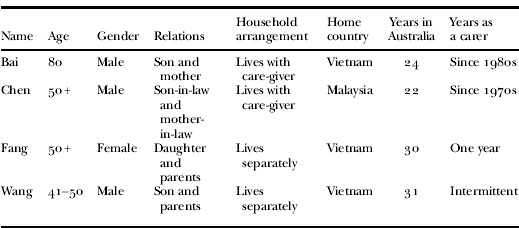
As Table 1 indicates, participants have lived in Australia for more than 20 years and all were first-generation migrants of Chinese ancestry, having arrived in Australia during the 1970s and 1980s from Vietnam and Malaysia. Thus, they migrated as children or young adults with one participant arriving in his fifties. Participants were over 50 years of age with one being over 80 years.
Participants’ profile
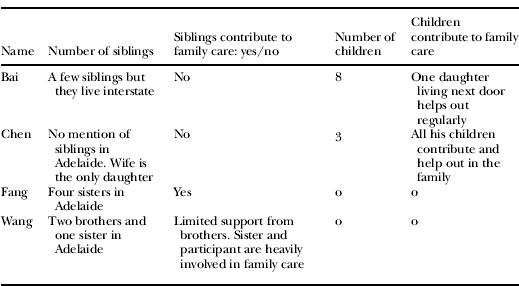
As Table 2 indicates, half the participants care for their parents, and in one case parent-in-law, with the assistance of other family members. All but one participant was assisted by their spouse to care for their aged parent or in-laws. Half of the participants had children who assisted with caring for their aged grandparents. Most were caring or had been caring for their relatives for more than 20 years. Two of the four participants lived with the relatives they were caring for and provided daily care including showering, toileting, dressing, preparation of meals and other tasks as required. The remaining two participants lived separately from their elders and shared caring responsibilities where possible with their siblings.
Participants profile by family structure
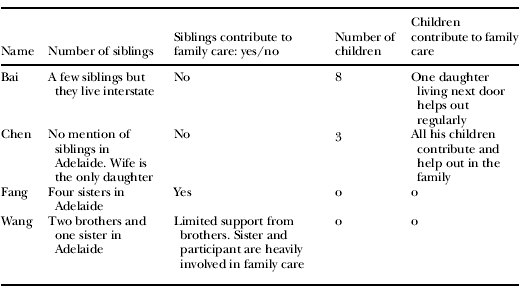
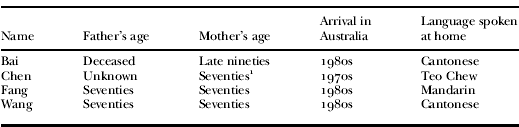
Table 3 shows that most parents being cared for were in their seventies with one elderly parent being in her nineties. Most arrived in Australia in the 1970s or 1980s and had limited or no fluency in English. Few had a spouse living.
Profile of parent's receiving care
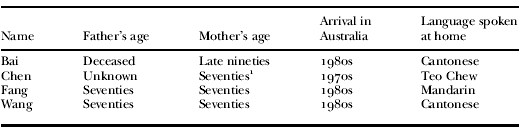
Note 1.: Mother-in-law.
Interviews were conducted at participants’ homes. Each interview took approximately one hour, and was audio taped and transcribed. All interviews were conducted in English, with the exception of one being conducted in Mandarin by the first author. The interviews focused on obtaining demographic data, exploring care-giver's daily experiences of caring for their parents, their identification of cultural influences on meanings of caring, and their views on ageing.
The study was granted ethics approval by the University of South Australia and the government department from which the sample was drawn. The sample was recruited from an aged care service provider in South Australia, Domiciliary Care SA, an organisation situated within the Department for Families and Communities (Government of South Australia 2009). Service co-ordinators from Domiciliary Care made initial contact with potential participants by telephone to determine if they were interested in participating in the study. These carers were selected for contact based on their Chinese ethnicity, and their proficiency in English, Mandarin or other Chinese dialects. Potential participants were given a brief statement about the purpose of the study, the possible benefits or risks of participating in the research, and an outline of research questions. If participants expressed interest in the study they were sent information sheets and consent forms in English and Chinese. Once participants agreed to take part in the study, they returned consent forms to the agency whereupon they were contacted by the research team to arrange an interview.
Thus, this exploratory study is built from a purposive sample of Chinese care-givers who access government assistance through domiciliary services available in the area in which they live. The role of social services is explored in further work (see Lim Reference Lim2010), in this paper we give primacy to meanings of filial piety and how they are negotiated within families. We recognise that as these families do access social services their experiences and understandings of filial piety are likely to differ from those who do not. We also recognise that further research is required to examine the experiences of Chinese care-givers who do not access community services to assist with caring for their aged family members.
Data were analysed using an interpretive approach to reveal themes, patterns, gaps, replication or difference across the narratives (Patton Reference Patton2002). The inductive analysis of the data revealed three dominant themes: the first, heterogeneity among families and the subjective meanings of filial piety. The second considers the diasporic experiences of filial piety as families practise caring outside their country of origin, and the third examines the inherent tensions experienced by carers between the values of filial piety and the daily practise of caring. The findings of this small sample underscore that diaspora and cultural shifts or questions occur among and within Chinese-Australian families with regard to filial piety and elder care. These themes are likely to be relevant among a larger sample and may be further examined in future research by focusing on how ageing is experienced by family members within a representative sample of Australian-Chinese families who have migrated to Australia from different origins by class and geography and during different waves of immigration. Indeed, discussions below which focus on the concepts of heterogeneity, subjectivity and diaspora each by their very definitions invite further questions about diversity and practices of filial piety in relation to aged parents.
Heterogeneity, subjectivity and meanings of filial piety
Studies of filial piety suggest that there is likely to be an erosion of filial piety principally as countries like China become increasingly modernised and as Chinese families living in western economies adapt to and participate in new cultures (Cheung and Kwan Reference Cheung and Kwan2009; Yan, Reference Yan2010; Zimmer and Kwong Reference Zimmer and Kwong2003). Research examining contemporary practices of filial piety in relation to the aged has mostly been quantitative in focus, explaining change to filial piety in the context of structural and or demographic determinants (e.g. Cheung and Kwan Reference Cheung and Kwan2009; Guo, Chi and Silverstein Reference Guo, Chi and Silverstein2011; Zuo, Wu and Silverstein Reference Zuo, Wu and Silverstein2011). This body of literature has focused on issues like geographic distance between families as adult children migrate for study or work, fertility reduction and accelerated ageing as being detrimental to filial piety (Chi and Silverstein Reference Chi and Silverstein2011). In this article we give particular attention to subjectivity and differences associated with meanings of filial piety as although filial piety held similar meaning among participants, the way in which it was practised in caring for parents was diverse. This diversity in practice is explicable with regard to well accounted for structural factors such as material and demographic circumstances but is also explicable in relation to subjectivity. We suggest that the importance of subjectivity and agency has been somewhat missing in studies of filial piety, largely leaving unexamined people's stories and their interpretation of cultural norms.
The theorising of subjectivity as a concept has a long and diverse history across social science disciplines, in particular philosophy, sociology, psychology and cultural studies (e.g. Grosz Reference Grosz1994; Weedon Reference Weedon1999). Common to this body of knowledge is the idea that subjectivity is more than the self or individual. Mansfield (Reference Mansfield2000: 2) concisely distinguishes between the subject and the self. He argues that ‘the word self does not capture the sense of the social and the social entanglement implicitly in the word “subject”’. It is this conceptualisation of the subject and subjectivity as socially constituted through political, legal and cultural fields in relation to institutions and other subjects that remains less developed in studies of filial piety. Further, the interrelationships between constructions and reconstructions of the subject will occur in the context of the subject's interpretation of societal changes or cultural shifts, thereby shaping their understandings and practices of filial piety (e.g. Giddens Reference Giddens1991; Weedon Reference Weedon1997).
All participants maintained that filial piety was a duty and for some living together was an important requirement of filial care. As scholars have suggested, however, mientze, that is, keeping face to avoid social stigma, is also culturally important. Thus, it would be unusual for Chinese families to openly report a significant rupture to beliefs associated with filial piety (Kuo Reference Kuo2010; Lan Reference Lan2002). Nevertheless, closer inspection of meanings of filial piety show heterogeneity across the sample informed by the differing and for some multiple subject positions they held as family members, carers and workers. Subject positions as carers were in turn mediated by gender, age and placement in the family (Chappell and Kusch Reference Chappell and Kusch2007; Chesley and Poppie Reference Chesley and Poppie2009).
We begin our analysis with Bai, who is positioned as an older man caring for his 98-year-old mother. For him filial piety is closely associated with his own experience and expectations of ageing. He is 80 years of age and explains that his attitude to ageing changed according to his own ageing. Bai tell us:
We only live our life once. I have one mother. When I get older, I realise that. You too will understand that. When you live to my age, there are many inconveniences. But my children help me with family matters, with English, they help me. But if my mum wants me to do something for her, if I am able to do that, I'll do it.
As Cheung and Kwan (Reference Cheung and Kwan2009) suggest, age is likely to shape meanings of filial piety for carers who are ageing as they become increasingly aware of their own needs for future care. Bai's comments affirm his belief in filial piety despite the demands and hardships associated with caring for his 98-year-old mother. He also receives help in specific areas like language from his children. Thus, Bai implies that while he cares for his mother, his children care for him, implying that filial piety is both cyclical and reciprocal. Bai, as an aged man, shows a reflexivity about the ageing process which may not necessarily stem from filial piety and which is evident in his comment, ‘we only live our life once’. Interestingly, this statement is a departure from traditional culture considering that Bai is Buddhist and Taoist faith teaches reincarnation.
For Fang, whose parents spent a year living with her when they were unwell, filial care is to provide comfort, give encouragement and support. As a daughter care-giver, she believes that children have a duty of care towards their parents. Fang explained:
We have five girls in the family. I am the eldest daughter in the family, and I have the responsibility to care for my parents. My siblings are all married, they have their own children.
Fang being the eldest daughter has more filial responsibility compared to her sisters. Confucianism teaches that family members have mutual, life-long obligations toward each other (Schwarz et al. Reference Schwarz, Trommsdorff, Zheng and Shi2010). Whilst it is expected that adult sons and their wives are the main care-givers (Hsueh, Hu and Clarke-Ekong Reference Hsueh, Hu and Clarke-Ekong2008; Schwarz et al. Reference Schwarz, Trommsdorff, Zheng and Shi2010; Sung Reference Sung1998), adult daughters are commonly seen as the ones who care for their parents in a material, emotional and spiritual way (Donorfio and Sheehan Reference Donorfio and Sheehan2001; Holroyd Reference Holroyd2003; Mui Reference Mui1995; Walker, Martin and Jones Reference Walker, Martin and Jones1992). Fang's comments indicate her belief and practice in filial piety. Whilst her caring practices do not overtly reconstruct meanings of filial piety, she acknowledges that these meanings are negotiated within families and that there are limits to the extent or types of demands parents might make. She explains:
Sometimes elderly parents expect too much, so (long pause) I don't know, it depends on different families, you know. I don't say every family will pay respect or care or look after their elderly parents but most families do, it is the values, the culture.
Confucianism and gendered norms are among the key factors that shape care-giving for Fang, however, strong spousal support and financial status are other significant factors. Fang said that her husband was ‘very good’ and ‘understanding’ and had been respectful towards her parents when they moved in with them. Fang also disclosed that she was financially able to work three days a week since she had completed payments on her house mortgage and that part-time work allowed her to give more time to her parents. Zhan and Montgomery (Reference Zhan and Montgomery2003) argue the employment status of the care-giver and the receipt of a pension by the elder influence the number of care-giving hours, and the level of financial assistance provided by an adult child. Thus, for Fang while filial piety is important her material conditions and those of her parents (who receive a monthly aged pension from the government) enable her to practise filial piety.
Unlike Bai and Feng, Chen understands filial piety as a restrictive tradition and actively attempts to resist and reconstruct norms of caring. Chen is a son-in-law in his sixties who has assisted his wife (an only child) in caring for her mother since their marriage. Chen informed us that caring for his wife's mother who has been living with them for 22 years has not been easy and the relationship was tense. Despite this he explains that ‘filial care is an obligation, a life-time commitment’. However, Chen also explained that he and his wife have considered placing his mother-in-law in a nursing home, but feared that she might be unable to adapt to the unfamiliar environment and feel isolated. Chen explained that his unease was compounded by his mother-in-law stating that: ‘if I have to go to the nursing home, I would rather starve to death’. Chen tell us that this was not simply a threat from his mother-in-law as when migrating to Australia they had left her in a nursing home in Kuala Lumpur and ‘she went on a hunger strike … so after three months after our arrival, we brought her to Australia’. Chen's narrative illustrates that Chen believes that his mother-in-law understands filial piety as an intractable right. However, Chen and his wife are attempting to create new filial practices that allow external interventions in caring for their elderly relative. Traditional meanings of filial piety sit uneasily with Chen, despite emotionally being brought back to cultural norms through the demands of his mother-in-law. His meanings of filial piety are shaped by the subject position of son-in-law and his wife's position as an only child. Further, Chen and his wife have no children. Hence, Chen unlike other participants in the study had no familial support to assist with caring for his mother-in-law and this is likely to influence how he constructs filial care.
Wang is younger than the other participants. He is in his forties and is employed full-time. He is the primary carer for his parents who are in their seventies and live in state housing. He is an eldest son who recognises shifting meanings associated with filial piety and social change. He understands that relationships are now more reciprocal and egalitarian rather than hierarchical. He explained that in his family, relationships with his siblings were changing. In the past, his younger siblings used to address him as ‘oldest’ brother according to his ‘rank’ in the family. Sung (Reference Sung1997: 89) argues that filial practices in recent times have gradually shifted. Moving away from authoritarian and patriarchal relationships to more egalitarian and reciprocal relationships is changing the way respect, care and concern are shown between generations and genders.
When asked about his understanding of filial care, Wang also noted social changes. He explained:
they [the Vietnamese] look after their elderly as best they can. In fact as a young boy … I used to watch my mom care for my grandma. She had a stroke and was bedridden.
Wang acknowledged that in his home country, there were no support services for the elderly. Adult children were expected to live with their parents and shoulder caring responsibilities. Despite ‘acute poverty’, Wang revealed that people seemed to live a much simpler life and had more time to care for one another, for example:
They don't work the sort of hours that we work. Often they are self-employed for one, two hours and they have enough to live on for that day and that's about it. There is a lot of down time, they sit around. However, life in Australia is different.
Wang's subjective experiences of filial piety are shaped by demographic factors like his age, where he now lives and material circumstances, however, they are also shaped by his interpretation of these conditions – as Bai stated ‘life in the past was simpler’.
Thomas (Reference Thomas2003: 42) claims that some adult children who have migrated to a new country feel the ‘clashes of cultures’, and are torn between values adhered to by people of the older generation and the dominant values of the host country. It is these potential ‘clashes of cultures’ which are reflected in Bai's narrative which we now examine.
Chinese diaspora: negotiating cultures
The conceptualisation of diaspora has been theorised, developed and debated among social scientists since the 1990s (e.g. Brah Reference Brah1996; Clifford Reference Clifford1994; Gilroy Reference Gilroy1993; Hall Reference Hall1993). At its core diaspora refers to the experience of originating from one country, land or place and living in another. As Anthias (Reference Anthias1998: 566) suggests, it is often ‘identified with the idea of particular sentiments toward the homeland, whilst being formed by those of the place of settlement’. At times the concept has been used as a unifying construct thereby homogenising experiences of subjects who have settled in other countries (Ahmed Reference Ahmed2000; Ang et al. Reference Ang, Brand, Noble and Sternberg2006). In Australia, for example, the migration experiences of Chinese families differ, often according to country of origin and wave of migration. The experience of Chinese Vietnamese families fleeing Vietnam to settle in Australia is a stark contrast to, for example, middle-class Hong Kong Chinese families settling in Australia as a consequence of policies encouraging skilled migration (Ip, Liu and Chui Reference Ip, Liu and Chui2007; Weston, Qu and Soriano Reference Weston, Qu and Soriano2003). The concept of diaspora is useful in calling attention to how subjects negotiate the practice of filial piety in their country of settlement. As Anthias (98: 565) suggests, diaspora allows for an examination of ‘the destabilising effect of transition and movement of the individuals’ cultural certainties [which] may be explored and the ontological … effects researched’. In this sample, the majority of carers arrived in Australia with little resources and no tertiary education. The exceptions are Chen and Fang, however it is Cheng and Wang with their different countries of origin and life experience who share similar ‘destabilising effects of transition and movement’ (Anthias Reference Anthias1998: 565).
The most commonly expressed experiences of diasporic sentiment shaping practices of caring related to the question of whether to place elderly parents in nursing homes. In conjunction, the ‘destabilising’ of traditions of filial piety occurred as carers juggled both work and caring.
The nursing home was for all participants the material manifestation of shame in relation to filial care. Chen explained that about 12–14 years ago, the local Chinese community raised funds to build a nursing home for the Chinese aged and with government support, they were given land. However, after the completion of the building, Chen said that:
Nobody wants to move in. All the Chinese … prefer to keep all the old ones. Nobody wants to move in, so we lost the place to another … community.
The raising of funds and the building of the nursing home in this instance indicates a willingness to alter filial practices within the community but individuals were unable to use this facility without emotional tension and guilt. Chen explains his emotions and the ontological impact of using the nursing home for his mother-in-law. He says:
Yeah, difficult … because we know very well that she won't last very long in the nursing home.
Besides the lack of respite support services for care-givers like Chen, he also said there were frustrating moments when he and his wife thought that they had ‘enough’ and had considered on several occasions putting his mother-in-law in a nursing home. Chen's experience of filial care indicates that the notion inherent in some of the literature on caring for the aged that culture buffers families from stress is questionable (Holroyd Reference Holroyd2003; Ip, Liu and Chui Reference Ip, Liu and Chui2007; Ishii-Kuntz Reference Ishii-Kuntz1997; Lo Reference Lo2004; Thomas Reference Thomas2003). Indeed, Chen's narrative also makes clear the autonomy held by his mother-in-law showing that practices of filial piety are dynamic and are reproduced and maintained on the basis of relations between those who are cared for and their carers. Thus, practices of filial piety are not static, but constructed and reconstructed on a daily basis. Indeed, whilst they are constituted in the context of diaspora, they are also re-constructed in the context of family dynamics.
Fang and Wang, who both have paid employment, reported that their ability to practise filial piety was difficult where work and finances have demanded time away from family. For Fang, a network of siblings and part-time paid employment allowed her to care for her parents. Wang, on the other hand, explained difficulties in the practice of filial piety as differences in lifestyle in Vietnam and Australia. He explains:
Well yes, you know, it is rather tricky … we are kind of living in two cultures. For our family, for people like us who kind of grew up in this country, there are certain expectations. We are to some extent caught up [in] the mainstream society … everybody works long hours, big mortgages to pay, all that stuff, and then, competing with that, is our sense of responsibility towards our parents and it is not an easy thing to balance.
As many studies across continents show, Chinese adult children caring for their aged parents experience difficulties fulfilling cultural values associated with filial piety as they compete with the demands of paid work and caring (Cheung and Kwan Reference Cheung and Kwan2009). For Wang, the competing demands of filial piety, providing economic, social and emotional support are difficult. He works full time to provide financial support for his family, which includes his parents, and finds it a strain to balance his multiple subject positions, as an eldest son, a husband and a male care-giver. He tells us:
Multiple roles … I guess we are all carers and cared for in some ways. My wife is my carer and together we support some of her siblings. Her sister in Sydney has a history of mental health issues … my wife also has folks back in Vietnam … she also has a sister … born with some sort of disability … we are actually financially supporting them … What I am saying is that, unless you work in a … full-time job, a lot of people [in Vietnam] still have a lot of time to sit around. They don't have a lot of money but they have a lot of time to sit around and care for one another. Whereas in the western world, everyone is running around.
Further, Wang questions and reflects on his reality of practising filial piety and uses words like ‘tension’, ‘real dilemma’ and ‘extra responsibility’. He explains:
So I guess when Dad is no longer around, who is going to stay with and care for mum. That's … an issue of tension at the moment … my sister has got a young boy, only two years old … an active boy, … I find it a real dilemma myself, because in many ways, my wife is my carer, and I don't want to put extra responsibility on her. And as for my other two brothers, one is living with his in-laws anyway, so that there is no way he is able to do that.
Wang also notes that there are changing power dynamics among family members and cultural tensions within Vietnamese-Chinese Australian families that impact on caring. He suggests that there is a difference between past practices of caring in Vietnam and contemporary practices among those families who have migrated to Australia. He suggests:
When I was growing up in the [19]60 s/70 s, older people in the family had power. Even when my grandmother was cared for [by] my mum, even though she could hardly speak or move, she was the boss in the house.
For all participants what were once what Anthias (Reference Anthias1998: 565) describes as ‘cultural certainties’ are now important beliefs, emotions and ties that at times create tension and are ‘destabilising’ but are almost always negotiated and reconstructed in families.
Cultural reconstructions? Family tensions
The challenges and reconstruction of filial piety when caring for elderly parents are evident in participants’ narratives of everyday struggles. These struggles are embedded in family dynamics where carers reinterpret and recreate meanings of filial piety through their subjective aspirations and their interactions with their parents. For example, whilst in traditional Chinese families, it is uncommon that sons-in-laws live with their wife's family, this was not the case for Chen. There is also an expectation that daughters-in-law are obliged to care for their husband's parents and Wang's wife's experiences depart from this tradition. Tensions and negotiations about filial responsibilities and rights were evident across the sample, however, Chen and Wang's narratives are the most blatant given their breaks with tradition. Thus, we use Chen and Wang as examples of overt shifts to practices of filial piety. Chen shares a tense relationship with his mother-in-law, whereas Wang, being the eldest son, discloses that he feels torn between his parents and his wife, who do not get on well together.
For Wang, the most persistent tension in being able to provide filial care is the strained relationship between his wife and his parents. Wang explains:
My parents are very formal. She is from a different type of family. Even though we live in the same kind of culture, you have such diversity in terms of family culture. She grew up in a family that has an open door policy, a very loud big family. My parents are very controlled and very organised. There are so many rules to what you do, how you speak. My wife finds it very intimidating.
Wang's wife resists traditional requirements associated with caring for her in-laws. Wang, aware of the strain between family members, is concerned that should anything happen to him, his siblings and his wife will be unable to care for his parents. He explains that his sister is struggling to raise her child and that she is unlikely to be able to care for her parents. He explains:
My sister has a young boy – he is not very easy. She does really struggle with her boy, an active boy.
Interestingly, Wang does not expect the same filial care from his sister to his parents nor from his wife to his parents, suggesting a shift for Wang in cultural and gendered understandings of filial piety. As Sung (Reference Sung, Bengtson, Kim, Myers and Eun2000) and Shih and Pyke (Reference Shih and Pyke2010) argue, there is evidence of changes to family structures or indeed diverse family structures from the traditional conceptualisation of family as intergenerational. Further, inherent in Wang's narrative there are considerations of autonomy and difference among families and family members that suggest a shift in Wang's perception of patriarchal authority to greater reflexivity and consideration of women's lives. These changes are reflected in studies on Chinese culture across continents (e.g. Shih and Pyke Reference Shih and Pyke2010; Sung Reference Sung, Bengtson, Kim, Myers and Eun2000; Thomas Reference Thomas2003).
In contrast, Chen's family dynamics are characterised by clashes of patriarchal authority, on the one hand, and filial practices associated with age and caring, on the other. Chen's relationship with his mother-in-law was strained from the beginning of his marriage when she went on a hunger strike in a nursing home in Malaysia. Shortly after their migration to Australia they felt compelled to arrange for her to live with them. Chen tells us how difficult it is for him and his wife to live with his mother-in-law:
Well, she doesn't listen. When she feels like it, she will talk to you and when she doesn't she won't talk. Someone needs to be at home with her. When my Mrs is at home with her, at times my mother-in-law gets noisy and screams. My Mrs gets sick of it, she just has to go out for a drive.
When asked about his opportunity for leisure time, Chen responded in frustration ‘at home there is no personal time at all. Sometimes I just go downstairs and stay away from her. Because she is very irritating.’
However, Chen confessed that at times he felt a little confused by his mother-in-law's behaviour and he explained:
When grandkids come … she is very good to them. She can communicate and talk … But when it comes to us, she does (not), sometimes we do not know if she is pretending or acting or whatever … She told me that so and so son-in-law is not like you. I replied so and so mother-in-law is not like you. It is just difficult.
Thomas (Reference Thomas2003) argues that older migrants may experience loss of independence when they leave their home country to reunite with their children. Their inability to speak a foreign language, and increasingly social and economic dependence on adult children, may result in the reversal of parent–child authority. It is likely that Chen's mother-in-law is working hard to maintain her authority.
Whilst studies on son-in-law care-givers in the Chinese context have been limited, it can be understood that the tensions between Chen and his mother-in-law are informed by a conflict of roles within the patriarchal and hierarchical Chinese family system. Men or male figures are often perceived as the head of the household, whereas senior family members including mothers-in-law are highly respected because of age and seniority. Chen's circumstance demonstrates the clash of two systems within the Chinese family structure, a situation of ‘gender’ versus ‘age’. As a son-in-law, Chen is expected to honour senior family members; however societal norms also require him to assert his authority as the head of the household.
In conclusion
The assumption that in Chinese-Australian families, filial piety informs caring practices is inherent in earlier literature on ageing and indeed in hegemonic understandings about ageing and Chinese culture in Australia. This homogenising assumption implies a static view of Chinese culture and ignores intergenerational change and changes to values associated with living in a culture different to one's culture of origin.
Our findings suggest difference among families in regard to cultural expectations and practices of caring. Specifically, such differences were evident in gender, with for some families gender becoming less hierarchical and defined with practices of caring. Thus, such was the case for Chen and Wang who took on major caring roles for their mother and mother-in-law. However, we know little about Chinese men as carers, how caring shapes their identity and performance of varying forms of masculinity. Feminist gerontologists have drawn attention to the lack of literature on men's ageing per se (e.g. Fennel and Davidson Reference Fennel and Davidson2003; van den Hoonard Reference van den Hoonard2007). They have argued that experiences of widowhood and caring have been explored predominantly from women's perspectives. Adding to this critique we suggest that monocultural understandings about both ageing, and ageing and caring have also dominated the literature on gender and ageing.
Additionally, whilst participants maintained that filial piety was a duty and for some living together was an important requirement of filial care, most had adopted less traditional filial practices with their aged parents living in separate households. Interwoven throughout the narratives of meanings of filial piety and practices of filial piety are not surprisingly the importance of emotions which shape the day-to-day aspects of caring. Emotions like love, frustration, fear and anger experienced by those being cared for and those giving care were central to constituting filial care. Indeed, one may argue that filial piety is an emotion as much as it is a practice. How the emotion of filial piety is interpreted and expressed is what has been of interest in this study. There were clear examples of those being cared for overtly using emotion to claim space and power within families and the most strident of these was Chen's mother-in-law who would scream or go on hunger strikes if she did not agree with the family. Carers talked about the emotional demands, tensions and conflict associated with caring. Consequently, further work exploring how emotions inform and shape power relations within Chinese families caring for the aged would allow for more nuanced understandings of subjectivities, meanings and practices of filial piety.
Some studies have suggested that Chinese culture is changing and filial piety is diminishing in some Asian societies with ‘affection’ rather than ‘duty and obligation’ informing intergenerational relationships. In this exploratory study we found that filial piety was central to the beliefs and practices of carers, but what differed was a shifting in the way filial piety is practised and the variation in ways of practising filial piety across these four Chinese-Australian families.