Introduction
Screening of herbicide-resistant weed populations provides useful information regarding their geographical distribution. Dissemination of such knowledge aids in slowing further proliferation of herbicide-resistant weeds, as informed land managers are better suited to engage in proactive weed management practices (Beckie Reference Beckie2011). Successful propagation of weeds in controlled environments is paramount in laboratories performing herbicide-resistance screening, yet the innate periodicity of germination for many weed species can make this an arduous task, as researchers may be unable to obtain a sufficient number of viable plants for testing. Consequently, methods to alleviate dormancy and improve germinability of weed seeds have been historically desirable (Everson Reference Everson1949).
Giant ragweed (Ambrosia trifida L.) is a highly competitive (Harrison et al. Reference Harrison, Regnier, Schmoll and Webb2001) summer annual weed species belonging to the Asteraceae family. Surveys of corn (Zea mays L.) and soybean [Glycine max (L.) Merr.] producers (Gibson et al. Reference Gibson, Johnson and Hillger2006; Kruger et al. Reference Kruger, Johnson, Weller, Owen, Shaw, Wilcut, Jordan, Wilson, Bernards and Young2009), in addition to Certified Crop Advisors (Regnier et al. Reference Regnier, Harrison, Loux, Holloman, Venkatesh, Diekmann, Taylor, Ford, Stoltenberg, Hartzler, Davis, Schutte, Cardina, Mahoney and Johnson2016), throughout the Midwest consistently rank A. trifida as one of the most problematic weeds, due in part to the spread of biotypes resistant to acetolactate synthase–inhibiting herbicides and/or glyphosate. Frequently referred to as a seed, involucre is the more appropriate botanical description of the A. trifida dispersal unit. The involucre consists of a seed-bearing achene surrounded by embryo-covering structures composed of an ovary wall membrane, pericarp, and involucral hull. To remain consistent with the majority of the literature, “seed” will be used hereafter. Physiological dormancy in A. trifida is caused by endogenous inhibition of the embryo (embryo-imposed) in addition to covering structure impedance of the embryo (coat-imposed) (Davis Reference Davis1930; Schutte et al. Reference Schutte, Regnier and Harrison2012). The sum and interaction of these mechanisms govern the extent of how deep-seated dormancy lies (for review, see Finch-Savage and Leubner-Metzger Reference Finch-Savage and Leubner-Metzger2006). The net effect of both embryo- and coat-imposed dormancy in A. trifida is reduced respiration. Tieng (Reference Tieng1962) identified glutaric acid, citric acid, and coumarin as respiration-inhibiting chemicals in both the pericarp and embryo. Moreover, Davis (Reference Davis1930) reported CO2 release from excised embryos to be more than 2-fold greater than intact seeds.
Baskin and Baskin (Reference Baskin and Baskin2004) proposed a classification system consisting of deep, intermediate, and non-deep physiological dormancy. While the vast majority of higher plants are classified as non-deep (Baskin and Baskin Reference Baskin and Baskin2004; Finch-Savage and Leubner-Metzger Reference Finch-Savage and Leubner-Metzger2006), observations by Page and Nurse (Reference Page and Nurse2015) describe A. trifida as having an intermediate level of physiological dormancy. Characteristics of this level include: excised embryos produce normal seedlings, cold stratification of 2 to 3 mo breaks dormancy, dry storage tends to shorten the stratification requirement, and gibberellic acid (GA3) promotes germination in some species (Baskin and Baskin Reference Baskin and Baskin2004). To date, the preponderance of studies of herbicide-resistant A. trifida have employed stratification of seeds in cool, moist soil to improve germination (Harre et al. Reference Harre, Nie, Jiang and Young2018; Moretti et al. Reference Moretti, Van Horn, Robertson, Segobye, Weller, Young, Johnson, Sammons, Wang, Ge, d’Avignon, Gaines, Westra, Green, Jeffery, Lesperance, Tardif, Sikkema, Hall, McLean, Lawton and Schulz2018; Norsworthy et al. Reference Norsworthy, Jha, Steckel and Scott2010; Vink et al. Reference Vink, Soltani, Robinson, Tardif, Lawton and Sikkema2012; Westhoven et al. Reference Westhoven, Davis, Gibson, Weller and Johnson2008). As confirmation of herbicide-resistant populations is a time-sensitive process, a shortcoming of the soil-stratification method is that it is a lengthy procedure requiring up to 12 wk.
Following the seminal work of Davis (Reference Davis1930), other research groups have investigated methods to hasten A. trifida germination for research purposes but with limited success outside of using soil stratification (Ballard et al. Reference Ballard, Foley and Bauman1996; Tieng Reference Tieng1962). More recently, however, Page and Nurse (Reference Page and Nurse2015) investigated physical and chemical methods to shorten the stratification period or bypass it altogether. Results from this recent study showed complete embryo excision without stratification to yield 96% germination of viable A. trifida embryos. The authors acknowledged embryo excision is a delicate and labor-intensive process but concluded this is an appealing method compared with stratification due to the relative time saved. There are two reasons results from Page and Nurse (Reference Page and Nurse2015) may not be pertinent to a researcher wishing to immediately experiment with a newly collected field population of A. trifida. First, seeds were collected from a nonagricultural site, and second, seeds were stored for 9 to 10 mo at 4 C before the start of the experiment. Research has indicated levels of embryo-imposed dormancy in A. trifida to be greater in agricultural populations compared with successional populations (Schutte et al. Reference Schutte, Regnier and Harrison2012). Furthermore, afterripening in cold storage has been shown to reduce A. trifida dormancy (Davis Reference Davis1930). Collectively, these factors may explain why germination of nontreated seeds was unusually high (60%) compared with past literature.
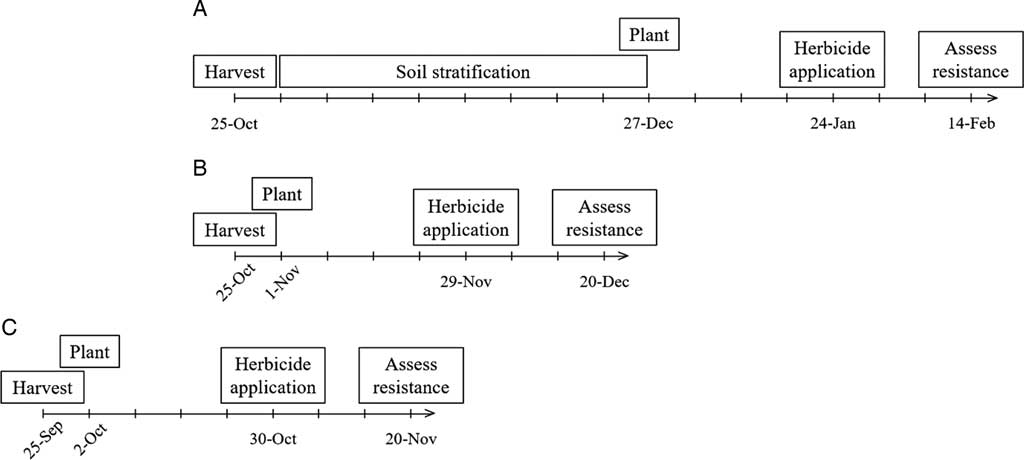
The objective of this research was to explore methods to hasten A. trifida germination in a more labor- and time-efficient manner than current practices. Results of this work will be useful to a researcher investigating putative herbicide-resistant populations by expediting the confirmation process as depicted in Figure 1.
Timely results are critical in a herbicide-resistance screening program. Ambrosia trifida seeds are typically harvested around the same time as crop harvest in mid- to late October to facilitate maturation. The time from planting to resistance assessment is based on prior experience propagating A. trifida in the greenhouse (Harre et al. Reference Harre, Nie, Robertson, Johnson, Weller and Young2017). (A) The predominant method used for A. trifida propagation involves an 8-wk period of stratification of seeds in cool, moist soil resulting in a minimum of 112 d between harvesting in the field and herbicide-resistance results. (B) Eliminating soil stratification alone would yield results in half the time. (C) A method that eliminates soil stratification and enables seeds to be collected earlier in the growing season has potential to yield results 86 d sooner than conventional methods.

Materials and Methods
Seed Collection
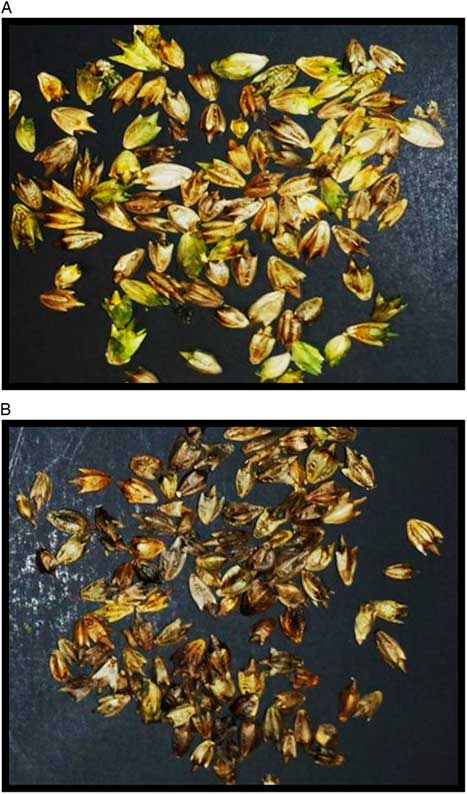
Ambrosia trifida seeds were collected in 2014 and 2015 from identical locations at the Throckmorton Purdue Agricultural Center (40.2969°N, 86.9036°W) near Lafayette, IN. Historically, the population exhibits an extended emergence period spanning from March through July (WG Johnson, personal communication). The field site had a history of conventional tillage, and grain crops were corn in 2014 and soybean in 2015. Collection dates for each year were September 25 and October 25; hereafter referred to as “early” and “late” collections, respectively. These dates were selected to collect seeds that differed in maturity, as indicated by seed color (Figure 2). At each collection, seeds from 20 plants were combined into a composite sample. This sample size was selected to adequately incorporate genetic variability for allogamous species such as A. trifida (Burgos et al. Reference Burgos, Tranel, Streibig, Davis, Shaner, Norsworthy and Ritz2013).
Differences in Ambrosia trifida seed maturity as indicated by seed color: (A) green to light brown immature seed from early collection on September 25 and (B) brown mature seed from late collection on October 25.

Processing
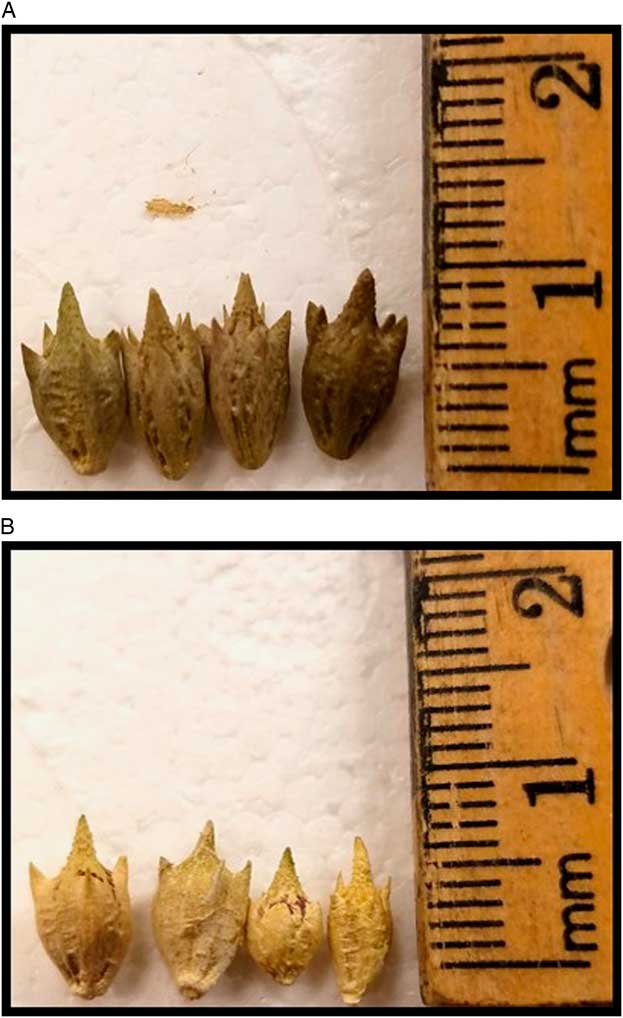
Seeds were threshed using a mechanical soybean thresher, and particulate debris was removed using a laboratory blower column (Oregon Seed Blower, Hoffman Manufacturing, Corvallis, OR). Within each sample, seeds were further sorted by size and color, as depicted for the late collection in Figure 3. This was done to obtain a uniform sample for testing and to minimize dormancy variances associated with A. trifida seed size (Schutte et al. Reference Schutte, Regnier and Harrison2008). Furthermore, seeds that did not pass the seed crush-test method (Sawma and Mohler Reference Sawma and Mohler2002) or had visible signs of insect predation (Amatangelo Reference Amatangelo1974) were discarded.
Example of late-collected Ambrosia trifida seed sorting: (A) seed uniform in size and color to be used in experiments and (B) seed uneven in size and pale in color to be discarded.

Treatments
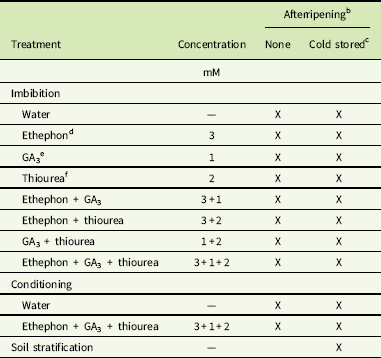
Following cleaning and sorting, seeds were immediately exposed to imbibition or conditioning treatments with no afterripening period; hereafter referred to as “non-afterripened” seeds. Additionally, seeds were stored in unsealed plastic bags at 4 C for 8 wk or exposed to soil stratification; hereafter referred to as “cold-stored” seeds. Cold-stored seeds that did not undergo soil stratification were exposed to the same imbibition or conditioning treatments as non-afterripened seeds before planting. Each of the following treatments were applied to 100 seeds and are summarized in Table 1.
Treatments applied to early and late collections of Ambrosia trifida seed.Footnote a

a Early and late collections were harvested on September 25 and October 25 each year, respectively.
b For each treatment, an “X” indicates application to non-afterripened and/or cold-stored seeds.
c Imbibition and conditioning treatments were applied after 8 wk of dry storage at 4 C, the same time and temperature criteria used for the soil-stratification treatment.
d Florel® Brand Growth Regulator, Monterey Lawn and Garden, Fresno, CA.
e GA3, gibberellic acid. Falgro® 20SP, Fine Americas, Walnut Creek, CA.
f CAS No. 62-56-6, Sigma-Aldrich, St Louis, MO.
Imbibition
Seeds were placed in petri dishes (60 by 15 mm) lined with filter paper (Whatman Grade No. 1 Filter Paper, GE Healthcare Bio-Sciences, Pittsburgh, PA) and 6 ml of deionized water or chemical solution were applied (Table 1). Concentrations were selected to be within the range reported in the literature of these chemicals alleviating seed dormancy (Brocklehurst et al. Reference Brocklehurst, Rankin and Thomas1982; Kȩpczyński Reference Kȩpczyński1986; Tieng Reference Tieng1962; Willemsen and Rice Reference Willemsen and Rice1972). Due to the large size of A. trifida seeds (approximately 0.5 by 1 cm), filter paper was also placed over the top to facilitate even distribution of the solutions. Petri dishes were placed in a laboratory incubator at 21 C (Abul-Fatih and Bazzaz Reference Abul-Fatih and Bazzaz1979) for 48 h. After 24 h, 3 ml of deionized water or chemical solution were added to maintain sufficient moisture for imbibition.
Conditioning
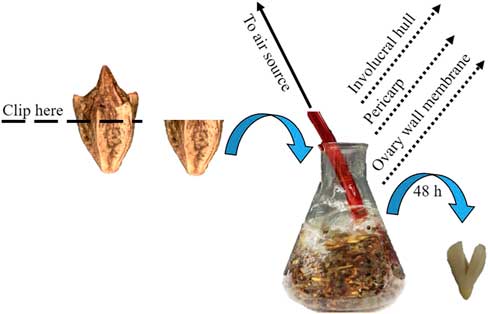
An overview of this method is shown in Figure 4. The crowns of A. trifida seeds were removed by clipping at the widest point with a razor blade. The crown section of the involucral hull, which also contained a small portion of endosperm, was discarded. The clipped seeds were then placed into a 250-ml erlenmeyer flask, and the flask was filled with 200 ml of chemical solution or deionized water (Table 1). A flexible hose attached to a laboratory bench air supply was inserted into the flask so that the end of the hose was touching the bottom of the flask. Aluminum foil covered the flask opening to prevent evaporation and stabilize the air hose. Air was slowly supplied so as to avoid splashing of the solution out of the top of the flask, yet ensuring seeds were in a constant tumbling action in the solution (Supplementary Video 1). After 24 h, the aeration process had expelled the majority of embryos from the involucral hulls, pericarps, and ovary wall membranes. As the embryo is the only component of A. trifida seeds that does not float, contents of the flask were slowly poured out and discarded, leaving only embryos. Flasks were refilled with 200 ml of chemical solution or deionized water, as germination-inhibiting compounds may be leached (Tieng Reference Tieng1962). Seeds were aerated for another 24 h to expel the remaining embryos from the enveloping structures. Embryos were placed on moist filter paper before being planted no more than 4 h later.
Schematic of the seed-conditioning method for Ambrosia trifida. Seed is first clipped at its widest point using a razor blade, and the crown section is discarded. This is done to ensure ample space for the embryo to be expelled/separated from the seed-covering structures during the aeration process. The remainder of the seed is placed in an erlenmeyer flask, and the flask is filled with deionized water or a chemical solution. Contents are aerated for 24 h before the solution is drained, refilled, and aerated for another 24 h. The tumbling action of the aeration process detaches the embryo from the involucral hull, pericarp, and ovary wall membrane (Supplementary Video 1). Upon completion of the process, the cotyledons will have become separated and the radicle end swollen.

Soil Stratification
Seeds were placed inside wire mesh bags (20-cm long by 15-cm wide) and buried no less than 4-cm deep in a plastic cooler containing a 3:1 mixture of nonsterilized sand:soil, saturated with water approximately at field capacity. The mesh size was 2 mm and was selected to ensure seeds remained in the bag, yet allowed sand and soil particulate to make direct contact with seeds. Each bag contained 10 g of seed, a quantity far greater than what was required for this experiment. Seeds were stored in this condition at 4 C for 8 wk with no further water added to the sand:soil mixture.
Planting
Greenhouse trays containing 31-cm3 cells were filled with commercial potting media (Sun Gro® seedling mix, Sun Gro Horticulture, Bellevue, WA). Intact seeds were planted 1.5-cm deep, while conditioned embryos were planted 0.5-cm deep, as preliminary work revealed this depth to optimize emergence; both were oriented with the radicle pointing down. Trays were placed in the greenhouse with day and night temperatures of 25 and 20 C, respectively (Abul-Fatih and Bazzaz Reference Abul-Fatih and Bazzaz1979). High-pressure sodium bulbs delivering 1,100 μmol m−2 s−1 photon flux density on a 16-h photoperiod supplemented natural lighting. Trays were misted with water to ensure the surface of the potting media never became dry.
Experimental Design and Analysis
An experimental unit consisted of a block of 20 cells, each planted with a single seed or embryo. Experiments were arranged as completely randomized designs with five replications and were repeated in time (2014 and 2015 collections). As the objective of this work was to ease A. trifida propagation for research purposes, emergence, rather than germination, was selected as the response parameter. For instance, the benefit to a researcher of a method improving germinability is moot if the treatment also alters growth, thus preventing normal emergence and a viable plant for testing. Emergence, defined as separated green cotyledons above the soil, was recorded daily for 18 d after planting. Total emergence (expressed as a percentage) was arcsine square-root transformed, evaluated for normality and homogeneity of variance using PROC UNIVARIATE and Levene’s test, and subjected to ANOVA using PROC GLIMMIX (SAS v. 9.4, SAS Institute, Cary, NC). Year, collection, and treatment were considered fixed effects in the model. The lengthy cold-storage period prevented experiments for non-afterripened and cold-stored seeds from being performed concurrently; therefore, experiments were analyzed separately. Means were separated using Fisher’s protected LSD (α=0.05) and back-transformed means are presented for ease of interpretation.
Cumulative emergence over the 18-d period was fit to a four-parameter Weibull function using PROC NLIN:
 $$f\left( t \right){\equals}M\left( {1{\minus}e^{{{\minus}\left[ {k\left( {t{\minus}l} \right)} \right]^{c} }} } \right)$$
where M is maximum percent emergence constrained to ≤100, k is emergence rate, t is time in days, l is lag phase in days between planting and first emergence constrained to >0, and c is the shape parameter (Brown Reference Brown1987; Brown and Mayer Reference Brown and Mayer1988).
Results and Discussion
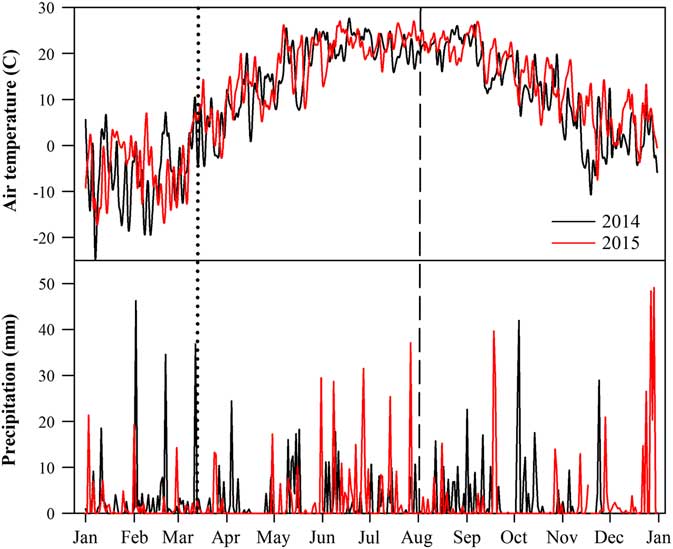
Throughout the A. trifida growing season, precipitation was greater in 2015 (13% below 30-yr average) than in 2014 (31% below 30-yr average) (Figure 5). Ambrosia trifida fecundity may differ between corn and soybean crops (Baysinger and Sims Reference Baysinger and Sims1991; Harrison et al. Reference Harrison, Regnier, Schmoll and Webb2001) and tends to improve with more available water (Kaur et al. Reference Kaur, Aulakh and Jhala2016). In addition, research on other species has shown dormancy to be affected by environmental conditions of the maternal plant (Baskin and Baskin Reference Baskin and Baskin1998; Gutterman Reference Gutterman2000; Meyer and Allen Reference Meyer and Allen1999). However, in the present study, these factors did not influence the responsiveness of A. trifida seeds to treatments intended to improve emergence (P=0.28). Accordingly, data are pooled across years. Emergence from imbibition treatments containing ethephon, GA3, or thiourea, in addition to all possible two-way combinations, did not differ from the three-way combination (unpublished data). Therefore, only data for the three-way combination (labeled as “chemical”) are presented.
Weather data across 2014 and 2015 at the Throckmorton Purdue Agricultural Center near Lafayette, IN, where Ambrosia trifida seed was harvested on September 25 and October 25 each year. Vertical dotted and dashed lines indicate the beginning of emergence and anthesis, respectively, of A. trifida in northern Indiana (Brabham et al. Reference Brabham, Gerber and Johnson2011; Johnson et al. Reference Johnson, Loux, Nordby, Sprague, Nice, Westhoven and Stachler2007).

Non-afterripened Seed
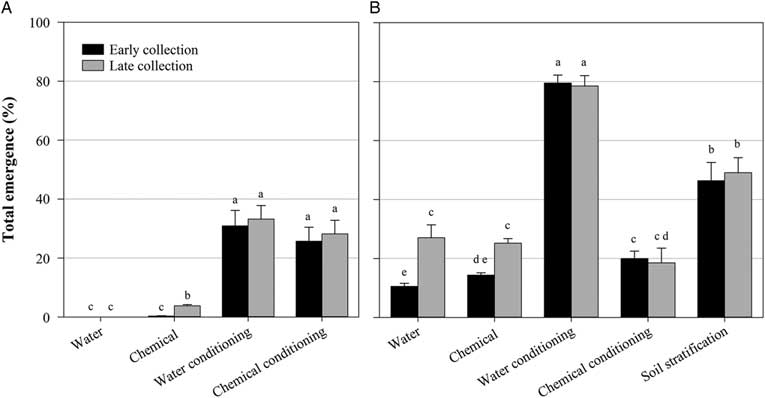
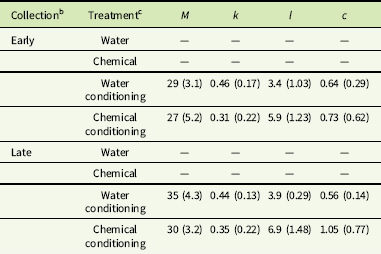
Imbibition in water alone yielded no (0%) emergence for both early and late collections (Figure 6A). Emergence improved following imbibition in chemical solution for late-collected seeds only, but was still less than 10%. The seed-conditioning process, either in water or chemical solution, produced the greatest emergence, ranging from 25% to 34%, and did not differ between early and late collections. Although parameter estimates from the cumulative Weibull distribution indicated the rate of emergence was similar between chemical-conditioning and water-conditioning treatments, the lag phase between planting and first emergence was 2.5 to 3 d longer from the chemical-conditioning treatment (Table 2). Closer inspection of seeds that did not emerge following the 18-d period revealed less than 2% had visible radicle root growth, indicating failed emergence was primarily due to the dormant state of the seed (unpublished data).
Total emergence 18 d after planting of Ambrosia trifida: (A) non-afterripened seed and (B) cold-stored seed at 4 C for 8 wk. Early and late collection dates were September 25 and October 25 each year, respectively. Chemical treatments included a mixture of 3 mM ethephon, 1 mM gibberelic acid, and 2 mM thiourea. For each graph, treatment bars with dissimilar letters are significantly different according to Fisher’s protected LSD (α=0.05). Error bars denote one standard error of the mean.

Parameter estimates of cumulative Ambrosia trifida emergence fit to a four-parameter Weibull function (Equation 1) of non-afterripened seeds.Footnote a

a Parameters (Brown Reference Brown1987; Brown and Mayer Reference Brown and Mayer1988): M, maximum percent emergence; k, emergence rate; l, lag phase (d) between planting and emergence; and c, shape of cumulative distribution. Cells with a dash (—) indicate data did not fit the model. Values in parentheses represent the SE.
b Early and late collections were harvested on September 25 and October 25 each year, respectively.
c Chemical treatments included a mixture of 3 mM ethephon, 1 mM gibberellic acid, and 2 mM thiourea.
Cold-stored Seed
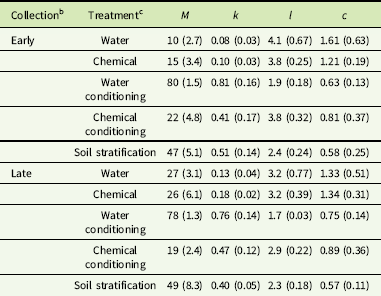
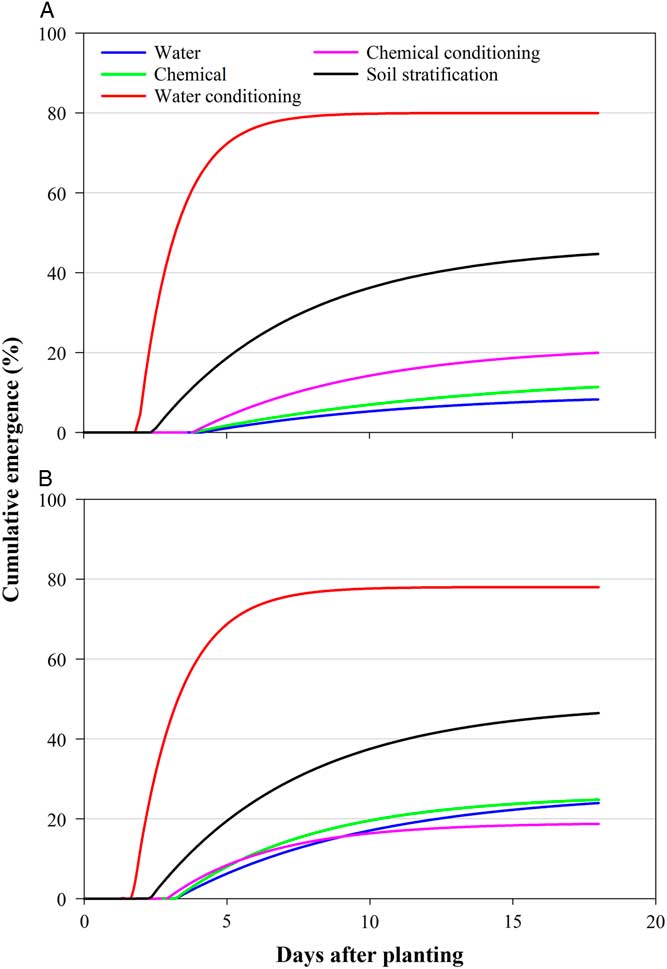
The afterripening process at 4 C for 8 wk increased emergence by 10% and 27% for early and late collections imbibed in water, respectively (Figure 6B). Imbibition in chemical solution did not improve emergence for either collection over imbibition in water. No differences in emergence were observed between early and late collections for the water-conditioning, chemical-conditioning, and soil-stratification treatments. However, efficacy among these three treatments varied greatly. Conditioning in water yielded nearly 80% emergence, while emergence from seeds conditioned in chemical solution was nearly four times less. Soil stratification was the second most effective treatment, yielding 46% to 49% emergence after 18 d across both collections.
Imbibed seeds of early and late collections, either in water or chemical solution, had the lowest germination rate and generally the longest lag phase between planting and first emergence, ranging from 3.2 to 4.1 d (Table 3; Figure 7). An apparent benefit of the water-conditioning treatment was an increase in the rate of emergence and concomitant decrease in the lag phase compared with other treatments. Compared with the widely adopted practice of soil stratification, the rate of emergence for the water-conditioning treatment was 58% to 90% greater, and emergence began at least 0.5 d earlier. The shape parameter of the cumulative Weibull distribution also provides useful information regarding emergence patterns. Values below 3.25 (Dubey Reference Dubey1967), as was the case for all treatments, specify distributions of emergence timing are positively skewed (viz., a tail of late-emerging seedlings). Thus, the more positively skewed distributions of the seed-conditioning and soil-stratification treatments (Table 3) indicate a greater proportion of seedlings emerging near the mean, with fewer sporadic late-emerging seedlings (Brown and Mayer Reference Brown and Mayer1988).
Parameter estimates of cumulative Ambrosia trifida emergence fit to a four-parameter Weibull function (Equation 1) of cold-stored seeds at 4 C for 8 wk.Footnote a

a Parameters (Brown Reference Brown1987; Brown and Mayer Reference Brown and Mayer1988): M, maximum percent emergence; k, emergence rate; l, lag phase (d) between planting and emergence; and c, shape of cumulative distribution. Values in parentheses represent the SE.
b Early and late collections were harvested on September 25 and October 25 each year, respectively.
c Chemical treatments included a mixture of 3 mM ethephon, 1 mM gibberellic acid, and 2 mM thiourea.
Cumulative emergence over 18 d of Ambrosia trifida seeds cold-stored at 4 C for 8 wk: (A) early collection harvested on September 25 and (B) late collection harvested on October 25. Chemical treatments included a mixture of 3 mM ethephon, 1 mM gibberellic acid, and 2 mM thiourea. Data were fit to a four-parameter Weibull function (Equation 1), and parameter estimates with standard errors are provided in Table 3.

The most effective treatments to improve germination are those that reduce the combined effect of embryo- and coat-imposed dormancies. The lack of emergence from non-afterripened seeds in the absence of germination-promoting chemicals is similar to results obtained by Schutte et al. (Reference Schutte, Regnier and Harrison2012), whereby nearly new seeds (45-d afterripening period at 4 C) did not germinate. Moreover, embryos investigated by Schutte et al. (Reference Schutte, Regnier and Harrison2012) did not germinate even once the embryo-covering structures were removed. The significant improvement in emergence from the water-conditioning treatment, therefore, effectively overcame both the endogenous dormancy of the embryo and impedance from embryo-covering structures of some non-afterripened A. trifida seeds, regardless of collection time. Based on studies of germination-inhibiting compounds in A. trifida embryos by Tieng (Reference Tieng1962), the release of embryo-imposed dormancy by the seed-conditioning method is likely facilitated by the leaching of these compounds during the process. This is the first report of a method alleviating dormancy in A. trifida that does not necessitate an afterripening period. Nevertheless, more than 66% of embryos from non-afterripened seeds still remained dormant following the conditioning process.
Maturation and afterripening assist primarily in alleviating embryo-imposed dormancy by several mechanisms, including a decrease in abscisic acid concentration and sensitivity, an increase in gibberellin-like substance concentration, an increase in light sensitivity, and a loss of nitrate requirement (Finch-Savage and Leubner-Metzger Reference Finch-Savage and Leubner-Metzger2006). The influence of cold-storage afterripening length on dormancy varies, yet tends to follow an inverse relationship for A. trifida (Davis Reference Davis1930; Tieng Reference Tieng1962). Results from the present study are consistent with previous findings in which a period of afterripening in cold storage largely improved emergence compared with non-afterripened seed. Results with seeds imbibed in water also indicate greater dormancy in the early collection compared with the late collection even after a period of cold storage, as physical modification to the seed (conditioning and soil stratification) was required to achieve similar levels of emergence. These findings agree with previous research indicating soil stratification and/or embryo excision to be the most beneficial techniques of promoting A. trifida germination (Ballard et al. Reference Ballard, Foley and Bauman1996; Page and Nurse Reference Page and Nurse2015).
The physical and physiological processes that occur during A. trifida stratification are not fully understood. In one case, the depletion of three phenol-extracted silver-stained polypeptides was noted in cotyledons as a result of soil stratification (Ballard et al. Reference Ballard, Foley and Bauman1996); whether these are associated with the physiological changes that occur during afterripening in the absence of soil stratification is unknown. Moreover, it has yet to be determined what effect physical contact with the abrasive sand mixture used in this method has on potentially weakening the embryo-covering structures and the influence soil and seed moisture may have on this process. Based on work performed on other weed species (Hu et al. Reference Hu, Ding, Baskin and Wang2017), dormancy release of A. trifida through soil stratification could be potentially improved by regulating these factors. The primary benefit of embryo excision, either by hand extraction with a razor blade (e.g., Page and Nurse Reference Page and Nurse2015) or by the conditioning process, is release from coat-imposed dormancy. However, this dormancy mechanism may also interact with embryo-imposed dormancy by preventing the escape of endogenous germination-inhibiting compounds from the embryo (Bewley et al. Reference Bewley, Bradford, HWM and Nonogaki2013). Thus, compared with hand extraction, the seed-conditioning process provides the potential additional benefit of expediting depletion of these compounds from the embryo.
Although this work documents a similar response to treatments from seeds collected over two different growing seasons, seeds were harvested from the same A. trifida population. Furthermore, seeds used in these experiments were sorted to select a uniform size, which may have inadvertently reduced the genetic variation of the sample (Schutte et al. Reference Schutte, Regnier and Harrison2008). Therefore, a constraint of this research is that multiple A. trifida populations consisting of different genotypes were not evaluated. As physiological dormancy may be affected by both environment and genotype in several species (Roach and Wulff Reference Roach and Wulff1987), it is possible the treatment response may vary by genotype. The seed-conditioning treatment has been used on other agricultural A. trifida populations from Indiana with success (JM Young, personal communication), yet it has not been evaluated on successional populations or populations without an extended emergence period. Indeed, A. trifida research efforts extend beyond those pertaining to herbicide resistance or even of agronomic importance (Diekmann et al. Reference Diekmann, Ford, Harrison, Regnier and Venkatesh2013), and future work to determine the efficacy of seed conditioning on these populations is justified.
Considerations
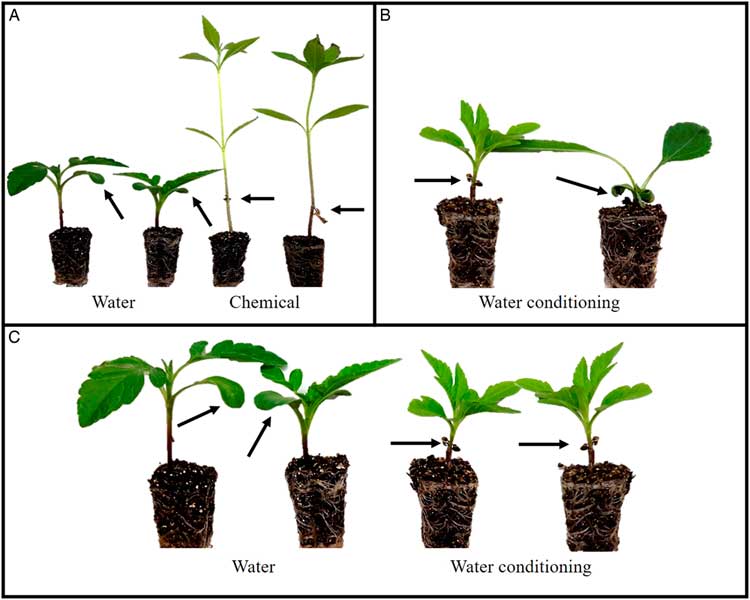
Anecdotal and/or statistical evidence of ethephon, GA3, and thiourea suggests these chemicals may have a stimulatory effect on A. trifida germination (Patzoldt and Tranel Reference Patzoldt and Tranel2002; Tieng Reference Tieng1962; Zelaya and Owen Reference Zelaya and Owen2004). However, results here indicate application of these chemicals via imbibition or through the conditioning process provided no benefit over water, except only minimally on the late collection of chemically imbibed non-afterripened seed. Furthermore, emerged seedlings that had been treated with chemical solution occasionally grew abnormally (Figure 8). It is possible that different concentrations of these chemicals may yield more favorable results. However, increasing the concentration of GA3, for example, would likely exacerbate the occurrence of elongated internode growth (Figure 8A); while Tieng (Reference Tieng1962) cautioned that increasing thiourea concentrations from 2 to 6 mM improved A. trifida germination, yet ultimately caused 50% of seedlings to die after 4 d. Additionally, abnormal seedlings would occasionally develop from the conditioning treatment as a result of damage to the plumule during the clipping process (Figure 8B). These instances can largely be avoided by ensuring seeds are clipped only at the widest point (Figure 4). Although cotyledons on seedlings from the conditioning treatments tended to desiccate sooner than nontreated seedlings (Figure 8C), true-leaf growth was similar and yielded suitable plants that have been used for experimentation (JM Young, personal communication).
The growth habit of Ambrosia trifida seedlings was occasionally altered by various treatments: (A) chemical solution of 3 mM ethephon, 1 mM gibberellic acid, and 2 mM thiourea can stimulate internode growth; (B) clipping too close to the radicle end of the seed results in damage to the plumule and abnormal growth for the seedling on the right; and (C) the seed-conditioning process damages cotyledons but yields seedlings with similar true-leaf growth to seeds imbibed in water. Arrows point to cotyledons.

Harvesting of A. trifida seeds for research purposes occurs during the fall when seeds reach full maturity, typically around mid- to late October, depending on geography (Harre et al. Reference Harre, Nie, Robertson, Johnson, Weller and Young2017; Schutte et al. Reference Schutte, Regnier and Harrison2012; Tieng Reference Tieng1962; Westhoven et al. Reference Westhoven, Davis, Gibson, Weller and Johnson2008). In situations where several populations are to be collected, this at times results in a race between the researcher collecting the field sample and the grower harvesting the crop. These results indicate use of seed-conditioning or soil-stratification techniques enable A. trifida seeds to be harvested earlier in the growing season without loss of emergence potential in the greenhouse. Compared with hand extraction of the embryo, seed conditioning requires less skilled labor, as only one incision is required, followed by extraction of the embryo through the aeration process. However, this technique still necessitates more labor than is required from using soil stratification, in which a large number of seeds can be buried together.
Based on the results of this study, the most appropriate method to alleviate A. trifida dormancy when experimental results are required quickly is to perform the seed-conditioning process in water on freshly harvested seeds without an afterripening period (Figure 1C). In instances in which results are less time-sensitive, it is advisable to expose seeds to a period of cold storage to improve germination. Seed quantity should dictate whether this period occurs in the form of dry storage with subsequent conditioning in water (Figure 1B) or in the form of soil stratification (Figure 1A). By yielding substantially higher emergence over soil stratification, the conditioning process will be a more efficient method when seed supply is limiting.
Supplementary material
To view supplementary material for this article, please visit https://doi.org/10.1017/wsc.2018.86
Acknowledgments
The authors extend gratitude to Denise Caldwell for first experimenting with the seed-conditioning method, John Hettinga for assistance with seed processing and emergence counts, and Julie Young for managing greenhouse logistics. No conflicts of interest have been declared. This research received no specific grant from any funding agency or the commercial or not-for-profit sectors.