

The founding of colonial Hong Kong was a turning point in modern history for various familiar reasons. It marked, for one, the end of the Opium War – the infamous war to ease Chinese restrictions on foreign trade and to punish China for trying to suppress the British-dominated opium trade.1 The Treaty of Nanjing (1842), by which China ceded Hong Kong for British merchants to use as a trading post, also included wider concessions that enabled them to trade on favourable terms at a strategic selection of unceded ports. These commercial and jurisdictional concessions pioneered what would be known as the ‘treaty port’ system of Sino-foreign trade. It was an exploitative system that Britain and other imperial powers later expanded so aggressively that treaty ports and territorial leases speckled coastal China by the early twentieth century.2 The legal infrastructure of these international enclaves embodied the Chinese experience of ‘informal imperialism’, the historical mode of imperial subjugation that stopped short of formal annexation.3 This partial subjugation of China lasted a century, giving the Treaty of Nanjing its invidious reputation.
But the founding of Hong Kong was also bound up with a less familiar process of legal change: the emergence of the modern British law of extradition. Hong Kong played a pivotal role in this process because, despite being formally ceded territory, it was an ambiguous juridical space with a transient and putatively foreign population. The Treaty of Nanjing and its supplement, the Treaty of the Bogue (1843) included provisions for the mutual exchange of fugitive criminals, which differed in important respects from two contemporaneous treaty arrangements between Britain and the United States (1842) and France (1843).4 The legal practices and discourse generated by all these treaties laid the groundwork for the Extradition Act 1870, the Act of Parliament that defined British law until 1989, while also anchoring the laws of most British colonies until their independence.5 The three decades between 1842 and 1870 were thus formative in crystallising this area of British imperial law. Legal actors sculpted and debated the limits of Crown authority over foreign fugitives, weighing the interests of crime control and foreign relations against the precepts of due process and the rule of law. In doing so, they developed an elaborate legal doctrine, only fragments of which existed before 1842.
This political and intellectual process of making extradition law took place across the British Empire, but it played out especially dramatically in Hong Kong. British officials were confronted in 1842, as soon as the Treaty of Nanjing was signed, with difficult questions about the rights and wrongs of conducting criminal legal proceedings in Hong Kong, either unilaterally or in collaboration with the Chinese government. These questions embroiled overlapping considerations of sovereignty, subjecthood, and criminal justice and procedure. Numerous disputes arose between the 1840s and 1870s, testing local and imperial ideas of what extradition meant and what made it lawful or unlawful.
History has forgotten the role of China in the origins of British extradition. It has also forgotten the role of extradition in the origins of British imperialism in China, as most studies have only explored British practices of extraterritorial jurisdiction at the unceded treaty ports.6 When brought back into focus, the multifarious tendrils of extradition challenge our understanding of the legal instrumentation of the expanding British Empire. They certainly challenge the long-held view that the delegates at Nanjing instituted, instantly and in so many words, ‘extradition’ between Hong Kong and China in addition to British ‘extraterritoriality’ in mainland China, the latter being widely regarded by scholars as the legal keystone of the treaty port system.7 The problem with this dichotomous narrative is that it presupposes ideas and practices that in fact took time to crystallise. As this book will show, it matters that the negotiators of the Treaties of Nanjing and the Bogue did not speak of ‘extradition’ or ‘extraterritoriality’ at any stage of their proceedings. Instead, they made looser promises to ‘punish’ or ‘hand over’ certain people under certain conditions.8 Scholars rarely problematise the labelling of these promises, but ‘extradition’ and ‘extraterritoriality’ have their own intellectual histories. Put simply, these words have accumulated meanings that did not cross the minds of the people who negotiated, interpreted, and enforced the Opium War treaties.
‘Extradition’, for one, was a French word that only entered common usage in Britain after the publication of Charles Egan’s The Law of Extradition (1846), a work on the Anglo-American and Anglo-French treaties of 1842–43.9 These treaties differed from the Opium War treaties in terms of how they were understood and enforced, and the indiscriminate use of the word ‘extradition’ obscures these differences. Similarly, extraterritoriality captured the imagination of positivist jurists seeking to legitimise the practice in the late nineteenth and early twentieth centuries. Those jurists associated the right of territorial sovereignty with Western civilisation in order to justify preventing the likes of China, Japan, and the Ottoman Empire – allegedly semi-civilised states – from disciplining Western sojourners within their borders.10 However, this Eurocentric positivist conception of international law was still germinating in the early 1840s, principally from the seed of Henry Wheaton’s Elements of International Law (1836); and, although Western chauvinism undoubtedly tainted the peace negotiations at Nanjing, it is misleading to suggest that Britain approached those negotiations specifically with an eye to preserving its own territorial jurisdiction while undercutting China’s.11 ‘[T]he very idea of extraterritoriality seems to presuppose the authority and legitimacy of territoriality,’ as Daniel Margolies and his colleagues have rightly noted.12 If we apply the terms ‘extraterritoriality’ and ‘extradition’ ahistorically, we risk losing sight of how ideas of territorial sovereignty traded blows, at Nanjing and in Hong Kong, with non-territorial ideas of subjecthood and the relative powers and obligations of British and Chinese officials.13
Indeed, the analytical lens of the emerging law of extradition reveals wider patterns of legal inchoateness and complexity. It reveals that Britain acquired Hong Kong under a peace settlement that tried to do many haphazard things to structure bilateral control over people and territory. This was done at a time when Britain had just started developing (and naming) formal procedures for exchanging criminals with foreign countries, so Hong Kong became a site of profound contestation over the terms of such exchanges. The young colony became a testing ground for competing claims over who got to do what, where, to whom, and for what reasons. When could fugitives be tried, released, or moved around as prisoners? When did it matter if they were British subjects, Chinese subjects, both, or neither? Or if they were charged with committing crimes in British territory, Chinese territory, both, or neither? And did it matter who arrested them, how they were treated, or whether their guilt was disputed? The answers to these and other questions were not obvious at all, nor were they merely of local interest. Forged in the mid-nineteenth century, they marked the jurisdictional contours of the British Empire, in China and everywhere. Extradition as we know it was created in this complex process. The messy edges of adjacent practices such as deportation and the exercise of extraterritorial jurisdiction were also thrown into unprecedented relief.
Territory and Sovereignty
We cannot begin to rethink the early history of colonial Hong Kong without recognising that it trailed the belated rise of a British Empire of territorial sovereignty: an empire built on the idea that British judges and officials possessed the exclusive authority to discipline people within British territory. Georgian Britain exercised territorial jurisdiction in the British Isles and generally respected the territories of its European neighbours; however, it was slow to behave similarly in connection with the indigenous polities that interspersed British settler colonies. In early New South Wales, settlers and officials rarely construed Aboriginal acts of violence as crimes justiciable in court, as Lisa Ford has shown. They answered Aboriginal violence with all manner of peaceful bargains and violent reprisals but not, as a rule, with criminal prosecution. This tradition of jurisdictional exclusion was driven by ‘syncretic’ logics that arose from sustained interaction between settler and Aboriginal communities – logics of diplomacy, reciprocity, and retaliation. In this context, ideas of ‘perfect territorial sovereignty’ only took hold in the 1820s and 1830s, when the accelerating colonisation of Australia was seen to require greater legitimation.14
Indigenous conduct also became justiciable in Canada and New Zealand between 1820 and 1840 but not before. In Canada, Britain asserted jurisdiction over indigenous people once they had outlived their usefulness as independent allies. Indigenous tribes had weakened themselves supporting Britain against the United States in the War of 1812, and their ancestral lands, though still a vital source of widely traded animal furs, were becoming increasingly irresistible targets of appropriation for colonial agriculture. These political and economic changes stimulated jurisdictional territorialisation, as P. G. McHugh has argued.15 Similarly, New Zealand was annexed pursuant to the Treaty of Waitangi (1840) after ‘lesser, more minimalist (and less costly) forms of imperium’ proved futile in managing disputes between acquisitive settlers and the indigenous Māori.16 Having worked with and through Māori chiefs to control British subjects – but not Māori people – during the 1830s, Britain abandoned this ‘personalized, jurisdictionally-oriented approach’ to ordering New Zealand, in favour of ‘more absolutist notions of sovereignty’.17
Hong Kong underwent a similar but later process of territorialisation, with a twist in the form of inchoate practices of extradition. Acquired as a safe haven and staging ground for British merchants trading at the Chinese port of Canton (Guangzhou), the small island – of only twenty-six square miles of mostly inarable land – was not originally marked for full-scale colonisation. The extent of British jurisdiction over Hong Kong’s Chinese population arose as a point of contention between the delegates at Nanjing, and also between ill-prepared officials in London. Britain was torn between wanting to govern the island as it pleased and to yield to China’s assertion that, with only minor exceptions, Chinese subjects fell under Chinese jurisdiction everywhere. Practical considerations compounded the issue as the 1840s rolled by: officials in Hong Kong struggled with the expense of governing Chinese people, especially amid mass migration from China.18 Driven by these centrifugal considerations, the colony equivocated about the treaty arrangement for fugitive exchanges, as this book will show. Many Chinese criminals were tried and punished locally, but many others were sent to mainland China through legal procedures that blurred the line between the exercise and non-exercise of British jurisdiction over Chinese subjects. These procedures were reformed over time as ideas of extradition firmed up, and British sovereignty came to be seen more clearly as entailing an official duty and power to set strict criteria for exposing anyone in Hong Kong to foreign jurisdiction – anyone, regardless of nationality or subjecthood.
Geopolitics influenced the configuration of territorial sovereignty, to be sure. China was not the New World: it was populous and unified, and Britain continued to recognise its sovereignty despite taking some of its land and subjecting it to harsh terms of peace. The fact that Hong Kong was chipped off this still-sovereign Chinese Empire, and folded into a still-territorialising British Empire, was exactly why complex practices of bilateral ordering arose and evolved. The cession of Hong Kong spurred legal actors to frame claims that either emphasised or de-emphasised the new international border – claims of how people’s rights and liabilities either changed or stayed the same whenever they moved between the ceded island and the unceded mainland. Things were different in North America and Australasia, where indigenous polities were largely (though never completely) absorbed into or destroyed by settler states.19 In those contexts, Anglophone legal actors constructed, broadly speaking, normatively plural legal regimes under an unbroken canopy of British sovereignty. In New Zealand, for example, special laws applicable to Māori people replaced Māori customs in the 1840s, as Shaunnagh Dorsett has shown.20 In Hong Kong, by contrast, official, judicial, and lawyerly constructions of the Chinese border constituted British sovereignty.
As a treaty partner, China also resisted British territorialisation. While contesting the British ordering of Hong Kong, Qing Chinese officials filled bilateral discussions with their own brand of subject-centric sovereignty. ‘Qing officials primarily enforced the [Qing] legal code over people, not territories,’ as Pär Cassel has argued.21 Qing China was ‘territorially organized’, internally and externally, but it had a long tradition of ‘ethnic legal pluralism’ – partitioning domestic jurisdiction along ethnic lines.22 In the frontier provinces of Tibet and Xinjiang, local elites were authorised to enforce Buddhist and Islamic laws against their own people. The Mongol people also had their own legal code, the Mongol Code, which they enacted in consultation with early Manchu conquerors; and, finally, the Manchu people, Qing China’s ruling class, were governed by special privileges and restrictions that did not apply to the Han Chinese or other ethnic groups. Manchu bannermen were generally exempt from capital punishment, for example, and they were only allowed to marry Manchu women.23 So, guided by this worldview, nineteenth-century Chinese officials placed much more emphasis on the ethnicity and subjecthood of fugitives who moved between China and Hong Kong, than on the location of their misconduct or choice of refuge. In other words, Chinese officials almost always claimed jurisdiction over fugitives of Chinese descent, no matter what they did and where they went. The extent to which British officials resisted these claims explains much about how the Opium War treaties – and, later, the Treaty of Tianjin (1858) – were understood and enforced between the 1840s and 1870s. The more the British emphasised locus over status, or at least alongside status, the more extradition took shape as a formal mechanism for the transborder exchange of fugitive criminals – a mechanism that dealt not only with clashes between the laws of peoples, but also between the laws of places.
These praxes of territorial jurisdiction add a new dimension to the imperial history of extradition. Bradley Miller has recently argued that practices of extradition emerged along the Canadian–American frontier in response to ‘the challenge of the border’, or the perceived problem that territorial sovereignty ‘undermined [states] by limiting their authority in a world in which people crossed borders with much more dexterity than law’.24 Miller argues that the Anglo-American Treaty of 1842 alleviated this problem to a degree. But ‘customary regimes of abduction’ also pervaded the nineteenth century because local law enforcers were more eager to achieve ‘supranational justice’ than senior officials in London and Washington.25 Practices of extradition were thus a solution to a problem in a context in which legal actors shared basic premises of state sovereignty.26 In Hong Kong, by contrast, there was no such dynamic in 1842. There was neither a pre-existing border with China nor any shared idea of sovereignty. There were, instead, plural claims of jurisdiction, embodied in a vague bilateral agreement for fugitive exchanges, which reflected local tensions and exigencies. Extradition grew out of this embryonic agreement as legal actors enforced it, disputed its meaning, and ultimately pursued imperial uniformity in interpreting international agreements of its ilk. Extradition, then, was not an answer to any prior challenge of sovereign borders – not in Hong Kong. On the contrary, it was a product of legal manoeuvring over time and a gradual distillation of jurisdictional plurality.27
Subjects and Aliens of Empire
By tracking emerging ideas and practices of extradition, this book also explores the complex legal status of Chinese people under British rule. The ethnic Chinese population of Hong Kong was treated more harshly and arbitrarily than other communities, as historians know well. Early colonial officials sought legitimacy on the island, but they buckled under the combined pressures of language barriers, jurisdictional competition from China, and the absence of reliable local collaborators.28 Fickle and coercive colonial ordinances regulated matters of housing, commerce, and public health through criminal sanctions directed at the Chinese community, bringing many thousands of people into regular contact with magistrates and policemen. These ordinances belied official promises of good governance and impartial justice; they set an ugly tone for the rest of colonial rule.29 As the nineteenth century gave way to the twentieth, other explicitly and implicitly racist laws restricted, among other things, what the Chinese-language press could print and where people of Chinese descent could live. From 1904 to 1946, the temperate Peak District of Hong Kong – a high-altitude escape from the subtropical heat – was effectively reserved for white residents.30
This pattern of racialised governance exemplified wider interplays between legal coercion and unequal subjecthood in the British Empire. Systemic racism unbalanced the scales of criminal justice in India, as Elizabeth Kolsky has shown. The Indian Penal Code, enacted in 1860, applied equally to everyone in the Raj, but the Criminal Procedure Code of 1861 granted ‘European British subjects’ special rights, including immunities from being detained by ‘native’ Indian personnel. ‘Native’ Indians therefore bore the brunt of the general criminal law, even if they managed to avoid narrower regimes of coercion. In tea-producing Assam, indentured plantation workers – migrant ‘coolies’ from other parts of India – were liable to fines and even imprisonment for breaches of contract under laws reminiscent of Atlantic slavery.31 Meanwhile, the subjecthood of trans-colonial migrants was also eroded. Natal devised a language test in 1896 to turn back Indian immigrants, while enacting other laws to disenfranchise existing residents of colour – laws that portended Apartheid.32 Then, Australia deployed a version of the ‘Natal formula’ against immigrants of Chinese descent, including British subjects born in Hong Kong; and, in 1914, Canada detained and deported over 350 Punjabi British subjects who had crossed the Pacific Ocean on the S.S. Komagata Maru.33 These discriminatory practices are all notorious. They dashed hopes of the inclusive subjecthood that, as Hannah Muller has argued, characterised the expanding British Empire in the late eighteenth century.34 Subjecthood lost value in the mature empire when racial prejudices and communal interests eclipsed notions of shared identity.
But the emerging law of extradition inflected the trajectory of unequal subjecthood with the adjacent jurisprudence of alienage. Few ethnic Chinese residents of Hong Kong were regarded as British subjects before the 1860s. This was because they were mostly migrants who arrived after China ceded the island. Furthermore, British officials gradually abandoned the view that the people living in Hong Kong at the time of the cession had become British subjects, as we shall see.35 To the extent, then, that people of Chinese descent faced formal discrimination in early Hong Kong, they did so mostly as aliens to the British Crown and not as unequal subjects. And, as aliens liable to be given up to China, these people occupied a similar legal position as other alien residents of British territory, who could also be given up to their home countries under international agreements. Crucially, those other aliens were seen to be entitled to the same procedural rights as British subjects in matters of criminal law. In 1850, the Foreign Secretary, Viscount Palmerston minuted, in relation to the procedure for surrendering fugitives to France, that ‘the formal safety of a foreigner in England should be substantially as secure as that of a British subject’.36 So, when officials extended a similar attitude to fugitives wanted by China – fitfully at first, then more consistently after 1865 – they afforded the Chinese residents of Hong Kong a sliver of formal equality in the form of legal rights that they could and did exploit. Race still mattered, to be sure, as British decisions not to hand people over to China were coloured by sensational accounts of Chinese barbarity and corruption. But, in the view of many Chinese people, these prejudices worked in their favour, shielding them from Chinese justice. In that sense, the compromised subjecthood of Chinese people was one thing; their overt alienage was another.
Chinese people were caught, then, between the mutable boons and banes of alienage and subjecthood. They were caught as the emerging logic of extradition altered what it meant for the British Empire to treat people equally. Demographic changes made it necessary, too, for officials to reassess this question after 1860. A growing number of people born in Hong Kong and the Straits Settlements could claim to be British subjects by right of birth (jus soli) and Chinese subjects by right of blood (jus sanguinis). Were these dual subjects eligible for British protection, and liable to British jurisdiction, when travelling in China? Was China treaty-bound to give them up as fugitives? Again and again, the rights of subjects and aliens of Chinese descent were compared with those of migrants and sojourners everywhere, as the empire struggled to craft rational and consistent laws of nationality and extradition.37 This comparative jurisprudence disclosed much more than racialised colonialism. It was pragmatic and formalistic in equal parts, and local and imperial at every turn.
Executive Power and the Rule of Law
This book explores, finally, the procedural and constitutional legalities of extradition. The modern idea of extradition contemplates formality, cooperation, and restraint. It speaks of extraditable and non-extraditable crimes, standards of proof, maximum lengths of detention, and other rules that define the boundaries of the mechanism. Modern lawyers also distinguish extradition from ‘alternative’ procedures for moving convicts and accused persons across international borders – procedures that are either less cooperative, such as deportation, or more loosely regulated, such as ‘extraordinary rendition’. Particular standards and definitions obviously differ between legal systems, but the modern use of ‘extradition’ generally denotes something more specific than the bare transfer of criminals between independent states.38 The word is sometimes used in a looser sense, on the other hand, to describe historical practices of less determinate features. For example, the world’s oldest known treaty, signed around 1280 bce between Ramesses II of Egypt and Hattusili III of the Hittite Empire, is commonly said to have provided for mutual extradition.39 As noted, many nuances in the modern legal relations between people and governments are lost in such accounts.
Rather, historicising the term ‘extradition’ reveals much about the legal history of empire and of international law. ‘Extradition’ first appeared in statutory form in a French executive order (décret-loi) of 1791; and, as part of international agreements, in a French treaty of 1828.40 These instruments and their contemporaries were some of the earliest to formally regulate state practices, though scholars have traced ‘prototype’ French treaties to as early as 1759.41 Other terms were used in that pre-revolutionary period, as well as in even earlier periods, when French and other European practices were discernibly more free-form. ‘Restituter’ and ‘remettre’ appeared in early modern French instruments, and ‘remittere’ appeared in Latin ones – all meaning to restore or remit fugitive criminals to their countries of origin.42 Anglo-American lawmakers updated their lexicon in a similar fashion, while taking equally gradual steps to regulate, reform, and reframe their practices. Processes of ‘surrender’ and ‘delivery’ were specified in English-language treaties and legislation at the turn of the nineteenth century, before ‘extradition’ was finally given formal recognition in an Act of the United States Congress of 1848 and in the British Extradition Act 1870.43
So, strictly speaking, extradition emerged late in Anglophone legal history. Medieval and early modern England exchanged traitors, murderers, and other felons with neighbouring countries, notably France and Scotland (before the union of 1603), under various treaties and ad hoc arrangements. But those practices were irregular, bound by few legal rules, and not called ‘extradition’. They also died out from the 1690s, several decades after it became customary for the Court of King’s Bench to supervise the detention of prisoners through the ancient writ of habeas corpus.44 During the reign of James I (1603–25), judges of the King’s Bench started issuing the writ on the King’s behalf, compelling jailers in England to produce the bodies of prisoners and to explain the legal grounds of their detention. This famous process of judicial review enabled unlawfully detained people to be set free. It became even more important with the decline of royal absolutism in the same century, as Parliament legislated to make all detentions ordered by the King and his Privy Councillors, including his Secretaries of State, amenable to judicial review.45 The legal opinion emerged, then, that the detention of fugitives for the purposes of trial or punishment in foreign countries was illegal at common law and only Parliament could authorise such proceedings.46 The Habeas Corpus Act 1679 confirmed that, save for convicts sentenced to transportation, no ‘inhabitant or resident’ of the Kingdom of England could lawfully be ‘sent prisoner’ beyond the realm.47
This constitutional shift manifested itself a century later in a historic legal regime for surrendering fugitives to America. In 1794, Britain and the newly independent United States signed the Jay Treaty to stabilise their relations amid British involvement in the French Revolutionary Wars.48 Under Article 27, the two countries agreed, ‘on mutual Requisitions … to deliver up to Justice, all Persons who being charged with Murder or Forgery committed within the Jurisdiction of [the requesting party], shall seek an Asylum within any of the Countries of [the requested party]’. A proviso added that the ‘delivery’ of any fugitive ‘shall only be done on such Evidence of Criminality as according to the Laws of the Place, where the Fugitive or Person so charged shall be found, would justify his apprehension and commitment for Tryal, if the offence had there been committed’.49 In this way, the proviso in Article 27 laid down what Anglophone lawyers would later call the requirement of ‘prima facie’ or presumptive proof of guilt for surrendering accused fugitives. The proviso also laid down an early version of the rule of ‘double criminality’ – the rule that each requested fugitive’s conduct must constitute a crime under the laws of both the requesting and requested states.50 In the Jay Treaty version of this rule, Britain could refuse an American request, for example, for a person charged with murder in Pennsylvania on the grounds that, under English law, the evidence disclosed not murder but manslaughter, a crime not listed in Article 27.51
In 1797, the Jay Treaty was implemented in Britain by an Act of Parliament, which reproduced Article 27 and established a procedure for fulfilling American requests.52 On receiving a valid request, the King’s Secretaries of State were empowered to issue warrants for the arrest of the named fugitive(s). Upon arrest, each fugitive was to be examined on oath, by a magistrate (or Justice of the Peace), along with relevant witnesses. The magistrate was then required either to discharge the fugitive if the evidence against them was lacking, or to commit them to jail if their guilt was proved to the standard required by Article 27. This, in theory, was the same standard as would cause a grand jury to endorse a bill of indictment for a crime committed in England.53 Finally, if the fugitive was committed to jail, then it was ‘lawful for one of his Majesty’s Secretaries of State, by Warrant under his Hand and Seal, to order the Person so committed to be delivered to [the] United States’.54
The Jay Treaty regime for fugitive ‘deliveries’ broke new legal ground. However, it was short-lived because Article 27 expired in 1806 along with other articles that Britain and the United States had decided not to make permanent.55 Next, the British government did not approach Parliament for more powers to remove fugitives until 1842–43, the crucial years in which treaties containing permanent extradition agreements were signed with the United States and France (see Map 0.1). In addition to reviving the regulatory framework of the Jay Treaty, the Anglo-American and Anglo-French treaties of 1842–43 provided for the surrender of fugitives charged with a longer list of crimes.56 The Acts of Parliament that implemented these treaties also empowered judges to discharge fugitives who were still awaiting removal two months after being committed to jail, unless the Crown could justify the need for further detention.57 The Anglo-American and Anglo-French treaties thus charted a clearer path towards legal modernity. They featured in the published works of Charles Egan (1846), Robert Phillimore (1854), and Travers Twiss (1861) – British jurists who now wrote about ‘extradition’ as a distinct area of law.58 In his The Law of Extradition (1867), an important treatise that would see four editions over five decades, Edward Clarke argued that ‘the history of the subject in England’ began in 1842.59 Later endorsed by no less prominent a jurist than James Fitzjames Stephen, Clarke’s account has influenced Anglophone understandings of the origins of extradition ever since.60
The territories of Britain, France, the United States, and China, c. 1843.
Figure I.1 long description.
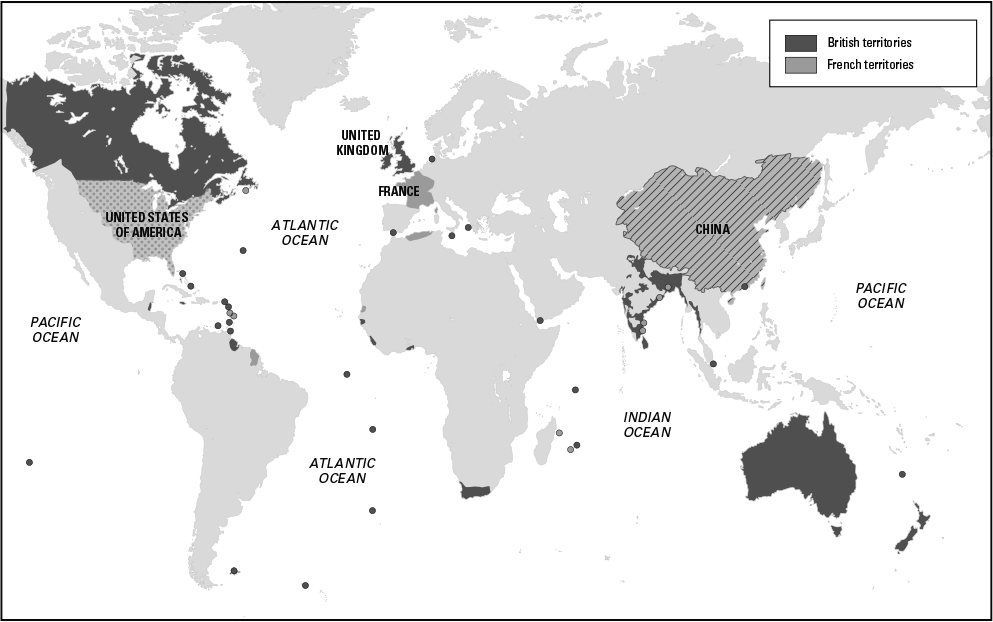
Figure I.1 Long description
Historical map of British, French, U.S., and Chinese territories circa 1843. Highlights include British territories in North America, Australia, and parts of Asia, French territories in Europe and parts of Africa and Southeast Asia, U.S. territories in North America, and Chinese territories in East Asia.
This brings us back to Hong Kong. Unbeknown to commentators in Britain, the early colonial government sent prisoners to China without express authorisation from Westminster, and without observing most of the safeguards that were starting to gain currency elsewhere. The colonial government was able to do this because Hong Kong was regarded as a ceded territory, not ‘settled’ by British subjects taking the common law with them, and the Crown was long understood to have the power to legislate for ceded territories where it had not decided to establish representative legislatures.61 However, the Crown’s divergent approach in Hong Kong was also shaped by the jurisdictional idiosyncrasies of the Chinese treaties; and, crucially, it was further enabled by the fact that imperial standards for extradition were not clarified until 1870.
Indeed, apart from enforcing narrow treaties with the United States (1842), France (1843), and Denmark (1862), Westminster was reluctant to make further legal provision for removing fugitives from British territory.62 This was because liberal parliamentarians viewed foreign legal systems with suspicion, and they vaunted Britain’s reputation as a place of political asylum.63 So, whereas France and other European countries had made strides to bring border-crossing fugitives to justice, Britain remained, as Clarke argued in 1867, ‘one of the least ready of all the nations of the world to perform her duty in this matter as a member of the family of civilised communities’.64 Concerns that Britain was falling behind international custom finally caused the House of Commons to appoint a Select Committee on Extradition in 1868.65 The report of this Select Committee led in turn to the enactment of the Extradition Act 1870. This historic statute empowered the Crown to implement future treaties by Orders in Council, instead of having to obtain an Act of Parliament on every occasion. To offset the risks of injustice, the Extradition Act codified a number of additional safeguards that still survive today in some form, including the famous ‘political offence exception’ – the blanket prohibition against the extradition of political refugees who faced official persecution in their countries of origin.66 Armed, then, with its new powers, the British government proceeded to sign and implement extradition treaties with thirty-six nations in Europe, Asia, Africa, Latin America, and the Pacific Ocean by 1903, making up for its reticence before 1870.67
The law of Hong Kong was brought almost entirely in line with imperial standards between 1865 and 1873. But it was brought there from a very different starting point, one in which prisoners were sent to China with relative abandon, through procedures that officials did not clearly or consistently regard as extradition. For this reason, the early history of Hong Kong offers a unique window into official ideas and practices at a pivotal time, just before the rights of foreign fugitives were ossified in British imperial legislation and doctrine. The early experience of Hong Kong reveals what the British Empire was willing to do – what motivated it and how far it was prepared to go – when unshackled by metropolitan politics and preconceptions.
Strands of Legal Change
In short, this book argues that the origins of extradition involved crucial experiments in the colonial ordering of territory, people, and executive power. Key experiments were carried out in mid nineteenth-century Hong Kong – experiments deeply interwoven with the origins of the colony itself. What follows is therefore as much a colonial history of an area of British law as a constitutional history of a Crown colony at Britain’s Chinese frontier. The wider British presence in mainland China sits in the background of this layered narrative. Although this book does not discuss the ‘extraterritorial’ empire directly, it suggests that developments in Hong Kong played a bigger role in shaping that project than other studies have recognised. As British rule in Hong Kong became more territorial – more similar to how other sovereign British territories were governed – so did the extraterritorial British Empire in China appear more aberrant and objectionable.
The chapters that follow are organised thematically and in semi-chronological order. Chapter 1, ‘Improvising Sovereignty’, covers the period between 1841 and 1844. It argues that British sovereignty in Hong Kong was built on inchoate ideas of extradition: half-formed ideas of whether and how the colony would surrender Chinese criminals to China. A bilateral agreement for such surrenders was made in 1842, but its terms were disputed primarily because British officials struggled to articulate the scope of their jurisdiction over the Chinese population of Hong Kong. Events on the ground then short-circuited efforts to resolve this problem. In The Queen v. Lo A-tow (1843), Governor Henry Pottinger conflated his power to refuse Chinese requests for fugitives for lack of evidence (which China did not dispute) with the power of British courts to try Chinese subjects and sentence them to punishment (which China did dispute). Pottinger’s interpretation of Lo A-tow established a tenuous precedent for territorial sovereignty in a turn of events that would have far-reaching consequences.
The next three chapters examine different aspects of extradition law-making over the same period between the 1840s and 1860s. Chapter 2, ‘Domesticating Mobility’, shows how the Hong Kong government’s efforts to bolster its legitimacy carved a distinction between extradition and deportation, or between the cooperative and unilateral removal of Chinese people to China. As China continued to press its jurisdictional claims after Lo A-tow, Hong Kong attracted thousands of Chinese migrants whose transient habits created practical and diplomatic challenges of governance. Faced with these challenges, the colonial government promised to ‘protect’ Chinese people from lawlessness and arbitrary punishment. These promises buttressed the government’s tenuous claim to the right to keep the peace and to remove people discretionally. Governors gave themselves flexible powers of ‘rendition’, ‘banishment’, and ‘deportation’ (using these words), while vesting other powers of policing and population control in a mercurial office of ‘Registrar General and Protector of Chinese Inhabitants’. Colonists, imperial officials, and British diplomats in China challenged these powers. Their contestations served to refine the colonial practice of extradition.
Chapter 3, ‘Navigating Disorder’, examines Hong Kong’s practice of giving people up to foreign authorities on charges of crimes committed at sea. Between 1850 and 1865, the colony’s ‘rendition’ procedure, its early version of extradition, was used to remove hundreds of accused pirates, mutineers, and other criminals of Chinese origin – criminals that officials believed China was better suited to punish. Other seafarers were also given up to French and American authorities, as the colony sought to take pressure off its overstretched and barely functional courts and prison system. Ideas of British sovereignty and the international law of piracy fuelled this pragmatic policy. Notably, officials believed that maritime crimes should only be tried in Hong Kong if they implicated ‘British interests’, specifically British victims, offenders, or territory. This rationale for jurisdictional restraint reached a controversial zenith in 1861. In the case of the French coolie ship, Ville D’Agen, a Peruvian sailor, Juan Pastor was nearly given up to China despite the absence of any treaty or statutory basis for his rendition.
Chapter 4, ‘Rationalising Reciprocity’, explores the question of Hong Kong’s legal right, or lack thereof, to request the surrender of fugitives who had taken refuge in Chinese territory. To what extent did British officials expect China to reciprocate the surrender of Chinese fugitives from Hong Kong? The Anglo-American and Anglo-French treaties for extradition were fully reciprocal, as were narrower agreements between some British colonies (such as Trinidad) and their sovereign neighbours (such as Venezuela). But Britain’s treaty relations with China were far more complex. This was not least because British subjects were not amenable to Chinese jurisdiction, while the jurisdictional status of Chinese subjects was disputed. As this chapter will show, the British effort to rationalise the Chinese treaties led to a key conclusion in 1865–66 that a state’s right to discipline its subjects in foreign territory – its right of extraterritorial jurisdiction – did not necessarily imply a right of extradition, or a right to retrieve absconded subjects from foreign territory. The distinction between extradition and extraterritoriality was therefore a product of gradual practice and discourse: it was decidedly not written into the Opium War treaties during 1842–43.
Finally, Chapter 5, ‘Founding Alsatia’, tracks the modernisation of the extradition law of Hong Kong against the backdrop of empire-wide legal reform between 1865 and 1873. This process unfolded through two explosive scandals, which caused imperial officials and judges to impose belated restrictions on the colonial removal of fugitives to China. The first, the case of How Yu-teen (1865), involved embarrassing allegations of British complicity in China’s violent execution of a political refugee; the second, Attorney General of Hong Kong v. Kwok-a-Sing (1873), was a habeas corpus dispute born of colonial infighting and the only extradition dispute to reach the Judicial Committee of the Privy Council in the nineteenth century. These scandals propelled Hong Kong away from the flexible and jurisdictional practice of rendition. The new reality – the imperially homogenous, late-Victorian law of extradition – carried drastically heightened expectations of individual rights and executive comportment.
In these ways, Extradition and Empire tells the story of the contested emergence of a modern mechanism or modality of criminal law, the origins of which are steeped in Victorian ideas of sovereignty and subjecthood. Needless to say, this book does not tell the whole story of international extradition, not least because it does not explore American or continental European perspectives. But neither is this story merely local, as the formative developments in Hong Kong drew from and fed back into wider shifts in British legal thought. As a focal point of these wider shifts, the emergent extradition law of the young frontier colony is more historically and juridically revealing than the sum of its parts.