


Introduction
A major challenge currently faced in mental health is how to disseminate evidence-based therapies such as cognitive behaviour therapy (CBT) to real-world settings. Collaborative partnerships between researchers and practitioners have the potential to bridge the gap between research and practice. While there have been calls for increased collaboration between mental health researchers and practitioners, there is little study of such collaborative processes, minimal conceptual writing and minimal descriptive literature identifying factors that may help or hinder collaboration or anecdotal insights gained from case studies (Garland et al. Reference Garland, Plemmons and Koontz2006).
Two divergent models are used to develop and disseminate psychological therapies: Research to Practice (RTP) and Community Centred (CC) (Flaspohler et al. Reference Flaspohler, Duffy, Wandersman, Stillman and Maras2008). The latter has also been termed community-based participatory research (Wells et al. Reference Wells, Miranda, Bruce, Alegria and Wallerstein2004).
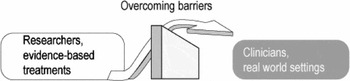
RTP is the dominant model (Wandersman et al. Reference Wandersman, Duffy, Flaspohler, Noonan, Lubell, Stillman and Saul2008). It is analogous to the drug development process, in which researchers develop new medications, which pharmaceutical companies then market to physicians, who are seen as consumers (Westen, Reference Westen2002). The RTP approach frames the adoption of innovation from the perspective of the researcher and attempts to bring research to practice through a linear transfer of knowledge from researcher to clinicians, sometimes with feedback towards the end (Westen, Reference Westen2002). The focus is on persuading clinicians and services to implement agents with proven efficacy in randomized controlled trials (RCTs) (Gotham, Reference Gotham2004; Grimshaw et al. Reference Grimshaw, Eccles and Tetroe2004; Forsner et al. Reference Forsner, Hansson, Brommels, Wistedt and Forsell2010). Behaviour change theories such as persuasive communication, social influence, adult learning theory and social cognition have been applied in attempts to change clinician behaviour (Sanson-Fisher et al. Reference Sanson-Fisher, Grimshaw and Eccles2004). The RTP approach has been criticized as taking inadequate account of ‘real world’ motivations for selecting programmes and the host of organizational factors that affect implementation of services (Miller, Reference Miller2003). The RTP approach is depicted in Figure 1.
The research to practice approach.

CC models begin with the community and ‘ask what it needs in terms of scientific information and capacity building to produce effective interventions’ (Wandersman et al. Reference Wandersman, Duffy, Flaspohler, Noonan, Lubell, Stillman and Saul2008, p. 230). They emphasize the improvement of existing practice and service delivery over the introduction of novel approaches. The clinician perspective is seen as instrumental to the improvement of existing practice within the local context. Integral to this approach is an appreciation of the resources, needs and complex realities of the community (Wandersman et al. Reference Wandersman, Duffy, Flaspohler, Noonan, Lubell, Stillman and Saul2008). The CC approach involves service providers as collaborators in treatment development and adaptation. This can bring recognition of what both groups learn from and contribute to each other and can assist organizations to feel ownership of a programme (Kegeles et al. Reference Kegeles, Rebchook, Hays, Terry, O'Donnell, Leonard and Neumann2000). This approach has been viewed as a useful way to bring out the best in both groups and takes account of the realities of the diversity of patients, clinicians and organizations (Weisz et al. Reference Weisz, Hawley, Pilkonis, Woody and Follette2000). In the CC approach, revision and adaptation do not reflect systemic resistance or poor planning, but are part of a process where the approach and the context adapt to each other in an effort to achieve a mutually beneficial fit (Hoagwood et al. Reference Hoagwood, Burns, Weisz, Burns and Hoagwood2002). Rather than clinician concerns being viewed as ‘resistant’, a degree of scepticism is viewed as normal and even desirable. Researchers expect the intervention will need to change and enter the process looking for ways it does not fit, and work to create a context that will address, collaboratively, the adaptation and adoption process (Liddle et al. Reference Liddle, Rowe, Quille, Dakof, Mills, Sakran and Biaggi2002).
This approach to research fits well with the collaborative approach taken in CBT: while clinicians may be experts on interventions, patients are experts on their own experience. This is just as important as therapist expertise, therefore a collaborative approach to working together in therapy is required (Kuyken et al. Reference Kuyken, Padesky and Dudley2009).
As well as working together with service providers, it can be argued that research teams need to collaborate with patients. Including patients in the development and implementation of research ensures the scientific enterprise is accountable to recovery principles and that the choice of study methods and outcomes genuinely reflects patient perspectives (Stanhope & Solomon, Reference Stanhope and Solomon2008). True collaboration with patients requires all aspects of the research process, from the initial idea, to design, implementation, data analysis and conclusions to be undertaken in partnership (Happell & Roper, Reference Happell and Roper2007). Despite calls for the increased involvement of service users in research, it happens infrequently (Hodges, Reference Hodges2005).
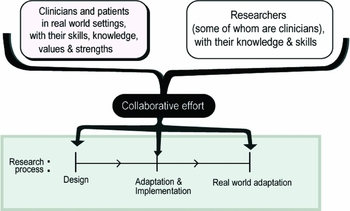
A number of benefits of patient involvement have been identified, including: increased recruitment; helping ensure the ethical acceptability of clinical trials; improved trial design; helping ensure that the researchers use outcome measures that are most relevant and meaningful to patients; improving the quality and robustness of the data; and power and persuasiveness of the results in qualitative research (Crawford & Kessel, Reference Crawford and Kessel1999; Schrank & Wallcraft, Reference Schrank, Wallcraft, Wallcraft, Schrank and Amering2009). A diagram of a collaborative approach to research, involving clients and clinicians is shown in Figure 2.
A collaborative approach to research.

McKay (Reference McKay, Hoagwood, Jensen and McKay2010) developed a model for the development of collaborative partnerships, identifying the different phases of collaboration and important tasks, including: (a) development of trust between partners, (b) information exchange, (c) shared decision-making, (d) leadership development and (e) transfer of ownership.
There can be different types of collaborative partnerships: Three levels of research-practice partnerships have been described: stage 1 ‘Investigator-initiated research’; stage 2 ‘Joint formulation of research questions’ and stage 3 ‘Joint decision-making on all aspects of research’ (Baker et al. Reference Baker, Homan, Schonhoff and Kreuter1999). Whatever the level of partnership, communication and trust-building will be cornerstones of collaborative efforts (Vangen & Huxham, Reference Vangen and Huxham2003). Reports of case studies of collaborative efforts are needed to gain insight into these processes (Garland et al. Reference Garland, Plemmons and Koontz2006).
The goal of this paper is to describe a case example of a collaborative process undertaken between researchers, service providers and patients to adapt CBT for patients with ‘sub- threshold mental health syndromes’ in a New Zealand primary-care setting; to share the participants’ perceptions of the process, perceived challenges and benefits of the collaboration; and to make suggestions for future research-practice collaborations.
Method
Case example of adapting therapy for a primary-care setting
This research-practice partnership represented stage 2 and aspects of stage 3 in Baker and colleagues’ (Reference Baker, Homan, Schonhoff and Kreuter1999) model and involved joint formulation of the research questions and joint decision-making during the research process. The study arose out of previous work with local primary-care clinicians; they had emphasized a gap in services for people with sub-threshold mental health syndromes and a desire by clinicians to be able to offer a brief intervention themselves. This gap was also indicated by primary-care patients in terms of a large group whose scores on standardized measures suggested they were experiencing sub-threshold syndromes, along with interview data suggesting a gap in services (Dowell et al. Reference Dowell, Garrett, Collings, McBain, McKinlay and Stanley2008).
Aim
‘Sub-threshold’ anxiety, depression and substance use conditions are common presentations in primary care, and often co-exist (Oakley Browne et al. Reference Oakley Browne, Wells and Scott2006). These syndromes do not meet the threshold for disorder in standard diagnostic systems such as DSM-IV (APA, 1995), but carry a significant disability burden along with the risk of developing a diagnosable disorder (Kessler et al. Reference Kessler, Zhao, Blazer and Swartz1997; Judd et al. Reference Judd, Schettler and Akiskal2002). ‘Sub-threshold’ is not a clearly defined term, with some authors using terms such as ‘sub-clinical’, ‘mild depression’ or ‘minor depression’. In addition, interventions in primary-care RCTs have been conducted with varied clinical groups such as sub-threshold depression (Cuijpers et al. Reference Cuijpers, Smit and Willemse2005), major depression, or sub-threshold syndromes (Mead et al. Reference Mead, MacDonald, Bower, Lovell, Richards and Roberts2005), which means that trials can not readily be compared or replicated.
The aim of the research team was to develop a brief intervention that would meet the needs of the sub-threshold group and be offered by clinicians working in primary care. This would have the advantage of building on existing clinician–patient relationships and reduce the need for further referral, for a patient group that may not want or need ten sessions of counselling, or referral to secondary-care services. It would be consistent with the ‘stepped care’ model, which suggests that a range of responses should be available for sub-populations with varying levels of symptoms and impairment (O'Donohue & Draper, Reference O'Donohue and Draper2011).
Context
The context of this study was a New Zealand primary-care setting, with multiple competing illness priorities, treatment plans that change to meet the varying needs of patients, difficult socioeconomic problems and time pressure. In New Zealand, primary care is usually the first point of health service access and General Practitioner (GP) appointments are usually 15 minutes long. When necessary, referrals are made to specialist services. Patients and their families tend to have long-term associations with primary-care practices, which allow clinicians to build trusting relationships and to understand the family context.
Participants
A project team was assembled with a range of theoretical perspectives and experience, as well as research expertise. The team included two primary-care clinicians with both academic posts and primary-care practices (A.D., F.G-S.); two secondary-care psychiatrists (S.C., S.H.), also with academic posts and clinical practices and a clinical psychologist with expertise in psychotherapy training (CBT) and experience in both primary and secondary care (F.M.). All team members attended meetings regularly from the start.
Other primary-care clinicians were involved in early focus interviews and in implementing the approach. Primary-care patients were involved in early focus interviews and in trialling the approach. A mental health service-user with an academic position, while not being formally part of the project team, was also involved in discussions regarding this project.
Procedure
Literature review
There was limited evidence supporting the use of ultra-brief interventions for sub-threshold depression in primary care, using cognitive behavioural and interpersonal dynamic principles (Barkham et al. Reference Barkham, Shapiro, Hardy and Rees1999). Other studies of CBT in primary-care mental health had involved longer interventions, more extensive training and delivery by other clinicians than primary-care doctors and nurses (Sullivan et al. Reference Sullivan, Craske, Sherbourne, Edlund, Rose, Golinelli and Roy-Byrne2007). In addition, there is a small evidence base developing in relation to self-help for sub-threshold syndromes (Jorm & Griffiths, Reference Jorm and Griffiths2006). However, a more recent study (published after this study commenced), evaluating a stepped care approach, delivered by psychiatric nurses and psychologists in primary care, did not find any evidence that a such an approach outperformed care as usual (Seekles et al. Reference Seekles, van Straten, Beekman, van Marwijk and Cuijpers2011b), although patients with an anxiety disorder (but not co-morbid depression), had a significant decrease in anxiety symptoms using guided self-help (Seekles, et al. Reference Seekles, van Straten, Beekman, van Marwijk and Cuijpers2011a).
Focus interviews with primary-care clinicians
In order to exchange information in line with McKay's (Reference McKay, Hoagwood, Jensen and McKay2010) important collaboration tasks, two focus interviews were conducted, comprising 15 primary-care clinicians in total, of whom nine were doctors and six were nurses. These interviews, which occurred before the intervention was developed, explored whether clinicians felt there was a need for an intervention with this group, what its characteristics would need to be and specifically the idea of having three ultra-brief sessions (1 hour in total), using a guided self-help approach.
Feedback from clinicians included the perspective that while the three sessions seemed like an ultra-brief intervention to members of the research team working in secondary care, in primary care this was a long intervention. Clinicians thought that any self-help resources would be best in a booklet form for this patient group as not all would have access to computers or the internet. They preferred a maximum of 3–4 booklets, so as not to be overwhelming. Clinicians requested that K-10 eligibility scores be increased to 35, so as to be practical in their setting. [The Kessler-10 (K-10) is a measure of global psychological distress, (Kessler et al. Reference Kessler, Zhao, Blazer and Swartz1997).] Clinicians also made it clear that they did not want to be taught the ‘theory’, but rather, practical strategies and a systematic approach. Clinicians emphasized that both the training and the intervention would need to be extremely brief to be practical and financially viable in the primary-care setting. There was discussion of the best time for training workshops and the need for formal continuing education certificates to be provided. These were arranged accordingly.
Further focus interviews with clinicians (seven GPs and one nurse) occurred after delivery of the intervention. All patients who received the intervention were interviewed 2 weeks after completing the intervention. Information from these focus interviews was used to guide the development of a RCT of the intervention and is reported elsewhere (Collings et al. Reference Collings, Mathieson, Dowell, Stanley, Jenkin, Goodyear-Smith and Hatcher2012).
Focus interviews with potential end users of the intervention
We purposefully set about recruiting a balanced gender sample of self-defined end users with the sub-threshold depression or anxiety definition. We interviewed 14 people, of whom seven were male and seven were female (age range 24–65 years). Recruitment was through an article in a community newspaper. This article stated that we were seeking people who were ‘feeling anxious or stressed, feeling low, but not clinically depressed, be using alcohol or drugs in a way that is causing some problems for them, or a combination of these, but not at a level where either treatment with medication or referral on to specialist services is likely to happen or be appropriate’. A small focus group interview was held in a local community centre, with three out of six people who had offered to attend actually attending. Subsequent interviews were arranged with individuals rather than further groups, on the assumption that it was difficult for people who were experiencing ‘stress’ in their lives to face meeting an unknown group of people. Feedback from potential users indicated that they did feel there was a need for such an intervention. They liked the idea of an intervention offered by a known clinician in primary care. It was important to them to be listened to and taken seriously. They liked the idea of a ‘here and now’, practical approach over the course of three brief sessions, but preferred to have the longer session first. They also responded positively to an example of a CBT-based self-help booklet.
All focus interviews were audio-taped and transcribed. Details of the focus interview results have been reported elsewhere (Collings et al. Reference Collings, Mathieson, Dowell, Stanley, Jenkin, Goodyear-Smith and Hatcher2012). The psychologist on the team (F.M.) was present at all the focus interviews, and was responsible for integrating information and feedback.
Broader consultation
As our ideas developed, we consulted with other experts in the area, including developers of self-help materials for anxiety and depression. This consultation emphasized the importance of having a low reading age in the written material; involving a graphic designer to ensure credible, well-presented resources and emphasizing to clinicians that they are in a ‘coach’, rather than a ‘therapist’ role.
Further feedback on the self-management booklets was obtained from our patients, colleagues, clinicians in speciality services, such as gambling and alcohol & drug services and primary-care clinicians. This was an opportunistic, organic process as new contacts were suggested. This assisted us with content, such as the inclusion of vignettes and pictures. We also sought input from professional editors with experience in health-related publications. This assisted us in ensuring clarity of expression, a low reading age and an engaging writing style.
Role play
The collaborative approach was continued with the development of the treatment manual. In line with clinician requests and advice, the treatment manual was designed to be concise and user friendly, with little emphasis on theory. In addition, jargon-free, accessible language was used so as to allow ease of communication (Weisz et al. Reference Weisz, Hawley, Pilkonis, Woody and Follette2000).
We role-played using the treatment manual with a team member who was a primary-care clinician, based on a case vignette of a patient with whom the clinician was familiar. This was helpful in identifying differences in outlook and practice style. The feedback regarding the structure, content and length of the sessions and other concerns following discussion led to refinements of the intervention.
Results
The approach developed through this collaborative process was a CBT-based guided self-management approach in which the primary-care clinician met with the patient for three sessions (one 30-minute, two 15-minute sessions), over a 5-week period. Patients were invited by clinicians to participate if they were experiencing distress and had K-10 scores of ≤35. The first appointment occurred within a week of clinicians identifying patients as suitable for the intervention. Clinicians were in a ‘coach’ role, rather than a ‘therapist’ role. The sessions were highly structured, with an emphasis on behaviour change and problem solving, rather than cognitive change. Clinicians worked through a series of questions designed to assist the patient to clarify the problem; identify helpful and unhelpful behavioural coping strategies; generate a specific, written plan of action (printed out as a ‘prescription’); build motivation and follow through on the action plan. Clinicians were encouraged to use their own ways of phrasing questions and to keep to the structure of the sessions at least 80% of the time. This allowed some flexibility and reduced the degree to which the approach was experienced as prescriptive. A brief summary of relevant CBT theory was provided in the treatment manual for interested clinicians. The content of sessions was mainly problem solving, coping strategies and behavioural change. There were also three CBT-based self-management booklets on the topics of stress, relationships and harmful behaviours, which included cognitive change strategies. Following the face-to-face sessions, there was one follow-up phone call or email.
The selection of a CBT-based intervention was based on the limited literature available. An advantage of this selection was that the psychologist on the project team had expertise in teaching CBT and good existing relationships with primary-care providers, and was therefore seen as a credible training source. Elements common to most brief therapies were identified (Pekarik, Reference Pekarik1996). These included: a clear, specific treatment focus; limited goals; a focus on present stress; rapid assessment and a high level of therapist and client activity. CBT fits well with these elements.
In considering what ingredients would be included in these brief sessions, we did not rigidly restrict ourselves to CBT approaches. Brief motivational tools called ‘readiness rulers’, were also included (Heather et al. Reference Heather, Smailes and Cassidy2008). Most of the primary-care clinicians had some familiarity with motivational interviewing strategies, so this was considered to be a useful addition to assist patients in implementing their change plans. Motivational interviewing (along with problem solving) has been suggested as suitable as a brief mental health intervention in primary care (Hunter et al. Reference Hunter, Goodie, Oordt and Dobmeyer2009). Motivational interviewing strategies have been combined successfully with CBT strategies in a number of mental health intervention studies (Cornelius et al. Reference Cornelius, Douaihy, Bukstein, Daley, Wood, Kelly and Salloum2011; Carlin, Reference Carlin2012).
The training session was 2½ hours long, free of charge and held in the evening at a location close to the primary-care practices involved in the study. The training session was provided by a psychologist and primary-care physician from the research team, who had existing relationships with many of the primary-care clinicians who attended. This fitted with McKay's (Reference McKay, Hoagwood, Jensen and McKay2010) model for the development of collaborative partnerships, in terms of the important task of building trust. The training package covered the rationale, session content and process, video demonstration of the approach and role-play practice by primary-care clinicians from the research team. The challenge was to provide an appropriate balance between providing sufficient information and overwhelming primary-care clinicians with information in a short period of time. The approach taken was to focus on the rationale, role of the clinician, structure of the intervention and content of the sessions, allowing time for a brief video demonstration and role-play practice by the clinicians.
Primary-care clinician and patient satisfaction ratings for a feasibility study of this intervention on Likert scale feedback forms were very positive, indicating that this approach was feasible and acceptable. Patients rated the sessions as very helpful and practical. Clinicians felt the sessions seemed to meet patient needs and would happily use the approach again. Both patients and clinicians felt that the sessions could have been a little longer. There were significant reductions in distress levels for patients (n = 18); however, there was no control group and numbers were too small for us to know whether this approach was in fact effective. A RCT is planned, which will include investigation of whether patients progress from sub-threshold symptoms to meet thresholds for diagnosable disorders.
Challenges and benefits
This collaborative approach to therapy development provided a number of challenges. There was an initial tension between the wish for a theoretical underpinning of the intervention and the need for a pragmatic tool that would serve the needs of busy clinicians in primary care. The exchange of knowledge about working styles and practices from both primary- and secondary-care paradigms was essential.
Those in the team who had spent time working in secondary-care mental health services found that they had to consciously take off their ‘secondary-care hats’. This involved acknowledging and letting go (with some anxiety) assumptions about ‘treatment’ for mental health issues. These included the ideas: that a mental health intervention can only be delivered by highly trained mental health clinicians; that formulation is an essential part of intervening; and that ‘treatment’ needs to take at least 6–10 sessions. Distilling CBT into a 1-hour (in total) guided self-help approach was challenging, as was limiting ourselves to three short, readable self-help booklets.
For those working in primary care, there was a need to review assumptions about how well psychological therapy principles were already well embedded in the general practice consultation. While establishing rapport and eliciting problems are ‘core business’, it became clear that systematically providing structured psychological therapy supports are not inbuilt features of routine consultations. In the context of the 15-minute GP consultation, there was also a need to accept that one double length and two standard consultations represented a ‘brief’ mental health intervention.
The extent of the adaptation to standard CBT in this study was a challenge to research team members who advocated close fidelity to treatment protocols. A consequence of the collaborative approach taken was a ‘letting go’ of strict adherence to treatment fidelity. The literature on adapting programmes suggests that when you make many changes to an intervention, you run the risk of rendering it ineffective. However, it can be argued that differing organizational contexts and clinician needs have almost always demanded a degree of tailoring to unique settings and conditions. Telling clinicians exactly how an intervention must be delivered is not likely to be successful; tailoring will and should occur to fit local needs. Tailoring interventions is also likely to increase the clinician's sense of ownership. However, there may be a point at which adaptation has reached the ‘zone of drastic mutation’, where effectiveness may be reduced (Blakely et al. Reference Blakely, Mayer, Gottschalk, Schmitt, Davidson, Roitman and Emshoff1987).
There were also a number of benefits to the collaborative process undertaken. The main benefit was that the approach developed was one that would fit well with the primary-care context and the needs of patients and clinicians. The focus interview process had the added advantage of establishing personal contact with the clinicians, which was seen as helpful in motivating them to try a new intervention in the demands of daily practice. Interviews with patients and clinicians after experiencing the intervention helped to further shape the intervention for the future.
Discussion
This paper outlines the use of a collaborative methodology in the development of a brief psychological CBT-based intervention for use in primary-care settings. Using the steps outlined above was an informative and rewarding process. The focus interviews with patients and clinicians contributed to this being a genuinely CC, collaborative partnership, rather than a solely researcher-driven RTP approach. The CC approach worked well in terms of taking account of the needs and preferences of patients and clinicians and achieving a mutually beneficial fit (Hoagwood et al. Reference Hoagwood, Burns, Weisz, Burns and Hoagwood2002). While the methodology involved significant contribution from both clinicians and patients further engagement with both might have been possible. Further clinician involvement could have been achieved by increasing the number of role plays undertaken with primary-care clinicians during the development process and having more primary-care clinicians involved in the research team would probably have refined the approach further.
An additional option for involving clinicians further would have been to convene a sustained focus group, consisting of practising clinicians, meeting regularly over several months. The clinicians would be paid as consultants to learn about the theoretical rationale and technical approach and to watch a series of videotaped sessions. The clinicians would then provide feedback about the new treatment, its potential relevance to their clinical work and potential barriers to applying the approach. Those who found the approach promising could then attempt to integrate it into their clinical work, with supervision and provide ongoing feedback (Westen, Reference Westen2002).
Enhanced collaboration with patients could have occurred through a sustained focus group, more individual application and feedback with our own patients during the development process and having patients as part of the research team, so that they were involved in decision-making rather than purely in an advisory role.
While there was some limited consultation with a service user with academic qualifications, it would have been valuable to have such a person as a formal member of the team, particularly in terms of assisting with patients, influencing research culture, policy and funding, and facilitating the participation of lay consumers (Gordon, Reference Gordon2010). We will formalize this relationship when implementing the RCT of this intervention.
While the collaborative approach taken assisted us in understanding the primary-care environment, there needed to be more emphasis on understanding the value system of individual practices. Complexity theory describes primary-care practices as variable and complex adaptive systems, shaped by their primary goals in which clinician behaviour is difficult to change. One approach to changing practice patterns may be through ‘joining’ with the value system of the practice, such as the practice's approach to individual patient care (Miller et al. Reference Miller, Crabtree, McDaniel and Stange1998). More emphasis on building a relationship with practice administrators may have been useful in terms of increasing their commitment to the project (Chorpita et al. Reference Chorpita, Yim, Donkervoet, Arensdorf, Amundsen, McGee and Morelli2002) and improving the team's understanding of the day-to-day operations of the practices, the available resources and the potential constraints (Lehman et al. Reference Lehman, Greener and Simpson2002).
We have described in detail a collaborative approach to adapting evidence-based treatment to the primary-care setting, for patients with sub-threshold mental health syndromes. This process resulted in a very brief CBT-based, guided self-management intervention, which was regarded very positively by both clinicians and patients. On the basis of our experience, we advocate seeing clinicians and patients as co-developers, rather than end users of interventions. A collaborative approach is more likely to ensure that interventions are relevant, acceptable and feasible for community providers to implement. In addition, it will allow the move away from a linear RTP approach to a genuine working relationship where the knowledge and experience of clinicians and patients is just as important as the knowledge and experience the researchers bring.
Summary
A collaborative approach to research has advantages over the dominant, linear research to practice approach for dissemination of evidence-based approaches such as CBT. A collaborative approach described in primary care included input along the way from multiple sources including clinicians, patients and academics and led to an ultra-brief intervention with a high degree of acceptability for clinicians and patients.
Acknowledgements
This study was funded by a grant from the New Zealand Health Research Council. The funder had no role in the study design, collection analysis and interpretation of data, the writing of the report or the decision to submit the paper for publication.
Declaration of Interest
None.
Learning objectives
(1) Differentiate research to practice and collaborative approaches to research.
(2) Identify the benefits of collaborative research for dissemination.
(3) Identify practical methods for enhancing collaboration in research.



Comments
No Comments have been published for this article.