

I Introduction
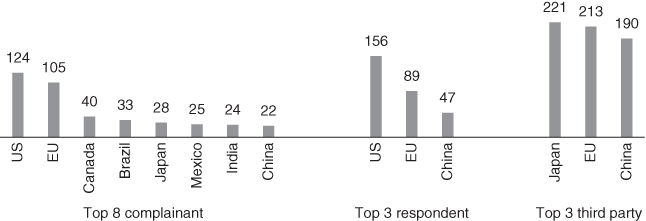
Since China joined the World Trade Organization (WTO) in 2001, its role in the WTO’s dispute settlement system (DSS) has developed significantly over the past twenty years. As widely observed, this period has witnessed China becoming an increasingly experienced and influential player, that is from a ‘rule taker’ (2001–2005) to a ‘rule shaker’ (2006–2009) and then a ‘rule maker’ since 2010 (Gao, Reference Gao and Deere-Birkbeck2011; Mercurio and Tyagi, Reference Mercurio, Tyagi, Herrmann and Terhechte2012; Toohey, Reference Toohey2011). This observation is supported not only by China’s active engagement in pushing for the appointment of new Appellate Body (AB) members so as to restore a functional DSS and its agreement to and use of the Multi-Party Interim Appeal Arbitration Arrangement (MPIA) to maintain a temporary appellate review mechanism. This observation is also supported by the number of disputes in which China has been involved. By 1 October 2021, China had been a complainant in 22 cases, a respondent in 47 cases and a third party in 190 cases, making it one of the most active players in the DSS: see Figure 11.1. While many factors may be employed to explain China’s behaviour and evolving practices (Ji and Huang, Reference Ji and Huang2010; Wang and Zhou, Reference Wang and Zhou.2022), a major one has to do with its growing capacity and expertise in WTO law and dispute settlement (Shaffer and Gao, Reference Shaffer and Gao2018).
Top users of the WTO dispute settlement system

This chapter is not intended to examine all the disputes in which China has participated. Instead, it focuses on select disputes involving China as a respondent, with an aim to critically analyse the impact of the DSS on China’s economic reforms and policymaking. This analysis necessarily involves a consideration of the overall pattern of development in China’s strategies and behaviours in these disputes and more specifically, the factors behind China’s approaches to implementing unfavourable WTO rulings. Section II discusses the effectiveness of the DSS, arguing that the system has been largely effective in leading not only to changes to a range of WTO-illegal policy instruments but also gradual and systematic adjustments of certain complex regulatory regimes in China. Despite China’s impressive record of implementing WTO rulings, its approaches have revealed three challenges for the DSS in relation to temporary breaches, repetitive breaches and post-compliance regulatory developments, which are discussed in Section III. These challenges, however, concern systemic constraints or loopholes in the system which can be utilised by all WTO Members. Section IV extends beyond the DSS to consider the broader issues relating to overwhelming criticisms about China’s failure to adhere to the spirit of WTO law and the WTO’s failure to push China to change its state-led economic model and transition to a full-fledged market economy. Section V sets forth some concluding remarks.
II Effectiveness
The efficacy of WTO rules would be significantly weakened without an effective mechanism that enforces the rules. The DSS, in serving this key function, has long been praised as ‘the jewel in the crown’ of the multilateral trading system. Since commencing its operation in 1995, the DSS has managed over 600 disputes, which demonstrates WTO Members’ continued belief in the utility of the system. Despite the United States (US)’s criticisms of the AB, it sees the value of the DSS in resolving trade disputes (USTR, 2021) and continues to resort to the system for that purpose.
When it comes to the implementation of WTO rulings, there is evidence to show that the DSS is largely effective in inducing compliance in most cases (Davey, Reference Davey2014; WTO, 2017a). Yet, the impact of the system on China remains controversial. The US, under the Trump administration, vehemently criticised the WTO for being ‘incapable of fundamentally changing [China’s] trade regime that broadly conflicts with the fundamental underpinnings of the WTO system’ (USTR, 2020a, p. 14). This perception of the WTO’s ineffectiveness was a key driver of the US’s recourse to unilateral actions that provoked the US-China trade war. The Biden administration has maintained this position. In a recent speech, United States Trade Representative (USTR) Katherine Tai criticised ‘China’s lack of adherence to global trading rules’ and failure to make ‘meaningful reforms to address the concerns’ about ‘its state-centered economic system’, and reiterated the need for the US to use all tools at its disposal including by creating new ones ‘to defend American economic interests from harmful policies and practices’ (CSIS, 2021). These concerns are shared by other major WTO Members particularly the European Union (EU) (European Commission, 2021).
There is little doubt that the current WTO rules and the DSS have their limits, some of which will be considered in Section III. However, these limits have largely resulted from the way in which the rules and the DSS are designed by WTO Members and hence can only be addressed through their collective efforts via negotiations. In other words, many perceived problems in the multilateral trading system that may have caused its lack of effectiveness are not specific to China. Thus, an assessment of the effect of the DSS on China must be undertaken objectively in light of these systemic constraints or loopholes that can be utilised by all Members.
Against this backdrop, I briefly discuss China’s compliance with adverse WTO rulings and the impact of the DSS on China’s economic reform and policymaking. As noted above, China has been a respondent in 47 disputes involving a total of 34 matters. Among the 34 cases, 27 have been completed either through a mutually agreed solution (15 cases) or China’s implementation of WTO rulings (12 cases). As regards the other seven cases, six remain in the litigation process and one has lapsed as the panel’s work was suspended for more than 12 months under Article 12.12 of the Understanding on Rules and Procedures Governing the Settlement of Disputes (WTO, 2018a). One may also divide these disputes into non-trade-remedy cases and trade remedy cases. The latter can be brought by the countries subject to antidumping (AD) and/or countervailing duties (CVD) only. Among the 27 completed cases, the US was the sole or joint complainant in 16 out of the 20 non-trade-remedy cases. Table 11.1 provides a summary of the completed cases, the major measures and goods/industries involved, and the status of compliance. For trade remedy cases (highlighted in grey), it further shows the period between the imposition and the termination of the duties.
| Short title (DS No.) | Complainant(s) | Measures (industries/goods/entities) | Status of compliance | |
|---|---|---|---|---|
| Settled disputes (15 cases) | ||||
| 1. | China – VAT on Integrated Circuits (DS309) | US | Discriminatory value-added tax (VAT) rebates (integrated circuits producers and design services providers) | Implemented by abolishing the VAT rebates |
| 2. | China – Taxes (DS358, 359) | US, Mexico | Tax preferences (foreign-invested enterprises) | Implemented by abolishing the tax preferences |
| 3. | China – Financial Information Services (DS372, 373, 378) | US, EC, Canada | Market access restriction and discrimination (financial information services providers) | Implemented by removing the restriction and discrimination |
| 4. | China – Grants, Loans and Other Incentives (DS387, 388, 390) | US, Mexico, Guatemala | Export subsidies (all kinds of Chinese merchandise recognised as ‘famous brands’) | Implemented by abolishing the subsidies and export performance requirements |
| 5. | China – Fasteners (DS407) | EU | AD (fasteners) | Implemented by re-investigation. Dec 2009 – ongoing (2nd sunset review commenced in Jun 2021) |
| 6. | China – Wind Power Equipment (DS419) | US | Subsidies based on local content requirements (wind power equipment) | Implemented by removing the subsidies |
| 7. | China – Autos and Auto Parts (DS450) | US | Export subsidies (auto and auto parts) | Settled as part of DS489 |
| 8. | China – Apparel and Textile Products (DS451) | Mexico | Subsidies (apparel and textile, cotton and chemical fibres) | Diplomatic solution, without detailed information on the revision of relevant policies |
| 9. | China – Demonstration Bases (DS489) | US | Export subsidies (7 industries and many sub-sectors) | Implemented by abolishing the subsidies and export performance requirements |
| 10. | China – Aircraft (DS501) | US | Discriminatory VAT exemptions (aircraft) | Implemented by terminating the VAT exemptions |
| 11. | China – Raw Materials II (US) (DS508) | US | Export duties (raw materials) | Implemented by removing the duties |
| 12. | China – Raw Materials II (EU) (DS509) | EU | Export duties and restraints (raw materials) | Implemented by removing the duties and restraints |
| 13. | China – Intellectual Property Rights II (DS542) | US | IPR protection and technology transfer | Implemented by revising the relevant law and regulations as well as agreeing to detailed obligations under the US–China Phase One Deal |
| 14. | China – Transfer of Technology (DS549) | EU | IPR protection and technology transfer | Implemented by revising the relevant law and regulations as well as agreeing to detailed obligations under the EU–China Comprehensive Agreement on Investment |
| 15. | China – Imports of Sugar (DS568) | Brazil | Safeguard measure on sugar | Diplomatic solution, without detailed information about the revision of relevant measures |
| Litigated disputes (12 cases) | ||||
| 16. | China – Auto Parts (DS339, 340, 342) | EC, US, Canada | Discriminatory internal charges (auto parts) | Implemented by revising the relevant policies and regulations |
| 17. | China – Intellectual Property Rights (DS362) | US | Inadequate IPR protection (copyright of content goods and trademark regarding confiscated imported goods) | Implemented by revising the relevant law and regulations |
| 18. | China – Publications and Audiovisual Products (DS363) | US | Trading rights and distribution services (cultural sector) | Partially implemented by revising the relevant regulations except for those relating to films. (Mutually agreed compensation on film) |
| 19. | China – Raw Materials (DS394, 395, 398) | EC, US, Mexico | Export duties and restrictions (raw materials) | Implemented by removing WTO-illegal duties and restraints |
| 20. | China – Electronic Payment Services (DS413) | US | Market access restriction and discrimination (electronic payment services) | Implemented by revising the relevant regulations |
| 21. | China – GOES (DS414) | US | AD and CVD (grain oriented flat-rolled electrical steel) | Implemented by re-investigation. Apr 2010–Apr 2015 |
| 22. | China – X-Ray Equipment (DS425) | EU | AD (X-Ray Equipment) | Implemented by re-investigation. Jan 2011–Feb 2014 |
| 23. | China – Broiler Products (DS427) | US | AD and CVD (broiler) | Implemented by re-investigation. Aug/Sep 2010 (CVD/AD) – Feb 2018 |
| 24. | China – Rare Earths (DS431, 432, 433) | US, EU, Japan | Export duties and restrictions (rare earths) | Implemented by removing WTO-illegal duties and restraints |
| 25. | China – Autos (US) (DS440) | US | AD and CVD (autos) | Implemented by terminating the duties. Dec 2011–Dec 2013 |
| 26. | China – HP-SSST (DS454, 460) | Japan, EU | AD (high-performance stainless steel seamless tubes) | Implemented by re-investigation |
| 27. | China – Cellulose Pulp (DS483) | Canada | AD (cellulose pulp) | Implemented by re-investigation |
This section considers the non-trade-remedy cases while the trade remedy cases will be examined in Section III as they create some unique challenges for enforcement. As discussed in detail elsewhere, in all the completed non-trade-remedy cases China maintained an impressive record of compliance, more favourable than those of the other key players in the system (Zhou, Reference Zhou and Qu2019). This record is strong evidence of the effective influence of the DSS on China, which has caused not only changes to specific policy instruments but also systematic adjustments of China’s complex regulatory regime in an incremental manner. More specifically, these disputes pushed China to repeal or modify laws, regulations and other policy instruments which led to the application of:
(1) discriminatory internal taxes including VAT rebates in the integrated circuits (IC) industry (WTO, 2005), VAT exemptions in the aircraft industry (Zhou, Reference Zhou and Qu2019, p. 35) and internal charges in the auto parts sector (WTO, 2009, p. 21);
(2) subsidies in a variety of forms at both national and local levels which were primarily aimed at fostering China’s industrial policies in select sectors such as wind towers (USTR, 2012, p. 51), auto and auto parts, textiles, agriculture, medical products, light industry, special chemical engineering, new materials, and hardware and building materials (USTR, 2015, 2016; WTO, 2016a) or more broadly at promoting exports of famous brands of Chinese merchandise in all sectors (USTR, 2009) or attracting foreign investment (WTO, 2008a);
(3) export duties and restrictions on a range of raw materials and rare earths (WTO, 2013a 2015, p. 18);
(4) restrictions on the right to import reading materials, audio-visual products, sound recordings and films for theatrical release in the cultural industries and restrictions on the supply of distribution services, that is the right of foreign-invested enterprises to engage in the wholesaling and retailing, of these cultural goods (WTO, 2012a);
(5) certain restrictions on market access for and discriminatory requirements on foreign services suppliers in the financial information services sector (WTO, 2008b) and the electronic payment services sector (WTO, 2013b); and
(6) inadequate protection of intellectual property rights (IPRs) including copyright and related rights for goods containing prohibited content and trademarks in relation to goods confiscated by Chinese customs due to IPR infringements (WTO, 2010).
It is true that China’s compliance in these disputes was confined to strictly addressing the findings of inconsistencies by WTO tribunals. Nevertheless, this issue concerns the limitation of WTO rulings in general that has been used by other Members. China’s approaches to implementation have shown its growing sophistication in the DSS with full comprehension of the limits of WTO rulings and how to implement the rulings in a narrow but adequate fashion.
However, even such ‘narrow’ implementation has required some significant changes to China’s economic policies, showing the broad and systemic impact that the DSS can have on domestic policymaking. The most notable example is the China – Publications and Audiovisual Products case, which was also the most difficult to implement due to the sensitivity of the cultural sector in China and the need for coordinated efforts by multiple departments or ministries of the State Council to revise a range of jointly published measures. China abolished or revised all WTO-inconsistent measures (other than two measures applied to films) to lift restrictions on the right to import the cultural goods involved. This was a significant step toward the dismantling of China’s state monopoly of trading rights in the cultural sector which was long regarded by the Chinese government as being essential for maintaining a rigorous censorship system to safeguard fundamental social values and political interests (Shi and Chen, Reference Shi and Chen2011). While China was not required to reduce the rigour of its censorship, the WTO rulings effectively pushed China to disentangle trading rights from censorship so that all entities are entitled to engage in the importation of the relevant goods. Although China failed to liberalise the right to import films apparently due to the resistance of the state entities involved (Zhang and Li, Reference Zhang and Li2014, p. 159), it entered into a memorandum of understanding with the US granting more market access to US films, a step toward further liberalisation of the market (WTO, 2012b). Notably, this was China’s only major failure of compliance in all the completed disputes.
Another example concerns China’s application of export duties and restrictions on raw materials and rare earths. While these measures were initially imposed to drive up world prices of these goods and hence increase China’s earnings from export sales (Lardy, Reference Lardy2002, p. 47), at the time of the dispute they had become part of China’s policy prescriptions to safeguard the security of exhaustible natural resources and sustainable development (Information Office of the State Council, 2012). Thus, this dispute raised some fundamental and sensitive issues relating to states’ economic sovereignty over natural resources and prerogative rights to prevent the depletion of these resources and protect the environment. Moreover, while export duties are generally allowed under the WTO and are widely used by Members for various regulatory goals, China is obliged to eliminate all such taxes and charges (subject to limited exceptions) under Section 11.3 of the Protocol on the Accession of China (Accession Protocol). Moreover, China has no recourse to the general exceptions to WTO rules (such as protection of exhaustible natural resources and the environment) to justify a deviation from this obligation, as the AB held in the two relevant disputes. Despite the strategic importance of China’s regulatory goals and the (unreasonable) rigidity of the WTO rulings, China removed all the WTO-illegal measures.
The final example concerns the disputes in which China took a tremendous effort to eliminate a wide range of subsidies applied across many industries at both national and local levels, as noted above. China’s implementation speaks against the widespread concerns about the potential difficulties of challenging Chinese subsidies due to a lack of transparency. On the contrary, most Chinese industrial subsidies take the typical forms contemplated in the WTO Agreement on Subsidies and Countervailing Measures (ASCM), and it is possible for WTO Members to use the existing rules and the DSS to push China to remove or reduce these subsidies that harm their interests (Zhou and Fang, Reference Zhou2021). In addition, one must consider the numerous AD and CVD actions against Chinese exports, which are frequently used to address the Chinese government’s intervention in the market including through subsidies (Nedumpara and Zhou, Reference Nedumpara and Zhou2018). Here, while there is a longstanding and ongoing debate about the AB’s ‘authority-based’ test for determining whether a granting entity constitutes a ‘public body’, this test did not prevent investigating authorities from finding Chinese state banks, state-owned enterprises (SOEs) and state-invested enterprises (SIEs) as public bodies (Appellate Body Report, 2011, 2019). In addition, China’s WTO-plus obligations under Section 15(b) of the Accession Protocol provide wide latitude for authorities to apply countervailing measures to address the negative effects of Chinese subsidies (Zhou and Fang, Reference Zhou2021).
The above analysis is not to suggest that China’s decisions to settle some of the disputes or implement unfavourable WTO rulings were detrimental to its own interest. In all the disputes, China’s strategy was driven by a mix of factors including consideration of reputational cost and legal capacity and resources vis-à-vis the feasibility and complexity of litigation and compliance (Ji and Huang, Reference Ji and Huang2010; Yang, Reference Yang2015). More importantly, it also involved careful assessments of the economic and political impact of implementation, particularly whether the termination of the contested measures served China’s economic and strategic goals. For instance, the removal of the discriminatory VAT rebates in the IC industry, the subsidies to manufacturers of wind power equipment and the discriminatory internal charges in the auto parts sector was consistent with China’s reform strategies and industrial policies and had insignificant impacts on the domestic industries involved (ICTSD, 2011; Ngangjoh-Hodu and Zhang, Reference Ngangjoh-Hodu and Zhang2016; Zhou, Reference Zhou and Qu2019, pp. 49–50). The liberalisation of trading rights and distribution services in the cultural sector was consistent with China’s progressive liberalisation of the sector and its effort to liberalise trading rights more generally and did not undermine its censorship regime. The elimination of the export taxes and restrictions on raw materials and rare earths was aligned with China’s industry reform strategies (Wang, Reference Wang2018) and did not prevent China from pursuing conservation and environmental goals. Accordingly, one may argue that at the core of China’s approaches to WTO compliance has been the use of the DSS as an external lever to facilitate domestic economic reforms while at the same time, limiting the impacts of the WTO rulings on its pursuit of chosen policy objectives. This approach will remain essential for discussions of China’s engagement in the DSS including responses to adverse rulings in future disputes.
III Challenges
Despite China’s record of implementing WTO rulings, its approaches and subsequent regulatory activities have revealed some systemic issues in the DSS. Below, I consider three major challenges and explain why they are not China-specific: (1) temporary breaches, (2) repetitive breaches and (3) post-compliance developments. The issue of temporary breaches is mainly associated with the lengthy process of WTO litigation, which provides room for a defaulting Member to use the process to buy time for WTO-illegal measures. The lack of retrospective remedies under the DSS further incentivises such practices (Wu, Reference Wu2017). The other two issues are an extension of temporary breaches also based on the abuse of the dispute settlement process. However, they involve some additional features. Repetitive breaches involve the application of the same policy instruments or practices which were found to be WTO-inconsistent in past disputes. Repetitive breaches are possible because WTO rulings in a dispute are generally constrained by the facts, claims and evidence in that particular case and are ‘not binding precedents for other disputes between the same parties on other matters or different parties on the same matter, even though the same questions of WTO law might arise’ (WTO, 2003). The issue of post-compliance developments concerns the introduction of new measures in similar or different forms as those adjudicated in past disputes for existing or new policy objectives. This issue not only shows the limitation of the DSS in general but also raises the question of how WTO Members balance the pursuit of domestic policy objectives with the observance of WTO rules more broadly.
All the litigated non-trade-remedy disputes, displayed in Table 11.1, took three or more years between the commencement of consultations and implementation. The China – Publications and Audiovisual Products case took five years due to the sensitivity and complexity of compliance as discussed above. Given the clear breach of China’s WTO accession commitments, one may argue that China deliberately chose to maintain the restrictions on trading rights in the cultural sector and used the dispute settlement process to buy time for its sectoral reforms.
Another example is the China – Auto Parts case which took around 3.5 years. This period of temporary breach provided extra time for China’s auto parts industry to further restructure and grow under the protection of discriminatory internal charges. When China terminated the measures, its auto industry had already become the world’s second-largest in terms of production volume (Tang, Reference Tang2009). This case can also be used to illustrate the issue of post-compliance developments. In light of its upgraded industrial policies for technological advancement and global competitiveness, China has resorted to other measures to advance the auto industry, with the new energy vehicles (NEVs) sector being the most notable example. To promote innovation and the production capability of NEVs, China has been providing massive subsidies and other supportive measures at both national and local levels (Fang and Zhou, Reference Fang and Zhou2022). While the DSS was effective in pushing China to remove a wide range of subsidies including in the auto industry (see Section II), China’s compliance in a specific dispute does not preclude it from introducing similar measures afterwards. Given China’s approaches to compliance, it is likely to continue to prioritise domestic policy objectives over the observance of WTO rules, and when necessary, pursue the objectives through WTO-incompatible means.
The China – Raw Materials and China – Rare Earths disputes offer an illustration of repetitive breaches. In both disputes, what China was required to change or remove were temporary instruments, that is export tariffs and quotas, which are typically updated and issued on an annual basis. The involvement of such temporary measures not only made it easy for China to implement but also provided room for China to reintroduce these measures. In 2016, merely one year after China’s implementation, the US and the EU challenged the same measures at the WTO as China maintained export restrictions on a range of raw materials that were not covered in the previous disputes. Although China quickly removed these measures (USTR, 2017, p. 31, 2018a, p. 35), it would be possible for a Member to use the proceedings to prolong the life of WTO-unlawful measures in such circumstances. The high similarity of the past and new measures and the products involved not only makes repetitive breaches more problematic than post-compliance developments but also raises the question of how the DSS may be reformed to simplify the adjudication process and facilitate a quicker resolution of disputes of this kind.
The above challenges are not China-specific and apply to all WTO Members. There are many examples. A well-known one is the US’s practice of ‘zeroing’ in AD actions despite a series of WTO rulings against it (Prusa and Rubini, Reference Prusa and Rubini2013). Another is the protracted WTO proceedings concerning the US’s and the EU’s subsidisation of their own national champions in the aviation sector (Crivelli and Rubini, Reference Crivelli and Rubini2020; Reuters, Reference Crivelli and Rubini2020). More generally, the facts that the US and the EU are the top two respondents in the DSS as well as the largest targets in compliance proceedings and retaliation requests (Reich, 2017) suggest that these more sophisticated players have used the systemic constraints and loopholes in the DSS even more frequently. As Krikorian has observed:
the US government has acted in its own self-interest and thwarted the potential impact of the dispute settlement mechanism either by effectively ignoring its decisions or by implementing them in such a way as to minimise their overall effect.
Thus, China’s approaches to WTO compliance demonstrate that it has merely become a similarly sophisticated player.
As flagged above, trade remedy cases have presented some distinctive features and challenges. China’s approach to compliance has routinely involved the initiation of a re-investigation, an approach adopted in the Interim Rules on the Implementation of the Rulings of the World Trade Organization on Trade Remedy Disputes published by China’s Ministry of Commerce (MOFCOM) in 2013. Since the MOFCOM’s decisions to modify or terminate an existing measure rely on re-investigations, such an investigation does not cause a suspension of the measure and may result in a decision to maintain it. Where a re-investigation leads to the continuation of an existing measure (at the original or a modified rate), compliance would only be achieved if the re-investigation had sufficiently addressed the substantive and/or procedural deficiencies in the original investigation. Given the technicality and complexity of these issues, it would be considerably more difficult to ascertain the adequacy of compliance in trade remedy cases than in non-trade-remedy cases without resorting to compliance proceedings. Thus, re-investigation may well be (ab)used to trigger compliance proceedings and hence prolong the life of AD/CVD measures. As shown in Table 11.1, most of the trade remedy disputes have seen Chinese AD/CVD duties staying in place for years close to or until the time for sunset reviews, with a few even extended for extra time after such a review. Such practices not only offer a perfect illustration of temporary breaches but also raises the issue of repetitive breaches given the similarities of the substantive and procedural issues in MOFCOM’s investigations that were challenged in these disputes (Zhou, Reference Zhou and Qu2019, pp. 158–78). As a WTO decision is binding on the parties to that specific dispute only, it does not prevent the MOFCOM from repeating the same or similar practices in subsequent investigations. Again, such temporary and repetitive breaches are not specific to China. Since 1995, a majority of WTO disputes have focused on trade remedies (WTO, 2017b). Yet, the effect of the DSS on inducing compliance in trade remedy disputes has been rather limited. The core cause of the limitation is that WTO’s findings of violations often concern the application of domestic trade remedy legislation in individual investigations (i.e., an ‘as applied’ breach) rather than the legislation per se (i.e., an ‘as such’ breach). Piecemeal attacks tend to be ineffective at ensuring meaningful compliance or systemic changes in a Member’s regulatory regime and practices (Mitchell and Prusa, Reference Mitchell and Prusa2016). Given the rampant (ab)use of trade remedies particularly AD worldwide, it is unlikely that China will retreat from its current practices. In recent years, we have seen China’s AD actions continuing to flourish and MOFCOM’s growing sophistication in reproducing the practices of the US, the EU and Australia to retaliate against their treatment of China as a non-market economy (NME) in AD actions (Zhou and Qu, Reference Zhou and Qu2022).
IV Broader Issues
Beyond the specific challenges for the DSS, the broader question is whether China has fulfilled its WTO obligations. As noted in Section II, the overwhelming criticism has focused on China’s failure to adhere to the spirit of the world trade rules and the ineffectiveness of the WTO to compel China to change its state-led economic model and become a full-fledged market economy. In the WTO’s latest Trade Policy Review of China in October 2021, the US, the EU, the United Kingdom and Australia reiterated these fundamental concerns (Lester, Reference Lester2021). In contrast, China stated that it is committed to ‘developing new systems for an open economy’, to ‘creating a market-oriented, law-based, and internationalized business environment’and to ‘comprehensively deepening reform, fully leverag[ing] the decisive role of the market in allocating resources and giv[ing] better play to the role of government to ensure better alignment between an efficient market and a well-functioning government’. Its goal is to carry on the over four decades of economic reform and opening up ‘towards fully building a modern socialist country’ (WTO, 2021). The interesting questions here are ‘do China’s WTO commitments require a fundamental change to its economic model and a transition to a Western-type market economy?’, and ‘if this was indeed the expectation of some WTO Members during China’s WTO accession negotiations, did these Members manage to incorporate relevant commitments in China’s accession instruments that reflect such expectation?’ These questions cannot be fully addressed in this chapter. But some general observations are provided below.
On the one hand, let’s consider Section 15(a) of China’s Accession Protocol which sets out a special AD rule allowing WTO Members to treat China as an NME in AD investigations. This special rule is subject to an expiry date contemplated in Section 15(d), that is, fifteen years after China’s entry into the WTO until 11 December 2016. The US and the EU continued to apply the special rule after the expiry date arguing that Section 15(d) does not terminate their right to use the special rule but merely causes a shift of the burden of proof from China/Chinese producers to investigating authorities. China challenged the practices of the US and the EU in two separate disputes immediately after the expiry date (WTO, 2016b, 2016c). China did not proceed with the case against the US and eventually suspended the case against the EU so that there were no published WTO rulings. Setting aside the highly complex technical issues, the US contended that China was expected to transition to a full market economy or that the special AD rule will continue to apply (USTR, 2017). For China, however, the US’s contention ‘is beyond the imagination of those … who actually participated in the negotiations’ as there was a clear agreement that the special rule shall exist for fifteen years only (MOFCOM, 2017). My assessment, based on detailed research of the limited negotiating record between the US and China (which was key to China’s WTO accession negotiations), is that China regarded the special AD rule as discriminatory and initially rejected it. Due to the US’s insistence, the two sides reached a compromise that the special rule must be subject to an expiration timeframe. This eventually led to the inclusion of the sunset clause envisaged in Section 15(d). In other words, the compromise reached was that while China accepted the special rule, the US agreed that it would remain applicable for fifteen years only (Zhou and Peng, Reference Zhou and Peng2018). Thus, this compromise was not based on or conditional upon whether China transitions into a full-fledged market economy but was merely intended to enable WTO Members to apply a discriminatory method to facilitate AD actions against China for an agreed period of time.
On the other hand, there are some very broad commitments made by China that may be considered as a promise to transition to a full market economy. Two of the most telling examples are paragraph 46 of the Report of the Working Party on the Accession of China and Section 9.1 of the Accession Protocol. While the former provides that all Chinese SOEs and SIEs should ‘make purchases and sales based solely on commercial considerations’, the latter requires China to ‘allow prices for traded goods and services in every sector to be determined by market forces’. One may argue that the expectation of WTO Members that China becomes a full market economy may have been embodied in such broad obligations, although even these obligations do not entail a commitment by China to fundamentally change its economic model. In any event, these obligations provide considerable room for WTO Members to challenge the Chinese government’s intervention (including via SOEs) in the market, thereby addressing the associated market distortions or unfair trade practices (Zhou et al., Reference Zhou, Gao and Bai2019). Since these China-specific rules have never been utilised, what is needed is perhaps not additional disciplines on China but more use of the existing rules. However, if more rules are desirable, then WTO Members will need to ensure these rules incorporate clearer commitments from China that reflect their expectation.
Compared with the controversies above, the lack of transparency in the Chinese economic and political system is almost a consensus among governments and other stakeholders and commentators. This issue has persistently made it difficult for WTO Members to understand and monitor China’s trade practices. For example, the WTO Secretariat Report on the latest Trade Policy Review of China noted that the information on China’s industrial subsidies remains strikingly inadequate particularly due to the involvement of SOEs even though China claimed to have made a full notification of subsidies in 2019 (WTO, 2021a, p. 16, 2021b, pp. 76–77). The issue of non-transparency has also made it difficult in assessing China’s compliance with WTO rulings. For instance, while China formally removed the restrictions on trading rights in the cultural sector, it remains unclear how such rights are granted (or denied) in practice and whether applications for becoming an eligible import entity are assessed objectively based on the statutory criteria rather than by discretion.
The issue of ‘forcing technology transfer’ offers another good example. Upon WTO accession, China promised that ‘approval for importation, the right of importation or investment by national and sub national authorities’ will not be conditional upon the transfer of technology under Section 7(3) of the Accession Protocol. Despite this promise, the US and the EU took a series of actions to stop China from practices of ‘forcing technology transfer’. They each challenged the relevant laws and practices at the WTO (see Table 11.1), and the US also conducted a meticulous assessment of Chinese practices in its Section 301 investigations (USTR, 2018b). Subsequently, the US-China Phase One Trade deal included more detailed disciplines on this issue (USTR, 2020b), and China introduced a provision in its new Foreign Investment Law 2020 to prohibit ‘all administrative organs and their employees … [from] forcing technology transfer through administrative means’. Despite these efforts, it will remain difficult to monitor how these commitments and laws are implemented in practice without enhanced transparency in China’s foreign investment review regime (Zhou et al., Reference Zhou, Jiang and Kong2020).
Finally, it is worth pointing out that the combination of state influence in commercial activities and the lack of transparency does pose some systemic and existential challenges for the world trading system. In the recent trade tensions between Australia and China, for instance, China was reported to have restricted the importation of Australian coal through informal instructions of the Chinese government to state-owned importers without a formal measure or decision of the relevant authorities (Tan, Reference Tan2020). Such practices not only make it hard for WTO Members to challenge Chinese measures but also raise the broader issues of whether China’s economic model is compatible with the world trading system and whether the WTO is adequate to cope with China. At the same time, such practices are detrimental to China’s own long-term interest as they would only undercut China’s credibility in the international community and reinforce the longstanding concerns about its regulatory and political regime.
V Concluding Remarks
China’s entry into the WTO is a momentous event in the eight decades of evolution of the multilateral trading system. The impact of the WTO on China is undeniably phenomenal given China’s sweeping WTO commitments and unprecedented economic reforms. In its twenty years of WTO membership, China has also maintained an impressive record of compliance with adverse WTO rulings despite the persistent and increasingly acute criticisms about its economic and political model. This record shows that the DSS can have a positive influence on China. While China’s compliance has also demonstrated some systemic constraints or loopholes in the system, these are not China-specific and can be utilised by all WTO Members. The absence of a functioning AB, however, has greatly affected the efficacy of the DSS and may cause irreparable damage to the credibility and integrity of the entire multilateral trading system. Following US’s and the EU’s abuse of their right of appeal to block unfavourable panel rulings in several disputes, China also ‘appealed into the void’ in one of the latest cases after the panel found in favour of the US’s imposition of safeguards measures on certain Chinese crystalline silicon photovoltaic products (WTO, 2021c). If the DSS remains so dysfunctional and other major players continue to abuse the system, then China will be increasingly disincentivised to comply with WTO rulings or to seek to comply with its WTO obligations in domestic policymaking. Over time, countries that are keen to push China to further economic reforms will lose an important policy option (i.e., multilateral disciplines) while other approaches (i.e., unilateral measures) have proven less effective or even counter-productive in dealing with the rising global superpower.

 Open access