In 1997 Claire Sponsler argued that, contrary to conventional interpretations, the anarchic, disruptive bodies of sin in medieval morality plays do not “unproblematically and unilaterally lead to the ratification of virtue over vice.” Instead, “the memory of the pleasures of misbehavior, of the satisfactions that come from unruly bodies allowed free rein” lingered with spectators to the extent that any “attempts made by these plays to bring misbehavior to a halt look highly unsatisfactory and incomplete.” For Sponsler, the powerful allure of vice performed was such that morality plays would have been unable fully “to negate the charms of misgovernance” they enacted.Footnote 1 In this article, however, I want to argue against Sponsler's assumption and investigate how one English morality play, The Castle of Perseverance, understood very well the allure of performed sin and actively cultivated it as part of its dramaturgical and didactic strategies. All morality plays, as Sponsler observes, use representations of “disorderly behavior grounded in the misuse of bodies and commodities,” investing these figures of sin “with remarkable energy, interest, and vitality, so much so that the vices are … very seductive.”Footnote 2 The Castle is no exception, and the vast majority of its roughly three thousand lines are spoken by the Three Enemies of Man and their affiliated Sins. In addition, the playtext also provides unusually rich, detailed descriptions of how these spiritual enemies and sins should move around the performance space. Drawing on the theory of kinesthetic empathy, I examine the kinesic dimension of these “unruly bodies” and argue, contrary to Sponsler, that it is their presence, and the audience's own embodied responses to them, that deepens and enhances, rather than detracts from, the play's moral message.
The concept of kinesthetic empathy, most thoroughly developed in the study and practice of dance, refers to the “empathetic interaction between performer and viewer that embodies aspects of the performer's movement.”Footnote 3 More specifically, as Susan Leigh Foster explains, it proposes that “[v]iewers’ bodies, even in their seated stillness, nonetheless feel what the [performing] body is feeling—the tensions, the expansiveness, the floating or driving momentums that compose the [performer's] motion.”Footnote 4 In other words, spectators of performance, whether in dance, theatre, or in film, can experience the “physical and imaginative effects of movement without actually moving their bodies; [reacting] in certain respects as if they were moving, or preparing to move.”Footnote 5 These definitions are, however, only the most recent iterations of the concept; a brief consideration of the term's origins will illustrate its development over the past century, the particular cultural and ideological contexts from which it emerged, and their continued influence. Both constituent words of kinesthetic empathy were developed in the late nineteenth century. Kinesthesia derives from the Greek kinein (to move) and aesthēsis (sensation), and was coined in 1880 in response to new scientific evidence for the nerve sensors that enable an individual's awareness of bodily position. Initially, then, the word referred exclusively to an individual's sense of movement, an experience now termed proprioception.Footnote 6 The term empathy was devised by the German aesthetician Robert Vischer in 1873. Vischer developed Einfühlung, meaning “in-feeling” or “feeling-into,” to describe the act and experience of viewing visual art. His idea, as Foster explains, was that “through an act of the imagination, but with the help of kinesthetic sensation,” the viewer could “enter into and inhabit the other” as represented by the artwork. “By sensing the structure of the object and allowing oneself to project into and experience [it],” Vischer argued, it was possible for the viewer to assume the mental state stimulated by the image or sculpture.Footnote 7 When Einfühlung was translated into English as empathy in 1909 it continued to connote an individual's potential to experience both emotional and physical responses to objects by “merging with the object of one's contemplation.”Footnote 8 By the 1930s, American dance critic John Martin had begun to expand the concept of empathy (or, for Martin, sympathy) to include responses to performance and, crucially, to connect an audience's empathetic responses to dance explicitly with their kinesthetic experience of it, proposing an active sharing of physical and emotional states between performer and spectator. For Martin, the viewer's potential to make the same movements as the observed performer, means that she is also able to simulate that movement in her own musculature. In doing so, the viewer can draw on her own experience to imagine the thoughts, ideas, and emotions that might prompt or be a result of such movements, therefore associating kinesthetic experience directly and intrinsically with emotional experience, and so a sense of intersubjectivity.Footnote 9 As Foster puts it, kinesthetic experience “guides our perception of and connection to what another is feeling,” whether that is a “choreographer's desires and intentions” or the performer's affective state.Footnote 10 As I go on to argue, however, the perceived links between kinesthetic experience, emotion, and intersubjectivity reflect the post-Enlightenment aesthetic and artistic contexts in which kinesthetic empathy was first conceived and theorized, and therefore does not necessarily apply to premodern or non-Western performance traditions.
Medieval theorists and commentators were nevertheless well aware of the bodily appeal of live performance, and the surviving playtexts pay close attention to actors’ bodies, their movements, postures, and gestures; from the tightly controlled and “silent” body of Christ during the York Play's Trial sequence to Towneley's Herod, whose rampaging body near bursts with rage, all are carefully considered and constructed. In some medieval plays, like the pageants of the famous York Corpus Christi Play, a kinesthetic and empathetic engagement with the performer's body, such as those described above, might be devotionally desirable and fully intended, helping audiences to feel closer to Christ, for example, to empathize with him, his mother, his followers, to feel pity, sorrow, and love for him and, ideally, contrition for the sins that make his sacrifice necessary. But morality plays offer a very different perspective on a medieval actor's potential kinesthetic connection with an audience. Morality plays articulated the abstract spiritual and moral dilemmas faced by Man in his day-to-day life in order to persuade their audiences to live a more virtuous existence. As such, they presented characters who were either personified abstractions of good and evil, virtues and sins (Gluttony, Mercy, New Guise, Charity, Lust), or supernatural entities (God, angels, devils). The central protagonist, an allegorical representative of all mankind, must then choose between these vices and virtues, aspects of his own identity who try to steer him toward either God or the Devil.Footnote 11 It is not necessarily the case, therefore, that kinesthetic empathy worked to connect the viewer to what such an abstract quality was feeling, its desires and intentions.Footnote 12 Equally, it seems unlikely that a medieval playwright wanted the audience to discover “the communal basis of their experience” with the Devil, or to share his affective state.Footnote 13 Although the allegorical bodies in The Castle of Perseverance would have had a kinesthetic impact on spectators, they were probably not intended to bring about an understanding of the feelings or psychological states of the abstract qualities embodied. Instead, this fifteenth-century morality play, I argue, used the body's unconscious response to devilish movement as a means for spectators to learn about themselves, via a simulated fall into temptation. In effect, kinesthetic empathy in The Castle taught resistance to itself.
To make this argument, I focus on how The Castle of Perseverance choreographed (to borrow Foster's phrasing) kinesthetic engagement; that is, how it constructed and cultivated an environment and physical register that actively encouraged a kinesthetic immersion in the bodies of sin and vice. Working through the play's use of space, the description of devilish bodies in the text and the ways in which the verse itself may have shaped the players’ kinetic performances, I conclude that far from undermining the play's moral message, as Sponsler suggests, the kinesthetic seductiveness of sin aided it, simulating the unconscious ease and pleasure of vice based on an individual's own kinetic and kinesthetic inclinations. In doing so, I also contribute to ongoing discussions about kinesthetic empathy, offering a different historical and cultural approach to the construction of corporeality and alternative perspectives on its potential in performance.
Kinesthetic Space
The body is fundamentally connected to the spaces it inhabits, and the two are, therefore, coexistent, each having the capacity to influence and change the other.Footnote 14 Or, as Janette Dillon puts it, “the material specificities of each particular type of space produce particular ways of being.”Footnote 15 Movement and the experience of movement is, then, fundamentally spatial, and the body expresses itself through its spatiality, so that all bodily actions have “a certain spatial dynamic.”Footnote 16 For Lefebvre, the body is “the animating principle” of space, and space in turn reproduces itself within the body's “lived experience.”Footnote 17 Space is produced by bodies, but it also constructs them, determining what actions are possible and/or appropriate. In performance, it is also a determining factor in the relationship between actor and audience. To begin to understand the movement, posture, and gestures of devilish bodies in The Castle of Perseverance, and their potential kinesthetic effects, we must first situate them within a performance space.
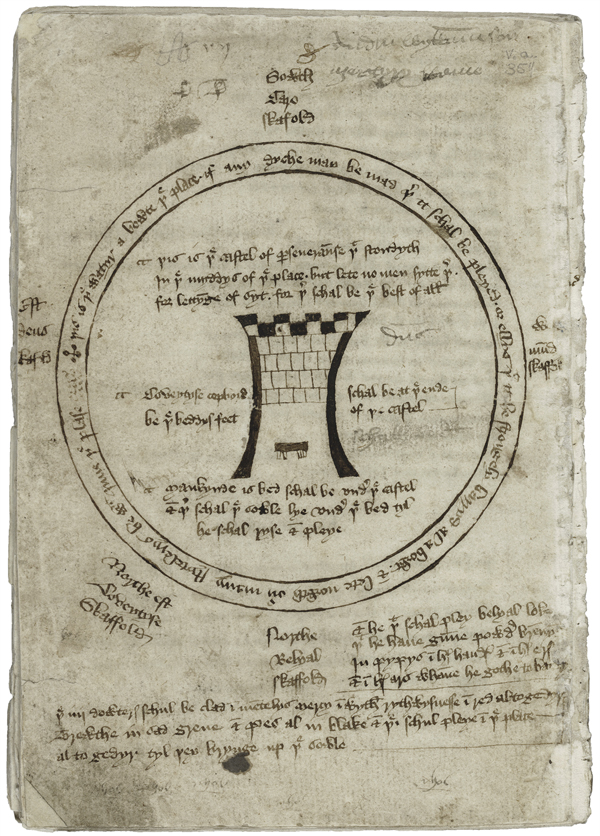
There were no theatre buildings in late medieval England, and so performance happened in everyday spaces—streets, churches, great halls, guildhalls, market squares—where a temporary performance space was carved out by the players’ bodies and voices, and, often, by stage structures. In cities like York and Chester, the pageant wagons that rolled through the streets momentarily changed the nature of those places, but they did so by merging York with the biblical places of the narrative, rather than by erasing it and creating a separate, distinct fictional place.Footnote 18 The Castle of Perseverance, however, erected static scaffolds, arranged to produce a very different relationship with the everyday environment, and so also created a very particular encounter between performer and spectator. The play was likely composed and performed in East Anglia sometime in the first quarter of the fifteenth century, but otherwise the text gives no indication of its precise location. It does, however, come with a unique stage plan (Fig. 1), the only one of its kind in the corpus of Middle English drama.Footnote 19 Although it is central to our understanding of the play and the bodies who perform and experience it, the diagram is, to say the least, ambiguous, being neither a record of a historic staging nor an exact “set design” for use by potential producers and performers.Footnote 20 Nevertheless, the structures indicated in the diagram would certainly have fashioned a distinctly separate space from the surrounding everyday environment, transforming it into an allegorical performance arena, structured by its emblematic stages and the spatial relationships between them.
The Macro Manuscript, The Castle of Perseverance, fol. 191v. Call no.: V.a.354. Stage directions. Used by permission of the Folger Shakespeare Library.

The Castle’s diagram identifies, through a combination of written and graphic information, six distinct scaffolds arranged around an open playing place, or platea.Footnote 21 The scaffolds belonging to the World, the Devil, the Flesh, God, and the deadly sin of Coveytyse (Avarice) are arranged in a circular formation around the central sixth, the eponymous Castle of Perseverance, the only scaffold to be identified pictorially. Sketched around the outside of the Castle, between this central feature and the other structures, is “þe watyr abowte þe place,” which the rubric suggests could be contained by a ditch, if any “may be mad [made].”Footnote 22 The diagram is silent on the positioning of the audience, except to say where they should not be: in “þe myddys [middle] of þe place.” Though it is not clear exactly what is meant by this, it is unlikely that the audience occupied any part of the platea, since, as William Tydeman argues, a reasonable amount of open, clear playing space would be necessary for both the famous battle at the foot of the Castle, and for the scene where Flesch chases and beats his sinful servants in placeam, “in the place” (s.d. 1822).Footnote 23 However, the playtext does suggest that, at certain points at least, some of the spectators were in close proximity with the players, as they were in the 1979 Poculi Ludique Societas production, which maintained a clear, open platea, placing the audience either on terraces in between the outer scaffolds or sitting cross-legged at ground level.Footnote 24 This would make sense of moments in the playtext that seem to indicate player–audience proximity and interaction, as when Bacbytere, World's messenger, directly addresses “all þo þat ben here,” revealing that “[w]yth euery wyth I walke and wende” (656–61), that he is with every man, a point made literal for those to whom he was closest.
In addition to identifying the owners of each of the outer scaffolds, the rubric also expressly locates the structures at specific compass points. God's scaffold is in the East, the World's is in the West, and the remaining two traditional Enemies of Man, the Devil (Belyal) and the Flesch, are positioned in the North and South, respectively. The fifth scaffold in the circle, belonging to the deadly sin of Coveytyse, is positioned in the North–East of the space, exactly halfway between God and the Devil. By providing Coveytyse with his own scaffold, as Richard Southern has pointed out, the play grants him equal standing with the traditional Enemies of Man and so marks him as a major power in the corruption of the protagonist, Mankynde.Footnote 25 The location of the main scaffolds, therefore, constructs what Catherine Belsey has termed an “emblematic geography,” an enclosed macrocosm of human experience, a “visual network of meanings,” separated from the world of the everyday that conveys through the structure of space the nature of the human condition, and the spiritual and moral choices available to mankind.Footnote 26 Positioned in the center of the circular space, the Castle would have been of equal distance from all of the surrounding scaffolds, no closer to God than to the three Enemies of Man. It is also visible to all of the audience regardless of their position at the edge of the circle. An individual standing next to, say, Flesch would have been just as proximate to the Castle as those spectators at Belyal's and God's scaffolds, all being equidistant from it. The audience, then, are also a part of this emblematic geography, situated within it and inhabiting it for the duration of the performance; it is their journey as much as it is Mankynde's, their spatial and bodily proximity to any one of the scaffolds placing them emblematically in a position of sin or virtue, with the spiritual routes available then laid out spatially before them. Those at Belyal's scaffold, for example, even if they could not see God and heaven in the East, could see the Castle, the route to salvation. Within such a space, then, there is quite literally no sin that cannot be repented, no sin from which the Castle, and consequently heaven, cannot be reached. It is achievable by all. Conversely, although the spectators positioned next to God occupy a spiritually superior location, they remain in a precarious, vulnerable position. Located not on the scaffold (representing heaven) but in the exposed platea and flanked by Coveytyse and Belyal on one side and Flesch on the other, the audience here would remain vulnerable to the Seven Deadly Sins as they performed in the place. No matter how spiritually pure you currently are, the space says, you must remain vigilant; from this position it is as easy to fall back into sin, to be lured by temptation, as it is to achieve salvation.
But the odds are against Mankynde and those he represents from the start. As David Bevington notes, “[s]ymmetry was perceived to be an expression of harmony, beauty, and goodness” and the “basic visual sign in God's great hieroglyph was considered to be order itself, in the cosmos and in society,” often represented by the visual sign of the circle.Footnote 27 The symmetry of The Castle’s circle is, however, broken both by the presence of Coveytyse's stage and the fact that four out of the six scaffolds belong to evil. There is no equilibrium in this representation of man's life on earth; God and virtue are vastly outnumbered, as Mankynde is enclosed on three sides by evil and sin, making the Castle and the East literally his only means of escape.Footnote 28 This is an inherently unbalanced space, one dominated by the intrinsically oppositional Devil and Sins, whose mere presence disrupts symmetry and order, an imbalance exacerbated as the play continues by the increasing physical presence of sin in the platea.Footnote 29 As the Bad Angel begins to work his charm and temptation takes hold of Mankynde, the threat to his soul is made physically manifest and immediately present. Lust-lykyng (or Pleasure) and Foly are the first of the Three Enemies’ attendants to descend into the place seeking for World “a seruaunt dynge and dere [worthy and dear]” (483), followed shortly by the vice Bacbytere and six of the Seven Deadly Sins as they move toward Coveytyse's scaffold (893; 1010). So, where initially evil was present only on the spatial periphery, elevated on the scaffolds and separated from the audience, Mankynde's decision to choose his Bad Angel over his Good invites the Sins down into the place, and into greater proximity with the audience, into their space, underlining their representation in the central protagonist and making the consequences of his actions relate directly to them.
Evil also tends to occupy the place en masse, in pairs or groups.Footnote 30 When Coveytyse calls on the other Deadly Sins (891–905), for example, they cross the place in two groups of three; when Bacbytere informs the Three Enemies of Man of Mankynde's return to the Virtues, each Enemy calls on his respective Sins to return to their scaffolds when they again move in groups (s.d. 1766, 1811). Later, World calls the others to war, and under his banner they descend into the place, “[þ]e Castel of Vertu for to spyll” (1896), initiating the largest gathering of evil within the platea and one of the greatest spectacles in medieval English drama. The Enemies of Man, then, form a demonic coalition against Mankynde and his hopes of salvation, working actively together to tempt him into damning his once innocent soul. It also means that evil, sin, and temptation seem to occupy fully The Castle’s performance space, so that not only is good outnumbered by the physical structures belonging to its opponents, but the bodily presence of evil is also literally everywhere, surrounding Mankynde and constantly present to the audience wherever they are within the space, within their sight if not physically immediate to them.
In contrast, very few figures of good inhabit the place, and for the first 1,297 lines it is only the Good Angel who interacts with Mankynde. When further aid does finally come via Schryfte and Penaunce (1298–1401), the exchange is brief and seems less active and more restrained than Mankynde's interaction with their sinful counterparts. The Seven Virtues are restricted for the entirety of the play to their Castle stronghold, and, although the Four Daughters of God are directed to “playe in þe place altogedyr tyl þey brynge up þe sowle” (rubric, f. 191v), they have no direct part in the action until Mankynde cries for mercy on his deathbed (3007).Footnote 31 Furthermore, where each of the other five scaffolds has constant movement either between or on them, God's scaffold is not only silent but motionless, with neither good nor evil stepping foot on the platform until the Four Daughters ascend to plead Mankynde's case (s.d. 3228). Although the characters of Schryfte, Penaunce, and Dethe are sent forth from God and, therefore, could probably appear from his scaffold, they, unlike the Four Daughters, do not have any direct verbal exchange with the Creator. They are of course his agents, but like the Good Angel they seem to act, if not independently of him, then without his obvious intervention.
With so much of the action performed by temptation and sin, both Mankynde (and probably many in the audience) cannot help but attend to their antics rather than the silent, static East. The vocal absence of God for the majority of the play further underlines the dominance of evil in both The Castle’s performance space and the audience's attention. At no point prior to the Four Daughters’ appeal does God intervene in the Fall of Mankynde or make his presence known to either Mankynde or the audience. At the beginning of the play, the World, the Devil, and the Flesch make their “boasts” (157–274), but God is silent and remains so until the close of the play.Footnote 32 This is not, however, a theatrical oversight, forming instead a spatial and corporeal simulation of human experience, as described by the fourteenth-century Book of Vices and Virtues:
Now schalt þou wel vnderstonde þat þer nys no þing þat a man may bettere kunne [know] þan þat God is, but þer nis no þing so hard to kunne þan whi & what þing God is. ¶ And þerfore we rede [advise] þat þou studie not moche to wite [know] ne enquere. For þou myȝt liȝtliche [likely] faile and go amys; it suffiseþ to þe [to] seie, “Faire swete fadre, þat art in heuene.” ¶ Soþ is þat he is ouer al present, in erþe, in þe scee, and in helle, as he is in heuene.Footnote 33
Despite his omnipresence in all things material and spiritual, “in erþe” and “þe scee” as well as in heaven, there remains “no þing so hard to kunne þan whi & what þing God is,” a belief realized in The Castle’s action and performance space. God is constant, he exists in all things, he is everywhere and in everything. He and the Castle of Perseverance are constantly present, but it is easy to be distracted from them by the absorbing and dominant presence of evil and temptation in the world. Where the Devil and his agents actively seek to corrupt, God and the Virtues must be sought through Mankynde's own free will. This is why, when the Good Angel begs the Virtues to help keep Mankynde in the Castle (2545), Mekenes (Meekness) replies,
It is, therefore, up to Mankynde and the audience to look past temptation and seek out God for themselves, to notice his silent, enduring presence in a world enveloped by evil and sin.
Devilish Movement
This, then, is the space in which the body performs. It is a space dominated by the presence of evil and temptation, a presence that is both seen in the physical structures of the space and felt in the bodily presence of the figures who occupy it. The way the Sins moved and what their bodies did during the performance would also have added to the play's “network of meanings,” though it is not they who provide us with the first substantial clue as to what might have constituted devilish movement. When Mankynde first enters the place as a newborn soul, he tells the audience,
This passage identifies the Good Angel and the Bad Angel, but also hints at how they should occupy their portion of the performance space. The Good Angel is very specifically on Mankynde's right side (303). The Bad Angel is not, however, located on Mankynde's left as we might expect, but is instead “about in euery degre.” This is, like the presence of evil in the space more generally, a reference to the constant threat of temptation in everyday life, but could also be translated literally into the physical performance of the Bad Angel. The specificity with which Mankynde refers to these two characters seems to indicate that the Good Angel is restricted in his movement and has, at this point at least, a very specific position in relation to Mankynde. In contrast, the Bad Angel “is about in euery degree,” which perhaps implies that the Bad Angel can move freely, occupying the space surrounding his victim so that, wherever Mankynde turns, his Bad Angel is present.Footnote 35
The Bad Angel's positional freedom is echoed in the speeches of other devilish servants. Bacbytere not only brags that “[w]yth euery wyth [man] I walke and wende [go]” (660), but that he is “lyth of lopys þorwe euery londe [nimble at leaping through every land]” (673). Like the Bad Angel, we get the sense that he is, or at least can be, everywhere, but we also learn that he is “lyth,” that is, nimble. Pryde similarly boasts that he is born “to braggyn and buskyn [hurry] abowt, / Rapely and redyly on rowte for to renne [quickly and readily in a crowd to run]” (910–11); Envye is “flet [fleet] as a fox” (933) and the more stately World says “I trotte and tremle in my trew trone [throne] / As a hawke I hoppe in my hende hale [noble hall]” (457–8), implying a rather undignified jogging and hopping motion similar to Bacbytere's leaping and Pryde's running. Even the bloated Glotony manages to “stampe and … styrte [leap] and stynt upon stounde [stop suddenly]” (960).Footnote 36 This manner of moving around the space corresponds with what Richard Rastall has termed “undirected energy” in his discussion of devilish noise.Footnote 37 Just as cacophony, indecent language, and nonsense signify devilish allegiance, so a character's excessive energy and multiplicity of direction in movement mark him or her as a servant of evil and wickedness. The Book of Proverbs perhaps provides a source for this notion, describing the bodily decorum of “homo apostata vir inutilis” (6:12)—an apostate, an unprofitable man—whose physical attributes include “pedes veloces ad currendum in malum” (6:18), feet that are swift to run to mischief.Footnote 38 Alexandra Johnston further identifies Augustine's influence on this physical and verbal representation of sin. As she explains, the frenetic energy that we see in dramatic figures like the Vice, a character type in the later Tudor interludes, was probably inspired by Augustine's principle that the further you are from God, the less stable you are, a spiritual position that would affect “the control of the bodily appetites.”Footnote 39
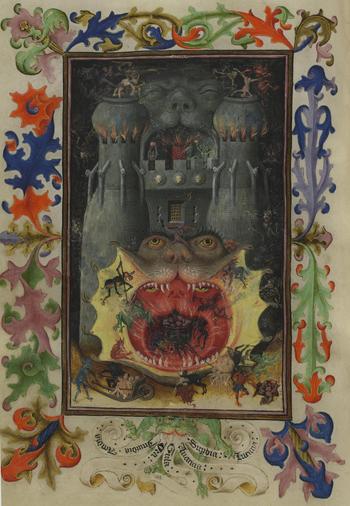
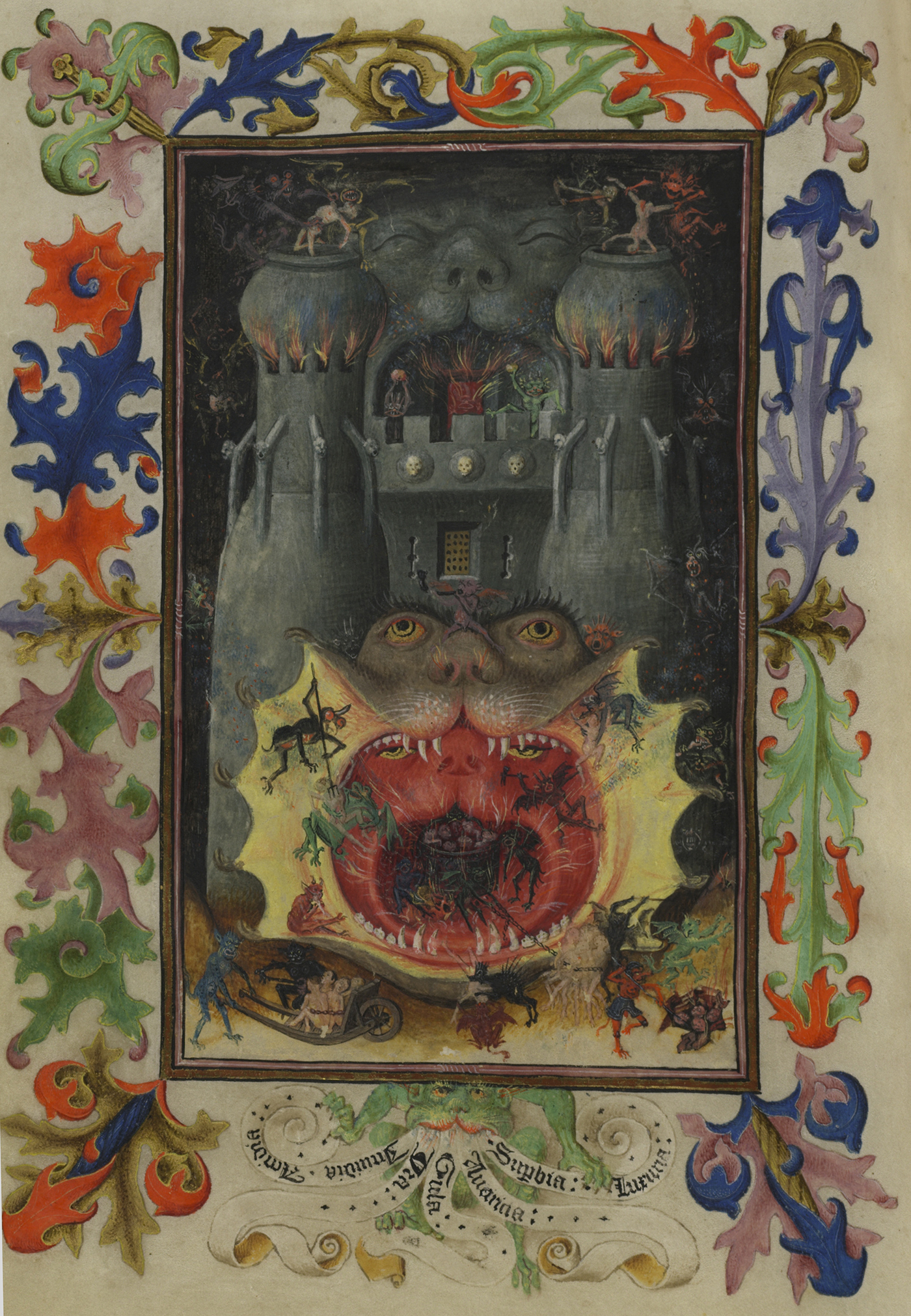
The sinful body seems, then, to manifest particular kinesic characteristics: energetic and exaggerated motions that must surely have been performed as well as described. The Mouth of Hell depicted in the Hours of Catherine of Cleves (Fig. 2) provides a particularly vivid indication of how a player's body might have performed these actions. While the viewer's focus might be drawn to the gaping, yellow hell mouth in this image, the eye is nevertheless distracted by the vigor of the swarming devils, their mere number seeming to threaten mankind's salvation. There is a strong sense of movement in this miniature, of frantic haste and frenzied action, but the postures of the devilish bodies, the manner in which they move, contributes just as much to the representation of hell. The devils’ limbs extend out away from their bodies, positioned frequently at awkward right angles to the torso, in effect consuming a far greater portion of the surrounding space than is necessary. This is neatly exemplified by the small, green devil who grins and dances with glee on the central battlement of the demonic castle, one arm and one leg raised in a lively devil's dance. Similarly, another green devil in the bottom right corner, beaked and with wings, also raises his arms above his head with one leg, again, bent and elevated. Like The Castle’s performance space, these devilish bodies are all asymmetric. No two limbs are doing exactly the same thing, reflecting the inherent instability and disharmony of evil. Movement in this image is chaotic, ungoverned, and uncivilized; frenzied, wild, and uninhibited.
“Mouth of Hell,” fol. 168v of Hours of Catherine of Cleves (The Morgan Library & Museum, MS M.917/945), Utrecht, The Netherlands, ca. 1440. Purchased on the Belle da Costa Greene Fund and with the assistance of the Fellows, 1963. Courtesy The Morgan Library & Museum, New York.
However, lively and energetic action is not The Castle’s only means of depicting sinful bodies. Lechery, who is, she says, “lovyd in iche a lond [loved in every land]” (972), provides a very different corporeal performance of sin. Drowsily, she describes how “[w]yth my sokelys [flowers] of swettnesse I sytte and I slepe” (973), indicating a bodily register that appears the exact opposite of the chaotic energy of her fellow Sins. Nevertheless, although not as frenetic as her brothers, Lechery does maintain evil's core kinesic characteristics and provides us with further insight into why its apparent opposite (feverish energy) is indicative of sin. The Book of Vices and Virtues is again helpful here, reminding its readers that “þe foule dede” is not the only temptation that constitutes lechery:
To þat synne longen alle þynges þat a mannes flesch is meued [moved] to, and desireþ fleschly lustes, as ben outrageous etynges [excessive eating] and drynkynges and esy [soft] beddynges and delicious and softe schertes [shirts] and smokkes [smocks] and swote [sweet] robes of scarlet, and alle oþere eses of þe body þat is more þan nede is.Footnote 40
So, to be lecherous entails not simply a desire for sexual pleasure, but a desire to consume all that is beyond the body's basic necessities, a characteristic that is also built into The Castle’s representation of evil as a whole. Just as Lechery's indolence is wasteful and so sinful, the trotting, leaping hastiness of Pryde, Envye, Bacbytere, and the World is excessive. Their movements are extravagant and careless, vigorous and elaborate, and occupy far more space than is necessary. They are, therefore, unproductive and ultimately destructive.
The players would perhaps have been further encouraged to adopt this devilish corporeal register by the formal structures of The Castle’s verse. As Simon Shepherd has argued, the playtext has an important role to play in shaping an actor's bodily attitude; not only does it bring certain expectations for performance style, based on, for example, genre and form, but it can also control breathing patterns through the burden of syntax, verse, rhyme, meter, phonology, syllable length and number, beats and pauses, dialogue exchange, and line length, calling for a whole bodily effort in addition to the labor of the vocal muscles. In this way, the text “links voice into gesture,” ensuring a correspondence between the player's speech and his or her body.Footnote 41 The playtext establishes, then, a character's bodily attitude, the player's muscular organization and also more generally indicates the “mode of performance, [the] performance register. In so far as the words invoke such things as genre or intertextual reference or parodic quotation, they indicate a register of movement (like a register of language), suggesting how it is done.”Footnote 42 The most notable feature of The Castle text is its abundant use of alliteration. The particular placement of that alliteration in relation to syllabic stress perhaps helped to construct each character's “register of movement.”
The alliterative device has often been associated with stage devils and the character of the Vice in early English drama, and, as Mark Eccles observes in the introduction to his edition of The Macro Plays, the Three Enemies of Man and the Seven Sins do alliterate nearly all their lines, their rhythms “strongly marked” by the stresses of the bob-and-wheel stanza form.Footnote 43 In The Castle, most of the stanzas are thirteen lines long, consisting of two quatrains of three- or four-stressed syllables, and a “wheel” of five lines with two or three stresses each. In such a large, open playing space as The Castle requires, the coincidence of stress and alliteration would undoubtedly have helped the audience to hear and follow the dialogue, but it would surely also have had a significant impact on the players’ bodily performances, perhaps helping them to personify the abstract concepts they embodied. The effort needed to sustain the stress and the alliteration, and remain audible, would certainly have required virtuoso performances from The Castle’s players. The first significant pause in World's opening speech, for example, is after four lines in which he must alliterate /w/ nine times and plosive /p/ eight times, each landing in quick succession, some on stressed syllables, some on unstressed.Footnote 44 This, mixed with the syntactical structures of the verse, demands a certain breathing pattern, the player's breaths providing enough air to hold the rhythm and the pace of the lines, and propel his words toward those on the opposite side of the space. Moreover, the repeated alliteration would perhaps force the performer to take his time and clearly enunciate each syllable; it is otherwise very easy to trip over, for example, “[b]e wylde wode wonys [dwellings] and euery weye-went [pathway]” (158), to run one word into the next in a jumble of nonsensical sounds. Posture would almost certainly have influenced the success of World's important opening speech; an upright body, bold and proud, would not only allow the player to fill his lungs, project, and pronounce his lines clearly, but would also agree with the personified figure of stately World and the content of his speech.
Belyal's verse offers similar insights into his register of movement. Like many stage devils, Belyal talks of gnashing his jaws and teeth. “I champe and I chafe, I chocke on my chynne [thrust out my chin]” (198), he says, and the verse here and elsewhere in his boast encourages the player to adopt a bodily register that exposes the snarling, aggressive attitude described. The placement of the affricate /tʃ/ (‘ch’) on the four stressed syllables lends emphasis to the sound, but, because there is no alliteration on Belyal's unstressed syllables, the rhythm of his verse is much more clearly delineated than fickle World's, where alliteration appears on both stressed and unstressed syllables. Belyal's verse produces a rocking, stamping rhythm that facilitates a similar motion even while sitting, as he tells us he is (196). Moreover, the sounds produced, like the /tʃ/ (‘ch’) of line 198 above, the /b/ of boystows [fierce] and bold (199), the /g/ of grope, gapyn, and grenne (200) and /k/ of Carlylle, Kent, and carpynge (201) are not only aggressively plosive, but also encourage the player to adopt a devilish physical attitude. Pronouncing the affricate /tʃ/ of champe, chafe, chocke, and chynne (198), for example, requires the speaker to part his lips and bare his teeth, bringing them together in an expression that resembles the clenched-tooth grimace of the devil in contemporary iconography. Similarly, the long vowel /e/ (‘eh’) combined with nasal /n/ in gr enne, br enne, w enne, and d enne (200–8), pulls the face into an open-mouthed grin. Though the actor playing Belyal probably wore a mask covering at least half, if not all, of his face, the act of producing these sounds and the facial expressions they require would likely promote the muscular bodily tension that accompanies such an aggressive and animalistic countenance.Footnote 45 Perhaps the effort required to propel the sounds beyond the confines of the mask would in fact have helped with this.
In contrast to Belyal, Flesch, as the personification of sensual indulgence and pleasure, would need to display bodily license and torpor. “I byde [dwell] as a brod brustun-gutte [broad bursting gut],” he tells us, sitting “florchyd [adorned] in flowrys” (235–7), and we can already imagine the static, rotund, and expansive figure who lounges among his soft furnishings and exotic flowers. Flesch's verse, in imitation of his nature, seems far more burdensome than either World's or Belyal's, and would probably have encouraged and aided the player in producing Flesch's unique corporeal register. If the first four lines of each speech are taken individually, Flesch is required to utter far more syllables than World, fifteen in line 235 as compared with either nine or ten in line 157, for example.Footnote 46 Although this may appear a very slight variation, in terms of performance it would probably have had a profound effect. Whereas the likes of Herod in York's Christ before Herod pageant, with his profusion of single syllables, can rattle through a speech at high speed,Footnote 47 Flesch's multisyllabic iterations would promote a far slower vocal delivery, encouraging the player to take his time and savor his gluttonous lines. The alliteration given to him here would also contribute thematically to this lethargic and torpid speech and body, typifying the role of Mankynde's Flesch. The /br/ cluster, with its trilled /r/, along with the /Ʌ/ (‘uh’) vowel and guttural /g/ in brustun-gutte, for instance, combine to produce a thick flow of sound, which appears to originate in the very depths of the body, once again underlining Flesch's sinfully indulgent nature. Even his words feed his flesh.
The script of The Castle of Perseverance, then, not only describes the actions of sin, but its formal features probably also helped to shape how the players performed evil. World, an arrogant prince “prekyd in pride” (159), needed a haughty posture that assumed ownership of the space, offering a direct challenge to the true king, God, on the opposite side of the place. Belyal “þe blake” (199) is more beastly and aggressive. Along with his animalistic costume and hell mouth scaffold, his words gnash and snap as his muscles and sinews tense in response to his fiendish verse. In contrast, the bloated and indulgent Flesch chews over his words, their phonetic essence reflecting and instigating his florid, languorous presence. These three do not perform the same frantic kinesis as the Bad Angel and Bacbytere, nor do they, at least at this point, seem to display the same energy as we see in the devils of The Hours of Catherine of Cleves, but they do still maintain the excessiveness that characterizes the bodily presence of evil and sin. It is their exaggerated, excessive gesticulations, their “demonic gesticulatio” that, as with Lechery, mark them as corrupt and damned.Footnote 48
Such bodies were clearly, then, in opposition to the bodies of the virtuous, the faithful, the rational, bodies that displayed a very particular comportment and exemplified their harmonious relationship with the spirits they harbored. In his De institutione noviciorum, Hugh of Saint Victor advises young novices how to achieve such a balance, advising them to avoid moving their “members” (their arms and legs) in a “disordered, or immodest or extravagant fashion,” and neither should they “diminish the peaceful nature” of their speeches by winking or drastically changing their facial expressions.Footnote 49 On a similar note Bernard of Clairvaux advises the newly appointed pope to:
Stand firm in yourself. Do not fall lower, do not rise higher. Do not proceed to greater length; do not stretch out to greater width. Hold to the middle if you do not want to lose the mean. The middle ground is safe. The middle is the seat of the mean, and the mean is virtue.Footnote 50
Although probably using the body as a metaphor for political “virtue,” Bernard, like Hugh, builds the image of a body that holds to its central core, a body that maintains a delicate poise and restricts its extension into the surrounding space. It seems very much to be about containment and consistency, modesty and constraint, the exact opposite of the uncontrolled and excessive activities of the devils explored above.
Although Bernard and Hugh provide their advice for the edification of young novices and other clergymen, the ideals for the rational, virtuous body do filter down to secular society. The author of The Book of the Knight of the Tower, for example, adapts the clerical bodily ideal for the maintenance of social position and gendered decorum. Addressing The Book to his daughters, he advises them to be “softe / humble / … stedfast of estate and of manere / of lytel speche to answere curtoisly and not to be ouer wyld to sprynge ne lepe.”Footnote 51 He also tells them, “be ye not like ne semblable [nor similar] the tortuse [tortoise] ne to the Crane. which torne their visage [turn their face] and the heede [head] aboue their sholders / and wynde their hede here and there as a vane [a weather vane].”Footnote 52 Instead, he says:
Alwey see that ye be stedfast in lokyng playnly to fore [before] you And yf ye wylle loke a syde / torne youre vysage & youre body to geder [together] / And so shalle ye hold you in youre estate [social position] more ferme & sure.Footnote 53
As in the examples from Hugh and Bernard, the poses described by the Knight have as their underlying notion the restriction of the body's occupation of the surrounding space, and so the limitation of excess. The idea that the head and body should remain aligned even when changing the direction of the gaze is similar (if more extreme) to Hugh's request that novices refrain from moving their limbs in an extravagant manner; both seek to maintain symmetry to perform physical and spiritual harmony, and a virtuous soul.
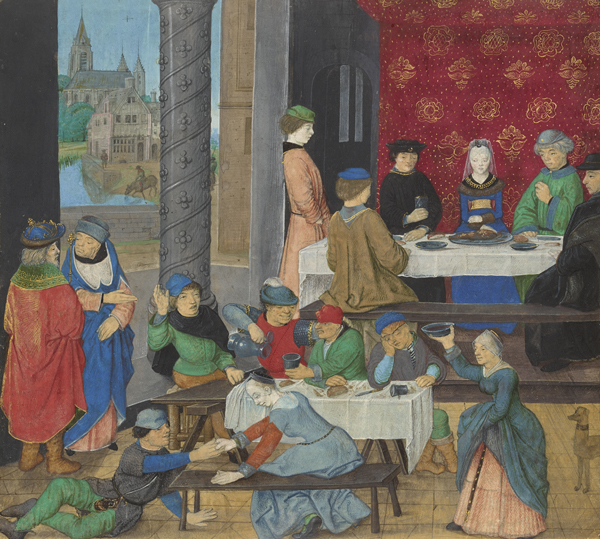
The Temperate and Intemperate miniature by the Master of the Dresden Prayer Book shows clearly the kinesic distinctions between moral and immoral man (and by implication woman), but also illustrates how sinful excess could be articulated in spatially restricted bodies, like the Three Enemies of Man, as well as in highly mobile ones (Fig. 3).Footnote 54 At the front of the image carouse a group of seven individuals, five men and two women, all shown in various raucously expressive postures. Like the devils in The Hours of Catherine of Cleves, the posture of each of these figures is different from the next, no two match each other exactly, and all express different preoccupations. Although they appear quite static—that is, they are not dancing, leaping, or running—these Intemperate bodies do share common kinesic conventions with the diabolic. Like the devils discussed above, most have their arms raised either level with or above the shoulder; two out of the seven have their legs crossed, which distorts the posture; and none of them shows the tall, upright bearing that is even today associated with propriety and decorum. Instead, they are in various stages of slouching, crouching, and lying, their debauchery and sin indicated in the chaos and disorder of their limbs, and so, though this is a still image, their movements appear palpable. Furthermore, like the devils of The Hours, the free and indecorous postures of the Intemperate seem to consume a much larger portion of the space surrounding them than the sedate group receding at the back of the image (the Temperate). This, of course, is partly to do with their position in the foreground, but if taken as individuals, the Intemperate do occupy a far broader section of the space around them than their Temperate counterparts. Like the devils, their limbs extend out away from their torsos to occupy the space in front and to the side. Those who do not have their arms raised instead spread forward onto the table, their forearms supporting the rest of their bodies. The upper body is also significant here. As mentioned above, none of the Intemperate stands or sits erect; rather they are hunched in varying positions, all of which curve their postures. This, again, suggests a greater occupation of the space around them, as their torsos occupy horizontal as well as vertical space, devouring the area around them as they consume the beer they share.
The Temperate and the Intemperate, by the Master of the Dresden Prayer Book. Miniature in Valerius Maximus, Faits et dits mémorables des romains (The Memorable Deeds and Sayings of the Romans [trans. Simon de Hesdin and Nicolas de Gonesse of Facta et dicta memorabilia]), bk. 2. MS. 43, recto. Bruges, Belgium, about 1475–80. J. Paul Getty Museum, Los Angeles. Digital image courtesy of the Getty's Open Content Program.
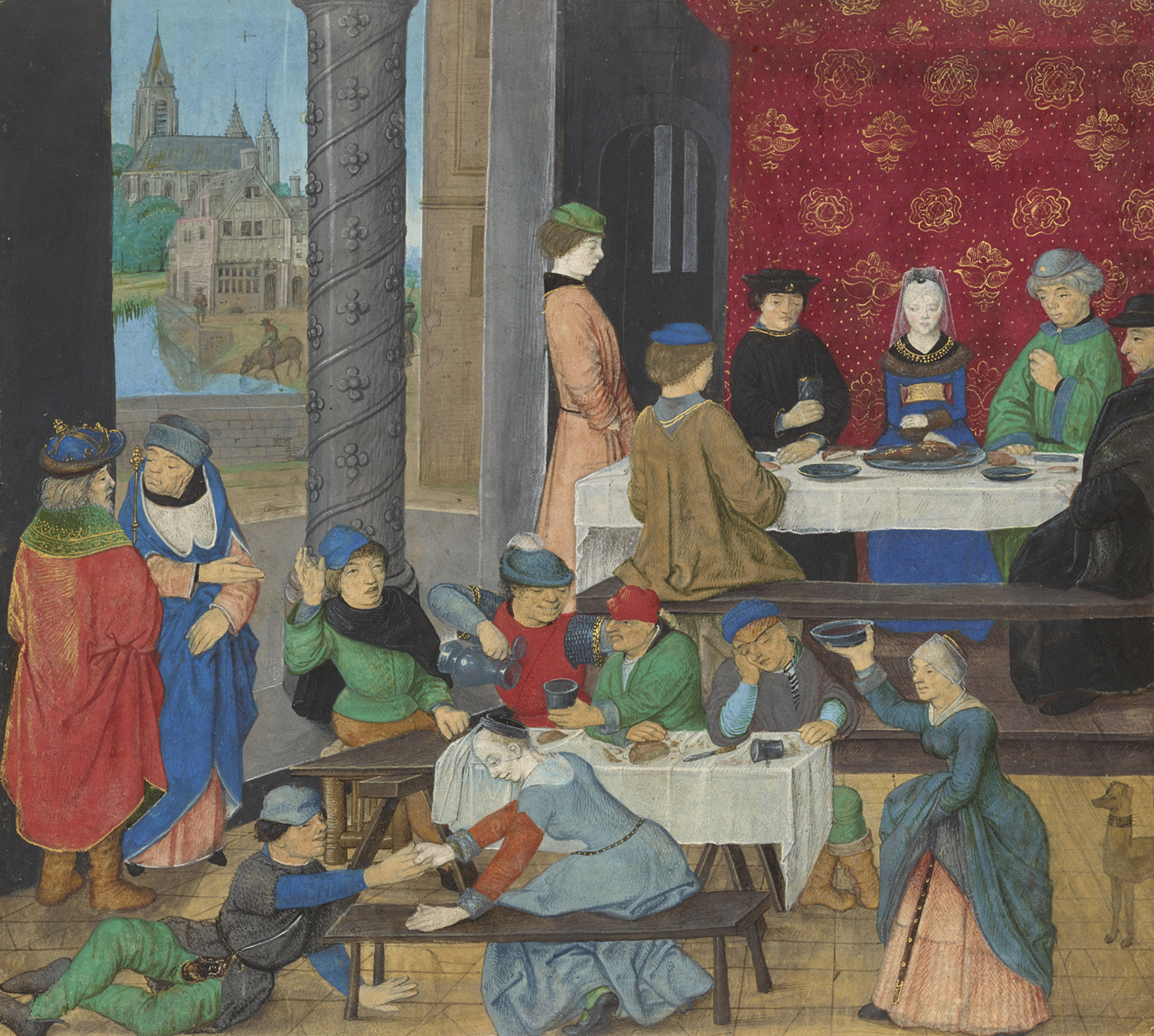
The images of devils and sins in the iconography discussed above all show the excess, imbalance, and instability that is typically associated with the forces of evil, but they also offer alternative means of expressing intemperance to suit different performance spaces. Characters like Bacbytere, Pryde, Envye, and the Bad Angel cross the place in the same energetic, frenzied manner of iconographic devils, whereas the Three Enemies of Man on their scaffolds show far less active, but equally uninhibited, bodily attitudes, perhaps similar to those we see in the Dresden Intemperate. These are, then, two ways of depicting devilish bodies, which can be tailored and refined depending upon the particular sin or vice they personify, but also the type of space they occupy. The first marks demonic allegiance through the mobile body, moving from one point in space to another. It uses speed and haste, leaping, trotting, and running, and therefore could only really be enacted fully in the open space of the platea. The second is probably intended for those figures who remain static or are constrained by the structural limits of a stage. These individuals cannot easily show their corruption through leaping or running, and so instead they must portray it through wild gesticulations that take their arms up and away from the core of the body, through crossed legs or raised knees, bent bodies and curved spines, all of which mark them as allies of the devil. World does talk of hopping “[a]s a hawke … in my hende hale” (458), but this is quite different from the leaping of Bacbytere, which would involve a forward as well as an upward motion. Hopping, by contrast, suggests a purely vertical action, the doer confined with limited momentum in any other direction.
In performance these wild, disorderly movements and gestures would contribute to the overall impression of the play. The dominance of evil in the space, established by the scaffolds and the layout of the performance area, is extended to the bodies and actions of those who performed within it. Evil and sin numerically dominate, and so they quite literally occupy more of the space than God and the Virtues, but even individually each Sin, through his or her devilish bodily register, would consume a greater portion of that space than his or her virtuous counterpart. This bodily register would, furthermore, make the sins more prominent within the audience's visual field, their lively, energetic actions demanding attention and detracting from the silent, peaceful East.
Empathy with the Devil
Matthew Reason argues that there is something ineffable about experiencing live performance, a certain x-factor that distinguishes it from film and television. It can, he suggests, “express something beyond that which could be said with language” alone, something that originates in our sensual, somatic perception of the event.Footnote 55 Although he is specifically referring here to nonverbal performance forms, like dance, similar observations have been made about the performance of plays. Bernard Beckerman, for example, notes that,
[a]lthough theater response seems to derive principally from visual and aural perception, in reality it relies upon a totality of perception that could be better termed kinesthetic. We are aware of a performance through varying degrees of concentration and relaxation within our bodies.Footnote 56
It is, then, the corporeal copresence of, and interaction between, actors and audiences that makes engaging with live performance such a unique experience. Furthermore, as the above quotation from Beckerman suggests, an actor's movements, postures, and gestures do not convey meaning through visual signs alone; it is, of course, possible to read them as one would read the visual signs of a painting, but those signs also have the potential to influence the spectator's own musculature, and so the effects of the live dramatic event will, as Shepherd writes, also be physically “felt in the body and [will] work powerfully to shape a spectator's sense of the performance.”Footnote 57
The role of the body in performance is consequently as much about the perceiving as the performing body. The very particular scripting of bodies and their occupation of space in The Castle of Perseverance is obviously closely connected with traditional and iconographic representations of sin and vice, but perhaps it also capitalized on this defining characteristic of the dramatic medium. As already suggested, the performance area of The Castle of Perseverance can be separated broadly into two types of playing space: the limited region of the raised scaffold and the open, expansive platea. The actors performing on the scaffolds would have been restricted in their movements by the limitations of space, whereas those in the open place would have had greater kinesic freedom and mobility and, therefore, probably displayed the more active and appealing bodily activity. Significantly, it is these latter characters who would have interacted and engaged most with the audience, as the Three Enemies of Man send their temptations to entice Mankynde, and by association the audience, to their company. With such an immediate and lively physical presence before them perhaps the audience of The Castle of Perseverance experienced what Jill Stevenson has termed temptation's “engaging and attractive body rhythms.”Footnote 58 They would see the Sins’ movements, but perhaps would also experience those movements via a kind of kinesthetic empathy.
As outlined above, kinesthetic empathy refers to an embodied, instinctive simulative response to the movement of others. When the live movement of another is perceived, the brain of the perceiver reenacts internally the experience of moving, so that “during a performance an actor's actions and reactions onstage are perhaps, to some degree, literally reenacted within the spectator.”Footnote 59 What is more, in doing so, the viewer can imagine, based on her own experience, the thoughts, ideas, and emotions that might prompt or be a result of such movements, therefore associating kinesthetic experience directly with emotional experience and, crucially, with a sense of intersubjectivity.Footnote 60 Much recent work in neuroscience has added to and supported the theory of kinesthetic empathy through studies into the mirror neuron system (MNS). Mirror neurons, first described by Giuseppe di Pellegrino et al. in 1992, are a category of visuomotor neuron activated in both the execution and observation of movement.Footnote 61 First identified in macaque monkeys, the initial study was followed by studies in humans.Footnote 62 Like kinesthetic empathy, this work suggests that the “observation of another individual acting triggers an internal simulation of her/his actions,” and that the viewer then reflects the bodily attitudes of the observed person, to some degree mirroring those attitudes in his/her own musculature.Footnote 63 Again paralleling the development of kinesthetic empathy, these neurological responses to movement are also often understood to be associated with the emotional states of the perceiver, offering a means through which an individual might interpret the attitudes, intentions, and feelings of the observed.Footnote 64
The evidence for mirror neurons has, however, been disputed, and the theory remains controversial. Initial reviews by Gregory Hickok and others, for example, question the validity of the evidence for mirror neurons, especially as it relates to humans, and observe also the complications presented by overlapping brain functions.Footnote 65 The region of the brain in which the MNS has been identified also plays a role in other brain functions, like working memory and receptive language, which may account for the brain activity associated with mirror neurons.Footnote 66 As Anthony D. Passaro further points out, the imaging currently used in MNS studies is still too weak to be able to identify individual neurons, so there is, as yet, no way of being able to distinguish mirror neurons from the other types of neurons clearly active in the same region of the brain.Footnote 67 Further criticisms arise from neurological evidence for the brain's neuroplasticity, that is, its ability to change, remap, and reconfigure itself in response to input from the environment or from damage caused by illness or injury. Maxine Sheets-Johnstone makes such an argument, observing that the “synaptic connections among neurons are not prespecified in any precise way by our genes” and that “however spatially fixed and permanent the anatomical parts of the brain, its neurology in a living sense in a living being is definitely on the move and not bound to spatially fixed and permanent pathways.”Footnote 68 So, instead of being born with mirror neurons, she argues, “the mirroring capacity of certain neurons derives basically from kinesthetic experiences of one's own moving, that is, from one's own moving experiences”; therefore, “mirroring depends on, is contingent on, our own kinesthetically experienced human capacities and possibilities of movement.”Footnote 69 The MNS is then to some extent reliant on cultural and familial contexts, meaning that individuals across time, cultures, and family or social groups will have varying degrees of mirroring capacities and ranges, different “neuronal registers” developed according to the specific movements we learn and experience in our own particular social environment. This means, in turn, that mirroring another's movements may not be as immediate or instinctive as the study results initially suggest; if the cultures of movement of person A differ significantly from those of person B, A's mirroring of B's actions may be neither instinctive nor immediate, the unfamiliar actions perhaps not mapping clearly onto those learned by A's MNS. Even if A does come to then “mirror” B's movements, an intersubjective exchange is not guaranteed because the connection between movement and emotions is dependent on individual past experiences; given the unfamiliarity of those movements it may then also be difficult for A to interpret and therefore experience the emotions of B.
To summarize, what these criticisms highlight is, first, that though there may be neuronal activity as an individual observes another's action, it is not yet clear that this is evidence of unique neurons that trigger an internal “mirroring.” Second, even if scientists do then find that evidence, it can only ever tell us what occurs physiologically, not how each individual experiences it nor how such an experience might be interpreted and used at a cultural level. As Hanna Järvinen has already recognized, “bodies and bodily experiences are historically specific rather than universally alike,”Footnote 70 and so “[w]hat spectators feel and why is highly individual and is linked with wider social, cultural and lived experience.”Footnote 71 The cultural specificity of movement and gesture, then, has considerable implications for both the MNS and kinesthetic empathy, and in recent years researchers in both fields have tried to account for such kinesic variation. Neuroscientist Christian Keysers, for example, in his 2011 book, The Empathic Brain, suggests that “what the mirror system really does is not so much mirror the neural state of whom we observe as translate and reinterpret what we see” into our own corporeal language, our own bodily experiences, which allows for cultural and individual difference.Footnote 72 Guillemette Bolens has similarly argued that though:
I cannot directly experience another person's kinesthetic sensations … I may infer [them] in another person on the basis of the kinesic signals I perceive in her movements. In an act of kinesthetic empathy, I may then internally simulate what these sensations may possibly feel like, via my own kinesthetic memory.Footnote 73
It is possible, therefore, that the wild, energetic, and ungoverned bodies of devils, Sins, and Vices in The Castle of Perseverance did work on the bodies of the watching audience so that they became kinesthetically immersed in, or had actively and consciously to resist, those same patterns and rhythms. This is not to say that an audience would have actually started to move like the Sins, only that such actions may have prompted, for some at least, an increased bodily tension, an unconscious shift in posture that echoed the movements witnessed, the dangerous reflection of a devilish corporeal register in their own musculature perhaps bringing with it related feelings and ideas, whatever they might be for the individual. Of course, not everyone would have responded in precisely the same way, and some may be more or less susceptible to this kind of movement, just as audiences are today. Responses would also, of course, have been dependent on the corporeal culture in which each individual participated, the particular bodily actions, movements, postures, and gestures he or she was used to making on a daily basis, and would have also varied depending on an individual's proximity to the performer, to other spectators (who may well telegraph their own energies in addition to the players’), and where they were positioned in the space. The potential for kinesthetic engagement with evil in The Castle was likely increased by the quantity of bodies in the performance space all enacting their highly energetic kinesis simultaneously. As discussed earlier, evil in this play tends to move en masse, as exemplified in the many unscripted but presumably frenetic scenes, such as when Glotoun (Glutony), Lechery, and Slawth (Sloth) are chased and beaten around the place by Flesch, their master (s.d. 1822), or when six of the Seven Deadly Sins gather at Coveytyse's scaffold (s.d. 1009). These scenes were undoubtedly engaging because they were intentionally comic, but perhaps they were also appealing because they involved the speedy, well-timed, exaggerated movement that typically absorbs an audience. As with pantomime slapstick, perhaps part of the joy in watching Flesch chase Glutoun, Lechery, and Slawth was the physical, if unconscious, effect felt in the body of the perceiver. The space in which these scenes occurred would have helped to create such an effect. The greater proximity between player and spectator in the place, along with its more fluid, ambiguous boundaries, probably encouraged a kinesthetic response to the characters’ activities. Furthermore, the presence of many equally frenetic bodies in the place all simultaneously performing their errant kinesis would likely have multiplied that energy and the probability of the audience responding kinesthetically to the physical action before them. As Dee Reynolds writes, kinesthetic engagement “is highly infectious and does not respect individual boundaries.”Footnote 74
Medieval theorists and commentators were certainly conscious of such embodied interactions, identifying effects akin to those proposed by proponents of kinesthetic empathy and mirror neuron theory. In the twelfth century, for example, Bernard of Clairvaux, citing Romans 1:20, suggested that souls need their bodies both to move through the world and sense “[t]he invisible things of God” and to be able to “know and influence each other.”Footnote 75 On this account, not only do the senses receive information about objects external to the body; they also communicate information about the individual to the outside world in what Christopher Woolgar has called a “more open process” of sense perception, by which “the senses gave out information or affected others directly, as well as receiving information.”Footnote 76 Accordingly, the soul of an individual could extend outside the body to interact with and affect objects and other souls via the sensory organs. The much later authors of A Tretise of Miraclis Pleyinge, an early fifteenth-century tract on the immorality of miracle plays, base their antitheatrical arguments on the observation that performance is “of oure fleyss, of oure lustis, and of oure five wittis” and, therefore, stirs men “to leccherie and debatis [arguments] as aftir most bodily mirthe comen moste debatis, as siche mirthe more undisposith a man to paciencie [patience] and ablith [prepares the way] to glotonye and to othere vicis.”Footnote 77 The Tretise authors, then, recognize performance as a process that appeals first to the “five wittis” and, as a consequence, it encourages spectators to love “more the liking of theire body and of prosperite of the world than likinge in God and prosperite of vertu in the soule” (TMP, ll. 318–20).
The Tretise’s emphasis on and anxieties about the corrupting effects of performance show a sophisticated awareness of the corporeal nature and potential of drama. This is displayed again further on when the authors outline why watching a religious play is so much more dangerous than looking at religious paintings. Advocates of miracle plays argue that, if it is permissible to represent in paint the miracles of God, then reenacting them through performance is also justified. Indeed, plays are even more effective; they are more memorable precisely because where a painting “is a deed bok [dead book],” a play is “quick,” that is, alive (TMP, ll. 179–85). In this statement it is the liveness of the embodied actor, moving in real time and space, that makes miracle plays so memorable. But, for the Tretise authors, the embodiment and reenactment of God's work entails more serious ethical and spiritual issues than its supporters would wish to recognize:
And to the laste reson we seyn that peinture [painting] … ben [be] but as nakyd lettris [letters] to a clerk to riden [read] the treuthe. But so ben not miraclis pleyinge that ben made more to deliten men bodily than to ben bokis to lewid [unlearned] men. (TMP, ll. 373–80)
By equating religious paintings with letters and reading, the authors of the Tretise imply that paintings can speak directly to the intellect of the viewer, his reason, his soul where truth lies. In contrast, miracle playing, because it is a quick book, alive and of the flesh, addresses the spectator's body and senses before his intellect. As a result the flesh hurts the spirit, “as in suche pleyinge the fleysh is most meintenyd and the spirite lasse” (TMP, ll. 492–3). Much as Sponsler did in the 1990s, the Tretise authors recognize the experiential basis of medieval dramatic performance, but also express anxieties about the immediate and irrepressible physical responses provoked by the plays. According to them, plays “reversith dissipline” (TMP, l. 76), an observation strikingly echoed by Shepherd, who notes that the “physical contagion” of an actor's kinesis can “undo the normal behaviour of a ‘civilized’ body, which has learnt to defer or repress involuntary body movements.”Footnote 78 In addition, The Tretise notes, performance's kinesthetic infectiousness perverts not only “oon singuler persone but … al an hool comynte [a whole community],” identifying the potential of audiences to telegraph individual excitement to their fellow spectators (TMP, ll. 236–40).
This evidence supports the notion that medieval plays did have an embodied, kinesthetic effect on their audiences, and commentators like the Tretise authors are clearly anxious about the lasting spiritual damage this could bring about. What is not so clear, however, is that such experiences were always bound to emotional or intersubjective connections. As mentioned in the introduction, current thinking about kinesthetic empathy sits oddly with the morality play format, a dramatic mode that operates allegorically through personified abstractions. Moreover, unlike other forms of performance in this period (like the miracle plays discussed by The Tretise), morality plays were concerned with guiding and reforming individual morality to renew and ensure individual spiritual health. In that sense, an audience's kinesthetic encounters in The Castle can perhaps be understood as a means of learning about oneself, rather than fostering “‘an ability to perceive and understand other people's emotions and react appropriately.’”Footnote 79 This perhaps also highlights how grounded current concepts of kinesthetic empathy are in nineteenth- and twentieth-century aesthetic and dramatic paradigms, a point also raised by Dee Reynolds in a recent essay. Noting that some forms of dance “foreground[ ] character, narrative and emotions,” elements that are also characteristic of modern naturalistic theatre, she reminds us of other contexts where “these features may be of minimal importance.” In these cases, Reynolds says, kinesthetic experience is not necessarily always bound to an understanding of the inner life of an observed mover, but can be purely an embodied response to the movement itself.Footnote 80 In these instances, therefore, empathy, a word that implies the ability to perceive and react to another's emotions, is misleading; Reynolds instead proposes the idea of kinesthetic affect, emphasizing “embodied responses which take the form of an ‘affective encounter’ rather than an ‘emotional identification’ with others.”Footnote 81 Affect here is seen to precede “the kinds of cognitive differentiations that separate out emotions into distinct and identifiable categories (such as happy, sad etc.)”; it is “pre-cognitive and refers to that point at which the body is activated, ‘excited,’ in the process of responding.”Footnote 82 It is “felt in the body, but not yet ‘captured’ in emotion.”Footnote 83 This also means that kinesthetic affect is often infectious, involuntary, and unconscious; like the Sins of The Castle, affective responses “seek us out.”Footnote 84
Reynold's account of kinesthetic affect seems closer to The Castle’s deployment of the corporeal effects of movement. As already illustrated, medieval theorists, playwrights, and commentators were acutely aware of the embodied nature of performance, and many of their observations are strikingly similar to those made by modern critics. It makes sense, then, that playwrights and performers would make use of kinesthetic affect, would harness it and cultivate it as both a dramaturgical and didactic tool. The Castle’s choreographing of devilish movement seems designed to be engaging and absorbing, to dominate the dramatic experience, to tempt, to seduce at a “pre-cognitive” level, and highlight how easy it is to fall in with sin. What is more, such an encounter relies on individual responses, not collective or communal ones. The personal, lived kinesic experience of each audience member is given room to influence the play's meaning, as every person responds differently to the varying movements of each personified sin. This enhances rather than detracts from the play's moral agenda, telling that individual something about herself, about how her own body engages with and is tempted by the world, life, and other bodies. The Castle, then, enacts “the process through which … knowledge production takes place,” only this is knowledge of the self and individual tendencies, rather than knowledge of the world and of others.Footnote 85
The innate attractiveness of demons, Sins, and Vices in morality plays and their influence over the audience have been a constant source of concern for many modern critics as well as medieval moralists; both perceive their charismatic presence as undermining the moral, didactic purposes of the plays. I would argue, however, that the seductiveness of such an engagement actually aided rather than undermined the moral lessons of the plays. From the outset of The Castle of Perseverance, it is sin that is most visible to the audience. The space is dominated by devilish figures in both its structures and the bodies who occupy the place. The movement of the characters continues this trend as the Sins burst energetically into the platea, drawing the audience's attention through their exaggerated movements. Each of these elements contribute to the message that sin and temptation exist all around us, that they constantly invade our awareness, distracting us from our true goal and end with God. Evil in this play also makes it very easy to engage with its followers; not only is it pleasurable, it is effortless and perhaps subconscious. The production of the Sins’ characteristic “body rhythms” capitalized on the innate responses of the audience's bodies to physical movement, their tempting charisma simulating the allure of vice in the everyday. Sin, says the play, is the simpler path and, if unmindful of the temptations present, it is easy to be seduced by its charms. But this is neither the final nor the enduring message. Although Mankynde succumbs to sin for a second time and his soul, perhaps embodied by a child actor, is beaten and dragged to hell, his final plea for mercy is answered. He (and so, allegorically, the audience) is saved from the clutches of hell and brought back to virtuous order and restraint, with the heightened, palpable, memorable experience of succumbing to temptation, of being possessed by sin, foregrounding that redemptive possibility. The play, therefore, is not simply telling or showing the audience the potential consequences of sin; it is creating an experience that enables them to understand these for themselves, paradoxically drawing attention to the body's instinctive, unconscious responses by first allowing it to be pulled in via kinesthetic affect. Neither does it abandon its audience to the bodily allure of active vice, and to assume so perhaps underestimates the dramaturgical skills of medieval devisers and performers. The play builds on the spatial environment constructed by its scaffolds, and scripts performances that actively encourage a kinesthetic response to the players’ bodies, creating within the safe space of its emblematic arena a simulated, proxy experience of the fall into sin and the route to salvation.