There has been a recent explosion of research into infant-directed speech (IDS) (see reviews by Golinkoff, Can, Soderstrom, & Hirsh-Pasek, Reference Golinkoff, Can, Soderstrom and Hirsh-Pasek2015; Soderstrom, Reference Soderstrom2007), much of it focusing on lexical and grammatical properties. Here, our focus is on the paralinguistic properties of IDS, particularly its rate of speech: much more is known about the features of IDS than the role they may play in fostering children's development. Does IDS help infants in any way? Certainly, its features are consistent with a signal designed to enhance learning (Eaves, Feldman, Griffiths, & Shafto, Reference Eaves, Feldman, Griffiths and Shafto2016). In particular, researchers have identified three key roles that IDS might play: to appeal to and maintain the focus of infants’ attention, to convey positive emotion in the parent–child relationship, and to assist with language development (see Spinelli, Fasolo, & Mesman, Reference Spinelli, Fasolo and Mesman2017). In addition, researchers have posited that different functions may be more important at different points in an infant's life: the attentional and affective functions may lead during early infancy, while the linguistic function may become more significant later on (Song, Demuth, & Morgan, Reference Song, Demuth and Morgan2010).
Substantial evidence suggests that IDS has properties that make it a better signal for language learning than the typical adult-directed speech (ADS) register. Both adults (Golinkoff & Alioto, Reference Golinkoff and Alioto1995) and toddlers (Ma, Golinkoff, Houston, & Hirsh-Pasek, Reference Ma, Golinkoff, Houston and Hirsh-Pasek2011) find it easier to learn new words from speech with IDS properties, suggesting that IDS might aid acquisition. It is less clear what aspects of the signal support this advantage, but fundamental frequency and prosodic features have been extensively studied. In most communities and languages studied, mothers tend to use a higher mean fundamental frequency when speaking with infants than when speaking with adults; however, there is considerable variation between speakers and across languages (Narayan & McDermott, Reference Narayan and McDermott2016). Recently, a meta-analysis by Spinelli et al. (Reference Spinelli, Fasolo and Mesman2017) found numerous positive outcomes to be associated with more canonical features of IDS prosody in infants’ input.
Speech rate has been better described as a feature of IDS than studied as a predictor of child language outcomes. Numerous studies report that speech rate is slower in IDS than ADS (e.g., Green, Nip, Wilson, Mefferd, & Yunusova, Reference Green, Nip, Wilson, Mefferd and Yunusova2010; Lam & Kitamura, Reference Lam and Kitamura2010), in both mothers and fathers (e.g., Gergely, Faragó, Galambos, & Topál, Reference Gergely, Faragó, Galambos and Topál2017); although not necessarily across all languages, when factors that impact speech rate are controlled (Han, de Jong, & Kager, Reference Han, de Jong and Kager2018). There is some evidence that ‘fine-tuning’ of rate in IDS occurs over the child's first year of life (Narayan & McDermott, Reference Narayan and McDermott2016), such that slowed rate may be diminished by the time the child is 18 months of age (Han et al., Reference Han, de Jong and Kager2018), and that change in speech rate during infancy and toddlerhood may be non-linear (Ko, Reference Ko2012), although much remains unknown about how speaking rate in IDS changes with children's communicative development, as opposed to age (Sjons, Hörberg, Östling, & Bjerva, Reference Sjons, Hörberg, Östling and Bjerva2017), or how rate changes impact learning.
Slowed speech rate in IDS may be an artifact of its linguistic structure. IDS typically has a shorter mean phrase length, which both impacts speech rate (since speakers typically produce longer utterances more quickly) and provides more opportunities for phrase-final lengthening (Martin, Igarashi, Jincho, & Mazuka, Reference Martin, Igarashi, Jincho and Mazuka2016). However, it does appear to be due to differences in the speech itself, not merely in the breaks between successive utterances, since eliminating pauses does not change the pattern of slower IDS speech (Fernald & Simon, Reference Fernald and Simon1984). Moreover, whether it is an artifact of the linguistic structure or not, the end result is that the average speech directed to infants is slowed relative to that directed to adults.
Surprisingly, very little research has assessed the overall impact of this decreased speech rate in IDS on children's language acquisition. In their recent meta-analysis of IDS prosody impacts on infant outcomes (Spinelli et al., Reference Spinelli, Fasolo and Mesman2017), rate was not discussed. IDS that has been manipulated to preserve only its rate features improved word recognition in a preferential looking task in infants (Song et al., Reference Song, Demuth and Morgan2010), a skill that is a necessary prerequisite for language acquisition. However, no improvement was seen when ADS was similarly manipulated. Similarly, Wang, Llanos, and Seidl (Reference Wang, Llanos and Seidl2017) found infants under 14 months to be disadvantaged in segmentation tasks when IDS speech rate was varied.
While most parents’ IDS is slower than their ADS, some parents are likely to speak more slowly to their children than are others. One of the goals of the current study is to identify whether a slowed speaking rate aids in language acquisition. We predict that a slower speaking rate would be useful for language learning because it provides the child with more time to process the incoming signal and store relevant information. Young children are still developing efficiency in speech processing, and this skill relates to vocabulary acquisition (Fernald, Perfors, & Marchman, Reference Fernald, Perfors and Marchman2006); a slower rate of speech in the input would presumably help compensate for a slower processing speed in the child. If this is the case, we would expect that children who typically hear a slower rate of speech would have higher vocabulary scores at later development.
How we measure speaking rate is also a concern in such research. Most studies of speaking rate within IDS have examined mothers’ overall input across utterances, rather than within specifically selected utterances. This may pose a problem, as noted by Martin et al. (Reference Martin, Igarashi, Jincho and Mazuka2016), as maternal utterances are shorter than utterances directed to adults. When IDS and ADS utterances are not of a comparable length, this influences speech rate. Thus, in order to accurately gauge maternal speech rate in IDS, it is important to control a number of variables.
First, it is important to control for utterance length, because speech rate is greatly impacted by the number of words in an utterance (Quene, Reference Quene2008; Yuan, Liberman, & Cieri, Reference Yuan, Liberman and Cieri2006). The longer an utterance, the shorter the average segment duration (Nakatani, O'Connor, & Aston, Reference Nakatani, O'Connor and Aston1981). Conversely, because adults typically lengthen the end of a phrase, a shorter utterance will typically have a slower overall rate of speech than a longer utterance (Oller, Reference Oller1973): this is because the end of the phrase is a larger proportion of the sentence overall. For example, Quene (Reference Quene2008) found that differences in speech rate found across age, gender, and dialect disappeared when utterance length was controlled.
It is also important to control for speech rate characteristics of questions, in contrast to statements. Questions are typically more common in IDS than in ADS (Golinkoff et al., Reference Golinkoff, Can, Soderstrom and Hirsh-Pasek2015) and, at least in some languages, questions are associated with a faster speaking rate than statements (van Heuven & van Zanten, Reference van Heuven and van Zanten2005).
The current study sought both to verify the possibility that IDS speech rate changes over the course of the child's early development (as suggested by Narayan & McDermott, Reference Narayan and McDermott2016), and to explore whether maternal speaking rate impacts children's language acquisition. We sought to rigorously control for possible factors that would impact speech rate independent of register (IDS/ADS). We predicted that children of mothers who use a slower rate of speech in IDS would have better language outcomes at two years of age. We defined such outcomes as results of standardized testing of receptive and expressive vocabulary, parental report of cumulative expressive vocabulary, and two measures of the child's expressive language sample at two years of age: mean length of utterance (MLU) and the number of unique word types the child produced during parent–child play. We selected these measures because they have clear relationships with the acquisition of lexical items, which has previously been shown to relate to the ability to process the incoming signal at an appropriate speed (Fernald et al., Reference Fernald, Perfors and Marchman2006).
Methods
Participants
Participants were 42 mother–infant dyads who were part of a larger longitudinal study at the University of Maryland. All participating mothers and infants were native English-speakers, who spoke a general mainstream dialect of English (General Main American English; GMAE), primarily mid-Atlantic. Infants were born within three weeks of their due dates, were typically developing, and had no previously diagnosed developmental disorders or delays or hearing loss. As part of the longitudinal study, each mother–infant dyad came to the university for experimental testing and natural observation when the child was 7, 10, 11, 18, and 24 months old. For these analyses, data from the 10- and 11-month visits were collapsed into a single time interval. Data were initially collected from fifty mother–infant dyads who completed all visits; however, eight of the mother–infant transcripts did not contain a sufficient number of eligible utterances (see criteria below) for analysis and were subsequently excluded.
IDS and ADS samples
The play sessions and interviews were both conducted in a sound-treated room. The mothers wore an Audio-Technica ATR-35S lavaliere microphone, and speech was recorded as uncompressed WAV files at a 44.1 kHz sampling rate on a Marantz PMD660 digital recorder. For the play session, the mother and infant were provided with a standard set of toys including play food, baby dolls, books, and stuffed animals. The mother was asked to play with her infant as she would at home.
To obtain a comparable ADS sample, a student research assistant played with the child while the experimenter interviewed the mother regarding her infant's play behavior at home. The interview and play session took about 15 minutes. At the onset of the project, the mothers were told that the observational component of the study was being conducted to examine their infant's play behavior. Thus, they were naive to the IDS and ADS analysis component of the research. Following the last play session and interview (at 24 months), participants were debriefed regarding our rationale for collecting IDS and ADS samples, and given an option to have their data excluded from analysis. No participant chose to withdraw from the study. Play sessions and interviews were transcribed using the Computerized Language Analysis (CLAN) program (MacWhinney, Reference MacWhinney2000).
Outcome measures at 24 months
Following the 24-month session, language outcomes data were obtained by the administration of standardized assessments of both expressive and receptive vocabulary: the Peabody Picture Vocabulary Test 4 (PPVT-4; Dunn & Dunn, Reference Dunn and Dunn2007) and Expressive One Word Vocabulary Test (EOWVT; Martin & Brownell, Reference Martin and Brownell2010). Each of these instruments assess the child's understanding and production, respectively, of selected vocabulary words; performance on these items is often taken as a proxy for the child's general progress in lexical development.
Because norms for the PPVT-4 begin at 30 months, raw scores were utilized; standardized scores were utilized for the EOWVT. Mothers also competed the MacArthur-Bates Communicative Development Inventories (MCDI; Fenson et al., Reference Fenson, Dale, Reznick, Thal, Bates, Pethick and Reilly1993). In contrast to the PPVT and EOWVT, the MCDI assesses (by parental report) the child's cumulative attempts to use items on the 600+ item survey to communicate. It attempts to estimate the child's total expressive vocabulary size. Raw scores were utilized for this measure. Additionally, we used CLAN to compute MLU and unique word types in the child's language during parent–child play as measures of two-year expressive language development.
Data selection procedure
The total number of IDS and matched ADS utterances available for analysis was 39,532. However, this number was reduced considerably by stringent criteria meant to control for possible influences of utterance length and construction on speech rate. To the extent that shorter utterances are produced more slowly, a goal was to compare relatively longer utterances in both IDS and ADS. Additionally, it was virtually impossible to locate adult-directed speech utterances that were shorter than 4 words in length, even in elliptical answers to researcher questions, further encouraging a focus on longer sentences.
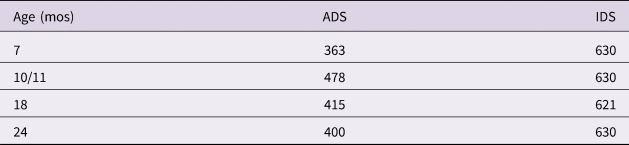
To this end, only statements 4 to 8 words in length in both IDS and ADS registers were selected for analysis. Utterances were excluded if they exceeded 10 seconds in duration, or contained whispering, yelling, phonological fragments, unintelligible speech, or a question. Also excluded were utterances disrupted by ambient noise, overlapping speech, or cries. Each mother's dataset contained up to 15 utterances at each age. This criterion was met for all speakers in the IDS condition, except for a single speaker which contained 6 utterances at age 18 months. For ADS it was more difficult to meet the criteria of 15 utterances at each age, as the parents produced longer utterances when speaking in this register. The criterion of 15 utterances was not met in ADS for 10 speakers at age 7 months, 11 speakers at age 10/11 months, 9 speakers at age 18 months, and 3 speakers at age 24 months. To maintain consistency, only the first 15 utterances per age/condition were included when more were available. Thus, the final set of IDS and ADS speech samples available for speech rate analysis was 4,167 utterances. A summary of utterances per age/condition is given in Table 1.
Utterances eligible for analysis by age (N = 42 dyads)

Acoustic analysis
Following export of the audio signal from eligible utterances in the CHAT transcript to the Praat program (Boersma & Weenink, Reference Boersma and Weenink2015), speech rate was calculated in syllables per second, as a transparent measure of information transfer from speaker to listener. Words had shorter syllable structure in infant- and child-directed samples, a possible source of variance; infant listeners presumably have little a priori knowledge of word boundaries in an utterance. Speaking rate for each utterance was calculated by first subtracting the time of speech onset from the time of speech offset. The audio was then played to verify segmentation, and the number of syllables for each utterance were counted and divided by the elapsed time of the utterance to derive syllables/second. In our analysis, we used the syllable count based on the Carnegie-Mellon University (CMU) pronunciation dictionary, through the R function nsyllable (https://www.rdocumentation.org/packages/quanteda/versions/1.5.1/topics/nsyllable). Word form was determined by transcription represented in the .cha files. If a word was not found in the CMU dictionary, it was estimated by counting vowel clusters, which is done by the program automatically.
Reliability
To measure inter-rater reliability, all utterances from four mother–infant dyads (transcripts at 7, 10/11, 18, and 24 months) in IDS (N = 240 utterances) and ADS (N = 167 utterancesFootnote 1) were exported for a follow-up analysis. This represented approximately 10% of the total sample. Pearson correlations between each rater's values for speech rate was .987 for IDS and 0.976 for ADS. The first author's values were used in the statistical analyses of IDS and the second author's values were used in the statistical analyses of ADS.
Results
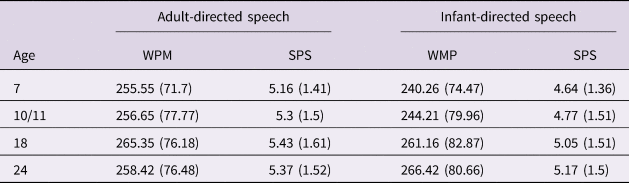
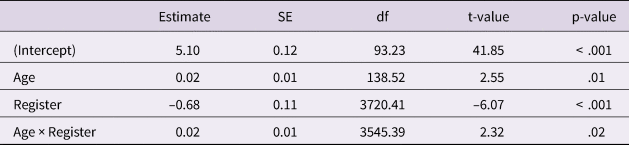
The number of utterances available for analysis at each age-point and to each speaker are shown in Table 1, and the means and standard deviations of words per minute (wpm) and syllables per second (sps) for each register at each age are given in Table 2. We predicted that mothers would produce a slower rate of speech within utterances when using IDS at each age interval in comparison to ADS, and that within the IDS conditions, rate of speech would increase (become more adult-like) as infants age. We examined the change in speech rate (sps) over age from the two registers (IDS, ADS) using a mixed effects model approach, which we modeled using the lmer package (Bates, Maechler, Bolker, & Walker, Reference Bates, Maechler, Bolker and Walker2015) with the R statistical software (R Core Team, 2018). We included random effects for age nested in speaker and for individual utterances. A fixed effect of Age would indicate a change in speech rate over time, whether increasing or decreasing. A fixed effect of Register would indicate an overall difference in speech rate between IDS and ADS. An interaction between Register and Age would indicate that the change in speech rate over time differed between IDS and ADS. For Register, ADS was coded as the reference condition, so any Register effects indicate a relative change in IDS speech rate. The results of the model revealed a significant effect of Age (β = 0.02, SE = 0.01, t value = 2.55, p = .01) and the positive estimate suggests that, as infants got older, the rate of speech increased. The effect of Register was also significant (β = –0.68, SE = 0.11, t value = –6.07, p < .001) and the negative estimate indicates that speech rate was slower for IDS compared to ADS. Critically, the interaction between Age and Register was also significant (β = 0.02, SE = 0.01, t value = 2.32, p = .02), indicating that, in comparison to ADS, IDS speech rate increased as infants aged. The output of this mixed effects model is given in Table 3 and the average syllables per second with standard error for each register at each age, including lines to indicate model fit, is plotted in Figure 1.
Speech rate in syllables per second by age and addressee (ADS, IDS).

Means and standard deviations (in parentheses) of speech rate by age and addressee in words per minute (WMP) and syllables per second (SPS)

Output of the model examining the effect of Register and Age on speech rate (syllables per second)

We also predicted that children whose mothers produced a slower rate of speech within utterances would have more advanced language skills at two years of age. To determine the relationship between speech rate within utterances and the three test scores obtained at 24 months (EOWVT, PPVT, and MCDI), as well as the child's MLU and word types in conversational speech, Pearson coefficients were computed using Holm adjusted p-values (Holm, Reference Holm1979) computed with the function corr.test using the psych package (Revelle, Reference Revelle2018) with the R statistical software (R Core Team, 2018); (see Table 4).
Pearson's correlation coefficient and associated p-value between Speech Rate (sps) and Child Language Outcomes

Note. r (p); * = significant at p < .05
There was a significant correlation between speech rate (sps) within IDS utterances to 7-month-old infants and child MCDI raw scores at age two years. The slower the mother spoke to her infant at 7 months of age, the greater the child's later vocabulary (based on parent-completed reports; r = –0.323, p = .037). There were no significant correlations between speech rate of IDS at any other age and any of the other child language outcomes.
Discussion
In this sample, using a relatively large number of matched utterances from a large group of mothers speaking conversationally to their children from 7 to 24 months of age, it was found that mothers typically speak more slowly to younger infants, although speech rate increases over the second year of life, and that speech rate to infants at seven months predicted parent-reported accumulated expressive vocabulary items at two years of age. By 7 months of age, infants appear to focus on the content of the speech they hear; we know that they are able to identify referents for words in laboratory settings (e.g., Bergelson & Swingley, Reference Bergelson and Swingley2012). A recent report also notes that the prosodic features (rate and stress) of IDS at 7 to 11 months of age elicits neural markers attributed to linguistic awareness, especially later phonological awareness (Leong, Kalishnakova, Burnham, & Goswami, Reference Leong, Kalashnikova, Burnham and Goswami2017). Speech rate is part of the ‘delivery’ system for the overall input; by decreasing speech rate, mothers provide infants with more time to process the content that they are hearing. Why rate appears in this sample to impact language development at the earliest recording point, but not at later ages, is unclear.
We also found a significant positive correlation with only one of our vocabulary measures, the MCDI. The MCDI differs from both the PPVT and the EOWVT in that it is a parental report inventory that assesses the child's cumulative attempted expressive lexicon, whereas the PPVT and EOWVT measure the child's expressive vocabulary during a visit to the laboratory. The MCDI has been found to show good agreement with the receptive version of the PPVT (Feldmann et al., Reference Feldman, Dale, Campbell, Colborn, Kurs-Lasky, Rockette and Paradise2005), as well as non-standardized measures of child expressive vocabulary in the laboratory (Ring & Fenson, Reference Ring and Fenson2000). The MCDI includes over 500 items, resulting in a much broader range of scores than those seen on the PPVT and EOWVT. For example, fewer than 50 items distinguished our lowest- and highest-scoring children on the PPVT, and far fewer items separated our top scores on the EOWVT from the lowest score. Similarly, children's MLU at age two, and word types used during our play sessions, did not differ broadly among the study children. As a cumulative measure with a wide range of scores, the MCDI may be better capable of distinguishing differences among children at age two years than our other outcome measures.
The slower speech rate observed in most reports of IDS register is perhaps one of its most obvious qualities. However, little is known about the degree to which variation in maternal speech rate impacts children's language development. This study has attempted to shed light on possible benefits of a slower rate in IDS in a large sample of typically developing infants. After making efforts to equate other aspects of IDS that distinguish it from ADS in ways that impact speech rate in general, a significant relationship was found between decreased speech rate of maternal IDS to children at 7 months of age and the child's language development at two years of age. Song et al. (Reference Song, Demuth and Morgan2010) found facilitative effects of decreased speech rate on task performance in infants who were 19 months old. Yet in our study, only speech to infants under one year of age was characterized by a significantly slower maternal speech rate. A slower speaking rate in IDS at this age may facilitate speech segmentation, which is developing at this age (e.g., Jusczyk & Aslin, Reference Jusczyk and Aslin1995), and is an essential step in acquiring a lexicon. In prior examination of the larger sample of children and caretakers from which data for this report are taken (Newman, Rowe, & Bernstein Ratner, Reference Newman, Rowe and Bernstein Ratner2016), we found that two other factors at 7 months of age predicted child language performance at two years of age: the child's ability to perform word segmentation and maternal type–token ratio, a measure of vocabulary redundancy in child-directed speech. Thus, as a whole, our work suggests that a number of factors at 7 months of age, both those that are child-internal (segmentation skill) and environmental (features of the child-directed speech), are associated with differences in child language skill roughly 18 months later. The ability to segment words from varying speech rates may also develop over time: at 14 months infants are able to adapt to changes in speaking rate in word segmentation and recognize words presented at a fast rate, but not at 11 months (Wang et al., Reference Wang, Llanos and Seidl2017). As speaking rate in speech to infants increases over the second year of life, as evidenced by our results, its influence on vocabulary development may decrease. Our results therefore place prominence on the role of maternal speech rate during the early stages of language acquisition, well before the child has begun to use the ambient language in a recognizable way, and its predictive role in language outcomes at two years of age.
Another possible explanation for the advantage of a slowed speaking rate only for children at 7 months may be that it allows the children to ‘break into’ the new linguistic system. A slowed rate of speech provides the child with more time in which to process the input, and presumably learn from it. This may be most important at the earliest stages of learning; once children have begun to acquire useful information about their linguistic system, that knowledge may help them process later input in a more efficient manner. That is, slowed rate at the onset of learning may allow the child to more easily identify what aspects of the ambient language input are the most important, which in turn allows them to better accommodate the typical fast rate of incoming information.
Although our results may indicate an important role for the slowed speech rate of IDS at 7 months, only one correlation reached significance. It is therefore important to review how the stimuli were chosen. Our analysis included only utterances between four and eight words in length, and the resulting speech rate measures obtained may not be representative of the mothers’ overall speech input to the child. Not only were shorter utterances considered inappropriate for our analyses, since they are typically produced more slowly in any register, it is virtually impossible to obtain a substantial number of matched short utterances from mothers when speaking to an adult in a conversational setting. A recent review by Wang, Seidl, and Cristia (Reference Wang, Seidl, Cristia, Heinz, Goedmans and van der Hulst2016) notes that differences in elicitation will obviously impact data availability as well as other features of the speech sample. While a conversational setting is high in ecological validity, it creates numerous obstacles to comparing speech across registers that are removed from more structured experimental approaches (such as asking parents to read phrases). For example, adults tend to use longer pauses between utterances when speaking to infants than when speaking to adults (Fernald & Simon, Reference Fernald and Simon1984). We eliminated these characteristic pauses rather than including them in our analyses. Had we included them, the impact of speech rate on child language outcomes that we observed may have been different, because previous research has highlighted the potential benefits of IDS with pauses at clause boundaries (Kemler Nelson, Hirsh-Pasek, Jusczyk, & Cassidy, Reference Kemler Nelson, Hirsh-Pasek, Jusczyk and Cassidy1989). When we truncate spontaneous samples to limit analyses to a subset of utterances, we have controlled some confounding variables that may impact our analyses. However, it is important to remember that we have not removed the items from the child's listening experience when we remove them from analysis. In ‘playing fair’ in controlling for criteria that are known to impact interchanges among adults in ADS, these findings may very seriously underestimate the role that slowed rate plays in assisting infant/toddler processing of input language as they attempt to master the challenges of language acquisition.
In fact, it is likely that the attempt to locate matched utterances resulted in a unique and less representative corpus of IDS. The actual mean MLUs (in words) of all of the mothers’ utterances during the play sessions at each age are lower than the bottom range for length of utterances that we chose to analyze (7 months: 3.95 words; 10/11 months: 3.75 words; 18 months: 3.64 words; 24 months: 3.98 words). Additionally, even the mean length of the utterances that met matching criteria were at the lower end of the range that we chose (7 months: 5.28 words; 10/11 months: 5.40 words; 18 months: 5.29 words; 24 months: 5.38 words). Thus, the utterances we chose to analyze are not fully representative of the mothers’ overall speech input. However, finding sufficient numbers of utterances this short in natural conversation with an adult interlocutor is almost impossible. Hence, we are faced with something of a conundrum in comparing across IDS and ADS registers. To the extent that both registers differ across numerous features, fixing one parameter is unlikely to control others that may co-vary. However, since IDS is typically both slower and involves shorter utterances, it may not be critical to identify the individual contributions of utterance length or speech rate (Martin et al., Reference Martin, Igarashi, Jincho and Mazuka2016). This assumes, of course, that parents who slow their speech with longer utterances also slow their speech with shorter ones.
Previous literature has identified other positive impacts of IDS properties, particularly at later points in the infant's development. With our current finding, we can add to the existing literature by proposing the idea that superimposing an acoustic property, such as decreased speech rate, on the already important and impactful semantic and syntactic features of IDS, may provide infants learning language with an even greater benefit. Slower speech appears to facilitate language development in young children, even when parents are conversing with children who have not yet begun to produce their first words.
Acknowledgments
Work on this project was supported by National Science Foundation grant NSF BCS 0745412. Katie Von Holzen was supported by training grant DC-00046 from the National Institute of Deafness and Communicative Disorders of the National Institutes of Health.