

1. Theoretical background: Cognition and discourse style
Language is understood as an instrument that can shape mental concepts and categories by creating meaning; as such, language is the basis of the human ability to symbolize. Cognitivism is a theoretical paradigm relevant in the perception of linguistic variation in communicative style. Therefore, the construction of theories of linguistic variation and style begins with the assumption that linguistic choices are based on cognition, which is the key in explaining linguistic choices (Aijón Oliva and Serrano Reference Aijón Oliva and Serrano2013: 141).
Syntactic variants are not totally synonymous. Any choice of grammatical person has repercussions in terms of the interpretation of discourse. From a cognitive viewpoint, any alteration in the syntactic form results in a difference in the way discourse is conceptualized; thus, the meaning of different structures is never the same (Aijón Oliva and Serrano Reference Aijón Oliva and Serrano2013: 13–24). Meaningful choice suggests an awareness of the functional and indexical inferences that speakers make; this implies that the linguistic form may modify the communicative content of an utterance, and may contribute to shaping communicative styles (Rampton Reference Rampton2006: 303). The present research rests on the assumption that the omission or expression of the first-person singular object a mí ‘to me/myself’ and its preverbal and postverbal position are morphosyntactic variants; thus, their meanings were hypothesized to be distributed unevenly across different communicative settings. Example (1) depicts the object variants.
(1)
a. A mí me llamó mi hermano. (expressed preverbal).
‘My brother called me/to me.’
b. Me llamó mi hermano a mí. (expressed postverbal).
c. ‘Me llamó mi hermano’. (omitted).
Genres are the prime candidates for the creation of discourse patterns through linguistic forms (Ariel Reference Ariel2008: 62). In linguistics, genres are sets of commonly shared linguistic features that are gradient and among which intertextuality might exist (Theodoropoulou Reference Theodoropoulou2014: 7–13, 97). They are regarded as conventional cultural-linguistic patterns or cognitive frameworks that are structured to enable engagement in discourse (Coupland Reference Coupland2007: 7). Most importantly, genres create paths that reflect social identities from which communicative styles arise.
An important element to consider when analyzing communicative styles is the socio-professional affiliations of the speakers participating in these genres. These affiliations can also be referred to as “contextual identities” (Kerbrat-Orecchioni Reference Kerbrat-Orecchioni2005: 157); that is, aggregations of features that qualify people to play a particular interactional role. Contextual identities go beyond the traditional stratified view of social classes; instead, the differences among human groups are based on the participants’ communicative duties rather than on their socio-economic power (Aijón Oliva and Serrano Reference Aijón Oliva and Serrano2013: 56–58). These communicative duties are characterized by sets of communicative rights and responsibilities.
Style allows for social identification based on the speaker's creative agency and its interplay with social and situational cues (Eckert Reference Eckert2000: 43–44; Coupland Reference Coupland2007: 3–24, 2014). Recent research on the relation between communication and style recognized that “there has been a broadening of the allowable databases for studying style in sociolinguistic theory” (Bell Reference Bell and Coupland2016: 405). Since a text is produced using different modes of meaning that are present in every use of language in social contexts (Halliday Reference Halliday, Angermuller, Maingueneau and Wodak2014: 268), the selection of syntactic variants involves making meaning choices that shape socio-communicative styles in discursive interactions.
Stylistic variation is not exclusively individual in nature. It ranges in terms of expressive possibilities, through which individual speakers or groups of speakers can manage their linguistic activities. This requires setting aside the traditional requirements of descriptive or referential sameness and viewing differences in meaning as a way to explain the existence of formal variations. As such, current cognitivist approaches to grammar offer the most fruitful path to the development of theories on variation (Serrano and Aijón Oliva Reference Serrano and Aijón Oliva2011: 138–139).
The expression of the first-person object variant a mí is indexical of a speech style whereby the focus of discourse is usually put on the speaker, as the speaker is the referent of the first-person singular object. From a discourse-oriented view of linguistics, subjects are participants endowed with psychological and sociological attributes that allow them to design linguistic strategies and pursue communicative goals (Angermuller et al. Reference Angermuller, Maingueneau, Wodak, Angermuller, Maingueneau and Wodak2014: 138). Direct participants in communication are not always equally present, and deictic forms, such as verbal object pronouns, play an important role as they define the scenic framework of the text or discourse (Maingueneau Reference Maingueneau, Angermuller, Maingueneau and Wodak2014: 151). This implies that the presence or absence of personal objects in speech might allow us to identify and define communicative styles.
This study contributes to the development of cognitive sociolinguistic theory, which seeks to provide a more comprehensive understanding of the construction and variation of meaning (Pütz et al. Reference Pütz, Robinson and Reif2014: 2) by referring to principles of sociolinguistic variation (Cheshire Reference Cheshire1987, Eckert Reference Eckert2000, Tagliamonte Reference Tagliamonte2006) and cognitive linguistics (Langacker Reference Langacker2000a) as theoretical bases. The central claim of cognitive and functional linguistics is that form and meaning are linked in linguistic analysis. Therefore, semantics and pragmatics both influence syntax, presupposing a usage-based model of language structure (Langacker Reference Langacker2000a, Bybee and Hopper Reference Bybee and Hopper2001, Gries and Stefanowitsch Reference Gries and Stefanowitsch2006, Kuznetsova Reference Kuznetsova2015: 5). In the usage-based theory, the cognitive representation of language emerges from its use, and grammar is viewed as a set of symbolic conventions (Perek Reference Perek2015: 6–7). The need for the integration of sociolinguistic variation in usage-based cognitive linguistics has already been brought up by scholars. Usage-based cognitive linguistics assumes the embodiment of grammar and the experientialist nature of meaning (Pütz et al. Reference Pütz, Robinson and Reif2014: 5).
1.1 Informativeness and subjectivity in Spanish
As a formal variation with meaningful stylistic repercussions, the main cognitive notion used herein to explain the meaning created by first-person singular a mí variation is informativeness. Informativeness is defined as the extent to which presented materials are new or unexpected, and it controls the selection and arrangement of textual options in texts (Lambrecht Reference Lambrecht1994: 273, Beaugrande and Dressler Reference Beaugrande and Dressler1997: 160, 201). The notion of informativeness is central to textuality; it is based on textual coherence and on the ways in which referents are cognitively processed and loaded. It is generally assumed that the formulation of a subject may convey several discursive-pragmatic functions, including focalization, contrast, and counter-expectations. Textual choices in discourse are more or less informative according to their newness or unexpectedness in relation to the preceding context. Informativeness has played an important role in many analyses of subject expression and placement (Aijón Oliva and Serrano Reference Aijón Oliva and Serrano2013: 31–35).
Person objects in Spanish have variable agreement that is carried out through verbal clitics that signal the referent. The first-person singular clitic me makes the expression of the pronominal object a mí unnecessary; therefore, the first-person referent remains salient in discourse. In (2), the expressed first-person singular object a mí is redundant.
(2) A mí me da la sensación de que queda solo Coalición Canaria. (CCEC <ElEnv 29-9>).
‘It gives me the impression that only Coalición Canaria remains.’
The referent of the first-person object a mí can become informative, requiring a great deal of mental processing due to its newness and unexpectedness in the context of the statement. As will be demonstrated, informativeness allows for a varied range of discursive-pragmatic meanings that accomplish different communicative goals. Among these meanings is the stylistic one, which is based on subjectivity. The expressed object a mí in (2) becomes informative and shapes a subjective stylistic meaning in the context of the statement.
Linguistic expressions can be analyzed as being either more or less subjective (Fried Reference Fried, Athanasiadou, Canakis and Cornillie2006: 45). Subjectivity refers to the extent to which the subject is personally invested in the discourse, as determined by the meaning of the utterance (Nuyts Reference Nuyts, Brems, Ghèsquiere and van de Velde2014: 68). More simply, subjectivity implies the speaker's presence through language. Such a view subsumes that the speaker is simultaneously a cognizer and a communicator (Nuyts Reference Nuyts2015: 106, 109, 110).
The process of subjectivization involves recruiting a specific meaning to express and regulate speakers’ beliefs and attitudes (Narrog Reference Narrog, Brems, Ghèsquiere and van de Velde2014: 30), providing a meaningful orientation in discourse. From a cognitive viewpoint, subjectivity alludes to the subject and is a matter of construal, implying that subjectively construed elements include the speaker (Langacker Reference Langacker and Haiman1985: 18, 2006). Thus, first-person singular object variants contribute to the development of communicative styles based on gradient subjectivity.
1.2 First-person object and clitic agreement
First-person singular is a universal semantic primitive (Goddard and Wierzbicka Reference Goddard and Wierzbicka1994: 3). It does not always denote that the individual speaking is the subject but is instead a construal speech role (Bhat Reference Bhat2004: 6, Gardelle and Sorlin Reference Gardelle, Sorlin, Gardelle and Sorlin2015: 3). Thus, personal pronouns must be interpreted in their context (Wiese and Simon Reference Wiese, Simon, Simon and Wiese2002: 9).
This research focuses on the variable expression and placement of the Spanish first-person object a mí, in which its reference can be marked by agreement with the verbal clitic me. Cliticization is a phenomenon that has received attention from many scholars and has been studied using different theoretical approaches (Perlmutter Reference Perlmutter1971; Zwicky Reference Zwicky1977, Reference Zwicky, Nevis, Joseph, Wanner and Zwicky1994; van Riemsdijk Reference van Riemsdijk1999; among many others). Person object agreement is made through clitics, that is, the grammaticalization of Latin pronouns that signal the person and number of referents. What has been traditionally called object duplication or object clitic doubling is now referred to as object agreement or object indexing (García-Miguel Reference García-Miguel2015: 207, Haspelmath Reference Haspelmath, Bakker and Haspelmath2013).
Spanish has an objective conjugation system (Llorente and Mondéjar Reference Llorente and Mondéjar1974, Aijón Oliva Reference Aijón Oliva2006: 173–174). Clitics should not be considered to be personal pronouns but should instead be seen as agreement morphemes due to their atonicity, strict adjacency to verbs, and ability to co-occur with coreferential tonic pronouns and noun phrases in the same clause (Aijón Oliva Reference Aijón Oliva2017b). The ability to achieve pronominal indexation by clitics is a formal property of objects in Spanish (García-Miguel Reference García-Miguel2015: 207). The variable agreement of objects through verbal clitics allows objects to remain salient across discourse. One of the most remarkable features of clitics is that they are linguistic units with one of the highest levels of accessibility in discourse (Ariel Reference Ariel, Sanders, Schilperoord and Spooren2001: 29–87).
Excerpt (3) shows the first-person singular object a mí as indexed by the clitic me. The object a mí can be placed in either the preverbal (a) or postverbal (b) position.
- (3)
a. A mí me llamó mi hermano.
‘My brother called me.’
b. Me llamó mi hermano a mí.
‘My brother called me.’
The context makes the agreement morpheme sufficient for the identification of the object; therefore, the expression a mí is not grammatically necessary. Thus, the following research questions were posed:
• Does the expression of a mí and its preverbal or postverbal position result in particular meanings when analyzed in terms of informativeness and subjectivity?
• Does the variable use of a mí result in particular communicative styles for speakers with different socio-professional affiliations?
• How does variation in the expression a mí contribute to the development of communicative styles in the interactions analyzed by means of +/– subjectivity?
2. Methodology
This section describes the methodology of the study, beginning with the corpus and the kinds of speakers included in it, followed by a brief discussion of how the data were extracted and analyzed.
2.1 Corpus and speakers
Variation in the first-person singular object me/a mí were examined in a corpus of contemporary Spanish texts, namely, the Corpus Conversacional del Español de Canarias (CCEC),Footnote 1 which is composed of texts transcribed from regional television and radio news programs (55,474 words), informative debates (41,753 words), talk shows (12,685 words) and news magazines (61,346 words). The media section of the corpus constitutes a total of 171,258 words. The texts in this corpus were collected by recording programs from television and radio from 2010–2013. The audiences for each genre are heterogeneous. The characteristics of each genre are as follows (Aijón Oliva and Serrano Reference Aijón Oliva and Serrano2013: 53).
• News programs: News programs are informational programs that cover diverse subjects (e.g., politics, sports, and weather). The texts are first written and then are read aloud by broadcasters. Excerpts from recorded interviews, speeches, and more are often inserted within reports. Journalists are the main participants in this genre, but private individuals and professionals are also involved.
• Informative debates: As suggested by the name, informative debates present different, often opposing views on a subject. The recurrence of informative debates and their recognition allow them to be qualified as a textual genre. Those interested in the critical assessment of the latest news are the prototypical audience of this type of program. This genre is basically performed by politicians and journalists.
• Talk shows: In talk shows, journalists and other speakers discuss present-day matters generally in a casual, non-contentious fashion. Journalists, private individuals, and professionals participate in this genre; politicians rarely participate.
• News magazines: News magazines assemble a wide variety of information and entertainment material. News magazines are among the most prominent programs offered by regional radio and television stations. Their target audience is generally female, and either middle-aged or mature. As with talk shows, journalists, private individuals, and professionals are the main participants.
To account for speakers’ social characteristics in the present investigation, the speakers were divided into four categories, or socio-professional affiliations, based on the communicative functions speakers have in the genres in which they take part. Therefore, a speaker may not have a single social characterization, as is generally assumed in traditional sociolinguistic theories. The delineation of the genres revealed several recurrent methods of self-presentation based on the situations in which the speakers take part. The classification made for the present research and the characteristics of each socioprofessional category are as follows:
• Journalists: This group includes professionals in mass-media communication. They often display an image of efficiency or neutrality, and this image is likely to be reflected in their typical expressive choices.
• Politicians: This group includes political party representatives. They are usually highly aware of the value of linguistic choices and how these choices can help them gain the approval of potential voters.
• Public figures: This group is more heterogeneous than the previous two groups. Public figures are speakers not professionally involved primarily in media communication but who are expressly invited to participate in it. This group includes intellectuals who write opinion pieces or take part in radio or magazines and also entrepreneurs, artists, athletes, advertisers, representatives of companies and associations, and more. Public figures usually enjoy more expressive freedom, given their usual position as guests.
• Private individuals: This group includes all speakers who take part in media interactions only circumstantially and often on their own initiative. Their occupations and social affiliations are, in principle, not publicly relevant, and sometimes their names are not even mentioned.
It is important to stress that these categories were formulated through the observation of communicative exchanges within a concrete setting.
2.2 Data extraction and analysis
The data was extracted by manually selecting sentences with me/a mí variants from the corpus. All of the tokens of the corpus were analyzed qualitatively using the cognitive notion of informativeness.
The statistical package GoldVarb Lion (Sankoff et al. Reference Sankoff, Tagliamonte and Smith2012) was used to calculate the percentage of variants. The overall frequency of the expressed object a mí was also calculated using the absolute variable method. This method allows for the observation of the normalized frequency of variants along with variations in any other internal or external features (e.g., genre, socio-professional affiliations, and sex/gender). The absolute variable method was used herein to measure the average number of occurrences of a variant per 10,000 words. The treatment of linguistic phenomena as absolute variables or by normalized frequencies assumes that any pairing of form and meaning was contextually chosen for its own value and not as an alternative or possible variant of any other form (Aijón Oliva and Serrano Reference Aijón Oliva and Serrano2013: 64–67).
3. Results
This section discusses the results obtained from the corpus study. First, the factors affecting the expression or omission of a mí are considered, followed by those affecting the placement of a mí before or after the verb.
3.1 Expression and omission of a mí
The first-person singular object may be expressed (clitic + Noun Prase: me + a mí or omitted (clitic me only). The quantitative analysis indicated, as expected, that the omission of the object (i.e., the use of the clitic me only) was the most frequent variant (Table 1).
Percentages of the omitted and expressed variants of the first-person singular object

Previous research studies on subject and object variation found similar results regarding the omission of pronominal subject (Aijón Oliva and Serrano Reference Aijón Oliva and Serrano2013) and person object (Aijón Oliva Reference Aijón Oliva2017a, Reference Aijón Oliva2017b; Serrano Reference Serrano2017a, Reference Serrano2017b) variants.Footnote 2
Each variant (either omitted or expressed) conveys a different meaning regarding the involvement of the speaker in discourse and how the statement is interpreted. In the following excerpts (4–6), the explicit formulation of the object a mí (‘to me’, ‘myself’) is not necessary as long as the clitic me alone is sufficient to index the first-person singular referent.
(4) Hay algo que me inquieta mucho y son las lentillas/las lentillas que nos hacen tener ojos de gato o vampire/¿qué puede pasar si nos vamos a la cama y no nos quitamos las lentillas? (CCEC <GaCent 3-10>)
‘There is something that that worries me, and that is contact lenses – those contact lenses that give us cat or vampire eyes – what could happen if we went to bed and did not take out those contact lenses?’
(5) Me gustaría finalizar con una guía de primeros auxilios. (CCEC <GaCent 3-10>)
‘I would like [lit. ‘It would be pleasing to me’] to finish with the first-aid guide.’
(6) ‘Parece muy tranquilo/pero me dices que no puedo tocar ni acercarme mucho.’ (CCEC <Can-Di 11-12>)
‘It seems so quiet, but you are advising me not to touch it or get close.’
Even when a clitic is present in a clause, a pronominal object may be overtly expressed for a concrete communicative or discursive purpose. For example, a singular first-person object can be singled out from other pronoun objects by a strong tendency toward expression and be placed in the preverbal position (Serrano Reference Serrano2017a). The expressed object a mí focuses on the first-person referent, associating it with the propositional content and therefore implying the commitment of the speaker. Being unnecessary and somewhat redundant, the expressed variant is informative. As shown in excerpts (7) and (8), the speaker relates a personal experience using the expressed object a mí.
(7) La verdad que este momento a mí me está causando una gran impresión. (CCEC <CanDi 11–12>)
‘Really, this moment is making a big impression on me.’
(8) Fue un disco importante para mí/porque fue un cambio y pude interpretar canciones que a mí también me gustan mucho, baladas, boleros… (CCEC <Vimige 11–12>)
‘It was an important record for me because it was different, and I could play songs that I like a lot, too [lit. ‘that are really pleasing to me, too’], such as ballads, boleros…’
The explicit formulation of the object, as shown in excerpts (7) and (8), is usually triggered by stressing its referent, implying the unexpectedness and cognitive processing of the referent's object by the presentation of contrastive or new information (Lambrecht Reference Lambrecht1994: 273). The expressed variant emphasizes the presence of the referent of the object and can thus shape different discursive-pragmatic meanings. One of these meanings allows for the tighter association of the event described with the participant who is speaking.
The expressed variant is very commonly used with psychological verbal lexemes, such as gustar, olvidar, and parecer, implying an emotional link of the content to the speaker. In the following examples, the expressed object a mí functions as the experiencer of the action: a mí me gustaría (9, 11) and a mí me parece (10). When the object is placed in the first clause of the sentence, as in excerpt (11), it may also be considered to be an external topic extracted from the subordinate clause: A mí la pregunta que me gustaría hacer… ‘To my mind, the question I would like to pose…’. Such a position exhibits syntactic and semantic autonomy with respect to other parts of the sentence.
The personal object a mí in psychological constructions, such as gustar ‘like’ or parecer ‘seem’ (among others), displays subject-like properties that usually refer to experiential activities (Rivas Reference Rivas2016). This reveals the notional proximity of first- and second-person objects to subjects (Serrano Reference Serrano2017a), particularly in constructions where the object me/a mí adopts the semantic roles of experiencer (gustar ‘like’, and encantar ‘love’) or cognizer (parecer ‘seem’, importar ‘matter’, and interesar ‘interest’).
(9) Yo a mí me gustaría introducir alguna noticia/finalmente no va a ir al cargo. (CCEC <ElEnv 29-9>)
‘I would like to introduce hot news [lit. ‘to me’]: In the end, I am not going to occupy the position.’
(10) A mí me parece que los combustibles fósiles son una remora y que los subsuelos deben permanecer ahí. (CCEC <RoyCo 22-2>)
‘It seems to me that fossil fuels are a hindrance, and the subsoils should remain in place.’
(11) A mí/la pregunta que me gustaría hacer es cómo ha sido el legado de Adán Martín. (CCEC <EspAM>)
‘[lit. ‘To me’] the question I would like to pose is, what is the legacy of Adán Martín?’
Constructions like these are described as dative subject clauses and include “conscious participants in the event, which are not intended to actively initiate it” (Givon Reference Givon2001: 128–129). The indexation of a referent in the verbal nucleus through bound morphemes like verbal clitics is a correlate of the cognitive salience achieved by the referent in discourse (Company Reference Company Company2001: 7). As many verbs in these constructions express psychological states (e.g., gustar, importar, and interesar), dative subjects convey agentivity. In a construction with a dative subject, the object acts as a pragmatic agent, as shown in excerpts (8–11). In excerpt (8), the pragmatic function of the agent of the object a mí is reinforced by the presence of the subject yo, whereas, in excerpts (9) and (10), the referent of the first-person object may be interpreted as the person who wants to introduce hot news, or as the person who would like to ask a question. The experiencer subjects are dative subjects that function as pragmatic agents. These have been also classified as experiential predicates, which usually act as a dative object experiencer (a mí me gusta [lit. ‘this likes me’]) (Vázquez Rozas Reference Vázquez Rozas, Clancy Clements and Yoon2006, García-Miguel Reference García-Miguel2015: 212). The syntactic behavior of these constructions – which is similar to that of the pronominal subject generally placed at the beginning of a clause – explains the tendency of the expressed object a mí to appear in the preverbal position (Table 2). In these cases, the frequency of first-person object expression is similar to that of the pronominal subject (De Cock Reference De Cock2014: 148).
Percentages for the preverbal and postverbal placement of the expressed first-person singular a mí + me object

a As a percentage of the total expressed variants
In the following excerpt, the speaker expresses a personal opinion about what he considers to be the most important thing about humor, with a focus on himself: …no es la risa por la risa, por lo menos eso a mí no me interesa ‘it is not laughter for laughter's sake, at least, that is not what's interesting to me’. The informativeness conveyed by the expressed object a mí places similar pragmatic stress on the referent as that of the first-person singular subject yo.
(12) Pues, te lo agradezco, pero sí … el humor yo creo que es un medio de transmisión de ideas importantísimo/no es la risa por la risa/por lo menos eso a mí no me interesa. (CCEC <RoyCo 30-8>)
‘Well, thanks for that, and yes … humor, I think, is a very important means of transmitting ideas; it is not laughter for laughter's sake, at least, that is not what's interesting to me.’
Moreover, in constructions with such experiential or psychological verbs, the expressed first-person object may be introduced by a first-person subject and act as a topic, as in excerpt (13).
(13) Yo a mí no se me olvida hace unos años cuando un propietario de un Hotel del Sur de Gran Canaria/me confesaba con gran amargura su fracaso. (CCEC <Elenv 13-10>)
‘I will never forget [lit. ‘It is not forgettable to me’] the time when, some years ago, a South Gran Canaria hotel owner confessed, with great bitterness, his failure’.
In these examples, the expressed object a mí is typical in discourse characterized by explicit and personal argumentation, a pragmatic function in which it is sometimes useful to suggest the speaker's involvement in a demarcated group or to reinforce ties with the hearer by including both participants in a common deictic scope. In (14), the expressed variant demonstrates that the speaker has been affected or damaged by the action or circumstances.
(14) … a mí me queda aquí un tiempito pasando frío/te echamos de menos Pepe y Víctor. (CCEC <RoyCo 30-8>)
‘I will remain here for a while … [lit. ‘A while remains to me’], getting cold. We miss you, Pepe and Víctor.’
In (15), the speaker presents himself as being responsible for the opinion given, focusing on what people have told him, with the use of a mí. This is a strategy that allows him to take responsibility for his speech.
(15) A mí particularmente me ha sorprendido la poca cantidad/que solo el 62.5% de los canarios estén en contra de las prospecciones de petróleo. (CCEC <ETT 28-1>)
‘I am particularly surprised [lit. ‘It has particularly surprised me’] that only 62.5% of Canarian people are against petroleum exploration.’
Due to its pragmatic role as the agent in most constructions and its resemblance to pronominal subjects, the object a mí is rarely postposed; this will be explained in the following section.
3.2 Variable placement of the expressed first-person object a mí
The expressed object a mí may be placed in preverbal or postverbal position in the clause. Elements placed at the beginning of a clause tend to be perceived as the most relevant ones and have the power to condition the interpretation of the remainder of the clause (Virtanen Reference Virtanen2004: 84–88, Fried Reference Fried, Brisard, Östman and Verschueren2009). This was exemplified in excerpts (10) and (12). The preverbal position is, in fact, the less marked position in Spanish when expressing first-person subjects and objects. The subject-verb-object (SVO) order is grounded on a linear view of the prototypical event in which an agent initiates an energy flow that ends in a patient object (Langacker Reference Langacker1991, Reference Langacker and Maldonado2000b). Objects that appear in the position of subjects are assumed to denote the notional features of subjects.
Moreover, the postverbal position is usually the informational focus (Aijón Oliva and Serrano Reference Aijón Oliva and Serrano2013: 120); informationally heavier referents tend to be placed at the end of clauses and – by means of informativeness – to be intuitively perceived as new, contrastive, or focal (Fernández Soriano Reference Fernández Soriano, Bosque and Demonte1999: 1237). Postverbal objects are placed in a prototypical position in the canonical scheme; they may thus iconically adopt the discursive and cognitive features generally associated with objects, and this would imply a higher informativeness than that associated with the preverbal position. As such, the variable placement of objects is closely related to informativeness (Aijón Oliva and Serrano Reference Aijón Oliva and Serrano2013: 76).
Therefore, through the informativeness of the referent, the postverbal position suggests affectedness caused by external actions or circumstances. This aligns with its prototypical position, which is associated with objects that play a semantic role. However, a quantitative analysis of first-person singular objects revealed that the preverbal position is clearly the preferred option, whereas only 8% of the expressed variants were placed in the postverbal position (Table 2).
The cognitive properties of the postverbal variant cause different discourse-pragmatic meanings. The most prototypical is when it is used in direct questions (16).
(16) Antes, ayudar era más por amor al arte… ¿me preguntas a mí? (CCEC <LaRev 29-10>)
‘Before, helping was done just for the fun of it … are you asking me?’
The lower degree of autonomy of the object in the postverbal position signifies that the stress on the referent is the pragmatic focus of the statement.
(17) Usted me dice a mí que yo tengo que darle esas cápsulas/pues dígame usted a mí/es un servicio que nos tendremos que cuestionar si queremos seguir dándolo. (CCEC <R 7-12-6>)
‘You're telling me [lit. ‘to me’] that I must give him those capsules, well, you tell me: is this a service that we should ask whether we want to keep on providing it?
Similarly, the postverbal object in excerpt (18) indicates that the self-referent is stressed, as is the focus of the verbal lexeme: no me valen a mí ‘they are not good for me’.
(18) Y por cierto, los antibióticos de mi vecino no me valen a mí. (CCEC <ETT 28-1>)
‘And, by the way, my neighbor's antibiotics are not good for me.’
The meaning provided by the postverbal position of the expressed object demonstrates the referent of the object is damaged. In excerpt (19), the speaker is involved in a problem caused by another party:
(19) Tú tienes que fomentar no generarme problemas a mí también. (CCEC < BDC7-3>)
‘You have to assure me that you will not create problems for me too” [lit. ‘to me’].’
Similarly, excerpt (20) presents the speaker as being homeless and living on the street: me ha enganchado la calle a mí [lit. ‘has hooked itself to me’]. However, the speaker is not upset about being homeless.
(20) Sí, señorita/me ha enganchado la calle a mí/yo no he buscado esta vida\me han ofrecido otras cosas, pero no he aceptado. (CCEC <R7-26-10>)
‘Yes, miss, the street has got me hooked [lit. ‘has hooked itself to me’]. I did not look for this life; people have offered me other things, but I have not accepted them.’
In excerpt (21), the expressed postverbal object a mí indicates that the speaker was frightened by a home accident.
(21) Esta casa es una ruina/estábamos tan tranquilos y de repente/el muro se cayó y me dio un susto a mí. (CCEC <CanDi13-12>)
‘The house is destroyed. We were so tranquil, and, suddenly, the wall fell down and gave me a scare [lit. ‘gave a scare to me’]’
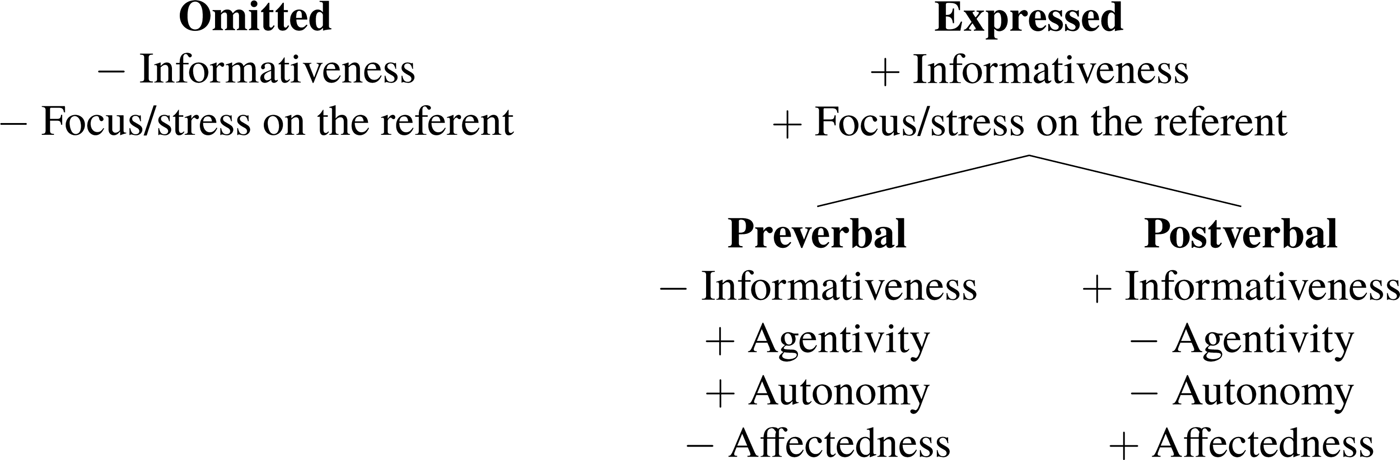
To sum up, the meanings conveyed by first-person object me/a mí variants are given in Figure 1.
Summary of meanings created by omitted and expressed first-person object variants

4. Distribution of variants across socio-professional affiliations
The preceding sections demonstrated that first-person object variants me/a mí accomplish different communicative goals across diverse communicative settings with different speakers. As such, communicative styles emerge from the contextual co-occurrence of meaningful syntactic choices and psychosocial identity features. Among these features is the socio-professional affiliation of the speaker, which refers to the specific aggregation of features that qualify people according to their interactional roles. These features were not chosen prior to the investigation, but were instead defined through the observation of the recurrent ways in which speakers self-presented in the texts analyzed. This implies that the same speaker might adopt different social identities depending on the communicative genre.
The normalized frequencies (i.e., the absolute variation) of the first-person object variants across the socio-professional categories considered show that the omitted variant (clitic only) is clearly dominant across the groups, although higher scores were found for this factor for private individuals and public figures. The expressed variant also had high scores among private individuals and politicians (Table 3).
Normalized frequencies of the expressed and omitted variants of the first-person singular object me/a mí

As private individuals’ participation in media interactions is variable, we would expect them to use both omitted and expressed variants. For example, they may use the omitted variant to present propositional content as general or personal, as observed in excerpt (22).
(22) Private individual:
Esta manzana me gusta más porque es de Valleseco. (CCEC <R7 20-10>)
‘I like [lit. ‘pleases me’] this apple more because it is from Valleseco.’
Private individuals may also express intuitions and opinions using an expressed object (23). The use of first-person object a mí reinforces the presence of the speaker and provides assertiveness to the statement. As private individuals occasionally play roles in mass-media communication, they sometimes voice the views and concerns of the general public.
(23) Private individual:
A mí me gustaría que para el primero de 2011 tuviéramos esta reforma aprobada. (CCEC R7 <12-6>)
‘I would like [lit. ‘It would be pleasing to me’] to have the reform approved by the first day of 2011.’
Public figures prefer the omitted variants since they are usuallyFootnote 3 expected to display professionalism rather than focus on themselves. In excerpt (24), a historian explains data that is not about himself.
(24) Public figure:
Y un dato también que me han comentado mucha gente/cuando Nelson atacó Santa Cruz que fue repelido por Gutiérrez Otero. (CCEC <LaAlp 2-12>)
‘And one piece of information that many people mentioned to me was when Nelson attacked Santa Cruz and was defeated by Gutiérrez Otero.’
In their roles, politicians are more inclined to explicit self-indexation by the expressed object a mí than the other groups. This seems reasonable given the fact that they usually participate in highly interactional and/or explicitly argumentative genres, including debates, talk shows, and interviews. The overt expression of the first-person object emphasizes the personal scope of the opinions and judgments expressed, just as it enhances the subject's assertiveness or pragmatic force in the propositional content. In excerpt (25), a politician signals his wish to express an opinion about another politician (Adán) using the expressed object. The politician seems to be speaking about himself through the preverbal use of a mí me gustaría [lit. ‘to me’], I would like to say’ as a topic before expressing his opinion.
(25) Politician:
Pero a mí me gustaría decir de Adán/yo creo que Adán tenía una clara visión de futuro. (CCEC <EspAM>)
‘But, I would like to say, I think that Adán had a clear vision of the future.’
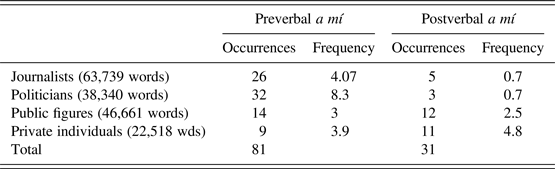
Of the four socio-professional affiliations, politicians make the most use of the preverbal variant, followed by journalists (Table 4).
Normalized frequencies of the preverbal and postverbal placement of the first-person singular object a mí

The preverbal variant's lower informativeness and higher agentivity make it suitable to be used in argumentative and persuasive utterances by politicians. Notice that, in the following excerpts, the preverbal object a mí serves to present a personal opinion using psychological verbs like parecer in (26) a mí me parece ‘it seems to me’ and sorprender (27), as in a mí me sorprende ‘I get surprised’ [lit. ‘It is surprising to me’].
(26) Politician:
A mí me parece muy poco/yo creo que tiene que gobernar y no lo está haciendo. (CCEC <DC7>)
‘It seems to me very little; I think he should govern, and he is not doing that.’
(27) Politician:
A mí me sorprende que una y otra vez nos amenazan que van a empezar las prospecciones no sé en qué mes. (CCEC <DC7>)
‘I am surprised [lit. ‘It is surprising to me’] that, time after time, they threaten to begin exploratory drilling, in I do not know what month.’
In both excerpts, the expressed preverbal object a mí acts pragmatically as the pronominal subject yo. Of the socio-professional groups, politicians most often use first-person plural subjects, showing a strong preference for the preverbal position in discourse (Aijón Oliva and Serrano Reference Aijón Oliva and Serrano2013: 194). In this way, politicians can exploit their personal involvement in discourse for argumentative purposes.
The postverbal position, even though it is the prototypical position for objects, is rather infrequent. Private individuals had the highest score for the postverbal placement of the first-person object, which suggests that this group of speakers perceives this communicative resource to be particularly useful. See example (28).
(28) Private individual:
Los que me conocen a mí saben que no estoy gordo/y cambiar esta imagen y movimiento no es fácil. (CCEC <CanDi3-12>)
‘Those who know me [lit. ‘to me’] know that I am not fat; to change that image and movement is not easy.’
The postverbal position modifies the meaning of the statement, implying a decrease in autonomy and an increase in the affectedness of the referent of the object. As such, the emphasis on the subject los que me conocen is reduced; thus, the referent of the object a mí is enhanced. This is particularly profitable in interpersonal communication, in which personal situations are frequently exposed, and self-stressing is required. However, the relationship between this non-specific third-person plural and the object is occasional, and other contexts may exist in which a non-specific third-person subject is used without a tonic pronoun (Weiner and Labov Reference Weiner and Labov1983, Shin and Otheguy Reference Shin and Otheguy2005: 158–159).
5. Cognitive foundation of style and the use of the first-person singular object
Any expressed element becomes more subjective when it is anchored in speech, particularly the speaker's orientation to the situation (Fried Reference Fried, Athanasiadou, Canakis and Cornillie2006: 47). It follows that the lesser informativeness of the omitted variant (clitic me only) promotes a style based on the absence of the referent in the communicative interaction, as the blurring of participants through first-person object omission helps to orient discourse in the direction of external entities. On the contrary, the expressed object me + a mí increases informativeness in a style based on stressing the self-referent. Therefore, the cognitive grounds for the meanings of each variant outline the style created by them; thus, the omitted variant contributes to shaping a neutral communicative style, and the expressed variants do the same for an informative or subjectivizing style.
Politicians’ discourse is usually argumentative, as they are engaged in political processes that require their words, proposals, and actions (Montgomery Reference Montgomery, Ekström and Patrona2011: 33). They are usually highly aware of the value of linguistic choices and how these choices can help them gain the approval of their audience. Therefore, they generally find it advantageous to use the first-person singular object in their interactions.
The quantitative analysis indicated that politicians exhibit a higher expression of a mí compared to the other groups, and public figures and journalists exhibit a lower expression of the object a mí in relation to the other groups. These results can be explained by the communicative goals of the speakers, and it can be seen that the omission of the object a mí is used to reach concrete communicative goals.
Politicians are particularly inclined to the explicit indexation of their speech; this finding is in accordance with results previously obtained for other pronouns and functions (Aijón Oliva and Serrano Reference Aijón Oliva and Serrano2013: 201). Self-indexation by the person objects me/a mí creates a communicative style that stresses positions and arguments. Note that, in excerpts (29) and (30), the politician switches to the omitted variant along a stretch of discourse.
(29) Politician: A mí me parecía importantísimo la visión que tenía de Canarias/nos complementábamos muchísimo/su visión de futuro/ me preocupa, yo creo que eso fue un impulso/pero a mí me parece interesantísimo. (CCEC <EspAM>)
‘The vision he had for the Canaries seemed so important to me; we greatly complemented each other. His vision for the future worries me. I think it was an impulse, but it seems very interesting to me.’
(30) Politician:
Yo la pregunta que me hago es que Adán Martín dejó la presidencia y hace tres años y medio/y a mí la pregunta que me gustaría hacer es cómo ha sido el legado de Adán Martín … me llamaba la atención su educación/me decía que sabía de turismo también/a mí es un rasgo de Adán Martín que me encanta. (CCEC <EspAM>)
‘I wonder [lit. ‘The question that I ask to myself is’] why Adán Martín left the presidency three years ago. The question I would like to pose is [lit. ‘I would like to pose this question to myself’]: How has Adán Martín's legacy been? His education attracted my attention [lit. ‘attracted me’]; he told me that he also knows about tourism. This is a characteristic of Adán Martín that I love [lit. ‘To me, this is a characteristic of Adán Martín that I love’].’
The first-person singular person subject or object is a prototype of subjectivity (Aijón Oliva and Serrano Reference Aijón Oliva and Serrano2013: 190–193). Politicians tend to focus on themselves and thus use the expressed variants of the first-person singular subject or object. Their utterances are underlined by self-explicit indexation; hence, they tend to develop a speaker-centered or subjective style.
Private individuals’ discourse is generally oriented toward explicitly argumentative interaction, as they often express their opinions and concerns about current topics. This explains their higher score in the use of the postverbal position.
(31) Private individual:
Tú me preguntas a mí que si puedo mandar dinero … no puedo mandar dinero a mi familia porque no nos llega ni para nosotros. (CCEC <R7-126>)
‘You ask me [lit. ‘pose a question to me,’] if I can send them some money … I cannot send money to my family because there is not enough, even for us.’
(32) Private individual:
La sensación que me da a mí cuando estás tanto tiempo parado/es que no sirves para nada. (CCEC <R7-126>)
‘The feeling I have [lit. ‘The feeling that it gives to me’] is that, when you are unemployed so many times, you are not useful for anything.’
Although private individuals often speak about their personal opinions and concerns, they generally do not self-index using the expressed variant but instead omit it, suggesting the neutralization and desubjectivization of the propositional content. The quantitative analysis indicated that this style is also used by public figures.
6. Conclusions
This study has demonstrated the main cognitive patterns of the variation of the first-person singular object me/a mí in texts from various media interactions. The omitted and expressed (preverbal or postverbal) variants convey different meanings based on their informativeness. First-person objects are most frequently omitted when they are represented by the clitic me. In turn, variability in their formulation and placement is less frequent. The meaning of first-person objects is based mainly on agentivity and self-referencing and is a communicative resource commonly used among different socio-professional affiliations.
The inherent meanings of syntactic variants are linked with their quantitative usage patterns and their pragmatic effects in communication. Although omitting the object is common for all speakers, public figures were found to do this more frequently. Further, both public figures and politicians were found to take advantage of expressing the variant as a communicative resource to enhance the self-referent. Subtle nuances may also be derived from the meanings conveyed by the preverbal or postverbal expressed variants, but these positions are distributed unevenly across socio-professional affiliations: politicians prefer the preverbal position, while private individuals prefer the postverbal position.
Variants can be used to perform certain identities in concrete communicative settings. Although private individuals had representative scores for both omission and expression, public figures were found to prefer non-subjectivizing variants, such as the omitted variant. In this way, they can avoid self-indexation, and their communicative style can be seen as neutral. On the contrary, politicians tend to emphasize their own responsibility for their statements. The speech of politicians and private individuals is usually argumentative, which results in frequent self-indexation. Therefore, using the expressed first-person singular object, these groups tend to perform a subjectivizing style. Speakers can choose different variants to accomplish different communicative goals and contribute to the creation of diverse communicative styles based on gradient subjectivity.
Corpus
Corpus Conversacional del Español de Canarias (CCEC)