




No CrossRef data available.
Article contents
Variability of spatial frames of reference in wayfinding discourse on commercial signboards
Published online by Cambridge University Press: 17 August 2005
Abstract
This study focuses on the everyday use of spatial frames of reference (FoR) and seeks to elucidate the underlying principles for guiding viewers from a signboard to a destination. Using Levinson's tripartite typology of FoR – absolute, relative, and intrinsic – and a VARBRUL analysis, it is shown that each FoR is differentially preferred depending on distinct geographic features of the route and the environment. Specifically, as geographic scale and route complexity increase, there emerges a general tendency away from intrinsic descriptions, through relative descriptions, to absolute descriptions, despite the general low usage of the absolute FoR in modern Japanese. It is argued that the asymmetries in the shift and maintenance of FoRs could be largely, if not wholly, accounted for by using such strategies as “single-perspective” and “absolute-reliance” and properties of “untranslatability.”I wish to thank Shoji Takano, Akiko Kato, and Hiroki Yoshioka for their invaluable comments on the earlier versions of the paper and their technical support on the VARBRUL analyses. My gratitude extends to Jane Hill and the two anonymous reviewers for giving me supportive comments and new insights, and to Hisashi Miura for his extensive assistance in the data collection and coding process. I also greatly benefited from interviews with senior employees at Sankoo Advertising Co., Cutting Kei, and Toyota Kookoku, and from various comments and inquiries from participants in the 11th Meeting of the Japanese Association of Sociolinguistic Sciences, the 37th SIG-SLUD Meeting of the Japanese Society of Artificial Intelligence, and the 28th Open Symposium: “Language” at Aichi University. The research for this article was supported by a Grant-in-Aid for Scientific Research (C) (No. 12610566), 2000–2003 (Japanese Ministry of Education, Science, Sports, and Culture). All misconceptions and errors are of course my own.
Keywords
Information
- Type
- Research Article
- Information
- Copyright
- © 2005 Cambridge University Press
INTRODUCTION
In this article, I will take a close look at spatial descriptions on commercial signboards and attempt to elucidate the underlying conventions for wayfinding in guiding viewers from a signboard to a destination. The study thus concerns broadly defined human navigation, which may be constrained by locally customized but typologically common properties of spatial reference. By focusing on an everyday use of spatial frames of reference (hereafter FoR) on signboards, I examine those properties in terms of the correlation between the use of FoRs and geographic features such as overall distance and turns of route. The results from conventional and VARBRUL analyses (Young & Bayley 1996) are presented and compared, and they show a general tendency of FoR usage away from “intrinsic” descriptions, through “relative” descriptions, to “absolute” descriptions as the geographic scale and route complexity increase. I then propose that the asymmetries in the shift and maintenance of FoRs could be largely, if not wholly, accounted for by contextual requirements and practical efficiency and by properties of the “untranslatability” grid (Levinson 1996b).
Navigation and wayfinding
The word “navigation,” which originally came from Latin navis ‘ship’, currently refers to any human (or nonhuman) means of transportation, especially automobiles, planes, ships, or any other means for moving from one place to another in terrestrial and nonterrestrial space. Such activity, relying on the dexterity and expertise of the navigators, naturally requires not only the identification of the source and the goal of travel but also specific information about the path and means of travel. It may be expedited by “cognitive artifacts” such as maps, compasses, geographic information systems (GIS), and/or natural sources – tangible or intangible – such as territorial and botanical distributions, celestial constellations, directions of waves and wind, and so on (Lewis 1976, Frank & Mark 1991, Hutchins 1995). A crucial faculty that makes such activities possible and effective is the navigator's spatial knowledge with regard to the environment, with which he or she constructs and elaborates spatial configurations (i.e., mental maps) with such categories as points (locations, landmarks, and reference nodes), lines (routes and boundaries), areas (regions and cognitive concepts), and surfaces (physical topography and density) (Golledge 1999, Allen 1999, cf. Lynch 1960).
In addition, it must be noted that spatial knowledge is not simply external or internal to the individual. Spatial activity in the public space is constrained by the domain-specific praxis embraced by each community, through which we are socialized into a habitualized use of space (Levinson & Brown 1994, Pederson et al. 1998). In that sense, we rely on some sort of an action scenario or socially shared behavioral system (or what Bourdieu 1977 calls “habitus”), which makes social actors react in practical and meaningful ways in accordance with the changing environment.
In another sense, spatial movements may be cognitively constrained by the potential resources that we are able to exploit in any given situation. The human navigator, for example, is obviously not capable of perceiving the microwave signals that a state-of-the-art global positioning system (GPS) can use – although, of course, we can use such a system as a cognitive artifact – and thus humans have to resort to innate and/or learned cognitive skills cultivated for particular spatial activities. Both constraints are always relevant when we move through space using any kind of cognitive artifacts with the goal of reaching a familiar or novel destination.
Commercial signboards represent one arena in which both cultural/social accustomization and cognitive mechanisms intersect for the purpose of resolving a possibly complicated task of wayfinding in a given environment. I will focus particularly on the linguistic and semiotic representation of FoRs in commercial signboards that are designed to guide viewers from the site of viewing to a designated destination. As a point of departure, I will rely on the theoretical frameworks proposed by the Cognitive Anthropology Group at the Max Planck Institute for Psycholinguistics, and I will present data analyzed using a VARBRUL program, hoping to reveal underlying guiding principles that make wayfinding easier. This study does not particularly explore spatial “cognition” per se, but it does touch upon some cognitive issues related to linguistic and gestural means of spatial representation.
Previous discourse studies on spatial description
Spatial description is truly an interdisciplinary area of research, and many linguists, psychologists, and discourse analysts have investigated the ways in which spatial perspective taking is achieved, maintained, and revised in relation to its linguistic realization in discourse. The primary methodology used has involved spatial description tasks designed to elaborate on the details of rooms, buildings, roads, natural environments, and so on.
One of the major findings of these studies is widely acknowledged (in different terminology) as the distinction between two perspectives: egocentric (from the viewer's perspective) and allocentric (outside the viewer's perspective), which are respectively associated with procedural and declarative knowledge, with varying degrees of integration between them. For example, Linde & Labov's (1975) seminal study of apartment descriptions found that 97% of the subjects took an “(imaginary) tour” perspective, identifying their perspectives with those of visitors or investigators of the environment, while the remaining 3% employed a more detached “map” perspective according to which the apartment was imaginatively depicted as if it were being viewed from above. In a way, this result is hardly surprising because being given an imaginary tour of an apartment is more consistent with listeners' everyday experience than is viewing the layout of an apartment from above.1
Similarly to Linde & Labov's study (1975), Brown 1995 finds that the majority of information givers (more than 80%) took what Linde & Labov call the “tour” approach, in spite of the assumption that the kind of map task Brown examines would naturally induce the speakers to use the “map” approach (Brown 1995:118).
This distinction is largely equivalent to Levelt's (1982, 1996) “intrinsic” and “deictic” and Li & Zubin's (1995) “expressive” and “reportive” frames, represented, respectively, by the experiencer's (subjective) or the presenter's (objective) mental states.2
For example, Levelt's studies (1982, 1996) reveal that the “linearization” processes for describing spatial networks consist of lines and nodes and are characterized by two types of perspective: an objective, detached “deictic” point of view (similar to Linde & Labov's “map” perspective) and a moving navigator's “intrinsic” perspective (Linde & Labov's “route” perspective). Also, in that rigidly structured space the subjects used the same perspective consistently, based on nonlinguistic features such as the image of spatial configuration.
This intermediate perspective is characterized by the scanning of an environment from a single, fixed point of view, and may exhibit features common to a hierarchical “higher-to-lower-order” (Shanon 1984) descriptive style and to particular linearization strategies such as “parallel line” and “round about” (Ehrich & Koster 1983).
Levinson himself (p.c.) avoids commenting on the validity of corresponding relations between Tversky's and his own models.
Methodologically, these studies often used monologues and/or descriptions of objects from the viewer's or navigator's perspective, but they did not particularly consider the negotiation of meaning between interlocutors. In effect, actual conversation may be quite different from monologues in many respects, requiring the discourse participants to negotiate the meaning and resort to different types of “grounding” of perspective.
The significance of interaction in identifying locations was examined in detail by Schegloff 1972 and Psathas 1991, who formulated phenomenological procedures for establishing membership categorization and interactional protocols emanating in situ in telephone/wireless conversation. The importance of interactants was repeatedly emphasized by Clark & Schaefer 1989, Schober 1993, 1995, and Brown 1995. Brown 1995 also stressed the importance of “adequate understanding” rather than “correct understanding,” given the fact that we normally react adequately and sufficiently and with a tolerable level of efficiency based on limited information rather than on fully and correctly elaborated information.
In another group of studies, cognitive load has been assumed to be the major source of motivation for frame shifting (Schober 1993, 1995; Tversky, Lee & Mainwaring 1999). For example, Schober 1993, 1995 particularly worked on this interactional aspect of spatial discourse and found that perspective taking in conversation takes into account not only the speaker's but also the addressee's point of view in such a way as to minimize effort for both participants. Tversky et al. 1999 maintained that people quite frequently change perspective depending upon the degree of cognitive load required to achieve a certain communicative task, and that the use of multiple FoRs is not restricted to the dyadic/interactional context. Even for spatial judgments in experimental settings, Carlson 1999 found that individuals relied on multiple frames of reference in judging the fit between physical environments and spatial expressions, and that multiple frames were automatically and initially activated. These studies suggest that strategies to solve spatial tasks may not rely on a uniform, consistent perspective – that is, the assumption that actors use a single perspective throughout an event may be untenable, even in an interactively restricted context such as the one employed in this study.
Frame of reference (FoR)
Current studies of spatial cognition largely assume two types of conceptualization of space: the world perceived metrically, and the world perceived deictically/topologically (Levinson 1996a, 1996b; cf. Piaget & Inhelder 1956).5
It seems that the non-coordinate system in Levinson's spatial array is roughly equivalent to the first and second stages of Piaget's developmental sequence of children's spatial conception, and his coordinate system to the third Euclidean space (Piaget & Inhelder 1956) – although, of course, Levinson does not resort to Piaget's developmental view for the source of variation.
Three developmental stages of spatial cognition defined by Piaget are (1) from birth to two years (0–2), sensorimotor or perceptual space, with “topological” segmentation, no representation, no symbolization; (2) from two to seven/eight years (2–7/8), “topological” space concept, representation and symbolization of the “topological” notions gradually develop; (3) from seven/eight to twelve/thirteen (7/8–12/13), systematic and parallel elaboration of the “projective” and “Euclidean” system – even here, the basic notions of “projective” space are genetically slightly primary to those of “Euclidean” space.
Levinson 1996a further proposed a functional typology of the coordinate system that classifies the whole static spatial array in the following way (see also Figure 1). The coordinate system requires three elements – relatum (Rl), referent (Rf), and perspective – to establish the spatial relationships, and it is comprised of three types of frames of reference: intrinsic, relative, and absolute. Notice that this is a typological grid for linguistic, not perceptual, encoding and decoding of space.

“The cat is _______ the truck.”
Let us look more closely at each type of coordinate system by using the sentences in Figure 1 (i) to (iii). First, sentence (i), The cat is to the left of the truck, correctly describes the scene. The coordinate system employed here is called the intrinsic FoR, because the cat's position is identified in terms of the truck's intrinsic orientations – front, back, left, and right, derived from its default direction of motion. In this FoR, the spatial relation is “binary,” relating two objects/entities (cat and truck) in the immediate context.
For sentence (i), however, another interpretation is possible when the cat is at the truck's intrinsic front – to the left of the truck “as seen by the viewer.” The ambiguity comes from another frame of reference applied to the spatial array, the relative FoR, which happens to share much of the same spatial vocabulary.
The relative FoR is often regarded as equivalent to what is called “deictic reference” in linguistics. In the current framework, however, there is a distinction between them in that the relative FoR is computed by the angular specification in terms of the viewer's, not the relatum's, “left/right” or “front/back,” while deixis is characterized by non-angular specifications such as “here/there” and “this/that.” In addition, in Figure 1 the cat and the truck are related by the implicit spatial configurations vis-à-vis the viewer. Therefore, the spatial relation is determined through viewer's (imaginary) location in the scene. It is thus a “ternary” relation among cat, truck, and viewer. Figure 1 can thus be described “relatively” with sentence (ii), The cat is in front of the truck.
In the absolute FoR, the referring practice can be simpler because this FoR only requires as an anchor absolute directions such as “NSEW,” “where the sun rises/sets,” “uphill/downhill,” “upstream/downstream,” or any other orientations based on fixed and stable geographic features.6
Levinson' s notion of “absolute” space is distinct from Newtonian absolute space, a concept that is more widely acknowledged. Newton's concept is abstractly based on the astronomical location of the universal center of gravity as the reference point. Apparently, the absolute directions based on this universal center constitute vertical orientations and may or may not coincide with the “absolute” directions defined by the Earth's geomagnetic orientations (compass directions) or indigenously established absolute directions on the horizontal plane (see Jammer 1993:chap. 4).
Relativity and diversity of space
The choice and frequency of use of FoRs variably represent culture-specific differences. As Levinson 2001, 2003 has stated, even if speakers can theoretically use the three systems, not all languages use them to the same extent as the more ordinary means of spatial description. Languages may exclusively use one, or a combination of just two, or all of them in skewed proportions. In English and Japanese, for example, all three FoRs are quite familiar, but the relative and/or intrinsic FoRs will usually be preferred (Levinson 1996a), except in some special circumstances such as talking about geographic relations or avoiding difficult discriminations between right and left (Inoue 2002, Mainwaring et al. 2003). Tzeltal (Mayan) speakers, however, have been found notably to use absolute (and intrinsic) FoR(s) in ordinary reference (Levinson 1994), whereas Yucatec (Mayan) and Tamil speakers are known to use them all (Pederson et al. 1998, Levinson 2003). Other speakers, such as Mopans (Mayan), are reported exclusively to use the intrinsic FoR, while Guugu Yimithirr speakers choose the absolute FoR for the same purpose (Danziger 1996, Haviland 1993). Given this great variation, the practical contingency of FoRs seems to represent unforeseeable variability. Interestingly, however, the only combination that has not been reported to occur is “relative without intrinsic” (Levinson 2001:576; see also Levinson 2003:93). That is, although there is tremendous diversity in the availability of FoRs across languages, certain universals may exist as constraints on variability.
These findings suggest that differential encoding and decoding of space is not simply a matter of “diversity” across languages but could also lead to a question of linguistic “relativity” if it is shown to exhibit cognitive differences (Lucy 1997). Along this line of research, Levinson and his colleagues have shown through numerous nonlinguistic experiments called Cognition Games that a differential preference in FoRs was found to motivate differential spatial cognition, which bears out the recurrent argument for a linguistic relativity effect (see Levinson 2003 for an extensive summary of the project).7
For example, they devised nonlinguistic spatial memory tasks and asked the informants to remember the spatial relationships. A rationale is that speakers of a certain language must remember the spatial relations depending upon which FoR is predominantly used in their language. Just as Guugu Yimithirr and Hai//om speakers remember things in absolute terms (Haviland 1993, Widlok 1996), so English and Japanese speakers remember in relative terms. That is, speakers with different FoRs as their predominant coordinates will think differently about spatial scenes and relations. This phenomenon consequently requires absolute-FoR speakers to always be aware of their spatial orientations. Surprisingly, the absolute populations such as Guugu Yimithirr and Hai//om have been found to rely on extremely accurate “dead-reckoning” navigation comparable to that of homing pigeons, in contrast to Dutch or British English speakers who show very weak sensitivity to absolute directions (Levinson 2003).
Language- and context-specific variability of FoRs
Preference for particular FoRs may be a cross-linguistic variable even among genetically related European languages. For example, Carroll 1997 found that English speakers tend to take an “objective (or object-centered)” perspective in describing physical objects, in contrast to German speakers, who are likely to adopt a “subjective (or viewer-centered)” perspective for the same task.
Furthermore, there are studies that indicate the variable distribution of FoRs even in a single linguistic community. One such example is Pederson's (1993, 1995) study of the variable use of FoRs by Tamil speakers for describing three types of referents: body parts, manipulable objects, and geographic places. Pederson observed that urban Tamil speakers mainly used the relative FoR for referring to body parts and manipulable objects but had contextual preference for the use of the absolute FoR in locating geographic places. Rural Tamils, in contrast, tended to rely on the absolute FoR even for descriptions of manipulable objects or tabletop space.
Inoue 2002 reports on an interesting ongoing phenomenon in the Kochi dialect in the southwestern part of Japan. As mentioned above, the use of the absolute FoR in Japanese is largely limited to special activities related to map and compass reading. In some regions in the Kochi Prefecture, however, the local people apply the absolute FoR to describe natural objects (including their own bodies) an exceptionally high percentage of the time compared with the practice of Japanese in other regions. Building on Pederson's work, Inoue conducted interviews and a questionnaire survey of local dentists regarding referents to which they and their patients applied the absolute FoR. These included (i) body parts, as in higashi no okuba ga itai ‘my eastern molar aches’, (ii) manipulable objects, as in minami-gawa no isu ni suwaru ‘I sit on a chair to the south’, and (iii) geographical locations, as in shika wa oshiro no kita desuka ‘Is the dentist to the north of the castle?’
Inoue summarized her findings as follows: (i) as many as 8.5% of those surveyed, mostly elderly people, used the first type of description; (ii) there is an increasing tendency to use the absolute FoR to describe “body parts < alienable objects < geographical locations”; (iii) the younger generation heavily relies on the relative FoR, while people in their forties and fifties are at the forefront of the shift to the relative FoR, revealing a competing use of relative and absolute FoRs; (iv) the shift to the relative FoR is almost complete in urban areas; and (v) the shift typically seems to be ongoing in regions with geographically conspicuous landmarks such as mountains. These studies point to the importance of looking at the regional, historical, and contextual variability in a single language community.
Purpose of study
In this study I will take the series of spatial expressions on a signboard as a piece of discourse – however simplified and truncated it may be (cf. Mark & Gould 1995) – and look at the quantitative correlation between the types of FoRs and purely physical, geographic contexts. The rationale for considering this aspect is twofold. Traditionally, sociolinguists have mainly dealt with the social and linguistic factors, which have been further decomposed into several variables that were assumed to induce the use of certain dependent variables.8
The use of the terms “dependent/independent variables” in a correlational study may sound anomalous, but it is widely accepted in language variation studies (see Young & Bayley 1996).
Second, although the notion “frame of reference (FoR)” has often been assumed to be a developmental and psychological construct (e.g., Piaget & Inhelder 1956; Hart & Moore 1973; Taylor & Tversky 1996; Levelt 1982, 1996), I argue that a more function-oriented analysis of FoRs is necessary. Practically speaking, there have been only a few discourse studies focusing on the functionally differentiated use of FoRs (e.g., Hanks 1990; Haviland 1993, 1996, 2000; Kataoka 1998; Bennardo 2000), as typically seen in Bennardo's (2000) study, which suggests that Tongans prefer different FoRs for small-scale and large-scale spatial contexts mediated by the indigenous concept of “front.” The merit of this study thus lies in the attempt to reveal the correlation between purely geographic factors and language use in the real world, and to confirm distinct teleological distributions of FoRs employed.
In order to examine this question, I conducted a quantitative analysis with the VARBRUL program, which is designed especially to deal with linguistic variation. As this study will show, Japanese is not invariably a relative/intrinsic language; although this is true by default, the language can potentially exhibit an absolute tendency in a particular activity. Through the VARBRUL analysis and Levinson's theory of spatial typology, commercial signboards are shown to be context-sensitive cognitive artifacts for facilitating the viewer's wayfinding activity, and to serve as a “porthole” into the locally conventionalized spatial practice and the universal constraints imposed by the nature of human perspective taking.9
Here I examine the spatial descriptions on signboards based on the fieldwork data and interviews with signboard producers, but I will not explore the effectiveness of the uses of various FoRs for navigation, which is beyond the scope of this essay.
DATA
Commercial signboards in the Japanese context
Commercial signboards are a ubiquitous medium of mass communication, used in most of the literate societies around the world. However, Japan has not joined the worldwide trend toward self-regulation of commercial advertising (Boddewyn 1992). For example, roadside signboards/billboards in the United States are subject to control under legislation dealing with the publicizing of company products and commercial merchandise as well as the dissemination of political slogans and mottos. There are other types of signboards that designate the location of individual stores or institutions, but they are legally restricted to being erected “on-premise” (i.e., erected on the site of, or near, the building) in order to preserve the scenic beauty of the environment (Enfield 1969).10
As far as I have seen and heard from various sources about other Asian countries such as Thailand, Nepal, China, and Korea, most signboards in these countries seem to be the “on-premise” types, as in Western countries.
In contrast, Japanese signboards are both constructed on-premise and also likely to be erected at some distance – usually several kilometers away, in some cases up to 30 kilometers from the destination – giving directions and guiding the viewer to the goal. Considering the fact that the origin of current Japanese signboards goes back to on-premise construction for personal stores dating back to the 8th Century (Funakoshi 1998), their function may have been historically extended, especially during the Edo era (1603–1867), to cover a wider commercial territory. Whatever the cause might be, this practice still persists strongly in Japan. Because of their ubiquity, roadside signboards function as a representative medium for wayfinding and spatial guidance in Japan.
Given this situation, we might ask what sorts of information are selected to facilitate long-distance guidance to the destination. Obviously, it is not enough to designate the direction and distance to the destination. Other sorts of information also need to be included, such as the estimated distance to the node (e.g., 500 m ahead or three signals away), spatial relations in relation to the landmark (e.g., in front of Jusco and 800 m north of Uny (supermarket)), and the mode or path of travel (e.g., 5 minutes by car and along Route 153). In addition, signboard communication is a one-way transmission of such information. In order to streamline and facilitate communication, signboards usually follow a relatively unified format for presenting spatial information.
The data were collected from 2000 through 2002 around the author's hometown in central Japan (Nisshin City, Aichi Prefecture). It is adjacent to Nagoya, one of Japan's major cities, with a population of more than 2 million people. According to a “metropolitan construction map” issued by the local government, this suburban area is divided into three major categories: the hilly district/farmland, the residential district, and the commercial district.11
A map of the urbanization plan published in 2000 by the Nagoya Civic Improvement Bureau defines at least 13 categories of land, ranging from the urbanization-prohibited area to the industrial area. In addition, considering other types of limitations in terms of the floor area ratio, the building-to-land ratio, the height limitation, and the purpose of use, there are approximately 40 categories for the types of land use. Obviously, it is impossible to include all these categories as contextual variables, so I will limit the analysis to only the three major types mentioned here.
In principle, data were collected from all the signboards along these roads, except some that faced the opposite lane and were not visible or were hard to see. There were no purposeful exclusions from the data. In total, 419 signboards and 575 tokens of spatial descriptions were collected for the current study. (The number of tokens is higher because some signboards include more than one FoR on a single signboard.)
Examples
Some examples from the current data are shown in Figure 2. As seen in Figure 2a and 2b, most signboards incorporate one or more FoRs to indicate the destination (reproduced in ex. 1a–1b). The most frequent type of signboard, by the way, advertised individual hospitals and clinics, accounting for approximately 60% of the total data.

Wayfinding signboards and spatial expressions.

In ex. (1a), the first phrase, Meitetsu Nisshin-eki mae ‘in front of Meitetsu Nisshin Station’, locates the destination based on the intrinsic FoR of Nisshin Station. However, since there are two exits from the station, one on the north and the other on the south, this is a polysemous expression. The following phrase, minami e 100meetoru ‘100 meters to the south’, clarifies the ambiguity based on the absolute FoR. In (1b), Yottsume shingoo sasetsu ‘left turn at the fourth traffic light’, the “here-and-now” of the viewer (the current origo, or the “here and now”) is backgrounded in the context, and only the future action expected – that of traveling to the fourth traffic light (the second, imaginary origo) – is foregrounded, based on the relative FoR. The expressions in Table 1 are typical examples from the data for each FoR.
Examples of FoR-based expressions.

I also interviewed several signboard producers in the region in order to obtain insiders' information regarding the processes leading to the final product. They were randomly chosen from the Yellow Pages of the telephone directory. What I was concerned about was the use of any kind of insiders' manuals elaborating the techniques and strategies for choosing suitable expressions for various (geographic) contexts of a signboard, such as “Use the NSEW terms when a signboard is in an open field” or “use the Right/Left terms in congested areas.” Eventually, everyone I interviewed denied the existence of such manuals or guidelines, saying that it was simply infeasible or even impossible to make them. As to the process of signboard production, there are numerous professional and nonprofessional requirements to be met among the customer(s), the signboard maker(s), and the designer(s), concerning the location, direction, size, and budget for the signboard, to name only a few factors. Taking into consideration all of these factors in a manual is an infeasible task because it is impractical to prepare a manual that covers all probable cases. Thus, each signboard and the expressions therein represent cooperation and compromise among the assessments made by the unspecified participants of variable geographic contexts. Consequently, signboard expressions may serve as a pool of cognitive artifacts, accumulated through the discourse participants' situated cognition and their optimal judgments of the contextual requirements.
Method
For the following analysis I used, in addition to a conventional frequency count, a quantitative analysis tool called VARBRUL, a program originally set out by Sankoff 1988 for the analysis of linguistic variation.12
The two most widely used versions of this program are GoldVarb for Macintosh (Rand & Sankoff 1990) and VARBRUL for PC (Pintzuk1988).
See Young & Bayley (1996: 256) for the rationale in using VARBRUL in variation studies instead of other multivariate statistical measures such as multiple ANOVA.
The variables listed below were considered for the conventional and VARBRUL analyses mainly because they are recognized to affect the encoding and decoding of spatial memory, especially in the psychological literature dealing with “mental maps” (see Tversky 1992, Golledge 1999, for reviews).14
The viewing angle relative to the route or the destination may serve as an independent variable, but it was practically impossible to analyze the angles because signboards are not necessarily erected parallel or perpendicular to the route but rather are gradiently angular.
I did not experience much coding difficulty for linguistic descriptions because of the rather strict definitions of FoRs and their features provided by Levinson (1996a) and because of the fact that most of the spatial descriptions were regulated to be in similar formats. First, I made a guideline and trained my graduate assistant to code the tokens based on four categories – absolute, relative, intrinsic, and non-coordinate (topological/deictic descriptions, distance, and place names), and then I checked (and corrected, if necessary) all the tokens before I processed them with the VARBRUL program. Specifically, we achieved 94% agreement for the first 100 tokens. Since most of the disagreements came from the interpretation of “front” – which can be both relative and intrinsic, depending upon the viewer's or the object's orientations – I refined the guideline to deal with the coding problem for the rest of the data.
Here I will limit my discussion to the spatial expressions based on FoRs, and then I will consider a nonlinguistic element – use of arrows – because it also accounts for a major portion of the spatial reference. Maps are not discussed here because of their much lower frequency in the data.

The distance and the number of turns on the way to the destination were not necessarily indicated on signboards. In those cases, I checked out the information with a map measuring tool on detailed maps.
ANALYSIS
Let us first look at the frequencies of the three FoRs in the data (Table 2). “No spatial description” here means that the signboard only includes one or more elements of the following information: the name of the destination, the work description, a web/e-mail address, and/or a telephone number. This category accounted for less than 10% of the total occurrences (55 of 575 tokens), and thus it was excluded from the analysis. Of the remaining 520 tokens, there were two types of linguistic description: a coordinate system (i.e., descriptions with FoRs: 82.9%) or a non-coordinate system (17.1%). The non-coordinate system included such strategies as depiction of topological/deictic relations (e.g., ‘Next to the Nagoya Bank’, ‘Inside the Oshikusa Housing Complex’, or ‘here/there’), and specification of named locations (e.g., ‘Kaguyama Intersection’), as well as other geographic information about the distance or the time of travel. I will deal mainly with coordinate descriptions below and will briefly refer to non-coordinate aspects in a later section.
Linguistic and non-linguistic information in signboards.

It can be seen from Table 2 that, first, approximately 90% of the tokens under discussion include some sort of spatial information that is based on the coordinate system or the non-coordinate system, and second, roughly 70% of them include arrows, while no more than 20% include a map or maplike description.17
Arrows were sometimes depicted inside the coexistent maps. In those cases, they were separately coded for each category.

A canonical distribution of linguistic/non-linguistic information.
Below, I will first examine the major source of information – linguistic description of the location and route – and then I will return to the nonlinguistic description in later sections.
Results for linguistic descriptions: Use of FoRs
Our ordinary spatial reference is part of covert language socialization, wherein communicative efficiency mostly relies upon the degree of frequency with which we associate a particular practice and the optimal communicative result. Thus, if we are locally socialized into a particular FoR, it will become the standard framework that habitually adapts us to a community- or genre-specific grounding of perspective. However, it is possible that both particular and universal features may mutually motivate such a grounding of perspectives. First, let us consider particularity.
The following results partially contradict and partially confirm previous perceptions of Japanese spatial reference through FoRs. First, in contrast to an ordinary perception that the relative and intrinsic FoRs are largely preferred in Japanese referential practice (Levinson 1996a; cf. Suzuki 1973, Inoue 2002), Table 3 shows that absolute reference, at 43.4%, accounts for the highest portion of total FoR occurrences. It surpasses the other two FoRs, with the relative FoR accounting for 38.0% and the intrinsic for 18.6%. At the same time, however, this result is largely comparable with Pederson's (1993, 1995) and Inoue's (2002) findings that spatial reference to geographic relations is more likely to include the absolute coordinate terms (NSEW) than other coordinate terms (RLFB) used in the relative or intrinsic FoRs.
Frequencies of FoR usage in signboards.

Explanations for this unstable result are still speculative, but there are certainly some. First, it is possible that a region-specific practice is relevant, although one not so extreme as in Inoue's (2002) case in Kochi. In fact, I have heard some people from other regions offering a folk-dialectological observation that people in Nagoya heavily favor absolute reference in spatial description.18
One of the participants at my lecture told me an anecdote in which his father, a local ophthalmologist in suburban Nagoya, was totally confused when his patients responded in NSEW terms to his inquiry about which side of the Landolt ring (the C-shaped sign used for a visual acuity test) was missing.
Variable use of FoRs
The following section explores the variable occurrence of FoRs and shows that each FoR is differentially preferred along a continuum in correlation with certain geographic factors. Before the VARBRUL analysis, I will also present a more conventional analysis of frequency, comparing it with that of the VARBRUL analysis, to see how they may be integrated. In order to streamline these features, I will first examine what I assume to be the two major geographic factors for wayfinding descriptions: the number of turns and the route distance from a signboard to the destination.
Tables 4 and 5 and Figures 4 and 5 clearly show that the preference for particular FoRs gradually shifts as the geographical factors change, eventually exhibiting a gradient cline of preference, especially between the relative and absolute FoRs. (I underline the highest ratio in each factor.)
Variable use of FoRs according to the number of turns (1).

Variable use of FoRs according to distance (1).


Variable use of FoRs according to the number of turns (2).

Variable use of FoRs according to distance (2).
As for number of turns (Table 4 and Figure 4), we notice that the relative and absolute FoRs seem to interact strongly with each other as the number of turns increases, while the intrinsic FoR is less affected by this geographic feature. To be more precise, we could at least observe the following points:
(a) More than half the FoR tokens occurred under the factor 1 (15.5 + 38.7), and more than 80% under 2 (15.5 + 38.7 + 27.8), indicating that most of the FoR-based signboards are preferably set up within the second turn before reaching the destination.
(b) The relative FoR tends to be applied when there is no turn or one turn to make before the destination, while the absolute FoR becomes increasingly favored as the number of turns increases.
(c) The pattern and preferred area of the intrinsic FoR are indecisive as far as the number of turns is concerned, implying at the moment when the intrinsic FoR is used may be influenced by other factors.
(d) Overall, the number of turns before the destination (i.e., the “degree of clutter” on the path) seems to influence the realization of FoR expressions in commercial signboards.
Turning to the next category, distance (Table 5 and Figure 5), an even more salient interaction between FoRs is observed. Generally, the relative FoR seems to have more affinity with the shorter distance (en route) and the absolute FoR with the longer distance, with the intrinsic FoR being largely unaffected by this feature and less interactive with the other FoRs. More specific points are as follows:
(a) For the commercial signboards, the most favored geographic area for placement is 1–3 kilometers prior to the destination (Factor 3). This accounted for more than 40% of the total occurrences of FoRs (N = 181; 42.0%). In this area roughly the same percentage of relative and absolute FoRs are used, which consequently undermines the use of intrinsic FoR.
(b) This area (Factor 3) serves as the switching point for the increasing tendency of absolute FoR and the decreasing tendency of relative FoR, with the former gaining the dominance hereafter.
(c) The pattern and preferred area for intrinsic FoR are again indecisive here as far as the route distance between source and goal is concerned, which implies that the use of intrinsic FoR may be influenced by other factors.
(d) Overall, the distance between the signboard and its destination seems to influence the realization of FoR expressions in commercial signboards.
To summarize the above findings, the relative and absolute FoRs do exhibit opposing tendencies for both the turn and distance factors, indicating that a more egocentric, relative perspective comes into play (i.e., in the “RLFB” or “right-left-front-back” terms) when the values of these variables are smaller, whereas a more wide-range, absolute perspective that requires a broader cognitive map comes into play (i.e., in the “NSEW” terms) when the values are larger. The use of the intrinsic FoR (also represented in the RLFB terms) is likely to be based on other motivations that are not known at present. However, it is still premature to conclude that the relative and absolute FoRs generally predominate in the wayfinding activity. As will be shown below, there appears to be an area of covert dominance of the intrinsic FoR observed in Japanese referential practice on signboards.
We have already examined the distribution and shifts of frequency factors of turn and distance, but the following VARBRUL analysis makes explicit what cannot be shown by simple percentages. Let me note once again that the neutral weight for the following analysis is 0.333, because there are three variables (absolute, relative, and intrinsic FoRs) for the dependent factor group. In Table 6, the weights above 0.400 are underlined for ease of comparison.
Weights and properties of factors and factor groups.

First, it is evident that the relative and absolute FoRs exhibited a tendency similar to that which was observed for the frequencies of turn and distance, but the major difference lies in the function and saliency of the intrinsic FoR. When the intrinsic weights relative to the distributional significance in the factor group were calculated, it became clear that the intrinsic FoR is highly sensitive to lower numbers of turns – a result not predicted by the simple calculation of frequencies of observed tokens. Also, the relative and absolute FoRs still correlate robustly with some factors in the group, as the highest weight shifts from “relative” to “absolute” for the higher range of turns (or clutter). The results for distance are less evident here, but we notice a similar tendency in the weight distribution, especially in terms of the shift of salient weights along the intrinsic-relative-absolute continuum.
Semantic notions of space are equally relevant to the depictions of geography. As many linguistic studies have indicated, spatial notions such as “source,” “path,” and “goal” are generally assumed to be the major semantic constructs for linguistic encoding of space (Lakoff 1987, Slobin 1997).19
Slobin (1997: 439) also distinguished four types of comparable notions: source, medium, milestone, and goal, among which “medium” may be equated with our “path,” and “milestone” with “landmark,” as seen in “He went from the station (goal), along the avenue (medium) and through the crowds (medium), past the monument (milestone), to his office (goal).” Some linguists add “direction” to this list, while admitting that it is a theoretically less accurate spatial construct than those mentioned (Lakoff 1987). In fact, much of the direction information is realized as the coordinate terms (NSEW, left/right, and front/back [and, very infrequently, up/down]), and thus it is categorized under the dependent variable.
Going back to Table 6, we now see that a semantic notion “path” underlies and intersects with the geographic factors “turn” and “distance.” Distance may be a less accurate candidate for the semantic property because the “source” and the “goal” elements may be (at least) partially profiled. Thus, they are put in parentheses in the “Semantic Elements” column. Interestingly enough, however, the absolute FoR comes into play only when the “path” notion is somehow incorporated into the space semantics of the factor group (see the “Salient FoRs” column). This implies that the extended ground, rather than the focalized “point” realized as either “source” or “goal,” needs to be profiled in order to invoke the absolute space (or vice versa). In fact, for the rest of the factor groups (“location,” “signboard,” and “destination”) in which only “source” or “goal” is the semantic element, the absolute description is never a salient mode of reference. This result is compatible with the observation above that the absolute FoR provokes large-scope, extended mental imagery, typically characterized by a larger distance and a higher degree of geographic clutter.
The category “location” is not purely geographic because it incorporates the signboard producers' decision as to which node/landmark is picked up for description, but it still is geographic in the sense that the decision is definitely influenced by the existence (or nonexistence) of such salient nodes and landmarks.20
“Description of nodes/landmarks” could also be a dependent variable, and in fact it was included in the “x” category in “linguistic dependent variables.” However, since the “x” category is a combined category and was excluded from the analysis, we have yet to discover the geographic effect on this factor.
A second feature is a coupling of “displaced” and the intrinsic FoR. In cases in which there is a salient landmark outside the line of travel, or when there is a salient landmark near the destination (or near the current origo, as seen in “distance”), the intrinsic FoR is most likely to be chosen (p = 0.701). This fact suggests that, although the intrinsic FoR is a convenient choice for referring to an object off the route, it is not necessarily the distance but the existence of a landmark or the number of turns that essentially motivates the choice.
Turning now to the “signboard” and “destination” groups, we notice largely common properties with regard to the choices of FoRs. In both groups, the relative FoR tends to be chosen when a signboard is set up in a hilly area or farmland that provides an open view of the surroundings. In contrast, the intrinsic FoR is the preferred choice for an environment with a limited view of the surroundings, such as a residential or commercial district – although the intrinsic FoR is slightly inhibited when the destination is located in a residential district.
Given all these results, despite the surprisingly high frequency of the absolute FoR in the current research site, the underlying preference for FoRs is mainly oriented toward the relative and intrinsic FoRs, which preserves the well-acknowledged Japanese referential property. However, the absolute FoR is particularly preferred when the referent is located far away or when wide-range mental imagery is required. In short, whether in rural or residential/commercial districts, the spatial terms people in suburban Nagoya rely on are basically the relative/intrinsic terms (RLFB), except when they try to invoke a faraway destination with the absolute terms (NSEW).
Now, we can summarize the contextual and functional differences among the three FoRs as follows. (i) Intrinsic description is preferred when the referent (and possibly the relatum also) is in a geographically close, uncluttered environment, and when the viewer can only obtain (or imagine) a limited view of the surroundings, based on a salient landmark. (ii) Relative description is preferred when the referent (and possibly the relatum also) is in a moderately remote but geographically perceivable environment, and when the viewer can generally obtain (or imagine) an open view of the surroundings, based particularly on the landmarks “on route” (including the current/imaginary origos). (iii) Absolute description is generally preferred in terms of frequency, and it is especially preferred when the referent is located far away and the viewer needs to travel through a cluttered environment, with or without landmarks, regardless of whether the surrounding view is open or limited. That is, the use of the absolute FoR is irrelevant to the immediate environment but is more closely tied to mental imagery.
Results for nonlinguistic description: Use of arrows
In this section, we look at the factors in the occurrence of an “arrow.” An arrow is nonlinguistic and is purely a deictic sign, just like a pointing gesture; thus; it is a non-coordinate measure of reference.21
There were some, though not many, instances of curved arrows, such as U-shaped and bent ones. In this study, however, the shapes of arrows were not considered.
However, when a signboard is set up parallel to the road, so that the viewer looks at it as he or she moves along, a right-/left-pointing arrow can indicate forward or backward movement, depending upon the viewer's direction of motion.
In our data, arrows appear on approximately 70% of all signboards, so this is a widely acknowledged means of direction giving. A map is also a nonlinguistic variable, but map use is quite limited (less than 20% of the signboards), and thus maps were excluded from the analysis. For the arrow group, there are obviously only two factors: “N.A.” or “occurred.” Therefore, the neutral weight for the VARBRUL analysis is 0.500. In Table 7, I have underlined tentatively identified promoting factors to highlight the general tendency of preferred geographic elements.
Weight and percentage of “arrow” occurrence for each factor.

It is now obvious that the factors preferred for the use of arrows largely overlap with those preferred by “intrinsic/relative” for “turn” and “distance” in Figures 4 and 5 and Tables 4, 5, and 6, and that for “location,” “signboard,” and “destination” the distribution of the promoting factors for arrows almost completely overlaps with those of the relative FoR given in Table 7. Accordingly, an arrow is used in fundamentally the same way as (intrinsic/)relative descriptions or coordinate linguistic expressions based on RLFB.
Analysis of co-occurrence of FoRs
In the above analyses, I have examined overt and covert preferences of FoRs used in signboard descriptions. This section explores more navigational aspects of wayfinding: the co-occurrence and sequence of FoRs in guiding viewers through space with successive instructions. First, two types of occurrence of FoRs, co-occurrence and sequence, should be differentiated. For example, Figure 6.1 shows a case in which the spatial instruction is based on the relative FoR (Mittsume shingoo sasetsu sugu ‘turn left at the third traffic light, and it is right there’), while Figure 6.2 consists of two instructions based on the absolute FoR (Nisshin-eki kita 300m ‘300 m North of Nisshin Station’, and famirii maato higashi-donari ‘on the east side of FamilyMart’). Examples (1) and (2) appear separately on the same signboard, whereas the two absolute expressions in (2) appear sequentially, apart from the relative expression in (1). Thus, in this instance, (i) the relative FoR and the absolute FoR co-occur, and (ii) the absolute FoR recurs, representing the Absolute ⇒Absolute sequence.23
However, there are some inherent limitations owing to the nature of written media. Specifically, spoken words are uttered linearly, thus making the decision about sequential order relatively easy. In the case of signboards, however, all sorts of verbal and nonverbal information are represented simultaneously on the board, consequently making it hard to decide on a single order of reading spatial expressions. For those cases, I basically followed the “left-to-right/top-to-bottom” principle for the Western-influenced orthography and the “top-to-bottom/right-to-left” principle for the Japanese orthography. Figure 6 is a mixed case in this respect, but it obviously exhibits only one sequence, absolute ⇒ absolute.

“Co-occurrence” and “sequence” of multiple FoRs.
Table 8 shows the number and ratio of the three types of combination, among which the relative-intrinsic co-occurrence exhibits a disproportionately low ratio in contrast to the other two. Now the question is whether there would be a principled account for the asymmetry. However, with only this much information, it seems impossible to offer any reliable answers. (Also, there were only four cases in which all three FoRs appeared on the same signboard, and four occurrences out of 419 signboards is obviously not sufficient for any well-informed judgments.) In order to examine in more detail the cause of the asymmetry, we need to go beyond a simple frequency count of co-occurrence to the analysis of sequential distributions and the feature decompositions of FoRs.
Three types of “co-occurrence” of FoRs.

Analysis of sequence of FoRs
Here I will consider the types of sequences and their frequencies in terms of the perspectival and terminological properties of FoRs, showing that the preference for certain FoR sequences may largely be ascribed to the “single-perspective” and “absolute-reliance” strategies, which can be tentatively summarized as the following dictum: Stay in the same “perspective,” and/or use the NSEW terms (before RLFB) whenever possible. Next, I will propose that “untranslatability” constraints (Levinson 1996b) provide a vital clue for explicating some of the asymmetric distributions of the sequences. I must note, however, that the following analysis has the status of hypothesis formation, not demonstration of significant differences among the sequences, since the number of sequential occurrences in my data is quite small.
Sequential occurrences turned out to be more frequently observed than co-occurrences, totaling 83 cases out of 419 signboards. Here, regarding the features of FoRs, I will employ two more types of binary, instead of ternary, distinctions for “perspective” (egocentric vs. allocentric) and “terms” (RLFB vs. NSEW) from the definitions summarized in Levinson 1996b and Taylor and Tversky 1996, because they combinatorily distinguish the three types of FoRs. The absolute and intrinsic FoRs share the property of allocentricity, in contrast to the egocentricity of the relative FoR, while the intrinsic and relative FoRs share the terminology of RLFB, in contrast to the NSEW used in the absolute FoR. Table 9 shows the types of sequences and their corresponding features based on these distinctions.
Nine types of “sequence” of FoRs.

First, we notice that Table 9 exhibits a tendency similar to that which was observed for co-occurrence, with the intrinsic < = > relative combinations being least frequently realized. Also, almost two-thirds of the sequences (65.2%) are accounted for by the four most frequent sequences (shaded in the Type of Sequence column). It is interesting to see that frame maintenance in terms of “perspective” (Allo = > Allo and Ego = > Ego) is generally, though not exclusively, preferred for these high-frequency sequences (shaded in the Perspectives column), while frame shifting between different perspectives (Ego < = > Allo) tends to be inhibited, especially over mid- to low-frequency sequences. These patterns seem partially to endorse the well-acknowledged tendency that once a certain FoR or perspective is chosen, it will continue to be used successively until the viewer comes to a “critical move” (usually a turning point) associated with the frame/perspective shift (Levelt 1982, 1996; cf. Brown 1995). Especially for the high-frequency sequences, the consecutive “allocentric” perspective seems to be the preferred means for grounding the geo-spatial relationships in language. This type of single-perspective (or linearization) strategy serves as the default, and it will contribute to corroborating tighter textual cohesion/coherence by invoking and establishing consistent spatial imagery. Also, prototypical spatial guiding is often achieved – at least within a limited environment – by the consecutive relative perspective (e.g., Linde & Labov 1975, Brown 1995), or by transposing and fixing the viewer's perspective onto a secondary origo. The occurrence of the “relative = > relative” sequence in the third place should be a reflection of this often-observed wayfinding strategy.
Second, the high-frequency sequences tend to employ an NSEW term as the first element of the sequence, followed by NSEW or RLFB terms in the second (shaded in the Terms column). We may ask why this is the case, given the well-known preference for the relative FoR in Japanese referential practice. First, this asymmetry may be related to context- or genre-specific constraints in time and place of information giving. As is closely examined below, this “absolute-reliance” strategy is well supported by the data and actual practice.
My interviewees (signboard producers in the relevant areas) unanimously agreed that the target viewers of signboards are automobile drivers who stop at an intersection or quickly pass the signboards with only a glimpse on their way to the destination. Thus, signboard producers seek to find, consciously or unconsciously, better presentation strategies to maximize advertising efficiency, with limited resources, on their signboards. Now let us compare the next examples from the data, in which two different FoRs are used sequentially. They come from the four most frequently used combinations presented in Table 9.
(a) Absolute-Absolute (N = 16) – e.g., ‘South of Ishigami Intersection, 800 m east of Kaguyama Elementary School’
(b) Absolute-Intrinsic (N = 15) – e.g., ‘West of Umemori Intersection, in front of the Takabari Seiyu (supermarket)’
(c) Relative-Relative (N = 12) – e.g., ‘Right turn at the second traffic light, 700 m on the right’
(d) Absolute-Relative (N = 11) – e.g., ‘(Go to) the west traffic light, turn right, and it is right there.’
Let us now imagine that an interested driver happens to miss the first or second half of the information on these signboards. Will he or she be able to reach the destination with a reasonable amount of certainty? If he or she missed the first half but caught the second half, the chance of reaching the destination would be the highest for (a) – as long as the person knows the landmark (Kaguyama Elementary School, in the example), and equally or less likely for (b), because the area indicated by ‘the front of the Takabari Seiyu Supermarket’ would be about the same as or larger than ‘800 m east of the Kaguyama Elementary School.’ The identification of the destination would be least likely for (c) and (d) because the driver would never know the (secondary) origo from which to start traveling 700 m (c) or to take a right turn (d).
On the other hand, if it is the second half that the driver missed, the chances would be about the same for all the cases: One only stands midway – although the viewer might be lucky to find the destination if it is reasonably close or highly conspicuous. In fact, however, absolute expressions often contain the distance information in the first element, as in ‘700 meters east of the Aichi Police Station’. In such a case, missing the second half does not cause much trouble, and absolute expressions have more merit than relative ones. In addition, automotive travelers have a tendency to deviate from a single route (e.g., stop at a gas station or simply get lost) when they travel in large-scale environments. In such cases, relative information is less versatile and convenient because, in order to make the information work fully, the travelers always need to stay on the route. In either case, if an expression is based on the absolute FoR, it will greatly facilitate the identification of the destination with a considerable likelihood of success. Of course, there is a catch here: The “absolute-reliance” strategy works only for those who are relatively familiar with the local geography.24
Further, this larger-scale-to-smaller-scale descriptive style, which is observed in (b), (d), and partially in (a), has an affinity with the Japanese conventionalized practice of aligning distal elements before proximal ones, as is seen in Japanese deictic collocations (achi-kochi, “there here” and are-kore, “that this”) and the conventions in presenting personal affiliations (XXX Company, YYY Division, ZZZ Section Head, Taro Suzuki); home address (country, zip code, prefecture, city/town, street, name), etc.
Theoretically, the intrinsic FoR may serve the same function as the absolute FoR because they are both allocentric and can indicate the destination without shifting the viewer's perspective along the way. As we have stated above, however, the intrinsic FoR shows particular functional distributions, which are preferred when a signboard is relatively close to the destination and is located in a visually limited area. This functional specificity could also have been a cause of the unstable status of the intrinsic FoR as a sequence constituent.
Referring back to what we observed in Table 9, the recursive sequences (“absolute = > absolute,” “relative = > relative,” and less conspicuously, “intrinsic = > intrinsic”) were assumed to be a reflection of the “linearization” (Levelt 1996) or what I would call the “single-perspective” strategy. However, if we divide the directions of sequence into two general types, “frame maintenance” and “frame shifting,” the latter is now the majority (“frame maintenance”: “frame shifting” :: (16 + 12 + 7) : (9 + 11 + 15 + 6 + 5 + 2) = 35 : 48). That is, there is much more than what we can make sense of with the “single-perspective” and “absolute-reliance” strategies alone. If frame shifting is the majority and one has to shift from one frame to another, there may be certain principles for coordinating such shifts.
Before further analysis, I would like to repeat the known properties of “untranslatability” as defined by Levinson (1996b) because this framework is essential for the following discussion. Levinson defines the imminent constraints imposed upon the three types of FoRs by constructing the “untranslatability” grid (Figure 7). In order to determine the properties, he examines a fixed spatial relation between two physical objects (bottle and chair) observed in the three types of FoR (absolute, relative, and intrinsic) and maps the possibilities of transfer among them. In this fixed spatial configuration, a bottle is placed in the chair's intrinsic front region.

Untranslatability across FoRs (Levinson 1996b).
Now, let us take, for example, the relative configuration in the upper right corner of Figure 7. If the spatial relationship that holds between the bottle and the chair is true (i.e., “bottle to right of chair”), it will also entail, or “translate into,” the intrinsic FoR (i.e., “bottle in front of chair”). However, even if the relation that holds between the objects in the intrinsic FoR is true, it will not translate into the relation in the relative FoR because the viewer's vantage point is not grounded. (Here, an “X” indicates fundamental untranslatability between FoRs.) Likewise, the absolute FoR translates into the intrinsic FoR, but not vice versa. Notice also that the absolute and relative FoRs are mutually untranslatable.
These inherent constraints in the untranslatability grid serve as an explanatory tool for the skewed use of certain FoR(s) in signboard descriptions – although, of course, this should be one of the multiple factors functioning there. In order to make heuristic comparisons, I put the sequential occurrences given in Table 9 into the format of Figure 7, and this is represented here as Figure 8. The number at the arrowhead indicates the frequency, and the thickness of the line is adapted to match the relative frequency. A circular arrow represents a recursive use of the same FoR, or frame maintenance.

Types of sequence in the (un)translatability format (Total N = 83).
Let us first take a look at the “absolute < = > intrinsic” and “relative < = > intrinsic” combinations in Figure 8. Although the number of occurrences is not reliably high, we notice that the translations “intrinsic = > absolute” and “intrinsic = > relative” are realized less frequently than their counterparts, which seems to reflect the inhibitory effect of untranslatability (notice the X marks defined by the untranslatability grid in Figure 7).25
Expecting the same pattern to appear in a larger sample, I added another 83 sequential occurrences from signboards in the same area, for a total of 166 cases in all. The overall picture remained the same as in Figure 8, with the major asymmetry between [“intrinsic = > absolute”/“intrinsic = > relative”] and [“absolute = > intrinsic”/ “relative = > intrinsic”] and that between [“NSEW< = >RLFB”] and [“RLFB< = >RLFB”], which I will mention later. The numbers of sequential occurrences of FoRs are as follows:
Frame maintenance: A = > A (37); R = > R (32); I = > I (13)
Frame shifting: I = > A (10), A = >I (29); I = > R (2), R = > I (7); A = > R (15), R = > A (21)
It is true that the untranslatabilities are valid only in a specific context (e.g., in the chair-and-bottle configuration), but the spatial context for signboard descriptions is highly comparable with that of the untranslatability grid. As is the case with the “chair” (relatum) in the grid, a typical relatum for identifying the destination is a salient landmark on the route, which is often inherently oriented and provides an angular specification in any of the three FoRs. The bottle and the destination (referent), in contrast, need not be oriented to be identified in a particular FoR chosen by the speaker. Thus, the hypothesized context in the grid offers a surrogate for the real-life situation, as represented by the following relationship: chair (inherently oriented relatum): bottle (non-oriented referent) :: secondary origo/landmark on route (inherently oriented or angularly specified relatum): destination (orientedness-irrelevant referent). Therefore, it would not be surprising that a sequential description in wayfinding, if its FoRs are shifted anyway, is likely to be constrained by the same untranslatabilities defined in the grid.
Another notable asymmetry in Figure 8 is the conspicuous dispreference for the “intrinsic < = > relative” sequence. Could this simply be the other side of the coin of “absolute reliance”? In fact, however, there is a claim that suggests higher usability of this sequence. Based on the typological observations of various uses of FoRs, Levinson (2001: 576) notes that the only combination that has not been observed so far is “relative without intrinsic”. A consequence of this claim is that the relative FoR (a ternary relation) may be largely a natural entailment of, or may be derived from, the intrinsic FoR (a binary relation), depending upon the degree to which the observer can transfer the intrinsic orientations of one entity (whether an object or a human) onto another. This claim is also compatible with the developmental sequence of children's spatial cognition from topological concepts to FoR concepts, among which the intrinsic FoR is available years before the relative FoR is properly acquired (see note 5). Given the ubiquitous use of these FoRs, generally low occurrences of the “intrinsic < = > relative” combination seem highly anomalous. Although this assumption is not necessarily the case in every language (see Levinson 2003 on Guugu Yimithirr and Mopan), it should perhaps be true in Modern Japanese. What could be the explanation for the current dispreference for the combination?
One possible cause would be a higher degree of lexical confusion, as is typically observed for the frequent human errors in naming “right” or “left.” Because the relative and intrinsic FoRs share the same spatial vocabulary (RLFB), a consecutive use of the vocabulary may pose even greater difficulties in mapping and interpreting spatial relationships.26
The confusion arises not only in the lexical processing but also in the conceptualizations of FoRs. In fact, a concern for this type of confusion and misrepresentation across disciplines has been repeatedly raised (see Levinson 1996b for different definitions of the concepts). For example, Levelt 1982 calls the imaginary navigator's perspective “intrinsic,” which is similar to Levinson's “relative,” the difference being that Levelt's intrinsicness inheres in an imaginary navigator but not in an object, while Levinson's “intrinsic” is often of an object, though originally of a viewer/navigator. Likewise, Klein 1982, 1983 regards Levelt's “intrinsic” perspective as an aspect of “the shifted origo,” assuming that it is characteristic of the route description in a natural environment. These conceptual ambiguities (and subsequent confusions) persist with the intrinsic and relative (and also deictic) FoRs (see Levinson 2003: 25–38).
In addition to that notorious confusion, there is considerable evidence of greater cognitive load associated with translating the frame of the speaker into that of other participants or objects (e.g., Tversky 1996). Therefore, the concatenation of the relative and intrinsic FoRs (or of the egocentric and allocentric perspectives) – with the same set of terminology – could be doubly burdensome for effective rendition and processing of spatial information. In other words, lower cognitive load with respect to functional efficiency may have won out over the typologically unmarked connection.
With all of these observations in mind, it seems fairly reasonable to say that, while maintaining a single FoR could be an idealized norm, we customarily change FoRs in spatial descriptions, most likely in preferred combinations. It has been assumed that one of the motivations for inducing a frame shift is to reduce discourse participants' communicative load (Schober 1995, Brown 1995). In addition, incorporating different FoRs may be a useful strategy for managing conflict and misunderstanding (Mainwaring et al. 2003). This study reiterates these claims and has shown that the frame shifting could be performed even in a nonreciprocal, verbally impoverished medium like commercial signboards. I have also suggested that the asymmetric distributions of FoR sequences in signboard descriptions may be largely elucidated in terms of the synthetic accounts of the “single-perspective” and “absolute-reliance” strategies and the “untranslatability” constraints.
More evidence for dominance of relative FoR in modern Japanese
So far we have seen functionally, cognitively, and typologically motivated uses of FoRs in Japanese signboard communication. A remaining question would naturally be: Which is the most robust FoR in modern Japanese? The following answer is hardly surprising, but I will present a new piece of evidence from the signboard descriptions to indicate that it is the relative FoR.
The rectangle in Figure 9 is a spatial reference that comprises two different FoRs – relative and absolute. First, it relatively indicates the destination with ‘Turn right at this traffic light’, followed and supplemented by the absolute expression, ‘300 m north of the Hirabari Station’. Notice that the latter description is put in parentheses and thus serves as supplementary and secondary information. This sort of parenthesized description was observed in 14 (8 + 6 + 0) out of 83 FoR sequences (Table 10). For a comparison, I also included seven more cases in which either a deictic or topological element was used in the parentheses (N = 7).
Use of FoRs and other means for the secondary information.


Primary and supplementary FoRs for spatial description.
It can be seen in Table 10 that parenthesized spatial descriptions utilize absolute, intrinsic, and other (deictic/topological) descriptions equally frequently, but that they are heavily skewed against relative descriptions. That is, the secondary spatial information is almost never supplemented by relative descriptions, which are exclusively limited to the primary source of information.27
At a later time, I found only one example in which relative FoR was used in parentheses. However, this case was not a pure kind, in that the first (unparenthesized) element was not an FoR expression but a street address. In any case, the relative FoR is definitely not a preferred choice for the secondary information.
SUMMARY AND CONCLUSION
Although the current analysis is limited in scope, particularly in terms of the genre and the consequence of use, my findings shed new light on the variable use of FoRs and can be summarized as follows. First, for these signboards in the suburban Nagoya district, spatial expressions seem to be formulated in accordance with geographic conditions surrounding the signboards and semantic properties of the described space. The three FoRs are variably sensitive to both geographic and semantic factors such as the number of turns, distance to the destination, location of a (presupposed) vantage point, and the districts of the signboard and the destination. Arrows, which are deictic in nature and thus are non-coordinate, are widely used as a coordinate strategy through the vertical mapping of the horizontal dimension.
Second, I have largely confirmed FoR-specific means of spatial reference, which are differentiated according to the relevant geographic environments. The intrinsic FoR is most preferred when the destination is in a geographically close, uncluttered environment and when the viewer has (or can imagine) only a limited view of the surrounding environment; the relative FoR is most preferred when the destination is moderately close and when the viewer can envision an uncluttered image of the environment; and, finally, the absolute FoR is in surprisingly wide use in the current area of research and becomes increasingly preferred when the destination is located farther away and in a geographically cluttered environment. My data show, however, that these three FoRs tend to be differentially merged and/or contrasted in terms of the sequential features of the RLFB/NSEW terms, ego-/allocentric perspectives, and untranslatability. Furthermore, parenthesized spatial information emerges as a covert category that reveals the often-acknowledged prevalence of the relative FoR in Japanese referential practice.
Overall, Japanese spatial reference in signboard descriptions seems to fluctuate between at least two sets of extremes, one contrasting overt absolute preference with covert relative preference, and the other consistency with variability of FoRs. The overt preference of the absolute FoR was ubiquitously observed in spatial descriptions on commercial signboards, whereas the covert preference for the relative (and intrinsic) FoR(s) was found to be underlyingly normative except for a restricted geography that evokes large-scale spatial imagery. In contrast, the use of FoR shift is consistent and opts for frame maintenance in terms of “single-perspective” and “untranslatability,” both of which would require a lower cognitive load for the indigenous practice of encoding and decoding spatial information. At the same time, the use of FoR tilts toward variability in terms of the skewed distributions of FoRs (realized here as “absolute-reliance”) in such a way that each FoR exhibits variable adaptation to functionally differentiated and geographically optimized communicative efficiency.
Finally, in order to study variable realizations of FoRs in similar contexts, a more flexible treatment of FoRs will be necessary. As this study has shown, widespread binary concepts for perspective taking – e.g., “egocentric vs. allocentric,” “3D models vs. 2.5D sketch,” “orientation-free vs. orientation-bound,” and “intrinsic vs. deictic” (cf. Levinson 1996b) – are in themselves heuristic construals, but they more efficiently account for the actual use and functionality of perspective taking in conjunction with the tripartite concepts of FoR. In fact, however, the tripartite distinction may still be an underspecified construct and may need further refinement. This proposal is, of course, not a novel one. As early as the 1940s, Bühler acknowledged the need to make finer distinctions for, say, the relative FoR, by incorporating several axes of the coordinates such as head, body, eyes, and so on (Bühler 1982; see Sholl 1999 for a current treatment). In addition, it is highly possible that other types of spatial activities based on deictic/topological and place names, as well as graphic representation through maps, may appear robust in other types of spatial reference not considered here. Further, there still is a need to consider the effectiveness and consequences of various uses of FoRs in actual navigation. Whichever specificity we may focus on, a more refined methodology and a well-informed selection of relevant factors are essential for future research.
Given all of this, language and space should be better embraced in terms of the socio-cognitive framework that integrates both relativistic and universal considerations. These social and cognitive constraints are reflected in the spatial language use described here as the archetypal wayfinding strategies. For viewers, a commercial signboard serves as a cognitive artifact that maximally embodies the signboard producer's situated cognition, and it waits to be exploited as a useful aid for navigation. Spatial discourse, no matter how restricted and mediated, will manifest a trace in the underlying mechanisms of human adaptation and habituation to the immediate environment.
References
REFERENCES
Allen, Gary L.
(1999).
Spatial abilities, cognitive maps, and wayfinding: Bases for
individual differences in spatial cognition and behavior. In
R.G. Golledge (ed.),
Wayfinding behavior: Cognitive and other spatial processes,
46–80.
Baltimore:
Johns Hopkins University Press.
Bayley, Robert
(2002).
The quantitative paradigm. In
J. K. Chambers et al, (eds.),
Handbook of Language Variation and Change,
117–41.
Oxford:
Blackwell.
Bennardo, Giovanni
(2000).
Language and space in Tonga: “The front of the house is where
the chief sits!”
Anthropological Linguistics
42:499–544.Google Scholar
Boddewyn, Jean J.
(1992) (ed.).
Global perspectives on advertising self-regulation: Principles and
practices in thirty-eight counrties.
Westport, CT:
Quorum.
Bourdieu, Pierre
(1977).
Outline of a theory of practice.
Cambridge:
Cambridge University Press.CrossRef
Brown, Gillian
(1995).
Speakers, listeners and communication: Explorations in discourse
analysis.
Cambridge:
Cambridge University Press.CrossRef
Bryant, David J.;
Tversky, Barbara; &
Franklin, Nancy
(1992).
Internal and external spatial frameworks for representing described
scenes.
Journal of Memory and Language
31:74–98.Google Scholar
Bühler, Karl
(1982 [1934]).
The deictic field of language and deictic words. In
R. J. Jarvalla &
W. Klein (eds.),
Speech, place, and action: Studies in deixis and related
topics,
9–30.
Chichester:
John Wiley.
Carlson, Laura A.
(1999).
Selecting a reference frame.
Spatial Cognition, andComputation
1:365–79.Google Scholar
Carroll, Mary
(1997).
Changing place in English and German: Language-specific preferences
in the conceptualization of spatial relations. In
J. Nuyts &
E. Pederson (eds.),
Language and Conceptualization,
137–61.
Cambridge:
Cambridge University Press.CrossRef
Clark, Herbert H., &
Schaefer, Edward F.
(1989).
Contributing to discourse.
Cognitive Science
13:259–94.Google Scholar
Danziger, Eve
(1996).
Parts and their counter-parts: Social and spatial relationships in
Mopan Maya.
Journal of the Royal Anthropological Institute inc. Man
2:67–82.Google Scholar
Ehrich, Veronika, &
Koster, C.
(1983).
Discourse organization and sentence form: The structure of room
descriptions in Dutch.
Discourse Processes
6:169–95.Google Scholar
Enfield, Clifton W.
(1969).
Federal highway beautification: Outdoor advertising control,
legislation, and regulation. In
J. Houck (ed.),
Outdoor advertising: History and regulation,
149–82.
Notre Dame:
University of Notre Dame Press.
Frank, Andrew U., &
Mark, David
(1991).
Language issues for GIS. In
D. Maguire
et al. (eds.),
Geographic information system: Principles and applications,
147–63.
London:
Longman.
Funakoshi, Mikio
(1998).
Kanban no sekai [The world of signboards].
Tokyo:
Taikoosha.
Golledge, Reginald G.
(1999).
Human wayfinding and cognitive maps. In
R. G. Golledge (ed.),
Wayfinding behavior: Cognitive and other spatial processes,
5–45.
Baltimore:
Johns Hopkins University Press.
Hanks, William F.
(1990).
Referential practice: Language and lived space among the
Maya.
Chicago:
University of Chicago Press.
Hart, Roger A., &
Moore, Gary T.
(1973).
The development of spatial cognition: A review. In
R.M. Downs &
D. Stea (eds.),
Image and environment: Cognitive mapping and spatial
behaviour,
246–88.
Chicago:
Adeline.
Haviland, John B.
(1993).
Anchoring, iconicity and orientation in Guugu Yimidhirr pointing
gestures.
Journal of Linguistic Anthropology
3:3–45.Google Scholar
Haviland, John B.
(1996).
Projections, transpositions, and relativity. In
J. J. Gumperz &
S. C. Levinson (eds.),
Rethinking linguistic relativity,
271–323.
Cambridge:
Cambridge University Press.
Haviland, John B.
(2000).
Pointing, gesture spaces, and mental maps. In
D. McNeill (ed.),
Language and gesture,
13–46.
Cambridge:
Cambridge University Press.CrossRef
Hutchins, Edwin
(1995).
Cognition in the wild.
Cambridge, MA:
MIT Press.
Inoue, Kyoko
(2002).
Zettai to sootai no hazama de: Kuukan shijiwaku niyoru
komyunikeeshon [In between the absolute andthe relative:
Communication through spatial frames of reference]. In
T. Oohori (ed.),
Ninchi Gnegogaku II: Kategorii-ka [Cognitive linguistics II:
Categorization],
11–35.
Tokyo:
University of Tokyo Press.
Jammer, Max
(1993).
Concepts of space: The history of theories of space in
physics.
3rd ed.
New York:
Dover.
Kataoka, Kuniyoshi.
(1998).
Gravity or levity: Vertical space in Japanese rock climbing
instructions.
Journal of Linguistic Anthropology
8:222–48.Google Scholar
Klein, Wolfgang
(1982).
Local deixis in route directions. In
R. J. Jarvella &
W. Klein (eds.),
Speech, place, and action,
161–82.
Chichester:
John Wiley.
Klein, Wolfgang
(1983).
Deixis and spatial orientation in route directions. In
H. L. Pick Jr. (ed.),
Spatial orientation: Theory, research, and application,
283–311.
New York:
Plenum.CrossRef
Kurath, Hans, &
McDavid, Raven
(1961).
The pronunciation of English in the Atlantic states.
Ann Arbor:
University of Michigan Press.
Lakoff, George
(1987)
Women, fire, and dangerous things.
Chicago:
University of Chicago Press.
Levelt, Willem J.M.
(1982).
Cognitive styles in the use of spatial direction terms. In
R. J. Jarvella &
W. Klein (eds.),
Speech, place, and action,
251–68.
Chichester:
Wiley.
Levelt, Willem J.M.
(1996).
Perspective taking and ellipsis in spatial descriptions. In
P. Bloom
et al. (eds.),
Language and Space,
77–107.
Cambridge, MA:
MIT Press.
Levinson, Stephen C.
(1983).
Pragmatics.
Cambridge:
Cambridge University Press.
Levinson, Stephen C.
(1994).
Vision, shape, and linguistic description: Tzeltal body-part
terminology and object description.
Linguistics
32:791–855.Google Scholar
Levinson, Stephen C.
(1996a).
Language and space. In
W. H. Durham
et al. (eds.),
Annual review of anthropology
25:353–82.
Palo Alto, CA:
Annual Reviews.
Levinson, Stephen C.
(1996b).
Perspective taking and ellipsis in spatial descriptions. In
P. Bloom
et al. (eds.),
Language and space,
77–107.
Cambridge, MA:
MIT Press.
Levinson, Stephen C.
(2001).
Covariation between spatial language and cognition, and its
implications for language learning. In
M. Bowerman &
S. C. Levinson (eds.),
Language development and conceptual development,
566–88.
Cambridge:
Cambridge University Press.
Levinson, Stephen C.
(2003).
Space in language and cognition: Explorations in cognitive
diversity.
Cambridge:
Cambridge University Press
Levinson, Stephen C., &
Brown, Penelope
(1994).
Immanuel Kant among the Tenejapans.
Ethos
22:3–41.Google Scholar
Lewis, David
(1976).
Observations on route finding and spatial orientation among the
Aboriginal peoples of the western desert region of Central
Australia.
Oceania
45:249–82.Google Scholar
Li, Naicong, &
Zubin, David A.
(1995).
Discourse continuity and perspective taking. In
J. Duchan
et al. (eds.),
Deixis in narrative: A cognitive science perspective,
287–307.
Hillsdale, NJ:
Erlbaum.
Linde, Charlotte, &
Labov, William
(1975).
Spatial networks as a site for the study of language and
thought.
Language
51:924–39.Google Scholar
Lynch, Kevin
(1960).
The image of the city.
Cambridge, MA:
MIT Press.
Mainwaring, Scott;
Tversky, Barbara;
Ohgishi, Motoko; &
Schiano, Diane
(2003).
Descriptions of simple spatial scenes in English and
Japanese.
Spatial Cognition and Computation
3:3–42.Google Scholar
Mark, David, &
Gould, Michael D.
(1995).
Wayfinding directions as discourse: Verbal directions in English
and Spanish. In
J. Duchan
et al. (eds.),
Deixis in narrative: A cognitive science perspective,
387–405.
Hillsdale, NJ:
Erlbaum.
McElhinny, Bonnie
(1999).
More on the third dialect of English: Linguistic constraints on the
use of three phonological variables in Pittsburgh.
Language Variation and Change
11:171–95.Google Scholar
Milroy, Lesley
(1987).
Language and social network.
London:
Basil Blackwell.
Pederson, Eric
(1993).
Geographic and manipulable space in two Tamil linguistic
systems. In
A.U. Frank &
I. Campari (eds.),
Spatial information theory: A theoretical basis for GIS,
294–311.
Berlin:
Springer.
Pederson, Eric
(1995).
Language as context, language as means: Spatial cognition and
habitual language use.
Cognitive Linguistics
6:33–62.Google Scholar
Pederson, Eric;
Danziger, Eve;
Wilkins, David;
Levinson, Stephen C.;
Kita, Sotaro; &
Senft, Günter
(1998).
Semantic typology and spatial conceptualization.
Language
74:557–89.Google Scholar
Piaget, Jean, &
Inhelder, Bärbel
(1956).
The child's concept of space.
New York:
Norton.
Pintzuk, Susan
(1988).
VARBRUL programs for DOS.
Philadelphia:
University of Pennsylvania Department of Linguistics.
Psathas, George
(1991).
The structure of direction-giving in interaction. In
D. Boden &
D. H. Zimmerman (eds.),
Talk and social structure: Studies in ethnomethodology and
conversation analysis,
195–216.
Cambridge:
Polity Press.
Rand, David, &
Sankoff, David
(1990).
GoldVarb: A variable rule application for the Macintosh (version
2.0) [computer program].
Montreal:
Centre de recherches mathématiques, Université de
Montréal.
Sankoff, David
(1988).
Variable rules. In
U. Ammon
et al. (eds.),
Sociolinguistics : An international handbook of the science of
language and society,
2:984–97.
Berlin:
de Gruyter.
Schegloff, Emanuel A.
(1972).
Notes on a conversational practice: Formulating place. In
D. Sudnow (ed.),
Studies in social interaction,
75–119.
New York:
Free Press.
Schilling-Estes, Natalie
(2000).
Investigating intra-ethnic differentiation: /ay/ in Lumbee
Native American English.
Language Variation and Change
12:141–74.Google Scholar
Schober, Michael F.
(1993).
Spatial perspective-taking in conversation.
Cognition
47:1–24.Google Scholar
Schober, Michael F.
(1995).
Speakers, addressees, and frames of reference: Whose effort is
minimized in conversations about locations?
Discourse Processes
20:219–47.Google Scholar
Sholl, M. Jeanne
(1999).
Egocentric frames of reference used for the retrieval of survey
knowledge learned by map and navigation.
Spatial Cognition and Computation
1:
475–94.Google Scholar
Slobin, Dan
(1997).
Mind, code, and text. In
J. Bybee
et al. (eds.),
Essays on language function and language type,
437–67.
Amsterdam:
John Benjamins.CrossRef
Suzuki, Takao
(1973).
Kotoba to bunka [Language and culture].
Tokyo:
Iwanami.
Taylor, Holly A., &
Tversky, Barbara
(1992a).
Descriptions and depictions of environments.
Memory and Cognition
20:483–96.Google Scholar
Taylor, Holly A., &
Tversky, Barbara
(1992b).
Spatial mental models derived from survey and route
descriptions.
Journal of Memory and Language
31:261–92.Google Scholar
Taylor, Holly A., &
Tversky, Barbara
(1996).
Perspective in spatial descriptions.
Journal of Memory and Language
35:371–91.Google Scholar
Tversky, Barbara
(1996).
Spatial perspective in descriptions. In
P. Bloom
et al. (eds.),
Language and space,
463–91.
Cambridge, MA:
MIT Press.
Tversky, Barbara;
Lee, Paul; &
Mainwaring, Scott
(1999).
Why do speakers mix perspectives?
Spatial Cognition and Computation
1:399–412.Google Scholar
Whorf, Benjamin L.
(1956).
Language, thought, and reality: Selected writings of Benjamin Lee
Whorf.
New York:
Wiley.
Widlok, Thomas
(1996).
Topological gossip and the indexicality of Hai//om
environmental knowledge.
Wundtlaan:
Cognitive Anthropology Research Group at the Max Planck Institute
for Psycholinguistics.
Young, Richard, &
Bayley, Robert
(1996).
VARBRUL analysis for second language acquisition research.
In
R. Bayley &
D. Preston (eds.),
Second language acquisition and linguistic variation,
121–34.
Amsterdam:
John Benjamins.CrossRef
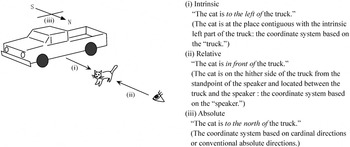
“The cat is _______ the truck.”
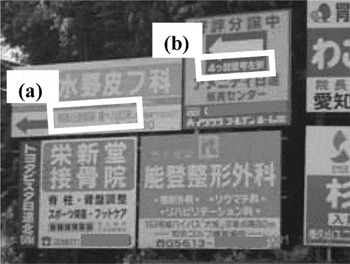
Wayfinding signboards and spatial expressions.
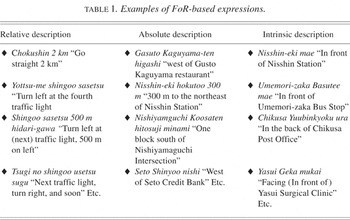
Examples of FoR-based expressions.
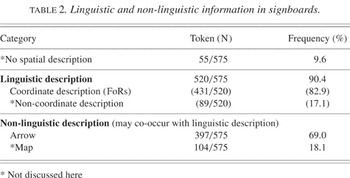
Linguistic and non-linguistic information in signboards.
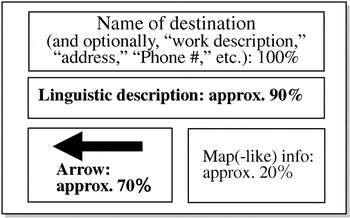
A canonical distribution of linguistic/non-linguistic information.
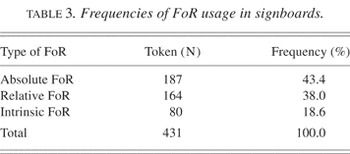
Frequencies of FoR usage in signboards.
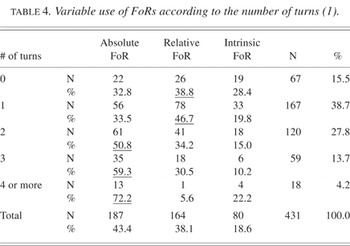
Variable use of FoRs according to the number of turns (1).
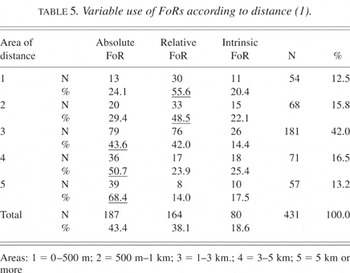
Variable use of FoRs according to distance (1).
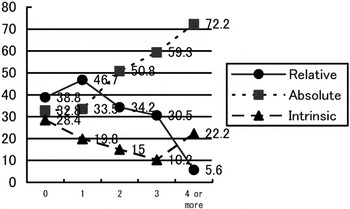
Variable use of FoRs according to the number of turns (2).
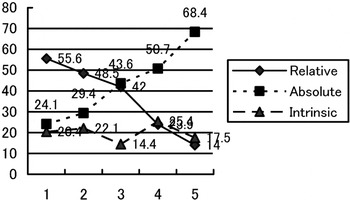
Variable use of FoRs according to distance (2).
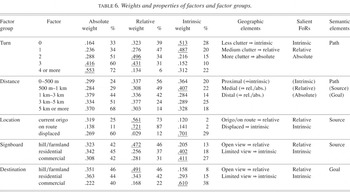
Weights and properties of factors and factor groups.
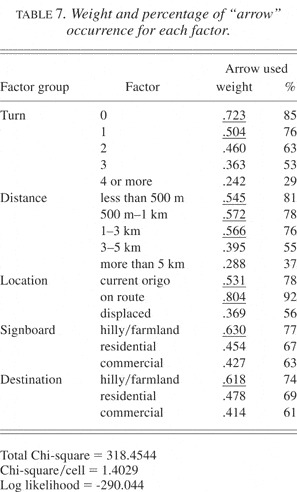
Weight and percentage of “arrow” occurrence for each factor.
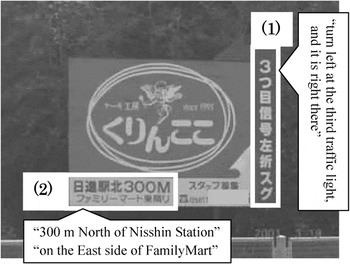
“Co-occurrence” and “sequence” of multiple FoRs.
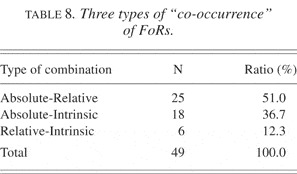
Three types of “co-occurrence” of FoRs.
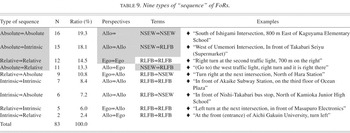
Nine types of “sequence” of FoRs.
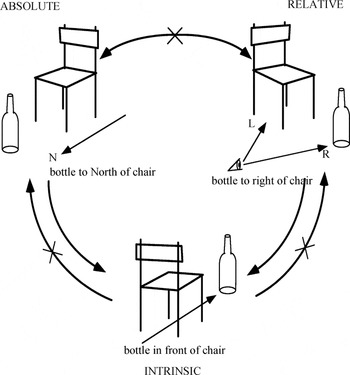
Untranslatability across FoRs (Levinson 1996b).
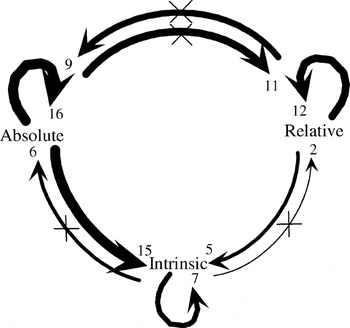
Types of sequence in the (un)translatability format (Total N = 83).
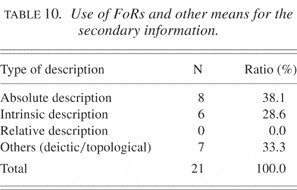
Use of FoRs and other means for the secondary information.
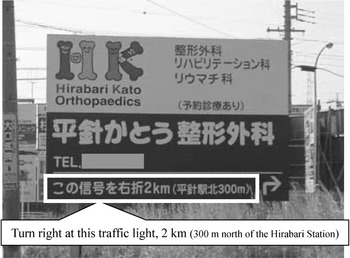
Primary and supplementary FoRs for spatial description.
 You have
Access
- 9
- Cited by