Introduction
Archaeologists increasingly consider colour in their interpretations, not only as a physical attribute tied to provenance or material style, but as a culturally constituted quality imbued with social value and symbolism. Twentieth-century anthropological examination of human colour perception and categorization centred primarily on language or neurophysiology, concluding alternately that it is either arbitrary and dependent on relativistic linguistic elements or universal and determined by cognitive evolution (e.g. Berlin & Kay Reference Berlin and Kay1969; Brown & Lenneberg Reference Brown and Lenneberg1954; Whorf Reference Whorf1956). While this debate continues into this century (e.g. Haynie & Bowern Reference Haynie and Bowern2016; Regier et al. Reference Regier, Kay and Cook2005), archaeologists now often focus on the meaning and materiality of colour as evidenced by the myriad ways people deployed substances of different hues in the past. In terms of lived human experience, colour is perceived through interaction with the material world. Colour meanings are rooted in ontology and practice as human and non-human entities, and their physical qualities, are differentiated and assigned significance. Contemporary archaeological studies highlight the diverse and sometimes complex roles colourful materials played in social relations. Objects of particular colours and aesthetic properties served as central components in mortuary and ritual practices, elite competition and the negotiation of social identity at different scales (e.g. Gage et al. Reference Gage, Jones, Bradley, Barber and Taçon1999; Jones & MacGregor Reference Jones and MacGregor2002; Munson Reference Munson and Hayes-Gilpin2019). These studies also demonstrate that the meanings and uses associated with particular colours are not only culturally specific, but may also be situationally polyvalent within the same general cultural contexts.
One way to conceptualize this variability in colour meaning is to consider how it is relational within gatherings of different objects, settings, and practices. The approaches of assemblage theory (DeLanda Reference DeLanda2006; Reference DeLanda2016) and actor-network theory (Latour Reference Latour2005; Law Reference Law1999; Reference Law and Turner2009; Law & Hassard Reference Law and Hassard1999), both based on Deleuze and Guattari's (Reference Deleuze and Guattari1987) concept of assemblages as impermanent arrangements of heterogeneous entities that perform as a whole, emphasize how the interactions between different components produce ‘new behaviors, new expressions, new actors, and new realities’ (Müller Reference Müller2015, 29; see also Bennett Reference Bennett2010). In these frameworks, an object's significance is principally derived not from its inherent properties, but from its connectivity with, and position relative to, other entities. This relationality does not equate with arbitrariness, however; assemblages have structure, but the diversity of their different components—which may include disparate materials and spatial scales, for example—can make it difficult to identify their modes of organization. Colour agency, the capacity of colour to bring about certain effects, can be conceived of as a product of the relationships between a whole constellation of elements, only a minor portion of which, for instance, might encompass the physical properties of a substance associated with its perceived colour or its original geographical source area.
In the Ancestral Pueblo region of the North American Southwest, the placement of offerings of small colourful objects in architectural contexts was a common practice beginning around 350 ce and continuing at least until the time of European contact (Fig. 1). These collections encompass various conventional material dichotomies (mineral/organic, cultural/natural and local/exotic) and are repeatedly found in circular, semi-subterranean ritual structures known as kivas. Archaeologically recovered kiva offerings are most numerous at the site of Pueblo Bonito in Chaco Canyon, the nucleus of a pre-Hispanic cultural system that extended across the San Juan Basin and larger Four Corners region of the northern US Southwest from the tenth through twelfth centuries ce. Early large-scale excavation projects found that the roof support pillars lining the interiors of many of Pueblo Bonito's kivas contained dedicatory offerings deposited at the time of construction (Judd Reference Judd1954; Reference Judd1964; Pepper Reference Pepper1920). Based on the importance of directionality in traditional Pueblo ritual practice, researchers suggest that the specific contents of these radial offerings may reference significant directions (Heitman Reference Heitman and Beck2007, 262–3; Mills Reference Mills, Walker and Mills2008, 95). In this paper I explore this idea by examining the relationships between the colours of materials represented in individual kiva offerings and directional quadrants (world quarters), prominent topographic features and probable object provenance. The results are compared to kiva deposit orientations at other contemporaneous archaeological sites in the Chaco region and to historic Pueblo colour directional schemes, highlighting continuities in cosmographic citation, ritual depositional practice and the symbolism of kiva architecture in the region over time. I conclude by discussing how we might interpret the significance of the colourful objects in these special caches with respect to their positions within diverse and multi-scalar assemblages, specifically those linking Ancestral Pueblo architecture to cosmology and landscape through social memory.
Ancestral Pueblo region of the northern US Southwest depicting locations of sites and landscape features discussed.

Pueblo and Chacoan directionality
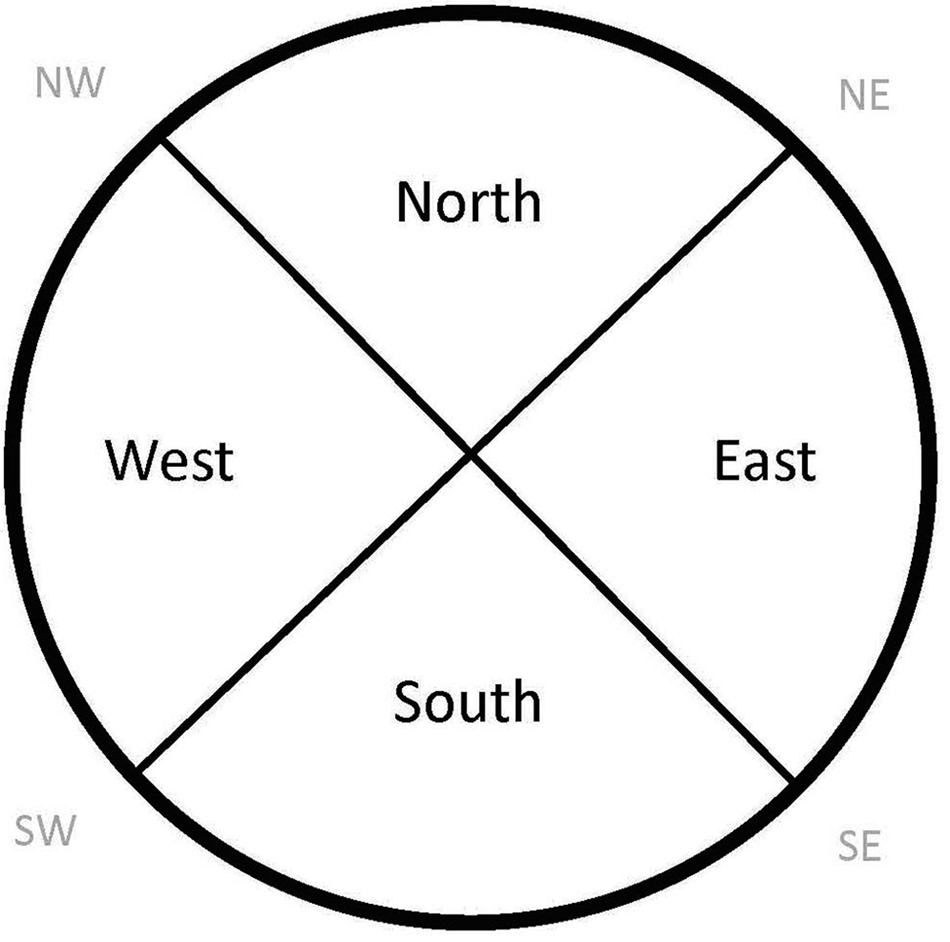
The assignment of specific colours to directions is a common practice in traditional societies around the globe. While these reflect a range of directional colour grouping schemes, those including sets of four are particularly widespread in Asia and the New World (DeBoer Reference DeBoer2005, 69). Native North American colour systems, where recorded, are predominantly quaternary, in that they involve a four-fold division loosely approximated by the commonly recognized cardinal directions. More accurately, however, they correspond to world quarters, the boundaries between which differ from conventional Western cartographic partitions (DeBoer Reference DeBoer2005, 73). When directional quadrants are referenced in modern contexts, it is often with respect to primary intercardinal points (i.e. northwest or southeast). Indigenous American world quarters, on the other hand, typically encompass the cardinal direction that they reference (Fig. 2).
World quarters in relation to intercardinal points.

Although the 20 Pueblo tribes in the US Southwest are linguistically diverse, speaking eight languages and numerous dialects thereof, ethnographic research reveals a broadly shared ontological understanding of the cosmos as senary. In this system, the universe consists of six divisions, including north, south, east and west quadrants/world quarters, as well as a zenith/above and a nadir/below (Ortiz Reference Ortiz1969; Parsons Reference Parsons1939; Swentzell Reference Swentzell, Markovich, Preiser and Sturm1992). Each of these is linked to one of five main colours—white, red, black, yellow and blue-green—plus a multi-coloured category or a lighter or darker version of one of the main colours (Cushing Reference Cushing1979; Dozier Reference Dozier1970; Ford Reference Ford1980; Ortiz Reference Ortiz1969; Stevenson Reference Stevenson1894; Voth Reference Voth1905). These directions are also associated with specific seasons, animals, plants and important substances such as tobacco, water, stones and seashells (Bradfield Reference Bradfield1995; Heitman Reference Heitman2011; Parsons Reference Parsons1939).
It is clear from both the ethnographic literature and information shared by members of modern descendant communities that directionality permeates traditional Pueblo life. As Heitman (Reference Heitman and Beck2007, 256) notes, ‘directional associations orient identities and cultural practice’ at all scales, from individual houses to communities to the larger physical and cosmological landscape (see also Duwe Reference Duwe2011). This includes the orientations of material culture such as architecture, shrines and offerings, but also intangible elements such as prayers, dances, processions, song sequences and ritual narratives. Important to these practices is circuitry—the order in which one proceeds through, addresses, or acknowledges the various directions. Pueblo ritual circuits are based largely on solar movements in relation to centre places, such as kivas, plazas and villages. This includes both the sun's east-to-west path each day and its seasonal course from summer to winter solstice. Much of the traditional ceremonial and agricultural calendar is determined by the rising and setting of the sun at certain places on the horizon as it moves from solstice to solstice, or north to south and back again. The Hopi, for example, still use the sun's position along the eastern and western horizons to indicate proper times to plant and conduct ceremonial processions, respectively (Wadsworth (ch. 9) in Van Dyke & Heitman Reference Van Dyke and Heitman2021).
Given the established ancestral connection between the Pueblos and the pre-Hispanic inhabitants of the northern Southwest and archaeological evidence of some underlying continuities between pre- and post-contact-period ritual architecture and practice, it is probable that the past residents of the region shared some of these general ideas related to directionality (Van Dyke Reference Vivan2007a; Reference Van Dyke, Walker and Venzor2011a). Of anywhere in the Ancestral Pueblo world, attention to directional alignment is perhaps most exemplified in the architecture of Chaco Canyon (Lekson Reference Lekson1999).
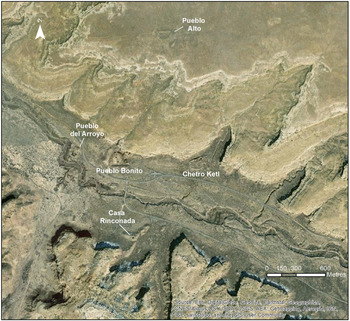
Chaco Canyon, located in northwestern New Mexico, lies at the centre of an Ancestral Pueblo regional network encompassing 100,000 sq. km, at least 230 large Chacoan-style masonry structures (great houses), and hundreds of pre-Hispanic road segments (Kantner Reference Kantner2003; Kantner & Mahoney Reference Kantner and Mahoney2000; Marshall et al. Reference Marshall, Stein, Loose and Novotny1979; Powers et al. Reference Powers, Gillespie and Lekson1983; Reed Reference Reed2008; Roney Reference Roney and Doyel1992; Vivian Reference Vivan1997a,Reference Vivianb) (Fig. 3). The first distinctive architectural elements of the system coalesced in the canyon at the beginning of the tenth century ce and reached their greatest areal extent by the early twelfth century ce. The canyon itself contains 15 great houses, the largest of which is Pueblo Bonito. This massive structure once stood three to four storeys in height and included an estimated 650 rooms. In addition to its sheer size, the presence of two elite mortuary crypts, caches of unique ritual objects, and goods imported from across the North American Southwest and Mesoamerica indicate that Pueblo Bonito served as a cultural and ceremonial hub for its surrounding region (Crown Reference Crown2016; Heitman & Plog Reference Heitman and Plog2015; Lekson Reference Lekson1999; Reference Lekson2006; Neitzel Reference Neitzel2003).
Central or ‘downtown’ Chaco Canyon showing sites discussed. (Sources: Esri, DigitalGlobe, GeoEye, i-cubed, USDA FSA, USGS, AEX, Getmapping, Aerogrid, IGN, IGP, swisstopo, and the GIS User Community.)

Beginning in the 1970s, researchers noted alignments and patterns in the spatial distribution of structures in the canyon (e.g. Fritz Reference Fritz, Redman, Berman, Curtin, Langhorne, Versaggi and Wanser1978). Sofaer (Reference Sofaer and Lekson2007) documented alignments between great houses and solar events, in addition to the ‘Sun Dagger’ petroglyph on Fajada Butte that marks solstices, equinoxes and lunar standstills (Sofaer & Sinclair Reference Sofaer, Sinclair, Carlson and Judge1987). Pueblo Bonito itself is oriented along cardinal axes, with its exterior south/front wall extending east–west and aligned with sunset at the autumn equinox and its conspicuous interior dividing wall running north–south (Farmer Reference Farmer and Neitzel2003; Malville & Munro Reference Malville, Munro and Ruggles2015; Munro & Malville Reference Munro and Malville2011; Williamson Reference Williamson, Carlson and Judge1987). The pueblos in the canyon also appear to be arranged in relation to each other along directional axes, reflecting a sacred geometry incorporating roads, ceremonial structures and prominent natural features (Lekson Reference Lekson1999; Marshall Reference Marshall, Morrow and Price1997; Sofaer Reference Sofaer and Lekson2007; Stein & Lekson Reference Stein, Lekson and Doyel1992; Van Dyke Reference Van Dyke2007a; Reference Van Dyke2009). In her examination of Chacoan ritual landscapes, Van Dyke (Reference Van Dyke, Walker and Venzor2011a, 31–2) suggests that Chaco Canyon was viewed as a centre place, a convergence of ‘geographic opposites’ in the San Juan Basin and an intersection of important directions in a senary universe (Van Dyke Reference Van Dyke2007a; see also Doxtater Reference Doxtater2002; Marshall Reference Marshall, Morrow and Price1997).
Pueblo Bonito's court kivas
Pueblo Bonito contains 35 kivas, more than any other Chacoan great house. In the northern US Southwest, the kiva form—semi-subterranean and generally circular in shape prior to 1300 ce—has deep historical roots. Between 6500 bce and 700 ce, before the widespread appearance of above-ground residential architecture, people in the region typically lived in ovoid-to-circular pit structures. These features increased in formality over time and sometimes included offerings placed beneath floors or in wall niches, storage bins and ventilator tunnels. After residential occupation shifted to above-ground pueblos in the central and southern San Juan Basin, pit structures became the focus of ceremonial activities, perhaps due to their connection with ancestral times.Footnote 1 In Pueblo origin stories, humans emerged from underground through a series of vertically stacked worlds. It is tempting to interpret kivas as symbolically representative of both an earlier architectural form and this aspect of traditional history. Southwestern archaeologists often consider the number, size and spatial distribution of kivas in their interpretations of past social organization. Among the Pueblos, individual kivas are associated with defined social segments, either kin-based clans or ritual sodalities. These groups possess varying degrees of political authority and ritual responsibility, depending on the specific tribe. The extent to which these post-Spanish contact organizational structures can be applied to the past is debated, particularly in light of evidence that Chacoan society involved a greater degree of social stratification and political centralization than documented for the relatively egalitarian Pueblos (Lekson Reference Lekson2018; Ware Reference Ware2014).
Although the basic kiva form is found throughout the Ancestral Pueblo region, specific architectural elements vary by geographic location. Chacoan kivas are divided into three categories—great kivas, court kivas and roomblock kivas. Great kivas are the largest (10–20 m in diameter) and could have accommodated the most ritual participants. Estimates of audience capacity for circular, roofed great kivas of this size range up to 250 people, though 63 to 189 is more likely (Dungan & Peeples Reference Dungan and Peeples2018, 19; Van Dyke Reference Van Dyke and Lekson2007b, 119). Great house communities generally have only one or two great kivas, suggesting that they served as locales of communal or large-scale ceremonial activity. Great kivas in Chaco had roofing structures supported by four massive timber posts and contain a distinctive set of intramural features not present in smaller kivas (Lekson Reference Lekson1986; Vivian & Reiter Reference Vivian and Reiter1960). These include an interior bench probably used for seating, two raised masonry vaults flanking an off-centre hearth/firebox and small wall niches containing offerings. Some of the great kivas in the canyon appear to be aligned to solar events, such that roof and wall openings channel light into the interior of the structures in distinctive ways, particularly during summer solstice (Farmer Reference Farmer and Neitzel2003; Swentzell Reference Swentzell, Markovich, Preiser and Sturm1992; Williamson Reference Williamson, Carlson and Judge1987; Zeilik Reference Zeilik, Carlson and Judge1987). For example, in his study of the largest Chacoan great kiva, Casa Rinconada, Farmer (Reference Farmer and Neitzel2003, 69) describes an imagined scene at noon on summer solstice in which a ‘priest standing at the kiva's center, immediately north of the firebox, would have been spotlighted by the most sacred and dramatic sunlight at a most sacred time of the year.’
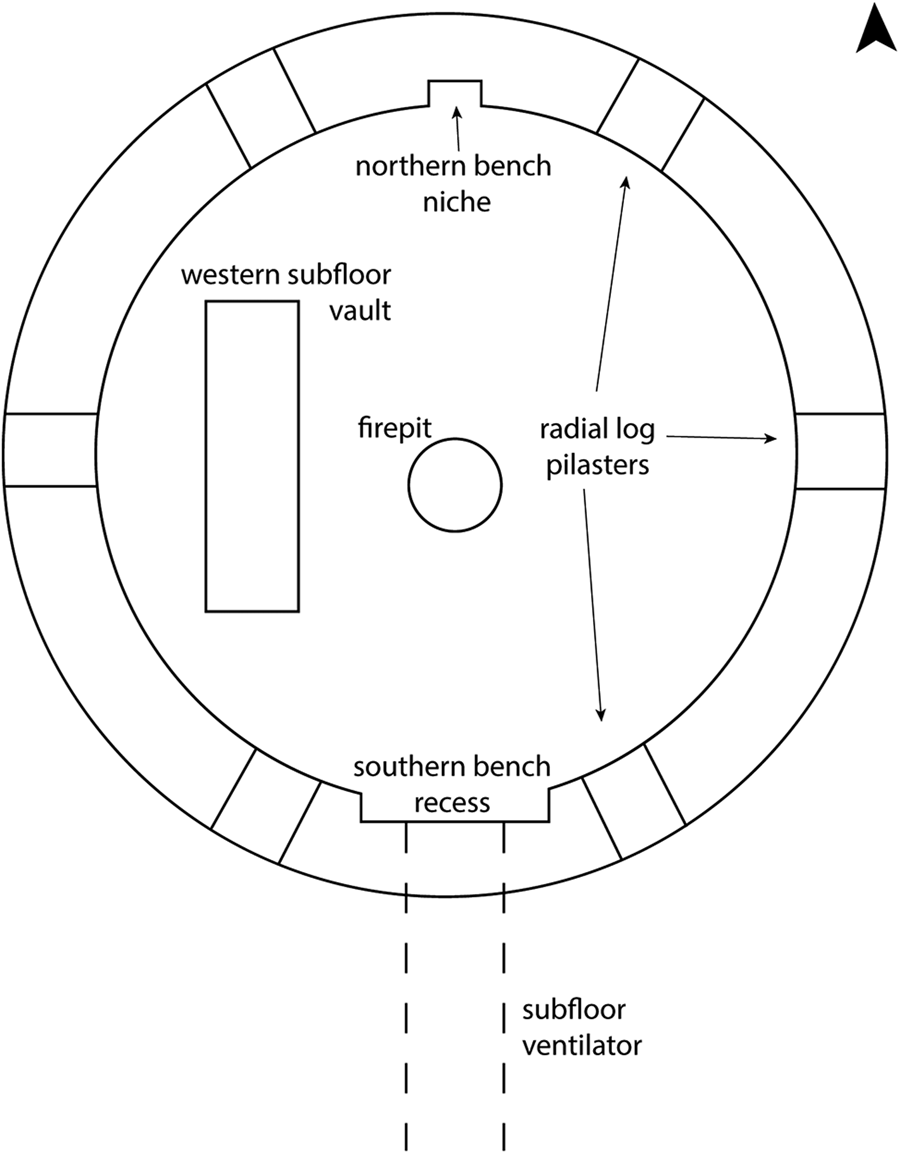
Court kivas and roomblock kivas are much smaller (4–8 m in diameter), located either in enclosed plazas or surrounded by pueblo rooms within construction units, and are more numerous at Chacoan great houses than great kivas. Of Pueblo Bonito's 35 kivas, nearly 80 per cent (27 kivas) share a suite of specific architectural traits defining what have been termed ‘court’ kivas (Windes Reference Windes2014). These features include: 1) low masonry roof-support pillars, known as radial-log pilasters, constructed on top of an interior masonry bench; 2) a ventilator tunnel located under the southern kiva wall; 3) a prominent recess in the bench along the southern portion of the structure; 4) a circular firepit in the central or south-central portion of the floor; and 5) a rectangular sub-floor vault to the west of the firepit (Fig. 4). Many court kivas also have a niche or small recess in the northern section of their benches. Roomblock kivas are defined by both their small sizes and a lack of these distinctive interior features.
Major interior features in Pueblo Bonito's court kivas.

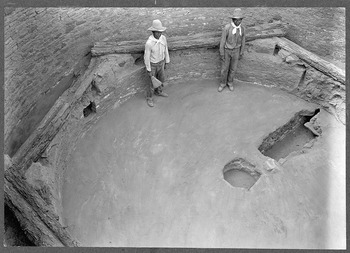
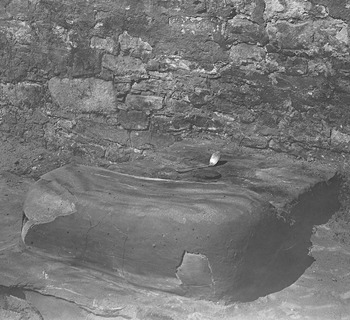
Pilasters served as supports for the lower portions of cribbed-log roofs, domed superstructures comprised of 150 to 300 imported timbers stacked in courses (Judd Reference Judd1954; Reference Judd1964; Windes Reference Windes2014, 349; but see Lekson Reference Lekson1986) (Fig. 5). The pilasters are equally spaced around the perimeter of each kiva and occur only in even numbers (6, 8 or 10), with six being the most common at Pueblo Bonito. At the core of each kiva pilaster is a shortened portion of a log oriented parallel to the bench surface (hence ‘radial log’); these logs are encased in sandstone masonry, the whole of which is covered in plaster (Fig. 6). Most kiva pilasters at the site contain offerings placed in small, adobe-capped cavities in the top of the radial logs (Judd Reference Judd1954; Reference Judd1964; Pepper Reference Pepper1920). The inaccessible positions of these assemblages indicate deposition during construction, suggesting they served as dedicatory offerings.
Lower portion of cribbed roof resting on radial log pilasters in Kiva L, Pueblo Bonito. (National Anthropological Archives, Smithsonian Institution, Negative No. 23222-A. Photograph by O.C. Havens, 1923.)

Radial log pilaster in Kiva C, Pueblo Bonito. Note plaster exterior and wooden repository cover next to spoon. (National Anthropological Archives, Smithsonian Institution, Negative No. 11897-A. Photograph by O.C. Havens, 1921.)

While great kivas in the canyon also include offerings, they are generally less numerous than those recovered from court kivas (with a few notable exceptions, such as the great kivas at Chetro KetlFootnote 2). Early excavators noted deposits of objects placed in benches, under/between floors and within vaults, but it appears that wall niches were the standard receptacles for great kiva offerings. Unlike court kiva pilaster offerings, which could not be manipulated without dismantling overlying cribbed roofs, great kiva niches remained relatively accessible throughout the use of a structure. Mills (Reference Mills, Walker and Mills2008, 88–9) notes that the wall niches in Chetro Ketl's Great Kiva II, while sealed with masonry and plaster, are constructed as if intended to remain open. Even sealed in this manner, they could be reopened during repeated episodes of deposition without compromising the structural integrity of the kiva as a whole.
The only offerings found in Pueblo Bonito's two excavated great kivas (Kivas A and Q) include an intact deposit in a wall recess of Kiva Q and objects consistent with those found in ritual deposits scattered across the floors of both structures. Archaeological evidence points to the intentional destruction of Kiva A that included the dismantling of its roof and the removal of the contents of Kiva Q's niche offerings sometime prior to the post-occupational infilling of the structure (Judd Reference Judd1964, 207). Therefore, this study focuses only on the court kivas at the site. The Bonitians’ strict adherence to the court kiva configuration, the cardinal orientation of the ventilator-bench recess-firepit complex, the even distribution of pilasters around the perimeter of these circular structures and the routine inclusion of offerings containing materials of multiple colours make these assemblages an ideal case study for examining Chacoan concepts of directionality and colour.
Kiva pilaster orientation
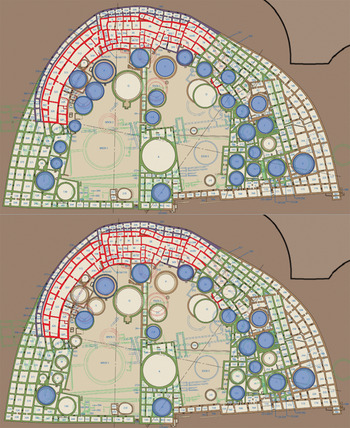
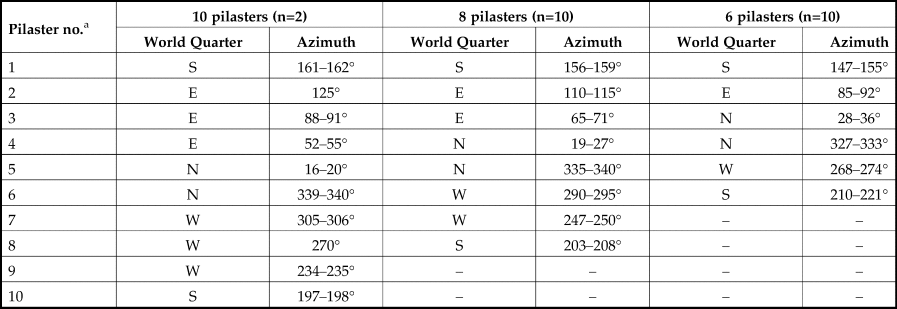
Two large archaeological projects under the direction of the American Museum of Natural History (AMNH) and the Smithsonian Institution, respectively, excavated the majority of Pueblo Bonito between the late 1890s and the 1920s (Judd Reference Judd1954; Reference Judd1964; Pepper Reference Pepper1920). Fortunately for this study, both projects generally assigned unique numbers to pilasters within each kiva. Although pilaster numbers are not denoted on published figures in the excavation monographs produced by either project, I reassociated most of the pilaster numbers with their positions within structures using field sketches and historic photographs when necessary. In all, I determined the orientations of 140 pilasters in 21 court kivas with reference to both azimuth directions (degrees) and directional quadrants corresponding to world quarters (Fig. 7; Table 1).
All court kivas in Pueblo Bonito (top) and those with both identifiable pilaster orientations and pilaster offerings (bottom), shaded. (Base image from the Chaco Research Archives.)

Summary of Pueblo Bonito court kiva pilaster orientations by world quarter (directional quadrant) and azimuth (measured to the nearest compass degree).

aNumbered anti-clockwise, starting with the first pilaster east of the southern wall recess.
The ventilator tunnels and bench recesses of Pueblo Bonito's court kivas cluster around south, varying in orientation from south-southeast to south-southwest (mean and median deviations from due south are 6° and 4°, respectively). Combined with the strong north–south orientation of Pueblo Bonito itself and the patterned spatial layout of kiva features in relation to the ventilator's position, it appears that court kivas are structured relative to a north–south axis, despite slight disparities relative to a true south compass bearing. Therefore, in these analyses, pilaster orientations are measured relative to the spatial arrangement of architectural features of the kivas themselves—namely, with the ventilator positioned in the middle of the southern directional quadrant/world quarter. Using this method, pilaster arrangements are exceptionally uniform, with individual pilaster bearings varying an average of only 2.5° from one another across all court kivas; six-, eight- and ten-pilaster configurations have mean standard deviations of 4.24°, 2.08° and 1.06°, respectively. Thus, the more pilasters a kiva contains, the less variation there is in their spatial configuration.
Colour and world quarters
Of the 140 kiva pilasters at Pueblo Bonito with discernible directional orientations, offerings from 90 pilasters (representing 17 different court kivas) are curated at AMNH and the Smithsonian National Museum of Natural History [NMNH] (Fig. 7). In total, these offerings include 10,177 individual objects. Between 2008 and 2014, I analysed and photographed these materials as part of a larger National Science Foundation-funded research project on Pueblo Bonito's ornaments and minerals (Mattson Reference Mattson2016a). Legacy collections such as these, curated for more than a century, present unique challenges to detailed analyses. In the case of material from Pueblo Bonito, researchers must navigate inconsistencies in collection methods and large variations in the level of detail provided in written descriptions and depicted on maps and drawings, both between and within projects. The material from the site is housed in multiple museums, and in some instances artefacts were transferred between them with little accompanying documentation. Each museum also applied different collection management strategies to this material, which varied uniquely over their respective institutional histories. Reconciling discrepancies between curated objects and original narrative descriptions and inventories associated with specific rooms or features can be maddening. Yet despite these issues, the site's early investigators clearly recognized the importance of pilaster offerings and generally took care to collect what appear to be the entirety of repository contents, including even ‘mundane’ items such as seed husks and lithic debitage that were typically not retained from other portions of the site. Importantly, the majority of objects from pilaster offerings in the museum collections also retain their links with the original pilaster feature numbers.
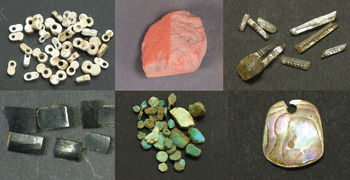
Although the specific contents of individual court kiva pilaster offerings are unique, the same general materials and forms occur repeatedly (Heitman Reference Heitman2011; Mattson Reference Mattson2016a; Mills Reference Mills, Walker and Mills2008). The most commonly represented materials are turquoise, marine shell, jet, shale and mineral pigments. Other objects that appear occasionally include galena, gypsum and selenite, quartz crystals, lithic debitage, raptor or carnivore claws and teeth, worked bird bone, feathers and fossils. Turquoise, marine shell, jet and shale appear most often as either finished or broken personal ornaments such as beads and mosaic tesserae, or as the debris from lapidary production. For this analysis, these materials are categorized into basic colour groups—white, red, black, blue-green and yellow—in addition to multi-coloured/iridescent and translucent (Table 2; Fig. 8). The boundaries between these categories are admittedly subjective and informed by my own particular cultural context and worldview. However, they encompass the major colour groups recognized by the Pueblos (and/or the ethnographers gathering this information) as most cosmologically significant. I follow others in combining blue and green into a single category based on the conceptual and linguistic intermixing of the two among historically documented Pueblos and archaeological evidence suggesting these colours are symbolically linked (e.g. Hedquist Reference Hedquist2017; Plog Reference Plog2003). Proportionally, turquoise and marine shell objects dominate court kiva offerings; this is not surprising considering these are the most common materials included in ritual deposits of all kinds across the Ancestral Pueblo world.
Materials found in Pueblo Bonito ritual caches associated with major colour categories. (This list does not include feathers or vegetal materials.)

Objects representing major colour groups at Pueblo Bonito. (Top row, left to right) marine shell bilobe beads (white) (AMNH Cat. No. H/12769); red ochre/iron oxide (red) (AMNH Cat. No. H/3083); quartz crystals (translucent) (NMNH Cat. No. 335535); (bottom row, left to right) jet mosaic tesserae (black) (AMNH Cat. No. H/9288); turquoise flakes and worked pieces (blue-green) (NMNH Cat. No. 340007) and abalone (Haliotis) pendant (multi-coloured) (NMNH Cat. No. 335701). (Courtesy of the Division of Anthropology, American Museum of Natural History and the Department of Anthropology, Smithsonian Institution. Photographs: H. Mattson.)

In terms of colour categories, blue-green objects comprise 55 per cent and white objects 41 per cent of the entire court kiva offering assemblage. This primarily includes turquoise and marine shell, but also the blue-green minerals azurite and malachite and other white materials such as gypsum and bone. The next abundant colour represented is red (2 per cent), including argillite (a red shale); red and pink chert; red, pink and orange shell; haematite; and red ochre. Black materials comprise less than 1 per cent of the assemblage and are represented by jet, grey and black shale, obsidian and galena. Multi-hued items, represented only by those made from Haliotis spp. (abalone) shell, comprise 1 per cent of the assemblage and translucent materials—quartz crystals and selenite—make up 0.7 per cent of the total. It should be noted that most of the individual pilaster offering assemblages contain objects representing two to four different colour categories. When multiple categories are represented, white and blue-green are almost always present; these colours appear to form a base from which items of other colours are added—first red, then multi-coloured, and finally black. This suggests that white and blue-green materials, and turquoise and marine shell specifically, had multiple meanings, a point to which I shall return at the end of my discussion.
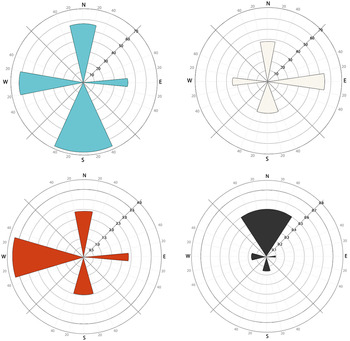
Although objects of several colours appear in most of the offerings, statistically there are significant associations between the relative frequency of artefacts of different colour categories and the directional quadrants of the pilasters in which they are found (χ2 = 255.81, df = 9, p < 0.0001). When examining possible combinations of colour and direction using chi-squared tests with a Bonferroni correction (to account for multiple comparisons), the following occur significantly more than expected: south with blue-green (p < 0.0001), east with white (p < 0.001) and west with red (p < 0.01). These associations stand out clearly when charted on directional or rose diagrams, traditionally used to present azimuthal meteorological or geological data (Fig. 9). Black materials occur more in northern pilasters than those of other directions, although this is not statistically significant (p = 0.15). Multi-coloured material (abalone shell) is more frequently found in pilasters within northern (p < 0.10) quadrants, but no significant associations are identified for translucent items due to small sample sizes.
Occurrence of major colours in pilaster offerings by world quarter, clockwise from upper left: blue-green, white, black and red. Concentric circles represent proportion of total offerings in each directional quadrant comprised of objects of that colour (length of ray). Values along perimeter represent proportion of total objects of each colour that occur in pilasters of that directional quadrant (thickness of ray).

Colour and landscape
As another layer of directional citation, pilaster offerings may reference specific physical features on the Chacoan landscape, such as important landforms and raw material sources. Prominent mountains, mesas and other geologic formations are ingrained in Pueblo oral history as cultural and cosmographic boundary markers and places associated with specific events and characters, migration histories and ceremonial practices. Landforms within and surrounding the San Juan Basin considered sacred in various Pueblo traditions include Shiprock, Huerfano Mesa, the Nacimiento Mountains, the Jemez Mountains, Mount Taylor, the Zuni Mountains, Hosta Butte, Cabezon Peak and the Chuska Mountains, among others (Van Dyke Reference Van Dyke2007a, 14–15, 241; see also Marshall Reference Marshall, Morrow and Price1997; Ortiz Reference Ortiz1969) (Fig. 1). While the relationship of certain great houses to celestial cycles receives the most public attention, the alignment of pueblos and shrines to one another and to conspicuous physical features is actually more typical of Chacoan architectural practice (e.g. Doxtater Reference Doxtater2002; Hayes & Windes Reference Hayes, Windes and Frisbie1975; Van Dyke Reference Van Dyke, Mills and Fowles2017). As noted by Van Dyke (Reference Van Dyke2007a, 91–7; Reference Van Dyke, Walker and Venzor2011a, 24; Reference Van Dyke, Nelson and Strawhacker2011b, 410), most great houses constructed before 1040 ce, including those in outlying communities, have a line of sight to a major landform. After this time, there appears to be an emphasis on great houses themselves as prominent visual markers on the landscape and intervisibility between them; shrines and roads become important components of this visual network, linking different communities to one another and to important landforms (Van Dyke Reference Van Dyke2007a, 184–90, 220–24; Reference Van Dyke, Walker and Venzor2011a, 25; Van Dyke et al. Reference Van Dyke, Bocinsky, Windes and Robinson2016).
Of all documented pilaster orientations represented in Pueblo Bonito's court kivas, south-southeast and west are associated with the most objects, accounting for 27 per cent and 15 per cent of all pilaster offering items, respectively. Blue-green materials are particularly concentrated in south-southeast-oriented pilasters (bearings ranging from 147° to 162°, with a mean of 154°); in fact, over a third of all blue-green materials recovered from pilasters are from those with south-southeast orientations (the first pilaster to the east of the southern bench recess). South-southeast-oriented kiva pilasters contain almost four times the amount of turquoise recovered from east, south, southeast and east-southeast-oriented pilasters combined, suggesting the purposeful emphasis of this specific direction during construction. This pattern could be connected to an older Ancestral Pueblo tradition in the San Juan Basin of acknowledging this direction through architecture, beginning with sixth-century ce pithouses (Hayes Reference Hayes, Hayes, Brugge and Judge1981; Munro & Malville Reference Munro and Malville2011). Five of the seven great houses founded in the late ninth and tenth centuries ce in the canyon have south-southeast orientations, including Pueblo Bonito during an earlier stage of construction (with a front-facing orientation of 161°). New construction in the canyon in the eleventh and early twelfth centuries ce shifted towards cardinal orientations. At Pueblo Bonito, a series of construction stages occurring between 1050 and 1115 ce (Stein et al. Reference Stein, Ford, Friedman and Neitzel2003) completely reoriented the structure.
This south-southeast directional veneration, first through pueblo layout and then in ritual deposition, could be linked to the position of Mt Taylor (3446 m above mean sea level: amsl), a dormant volcano and the highest peak south of Chaco Canyon. Mt Taylor is located south-southeast of much of the central Basin and 161° from Pueblo Bonito, the same orientation as the structure when it was founded. In Hopi narratives, Mt Taylor is the home of the creator deity Spider Woman, who in some clan stories had a kiva with turquoise and shell beads in the walls (James Reference James1974). Spider Woman is also a creator deity in Keres tradition, and the first humans she created taught the rest of the people that turquoise was a sacred substance (Stirling Reference Stirling1942). Acoma and Laguna Pueblos associate Mt Taylor with the direction west, which is linked to blue-green in their colour directional systems, and it is also viewed as the home of the katsinas (venerated spiritual beings) (Duwe Reference Duwe2011, 125). In the Navajo worldview, Mt Taylor is one of four sacred peaks and is associated with the direction south (it is located south of the Dinétah, the Navajo traditional homeland) and the colour blue-green. The Navajo word for the peak is Tsoodził, which means blue bead or turquoise mountain.
Kiva pilasters at Pueblo Bonito oriented to the west (with measured bearings ranging from 269° to 280°) also contain a large number of blue-green materials, as do those oriented to the northwest (305° to 326°). These directional bearings are consistent with the locations of the Chuska Mountains and Shiprock from Chaco Canyon. The Chuska Mountains (2700 m or 9000 ft amsl) are a linear uplift located to the west of the canyon; their southern and northern termini are located at bearings of 260° and 287° from Pueblo Bonito, respectively. They were an important source of lithic raw material, and communities in the Chuska area produced a significant amount of pottery used by Pueblo Bonito's residents (Cameron Reference Cameron2001; Crown et al. Reference Crown, Marden and Mattson2016; King Reference King2003). Shiprock, located to the northwest at a bearing of 313° from Pueblo Bonito, is a dramatic volcanic landform projecting 482 m above its surrounding area. It is visible from both the northern and southern portions of the San Juan Basin and, in the context of population movements between these two regions, perhaps served to ‘anchor identities across time and space in multiple, overlapping ways’ (Van Dyke Reference Van Dyke, Nelson and Strawhacker2011b, 415–16; see also Windes & Van Dyke Reference Windes, Wilshusen, Schachner and Allison2012, 99).
Non-local materials are concentrated in Chaco's great houses, particularly in Pueblo Bonito. Turquoise and marine shell are the main imported materials in the kiva offering sample, though small numbers of obsidian and non-local chert are also present. Chacoans probably acquired these materials through trade, requiring relationships with other communities on the Colorado Plateau and across the greater Southwest. Various provenance studies of turquoise objects from the canyon conclude that the mineral was imported from a variety of sources in the Southwest, ranging from the Cerrillos Hills located 185 km to the east near Santa Fe to mines in Nevada located up to 900 km to the northwest (Hull et al. Reference Hull, Fayek, Mathien, Shelley and Durand2008; Reference Hull, Fayek, Mathien and Roberts2014; Thibodeau et al. Reference Thibodeau, Killick, Hedquist, Chesney and Ruiz2015). A 2014 study using hydrogen and copper isotopes included 29 turquoise objects from Pueblo Bonito, none of which are from kiva deposits specifically (Hull et al. Reference Hull, Fayek, Mathien and Roberts2014). The researchers identified five different geological source areas represented, with the majority of artefacts linked to sources to the west (50 per cent) and east (44 per cent) of the canyon (Hull et al. Reference Hull, Fayek, Mathien and Roberts2014, table 2). An earlier study, using the same method, tested turquoise artefacts from smaller sites in the canyon (Hull & Fayek Reference Hull, Fayek, King, Cartwright, McEwan and Stacey2012). The results are similar, with over half (63 per cent) of the objects linked to turquoise sources to the west. That only one turquoise object from the Pueblo Bonito sample traces back to a southern source suggests that the predominance of turquoise in southern quadrant and south-southeast pilasters is not related to source area. Although turquoise items are also numerous in western and northwestern pilasters, far fewer than expected occur in eastern pilasters even though eastern turquoise sources are significantly represented at Pueblo Bonito. Of course, this may not be an issue of quantity; until the isotopic composition of turquoise objects from pilaster offerings is analysed, the spatial distribution of individual artefacts in relation to original source areas cannot be fully examined.
Marine shell is even more exotic to the canyon, with the nearest coast located 700 km to the southwest. The main mollusc genera represented in the kiva offering assemblage include Olivella, Spondylus and Glycymeris from the Gulf of California and Haliotis from the southern California Pacific coast. While similar to turquoise in that it occurs in almost every pilaster offering, marine shell is particularly associated with the eastern world quarter. The closest coast east of Chaco Canyon is the Gulf of Mexico, and yet no species from that body of water are represented in the material culture of Pueblo Bonito or of other Chacoan sites.
In addition to turquoise and shell, other non-local materials important to Pueblo Bonito's residents include pink Narbona (or Washington Pass) chert from the Chuska Mountains 80 to 100 km to the west of the canyon and obsidian originating in three different areas—the Jemez Mountains 140 km to the east-southeast, Mt Taylor 110 km to the south-southeast and the Red Hill area located 260 km to the south-southwest. The offering assemblage in this study includes just one piece of obsidian, recovered from a north-northeast-oriented pilaster, and two pieces of Narbona pass chert, both from a north-northwest-oriented pilaster. Overall, it does not appear that the Bonitians distributed their offerings according to the direction from which the materials originally derived.
Other Chacoan court kivas
Of 52 excavated or partially excavated court kivas at Chaco Canyon, 27 are from Pueblo Bonito and 25 are from eight other sites.Footnote 3 Of these non-Bonito court kivas, only two—one at Pueblo del Arroyo and one at Pueblo Alto—had intact pilaster offerings. Many others probably included offerings at one time, but architectural remodelling activities either removed their pilasters entirely or exposed offering repositories to emptying or looting after dismantling of roof structures prehistorically (Judd Reference Judd1959). Pueblo del Arroyo's Kiva C, constructed in 1064 ce, has an eight-pilaster configuration and contains a total of 442 objects in radial offerings (Judd Reference Judd1959, 61–2; Mills Reference Mills, Walker and Mills2008, 97). Similar to Pueblo Bonito's court kivas, blue-green materials (all turquoise) are found in the highest frequencies in the southern world quarter, particularly the south-southwest-oriented pilaster, which contains 74 per cent of all the turquoise from the structure's offerings. Turquoise artefacts are also slightly more numerous in pilasters with northwest orientations. White objects, while present in all but one of the eight pilasters, occur in significantly greater quantities than expected in the pilasters associated with the eastern and northern world quarters (χ2 = 61.41, df = 3, p < 0.01). During the National Park Service investigation at Pueblo Alto (1020–1130 ce), located just north of Pueblo Bonito, a test trench placed through a court kiva (Kiva 3) revealed a pilaster offering comprised of 52 turquoise pieces and four gypsite items—two beads and two pendants (Mathien Reference Mathien, Mathien and Windes1987, 421; Windes Reference Windes1987, 404). Based on the placement of the trench, the pilaster is located in the eastern world quarter of the kiva. The significance of this assemblage in relation to the other pilaster offerings cannot be assessed, however, as the rest of the structure remains unexcavated.
Outside Chaco Canyon, Chaco-style court kivas are found at numerous outlying great houses (Windes Reference Windes2014, table 2). Of these, intact pilaster offerings occur at the sites of Aztec West Ruin, Ida Jean and Chimney Rock. Aztec West Ruin, located 110 km north of the canyon, is the largest outlying Chacoan great house and contains five kivas meeting the court kiva criteria. Early excavators found pilaster offerings in one of these, Kiva L, a Chaco-style structure with a construction date of 1098 ce, placing it at the height of the Chacoan system (Brown et al. Reference Brown, Windes, McKenna and Reed2008, 237–8; Morris Reference Morris1928). The kiva includes 10 pilasters, nine of which are recorded as containing offerings totalling 106 objects. The assemblage in each pilaster consists of white shell beads, one or more pink shell or shale worked disks, one shell bracelet fragment (white) and pieces of turquoise; some of the pilasters also contain pieces of abalone shell. No material or colour is significantly associated with any particular directional quarter or individual pilaster bearing. However, the specific types of objects included in kiva offerings is similar to those found at Pueblo Bonito, particularly Olivella shell beads and shell bilobe beads (Mattson Reference Mattson2016a). Information on the contents of offerings in relation to pilaster orientation is unfortunately scarce for the two northern outlying great houses of Ida Jean and Chimney Rock, located 158 km to the northwest and 140 km to northeast of Chaco Canyon, respectively. Bone (probably bird) and pendants are described as included in the pilaster offerings in Ida Jean's Kiva A (1078 ce), and a turquoise pendant and turquoise pieces (presumably lapidary debris) are noted in pilaster offerings in Chimney Rock's West Kiva (1076–1090s ce) (Brisbin & Brisbin Reference Brisbin and Brisbin1975; Jeançon & Roberts Reference Jeançon and Roberts1923–24; T. Windes pers. comm., 27 February 2020). Given the small number of excavated Chacoan court kivas, it is difficult to say if those residing in other canyon communities or at other sites in the larger Chacoan network shared the same colour directional associations reflected in Pueblo Bonito's kivas.
Discussion
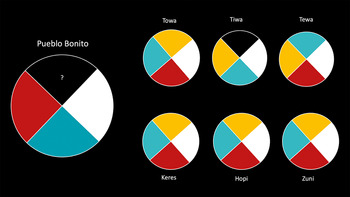
How do the patterns identified at Pueblo Bonito compare to the colour directional schemes documented for the historic Pueblos, and what implications might this have for our understanding of Chacoan cosmology and ritual practice? The ethnographic literature consistently reports an association between the colour white and east among all the Pueblos (Dozier Reference Dozier1970; Holeman Reference Holeman2013; Parsons Reference Parsons1939) (Fig. 10). Zuni, Hopi, Keres and Towa-speaking Pueblos share a colour directional system consisting of white/east, red/south, blue-green/west and yellow/north combinations. Where recorded, links between directions and specific substances among these groups include east with white stone or shell, south with pink stone or shell, west with turquoise and north with yellow stone (Holeman Reference Holeman, Arbuckle and McCarty2014, table 6.1). Tewa-speakers share white/east and red/south associations, but assign blue-green to north and yellow to west (Ford Reference Ford1980, 20; Ortiz Reference Ortiz1969, 19). The Tiwa-speaking Pueblos depart the most from the others, with a system that includes white/east, blue-green/south, yellow/west and black/north. Pueblo Bonito's directional scheme, at least as materialized in court kiva offerings, both partially resembles and diverges from all of these. Of interest is the consistent presence of yellow in all the historic Pueblo quaternary colour systems, but its paucity in Pueblo Bonito's directional offerings. The only yellow materials found in a pilaster context are from one partially excavated court kiva (Kiva S); because of the incomplete nature of that assemblage, and the inability to reconstruct original pilaster orientations, it is not included in the larger sample. Yellow pigment in the form of limonite and yellow ochre is generally present at the site, however, both as raw material and residue on ground stone palettes. It is also found in a range of contexts, from domestic refuse to deposits associated with burials and ritual storage areas. This suggests that yellow was socially meaningful, but perhaps its value is not as enmeshed in directional or georitual citation as other colourful materials.
Directional colour schemes documented for the historic Pueblos compared to that suggested for Pueblo Bonito.

Diversity and shared ritual practice
Biological studies using cranial morphometric, dental trait and mitochondrial DNA data reach conflicting conclusions regarding the relatedness of Chaco Canyon's residents to specific late pre-Hispanic and early historic Pueblo communities (1300–1800 ce). Some argue that the interred individuals at Pueblo Bonito are more affiliated with ancestral Tewa, ancestral Zuni, Keres and/or historic Hopi populations (e.g. Corruccini Reference Corruccini1972; El-Najjar Reference El-Najjar1978; Kennet et al. Reference Kennett, Plog and George2017; Schillaci Reference Schillaci2003; Schillaci & Stojanowski Reference Schillaci and Stojanowski2003), while others find major differences with these groups (Snow & LeBlanc Reference Snow, Leblanc, Heitman and Plog2015).Footnote 4 What bioarchaeological research seems to agree on is the presence of significant genetic variability both within Pueblo Bonito and in Chaco Canyon more generally. This is supported by recent studies of perishable material remains from Pueblo Bonito, which identify a range of learning traditions related to basket, sandal and woven mat construction (Bellorado Reference Bellorado2020; Jolie Reference Jolie2018; Jolie & Webster Reference Jolie, Webster, Heitman and Plog2015). It is also consistent with Pueblo oral histories, in which Chaco Canyon is widely understood as a place where many different clans converged and lived for a time before continuing on their separate migration journeys (e.g. Kuwanwisiwma Reference Kuwanwisiwma and Noble2004, 44–5; Ladd in Sofaer Reference Sofaer1999; Swentzell Reference Swentzell and Noble2004, 51; see also Outah (ch. 9), Seowtewa, Haskie & Quam (ch. 10) in Van Dyke & Heitman Reference Van Dyke and Heitman2021).
If Pueblo Bonito was a diverse community, how do we explain the uniformity apparent in other aspects of material culture and practice—such as architecture and ritual deposition—that imply a shared social identity and worldview? As demonstrated by biological anthropological research, language and genetic structure can depart significantly from one another, as they do across Indigenous populations in North America (e.g. Hunley & Long Reference Hunley and Long2005). Similarly, material practice can also diverge from linguistic and genetic arrangements. This is certainly the case in the northern Southwest, where significant consistencies in Pueblo religion and ritual practice span major linguistic differences and episodes of population reorganization. Degree of interaction and geographical proximity, not just linguistic or historical affiliation, appear to be important conditioning factors in the spatial distribution of Pueblo social and ceremonial organizational structures (Ware Reference Ware2014). In the case of Chaco, it appears that groups with different migrational histories coalesced in the canyon and the surrounding area, becoming a ‘community of communities’ (Toll Reference Toll2001, 63) over the course of several centuries through intermarriage, intensive exchange and participation in a shared ceremonial-ideological complex associated with prescribed architectural and ritual depositional conventions.
Kiva architecture and Pueblo cosmography
While the resemblance between the colour directional patterns in Pueblo Bonito's court kivas and those of post-contact Pueblos may or may not be significant in terms of specific genetic or historical affinity, it indicates the endurance of an ontology in the region that continued for at least 800–900 years after the end of the Chaco system. This includes a cosmography in which the universe is divided into world quarter directions and related colours (even if those specific associations vary), sacred features of the local landscape and a similar suite of potent substances. Beginning in the fourth century ce and continuing throughout the Ancestral Pueblo and Pueblo temporal sequence, turquoise, red and blue-green pigments and marine shell are consistently found in structured or ritualized archaeological contexts. In these settings, they occur alone or with other objects, as complete or broken finished artefacts and as unworked specimens or the debris from manufacture. In other words, the value of these materials appears to be unaffected by size, form, purity or completeness; this suggests that they possess intrinsic relational properties (Mattson Reference Mattson and Mattson2021; Zedeño Reference Zedeño2008; Reference Zedeño2009). These potencies appear to include powers to sanctify, ensoul and protect structures, individuals and objects with which they are associated (Mills Reference Mills, Walker and Mills2008). When placed in court kiva pilasters, they may symbolically support the elaborate, heavy and expensive cribbed roofs of these special structures.
Indigenous and other anthropological scholars suggest that kiva roofs represent both the sky and an inverted basket in Pueblo worldviews, two concepts linked in Tewa language and cosmology (Lekson Reference Lekson1986; Reference Lekson2007; Ortman Reference Ortman2010; Swentzell Reference Swentzell, Markovich, Preiser and Sturm1992). Ortman (Reference Ortman2010) suggests that Ancestral Pueblo kivas in the Mesa Verde region north of Chaco Canyon are material metaphors for containers, specifically that kiva walls and roofs are analagous to pottery bowls and coiled baskets, respectively. In Tewa, Hopi and Zuni cosmology, the earth is also viewed as a pottery bowl. In this perspective, then, a kiva symbolizes the earth and its cribbed roof represents the sky. If we extend this metaphor, kiva pilasters could be regarded as important points on the earth's or village's actual or cosmographic horizon, places where the earth and sky intersect, and significant foundational points in a georitual landscape. Fowles (Reference Fowles2009) demonstrates how the thirteenth- and early fourteenth-century ce residents of T'aitöna (or Pot Creek Pueblo), an ancestral Tewa and Northern Tiwa site in northern New Mexico, used shrines to integrate the built and natural landscape around the pueblo and reference a larger cosmological order. This includes a ritual geometry in which world quarters are marked by shrines, hills and mountains positioned at distinct intervals from the village, similar to the nested spheres affixed by the cardinal directions comprising the Tewa cosmos (Fowles Reference Fowles2009, 450; Ortiz Reference Ortiz1969). Chacoan kivas may map out broadly comparable relationships, but on the scale of a single structure rather than an entire ‘villagescape’. This is consistent with the Keresan view of kivas as representative of the greater cosmos, where roof posts are associated with both the cardinal directions and trees along which humans ascended from the lower world or centre place, itself represented by the kiva (Duwe Reference Duwe2011; Heitman Reference Heitman and Beck2007; Parsons Reference Parsons1939; Stirling Reference Stirling1942). Similarly, a Hopi archaeologist recently indicated that round kivas represent the circular universe and the celestial features by which the clans navigated during their migrations (Wadsworth (ch. 9) in Van Dyke & Heitman Reference Van Dyke and Heitman2021). Heitman (Reference Heitman and Beck2007) suggests that certain architectural spaces in Pueblo Bonito, not just kivas, served as microcosms of cosmological relationships. Suites of rooms within the pueblo may have been linked to multi-generational, ranked ‘houses’, with the interior arrangement of symbolic elements such as posts and ritual caches affirming the position of associated individuals as supernaturally established (Heitman Reference Heitman, Heitman and Plog2015; Plog & Heitman Reference Plog and Heitman2010).
Conclusion
The colour distributional patterns in court kiva pilaster offerings at Pueblo Bonito appear to be conditioned by interconnected aspects of Ancestral Pueblo cosmology and ontological taxonomy, the physical and cultural landscape of the San Juan Basin and Chacoan architectural tradition. For example, blue-green objects in these caches probably acted in accordance with the intrinsic powers assigned to substances of this colour, which in Pueblo societies widely include the abilities to consecrate and animate (e.g. Mills Reference Mills, Walker and Mills2008; see also Mattson Reference Mattson and Mattson2021). In this capacity, they are similar to offerings placed in other non-court-kiva architectural contexts at Pueblo Bonito and at other Chacoan great houses during this time. In conjunction with the north–south orientation of court kivas, expressed through the arrangement of specialized interior features, these objects also acknowledge the southern world quarter in a deeply rooted quaternary or senary colour directional system. More specific to the surrounding georitual landscape, blue-green dedicatory objects tie court kivas to the southeast and south-southeast, an orientation cited repeatedly in the architecture of preceding periods. I suggest this positioning may reference Mt Taylor as an important physical feature in the Chacoan cultural landscape (e.g. Van Dyke Reference Van Dyke, Van Dyke and Alcock2003; Reference Van Dyke2007a; Van Dyke & Heitman Reference Van Dyke and Heitman2021). However, blue-green objects are not restricted to pilaster offerings, ritual spaces, or even architectural contexts at Pueblo Bonito. Turquoise is also used for items of personal adornment, interred in large quantities with elite individuals in mortuary contexts, and is consistently but sparsely distributed throughout refuse deposits suggesting its moderate use in everyday activities (Mattson Reference Mattson2016a,Reference Mattson and Crownb). The roles of blue-green and other colourful materials, then, are situational and contingent.
‘Assemblage’ and related actor-network approaches in social theory (e.g. Deleuze & Guattari Reference Deleuze and Guattari1987; DeLanda Reference DeLanda2006; Reference DeLanda2016; Latour Reference Latour2005; Law Reference Law and Turner2009) underscore this relationality and urge us to consider how agency and materiality emerge through the connections between different components (human and non-human) rather than being attached to any single element (for examples of archaeological applications, see Alberti et al. Reference Alberti, Jones and Pollard2013; Fowler Reference Fowler2013; Hamilakis & Jones Reference Hamilakis and Jones2017; Lucas Reference Lucas2012). They also highlight the heterogeneous and multi-scalar nature of these assemblages or networks of associated entities. In the case presented here, this diverse ‘gathering’ minimally includes minerals of certain colours, whole and broken ornaments and the debris from their manufacture, round ritual structures (kivas) and those with particular interior features (court kivas), Ancestral Pueblo architectural practice, prominent features within and surrounding the larger San Juan Basin landscape, and world quarter directions as determined by celestial movements. What is it, then, that emerges in the relational ties between these various entities? Following other scholars of Chacoan material practice and identity, I suggest it is social memory (e.g. Crown & Wills Reference Crown and Wills2003; Crown et al. Reference Crown, Marden and Mattson2016; Kovacik Reference Kovacik1998; Mills Reference Mills, Walker and Mills2008; Plog & Heitman Reference Plog and Heitman2010; Van Dyke Reference Van Dyke, Van Dyke and Alcock2003; Reference Van Dyke2004; Reference Van Dyke2007a; Reference Van Dyke2019). In a study of ritual depositional practice at Pueblo Bonito, Mills (2008) emphasizes the ways that objects included in enclosed dedicatory and termination offerings, representing acts of commemoration, transformed architecture into sites of memory. Working with a much larger spatial scale, Van Dyke (Reference Van Dyke, Van Dyke and Alcock2003; Reference Van Dyke2007a) identifies how the symmetry, intervisibility and remodelling of great house architecture and other constructed features are bound to one another and to the broader Chacoan landscape through social memory and references to the ancestral past (see also Fowler & Stein Reference Fowler, Stein and Doyel1992; Stein & Lekson Reference Stein, Lekson and Doyel1992). The analysis presented here not only supports the work of both of these researchers, but also links them together through the identification of additional material associations (i.e. colour) that tie these entities of different scales (substances, offerings, architecture and landscape) together through the active construction of social memory.
That traditional architecture includes an ‘assemblage’ of different but related elements is clearly reflected in Pueblo oral history and practice. Rina Swentzell (Reference Swentzell, Markovich, Preiser and Sturm1992, 29), a Santa Clara Pueblo architect, notes that ‘the Pueblo myths, stories, songs, and prayers describe a world in which a house or structure is not an object–or a machine to live in–but is part of a cosmological world view that recognizes multiplicity, simultaneity, inclusiveness, and interconnectedness’. Offerings of turquoise are placed under floors or roof-support posts of newly constructed buildings to impart durability (e.g. Nabokov Reference Nabokov1986, 6), strings of beads—either actual or depicted in murals—are sometimes placed on the interior walls of ceremonial spaces or houses as an act of consecration (Hibben Reference Hibben1975, 31; Mills Reference Mills, Walker and Mills2008, 98), and special stones associated with personal memories may be included in walls (Ellis Reference Ellis1997, 2, cited in Van Dyke Reference Van Dyke, Van Dyke and Alcock2003, 180). Integral parts of buildings may also be less tangible. At Hopi, specific songs accompany construction to make houses strong and long-lasting; referring to Pueblo Bonito, Hopi cultural specialist Ronald Wadsworth notes that it is ‘built with song’ (ch. 9 in Van Dyke & Heitman Reference Van Dyke and Heitman2021; see also Sekaquaptewa & Washburn Reference Sekaquaptewa and Washburn2004). Petuche Gilbert, an Acoma representative, describes (in Sofaer Reference Sofaer1999) how Pueblo Bonito's architecture reflects not only the community working together, but also prayers recited during construction. In other words, buildings are composites ‘where ethereal and nonmaterial qualities of the cosmos are emphasized’ and ‘where there is capacity to flow as well as sensuous concern with colors and shapes’ (Swentzell Reference Swentzell, Markovich, Preiser and Sturm1992, 29).