Introduction
Phenology is a major structuring element in all areas of ecology and evolution (Forrest & Miller-Rushing, Reference Forrest and Miller-Rushing2010). In the case of specialized herbivorous insects, seasonal synchronization with suitable stages of host plants is critical for survival, reproduction, and population growth (Tauber et al., Reference Tauber, Tauber and Masaki1986; Bale et al., Reference Bale, Masters, Hodkinson, Awmack, Bezemer, Brown, Butterfield, Buse, Coulson, Farrar, Good, Harrington, Hartley, Hefin Jones, Lindroth, Press, Symrnioudis, Watt and Whittaker2002). Evolution of different herbivore life-history strategies for host–plant synchronization is strongly influenced by predictability and duration of seasonal fluctuations (Tauber et al., Reference Tauber, Tauber and Masaki1986). Some changes recur on a regular cyclic basis, while others do not provide advance warning allowing physiological or behavioral responses.
Dormancy, defined as a state of suppressed development, encompasses both quiescence and diapause (Koštál, Reference Koštál2006), and allows herbivorous insects to cope with adverse conditions and plant phenology. Diapause is an endogenously mediated interruption of morphogenesis that precedes the advent of adverse conditions and whose end does not necessarily coincide with the end of adversity (Koštál, Reference Koštál2006). While diapause frequently evolves among insects exploiting plants that occur regularly and predictably at a particular time of the year, to cope with acyclic, yet frequent catastrophic events, insects can exhibit spreading of adult emergence over several years through prolonged diapause (Menu, Reference Menu1993; Menu & Debouzie, Reference Menu and Debouzie1993). Under such conditions, no single phenotype is well suited for all conditions, and a bet-hedging strategy consist in producing a variety of phenotypes as a way of managing the risk of widespread events such as masting, drought, frost, and floods (Donaldson-Matasci et al., Reference Donaldson-Matasci, Bergstrom and Lachmann2013).
All studied species of Tephritid fruit flies in the genus Rhagoletis are specialized stenophagous herbivores with adults that meet and mate on the host fruit where the larvae develop after egg laying (Prokopy & Papaj, Reference Prokopy, Papaj, Aluja and Norrbom2000). Most species are univoltine, exploit groups of plants with discrete yearly phenology, and synchronize adult emergence with fruiting through pupal diapause (Bush, Reference Bush1966). In Rhagoletis the majority of individuals in the population emerge as adults the following season, a small proportion forgoes diapause and emerges within a month of pupation (Dambroski & Feder, Reference Dambroski and Feder2007; Rull et al., Reference Rull, Tadeo, Lasa and Aluja2016), and other individuals engage after multi-year (2–5 years) diapause (Boyce, Reference Boyce1931; Dean, Reference Dean1973; Boller & Prokopy, Reference Boller and Prokopy1976; Moraiti et al., Reference Moraiti, Nakas and Papadopoulos2012; Neven & Yee, Reference Neven and Yee2017). For R hagoletis pomonella, the most studied species in the genus, it has been found that diapause regulation is a complex gene × environment interaction and diapause depth and timing of diapause termination or rates of post-diapause development are under differential selection and genetically uncoupled (Feder & Filchak, Reference Feder and Filchak1999; Dambroski & Feder, Reference Dambroski and Feder2007). It has also been found that diapause variation evolved in central Mexican R. pomonella populations associated to an inversion polymorphism that introgressed into US populations (Feder et al., Reference Feder, Berlocher, Roethele, Dambroski, Smith, Perry, Garvrilovic, Filchak, Rull and Aluja2003; Reference Feder, Xie, Rull, Velez, Forbes, Leung, Dambroski, Filchak and Aluja2005). Subsequently, inversions coupled with host discrimination traits and ecologically different plant niches fostered shifts to novel plants and speciation of the R. pomonella species group in the USA (Xie et al., Reference Xie, Rull, Michel, Velez, Forbes, Lobo, Aluja and Feder2007; Reference Xie, Michel, Schwarz, Rull, Velez, Forbes, Aluja and Feder2008). Importantly, each sibling species in the R. pomonella group infests a different, non-overlapping set of host plants (Bush, Reference Bush1966; Berlocher, Reference Berlocher2000). These species differ in diapause traits differentially adapting them to variation in host fruiting phenology (Berlocher, Reference Berlocher2000).
In the case of Rhagoletis associated to plants in the genus Prunus, Baker & Miller (Reference Baker and Miller1978) documented differences in post-diapause eclosion among four European populations of Rhagoletis cerasi, with an Italian population displaying longer periods in the pupal stage than three populations from colder climates. Moraiti et al. (Reference Moraiti, Nakas and Papadopoulos2014), when comparing Greek and German populations, concluded that diapause duration (annual dormancy) is an adaptive response to local climatic conditions produced by phenological differences between local host plant cultivars, while plastic responses to inter annual climatic variability resulted in two types of long life cycles: prolonged and facultative dormancy as response to insufficient and extended chilling, respectively. Long life cycles are expressed as a part of dormancy bet-hedging strategies of R. cerasi populations. Similary, Rhagoletis indifferens pupae exposed to constant temperature (26°C) and a 20-week long artificial 5°C winter produced large proportions (56–75%) of live uneclosed individuals after 40 weeks (Neven & Yee, Reference Neven and Yee2017). As for R. cerasi, these uneclosed pupae were most likely engaging in prolonged dormancy.
The cingulata species group in the genus Rhagoletis is currently composed of five species infesting plants in three families, among which R. cingulata and R. indifferens are specialized on plants in the genus Prunus (Smith & Bush, Reference Smith, Bush, Aluja and Norrbom2000). Due to their pest status of cherries in the USA, some aspects related to dormancy and phenology have been examined for R. indifferens (Frick et al., Reference Frick, Simkover and Telford1954; Van Kirk & AliNiazee, Reference Van Kirk and AliNiazee1981; Reference Van Kirk and AliNiazee1982; Stark & AliNiazee, Reference Stark and AliNiazee1982; Dowell & Penrose, Reference Dowell and Penrose2012; Neven & Yee, Reference Neven and Yee2017) and R. cingulata (Teixeira et al., Reference Teixeira, Isaacs and Gut2007). In the case of R. cingulata, two Mexican populations exploiting different varieties of black cherries, Prunus serotina var capuli and P. serotina var virens, differing in fruiting phenology, have been discovered (Padilla, Reference Padilla1964; Rull et al., Reference Rull, Aluja and Feder2011). Mexican ‘populations’ exhibit some degree of reproductive isolation with eastern US populations and appear to be allochronically isolated (Tadeo et al., Reference Tadeo, Feder, Egan, Schuler, Aluja and Rull2015). Rhagoletis turpiniae is a species of no economic importance associated to plants in the genus Turpinia in central Mexico that has been included in a comparative study examining dormancy among sympatric species of Rhagoletis exploiting different host plants (Rull et al., Reference Rull, Tadeo, Lasa and Aluja2016). The remaining species of the group, Rhagoletis cionanthi and Rhagoletis osmanthi, are very poorly known (Bush, Reference Bush1966).
Here, we compare the effect of winter length on survival and duration of dormancy among two R. cingulata diverging populations that exploit two black cherry varieties differing in fruiting phenology and exposed to different, regular, and catastrophic (frost) environmental fluctuations in highland semi-arid habitats, and R. turpiniae, a recently derived species in the cingulata species group that exploits host plants in moister, warmer, and more stable environments. Results of this comparative study, contrasted with existing literature on the pomonella species group and R. cerasi, may contribute in establishing the existence and extent of allochronic isolation between diverging R. cingulata populations, the effect of host plant phenology on duration of dormancy, and the effect of catastrophic unpredictable environmental fluctuations on the frequency of individuals undergoing prolonged dormancy. Overall, we aimed to gain insights on how insects inhabiting high elevation temperate climates in the Neotropics adapt to cope with environmental fluctuation.
Materials and methods
Biological material
Infested P. serotina var capuli was collected under the canopy of several trees in the locality of Humantla, Tlaxcala (19.18.46N, 97.55.18W; 2497 m) (fig. 1) on 13 August 2015 at the edge of the Mexican Altiplano Central. The area is characterized by dry mild weather with an average yearly temperature of 15°C, an average rainfall of 682 mm concentrated from May to September, and a high probability (80%) of frost from early November to late February (Ortiz et al., Reference Ortiz, Ruiz and Fierro1992). Prunus serotina var capuli flowers from January to March (McVaugh, Reference McVaugh1951).
Geographical location of infested fruit collection sites for central Mexican (Huamantla, Tlaxcala) and northeastern (Los Lírios, Coahuila) Rhagoletis cingulata and Rhagoletis turpiniae (Xalapa, Veracruz).
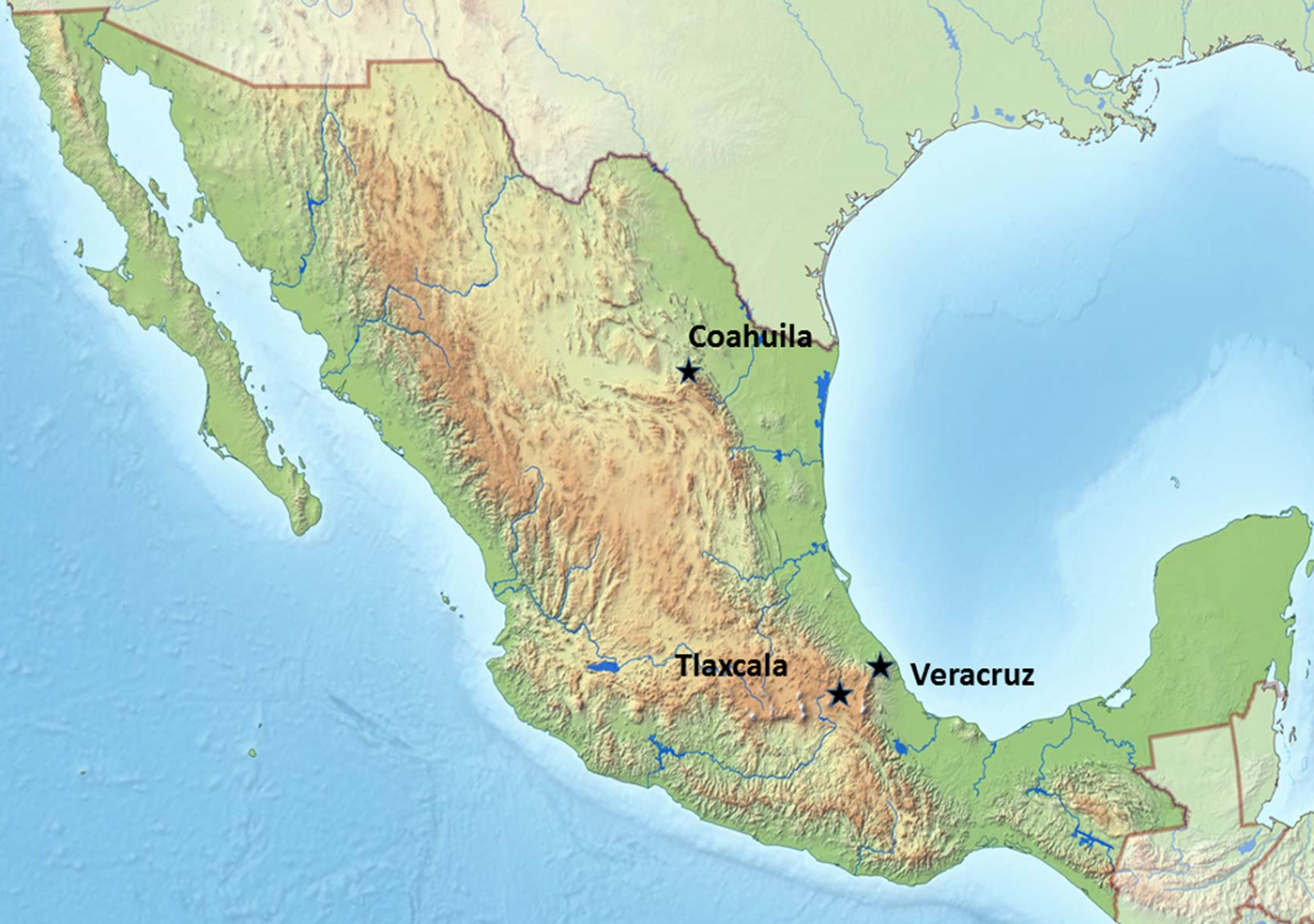
Prunus serotina var virens was collected at the locality of Los Lirios (25.23.31N: 100.36.40W; 2244 m), Coahuila on 28 August 2015, on the eastern side of the Sierra Madre Oriental in northeastern Mexico. The area is characterized by dry mild weather with an average mean temperature of 18.2°C and 375 mm of annual rainfall occurring from June to September (http://es.climate-data.org/), the probability of frosting events from November to February is high (>50%) in southern Coahuila (Martínez & Ruiz, Reference Martínez and Ruiz2005). Prunus serotina var virens begins flowering in March, with late spring frost damaging flowers and causing large numbers of newly set fruit to fall (Hough, Reference Hough and Fowells1965).
Infested Turpinia insignis fruits were collected on the grounds of the Instituto de Ecología A.C. (INECOL), and the Clavijero Botanical garden (CBG), on the old Xalapa-Coatepec road (19.30.45, N: 96.56.40W; 1334 m) from 10–17 August 2015, on the eastern side of the Sierra Madre Oriental in the state of Veracruz in central Mexico. Xalapa has an average mean temperature of 18.2°C, and 1587 mm of annual precipitation peaking from May to October and is virtually free of frost. Turpinia insignis can be found from 600 to 2000 m, on moist eastern side of the Sierra Madre Oriental, and flowers from January to April (dry season) (Sosa, Reference Sosa1988).
In all cases, fruits were immediately taken to the laboratory and handled as described by Rull et al. (Reference Rull, Aluja, Feder and Berlocher2006) to recover pupae. Pupae were removed from trays every other day, placed in transparent plastic 200 ml cups containing 2 cm of moist vermiculite (such pupae were in consequence 0–2 days old), capped with a mesh covered lid, and taken to a laboratory under controlled environmental conditions at 24°C, 65% RH, and 13/11 h L/D photoperiod. As a consequence, regardless of collection date, all pupae were aged 1–2 days when submitted to controlled temperature treatments. In all cases, vermiculite was moistened with a 2% (wt./vol.) sodium benzoate solution twice a week during the entire experimental period. Pupae remained under pre-winter conditions for exactly 40 days and were transferred to a conventional refrigerator at 5 ± 1°C for durations described below. The duration of the pre-winter period was established based on criteria detailed by Rull et al. (Reference Rull, Tadeo, Lasa and Aluja2016) to record proportions of non-dormant flies. During this pre-winter period, date of emergence and sex of individual flies and parasitoids were recorded. Adults recovered <40 days after pupation were considered to be non-dormant.
Temperature regimes
In the case of R. cingulata populations from Tlaxcala, 1400 pupae were recovered and separated in individual 200 ml plastic containers (cups) in sets of 100 pupae per cup. Cups were subjected to periods of different lengths at 5°C. Two cups were left at constant 24°C temperature for the entire experimental period and the remaining sets (three cups per temperature regime) were placed at artificial 5°C ‘winter’ periods for 4, 8, 10, and 16 weeks after which they were returned to laboratory conditions as described for the pre-winter period. Winter length treatments were chosen based on previous results with Mexican populations of four species of Rhagoletis (Rull et al., Reference Rull, Tadeo, Lasa and Aluja2016). The low-temperature periods (4–16 weeks) selected for this experiment encompass regimes that have resulted in maximum percent post-dormancy adult eclosion, while the longest cold period (16 weeks) produced statistically similar percent eclosion than longer ‘winter’ periods (18–20 weeks). Adult fly and parasitoid emergence were recorded for all treatments until emergence of all adults (30 June 2016). In sum, except for the constant temperature treatment (two cups, 200 pupae) there were 300 R. cingulata pupae from Tlaxcala (placed in three cups with 100 pupae each) for each one of the 10, 5°C ‘winter’, periods.
For R. cingulata from Coahuila, a total of 812 pupae were recovered and subjected to controlled temperature regimes as follows: two cups (one containing 100 and one 112 pupae) were held at constant temperature (24°C), two 100-pupae cups were placed at 5°C for 4 and 8 weeks after the 40-day pre-winter period, and one 100-pupae cup was placed at 5°C for 10 and 16 weeks after the 40-day pre-winter period.
For R. turpiniae from Veracruz, a total of 1372 pupae were recovered and subjected to controlled temperature regimes as follows: three cups (two containing 124 and one with 100 pupae) were subjected to constant temperature (24°C) for the entire observational period. Two 100-pupae cups were subjected to a 4-week 5°C winter period, three cups whit 100 pupae were subjected to a 8-week 5°C winter period, three cups (two with 100 pupae and one with 194 pupae) were subjected to a 10-week 5°C winter period, and two cups (one with 80 pupae and one with 74) were subjected to a 16-week 5°C winter period.
At the end of the adult emergence recording period (30 June 2016), uneclosed pupae for all treatments and replicates were inspected under a dissecting microscope to establish the proportion of pupae having entered a ’long’ diapause (live pupae) and the proportion of uneclosed pupae having suffered mortality.
Statistical analyses
Cumulative percent post-winter adult eclosion, the proportion of pupae undergoing long diapause (>10 months), and pupal mortality after 10 months, were compared among treatments within each species by means of χ2 tests of observed proportions vs. expected proportions according to a uniform distribution of percent eclosion, survival, and mortality respectively. Overall percent adult eclosion after dormancy, the overall proportion of pupae undergoing long diapause, percent pupal mortality, and overall parasitism were compared among species (across sites) by means of χ2 tests of observed vs. expected proportions according to a uniform distribution. The length of time from pupation to adult eclosion (corrected for winter length) was compared among treatments and sex within each fly species, and between male and female flies (pooled together) of each species and their parasitoids by means of general linear models (GLM). The length of time from pupation to adult eclosion (corrected for winter length) was compared across populations/species by building a GLM with species (site), sex, and treatment as dependent variables. In the case of across site comparisons, only the 8-, 10-, and 16-week artificial winter treatments were included in the model, given that no adult eclosion was recorded for pupae of all populations/species when exposed to constant temperatures and short winters (4 weeks).
Results
Non-dormant flies
A very small proportion (1.4 ± 1.1%) of central Altiplano (Tlaxcala) R. cingulata adults emerged during the 40-day pre-winter period without becoming dormant (13 males and six females). The developmental period for such adults lasted from pupation to adult eclosion an average (±SD) of 35.2 ± 1.9 days for males, and 36.2 ± 1.5 days for females. Only one adult of a braconid parasitoid emerged without becoming dormant. The developmental period for this non-dormant adult lasted 35 days.
For northeastern (Coahuila) R. cingulata, only one braconid parasitoid emerged without becoming dormant and did so 34 days after pupation.
In the case of R. turpiniae (Veracruz) 1.82 ± 1.86% adults emerged during the 40-day pre-winter period without becoming dormant (ten males and 14 females). The developmental period for such adults lasted from pupation to adult eclosion an average (±SD) of 39.4 ± 1.4 days for males, and 39.4 ± 2.6 days for females. Thirty-five adult braconid parasitoids emerged without becoming dormant, and did so after an average (±SD) of 38.1 ± 3.8 days after pupation.
Dormant flies
Percent eclosion according to winter length
There were significant differences in the proportion Tlaxcala R. cingulata adults emerging after artificial winters of different duration (χ2 = 99.76; df = 4; P < 0.01) Pupae exposed to winter periods of 16 weeks eclosed in greater proportions (34.6%) than pupae exposed to shorter winter periods or constant temperatures (fig. 2a). A large proportion of pupae entered prolonged dormancy periods (>10 months). Pupae exposed to artificial winters of <16 weeks or constant temperatures remained dormant for more than 10 months in greater proportion than those exposed to 5°C for 16 weeks (χ2 = 43.14; df = 4; P < 0.01). Pupae exposed to 16-week artificial winters experienced greater mortality than those exposed to artificial winters of shorter duration or constant temperatures (χ2 = 176.4; df = 4; P < 0.01).
Proportions of: adult eclosion (black bars), live pupae undergoing prolonged dormancy (dark gray bars), and dead pupae (light gray bars), for two populations of Rhagoletis cingulata from central (Tlaxcala) and northeastern (Coahuila) Mexico exploiting early (Prunus serotina var capuli) and late (P. serotina var capuli) fruiting black cherries and Rhagoletis turpiniae (Veracruz). Pupae were exposed to 5°C artificial winters of different lengths (0, 4, 8, 10 and 16 weeks).

In the case of northeastern R. cingulata from Coahuila, there were significant differences in the proportion of adults emerging after artificial winters of different duration (χ2 = 20.97; df = 4; P < 0.01). Pupae exposed to 5°C for 4, 8, and 10 weeks emerged in greater proportions than expected from a uniform distribution of adult emergence (fig. 2b). There were also significant differences in the proportion of pupae entering prolonged diapause (χ2 = 90.11; df = 4; P < 0.01). Pupae exposed to constant temperatures and a 4-week artificial winter entered prolonged diapause in greater proportions than expected from a uniform distribution. Pupae exposed to artificial winter periods of 8, 10, and 16 weeks suffered greater mortality than expected from a uniform distribution (χ2 = 16.87; df = 4; P < 0.01).
For R. turpiniae (Veracruz), pupae exposed to 10- and 16-week artificial winter periods emerged as adults in greater proportion than expected from a uniform distribution (χ2 = 29.92; df = 4; P < 0.01) (fig. 2c). Pupae exposed to constant temperatures and 4 weeks of artificial winter entered prolonged diapause in greater proportion than expected from a uniform distribution (χ2 = 44.37; df = 4; P < 0.01). Pupae exposed to winters of 10 and 16 weeks suffered mortality in greater proportion than expected from a uniform distribution (χ2 = 11.32; df = 4; P = 0.023).
Overall mean proportion (±SD) of adults eclosing after dormancy, pupae undergoing long dormancy, pupal mortality, and parasitism are summarized in table 1. Rhagoletis cingulata pupae from Coahuila emerged as adults in greater proportions than expected from a uniform distribution (χ2 = 12.36; df = 2; P = 0.002). A greater proportion of R. cingulata pupae from Tlaxcala underwent long diapause than expected from a uniform distribution (χ2 = 17.61; df = 2; P < 0.001). There were no statistical differences in percent mortality among species/populations when compared with a uniform distribution (χ2 = 4.96; df = 2; P = 0.083). Rhagoletis cingulata pupae from Coahuila and R. turpiniae pupae from Veracruz suffered a greater proportion of parasitism than that expected from a uniform distribution (χ2 = 38.00; df = 2; P < 0.001).
Mean proportion (±SD) of adults eclosing after dormancy (within 10 months of pupation), pupae undergoing long dormancy (>10 months), and pupal mortality for two populations of Rhagoletis cingulata populations (Tlaxcala and Coahuila) and Rhagoletis turpiniae.

Within columns, figures followed by an asterisk (*) denote greater proportions than expected from a uniform distribution across sites according to χ2 tests.
Duration of post-winter dormancy
Rhagoletis cingulata pupae from Tlaxcala subjected to artificial winter periods of different lengths eclosed at significantly different time intervals (after substracting winter length) (F = 806.76; df = 4.16; P < 0.001). No adults eclosed during the 10-month observational period from pupae subjected to constant temperatures and 4 weeks at 5°C, pupae subjected to 8 weeks at 5°C, took longer to eclose as adults than pupae subjected to winters of 10 and 16 weeks (table 1). No statistical differences were observed in time to adult eclosion between sexes (F = 0.40; df = 1.16; P = 0.53), and the interaction between sex and winter length was not significant (F = 1.02; df = 4.16; P = 0.42).
Rhagoletis cingulata pupae from Coahuila eclosed as adults at different time intervals (F = 70.79; df = 4.5; P < 0.001). Adults emerging from pupae subjected to constant temperatures took longer to eclose than those recovered from any other temperature treatment (table 1). No statistical differences were observed in time to adult eclosion between sexes (F = 0.007; df = 1.5; P = 0.93), and the interaction between sex and winter length was not significant (F = 1.03; df = 4.5; P = 0.47).
Rhagoletis turpiniae from Veracruz eclosed as adults at different time intervals (F = 383.9; df = 4.15; P < 0.001). No adults eclosed during the 10-month observational period when pupae were subjected to constant temperatures and 4 weeks at 5°C (table 1). No statistical differences were observed in time to adult eclosion between sexes (F = 0.47; df = 1.15; P = 0.49), and the interaction between sex and winter length was not significant (F = 1.86; df = 4.15; P = 0.16).
There were significant differences across sites in the time in days elapsed from the end of artificial winter to adult fly eclosion (F 2, 279 = 90.34; P < 0.001). As revealed by unequal N honest significant difference tests, flies from Coahuila emerged significantly later than flies from Veracruz, which in turn, emerged significantly later than flies from Tlaxcala (fig. 3). There were significant differences in the time in days elapsed from the end of artificial winters of different duration to adult fly eclosion (F 2, 279 = 19.84; P < 0.001). Pupae exposed to 5°C for 8 weeks took longer to emerge (132.21 ± 2.56; mean ± S.E, days) than pupae exposed for 10 weeks (128.49 ± 1.63 days), which in turn, took longer to emerge than those exposed for 16 weeks (114.06 ± 1.09 days). There was however a significant interaction between site and winter length duration (F 4, 279 = 7.11; P < 0.001) because pupae from Veracruz took longer to emerge as adults when exposed to 5°C for 10 weeks. There were no significant differences between sexes in time to adult eclosion (F 1, 279 = 0.33; P = 0.56).
Duration of dormancy in days for: Rhagoletis cingulata exploiting late fruiting black cherries Prunus serotina var virens (black bar), Rhagoletis turpiniae exploiting Turpinia insignis (dark gray bar), and R. cingulata exploiting early fruiting black cherries P. serotina var capuli (light gray bar).

Parasitoids
Only one unidentified braconid parasitoid infesting R. cingulata from Tlaxcala became dormant; this individual emerged 116 days after exposure to a 10-week artificial winter period at 5°C.
In the case of R. cingulata from Coahuila, 74 parasitoids became dormant when subjected to artificial winter periods of different duration. A GLM revealed a significant interaction between treatment (winter length) and trophic level (herbivore/parasitoid) (F = 24.86; df = 4.6; P < 0.001). When exposed to constant temperatures and short winters (4 and 8 weeks), parasitoids emerged significantly earlier than their fly (herbivore) hosts, and when exposed to winters of 10 and 16 weeks of duration, parasitoids emerged later than their hosts (table 2).
Average (±SE) duration (days) corrected for artificial winter length (by substracting the total number of days held at 5°C according to treatment) from pupation to adult eclosion of three species of Rhagoletis fruit flies and their parasitoids.

1 N.D. = no data (no post-winter adult eclosion).
In the case of R. turpiniae (Veracruz), 29 parasitoids became dormant after exposure to artificial winters of 8 and 10 weeks. The time from pupation to adult parasitoid eclosion corrected for winter length was significantly longer than that recorded for their fly hosts (t = 4.44; df = 5; P < 0.001) (table 2).
Discussion
As for other species in the genus Rhagoletis inhabiting Mexican high elevation temperate habitats (Rull et al., Reference Rull, Tadeo, Lasa and Aluja2016), very small proportions (<2%) of flies from the three species in the cingulata species group examined here and a few associated adult parasitoids emerged without becoming dormant. Pupae exposed to 5°C for different periods of time (0–16 weeks) became dormant and emerged as adults in proportions <30%, in contrast to other species in the cingulata species group from the USA, where 80% of R. indifferens exposed pupae can emerge as adults after 3 months at 3°C (Frick et al., Reference Frick, Simkover and Telford1954; Brown & AliNiazee, Reference Brown and AliNiazee1977). Large proportions (19–55%) of exposed pupae entered prolonged dormancy (>10 months), and large proportions of pupae died without emerging as adults. The number of days elapsed from the end of artificial winter to adult eclosion was longer for R. cingulata exploiting late fruiting P. serotina in northeastern Mexico (Coahuila) than for flies recovered from earlier fruiting plants in the central Altiplano (Tlaxcala), resulting in significant allochronic isolation between Mexican ‘populations’ of R. cingulata. Rhagoletis turpiniae and northeastern R. cingulata pupae suffered high proportions of parasitism.
Small proportions (<2%) of pupae in our experiment emerged within 40 days of pupation as adults without becoming dormant. Similar findings have been reported for Mexican populations of three species of Rhagoletis (Rull et al., Reference Rull, Tadeo, Lasa and Aluja2016). In the case of flies in the cingulata species group, Van Kirk & AliNiazee (Reference Van Kirk and AliNiazee1982) report 3% adult eclosion between 27 and 77 days after pupation for R. indifferens held at 22°C, while Frick et al. (Reference Frick, Simkover and Telford1954) mentions that 0.3–1.1% of the population failing to become dormant. These patterns are similar to those we found for the three Mexican populations examined here. In the case of flies in the pomonella species group, Dambroski & Feder (Reference Dambroski and Feder2007) found greater proportions of non-diapausing flies at Northern than at Southern latitudes; such a trend does not appear to be evident for species in the cingulata species group.
Two North American species of Rhagoletis of economic importance have been introduced to Europe in the past 20 years (R. cingulata and R hagoletis completa) (Aluja et al., Reference Aluja, Guillén, Rull, Höhn, Frey, Graf and Samietz2011; Johannesen et al., Reference Johannesen, Keyghobadi, Schuler, Stauffer and Vogt2013; Verheggen et al., Reference Verheggen, Verhaeghe, Giordanengo, Tassus and Escobar-Gutiérrez2017), while others (R. pomonella in particular) could potentially become established in several temperate fruit growing regions of the world (Geng et al., Reference Geng, Li, Rajotte, Wan, Lu and Wang2011; Qin et al., Reference Qin, Paini, Wang, Fang and Li2015). Because extensive pesticide use is no longer an acceptable option to deal with invasive pest species, environmentally friendly pest management techniques such as the sterile insect technique (SIT) are being developed for area-wide pest management (Nestel et al., Reference Nestel, Rempoulakis, Yanovski, Miranda, Papadopoulos, Horowitz and Ishaaya2016). Cost-effective artificial rearing is a prerequisite for SIT development and rearing of natural enemies (Klassen, Reference Klassen, Dyck, Hendrichs and Robinson2005). While substantial progress has been made for artificial rearing of R. cerasi (Köppler et al., Reference Köppler, Kaffer and Vogt2009), selection of non-diapausing strains of Rhagoletis could further facilitate SIT. Non-diapausing strains of R. pomonella have been selected for by exposing larvae and pupae to constant light or long photoperiods (Baerwald & Boush, Reference Baerwald and Boush1967; Prokopy, Reference Prokopy1968). However, Brown (Reference Brown1978) reports that the progeny of crosses of non-diapausing R. indifferens reverted to diapausing during selection attempts. Exploring the role of photoperiod and latitudinal variation on the frequency of non-diapausing individuals may contribute to development of non-diapausing strains of Rhagoletis.
AliNiazee (Reference AliNiazee1975) found for field collected pupae of R. indifferens exposed to subfreezing temperatures for different periods of time, a maximum of 77% adult emergence and a maximum of 30% of pupae undergoing prolonged dormancy. Similarly, Frick et al. (Reference Frick, Simkover and Telford1954) exposed R. indifferens pupae to 4°C for periods ranging from 0 to 230 days, and obtained 0–80% adult emergence, 6.3–87% of pupae undergoing prolonged dormancy, and pupal mortality ranging from 12 to 23%. In this case, optimal adult recovery (80% emergence) was obtained when holding pupae at 4°C for 150–210 days, while short (<90 days) and long (231 days) winters resulted in high proportions (>40%) of pupae engaging in prolonged dormancy. High proportions of pupae engaging in long dormancy are not limited to flies in the cingulata species group, in the case of R. cerasi, short (<4 months) winters also result in large proportions of pupae engaging in long dormancy (Vallo et al., Reference Vallo, Remund and Boller1976). While examining fitness tradeoffs of pupae undergoing annual and prolonged dormancy, Moraiti et al. (Reference Moraiti, Nakas and Papadopoulos2012) conclude that prolonged dormancy is likely to be part of a bet-hedging strategy that R. cerasi populations follow as an adaptation to the environmental variability of their habitats. Bet hedging has been examined in detail for the chesnut weevil Curculio elephas, an insect species that exploits fruit undergoing periodic unpredictable masting events (Menu, Reference Menu1993). In this case, Gourbière & Menu (Reference Gourbière and Menu2009) found that diapause-duration variability is more likely to have evolved by the spread of a bet-hedging strategy than by the establishment of a genetic polymorphism. Here, we found that higher proportions of the central Altiplano (Tlaxcala) pupae engaged in prolonged dormancy when exposed to artificial winters of different length. Flowering and fruit set of P. serotina var capuli in Tlaxcala overlaps with periods of high likelihood of frosting events (Ortiz et al., Reference Ortiz, Ruiz and Fierro1992), and large area extensions with fruitless trees occur on a periodic basis without following a predictable pattern (JR personal observation). A similar, yet less acute, pattern has been reported in the case of P. serotina var virens in southern USA (Hough, Reference Hough and Fowells1965). However, in Coahuila, P. serotina var virens begins flowering in March, a period that does not overlap with the period (November–Febrearury) of maximum likelihood (>50%) of frosting events, while R. turpiniae occurs in a frost-free environment. When compared with other species in the cingulata species group, and a species exploiting hosts under similar ecological conditions, Mexican populations seem to exhibit a high propensity to engage in prolonged dormancy, require cold periods of shorter duration to break diapause, and suffer greater mortality. Because in all cases, pupae was recovered during the same collection date and assigned randomly to temperature treatments, the outcome of our experiments seems to suggest that the observed variability in diapause length is not the result of a genetic polymorphism but rather an effect of phenotypic plasticity. Understanding of this life-history strategy among Mexican Rhagoletis in the R. cingulata species group will require however lengthy (2–4 years) and specifically designed experiments.
The high mortality levels observed among pupae in our experiment may be due to a combination of factors. In the case of R. turpiniae, temperature may have a higher threshold than 0–5°C, since low temperatures in Xalapa rarely drop below 9°C. In the case of Mexican R. cingulata populations, humidity may be an important cue for regulation of dormancy. For northeastern R. cingulata, and R. turpiniae, parasitism levels were also extremely high and mortality could have been caused by unemerged parasitoids. However, in all cases, there seemed to be a trend for higher mortality for pupae exposed to longer winter lengths, suggesting that energy reserves may have been exhausted more rapidly than in the case of species inhabiting environments at more Northern latitudes.
Allochrony has been found to be an important component for the interruption of gene flow between the hawthorn and the apple host races of the apple maggot fly (Feder et al., Reference Feder, Hunt and Bush1993; Feder & Filchak, Reference Feder and Filchak1999; Filchak et al., Reference Filchak, Roethele and Feder2000). In fact, each of the six recognized sibling species in the R. pomonella species complex infests a unique set of host plants that overlap in distribution, but differ in fruiting phenology (Bush, Reference Bush1966; Berlocher, Reference Berlocher2000; Xie et al., Reference Xie, Michel, Schwarz, Rull, Velez, Forbes, Aluja and Feder2008). For cherry infesting R. cerasi, a parallel has been drawn with R. pomonella host races (Schwarz et al., Reference Schwarz, McPheron, Hartl, Boller and Hoffmeister2003). Flies breeding on Prunus and those breeding on Lonicera show marked differences in adult emergence adjusted to the fruiting phenology of their respective hosts (Boller & Bush, Reference Boller and Bush1974). Recently, in the cingulata species group, Yee et al. (Reference Yee, Goughnour, Hood, Forbes and Feder2015) found that eclosion times of adult R. indifferens from allopatric populations infesting sweet (introduced, early fruiting) and bitter (native, late fruiting) cherry also differ according to the phenology of their respective host plants. Bitter cherry flies and their associated parasitoids eclosed later than sympatric sweet cherry adults (Yee et al., Reference Yee, Goughnour, Hood, Forbes and Feder2015). Rull et al. (Reference Rull, Aluja and Feder2011) identified three North American geographically isolated populations of R. cingulata exploiting three subspecies of P. serotina differing in fruiting phenology. These ‘populations’ exhibited significant differences in the time from fruit collection to adult eclosion under uncontrolled environmental conditions in central Mexico (Xalapa), and were found to be reproductively isolated (Tadeo et al., Reference Tadeo, Feder, Egan, Schuler, Aluja and Rull2015). Here we found that under similar environmental conditions, two of these populations (central and norteastern Mexico) differ in duration of dormancy. Northeastern Mexican R. cingulata exploiting late fruiting P. serotina var. virens eclosed from 20 to 39 days later than R. cingulata recovered from P. serotina var. capuli in central Mexico. In sum we can now conclude that these populations are geographically, reproductively, and allochronically isolated.
In the case of Mexican populations of R. cingulata, winter length had a significant effect on the duration of dormancy. Pupae exposed to short winters (8 weeks) took longer to eclose as adults than pupae exposed to long (10 and 16 weeks) winters. Brown & AliNiazee (Reference Brown and AliNiazee1977) documented similar patterns for R. indifferens from western USA. In this case, longer periods under low temperatures (winter) resulted in faster and more synchronous adult eclosion after re-exposure to warm temperatures. Apparently, Prunus infesting flies in the R. cingulata species group exhibit plasticity in response to environmental variation. The ecological significance of this plasticity may be linked to the effect of environmental variation (in this case winter length) on plant phenology. Long winters may shorten the window for successful egg laying during fruiting.
Flowering and fruit set seasonal patterns for P. serotina var capuli and P. serotina var virens may be governed by precipitation, while the peak of annual rainfall occurs during the month of June in Tlaxcala, maximum rainfall occurs in September in Coahuila (http://es.climate-data.org/). As a result, maximum fruit availability for egg laying and fruit infestation peak during June–July in Tlaxcala and during September in Coahuila (Rull et al., Reference Rull, Aluja and Feder2011). In turn, these regional differences in host plant phenology appear to have selected for the longer post-winter adult eclosion patterns observed for R. cingulata from Coahuila during our study.
High levels of parasitism were detected for two of the three fly species examined here; in all cases, some individual wasps emerged as adults without becoming dormant and overall those individuals engaging in dormancy emerged as adults 30–50 days later than their fly hosts. In general, parasitoids associated to Rhagoletis adjust their life cycle to that of their host (Ovruski et al., Reference Ovruski, Wharton, Rull and Guillén2007; Rull et al., Reference Rull, Wharton, Feder, Guillén, Sivinski, Forbes and Aluja2009; Reference Rull, Tadeo, Lasa and Aluja2016). Interestingly, Forbes et al. (Reference Forbes, Powell, Stelinski, Smith and Feder2009) found that the braconid wasp Diachasma alloeum has formed new incipient species as a result of specializing on diversifying hosts of R. pomonella. Traits that differentially adapt flies to early fruiting apple or late fruiting hawthorn quickly evolved and serve as ecological barriers to reproduction, also isolating wasps. Hood et al. (Reference Hood, Forbes, Powell, Egan, Hamerlinck, Smith and Feder2015) further showed that this may be occurring for three species of parasitoids associated with Rhagoletis flies in the pomonella species complex. Although our data are scarce to reach similar conclusions for braconids associated to R. cingulata populations exploiting hosts with different fruiting phenology, it may highlight the opportunity to investigate if parasitoids are diversifying in cascade as their hosts. In particular, we believe that examining if the high tendency of R. cingultata from central Mexico to engage in prolonged dormancy has selected for parasitoids adopting a similar life-history strategy or results in temporal escape from parasitism is an interesting avenue for future research.
Acknowledgements
Funding was provided by the International Atomic Energy Agency (IAEA Research Contract No: 18331/R0), the Mexican Campaña Nacional contra Moscas de la Fruta (SAGARPA-CONACOFI-INECOL) and the Instituto de Ecología A.C.