Implications
Postnatal piglet mortality mainly due to crushing in non-crating farrowing systems has been of great concern, particularly with litters of hyperprolific sows. The loose-housed pen seems to reduce stress of sows mainly through provision of space for the sow to achieve maternal behaviour. Our research, however, implies that if the loose-housed pen is poorly designed, it may result in restlessness of postpartum sows, which could indicate discomfort of the sows, with consequent deleterious effects on piglet survival.
Introduction
In pig husbandry, loose-housed or non-crating farrowing systems have been developed as alternatives to a farrowing crate where sow welfare is compromised in a number of ways (for a review, see Baxter et al., Reference Baxter, Andersen and Edwards2017) including interruption of nest-building (Yun et al., Reference Yun, Swan, Farmer, Oliviero, Peltoniemi and Valros2014) and maternal interaction with the piglets (Chidgey et al., Reference Chidgey, Morel, Stafford and Barugh2017). In practice, however, the implementation of loose housing remains a challenge for pig producers partly because the number of piglet deaths, primarily caused by crushing, increases during early lactation (Weary et al., Reference Weary, Phillips, Pajor, Fraser and Thompson1998; Pedersen et al., Reference Pedersen, Jørgensen, Heiskanen and Damm2006; Weber et al., Reference Weber, Keil, Fehr and Horat2009; Baxter et al., Reference Baxter, Adeleye, Jack, Farish, Ison and Edwards2015).
Postnatal piglet deaths occur mainly due to starvation, crushing, hypothermia or their combinations in modern pig husbandry (Weary et al., Reference Weary, Phillips, Pajor, Fraser and Thompson1998; Edwards, Reference Edwards2002; Vasdal et al., Reference Vasdal, Østensen, Melišová, Bozděchová, Illmann and Andersen2011). There are growing concerns that large litter size, in conjunction with a decrease in average piglet birth weight and an increase in proportion of lower birth weight piglets, has brought about an increase in piglet mortality including crushing (for a review, see Rutherford et al., Reference Rutherford, Baxter, D’Eath, Turner, Arnott, Roehe, Ask, Sandøe, Moustsen, Thorup and Edwards2013). The risk of being crushed may depend on sow maternal nurturing and carefulness behaviour, which could be inhibited by stress in the peripartum period (for reviews, see Algers and Uvnäs-Moberg, Reference Algers and Uvnäs-Moberg2007; Yun and Valros, Reference Yun and Valros2015). Hence, in order to reduce postnatal piglet loss in the loose-housed systems, it would be beneficial to optimize farrowing housing to improve maternal behaviour of the peripartum sows.
The present study was therefore conducted to investigate the effects of two different farrowing housing systems on sow behaviour during and after parturition, and their associations with immediate, that is within the first 24 h after the onset of parturition (T24), postnatal piglet mortality. The study also examined the physiological changes (i.e. salivary cortisol elevation) in prepartum sows and investigated their interactions with behavioural observations of postpartum sows and immediate postnatal piglet loss in different farrowing housing. It was hypothesized that the different housing systems would result in different responses in prepartum salivary cortisol levels and behaviour observations during T24 in sows, and that this would be reflected in immediate postnatal piglet mortality.
Material and methods
The study procedure was reviewed and approved by the Animal Experiment Board (ELLA) in Finland, permission ESAVI/2325/04.10.07/2017. The experiment was conducted during 2017 at a commercial pig farm in western Finland.
Animals, experimental design and management
During pregnancy, sows were housed in groups of between 18 and 20 per pen, where they were allowed ad libitum access to water and were fed a standard pregnancy diet twice a day via an automatic liquid feeding system. A total of 30 sows (Danish Yorkshire×Danish Landrace inseminated with Duroc semen; 12 parity 3, 15 parity 4 and 3 parity 5) were selected from five batches at farrowing intervals of 2 weeks. The sows were allocated according to parity and backfat thickness measured at P2 (~7 cm on both sides of mid-line at the level of the last rib) using ultrasound (10.0 MHz linear array probe, MyLab™One VET; Esaote, Maastricht, The Netherlands) before moving them to the farrowing accommodation. All sows had farrowed more than 11 live born piglets during the previous parturition, and had experienced only the closed crate during previous parturition and lactation periods.
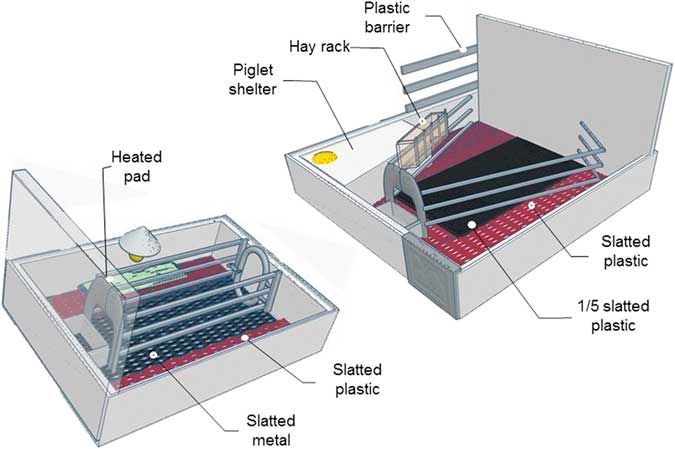
Approximately 7 days before the expected parturition date, the sows were moved to a farrowing and lactating unit in a temperature-controlled room (21±1°C), and were separately housed in two different individual pens (Figure 1). The treatments were: (1) CRATE: 15 sows were confined in farrowing crates (0.80×2.20 m) within pens (2.50×1.70 m), with fully slatted plastic floors in the piglet areas that contained heating pads and fully slatted metal floors in the sow areas, and (2) OPEN: 15 sows were housed in open farrowing crates, trapezoid in shape (0.80×2.20×1.80 m; the sow area was therefore 2.86 m2) within pens (2.50×2.40 m), with fully slatted plastic floors (4.00 m2) outside of the crates and partially (~20%) slatted plastic floors (2.00 m2) inside of the crates. In OPEN, ~20 l of hay or straw were provided in a rack (80×45×20 cm, with a net interval of 9 cm) that was attached to one side of the crate. The OPEN pens contained wooden piglet shelters in one corner with a plastic floor covered with rubber mats and a heat lamp. All pens were connected to a concrete wall on one side and the remaining sides were surrounded by a 60-cm high plastic fence. In OPEN, plastic barriers were installed horizontally to prevent physical contact or movement of the sows between neighbouring pens.
Schematic diagram of a farrowing CRATE (left panel; sow area=0.80×2.20 m, pen size=2.50×1.70 m) and an OPEN crate (right panel; sow area=0.80×2.20×1.80 m, pen size=2.50×2.40 m).

The temperature of the floor surface was measured using an IR thermometer (IR260 Extech®; Nashua, NH, USA). The temperatures of the fully slatted plastic floor of both housing systems, the rubber mats of the shelter in OPEN and the heating pad in CRATE were maintained at ~21°C, 28°C and 35°C , respectively, during the experimental period. There was no induced delivery or parturition assistance for these sows. Umbilical cords were broken by researchers if present, after at least 20 s following birth. Thereafter, the piglets were lifted and dried with towels, and were marked with their birth order number on their backs and returned to the pick-up point. To minimize disturbance of the farrowing process and sow behaviour, the researchers aimed to stand outside the sow area when performing the procedure. No cross-fostering, euthanasia or any medical treatments for piglets were performed during T24.
Data collection
Litter size, birth order and piglet mortality
The researchers attended all parturitions and therefore litter size could be recorded separately for stillborn and live born piglets at birth. Stillbirths were determined as found dead at birth (no respiration activity and no movement of the limbs or body). Mummified piglets were not included in the study. Birth order of each piglet was recorded, and thereafter relative birth order of the piglets was calculated using the formula [(birth order−1)/(total born piglets−1)]. Piglet mortality, through crushing or other factors except crushing during T24, was determined on the farm. Piglet death resulting from crushing was defined according to visible signs of trauma, such as bruised corpses or broken bones and it was verified by video data analyses when necessary. A detailed postmortem examination was not carried out in the current study.
Behavioural observations
All sows and their offspring were video-recorded using internet protocol (IP) cameras (NICECAM420WL; Niceview Corp. Pori, Finland) during T24. One camera was mounted in one corner of each pen 2.0 m above floors in CRATE, and two cameras per pen were mounted in opposite corners 2.0 m above the floor in OPEN. The sequence output was recorded using IP-camera software (Blue Iris v.2.64; Perspective Software, Lenexa, KS, USA). The CowLog version 3.0.2 (Hänninen and Pastell, Reference Hänninen and Pastell2009) behavioural observation program and a media player (MATLAB®; The MathWorks, Inc. Espoo, Finland) were used for data analyses by two trained observers. The display resolution was 640×480 pixels, and the frame rate was 5 FPS. Farrowing duration was determined as time interval between the expulsions of the first and the last piglet born, including stillbirths. Cumulative farrowing duration was regarded as the elapsed time between the birth of the first piglet and that of each subsequent piglet. Birth interval was regarded as the time difference between births of two consecutive piglets. Piglet vitality was scored from the video recordings for 15 s immediately after birth. The score for piglet vitality was determined using parameters according to Baxter et al. (Reference Baxter, Jarvis, D’eath, Ross, Robson, Farish, Nevison, Lawrence and Edwards2008). The scales for vitality score were: (1) 1: no movement or breathing; (2) 2: no body or leg movements but the piglet is breathing or attempting to breathe; (3) 3: some movement, breathing or attempting to breathe and rights itself onto its sternum; and (4) 4: good movement, good breathing, standing or attempting to stand. Durations of body postures, comprising standing (all four legs are straight), sitting (forelegs are straight whereas posterior touch the floor), sternal lying (sow is lying with sternal recumbence without udder exposed) and lateral lying (sow is lying with lateral recumbence with udder exposed) and the total number of postural changes of the sows were recorded. The onset of bar-biting behaviour was defined as when sows bit or licked the farrowing crate or feed trough for longer than 5 s, and the end was defined as no performance for longer than 30 s. Manipulation of the hay rack was observed but not included in bar-biting behaviour. Time from birth to first udder contact by the piglet (BUC) was determined as time from birth to first nose contact by the piglet at any point of the udder. Trapping was defined as a piglet being caught under any part of the sow whilst the sow changed a posture, and the total number of piglet trapping events was recorded. Suckling behaviour was observed from the birth of the last piglet until T24. The start of suckling behaviour was defined as when more than half of the piglets in a litter were performing sucking movements (a teat in the mouth) at the udder. The end of suckling was defined as when more than half of the piglets had left the udder or remained inactive near the udder. Udder massage was included in the observation of suckling behaviour since it was difficult to separate actual suckling from udder manipulation during the current experimental period. The piglets that appeared in blind spots where the view was obstructed either by the sow or by the farrowing crate were excluded from the behaviour analysis in this study.
Salivary cortisol collection and assays
Saliva samples from each sow were collected on synthetic swabs (Salivette® Cortisol; Sarstedt, Nümbrecht, Germany) on days 1, 2 and 3 before parturition, ~1 h after the morning feeding (0700 h). The swabs were fixed with forceps and placed around the back teeth for ~1 min. The collected saliva samples in the swabs were stored at −20°C for subsequent analysis of cortisol. All saliva samples were centrifuged for 10 min at 1000×g immediately before analysis. Concentrations of salivary cortisol were analysed in duplicate with a radioimmunoassay kit (ImmuChemTM CT cortisol kit; MP Biomedicals, Orangeburg, NY, USA) using a modified RIA method for saliva. Salivary cortisol assays are described in more detail in Yun et al. (Reference Yun, Björkman, Pöytäkangas and Peltoniemi2017).
Statistical analysis
SAS version 9.4 (SAS Institute Inc., Cary, NC, USA, 2012) was used for statistical processing of all the data. PROC UNIVARIATE with the Shapiro–Wilk test was used to test normality of the data. A PROC MIXED model was fitted to the data for farrowing duration, birth interval, litter size, vitality score, postnatal piglet mortality rate and cortisol concentrations. Housing type was used as a fixed effect and a batch as a random effect. Parity as a fixed effect was used to test its effect on farrowing duration and birth interval. Repeated measure tests with a ‘first order autoregressive’ structure were used for cortisol data analysis for days 1, 2 and 3 before the parturition. The experimental unit was mean value per litter, and data are presented as LSmeans±SE.
A Poisson distribution with a logarithmic link function was fitted to PROC GLIMMIX to analyse the effects of housing systems on postural changes, duration of sow postures and the incidences of bar-biting and piglet trapping during parturition (i.e. between the first and the last piglet born) and T24. Suckling behaviour and BUC were analysed using a non-parametric test with rank transformation. The ranking was done using the BLOM algorithm. Thereafter, a PROC GLM model was fitted to the ranked data including housing type as a fixed effect. Data for sow and litter behaviour are presented as means±SEM. All the correlations in the study were tested using Spearman rank correlation coefficients (r).
A binomial distribution with a logit model was fitted to PROC GLIMMIX to evaluate parameters (i.e. total litter size, relative birth order, cumulative farrowing duration, birth interval, vitality score and BUC) of surviving and dead piglets. Mortality variables (survival v. death) for each housing type (CRATE v. OPEN) were used as independent variables. The piglet was the experimental unit, and the sow nested within the batch was used as a random effect. Data for observations of surviving and dead piglets are presented as means±SE.
Results
The average backfat thickness and parity were 18.5 (±SD 3.5) mm and 3.8 (±SD 0.7) for the CRATE sows, and 18.3 (±SD 3.3) mm and 3.6 (±SD 0.6) for the OPEN sows, respectively.
Farrowing process and litter characteristics
Average duration of farrowing of all sows was 369 (±SD 204) min. Farrowing housing systems did not affect the duration of farrowing or birth interval (Table 1). There was no effect of parity on farrowing duration or birth interval in the present study. Litter size, including stillborn and live born piglets, or the vitality score of the live born piglets did not differ between the housing systems (Table 1). Farrowing duration and birth interval were not correlated with litter size or vitality score. In addition, no correlations were established between those parameters and piglet mortality.
Farrowing process and litter characteristics in sows with the farrowing crate closed (CRATE, n=15) or open (OPEN, n=15)Footnote 1

1 Data are presented as LSmeans with standard errors.
2 Percentages for postnatal piglet mortality resulting from crushing and other causes during the first 24 h after the onset of parturition.
A total of 563 piglets were produced from the 30 sows. Of these, 518 were born alive and used for mortality analyses during T24. Of the 518 live born piglets, 40 died by crushing and 12 died for other reasons during T24. Total and crushed piglet mortality rates were higher (P<0.001, for both, Table 1), and the rate of mortality due to other reasons tended to be higher in OPEN (P=0.08, Table 1), when compared with those in CRATE.
Behavioural observations of sows
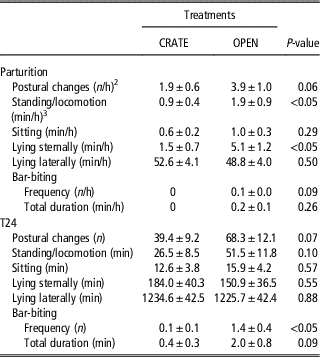
The data for sow behaviour during parturition are presented as frequency or duration per hour since the length of parturition differed between sows. During parturition, sows in OPEN tended to show higher frequency of postural change and spend longer times standing, when compared with the CRATE sows (P=0.06, P<0.05, respectively, Table 2). Similarly, these tendencies were also shown during T24 (P=0.07, P=0.10, respectively, Table 2). During parturition, the sows in OPEN were associated with longer durations for sternal lying down than those in CRATE (P<0.05, Table 2). Frequency of bar-biting behaviour tended to be higher in sows with OPEN during parturition (P=0.09, Table 2), and it was higher for OPEN sows during T24 (P<0.05, Table 2), when compared with values for CRATE sows. Frequency and total duration of bar-biting behaviour were correlated with the numbers of postural changes (r=0.63, P<0.001; r=0.68, P<0.001, respectively) and duration of standing (r=0.42, P<0.05; r=0.55, P<0.01, respectively) of the sows (n=30) during T24. During the experimental period, none of the sows were observed using hay from the racks.
Behavioural observations during the first 24 h after the onset of parturition (T24) for sows housed in the closed (CRATE, n=15) or open (OPEN, n=15) farrowing cratesFootnote 1

1 Data for behaviour observations present means±SEM.
2 Frequency/farrowing duration (h).
3 Total duration/farrowing duration (h).
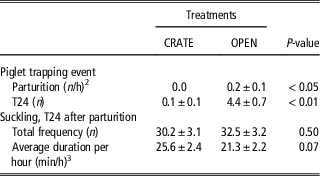
Piglet trapping events were more frequently observed in OPEN during parturition and T24 (P<0.05, P<0.01, respectively, Table 3), compared with in CRATE. During T24, the trapping events were correlated with the number of postural changes and duration of standing (r=0.50, P<0.0001; r=0.44, P<0.0001, respectively), and with frequency and total duration of bar-biting behaviour (r=0.60, P<0.001; r=0.53, P<0.01, respectively) of the sows (n=30). Frequency of suckling did not differ between the housing systems, but average duration of suckling per hour tended to be longer for CRATE than for OPEN piglets until T24 after the end of parturition (P=0.07, Table 3).
Maternal characteristics of sows housed in the closed (CRATE, n=15) or open (OPEN, n=15) farrowing crates during the first 24 h after the onset of parturition (T24)Footnote 1

1 Data are presented as means±SEM.
2 Frequency/farrowing duration (h).
3 Total suckling duration/(24−farrowing duration (h)).
Frequency and total duration of bar-biting behaviour of the sows (n=30) were correlated with the rate of total live-born mortality (Table 4), and the rate of mortality caused by crushing (Table 4). During T24, the rates of total live-born mortality and mortality caused by crushing were also correlated with the number of postural changes (Table 4), duration of standing (Table 4) and piglet trapping events (Table 4) by the sows (n=30).
Spearman rank correlation coefficients (r) between behavioural observations for sows and postnatal piglet mortality rates during 24 h after the onset of parturition (n=30)

1 The rates of total piglet mortality (n=51 out of the 518 live born piglets) and mortality caused by crushing (n=39 out of the 518 live born piglets).
2 Behaviour observations for the sow present the numbers of postural changes, duration of standing and piglet trapping events.
Characteristics of surviving and dead piglets
During T24, four out of the 259 live born piglets were dead in CRATE, whereas 47 out of the other 259 live born piglets were dead in OPEN. When comparing dead piglets with survivors, piglet mortality during T24 was not influenced by litter size, cumulative farrowing duration, birth interval or vitality score in either housing system. Dead piglets tended to be born earlier than survivors (P=0.07, Table 5) in OPEN, but no difference was found among CRATE piglets. Dead piglets had longer BUC than survivors in both CRATE and OPEN (P<0.001, P<0.05, respectively, Table 5). There was a negative correlation between vitality score and BUC in CRATE (n=173, r=−0.25; P<0.001), but no correlation was established in OPEN (n=116, r=−0.08; P=0.41). The average BUC of the litter in OPEN tended to be longer than that in CRATE (means±SEM; 25±4.3 v. 37±5.0 min, P=0.08). The average BUC of the litter was positively correlated with the total mortality rate during T24 (n=30, r=0.41; P<0.0001).
Characteristics of surviving and dead piglets in the closed (CRATE) and open (OPEN) farrowing crates during 24 h after the onset of parturitionFootnote 1

1 Data are presented as means±SE, except relative birth order.
2 The average number of total born piglets in the litter.
3 Relative birth order was calculated as (birth order−1)/(total born piglets−1), and the results presented by medians.
4 Time from birth to nose contact by the piglet at any point of udder area.
Salivary cortisol concentrations of prepartum sows
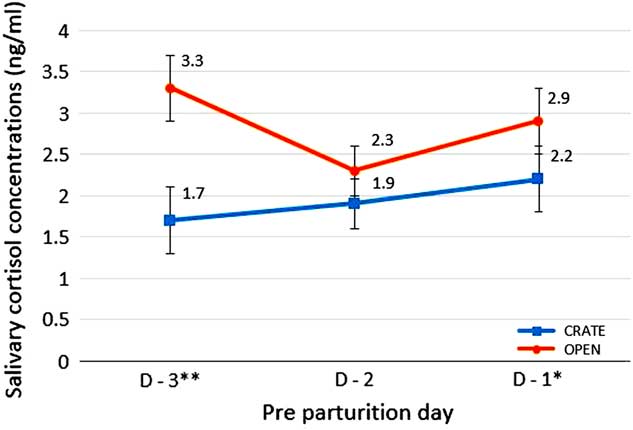
Salivary cortisol concentrations of the sows in OPEN were greater on day 3 before parturition (P<0.05, Figure 2), and tended to be greater on day 1 before parturition (P<0.10, Figure 2), compared with those in CRATE. Repeated measures showed that salivary cortisol concentrations of the sows were greater in OPEN than in CRATE during the 3 days before parturition (3.0±0.4 v. 2.0±0.3, P<0.05). Prepartum salivary cortisol concentrations were not correlated with farrowing duration, behavioural observations of the sows or postnatal piglet mortality during T24.
Salivary cortisol concentrations of sows in the closed farrowing crate (CRATE: n=15) or open (OPEN: n=15) on days 1, 2 and 3 before parturition. Values are presented as LS means with SE bars. *P<0.10; **P<0.05. LS=least square.

Discussion
The current findings support those of previous studies suggesting that a potential increase in the number of crushed piglets in hyperprolific sows in loose-housing systems represents a major cause of postnatal piglet mortality (for a review, see Rutherford et al., Reference Rutherford, Baxter, D’Eath, Turner, Arnott, Roehe, Ask, Sandøe, Moustsen, Thorup and Edwards2013). The present results showed that postnatal piglet mortality caused by crushing, or for other reasons, could be associated with a different behavioural pattern in the sow during 24 h after the onset of parturition. Furthermore, the current study established potential factors that increase immediate postnatal piglet mortality, from the perspectives of neonatal piglet features and housing structure per se in two different housing systems with large litters.
The sows in the current open crate system showed more incidences of bar-biting and tended to show more postural changes during farrowing and the first 24 h following the onset of parturition, compared with the sows in the closed farrowing crate. Similarly, the studies by Melisova et al. (Reference Melišová, Illmann, Chaloupková and Bozděchová2014) and Hales et al. (Reference Hales, Moustsen, Nielsen and Hansen2016) demonstrated that sows in loosed housing showed more postural changes in the first 3 days after parturition than sows in confined system. The larger space may result in more postural changes including rolling in the loose-housed sows (Weary et al., Reference Weary, Pajor, Fraser and Honkanen1996). On the other hand, Harris and Gonyou (Reference Harris and Gonyou1998) suggested that the increased postural change or restlessness could indicate the state of discomfort of the peripartum gilts, irrespective of farrowing housing. Our previous study by Yun et al. (Reference Yun, Swan, Oliviero, Peltoniemi and Valros2015) has also demonstrated that standing and locomotion activity could be increased in crated sows when they were confined suddenly from the onset of parturition, compared with crated sows adapted to confinement since the prepartum period. Furthermore, the present study revealed that the number of postural changes and duration of standing were positively related to the incidence of bar-biting during 24 h after the onset of parturition. Considering that bar-biting is known to be a stress indicator (e.g. Thodberg et al., Reference Thodberg, Jensen and Herskin2002a), the current findings may consequently imply that the sows in the open crate were discomforted during parturition and postpartum. In the open crate system used in this study, the sows were often observed slipping on the floor of the sow area. In addition, the sows might have been uncomfortable with the piglets sharing the sow area where the protective structures were not suitably designed to support the sows for lying down carefully. We therefore speculate that sows previously used to farrowing crates were experiencing additional stress when attempting to avoid lying down on piglets in the current open system, in particular with the large litter size of the sows in the current study.
This study demonstrated that the piglets in the open crate were more exposed to the risk of being trapped by the sows, and that this resulted in the higher mortality due to crushing when compared with figures from the farrowing crate. This is in line with reported results suggesting that crushing by the sows can be a major cause of postnatal piglet mortality in loose housing (e.g. Pedersen et al., Reference Pedersen, Jørgensen, Heiskanen and Damm2006). The current results for the associations between sow behavioural observations and postnatal piglet mortality including crushing also support previous findings that crushing, particularly in loose housing, could depend on standing-to-lying down behaviour (Weary et al., Reference Weary, Phillips, Pajor, Fraser and Thompson1998) and the number of postural changes (Thodberg et al., Reference Thodberg, Jensen and Herskin2002b; Chidgey et al., Reference Chidgey, Morel, Stafford and Barugh2017) of the sows. It is also suggested that the risk of being crushed can be increased in starved piglets, mainly due to compromised viability (e.g. Pedersen et al., Reference Pedersen, Jørgensen, Heiskanen and Damm2006). It therefore appeared that the piglets in the current open crate system might be at disadvantage when compared with those in the closed crate system in terms of the risk of being crushed since a tendency for reduced suckling rate was shown in the open crate system. Furthermore, according to recent findings by King et al. (Reference King, Baxter, Matheson and Edwards2018), sows with previous experience of crating could have increased piglet mortality when given more space at farrowing in a subsequent parity because the sows had no chance to learn to reduce the risk of piglet crushing. Our present results suggest that this may indeed be the case since all the sows in this experimental herd had experienced only the crate during previous parturition and lactation periods. Other studies have shown that the incidence of crushing in pre-weaning piglets can be reduced by protective structures such as a sloping wall and a protective rail in loose-housed systems (Damm et al., Reference Damm, Moustsen, Jørgensen, Pedersen, Heiskanen and Forkman2006; Andersen et al., Reference Andersen, Tajet, Haukvik, Kongsrud and Bøe2007). We therefore suggest that the high piglet mortality in the open crate in this study could have been reduced by installing further protective structures. It might be beneficial to install such structures in particular on the wall side, as sows prefer to lie down against a solid wall (e.g. Damm et al., Reference Damm, Moustsen, Jørgensen, Pedersen, Heiskanen and Forkman2006).
During parturition and early lactation, sows need a certain degree of space to inspect and group their offspring before lying down (for a review, see Baxter et al, Reference Baxter, Lawrence and Edwards2011). Weber et al. (Reference Weber, Keil, Fehr and Horat2009) suggested that if this space in loose-housing systems is <5 m2, it could interrupt piglet gathering behaviour, which in turn increases piglet mortality compared with the crating system. This could also be one explanation for the current results for increased piglet mortality in the open crate where the extent (2.86 m2 in total) of the sow area was smaller than this requirement. From another structural point of view regarding increased piglet mortality, thermoregulation of neonates could be compromised in loose-housed pens, either because floor heating for the piglets is often absent or because piglets tend to be born further away from the heated site, as reported by Vasdal et al. (Reference Vasdal, Østensen, Melišová, Bozděchová, Illmann and Andersen2011) and Baxter et al. (Reference Baxter, Adeleye, Jack, Farish, Ison and Edwards2015). It is suggested that cold could induce hypothermia and thus reduce piglet viability, which in turn could elevate risks of the piglets being crushed and dying (Baxter et al., Reference Baxter, Jarvis, D’eath, Ross, Robson, Farish, Nevison, Lawrence and Edwards2008; Weber et al., Reference Weber, Keil, Fehr and Horat2009; Pedersen et al., Reference Pedersen, Berg, Jørgensen and Andersen2011). Moreover, the higher risk of crushing was apparent when piglets stayed close to the udder in an attempt to keep warm (Weary et al., Reference Weary, Pajor, Fraser and Honkanen1996; Weber et al., Reference Weber, Keil, Fehr and Horat2009). A recent study by Chidgey et al. (Reference Chidgey, Morel, Stafford and Barugh2017) also demonstrated that piglets between the ages of 1 and 6 days spent more time inactive near the udder of the loose-housed sows to maintain body temperature compared with piglets of the crated sows, and that this would have resulted in the increase in pre-weaning piglet mortality in the loose-housed pen studied by Chidgey et al. (Reference Chidgey, Morel, Stafford and Barugh2015). Although a piglet shelter with a heat lamp was present in the open crate used in the current study, piglets were seldom observed entering the shelter spontaneously during the experimental period. This may be explained by a recent finding that the heating with incandescent bulbs reduced the time that piglets stay in the creep area in early lactation, compared with radiant heating system (Larsen et al., Reference Larsen, Thodberg and Pedersen2017). Based on such evidence, it was therefore assumed that the thermoregulatory capacity of the postnatal piglets in the open crate might have been impaired, possibly due to being in a larger pen with improper heating system, compared with the closed crate. Consequently, the potentially lowered piglet body temperature might have resulted in increased crushing and subsequent death of the neonates.
The current findings, similar to those of Rohde Parfet and Gonyou (Reference Rohde Parfet and Gonyou1988), Baxter et al. (Reference Baxter, Jarvis, D’eath, Ross, Robson, Farish, Nevison, Lawrence and Edwards2008) and Vasdal et al. (Reference Vasdal, Østensen, Melišová, Bozděchová, Illmann and Andersen2011), confirmed that time from BUC by the neonates played an important role in postnatal piglet survival. First suckling behaviour by the neonates, which was determined in those reported studies, was not observed in the present study due to technical restrictions. Based on the evidence presented by Rohde Parfet and Gonyou (Reference Rohde Parfet and Gonyou1988), however, we believe that the time from birth to first suckling can be predicted by the time from BUC, which was analysed in this study. Baxter et al. (Reference Baxter, Jarvis, D’eath, Ross, Robson, Farish, Nevison, Lawrence and Edwards2008) and Vasdal et al. (Reference Vasdal, Østensen, Melišová, Bozděchová, Illmann and Andersen2011) revealed that the higher vitality score the piglets had at birth, the earlier they achieved first suckling. This is in line with the results for the closed crate in this study, although it should be noted that a rather weak rank correlation was reported. However, the current results indicated no correlations in the open crate. Considering a tendency for longer duration from BUC established for the open crate, presumably the advantages for the piglets with good vitality at birth did not contribute to shortening the time from birth to first udder contact in the open crate. This may be because the space was larger and the sows were more active during parturition, as shown in the present study. In addition, this larger space and greater activity of the sow might have brought about the finding that early birth order was associated with a higher risk of death in the open crate. Meanwhile, all the piglets included in the present study were completely towel dried after birth, in order to weigh them for the follow-up study. According to Vasdal et al. (Reference Vasdal, Østensen, Melišová, Bozděchová, Illmann and Andersen2011), latency to first suckling could be influenced by drying the neonate piglets in loose-housed pens. Therefore, this procedure, used in the current study, cannot be excluded from the factors affecting the data for the mortality rate and time from BUC by the piglets and their associations with vitality score at birth.
Increasing farrowing duration has been a growing concern in modern pig herds with large litter size since it was shown to be associated with increases in stillbirth rate or postnatal piglet death (Herpin et al., Reference Herpin, Le Dividich, Hulin, Fillaut, De Marco and Bertin1996; Van Dijk et al., Reference Van Dijk, Van Rens, Van der Lende and Taverne2005). Contrary to those findings, the current results did not show that the farrowing process was associated with litter size, including stillbirths, piglet vitality at birth or postnatal mortality. Meanwhile, the average number of total piglets born per litter in the present study was relatively high compared with those reported by Herpin et al. (Reference Herpin, Le Dividich, Hulin, Fillaut, De Marco and Bertin1996) or Van Dijk et al. (Reference Van Dijk, Van Rens, Van der Lende and Taverne2005) (18.8 v. 10.6 or 11.7 piglets per litter, respectively). Furthermore, the selection of the current experimental sows was set to minimize sow-related factors, such as parity, which affect litter size and piglet mortality. Therefore, no conclusion can be reached in the present study on the association between farrowing duration, litter size and parity.
The present study revealed that the open crate system increased salivary cortisol concentrations of prepartum sows, compared with the crated system. This is similar to recent findings by Hales et al. (Reference Hales, Moustsen, Nielsen and Hansen2016) demonstrating that sows in loose housing had higher salivary cortisol levels on 1 day before parturition. During the prepartum period, the provision of a wider space could increase sow activity, including nest-building behaviour (Yun et al., Reference Yun, Swan, Farmer, Oliviero, Peltoniemi and Valros2014). It may therefore be speculated that the elevated salivary cortisol levels observed in the sows of the current open crate could be related with more vigorous activities prepartum. However, to our knowledge, there is little research to investigate the activity effect per se on the salivary cortisol levels in prepartum sows. In contrast, lower salivary cortisol levels of the prepartum sows confined in the farrowing crate can be explained by hypocortisolism, indicating that chronic or repeated stress can cause a blunted cortisol response (Fries et al., Reference Fries, Hesse, Hellhammer and Hellhammer2005; Valros et al., Reference Valros, Munsterhjelm, Puolanne, Ruusunen, Heinonen, Peltoniemi and Pösö2013). On the other hand, in comparison with the closed crate, the open crate used in this study may have exposed sows to some additional stressors. Specifically, the experimental pen was enclosed by a low fence (height 60 cm) on three sides, with one side adjoining the wall. Thus, the sows were often exposed to farm staff and neighbouring sows since they were allowed to move freely within the sow area of the open crate. In nature or semi-natural conditions, however, it is widely known that prepartum sows prefer nesting sites isolated from their social group (Stolba and Wood-Gush, Reference Stolba and Wood-Gush1984; Mayer et al., Reference Mayer, Martin and Brisbin2002). Even under commercial conditions, domesticated sows also preferred to farrow more distantly from neighbouring sows in order to achieve isolation (Baxter et al., Reference Baxter, Adeleye, Jack, Farish, Ison and Edwards2015). In the current open crate, however, the sows were unable to properly isolate themselves from sows of the neighbouring pen. Thus, this might, in turn, increase salivary cortisol levels in the prepartum sows. Similarly to the study by Hales et al. (Reference Hales, Moustsen, Nielsen and Hansen2016), however, we failed to reveal interactions between prepartum salivary cortisol levels and postpartum sow behaviour, including bar-biting. Further studies therefore are needed to demonstrate the causal relationship between salivary cortisol levels and behaviour observations in peripartum sows.
In conclusion, immediate postnatal piglet mortality, mainly due to crushing, may be increased in the non-crating system with large litters, especially if the pen is poorly designed, heating system for the piglet is impaired or space allowance for sows is inadequate. The present results suggest that it can also be associated with frequency of postural changes, duration of standing and incidence of piglet trapping in postpartum sows in the open crate system. Therefore, in order to achieve maximum piglet survival in the non-crating farrowing system with large litters, farrowing housing should be considered to minimize the incidence of crushing from potential increases in these behaviours of postpartum sows.
Acknowledgements
This study was funded by grants from the Ministry of Agriculture Finland (MMM Dno 1788/312/2014), the Finnish Veterinary Foundation, Hankkija ltd and Atria Ltd, which the authors gratefully acknowledge. The authors wish to thank the farmers Johan and Alexander Backlund for their valuable efforts and support to carry out the study, and Merja Pöytäkangas (lab technician) for help with the cortisol analyses.
Declaration of interest
None
Ethics statement
None
Software and data repository resources
None