Introduction
Body mass index is one of the most commonly used nutritional indices. According to the Scopus database, in 2012 more than 2000 research papers containing references to BMI were published. Many of them are concerned with socioeconomic determinants of BMI values and the prevalence of underweight, overweight and obesity.
In 1989 Sobal & Stunkard (Reference Sobal and Stunkard1989), when studying the scientific literature, noticed that the relationship between obesity and SES is inverse for the most developed countries, whereas in developing countries the relationship is positive. This dependence was also revealed in a recent literature research study by McLaren (Reference McLaren2007). An analysis performed on the basis of World Health Survey (WHS) data from studies carried out in 70 countries in the years 2002–2003 also indicates that in countries with low GDP the number of obese people increases with the improvement of SES, whereas in countries with high GDP, it decreases with the improvement of SES (Pampel et al., Reference Pampel, Denney and Krueger2012). Accordingly, despite the passage of time and cultural changes taking place in almost every society, the nature of this relationship remains unchanged. The relationship is more marked for adults; data collected among children and adolescents are less consistent. In the study by Sobal & Stunkard (Reference Sobal and Stunkard1989), 40 (32%) studies conducted in developing counties demonstrated a negative relationship between SES and childhood obesity, 35 (41%) showed a positive relationship and 40 (32%) did not show any type of dependency. Similarly, inconsistent results were obtained on analysing 45 cross-sectional studies carried out in the years 1990–2005 in highly developed Western countries (Shrewsbury & Wardle, Reference Shrewsbury and Wardle2008). It was concluded that in most studies SES is inversely related to childhood overweight and obesity (42% of analysed studies), no relationship was reported in twelve (27%) studies, and in fourteen (31%) cases the relationship differed depending on the subgroup. The inverse relationship between SES and obesity was observed more frequently in children than in teenagers. If parents' level of education was selected as SES indicator, an inverse relationship was found in 75% of studies. Parents' level of education rather than their profession or income had a greater impact on the prevalence of obesity in children and adolescents (Shrewsbury & Wardle, Reference Shrewsbury and Wardle2008).
There are no national data concerning the prevalence and determinants of overweight and obesity in children and adolescents in Poland. Studies covering individual regions show either lack of dependence (Ebbeling et al., Reference Ebbeling, Pawlak and Ludwig2002) or a negative relationship between SES and body fat level (Due et al., Reference Due, Damsgaard, Rasmussen, Holstein, Wardle and Merlo2009; Tabak et al., Reference Tabak, Oblacińska, Jodkowska and Mikiel-Kostyra2012).
When analysing the prevalence of abnormal body mass one should not focus exclusively on the issue of overweight and obesity. Excessively low BMI values also constitute a health risk. For years being underweight was associated with malnutrition, in particular of protein–energy type. However, malnutrition may result not only from low food intake, but also from deliberately consuming very small amounts of food (following various diets). The prevalence of underweight has been reported to be increasingly, not only among the poor, but also in groups of high socioeconomic status. In the latter case it results from following fashion, which promotes an extremely slim figure.
Body mass and BMI are very eco-sensitive characteristics and may undergo dramatic changes over a relatively short period of time. Lifestyle, being a natural extension of socioeconomic status, has a significant influence on the values of those indices. For children and adolescents socioeconomic status is most frequently defined through their parents' education and profession or household income. It also includes other social variables such as place of residence or number of offspring. As mentioned before, among the above-mentioned factors it is parents' education that has the strongest effect on their children's body fat level. Not only is it connected with their income, but also with their lifestyle resulting from the knowledge of behaviour limiting the risk of various diseases, healthy nutrition and physical activity (Seabra et al., Reference Seabra, Mendonc, Thomis, Peters and Maia2007; Bere et al., Reference Bere, van Lenthe, Klepp and Brug2008). Undoubtedly the impact of the family context on the development of children is significant. Nevertheless, towards the end of their childhood children spend substantial amounts of time in peer groups. The older they are, the more they tend to rely on their friends' views and opinions. This is particularly noticeable during adolescence, which is characterized by searching for one's own style and a strong desire to be accepted by one's peers.
Some authors have postulated a key role for the environment in determining lifestyle behaviour and prevalence of overweight and obesity. Differences in place of residence (e.g. rural vs urban) are associated with eating habits and with differences in physical fitness activities (McMurray et al., Reference McMurray, Harrell, Bangdiwala and Deng1999; Tsimeas et al., Reference Tsimeas, Tsiokanos, Koutedakis, Tsigilis and Kellis2005; Liu et al., Reference Liu, Bennett, Harun and Probst2008; Hoffmann et al., Reference Hoffmann, Bryl, Marcinkowski, Strażyńska and Pupek-Musialik2011). The present work is an attempt to establish whether the influence of socioeconomic factors, i.e. parents' education and place of residence, on BMI and the prevalence of underweight and overweight changes with age. The analysis was based on continuous studies. Despite many studies on the socioeconomic determinants of abnormal body mass in children, few of them are based on continuous data. This work concerns the problem of socioeconomic determinants of both excessive and low body mass, a scope which is also infrequent in research publication.
Methods
Tests were performed among 16- to 18-year-old female secondary school students from schools located in two cities of southern Poland: Krakow and Nowy Sącz. In total, 1008 girls were surveyed: 463 aged 16 years, 345 aged 17 years and 200 aged 18 years. For each student body height and mass data at an earlier age were collected from medical records. Those measurements had been taken by school nurses during periodic check-ups in the first (at the age of 6.5–7.5), third (at the age of 8.5–9.5) and final grades of primary school (at the age of 13.5–14.5). Measurements in all schools were always taken according to the same procedures and with the use of the same types of measuring instruments. Body height was measured by means of a stadiometer accurate to 0.5 cm; body mass was measured accurate to 0.5 kg. Subjects were wearing gym outfits (T-shirt, shorts) when the measurements were taken. Measurements at 16–18 years were taken by the author according to the above procedure.
Socioeconomic status information was collected in a survey. ‘Parents' education’ was categorized as: 1, primary or vocational; 2, secondary; 3, higher. ‘Place of residence’ was categorized as: 1, rural; 2, urban. Underweight, overweight and obesity were determined on the basis of BMI using cut-off points recommended by the International Obesity Task Force and as defined by Cole et al. (Reference Cole, Bellizzi, Flegal and Dietz2000, Reference Cole, Flegal, Nicholls and Jackson2007).
Differences in BMI between socioeconomic groups at different ages were tested by use of a two-way analysis of variance for repeated measures designs. The chi-squared test was used for statistical analysis of the prevalence of underweight and overweight in girls at different ages and in the groups with different SES levels. The significance level was 0.05.
Results
BMI in relation to parents' education level and place of residence
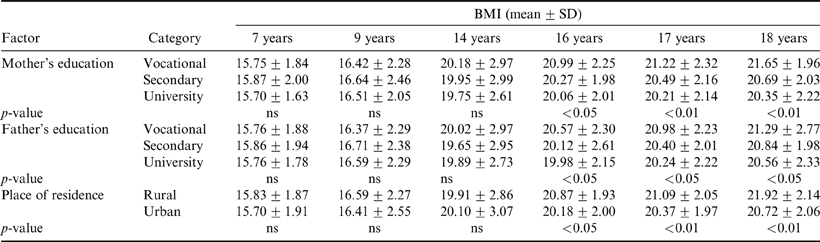
An analysis of BMI change in relation to age by socioeconomic group was performed for crude and standardized values (z-scores). In the latter case, 16-, 17- and 18-year-old girls were collated into a single age group. Table 1 presents mean BMI in age categories in relation to mother's education, father's education and place of residence. The results (main scores) did not reveal any significant differences in mean BMI value in relation to the analysed socioeconomic variables. Body mass index change with age depended on socioeconomic factors: mother's education (p<0.001) and father's education (p<0.01), as well as place of residence (p<0.001). Differences between means in respective socioeconomic groups increased with age. Statistically significant socioeconomic differences were noticeable only in the oldest age groups. Subjects whose mothers and/or fathers had higher education displayed the lowest BMI values. Town inhabitants had lower BMI values (Table 1).
Body mass index of Polish girls by age cohort and socioeconomic factors

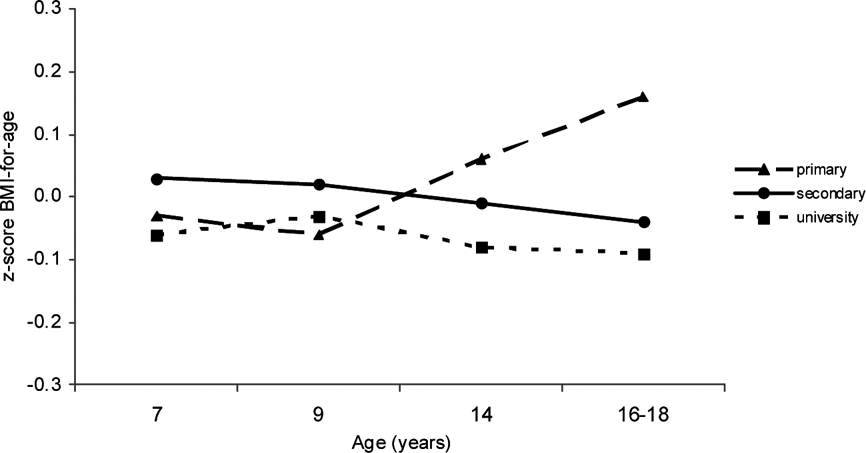
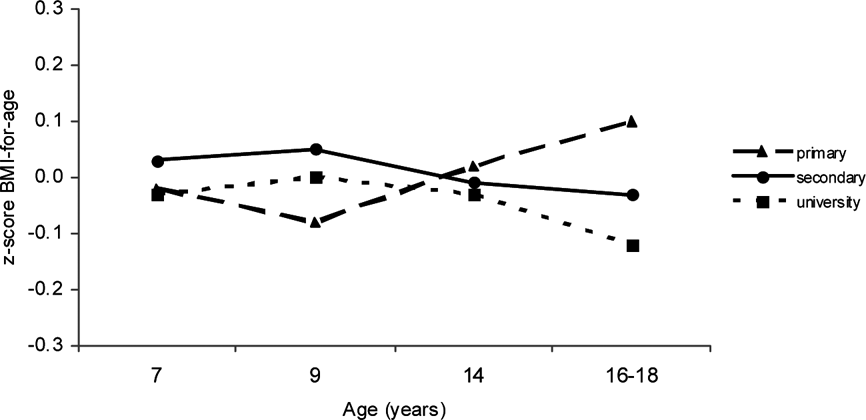
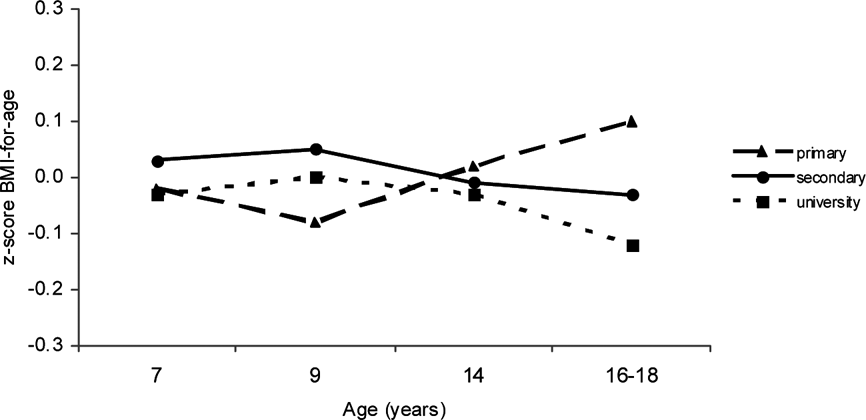
For standardized BMI-for-age z-scores, variance analysis of main effects did not reveal any significant differences in the dependence on age and on each of the analysed socioeconomic factors. Significant interactions were found between standardized BMI z-score changes with age and mother's education (p<0.001), father' education (p<0.01) and place of residence (p<0.001). For subjects whose mother had primary education, standardized BMI z-score rose with age, whereas for subjects whose mother had secondary or higher education it decreased with age (Fig. 1). The same relationship held for father's education (Fig. 2). Both factors had a significant impact on BMI only in the oldest age group.
BMI-for-age z-scores in relation to mother's education.
BMI-for-age z-scores in relation to father's education.
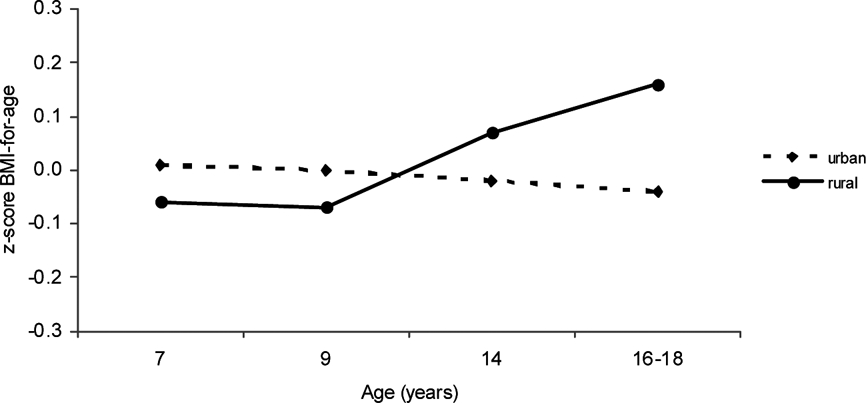
In the case of the changes in BMI-for-age z-scores in relation to ‘place of residence’ among subjects living in urban areas there was a drop, while among subjects from rural areas there was a rise (Fig. 3). Statistically significant differences between subjects in urban and rural areas were also visible in the oldest age group.
BMI-for-age z-scores in relation to place of residence.
Prevalence of underweight, overweight and obesity in relation to parent's education and place of residence
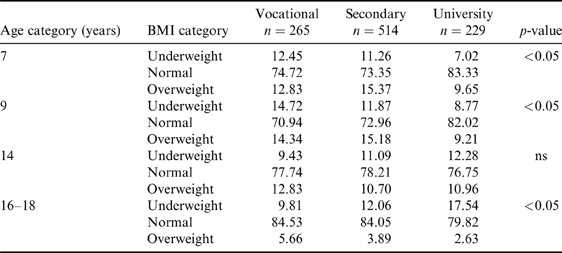
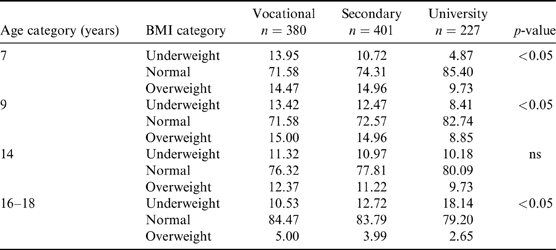
Tables 2, 3 and 4 show the prevalence of underweight, overweight and obesity, respectively, in relation to age and the analysed socioeconomic factors. In the younger age groups (7- and 9 year-olds), the percentage of subjects with normal body mass increased with mother's and/or father's level of education. The lowest prevalence of both underweight and overweight was observed in the group of subjects whose mothers and/or fathers had higher education. No significant differences in the prevalence of underweight and overweight were reported at the age of 14. Finally, in the oldest age group (16–18 years of age) the highest level of underweight, as well as the lowest level of overweight subjects, was among persons whose parents had higher education (Tables 2 and 3).
Prevalence of underweight and overweight in Polish girls by mother's education
Prevalence of underweight and overweight in Polish girls by father's education
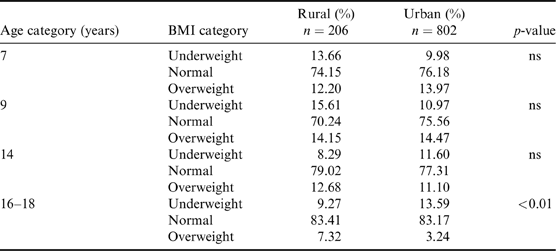
Prevalence of underweight and overweight in Polish girls by place of residence
When analysing the ontogenetic changes in the prevalence of underweight, overweight and obesity, it can be noted that among subjects whose mother and/or father has higher education the prevalence of underweight increased with age, and in other groups it remained at a similar level. As subjects grow up, there is a decline in the prevalence of overweight and obesity in all groups.
In the younger age categories (7- and 9-year-olds) underweight was less frequent in subjects from towns than in those from rural areas, while in the older categories (14, and 16–18 years of age) an opposite tendency was found. Significant differences in the prevalence of underweight, overweight and obesity depending on place of residence were recorded only in the oldest age category, i.e. in 16- to 18-year-olds. In comparison with town inhabitants, twice as many students from villages were either overweight or obese (Table 4).
Discussion
Underweight and obesity are held to be conditioned by genetic, socioeconomic and cultural factors. To verify whether the same environmental factors that modify the prevalence of overweight and obesity will also affect the prevalence of underweight is not an easy task. Results available in the scientific literature demonstrate that low socioeconomic status may be conducive to underweight and obesity alike (Delisle, Reference Delisle2008; Florencio et al., 2011; Subramanian et al., Reference Subramanian, Perkins, Ozaltin and Smith2011). Obviously, persons with limited financial resources cannot spend too much on food. They will either buy small amounts of food or the cheapest products, frequently low in nutrients but high in calories. Low-status persons often work physically, but much more rarely participate in physical exercise than do people of high status. Consequently, for persons who do not perform manual work, low status is associated with low amounts of physical activity. Similarly, high status may also contribute both to obesity and underweight (Neuman et al., Reference Neuman, Finlay, Smith and Subramanian2011; Subramanian et al., Reference Subramanian, Perkins, Ozaltin and Smith2011; Wronka et al., Reference Wronka, Suliga and Pawlińska-Chmara2011). The possibility of buying large amounts of various food products may lead to excessive weight gain; on the other hand, the cultural pressure to look perfect, particularly noticeable among persons of high status, often makes such people unduly concerned with their body weight. Weight reduction practices are not only undertaken by overweight and obese people, but also those of normal weight (Bauer & Kirchengast, Reference Bauer and Kirchengast2006; Mikolajczyk & Richter, Reference Mikolajczyk and Richter2008; Kapka-Skrzypczak et al., Reference Kapka-Skrzypczak, Bergier, Diatczyk, Niedźwiecka, Biliński and Wojtyła2012). Thus it is very difficult to establish an unambiguous relationship between SES, BMI and the prevalence of abnormal body mass.
The literature increasingly makes references to the phenomenon of ‘dual burden of body weight’, which describes the co-existence of overweight and underweight in the same population. This issue is observed in many societies undergoing a transition of their lifestyle and dietary habits. Even members of one family may significantly differ in weight status, with one being overweight and the other underweight (Price & Swiger, Reference Price and Swiger2012). Studies conducted in six countries (Brazil, China, Indonesia, the Kyrgyz Republic, Russia, Vietnam and the United States) indicate that this situation exists in 22–60% of households (Doak et al., Reference Doak, Adair, Bentley, Monteiro and Popkin2005). Dual burden is also observed in highly developed countries. In the US 50% of households with an underweight person also had an overweight person (Doak et al., Reference Doak, Adair, Bentley, Monteiro and Popkin2005).
The findings of the present work suggest a co-existence of underweight and overweight in childhood (7 and 9 years of age) among subjects whose parents had a vocational education. Along with an increase in the level of education, the number of children with normal body mass rose. The parental education factor affected in various ways the prevalence of abnormal body weight in girls during childhood rather than during adolescence or early adulthood. At a younger age, parents' higher education was associated with lower prevalence of abnormal body weight. In the group of subjects whose mother and/or father had higher education, the prevalence of underweight increased with age. In groups of subjects whose parents had vocational or secondary education no significant changes across age categories in the prevalence of underweight were observed. After the puberty period the prevalence of overweight and obesity droped rather markedly in all groups. Similar results have been reported in other Polish studies, as well as in other countries of the post-socialist bloc (Tutkuviene, Reference Tutkuviene2007; Vignerová et al., Reference Vignerová, Humeníková, Paulová and Riedlová2008; Zadzinska et al., Reference Zadzinska, Rosset, Koziel, Nawarycz, Borowska-Struginska and Lorkiewicz2011).
Parental education factors are considered reliable indicators of their socioeconomic status and key determinants of their children's lifestyle. A relationship has been demonstrated between parents' education, in particular mother's education, and dietary habits as well as the amount of physical exercise of children and adolescents. Children of parents with higher education more frequently engage in sports activities than children whose parents have vocational education. They also differ in terms of nutritional habits. Children whose parents have higher education more frequently have healthy dietary habits, and their diet is more balanced in terms of nutrients. Such differences stem partly from different income of people with high and low education levels. Knowledge of healthy nutrition and healthy lifestyle also plays an important role.
In some counties place of residence is also used as a status indicator. Numerous studies indicate that types of behaviour considered as detrimental to health are more frequent in rural environments (Hoffmann et al., Reference Hoffmann, Bryl, Marcinkowski, Strażyńska and Pupek-Musialik2011; Suliburska et al., Reference Suliburska, Bogdański, Pupek-Musialik, Głod-Nawrocka, Krauss and Piątek2012). Generally speaking, in industrialized countries a higher average living standard is observed in urban environments, resulting from the greater possibility of finding a well-paid job. Nevertheless, important social and economic changes in rural areas have been in progress since late 20th century. The result of those changes is the standardization of living conditions and lifestyles between village and town inhabitants. This is reflected in anthropometric characteristics, as in many countries no differences in body height or BMI values are reported between subjects from rural and urban areas.
The findings concerning the differences in the prevalence of abnormal body weight depending on place of residence are inconsistent. This is largely determined by how strongly the differences in economic conditions between city and village inhabitants are demonstrated. A higher prevalence of overweight and obesity among girls from rural areas has been reported in the US (Liu et al., Reference Liu, Bennett, Harun and Probst2008), Australia (McMurray et al., Reference McMurray, Harrell, Bangdiwala and Deng1999), Finland (Kautiainen et al., Reference Kautiainen, Koivisto, Koivusilta, Lintonen, Virtanen and Rimpela2009), Sweden (Neovius et al., Reference Neovius, Janson and Rossner2006), Italy (Bertoncello et al., Reference Bertoncello, Cazzaro, Ferraresso, Mazzer and Moretti2008), Russia (Wang et al., Reference Wang, Monteiro and Popkin2002) and Greece (Tambalis et al., Reference Tambalis, Panagiotakos and Sidossis2011). In Greece, however, certain studies suggest the opposite tendency (Tsimeas et al., Reference Tsimeas, Tsiokanos, Koutedakis, Tsigilis and Kellis2005). As for underweight, in the case of developing countries it is more frequently observed in rural rather than urban areas but it is worth noting that the majority of studies on the prevalence of underweight in developed countries concern only selected groups, mainly children and adolescents from poorer regions of the country.
Research done in Poland in 2005 among secondary school students from five regions showed that underweight was slightly more frequent in teenagers from villages than in towns. More obese girls were recorded in towns than in villages (Oblacińska & Jodkowska, Reference Oblacińska and Jodkowskiej2007). Disparate results were obtained when comparing children from rural areas of Eastern Poland with children living in Warsaw (Popławska et al., Reference Popławska, Dmitruk and Czeczuk2007). Girls from villages were more frequently overweight or obese than ones from urban areas.
According to the results of the present study, statistically significant socioeconomic differences in BMI are visible only in the oldest age group, i.e. 16–18 years of age. This concerns mother's education, father's education and place of residence factors alike. A similar tendency can be found in research publications from the United Kingdom (Batty & Leon, Reference Batty and Leon2002). In most studies no socioeconomic determinants of body fat level were found in childhood. However, several studies have revealed an association between socioeconomic status and adiposity in early adulthood.
Also, other data in research publications show that the influence of socioeconomic factors on BMI values and the prevalence of underweight, overweight and obesity may vary across age categories. The number of continuous studies is relatively low. A study monitoring BMI changes in children from southern England from birth to the age of 10 revealed that socioeconomic differences in body fat level become noticeable only after the age of 4 and grow in prominence with each year afterwards (Howe et al., Reference Howe, Tilling, Galobardes, Smith, Ness and Lawlor2011).
Cross-sectional studies suggest that socioeconomic differences in the prevalence of abnormal body mass often tend to vanish. This is explained by the fact that with age the family environment plays an increasingly less important role, and friends become the main influence. It was concluded that it is parents who have the greatest impact on the dietary habits of younger children, whereas for teenagers the role is taken over by their peers (Zabinski et al., Reference Zabinski, Daly, Norman, Rupp, Calfas and Sallis2006). Studies carried out among Swedish 18-year-olds have demonstrated that healthy habits are more strongly linked to whether, after leaving school, a person intended to go to college/university or start working than with their parents' education. Their lifestyle was influenced by their planned future socioeconomic position instead of their current socioeconomic status (Hagquist, Reference Hagquist2006).
Caring for appearance becomes more pronounced with age. In the adolescence period the number of young female subjects dissatisfied with their figure and body weight markedly increases, which leads to slimming diets. Although it is peers who have a substantial influence on their decision to slim, the effect of their mothers' encouragement should not be disregarded (Armstrong & Janicke, Reference Armstrong and Janicke2012). In the present study a rise in the prevalence of underweight with increasing age is noticeable in girls whose mothers had higher education. This may be caused by a desire to achieve a perfect, extremely slim figure. It is very likely that women with higher education, in comparison with women with vocational education, feel the pressure to look perfect and to indulge in weight control behaviour, with their daughters following their example.
The findings demonstrate that both family environment and neighbourhood, depending on the child's age, have different impacts on the prevalence of abnormal body mass. Abnormal body weight is observed in children of parents with higher education least often in childhood and most often in adulthood. At the age of 7, there are many more underweight girls in rural areas than there are in towns; at the age of 16–18 underweight is much more common in towns. Both factors have a significant impact on BMI changes with age. Parents' higher education and urban environment are associated with smaller BMI gains between the ages of 7 and 18 years and the occurrence of underweight in the age group 16–18 years.