Introduction
The term “caregiver burden” is most frequently used when measuring the impact of the caring experience, which has been found to be highly associated with poor outcomes for both caregivers and patients (Papastavrou et al., Reference Papastavrou, Kalokerinou, Papacostas, Tsagari and Sourtzi2007). In the previous literature, caregiver burden is described as a multidimensional response to physical, psychological, social, and financial demands from caring for patients (Etters et al., Reference Etters, Goodall and Harrison2008). Caregiver burden can be differentiated as objective (activities and consequences of negative caregiving experiences) and subjective (such emotional responses as anxiety, concern, and frustration). The general burden score, which sums up the objective and subjective burdens, is most frequently used because the objective and subjective burdens are strongly correlated (Zarit and Zarit, Reference Zarit and Zarit1987).
The AD patient may present with many different types of behavioral and emotional problems, along with the memory loss and other cognitive impairments. Those with AD often develop conditions that require intense attention and special personal care from caregivers (Gonyea et al., Reference Gonyea, O’Connor, Carruth and Boyle2005). An understanding of the particular elements of the disease and of the caregiving conditions that are closely associated with caregiver burden can be extremely helpful in predicting the level of intensity experienced, and in developing individual caregivers’ coping strategies accordingly.
Researchers have identified the determinants of caregiver burden and found that the degree of caregiver burden depends on several contextual factors, caregiving-related factors, and the socio-demographic characteristics of patients and caregivers (Kim et al., Reference Kim, Chang, Rose and Kim2011). The possible predictors of caregiver burden in dementia and their influence have been explained by several models, for example, the Lazarus and Folkman (Reference Lazarus and Folkman1984) stress-appraisal-coping model, the Poulshock and Deimling (Reference Poulshock and Deimling1984) two-dimensional model of psychosocial morbidity, the Haley et al. (Reference Haley, Levine, Brown and Bartolucci1987) stress and coping model, or the Pearlin et al. (Reference Pearlin, Mullan, Semple and Skaff1990) and Conde-Sala et al. (Reference Conde-Sala, Garre-Olmo, Turro-Garriga, Vilalta-Franch and Lopez-Pousa2010) stress process framework. These models included patient factors, such as socio-demographic characteristics and behavioral problems, self-care needs, and cognitive function, that were dementia related (Gallagher et al., Reference Gallagher2011; Kim et al., Reference Kim, Chang, Rose and Kim2011). In these models, the caregiver factors were categorized as caregiving context, caregiver health, coping, and competence (van der Lee et al., Reference Van der Lee, Bakker, Duivenvoorden and Droes2014). Complex models are expected to provide valuable insight into the relative importance of the determinants of caregiver burden. However, a recent systematic review of multivariate burden models identified that the sample sizes in the complex-model studies were not always large, which makes these findings sensitive in confidence. In the study by van der Lee et al. (Reference Van der Lee, Bakker, Duivenvoorden and Droes2014), it was recommended that patient and family caregiver determinants should be assessed using larger sample sizes.
Our own study used the concept of a stress process model (Pearlin et al., Reference Pearlin, Mullan, Semple and Skaff1990; Conde-Sala et al., Reference Conde-Sala, Garre-Olmo, Turro-Garriga, Vilalta-Franch and Lopez-Pousa2010). This model focused on the multidimensional factors of the determinants of caregiver burden and categorized the determinants of caregiver burden as contextual variables (socio-demographic factors of patients and caregivers), primary stressors related to patient symptoms or disease progression, and secondary stressors including difficulties arising from caregiving related situation.
The multidimensional factors of caregiver burden in AD have seldom been examined, or studied in only a small number of participants (Bae et al., Reference Bae2006; Lee et al., Reference Lee, Kim and Kim2006; Cheon, Reference Cheon2011; van der Lee et al., Reference Van der Lee, Bakker, Duivenvoorden and Droes2014). Thus, it was necessary to perform a large-scale, population-based survey that explored the multidimensional factors of AD patients and caregivers in order to provide reliable, specific information on caregiver burden.
Method
Sample
A secondary analysis of a large community dataset was conducted to evaluate caregiver burden in AD in South Korea. We analyzed the data from 1,133 AD patients and 1,133 primary caregivers registered in the online database of the Seoul Metropolitan Center for Dementia (Lee, Reference Lee2007). Primary caregivers aged over 18 years who were a relative or friend were considered to be eligible for the study. Data were collected between June 2010 and July 2012 for inclusion in the study. A medical research ethics review committee (IRB NO. H-1206-118-415) approved the study before it was conducted.
Participants aged over 60 years were eligible for the dementia screening test, which was conducted at district dementia support centers. The Mini-Mental State Examination (MMSE) (Lee et al., Reference Lee, Lee, Lee, Kim, Jhoo and Youn2002) was used to screen people with cognitive impairment using an adjusted cut-off score based on age, gender, and education level; patients identified as at high risk for dementia were further examined by the “Consortium to Establish a Registry for Alzheimer's Disease” (CERAD) to determine the severity of their cognitive impairment (Lee et al., Reference Lee, Lee, Lee, Kim, Jhoo and Youn2002). A diagnosis of dementia was confirmed by a medical practitioner based on the Diagnostic and Statistical Manual of Mental Disorders, Fourth Edition (DSM-IV; American Psychiatric Association, 1994), while AD was confirmed by the National Institute of Neurological and Communicative Disorders and Stroke and by the AD and Related Disorders Association (McKhann et al., Reference McKhann, Drachman, Folstein, Katzman, Price and Stadian1984).
Assessments
Multidimensional factors of individuals with AD and their caregivers were assessed. Socio-demographic data for patients included gender, age, and education. Dementia-related factors were examined within the following categories: cognitive functions, behavioral problems, activities of daily living (ADL) and IADL. Further information about patients’ other health problems was also obtained. In addition, four of the most frequently reported physical impairments among elderly persons were examined: vision problems, hearing loss, eating problems, and pressure ulcers (Minaker, Reference Minaker, Goldman and Schafer2011).
Cognitive function was measured by assessing memory, orientation, problem solving, and communication using the Seoul Dementia Care Assessment Packet (DCAP; Kim et al., Reference Kim, Chang, Rose and Kim2011). Four domains were examined and rated on a scale from 0 (no problem) to 3 (severe deterioration). Higher scores indicated problems related to cognitive function, with a maximum score of 12. Cronbach's α coefficient was found to be 0.89 in the current study.
Behavioral problems were measured by assessing violent behavior, wandering, denial, inappropriate social behavior, insomnia, and delusion using the DCAP (Kim et al., Reference Kim, Chang, Rose and Kim2011). Six domains were examined and rated on a scale from 1 (none) to 3 (almost every day: 6 to 7 times per week). Higher scores indicated more behavioral problems, with a maximum score of 18. Cronbach's α was found to be 0.82 for the sample used in this study.
ADLs were measured by assessing eating, washing, individual hygiene, dressing, using the bathroom, and movements. The Korean Activities of Daily Living (K-ADL) scale was used to evaluate the above (Won et al., Reference Won2002). Higher scores indicated more impairment of instrumental daily activities, with a maximum score of 27. A high internal consistency was observed, with a Cronbach's α coefficient of 0.96.
IADLs were measured by assessing the following: meal preparation, daily household chores, managing money, managing medication, using the telephone, buying products, and using transportation. The Korean Instrumental Activities of Daily Living (K-IADL) scale was used to evaluate the above (Won et al., Reference Won2002). Higher scores indicated more impairment of instrumental daily activities, with a maximum score of 21. A high internal consistency was observed, with a Cronbach's α of 0.95.
Socio-demographic data relating to caregivers were collected and interviews were conducted to evaluate the contextual factors related to caregiving. The primary caregivers were interviewed by trained nurses, with each interview lasting for about 30 minutes. Caregiver burden was measured using the Zarit Burden Interview (ZBI), which was developed to measure the subjective stress level of the caregivers (Zarit and Zarit, Reference Zarit and Zarit1987). The Korean version of the ZBI (ZBI-K) was used in this study. The ZBI-K essentially incorporates the same content as the original ZBI but the questionnaire items are worded carefully to reflect the Korean culture (Bae et al., Reference Bae2006). The ZBI covers those areas that have been most frequently reported by caregivers as problematic matters, including personal burden and role strain. Twenty-two items were scored on a 4-point scale ranging from 0 (“never”) to 4 (“nearly always”), quantifying the caregiver burden with a maximum score of 88. A high internal consistency was observed, with a Cronbach's α of 0.96.
Statistical analysis
The caregiver burden scores – based on the characteristics of both patients and caregivers – were analyzed using the t-test or ANOVA. Statistical significance was defined as p < 0.05 and data were analyzed using SPSS version 20.0 (SPSS, Inc., Chicago, IL, USA). To account for multiple comparisons, Scheffe's test was subsequently used to determine the differences between subgroups with each variable. A correlation matrix was constructed using Pearson's correlations to measure the linear dependence between variables and to identify their relationships with caregiver burden. Finally, a hierarchical multiple regression analysis was performed by entering study variables based on the theoretical framework. Prior to the regression analysis, all assumptions were checked including univariate and multivariate normality, linearity, homoscedasticity, and diagnostic testing for multicollinearity and error independence. After examining univariate normality, the number of hours of caregiving per day was converted using the log function. For multivariate normality, eight outliers were excluded based on critical values and degrees of freedom with the Mahalanobis distance function. Study variables were categorized into four blocks based on the theoretical framework in this study, the stress-process model. Each patient's sociodemographic variables were entered into Block 1, followed by the caregiver's demographic variables in Block 2, the patient's disease factors in Block 3, and caregiving-related variables in the final block. Modifiable variables were included in the last two blocks to suggest possible interventions that might benefit caregivers.
Results
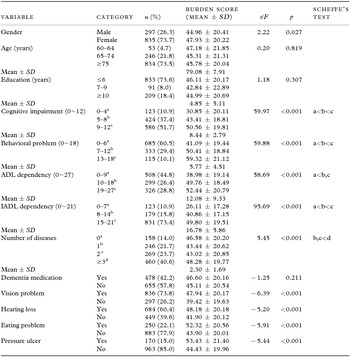
Table 1 presents caregiver burden scores according to the socio-demographic factors and dementia-related factors of patients. The AD patients comprised 297 (26.3%) men and 835 (73.7%) women, with the majority aged 75 years (73.5%; mean age = 79.08 years, range 60–103). Female patients were reported to present with a slightly higher caregiver burden than male patients (p < 0.001). No statistically significant differences were found among other demographic factors of the dementia patients, including age and level of education.
Descriptive of patient characteristics and caregiver burden

More advanced stages of disease progression were significantly associated with higher caregiver burden scores. Such patients scored high on cognitive impairment (p < 0.001), behavioral problems (p < 0.001), ADL dependency (p < 0.001), and IADL dependency (p < 0.001). Comorbidity also contributed to an increase in caregiver burden. Caregivers of patients with three or more comorbidities, in particular had significantly higher burden scores than caregivers of those with two diseases or fewer. Caregivers of patients with any kind of physical impairment or deterioration had significantly higher caregiver burden scores (p < 0.001).
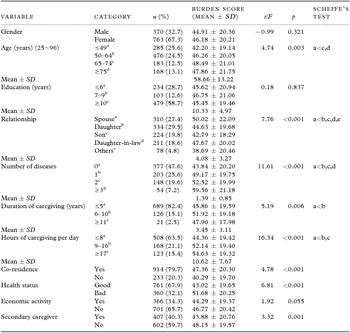
Table 2 presents caregiver burden scores according to the socio-demographic factors and caregiving factors of the caregivers. The majority of the caregivers were female (67.3%), and 37% of caregivers had over ten years of education. Female caregivers reported a higher level of caregiver burden than male caregivers. Caregivers aged less than 49 years had less caregiver burden than the other age groups. Of all types of caregivers, approximately 94% were immediate family of the patients, including spouses (28.7%), daughters (39.4%), sons (13.4%), and daughters-in-law (14.6%). Spouse caregivers had significantly higher caregiver burden than other family members (p < 0.001).
Descriptive of caregiver characteristics and caregiver burden

About 79.7% of the patients were living with their family caregivers and 18.7% of caregivers were performing their caregiving roles for at least 17 hours each day. Caregivers co-residing with patients had higher burden scores than caregivers who were not (p < 0.001). Caregivers spending more than nine hours per day caring for the patient reported significantly higher caregiver burden scores than caregivers who spent 8 hours or less on caregiving activities (p < 0.001). Caregivers who had provided care for more than 6 years reported a much heavier burden (p < 0.05) and those with no assistance had even higher burden scores (p < 0.001).
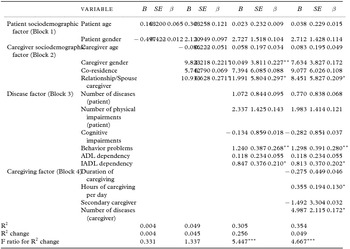
Study variables based on the theoretical framework were entered into a four-block hierarchical multiple regression model (Table 3). The socio-demographic factors of patients were grouped in Block 1, which comprised the age and gender of patients, representing 0.4% of variance in caregiver burden. The socio-demographic factors of caregivers were grouped in Block 2, which comprised the age, gender, co-residence, and type of relationship with the dementia patient, representing a variance increase of 4.5% in terms of caregiver burden. Dementia-related factors were categorized into Block 3, which comprised cognitive impairment, behavioral problems, and ADL/IADL dependency as well as a number of diseases and physical impairments, representing a variance increase of 25.6% for caregiver burden. This was the largest contributor to caregiver burden of all three categories, with F (6, 1,100) = 5.447, p < 0.001. Caregiving factors were grouped into Block 4, which comprised the duration of caregiving, presence of secondary caregiver, the hours of caregiving per day, and the number of diseases associated with the caregiver. The Block 4 factors increased the variance by 4.9%, with F (4, 1,009) = 4.667, p < 0.001. Examining the beta scores for individual factors, behavioral problems were found to be the greatest contributor to the variance (B = 1.298, β = 0.280), followed by spousal relationship with patient (B = 5.827, β = 0.209), IADL dependency (B = 0.813, β = 0.202), number of diseases associated with the caregiver (B = 4.987, β = 0.172), and hours of caregiving (B = 0.355, β = 0.130).
Hierarchical multiple regression model of factors determining caregiver burden

*p < 0.05, **p < 0.01, ***p < 0.001.
Discussion
This study examined the impact of multidimensional factors that have been considered to be associated with caregiver burden in AD based on a stress process model using large community data. Analyzing a large community dataset, caregiver burden was quantified to define the relationships between the multidimensional factors and the levels of caregiver burden. The study results identified that two categories (dementia-related factors and caregiving factors) of four factors explained caregiver burden significantly. In particular, dementia-related factors gave rise to more variance than socio-demographic factors of patient and family caregivers or caregiving factors. These results are consistent with the findings of other studies (Conde-Sala et al., Reference Conde-Sala, Garre-Olmo, Turro-Garriga, Vilalta-Franch and Lopez-Pousa2010; Kim et al., Reference Kim, Chang, Rose and Kim2011), which reported that patients’ dementia-related factors were more significant predictors of caregiver burden than caregiver or caregiving-related factors.
The findings of the study revealed that behavioral problems represented a more burdensome individual variable among dementia-related factors including cognitive impairment, behavioral problems, ADL and IADL dependency, and number of physical impairments (vision, hearing, eating, and pressure ulcers). In a recent systematic review (van der Lee et al., Reference Van der Lee, Bakker, Duivenvoorden and Droes2014) of 32 studies relating to subjective caregiver burden, behavioral problems (found in 79% of the studies) were cited as the most important determinants of caregiver burden, especially for caregivers of patients with AD. Psychiatric behavioral symptoms such as aggressive behavior, inactivity, and dangerous behavior require constant attention; this has been found to influence the decision of family caregivers in terms of whether to institutionalize the patients (Papastavrou et al., Reference Papastavrou, Kalokerinou, Papacostas, Tsagari and Sourtzi2007). This finding may be explained by the fact that many caregivers are able to accept the idea that an elderly patient loses cognitive skills, while they find behavioral problems more difficult to bear as such problems involve continuous monitoring and coping skills. It has also been suggested that strategies for coping with individual patients’ behavioral symptoms should be developed that consider the specific needs of family members, targeting the problems caused by AD.
However, Kim et al. (Reference Kim, Chang, Rose and Kim2011) reported that impairments in ADL and IADL represented the most variance in caregiver burden with general dementia. In this study, IADL dependency was the third most important variable for explaining the variance in caregiver burden, while ADL did not explain a significant amount of the variance. Difficulty with managing IADLs has been found to be particularly common in patients with AD as such tasks involve complex activities such as housekeeping and medication management (Farias et al., Reference Farias2009; Sussman and Regehr, Reference Sussman and Regehr2009; Conde-Sala et al., Reference Conde-Sala, Garre-Olmo, Turro-Garriga, Vilalta-Franch and Lopez-Pousa2010). Miyamoto et al. (Reference Miyamoto, Ito, Otuska and Kurita2002) found that caregivers of mobile patients with dementia reported a greater level of burden because of behavioral problems. Assessing the deficits in IADLs may be essential to understanding caregiver burden in AD. However, the assessment of functioning in AD is often related to deficits in ADLs and is conducted after objective cognitive impairment and a diagnosis of AD, while impairment of cognition and memory skills occurs later. Early assessment and intervention for IADL impairments in AD may significantly enhance our understanding and thereby reduce caregiver burden in AD.
In this study, caregiver gender was identified as a significant variable in explaining variance. Females tend to experience greater caregiver burden than males; however, spousal relationship, objective caregiving hours, and the number of diseases associated with the caregiver were more important determinants of caregiver burden than gender in this study. Spousal relationship was found to be a consistently significant factor, indicating that spousal relationship is a more significant determinant of burden than other factors. One cohort study reported that the risk of depression was four times higher in spouse caregivers than in controls (Joling et al., Reference Joling2010). Connell et al. (Reference Connell, Janevic and Gallant2001) found that spouse caregivers often suffer from age-related chronic disease, experiencing more difficulties as the care needs increase. In addition, in a close relationship, stronger emotional attachment to the patient may lead to a greater burden in the caregiver (Tremont et al., Reference Tremont, Davis and Bishop2006). It is therefore, important to develop specific interventions that target spouse caregivers when designing supportive programs for caregivers (Vernooij-Dassen and Downs, Reference Vernooij-Dassen and Downs2008).
In this analysis, time spent on caregiving activities was significantly associated with the level of caregiver burden. On average, caregivers in this study provided 10.6 hours of caregiving per day. Comparing caregiver burden with caregiving hours per day, the lowest score was observed in the caregiver group with less than 8 caregiving hours. When the time spent caregiving increased to more than 8 hours, the burden score increased significantly from 44.36 to 52.14 (out of 88). Studies have revealed that the total number of caregiving hours is closely related to the level of patient dependency; functional decline may increase the caregiving hours as well as the caregiver burden (Cho et al., Reference Cho, Cho and Kim2010; Gallagher et al., Reference Gallagher2011). When caregivers need to devote more time to caring for patients with dementia, caregivers are more likely to detach from their own support systems (Han et al., Reference Han2014). We need to find the trigger point in the number of hours spent caregiving so as to screen family caregivers.
In this study, caregiver's age was not a contributor of caregiver burden, while the number of diseases associated with the caregiver was a significant factor. Caregiver's age may be an indirect determinant of burden as older adult caregivers experience physical vulnerability in terms of an increasing number of diseases. Health was reported to be an important variable in previous burden studies and was shown to significantly increase the psychological distress of the caregiver (Conde-Sala et al., Reference Conde-Sala, Garre-Olmo, Turro-Garriga, Vilalta-Franch and Lopez-Pousa2010; van der Lee et al., Reference Van der Lee, Bakker, Duivenvoorden and Droes2014). These findings provide further evidence for the need for respite care to reduce the actual caregiving hours and for a health management program that addresses the physical health issues of caregivers.
The findings from this study provide evidence for the need to design individualized care services or caregiving skill-building programs that meet the multidimensional needs of families, caregiving for patients with different levels of behavioral problems and IADL dependency. In addition, information relating to the relative importance of each risk factor and the significance of individual variables is provided by this study. Caregivers at high risk should be identifiable by thorough analysis and examination of the data they collected relating either to the patient diagnosed with AD or to their caregiver seeking support. All aspects of caregiving activities should be considered in this process, with an evaluation of any factors that may contribute to a greater caregiver burden. A comprehensive assessment that identifies modifiable factors, such as caregiving factors or other critical factors, will help clinicians to develop more effective strategies or interventions.
Several limitations were identified in this study. Although the associations identified in this study suggest temporal relations, longitudinal analyses are also required for the evaluation of causality, mediation, and time-order effects. Moreover, with the cross-sectional analysis, it is not confirmed whether the increased burden is results from cognitive or physical impairment of patients. A highly burdened caregiver may have a tendency to neglect the cognitive or physical support of patients with dementia. Another limitation of this study is that there may be a risk of making a Type 1 error as several analyses were conducted on the same variables, although a multiple-comparison procedure, the Scheffe method, was used to reduce this limitation. Clinical or practical significance in caregiver burden between groups should be interpreted with caution in some variables. When statistical differences of burden score were found between male and female caregivers and those with a number of diseases, a few points’ difference in means may not be clinically or practically significant. Lastly, the variables in this study are limited to demographic factors, dementia-related factors, and caregiving factors, some of which are not modifiable with interventions. In future research, other modifiable variables such as sense of competence and self-efficacy in caregivers, and existing coping strategies could be investigated in terms of their influence on burden scores (Lee et al., Reference Lee, Kim and Kim2006; Choi and Kim, Reference Choi and Kim2010). By the implementation of education and support programs, such variables may be modifiable, leading to a reduction in caregiver burden. In spite of its limitations, the current study also has its strength. Importantly, it provides information about both patient and caregiver determinants and the relationships between caregiver burden and various characteristics of patients with AD and their caregivers, using a large community database from South Korea. Most previous studies about caregiver burden involved only a small number of participants or limited variables.
In conclusion, the findings identify the importance of assessing the multidimensional factors involved in caregiver burden and of developing an individualized approach to alleviate caregiver burden in AD. Caregivers’ status should be assessed individually to identify the factors that cause a high level of caregiver burden. There is a need for individualized recommendations and education for family caregivers so that they can cope with specific behavioral symptoms and IADL deficiency in patients with AD at home. In addition, by increasing the formal and tangible support provided at home, the time spent caregiving can be reduced, thus enabling the family to provide more companionship and to nurture quality of life, rather than spending their time solely meeting basic needs. There has been an increase in elderly-couple households while caregiving by child caregivers is decreasing. Therefore, efforts should be made to develop a psychological and physical support system for elderly spouse caregivers.
Conflict of interest
None.
Description of authors’ roles
M. Park, S. K. Kim and S. J. Kim contributed to the conceptualization, data analysis and preparation of the paper. M. Sung contributed data collection and analysis. D. Y. Lee contributed to data management and manuscript preparation. M. Park designed the study and completed the paper.
Acknowledgments
This study was supported by a grant from the Seoul Metropolitan Center for Dementia (SMCD) and the Basic Science Research Program through the National Research Foundation of Korea (NRF) funded by the Ministry of Science, ICT and Future Planning (NRF-2013R1A2A2A01069090).