INTRODUCTION
The alpheid shrimp fauna of the southern Gulf of Mexico is relatively well known, with important contributions made by Román-Contreras (Reference Román-Contreras, Yañez-Arancibia and Day1988), Hernández-Aguilera et al. (Reference Hernández-Aguilera, Toral-Almazán and Ruiz-Nuño1996), Martínez-Iglesias et al. (Reference Martínez-Iglesias, Carvacho and Ríos1996), Álvarez et al. (Reference Álvarez, Villalobos, Rojas and Robles1999), McClure (Reference McClure, Hernández-Aguilera, Ruiz-Nuño, Toral-Almazán and Arenas-Fuentes2005), Hermoso-Salazar & Arvizu-Coyotzi (Reference Hermoso-Salazar, Arvizu-Coyotzi, Granados-Barba, Abarca-Arenas and Vargas-Hernández2007), Hernández et al. (Reference Hernández, Álvarez and Villalobos2010) and Anker (Reference Anker2010, Reference Anker2012). The most recent checklist of decapods of the entire Gulf of Mexico (Felder et al., Reference Felder, Álvarez, Goy, Lemaitre, Felder and Camp2009) included eight genera and 61 species of the family Alpheidae, to which Anker (Reference Anker2010, Reference Anker2012) and Anker & Nizinski (Reference Anker and Nizinski2011) added one genus and nine species, more precisely eight shallow-water species from Alacranes Reef (Campeche Bank) and Florida (Tampa Bay, Florida Keys), and one deep-water species collected in the northern section of the gulf, off Louisiana. However, considering both the great variety of habitats in the Gulf of Mexico (shallow coral reefs, seagrass beds, mangroves, estuaries, mixed sand–rock bottoms, deep-water coral reefs, etc.) and the even greater diversity of alpheids in the nearby Caribbean Sea, the above number (70 species) is far from being the final total, as the present study will demonstrate. The generally very cryptic life style of alpheid shrimps, their challenging taxonomy and the relatively scarce alpheid-focused sampling in the southern area of the Gulf of Mexico are the main factors responsible for the still insufficient knowledge of this important group in the region.
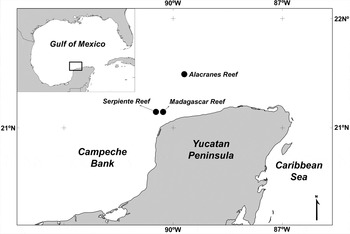
In order to increase our knowledge of the Alpheidae (and other Decapoda) in the south-western Gulf of Mexico several surveys have been conducted on coral reef systems off Mexico's northern Yucatan Peninsula, in August 2008, August 2009 and June 2011. The surveyed sites included Alacranes Reef (22°29′16.12″N 89°41′5.89″W), Madagascar Reef (21°26′17.00″N 90°16′38.20″W) and Serpiente Reef (21°26′28.30″N 90°17′34.00″W) (Figure 1). Sampling was done by push nets, suction pumps, or by hand: flipping rocks, breaking coral rubble and conch shells, opening of potential hosts, mainly sponges, etc., both by snorkelling and SCUBA diving (1–30 m).
Location of Alacranes, Madagascar and Serpiente Reefs in the Gulf of Mexico.

Using the above-described methods, over 25 alpheid species were collected at the three surveyed reefs. Eight species represented noteworthy range extensions into the southern Gulf of Mexico, with most of them being also new records for the Gulf of Mexico and/or the Mexican territorial waters. These eight species are reported herein, with brief comments on their biology, taxonomy and geographical range. Colour photographs are provided for most for them. The Mexican specimens are deposited in the carcinological reference collection (YUC-CC-255-11) of the Universidad Nacional Autónoma de México, Sisal, Mexico (UMDI-Sisal). Additional specimens examined as comparative material are deposited in the Florida Museum of Natural History, University of Florida, Gainesville, FL, USA (FLMNH UF). Carapace and total length (CL, TL) are given in mm and were measured from the tip of the rostrum to the posterior margin of the carapace and telson, respectively.
RESULTS
SYSTEMATICS
Family ALPHEIDAE Rafinesque, Reference Rafinesque1815
Genus Alpheus Fabricius, Reference Fabricius1798
Alpheus immaculatus Knowlton & Keller, Reference Knowlton and Keller1983
(Figure 2A, B)
Alpheus immaculatus Knowlton & Keller, Reference Knowlton and Keller1983: 354, figures 1A–E, 2A–F, 3A–H, 4A; Knowlton & Keller, Reference Knowlton and Keller1985: 893, figures 1–5; Almeida & Anker, Reference Almeida and Anker2011: 1, figures 23, 24.
MATERIAL EXAMINED
Mexico. YUC-CC-255-11-000137: 1 male (CL 11.0, TL 30.0), Gulf of Mexico, Alacranes Reef, Station ALN01, 22°23′42.7″N 89° 42′20″W, depth 9 m, with Bartholomea annulata, leg. J. Duarte, 1 August 2009; YUC-CC-255-11-000138: 1 ovigerous (ov.) female (CL 12.0, TL 33.0), Gulf of Mexico, Alacranes Reef, Station ALN01, 22°23′42.7″N 89° 42′20″W, depth 9 m, with B. annulata, leg. J. Duarte, 1 August 2009; YUC-CC-255-11-000238: 1 male (CL 11.0, TL 22.0), 1 ov. female (CL 14.0, TL 36.0), Gulf of Mexico, Serpiente Reef, Station Ser-002, 21°26′22.30″N 90°28′25.40″W, depth 8 m, with B. annulata leg. J. Duarte, 13 June 2011.
TYPE LOCALITY
East Discovery Bay, Jamaica (Knowlton & Keller, Reference Knowlton and Keller1983).
HABITAT
Sand flats with abundant rubble and coral rubble fields, obligate associated of the cork-screw sea anemone Bartholomea annulata (Le Sueur); depth range: 8–17 m (Knowlton & Keller, Reference Knowlton and Keller1983, Reference Knowlton and Keller1985; Almeida & Anker, Reference Almeida and Anker2011; present study).
DISTRIBUTION
Caribbean Sea: Venezuela, Curaçao, Haiti, Jamaica; Gulf of Mexico: Alacranes and Serpiente Reefs off Mexico (Knowlton & Keller, Reference Knowlton and Keller1983, Reference Knowlton and Keller1985; Almeida & Anker, Reference Almeida and Anker2011; present study).
REMARKS
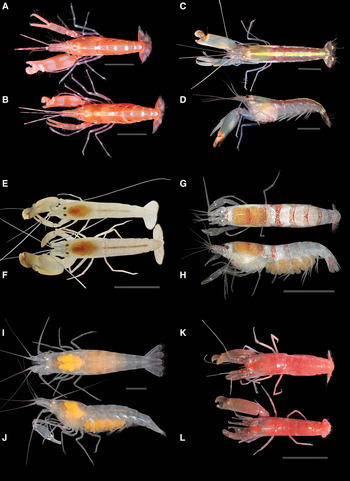
In the southern Gulf of Mexico, A. immaculatus can be easily confused with the closely related A. armatus Rathbun, Reference Rathbun1901, another obligate associate of B. annulata. In the field, the two species can be separated by colour pattern, more precisely, by the absence of bright yellow-green spots in A. immaculatus (Figure 2A, B); these spots are very conspicuous in A. armatus. The best morphological character to separate A. immaculatus from A. armatus is the length and ratio of the rostrum, which is generally longer and more slender in the former species (Knowlton & Keller, Reference Knowlton and Keller1985; Almeida & Anker, Reference Almeida and Anker2011). The Alacranes and Serpiente Reef specimens represent the first record of A. immaculatus for the Gulf of Mexico.
Some snapping shrimps from the south-western Gulf of Mexico reported in this study: (A, B) Alpheus immaculatus (A: YUC-CC-255-11-000137, male; B: YUC-CC-255-11-000138, female); (C, D) Alpheus paraformosus (C: YUC-CC-255-11-000177, female; D: YUC-CC-255-11-000175; male); (E, F) Alpheus punctatus (E: YUC-CC-255-11-000849, male; F: YUC-CC-255-11-000850, female); (G, H) Parabetaeus hummelincki (YUC-CC-255-11-000238, ov. female.; (I, J) Salmoneus depressus (YUC-CC-255-11-000228, ov. specimen); (K, L) Synalpheus dominicensis (YUC-CC-255-11-000151, 2 different males); Scales: A-F: 10 mm; G-I: 5 mm; (all photographs by J. Duarte, except E and F by D. Santana-Moreno).

Alpheus paraformosus Anker, Hurt & Knowlton, Reference Anker, Hurt and Knowlton2008
(Figure 2C, D)
Alpheus paraformosus Anker et al., Reference Anker, Hurt and Knowlton2008: 12, figures 5, 6, 7f–h.
MATERIAL EXAMINED
Mexico. YUC-CC-255-11-000175: 1 male (CL 8.0, TL 22.0), Gulf of Mexico, Alacranes Reef, Station ALN31, 22°23′2.18″N 89°37′55.60″W, depth 3 m, in coral rubble, leg. J. Duarte, 9 August 2009; YUC-CC-255-11-000177: 1 ov. female (CL 10.0, TL 29.0), Gulf of Mexico, Alacranes Reef, Station ALN30, 22°23′5.60″N 89°38′22.70″W, depth 1.5 m, inside dead conch, leg. J. Duarte, 9 August 2009.
EXTRALIMITAL MATERIAL EXAMINED
St Martin. FLMNH UF 32393 (BSTM-1412): 1 male (CL TL not measured), Ilet de l'Embouchure, sand flat with seagrass and rubble, depth 0.5–1 m, under/in coral rubble, leg. A. Anker et al., 22 April 2012.
TYPE LOCALITY
Punta Coco, San Cristobal, Bocas del Toro, Panama (Anker, et al., Reference Anker, Hurt and Knowlton2008).
HABITAT
Mixed sand–rubble bottoms, in crevices of coral rocks or conglomerates of dead corals among turtle grass (Thalassia testudinum), occasionally in empty conch shells (Lobatus gigas Linnaeus); depth range 0–3 m (Anker, et al., Reference Anker, Hurt and Knowlton2008; present study).
DISTRIBUTION
Caribbean Sea: Panama, Honduras, St Martin; Gulf of Mexico: Alacranes Reef off Mexico (Anker, et al., Reference Anker, Hurt and Knowlton2008; present study).
REMARKS
The specimens from Alacranes Reef and St Martin correspond closely to the original description in Anker et al. (Reference Anker, Hurt and Knowlton2008) both in morphology and colour pattern (Figure 2C, D). In both sexes, the minor cheliped fingers are lacking balaeniceps setae, a feature distinguishing A. paraformosus from the closely related A. formosus Gibbes, Reference Gibbes1850. The presence of A. paraformosus in Alacranes Reef extends its previously known range from Honduras northwards into the Gulf of Mexico; it is also the first record of this species for Mexico. The specimen from St Martin extends its range even more significantly eastwards, indicating that the species' distribution is spanning the entire Caribbean Sea, as predicted by Anker et al. (Reference Anker, Hurt and Knowlton2008).
Alpheus punctatus Anker, Reference Anker2012
(Figure 2E, F)
Alpheus punctatus Anker, Reference Anker2012: 50, figures 33–37, 64F, 65F, 66F, 67F, 69E.
MATERIAL EXAMINED
Mexico. YUC-CC-255-11-000849: 1 male (CL 5.4, TL 17.2), Gulf of Mexico, Campeche Bank, Station CHAMPOTON, 19°25′50.38″N 90°46′53.94″W, depth 6 m, in eroded conch shell, leg. D. Santana-Moreno, 23 May 2005; YUC-CC-255-11-000850: 1 female (CL 6.0, TL 18.7), same collection data as for previous specimen.
TYPE LOCALITY
Bocas del Toro, Panama (Anker, Reference Anker2012).
HABITAT
Near-shore reef flats with abundant coral rubble, coral debris, Thalassia patches and Halimeda clumps, sometimes in empty conch shells; depth range 0.5–9 m (Anker, Reference Anker2012; present study).
DISTRIBUTION
Caribbean Sea: Panama, Costa Rica, British Virgin Islands; Gulf of Mexico: Campeche Bank off Mexico, gulf side of Florida Keys (Anker, Reference Anker2012; present study).
REMARKS
The specimens from the Campeche Bank represent the first record of A. punctatus for the Mexican territorial waters. The two Mexican specimens at CL 5.4 and 6.0 mm are young adults, being much smaller in size compared to the type specimens from Panama (holotype with CL 10.5 mm). However, they agree with the specimens reported by Anker (Reference Anker2012) in all morphological features and also in the diagnostic colour pattern (Figure 2E, F). In the southern Gulf of Mexico, A. punctatus may be confused with A. amarillo Anker, Reference Anker2012, which is known from Alacranes Reef (Anker, Reference Anker2012). However, A. punctatus can be separated from A. amarillo by the unarmed sternites of the first and second abdominal somites, the larger plunger on the dactylus of the major chela, and in life, also by the colour pattern (see Anker, Reference Anker2012).
Genus Parabetaeus Coutière, Reference Coutière1897
Parabetaeus hummelincki (Schmitt, Reference Schmitt1936)
(Figure 2G, H)
Alpheopsis hummelincki Schmitt, Reference Schmitt1936: 364, plate 11, figure 1.
Neoalpheopsis hummelincki—Chace, Reference Chace1972: 78.
Parabetaeus hummelincki—Nomura & Anker, Reference Nomura and Anker2001: 52; Anker, Reference Anker2007: 34; Anker, Reference Anker2011a: 1, figures 1–3.
Neoalpheopsis euryone —Manning & Chace, Reference Manning and Chace1990: 17 [not De Man, 1910].
MATERIAL EXAMINED
Mexico. YUC-CC-255-11-000238: 1 ov. female (CL 3.9, TL 11.0), Gulf of Mexico, Serpiente Reef, Ser-002, 21°26′22.30″N 90°28′25.40″W, depth 12 m, in crevices of dead corals, leg. J. Duarte, 13 June 2011.
TYPE LOCALITY
Bonaire (Schmitt, Reference Schmitt1936).
HABITAT
Sand–rubble flats, with abundant shelter in the form of coral rocks, debris, calcareous algae; depth range: 0.5–12 m (Anker, Reference Anker2007, Reference Anker2011a; present study).
DISTRIBUTION
Caribbean Sea: Mexico (Cozumel Island), Venezuela (Los Roques), Dominican Republic, Bonaire, St Vincent; Gulf of Mexico: Serpiente Reef off Mexico; Bermuda; Brazil: Trindade, Atol das Rocas; Ascension Island; Saõ Tomé (Schmitt, Reference Schmitt1936; Chace, Reference Chace1972; Manning & Chace, Reference Manning and Chace1990; Anker, Reference Anker2007, Reference Anker2011a; present study).
REMARKS
Parabetaeus hummelincki is widely distributed in the Atlantic Ocean, ranging from the southern Gulf of Mexico, Bonaire and Bermuda in the western Atlantic, to the Gulf of Guinea (São Tomé) in the eastern Atlantic, encompassing the central Atlantic Ascension Island and offshore islands of Brazil (Trindade, Atol das Rocas). However, throughout the range, this species seems to be uncommon and difficult to collect, being very swift. Our single specimen from Serpiente Reef (Figure 2G, H) represents the first record of P. hummelincki for the Gulf of Mexico, extending its range slightly northwards from Cozumel Island in the Mexican Caribbean (Anker, Reference Anker2011a).
Genus Salmoneus Holthuis Reference Holthuis1955
Salmoneus depressus Anker, Reference Anker2011b
(Figure 2I, J)
Salmoneus depresus Anker, Reference Anker2011b: 44, figures 4–6; Anker et al., Reference Arthur, Joel, Paulo and Marcos2013: 452, figs. 1, 2.
MATERIAL EXAMINED
Mexico. YUC-CC-255-11-000228: 1 ov. specimen (CL 4.9, TL 17.0), Gulf of Mexico, Madagascar Reef, Station Mad-003, 21°26′17.00″N 90°16′38.20″W, depth 15 m, in crevices of dead corals, leg. J. Duarte, 11 June 2011; YUC-CC-255-11-000229: 1 ov. specimen (CL 5.9, TL 18.0), same collection data as for previous specimen.
TYPE LOCALITY
Bocas del Toro, Panama (Anker, Reference Anker2011b).
HABITAT
Sand flats with abundant dead corals, coral rubble, often close to seagrass meadows and mangroves, under rubble, in crevices, also in eroded conch shells and empty urchin tests; depth range: 1–15 m (Anker, Reference Anker2011b; present study).
DISTRIBUTION
Caribbean Sea: Panama, Venezuela, Barbados; Gulf of Mexico: Madagascar Reef off Mexico (Anker, Reference Anker2011b; present study); Brazil: São Paulo (Anker et al., Reference Arthur, Joel, Paulo and Marcos2013).
REMARKS
Salmoneus depresus is characterized by the presence of a deep, dent-like depression on the mediodorsal surface of the carapace (Anker, Reference Anker2011b), which is very obvious in the herein reported specimens (visible in lateral view of the shrimp in Figure 2J). The material from Madagascar Reef is a considerable northward range extension for this species and also represents the first record for the Gulf of Mexico and Mexican territorial waters.
Genus Synalpheus Spence Bate Reference Spence Bate and Murray1888
Synalpheus chacei Duffy, Reference Duffy1998
Synalpheus chacei Duffy, Reference Duffy1998: 389, figures 1–5; Duffy et al., Reference Duffy, Morrison and Rios2000: 504, figures 1–3; Hultgren & Duffy, Reference Hultgren and Duffy2011: 356, figures 1, 2; Anker et al., Reference Anker, Pachelle, De Grave and Hultgren2012: 33, figure 21.
Zuzalpheus chacei—Ríos & Duffy, Reference Ríos and Duffy2007: 16, plate 2.
MATERIAL EXAMINED
Mexico. YUC-CC-255-11-000205: 5 adult males (CL 3.9, TL 9.0), 2 juvenile males (CL 1.5–2.9, TL 4.1–6.1), Gulf of Mexico, Alacranes Reef, 22°29′16.12″N 89°41′5.89″W, depth 8 m, leg. N. Simões, in Agelas sp., August 2008.
TYPE LOCALITY
Carrie Bow Cay, Belize (Duffy, Reference Duffy1998).
HABITAT
This species lives in social colonies (aggregations of dozens, sometimes hundreds of individuals) in several species of sponges, Agelas dispar Duchassaing & Michelotti, Agelas clathrodes (Schmidt), Hyattella intestinalis (Lamarck), Ectyoplasia ferox (Duchassaing & Michelotti), Lissodendoryx strongylata van Soest, L. colombiensis Zea & van Soest and Niphates amorpha Wiedenmayer, at a depth range of 2–20 m (Duffy, Reference Duffy1998; Ríos & Duffy, Reference Ríos and Duffy2007; Anker et al., Reference Anker, Pachelle, De Grave and Hultgren2012).
DISTRIBUTION
Caribbean Sea: Belize, British Virgin Islands, Panama; Gulf of Mexico: Alacranes Reef (Duffy, Reference Duffy1998; Ríos & Duffy, Reference Ríos and Duffy2007; Anker et al., Reference Anker, Pachelle, De Grave and Hultgren2012; present study).
REMARKS
The material from Alacranes Reef is the first record of S. chacei for the Gulf of Mexico. The species can be distinguished from other species of Synalpheus by the presence of two rows of gambarelloid setae on the minor cheliped (Duffy, Reference Duffy1998; Ríos & Duffy, Reference Ríos and Duffy2007; Anker et al., Reference Anker, Pachelle, De Grave and Hultgren2012).
Synalpheus dominicensis Armstrong, Reference Armstrong1949
(Figure 2 K, L)
Synalpheus dominicensis Armstrong, Reference Armstrong1949: 23, figure 8; Chace, Reference Chace1972: 92; Duffy, Reference Duffy and Kikuchi2002: 5, figure 1; Anker et al., Reference Anker, Pachelle, De Grave and Hultgren2012: 37, figure 24.
MATERIAL EXAMINED
Mexico. YUC-CC-255-11-000151: 6 males (CL. 2.9–4.0, TL 6.0–9.0), Alacranes Reef, ALN09, 22°22′43.6″N 89°39′03.9″W, depth 10 m, leg. J. Duarte, N. Simões, 4 August 2009.
TYPE LOCALITY
Piedra Prieta Reef, Barahona, Dominican Republic (Armstrong, Reference Armstrong1949).
HABITAT
Coral reefs and associated habitats, typically in crevices of eroded corals, rarely in sponges (Macdonald, et al., Reference Macdonald, Hultgren and Duffy2009; Anker, et al., Reference Arthur, Joel, Paulo and Marcos2013).
DISTRIBUTION
Caribbean Sea: Panama, Cuba, Jamaica, Dominican Republic, St Martin; Gulf of Mexico: Alacranes Reef; Bahamas: Anguilla and Damas Cays (Armstrong, Reference Armstrong1949; Lemaitre, Reference Lemaitre1984; Anker, et al., Reference Anker2012; present study).
REMARKS
Synalpheus dominicensis is fairly common in the Caribbean Sea and the Bahamas, but has not been previously recorded from the Gulf of Mexico. The present material also represents the first record of this species for the Mexican territory. The two most useful diagnostic features of S. dominicensis distinguishing it from all other species in the western Atlantic are the presence of movable spines on the ventral margin of the third pereiopod merus (Armstrong, Reference Armstrong1949) and the uniform, deep-red colour (Figure 2 K, L; see also Anker et al., Reference Anker, Pachelle, De Grave and Hultgren2012).
Synalpheus elizabethae (Ríos & Duffy, Reference Ríos and Duffy2007)
Zuzalpheus elizabethae Ríos & Duffy, Reference Ríos and Duffy2007: 23, figures 7–10, plate 2.
Synalpheus elizabethae—MacDonald et al., Reference Macdonald, Hultgren and Duffy2009: 23, figure 10; Hultgren & Duffy, Reference Hultgren and Duffy2011: 356, figures 1, 2; McGrew & Hultgren, Reference McGrew and Hultgren2011: 196, figures 1–5; Anker et al., Reference Anker, Pachelle, De Grave and Hultgren2012: 39, figure 25.
MATERIAL EXAMINED
Mexico. YUC-CC-255-11-000206: 10 males (CL 1.1–3.0, TL 3.3–6.1), Gulf of Mexico, Alacranes Reef, 22°29′16.12″N 89°41′5.89″W, depth 8 m, unidentified sponge, leg. N. Simões, August 2008.
TYPE LOCALITY
Carrie Bow Cay, Belize (Ríos & Duffy, Reference Ríos and Duffy2007).
HABITAT
Coral reefs and adjacent rubble habitats, in eusocial colonies in sponges, e.g. Lissodendoryx colombiensis, L. cf. strongylata, Hymeniacidon caerulea and Aiolochroia crassa; depth range: 0.5–18 m (Ríos & Duffy, Reference Ríos and Duffy2007; Anker et al., Reference Anker, Pachelle, De Grave and Hultgren2012).
DISTRIBUTION
Caribbean Sea: Belize, Honduras, Costa Rica, Panama, Jamaica; Bahamas: Lee Stocking Island; Gulf of Mexico: Florida Keys, Alacranes Reef (Ríos & Duffy, Reference Ríos and Duffy2007; Macdonald et al., Reference Macdonald, Hultgren and Duffy2009; Anker et al., Reference Anker, Pachelle, De Grave and Hultgren2012; present study).
REMARKS
In the Gulf of Mexico, S. elizabethae was previously known only from the south-eastern corner (Florida Keys). Thus the specimens from Alacranes Reef represent the first record of this species for the south-western Gulf of Mexico and Mexican territorial waters. Synalpheus elizabethae is closely related to S. rathbunae Coutière, Reference Coutière1909, which appears to be present in the southern Gulf of Mexico (Felder, et al., Reference Felder, Álvarez, Goy, Lemaitre, Felder and Camp2009). A comparative table listing morphological characters used in the separation of species of the S. rathbunae species complex can be found in Ríos & Duffy (Reference Ríos and Duffy2007).
ACKNOWLEDGEMENTS
Field and laboratory based work was supported by CONACyT grants SEMARNAT-108285 and DGAPA-PAPIME-PE207210 (UNAM) to N.S. All specimens were collected under the Mexican Government collecting permit 11802.271109.4094. We thank SEMAR, SCT and CONANP staff at Alacranes National Park, for their helpful assistance with transportation, accommodation and logistics during fieldwork. Gemma Martínez-Moreno, Maribel Badillo-Alemán and Patricia Guadarrama-Chávez (UNAM-Sisal) helped with general laboratory work. Rigoberto Moreno-Mendoza (UADY), Daniel Santana-Moreno and Diana Ugalde (ICMyL, UNAM) helped in the field. Alfredo Gallardo-Torres organized field logistics; boats were operated by Fernando Mex (UNAM-Sisal—‘Kaak-Naab') and Don Marce, Rafa and Melitón ('El Arlequín'). The following colleagues contributed with useful comments or literature: Carlos Paz-Rios, Alma Morelos-Villegas, María Teresa Herrera-Dorantes (Cinvestav-Mérida) and Paulo P.G. Pachelle (UFC, Fortaleza, Brazil). Additional colour photographs were provided by Daniel Santana-Moreno and edited by Alberto Guerra.