BACKGROUND
Preventing catheter-associated urinary tract infection (CAUTI) is a national safety priority and has been adopted as a metric by the Centers for Medicare and Medicaid Services to optimize outcomes. 1 – Reference Fakih, George, Edson, Goeschel and Saint 3 The risk of developing a CAUTI starts upon insertion and increases daily until catheter removal; this risk is also affected by patient characteristics.Reference Chenoweth and Saint 4 , Reference Meddings and Saint 5 In addition to urinary tract infection (UTI), the presence of the urinary catheter may lead to unnecessary urine cultures, associated inappropriate use of antimicrobials,Reference Cope, Cevallos, Cadle, Darouiche, Musher and Trautner 6 colonization and outbreaks of multidrug-resistant Gram-negative organisms,Reference Jacob, Klein and Laxminarayan 7 , Reference Sievert, Ricks and Edwards 8 and Clostridium difficile infection.Reference Drekonja, Rector, Cutting and Johnson 9 Noninfectious complications such as urethral and bladder traumaReference Hollingsworth, Rogers and Krein 10 and impaired mobilityReference Saint, Lipsky and Goold 11 are also salient patient harms related to the catheter. Our objectives are to discuss the current outcome measures used to evaluate CAUTI events and to address their strengths and limitations in the context of both clinical practice and healthcare policy. We conclude by emphasizing the benefits of using the device utilization ratio (DUR) as an additional performance measure that reflects the risk of both infectious and noninfectious harm associated with the catheter.
Outcomes Currently Used to Evaluate CAUTI
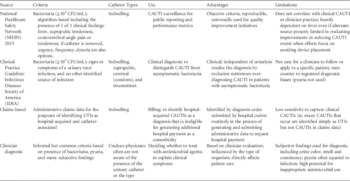
Several different definitions of CAUTI are currently in use for epidemiological surveillance, clinical diagnosis, and billing (Table 1).
The National Health Safety Network and Infectious Diseases Society of America Claims-Based Definitions for Catheter-Associated Urinary Tract Infections (CAUTI) and Clinician Diagnosis

NOTE. CFU/mL, colony-forming units per milliliter.
Surveillance-based criteria for CAUTI
The most frequently used surveillance definition of CAUTI comes from the Centers for Disease Control and Prevention (CDC) National Healthcare Safety Network (NHSN). 12 The NHSN CAUTI definition applies to patients with an indwelling urinary catheter in place for >2 calendar days on the day of the event and who have the catheter in place on the day of or the day before the event. The catheter-associated symptomatic UTI (SUTI) definition requires the application of different algorithms to identify CAUTI events that draw on a combination of clinical symptoms or signs, the result of the urine culture, and the temporal use of an indwelling urinary catheter. The algorithms rely on the presence of no more than 2 species of microorganisms in the urine, in addition to other elements such as fever (regardless of the cause) or localized findings. Starting in January 2015, the SUTI definition excluded urine analysis findings, nonbacterial organisms, and any quantitated urine cultures with <100,000 colony-forming units (CFUs) per milliliter.
CAUTI as defined by clinical practice guidelines
The clinical definition of CAUTI published by the Infectious Diseases Society of America (IDSA) is based on clinical and laboratory findings, with the exclusion of other sources of infection.Reference Hooton, Bradley and Cardenas 13 The IDSA clinical definition incorporates patients with a urinary catheter (including indwelling and non-indwelling catheters) or those who have had a catheter discontinued within 48 hours prior to signs or symptoms. The clinical definition has 3 components: (1) significant amount of bacteriuria defined as ≥103 CFU/mL; (2) signs or symptoms of a urinary tract infection (as defined below); and (3) no other identified source of infection.Reference Hooton, Bradley and Cardenas 13 Signs and symptoms that may be compatible with CAUTI include new fever, chills, altered mentation, or malaise with no other recognized cause. In addition, flank pain, costovertebral angle tenderness, acute hematuria, and pelvic discomfort are considered local findings compatible with the diagnosis. Urinary frequency, dysuria, and urgency are included if the catheter has been removed within 48 hours. Many of these signs and symptoms are non-specific and make the clinical CAUTI definition a diagnosis by exclusion.Reference Hooton, Bradley and Cardenas 13 Furthermore, the IDSA guidelines exclude both the urinalysis results and the type of organism from the diagnosis of CAUTI.
Claims-based diagnosis of CAUTI
CAUTI events are also defined using administrative discharge data, which are submitted as claims to request payment. These data are used to identify UTIs as hospital-acquired and catheter-associated and thus not eligible as payable comorbidities. 14 , 15 Administrative data-derived hospital-acquired CAUTI rates are much lower than expected (0.14% of hospitalizations) according to medical record reviews and epidemiologic surveillance for CAUTIs.Reference Meddings, Reichert, Rogers, Saint, Stephansky and McMahon 16 , Reference Meddings, Saint and McMahon 17 A recent systematic review on the accuracy of administrative code data reported low sensitivity but high specificity for diagnosing CAUTI.Reference Goto, Ohl, Schweizer and Perencevich 18 Although UTIs are commonly listed as diagnoses in discharge data, very few are identified in administrative data as CAUTIs because the documentation generated by clinicians that hospital coders must rely upon for generating diagnosis codes rarely includes explicit descriptions of UTIs as being catheter-associated.Reference Meddings, Reichert, Dueweke and Rhyner 19
Clinician-based diagnosis of CAUTI
In clinical practice, clinicians often obtain urine cultures based on findings that are not consistent with evidence or guidelines, such as urine color, cloudiness, and odor.Reference Hooton, Bradley and Cardenas 13 These findings are non-specific for the presence or absence of organisms in the urine. Furthermore, clinicians often do not distinguish between asymptomatic bacteriuria and symptomatic CAUTI in their catheterized patients.Reference Cope, Cevallos, Cadle, Darouiche, Musher and Trautner 6 , Reference Lin, Bhusal, Horwitz, Shelburne and Trautner 20 Pyuria in particular often drives inappropriate antimicrobial use and misdiagnosis of asymptomatic bacteriuria as CAUTI.Reference Cope, Cevallos, Cadle, Darouiche, Musher and Trautner 6 , Reference Trautner, Petersen, Hysong, Horwitz, Kelly and Naik 21 Many clinicians treat patients with asymptomatic bacteriuria,Reference Cope, Cevallos, Cadle, Darouiche, Musher and Trautner 6 even in patient groups with high risk for developing Clostridium difficile infection.Reference Shaughnessy, Amundson, Kuskowski, DeCarolis, Johnson and Drekonja 22
Results from the Medicare Patient Safety Monitoring System, which captures adverse events in a sample of patients admitted to US hospitals, were recently reported regarding clinician-diagnosed CAUTI for patients with specific diagnoses or surgeries over the period 2005–2011.Reference Wang, Eldridge and Metersky 23 Clinician-diagnosed CAUTI was defined as an event in a patient who either had an indwelling catheter or underwent intermittent catheterization during their inpatient stay, where the physician made the diagnosis of UTI and ordered antimicrobials.Reference Wang, Eldridge and Metersky 23 Physicians diagnosed CAUTI in ~5% of patients exposed to urinary catheterization for different primary diagnoses, whereas the NHSN CAUTI rate in the medical–surgical units in acute care hospitals averaged <1.5 events per 1,000 catheter days during a similar time period. Reference Dudeck, Horan and Peterson 24 With a national inpatient average length of stay of 4–5 days, CAUTI events are much more prevalent based on a clinician-diagnosis compared to the NHSN-based definition.
Limitations of the Outcomes Currently Used to Measure CAUTI
The optimal definition for CAUTI used in quality improvement efforts is one that only captures true instances of disease for which treatment is recommended, thus serving both clinical and surveillance needs. At present, all of the available definitions suffer from substantial limitations. For example, the IDSA definition is based on excluding other sources of potential infection and relies on subjective criteria.Reference Hooton, Bradley and Cardenas 13 Clinician practice often does not follow these guidelines and may be driven instead by perceived risks, such as patient characteristics (older age), types of organisms (Gram-negative organisms on urine culture), and the presence of pyuria.Reference Cope, Cevallos, Cadle, Darouiche, Musher and Trautner 6 , Reference Trautner, Petersen, Hysong, Horwitz, Kelly and Naik 21 Clinicians often treat asymptomatic bacteriuria as a UTI,Reference Cope, Cevallos, Cadle, Darouiche, Musher and Trautner 6 , Reference Lin, Bhusal, Horwitz, Shelburne and Trautner 20 as a positive urine culture is a strong trigger for antimicrobial use even without evidence of infection.Reference Leis, Rebick and Daneman 25 Claims-based CAUTI is associated with very poor sensitivity, underestimating the number of events. Only the NHSN definition, a national measure used for quality improvement initiatives, is based on objective criteria, which makes it attractive for public reporting and comparison over time.
Limitations of the NHSN CAUTI definition, criteria, and summary measure in evaluating outcomes
Although the NHSN CAUTI measure is the measure most widely used to evaluate CAUTI nationally, it also has several limitations. First, case finding, using the previous NHSN CAUTI definition, is restricted by low positive predictive value when compared with clinical CAUTI diagnoses.Reference Al-Qas Hanna, Sambirska, Iyer, Szpunar and Fakih 26 In one study, only 35% and 62% of cases fitting the NHSN definition were considered CAUTIs when evaluated by infectious diseases specialists and treating physicians, respectively.Reference Al-Qas Hanna, Sambirska, Iyer, Szpunar and Fakih 26 Moreover, some NHSN-defined CAUTIs may not merit clinical treatment, particularly those diagnosed on the basis of fever alone, as the fever might actually be caused by a nonurinary etiology. Refinements in the NHSN criteria enacted January 2015, excluding funguria and lower urine-culture colony counts, may improve the positive predictive value of the definition for detecting clinically relevant events. A more clinically relevant NHSN definition will be more accepted and thus support efforts to reduce CAUTI.
A second limitation of the surveillance definition is the potential for underreporting of CAUTI events. Validation of reported CAUTI outcomes by CMS is also in progress, a process that has its own constraints,Reference Fortuna, Brenneman, Storli, Birnbaum and Brown 27 but may result in improved compliance by hospitals reporting these to NHSN. The Healthcare Infection Control Practices Advisory Committee (HICPAC) acknowledges the limitations of surveillance definitions when evaluating clinical disease and recommends that reported data be systematically validated.Reference Talbot, Bratzler and Carrico 28 Developing electronic means to capture NHSN CAUTI would reduce reporter subjectivity and also eliminate the inherent bias of self-reporting.Reference Trautner, Patterson and Petersen 29 An electronically accessible definition could be based upon urinary catheter presence, associated bacteriuria, and fever; such a definition would capture more than 90% of the currently identified NHSN CAUTI cases.Reference Al-Qas Hanna, Sambirska, Iyer, Szpunar and Fakih 26
Third, NHSN-defined CAUTI events may be influenced by the prevalence of fever and the frequency of urine culture collection in a given location, both of which are critical elements for case identification.Reference Al-Qas Hanna, Sambirska, Iyer, Szpunar and Fakih 26 For example, the NHSN reported that the pooled mean CAUTI rate for neurosurgical intensive care units (ICUs) (high fever prevalence) is 5.3 per 1,000 catheter days, 3 times greater than the mean CAUTI rate of medical–surgical ICUs with >15 beds.Reference Dudeck, Edwards and Allen-Bridson 30 Furthermore, seasonal influenza, often associated with admissions to ICUs for febrile patients with severe infection, may lead to an increase in NHSN-defined CAUTI rates. In addition to patient-specific risk factors (eg, fever prevalence or duration of catheter use), provider- or facility-specific practices (eg, reflex urine culturing triggered by fever or abnormal urinalysis) may result in higher NHSN-defined CAUTI rates.Reference Al-Qas Hanna, Sambirska, Iyer, Szpunar and Fakih 26 , Reference Golob, Claridge and Sando 31 The presence of fever leads clinicians to obtain urine cultures,Reference Hartley, Valley and Kuhn 32 resulting in an increase in detection of patients with asymptomatic bacteriuria who may not have clinical CAUTI.
Fourth, the NHSN reliance on catheter days as the denominator for CAUTI rates makes it challenging in some situations to measure the impact of specific quality improvement efforts focusing on reducing device use. Interventions mainly focusing on device avoidance, such as an intervention in the emergency department to prevent inappropriate placement,Reference Fakih, Heavens, Grotemeyer, Szpunar, Groves and Hendrich 33 may lead to selecting a smaller population with higher risk for infection, resulting in a paradoxical increase or no change in NHSN CAUTI rates.Reference Wright, Kharasch, Beaumont, Peterson and Robicsek 34 , Reference Fakih, Greene and Kennedy 35 A population-based CAUTI rate (calculated as the number of CAUTI events divided by the total number of patient days multiplied by 10,000) factors in the effect of catheter avoidance on the entire population and may better reflect the success of such efforts, especially for the same unit or facility over time, as it accounts for both the change in device use and the change in device infection risk.Reference Fakih, Greene and Kennedy 35
Despite the limitations of the NHSN measure, this measure is especially useful for evaluating CAUTI over time, particularly for units with stable device utilization and urine culturing practices. This measure is enhanced by using the standardized infection ratio, which adjusts for patient mix by type and size of patient care location, and hospital affiliation with a medical school. However, following trends nationally over time has been challenged by successive definition modifications, refinements, and clarifications as well as uptake in reporting as a result of state and national reporting mandates. Further refinements to the NHSN CAUTI measure to improve standardization of reporting, along with implementation of electronic surveillance, will facilitate monitoring of infectious complications associated with the urinary catheter. In addition to monitoring CAUTI, monitoring a device-use performance measure might serve as a useful way to capture the broader potential for catheter harm.
What is the Ideal Performance Measure to Assess Potential Catheter Harm?
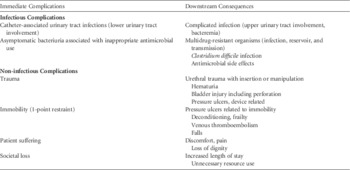
To date, the majority of interventions leading to a successful reduction in CAUTI (with different definitions used) have focused on reducing urinary catheter use, either by shortening duration or avoiding placement.Reference Meddings, Rogers, Krein, Fakih, Olmsted and Saint 36 The main outcome focus has been CAUTI reduction, rather than avoiding catheter-associated harm. Other infection-related events (eg, inappropriate antimicrobial use, antimicrobial resistance, and Clostridium difficile infection) and noninfectious complications,Reference Hollingsworth, Rogers and Krein 10 such as urethral damage, pain, or inadvertent catheter removal, have received limited attention. Importantly, the catheter may act as “a 1-point restraint,” limiting the patient’s mobility.Reference Saint, Lipsky and Goold 11
While the urinary catheter use measure has traditionally been regarded as a process measure when evaluating CAUTI risk, it serves as a performance measure (both process and outcome measure) for potential “catheter harm” (Table 2). The urinary catheter device utilization ratio, calculated by dividing the number of indwelling catheter-days by patient days on the same unit, may be adjusted for variables currently reported to NHSN, including hospital demographics, such as size and teaching status, as well as unit type. The CDC is evaluating methods for risk adjustment of the device utilization ratio in an effort to develop a quality metric that may be amenable to interfacility comparisons. These efforts may also facilitate development of target device utilization ratios for different patient care locations. The device utilization ratio provides additional benefits in evaluating the population at risk for device-related infection.Reference Wright, Kharasch, Beaumont, Peterson and Robicsek 34 , Reference Fakih, Greene and Kennedy 35 The current NHSN defined CAUTI rate uses catheter days for a denominator and does not distinguish between a hospital with a low or a high device utilization ratio for the same rate. A unit with a high device utilization ratio may have the same CAUTI rate as one with a lower ratio, despite having more CAUTI events. Finally, the device utilization ratio is easily obtainable from electronic medical recordsReference Woeltje, Lin, Klompas, Wright, Zuccotti and Trick 37 and is less susceptible to reporting bias. The device utilization ratio is the most patient-centered measure (in contrast to being event centered) because it has the potential to evaluate the overall risks to the patient associated with the catheter.
Infectious and Noninfectious Harms Associated with Urinary Catheters

While device utilization provides a global measure of potential catheter harm, it does have limitations. The device utilization ratio does not distinguish between the number of catheter insertions and the duration of catheterization. The risk of urinary tract infection is likely not evenly spread throughout the life cycle of the catheter,Reference Meddings and Saint 5 with a greater risk the longer the catheter is in place. The incidence of bacteriuria is related to duration of catheter useReference Garibaldi, Mooney, Epstein and Britt 38 ; for example, the risk of bacteriuria in a patient with an indwelling catheter for 10 days may not be the same as the risk to 5 patients with catheter use of 2 days each. A potential complementary measure, also easily captured using data entered into electronic medical records, is to assess the rate of catheter insertions per patient admission. Furthermore, the device utilization ratio does not predict the proportion of appropriately used catheters, although a reduction over time is likely correlated with improvement. Reference Miller, Krein and Fowler 39 Prior to implementation, evaluation of a proposed risk-adjusted device utilization metric with regard to usability as a quality metric and association with appropriateness is needed.
With all of the changes in the national approach to patient safety, it is important to consider a measure that reflects the multiple risks and harms associated with urinary catheters, including CAUTI. Expanding beyond traditional surveillance that is event-specific to additional performance measures may enable the evaluation of multiple risks to patient harm and is consistent with the statement by Fridkin and Olmsted: “Surveillance systems must be able to evolve in response to ever changing needs of the communities and society they serve.”Reference Fridkin and Olmsted 40 A standardized measure of device utilization can serve as a performance metric that is objective, amenable to electronic reporting, and correlates with risk of both infectious and non-infectious harms associated with the urinary catheter.
ACKNOWLEDGMENTS
Financial support. This project was supported by a contract from the Agency for Healthcare Research and Quality (grant no. HHSA290201000025I/HHSA29032001T).
Potential conflicts of interest. M.G.F., S.S., S.K., and J.M. report receiving support for involvement in the “On the CUSP: Stop CAUTI” initiative. M.G.F. reports receiving support from the Ascension Health Hospital Engagement Network effort to prevent healthcare-associated infections; and support from Michigan Health and Hospital Association Hospital Engagement Network to reduce CAUTI. C.V.G. reports no conflicts of interest. B.W.T. reports support from the Department of Veterans Affairs (grant no. VA RRP 12-433) and the National Institutes of Health (grant no. NIH DK092293), and the Agency for Healthcare Research in Quality (AHRQ Safety Program for Long-Term Care: Preventing CAUTI and Other HAIs). J.M.’s research is funded by grants from the Agency for Healthcare Research and Quality (grant nos. 1K08HS019767 and 1R010HS018344. R.N.O. receives honoraria from Health Research & Educational Trust as extended faculty and as a member of Ethicon, Inc., Speakers’ Bureau. He also is a consultant to Joint Commission Resources and Premier, Inc. S.K. reports support from the Department of Veterans Affairs (grant no. 1 I01 HX001101-01). Additionally, S.S. reports that he is on the medical advisory boards of Doximity and Jvion.
DISCLAIMER: The findings and conclusions in this report are those of the authors and do not necessarily represent the official position of the Agency for Healthcare Research and Quality, the Centers for Disease Control and Prevention, or the Department of Veterans Affairs.