Carbapenem-resistant Enterobacteriaceae (CRE) have increasingly been recognized as multidrug-resistant organisms (MDROs) of significant clinical and public health concern due to their prevalence, colonization potential, high levels of antibiotic resistance, associated morbidity and mortality, and potential for widespread transmission.
Enterobacteriaceae bacteria are common pathogens that represent a major source of infection in healthcare settings.Reference Sievert, Ricks and Edwards 1 – Reference Prabaker, Lin and McNally 4 Surveillance data indicate that up to 92% of CRE infections occur in patients with sustained healthcare exposures.Reference Kallen, Ricks and Edwards 5 Active surveillance in outbreak situations has also shown colonization to be common among asymptomatic patients.Reference Ben-David, Maor and Keller 6 Colonized patients, both identified and unidentified, can serve as a reservoir for transmission of these organisms to other patients.Reference Won, Munoz-Price and Lolans 2
Infections caused by CRE have limited or no treatment options. Various resistance mechanisms render these organisms nonsusceptible to several classes of antibiotics, including carbapenems, which are often considered drugs of last resort for CRE infections. Invasive CRE infections have been associated with mortality rates of up to 50%.Reference Patel, Huprikar, Factor, Jenkins and Calfee 7
CRE also have the potential to spread rapidly, due not only to breaches in infection control but also to the transfer of mobile genetic elements conferring resistance. Enterobacteriaceae resistant to carbapenems, such as Klebsiella pneumoniae, often carry genes encoding enzymes like the K. pneumoniae carbapenemase (KPC) on mobile plasmids that can confer carbapenem resistance to other gram-negative bacterial species.Reference Yigit, Queenan and Anderson 8 KPC was first recognized in the United States in 2001, and it has accounted for most of the spread of CRE throughout the United States. In addition to KPC, several additional carbapenemases have been identified since 2009, including New Delhi metallo-β-lactamase (NDM), Verona integron-encoded metallo-β-lactamase (VIM), oxacillinase-48-type carbapenemases (OXA-48), and the imipenemase (IMP) metallo-β-lactamase.Reference Kumarasamy, Toleman and Walsh 9 , Reference Nordmann, Dortet and Poirel 10
The Centers for Disease Control and Prevention (CDC) recommends immediate action to prevent further spread of this “urgent” antibiotic-resistance threat. 11 Due to the movement of patients within healthcare systems, control of MDROs requires widespread engagement and regional coordination across healthcare facilities (HCFs).Reference Lee, McGlone and Song 12 , 13 Studies evaluating a regional approach to infection control interventions have shown this approach to be effective in reducing MDRO transmission.Reference Ostrowsky, Trick and Sohn 14 , Reference Schwaber and Carmeli 15 Mathematical modelsReference Slayton, Toth and Lee 16 have estimated that a coordinated approach may result in up to a 74% cumulative reduction in CRE acquisition over a 5-year period compared with independent facility-based interventions.
A coordinated, regional approach is especially important for the District of Columbia because it is the only metropolitan city that is viewed as a state with respect to assessments of infection control outcomes and epidemiology, which leads to difficulty in interpreting comparative data. All HCFs are clustered in a small region, with patients often receiving care at multiple facilities over a short period of time. These facilities not only serve more than 6 million residents in the metropolitan District of Columbia area but also provide care for patients from Maryland and Virginia, as well as national and international travelers. Therefore, a regional approach with coordination among facilities, partners, and stakeholders is essential.
An initial step in controlling the spread of antibiotic resistance often is to quantify the magnitude and distribution of MDRO infection and colonization. An accurate estimate of the burden of CRE colonization can only be determined through active surveillance of patients at risk for CRE. At the time of this study, because CRE reporting was not mandated in the District of Columbia and because individual facilities do not routinely conduct active surveillance for CRE, the prevalence of colonization was unknown. The objective of this study was to assess CRE colonization prevalence within HCFs in Washington, DC, and to initiate a collaborative approach for further assessment and control efforts.
METHODS
Facility Recruitment
The District of Columbia Department of Health (DOH), the District of Columbia Hospital Association (DCHA), and the District of Columbia Department of Forensic Science-Public Health Lab (DFS-PHL) partnered to design and conduct a multicenter point-prevalence study of CRE colonization in HCFs in the District of Columbia. A total of 16 facilities in the District of Columbia voluntarily agreed to participate: all 8 short-term acute-care hospitals (ACHs), 2 (both) long-term acute-care hospitals (LTACs), 1 (the sole) inpatient rehabilitation facility, and 5 of the 19 skilled-nursing facilities (SNFs). Results for LTACs and SNFs were combined as long-term-care facilities (LTCFs) for analysis. Each HCF conducted bacterial colonization surveillance of all participating units over a 1–3-day interval (depending on facility size) from January 11 to April 14, 2016.
Data Collection
An independent, external ethical review was conducted by the Western Institutional Review Board (WIRB; Pallyup, WA). Facilities could waive oversight of the study protocol to WIRB or evaluate the protocol independently for approval. Written informed consent was waived; verbal consent was obtained. Patient variables collected were age, sex, and zip code. Location variables included facility and unit type, as defined by the National Healthcare Safety Network (NHSN). Types of healthcare units were grouped as critical care units, step-down wards, general wards, inpatient rehabilitation units, and long-term care units (ie, LTAC and SNFs combined).
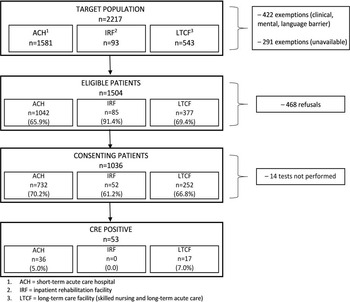
The Healthcare Antibiotic Resistance Prevalence–DC (HARP-DC) study team, consisting of representatives from the partnering organizations, coordinated with each HCF principle investigator to facilitate collection of CRE samples by facility-based volunteers. Sampling teams varied in composition by facility; they included infection preventionists, nurses, residents, and physicians. Adult inpatients on all units (excluding psychiatry and obstetrics-gynecology) who were present in their rooms at the time of study visit were approached for consent. Pediatric patients were only included from the dedicated pediatric facility where parents provided consent. Patients were excluded if they were unable to provide verbal consent due to language barrier, cognitive inability, or if it was a mentally/emotionally or clinically inappropriate time (Figure 1). For patients who agreed to participate, perianal samples were collected using ESwab Collection Kits (Becton Dickinson, Franklin Lakes, NJ). Adult patients capable of swabbing themselves were instructed how to collect the sample properly and were permitted to do so.
HARP-DC study enrollment process. Display of patient recruitment for point prevalence study of CRE colonization by facility type. Inpatients on all wards (excluding psychiatry and ob-gyn) present in their room at the time of study were approached. Exclusion criteria included inability to provide verbal consent due to a language barrier, or inappropriate timing (given the patient’s clinical/mental/emotional status).

CRE Identification
All samples were analyzed for CRE detection at the OpGen Clinical Services Laboratory (Gaithersburg, MD). Using 2015 CDC surveillance definition, CRE were defined as nonsusceptible to any of the carbapenems (ie, imipenem, meropenem, doripenem, or ertapenem) or were identified to possess a carbapenemase gene. Samples were analyzed using the Acuitas CR Elite Test (OpGen), which consists of 2 tests run in parallel, the MDRO gene test and the CRE culture screen.Reference Walker, Rockweiler and Kersey 17 The MDRO gene test is a real-time polymerase chain reaction (qPCR) microfluidic array that detects 10 groups of antibiotic resistance genes, including carbapenemases and β-lactamase genes, that confer resistance to carbapenems in Enterobacteriaceae and other gram-negative pathogens (eg, Acinetobacter spp. and Pseudomonas aeruginosa). The CRE culture screen selects for phenotypic carbapenem resistance using chromogenic agar medium, with further genus and species identification and antimicrobial susceptibility characterization (ID/AST) using VITEK 2 (bioMérieux, Durham, NC). Thus, CRE were identified genetically by the MDRO gene test, phenotypically by the CRE culture screen, or by both methods. Samples with growth on the CRE culture screen underwent further testing using the Acuitas Resistome Test, a qPCR test that detects 50 antibiotic resistant gene families across several hundred variants associated with MDROs. In brief, 100 µL of total nucleic acid was extracted from each culture isolate. qPCR amplifications specific to the Acuitas Resistome Test targets were performed using the template from each sample and primers and fluorescent reporter probes for each target. Results were analyzed on a BioMark HD System (Fluidigm, San Francisco, CA).
Determining Strain Relatedness
Phenotypic and genetic results of recovered isolates were integrated to construct Lighthouse profiles for typing, cluster identification, and tracking. Each Lighthouse profile comprises codes that include (1) organism genus and species identification, (2) phenotype code determined by AST results, (3) listing of up to 3 gene codes determined by the Acuitas Resistome Test, (4) a unique numerical code representing the pattern of all positive and negative assays from the Acuitas Resistome Test results, and (5) the AST profile code representing the unique pattern of nonsusceptible AST results (Supplementary Figure S1). Genetically related types were determined by combining the organism name and the code for the Acuitas Resistome Test results. These types were further divided into subtypes using the Lighthouse profile’s AST code.
All results were posted on the secure Acuitas Lighthouse MDRO Management System (OpGen) website portal for real-time access by the study coordinators and principle investigators.
Statistical Analysis
Descriptive statistics were performed to summarize patient-level and facility characteristics. Proportions were reported for categorical variables, and differences were tested using 2-tailed χ2 tests. Prevalence and 95% confidence intervals were calculated using the Poisson distribution. The prevalence of CRE was calculated as the number of patients with a positive result (by qPCR or by ID/AST) divided by the total number tested. Differences in prevalence were assessed using the prevalence ratio. Covariates of interest measured at time of sample collection were assessed using Poisson regression with robust variance estimates to determine association with CRE colonization. All statistical analyses were performed using Stata statistical software version 13 (StataCorp, College Station, TX).
RESULTS
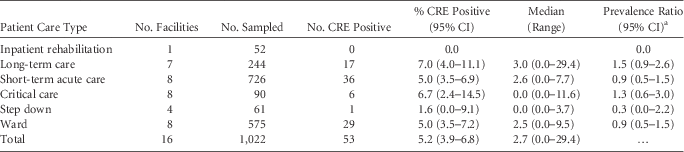
Of 1,022 completed tests, 53 samples tested positive for CRE, yielding a prevalence of 5.2% (95% CI, 3.9%–6.8%). Of 726 tests from ACHs, 36 (5.0%; 95% CI, 3.5%–6.9%) were positive; of 244 tests from LTACs and SNFs, 17 (7.0%; 95% CI, 4.1%–11.2%) were positive. The relative prevalence ratio was 0.9 (95% CI, 0.5–1.5) and 1.5 (95% CI, 0.9–2.6), respectively. Of 52 samples from the inpatient rehabilitation facility, none were positive.
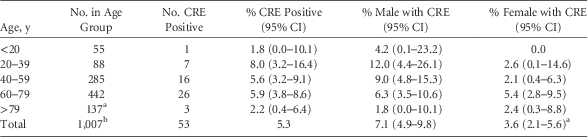
We observed wide variability in the prevalence of CRE by facility and facility type (Table 1). The median percentage of positive samples by facility was 2.7, with a range of 0.0 to 29.4. Within ACHs, 6 of 90 critical care patients (6.7%; range, 0.0%–11.6%), 1 of 61 step-down patients (1.6%; range, 0.0%–3.7%), and 29 of 575 ward patients (5.0%; range, 0.0%–9.5%) tested positive. Males had a significantly higher prevalence (7.1%; 95% CI, 5.3%–10.6%) than females (3.7%; 95% CI: 2.1%–5.6%; P<.02). The prevalence by age group was 1.8% (95% CI, 0.0%–10.1%) for those under 20 years of age, 8.0% (95% CI, 3.2%–16.4%) for those aged 20–39, 5.6% (95% CI, 3.2%–9.1%) for those aged 40–59, 5.9% (95% CI, 3.8%–8.6%) for those aged 50–79, and 2.2% (95% CI: 0.4%–6.4%) for those over 79 years of age (Table 2). Zip code data were collected but were not interpretable for long-term-care patients because most listed the facility as their home zip code. Of 697 patients with zip code recorded from ACHs, no more than 3 patients tested positive from any of the 200 zip codes recorded.
Prevalence of Carbapenem-Resistant Enterobacteriaceae (CRE) by Facility and Unit Type

NOTE. CI, confidence interval.
a Prevalence ratio=% CRE in patient care type / % CRE for all other patient care types.
Prevalence of Carbapenem-Resistant Enterobacteriaceae (CRE) by Age and Gender

NOTE, CI, confidence interval.
a P<.05.
b 15 samples lacked age data.
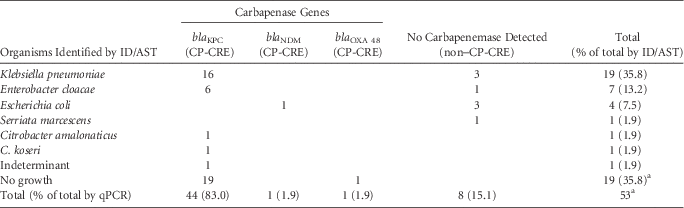
The CDC definition of CRE includes Enterobacteriaceae with carbapenemase production (CP-CRE) and those with carbapenem resistance without an identified resistance gene (non–CP-CRE). 13 In this study, CP-CRE were detected by qPCR with parallel testing by ID/AST for non–CP-CRE. Therefore, CRE positivity could be detected by either method or by both methods. qPCR detected CP-CRE in 45 samples: 44 positive for bla KPC, 1 for bla NDM, and 1 with both bla KPC and bla OXA48. Of these, 19 samples were identified only by qPCR. ID/AST detected CRE in 33 samples: 19 Klebsiella pneumoniae, 7 Enterobacter cloacae, 4 Escherichia coli, and 1 each of Serratia marcescens, Citrobacter amalonaticus, and Citrobacter koseri. Of these, 8 were non–CP-CRE, with identification only by ID-AST but not by qPCR (Table 3).
Carbapenem-Resistant Enterobacteriaceae (CRE) Identification by Resistance Gene Testing and Microbiologic Culture Methods

NOTE. CP-CRE, Enterobacteriaceae with carbapenemase production; ID/AST, genus and species identification and antimicrobial susceptibility characterization; qPCR, quantitative polymerase chain reaction.
a 1 sample without growth was positive for both KPC and OXA-48. The total column corrects for the double count.
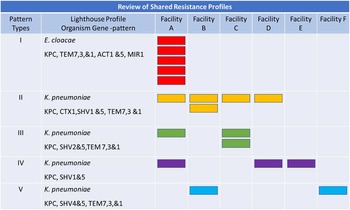
Lighthouse profiles were used to assess strain relatedness (Supplementary Table S1). Of the 53 samples positive for CRE, 18 were determined to share genetic similarity with at least 1 other sample. Among these 18 samples, 5 genetic types containing a unique combination of resistance genes were identified. AST results were incorporated to further divide these 5 types into subtypes using the code for each unique antibiogram within the type. Within each type, there were no AST differences for aztreonam, cefazolin, cefepime, ceftazidime, ceftriaxone, ciprofloxacin, imipenem, levofloxacin, meropenem, piperacillin/tazobactam, or ticarcillin. Within-type AST differences were only observed for aminoglycocides and trimethoprim-sulfa. In addition, 5 patients from HCF A were positive for CRE E. cloacae with an identical genetic type and AST subtype (Type 1). Type 2 was detected in 5 samples in 4 facilities; type 3 was detected in 3 samples in 2 facilities; type 4 was detected in 3 samples in 3 facilities; and type 5 was detected in 2 sample in 2 facilities (Figure 2).
Review of shared resistance profiles. Illustration of how 18 nonunique samples that were identified by Lighthouse profiles were distributed among participating facilities. The Lighthouse profile was composed of organism, PCR gene identification, and antibiogram. Patterns 1, 2, and 3 show possible transmission within facilities and Patterns 2, 3, 4, and 5 show possible transmission between facilities.

DISCUSSION
HARP-DC is one of the first studies to our knowledge to measure CRE colonization prevalence in a region aligning with the CDC’s recommended “collaborative approach.” Active surveillance data collected over a short period from all participating HCF types and units were analyzed using a single laboratory with a comprehensive testing methodology. This design (1) provides estimates of CRE colonization in inpatient HCFs across all age groups and the continuum of care in Washington, DC, (2) establishes a baseline prevalence to monitor trends over time, and (3) enables comparison of rates across facilities. The overall prevalence of 5.2% confirms that CRE has become endemic in HCFs; the prevalence of 29.4% in 1 facility demonstrates the potential for hyperendemicity, which may have grave implications for patient care. The study also provides a model for other regions to conduct CRE prevalence measurements.
Since CRE were first identified, the CDC has advised HCFs to measure infection incidence and to aggressively respond to any rate increase or evidence of transmission within an individual facility. 13 The CDC has also advocated for public health organizations to measure incidence or prevalence in a region, as organisms can spread between facilities by patients, staff, or shared environmental sources. The 4 main methods of CRE surveillance are (1) individual facility surveillance using clinical cultures to estimate incidence,Reference Song, Toal, Walker, Perez-Albuerne, Campos and DeBiasi 18 (2) multifacility surveillance using clinical cultures to measure regional incidence,Reference Shaw, Harper, Vagnone and Lynfield 19 – Reference Pfeiffer, Cunningham and Poissant 23 (3) individual facility using active surveillance to detect CRE colonization following identification of a cluster,Reference Pisney, Barron, Kassner, Havens and Madinger 24 and (4) multifacility active surveillance for colonization to determine regional prevalence.Reference Johnson, Wilson, Zhao, Richards, Thom and Harris 25 – Reference Swaminathan, Sharma and Blash 28
Traditionally, facilities have relied on clinical cultures to conduct CRE surveillance, with active surveillance occurring only after the identification of an outbreak or cluster. Clinical cultures provide a measurement of CRE infection and are easier to obtain because samples are more readily available. Some researchers have found that patients with clinical cultures are more likely to transmit the organism to others.Reference Fitzpatrick, Zembower, Malczynski, Qi and Bolon 29 However, because colonization plays a role in transmission, is a predictor for possible later infection, and is often underrecognized,Reference Brennan, Coyle and Marchaim 21 conducting active surveillance provides an accurate measure of overall CRE burden rather than infection, and it establishes a baseline prevalence.
Although the CDC has advocated for a regional approach to MDRO control, few studies to date have undertaken regional CRE surveillance through either clinical culture or active surveillance because such studies are often too expensive or labor intensive.Reference Pereira, Shaw and Vagnone 22 , Reference Pisney, Barron, Kassner, Havens and Madinger 24 , Reference Mathers, Poulter, Dirks, Carroll, Sifri and Hazen 26 In addition, variation in laboratory methods, changes in CRE definition, discord between automatic testing instruments and broth microdilution methods for CRE identification, unavailability of molecular testing in many clinical laboratories,Reference Pfeiffer, Cunningham and Poissant 23 and changing Clinical Laboratory Standards Institute break points can make assessment of patterns over time or comparison between facilities difficult. HARP-DC controlled for these variations by using the CDC CRE surveillance definition and by limiting testing to a single laboratory.
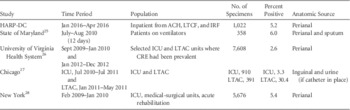
HARP-DC is one of the few studies (Table 4) to measure regional CRE colonization prevalence without an instigating outbreak or a focus on units with anticipated higher rates.Reference Johnson, Wilson, Zhao, Richards, Thom and Harris 25 – Reference Swaminathan, Sharma and Blash 28 In this study, the prevalence in general wards was 2.5 per 100 patients compared to 2.7 for the entire study, including intensive care units (ICUs) and LTACs (prevalence ratio=0.9). Until recently, researchers expected a relatively low CRE prevalence on general wards compared with ICUs or LTACs.Reference Brennan, Coyle and Marchaim 21
Published Reports of Regional Carbapenem-Resistant Enterobacteriaceae (CRE) Prevalence Studies Using Active Surveillance

NOTE. HARP-DC, Healthcare Antibiotic Resistance Prevalence–District of Columbia; ACH, acute-care hospital; LTCF, long-term-care facility; IRF, inpatient rehabilitation facility; ICU, intensive care unit; LTAC, long-term acute-care hospital.
Rapid MDRO identification by qPCR for resistance profile characterization is a helpful method either for active surveillance for colonized patients or for surveillance using clinical samples. While HARP-DC’s goal was to provide an estimate of CRE prevalence, the rapid organism-profile identification of a previously unrecognized cluster within a hospital also provided an example of how surveillance programs using such techniques may identify outbreaks at an early stage.
As described in the literature,Reference Schechner, Straus-Robinson and Schwartz 30 – Reference Vasoo, Cunningham and Kohner 32 molecular nucleic amplification technologies such as qPCR are more sensitive than culture. In this study, 19 samples were identified as CP-CRE by qPCR without growth by culture. qPCR has the additional ability to identify the presence of nonviable cells, which could also explain these results. However, in several cases, CRE was recovered by culture but not detected by qPCR. This discrepancy may be because qPCR only detects targets in its panel. The 8 non–CP-CRE identified in this study may be due to novel resistance mechanisms other than carbapenemase production, such as β-lactamases, and/or to mutations in the bacterial cell membrane.Reference Blair, Webber, Baylay, Ogbolu and Piddock 33
We faced several challenges and limitations in this study. We were only able to enroll ~50% of the target population. As participation required verbal consent from the patient or a legally authorized representative, enrollment of the cognitively impaired or ventilated patients was difficult. In addition, use of the perianal site for sample collection may have decreased the acceptance rate. Instead of using the perianal site for sampling, alternative sites such as the inguinal siteReference Weintrob, Roediger and Barber 34 – Reference Buehlmann, Fankhauser, Laffer, Bregenzer and Widmer 36 might have improved the sample strategy. Because the collectors could determine patient selection appropriateness, some patients were not enrolled because of modesty or concern that repositioning would be too uncomfortable. These limitations may have biased the study to disproportionately sample those who were more mobile, movable, alert, and coherent, and therefore, the CRE prevalence estimate may be underestimated.
To ensure maximum HCF participation, the only patient-based variables collected were age, gender, zip code, and unit type. Without epidemiologic risk-factor data collection, the investigators were unable to assess the role of comorbidities, device days, surgeries, use of mechanical ventilation, hemodialysis, antimicrobial therapy, and preceding HCF exposure. Therefore, we were able to determine whether a particular sample possessed a carbapenemase-producing gene but not whether or how that organism had been transmitted. Similarly, because results were only analyzed at the unit level, HCFs were unable to use the data to isolate colonized patients or to make clinical decisions. In addition, we did not collect variables to allow classification of likely acquisition as defined by the NHSN to represent community onset or healthcare onset. Without a clearer understanding of colonization duration, it is difficult to establish onset.Reference Brennan, Coyle and Marchaim 21 , Reference Swaminathan, Sharma and Blash 28
In conclusion, this study provides an important baseline measurement of CRE burden in Washington, DC, HCFs and confirms likely transmission within and between facilities. Testing performed by a single laboratory over a short period of time can provide a useful measure of CRE burden in a region and establish patterns of transmission within and between facilities.
ACKNOWLEDGMENTS
We thank the HARP-DC Study Team members from the following facilities: DC Hospital Association, Washington, DC (Raissa-Audrey Tseumie); Section of Infectious Diseases, MedStar Washington Hospital Center, Washington DC (Aleeta Iloanya, Osamuyimen Igbinosa, Olaide Akande, Augusto Dulanto, Kunal Jakharia, Niyati Jakharia, Sheena Ramdeen, Cleo Johnson, Janet Thorne, Shyrie Edmonson, Melody Nagle); Office of Infection Control/Epidemiology, Children’s National Medical Center, Washington, DC (Margaret Ryan); Division of Infectious Diseases and Travel Medicine, MedStar Georgetown University Hospital, Washington, DC (Joseph Tampone, Seble Kassaye, Rebecca Kumar, Deepa Lazarous, Puneet Azarwal, Roshni Biswas, Allen Chao, Kelly Wang, Amanda Finnell); Infection Control Department, MedStar Georgetown University Hospital, Washington, DC (Holly White, Leslie Gates, LaToya Forrester); Infectious Disease/Infection Control Department, United Medical Center, Washington, DC (Bev Johnson, Shirlitta Warren-Cropper, Mae Cundiff, Irene Majo, Effie Negash, Linda Pulley, Sonna Sesay, Mary Falana); Infection Control Department, Sibley Memorial Hospital, Washington, DC (Mary Sisk, Malorie Givan, Tina Hoang, Ruth Abo, Anne Durias); Infection Control Department, Howard University Hospital, Washington, DC (Abiodun Otolorin, Kenisha Atwell, Devoir Jackson, Brian Grant, Alonda Thompson, Latoya Silverton, Gbeminiyi Samuel, Teresits Paragua, Esmeralda Salgado, Sidra Qazi, Shahabuddin Soherwardi, Roxane Joseph, Elaine Williams, Oluwafunmilayo Fatuyi, Yonette Paul, Ankrah Nii-Kwanchie, Nadege Fackche, Jennifer Obi, Sandra Mavin, Fredrecker Adams, Sandra Lanier, Diana Davis); Medical Affairs Department, MedStar National Rehabilitation Hospital, Washington, DC (TsiTsi McLure, Jyosha Pisati, Olatwunji Ojo, Cindy Zammit); Infection Prevention Department, George Washington University Hospital, Washington, DC (Regan Trappler, Brooke Solarz, Marie Koroma, Deidre Smith, Alisha Wilson, Camille Stallard, Allison Mayfield, Natalie Burns); Administration Department, Transitions Healthcare Capitol City, Washington, DC (Ganiat Yusuf, Michele Earhart, Charles Onyeador); Infection Control/Prevention Department, BridgePoint Hospital Capitol Hill, Washington, DC (Vanetta Bonner, Donna Williamson).
Financial support: This study was supported in part by a Centers for Disease Control and Prevention Cooperative Agreement (grant no. U50CK000374).
Potential conflicts of interest: Dr Kumar reports grants and other compensation from Janssen, GlaxoSmithKline, Merck, and Gilead, and other compensation from Pfizer, Johnson and Johnson, and Viiv Healthcare outside the submitted work. Dr Wagner reports being employed by OpGen, which received payments for laboratory support through a grant facilitated by the Washington, DC, Department of Health. Other relevant financial activities outside the submitted work include employee-related salary and stock options with OpGen. All other authors reported no conflicts of interest related to this article.
SUPPLEMENTARY MATERIAL
To view supplementary material for this article, please visit https://doi.org/10.1017/ice.2017.110