





Introduction
Although advance care planning (ACP), including end-of-life (EOL) conversations, concerns all age groups, its relevance for frail older persons is particularly pronounced. Frailty is often an age-associated syndrome of vulnerability and decreased function that endangers physical independence and cognitive well-being, negatively affecting outcomes and increasing disability risk (Tang et al. Reference Tang, Teh and Lee2023b). Moreover, frail older persons have an increased risk of sudden deterioration in health and future cognitive function loss, situations in which they may no longer be able to indicate their wishes and may require anticipated decision-making (Clegg et al. Reference Clegg, Young and Iliffe2013). Their palliative care needs are often underassessed and undertreated, yet palliative care integration can bolster patient satisfaction in geriatric populations (Schelin et al. Reference Schelin, Furst and Rasmussen2023). It takes time to understand and communicate EOL wishes and preferences. Therefore, these conversations should be initiated early (Boddaert et al. Reference Boddaert, Pereira and Adema2022). ACP allows frail community-dwelling older persons to formulate goals and preferences for future medical treatments, care, and palliative care; discuss these with caregivers, family, and close friends; and record and revise them when necessary (Rietjens et al. Reference Rietjens, Sudore and Connolly2017). ACP is frequently referred to as “anticipatory care planning,” “proactive care planning,” or “future care planning.” Timely ACP is associated with improved patient and family experiences with EOL care, palliative care, greater concordance between patients’ preferences and received care, and fewer undesirable treatments (Detering et al. Reference Detering, Hancock and Reade2010; Silveira et al. Reference Silveira, Kim and Langa2010; Brinkman-Stoppelenburg et al. Reference Brinkman-Stoppelenburg, Rietjens and Van der Heide2014). In jurisdictions like the Netherlands, where medical assistance in dying, including euthanasia under certain conditions, is legal, this topic may potentially be addressed in ACP and EOL conversations (Murray et al. Reference Murray, Boyd and Moine2024; Hopkins et al. Reference Hopkins, Price and Etkind2025). General practitioners (GPs) are considered well equipped to discuss ACP, including EOL preferences, with frail community-dwelling older persons because of their longstanding and trusted patient relationships (Abarshi et al. Reference Abarshi, Echteld and Donker2011; Hayhoe and Howe Reference Hayhoe and Howe2011; Scott et al. Reference Scott, Mitchell and Reymond2013). Despite the known advantages of EOL conversations and positive attitudes toward them among both patients and GPs (Sharp et al. Reference Sharp, Malyon and Barclay2018; Zwakman et al. Reference Zwakman, Jabbarian and van Delden2018), a marked disparity remains between the majority of patients who would like to have EOL conversations and the minority who currently do (Weathers et al. Reference Weathers, O’Caoimh and Cornally2016; van der Plas et al. Reference van der Plas, Glaudemans and Onwuteaka-Philipsen2021; Burghout et al. Reference Burghout, Nahar-van Venrooij and Bolt2023).
A better understanding of frail older persons’ perspectives and attitudes may help achieve higher and timely ACP engagement in this group, allowing GPs to tailor communication that resonates with the frail older person’s needs and concerns (Rietjens et al. Reference Rietjens, Sudore and Connolly2017). However, the literature on frail community-dwelling older persons’ perspectives is scarce (McLennan et al. Reference McLennan, Boddy and Daly2015; Iida et al. Reference Iida, Ishimaru and Tsujimura2025); studies are limited to (frail) older persons in long-term care facilities (Mignani et al. Reference Mignani, Ingravallo and Mariani2017) or those with specific diseases (Johnson et al. Reference Johnson, Butow and Kerridge2016; Sellars et al. Reference Sellars, Clayton and Morton2018; Zwakman et al. Reference Zwakman, Jabbarian and van Delden2018; Steiner et al. Reference Steiner, Stout and Soine2019; Bolt et al. Reference Bolt, van der Steen and Khemai2021). This study therefore examined frail community-dwelling older adults’ perspectives on ACP, including EOL conversations. It focuses on why, how, and with whom they prefer to discuss their EOL wishes and preferences, and their expectations regarding documenting and sharing these.
Methods
Study aim, design, and setting
To obtain insights into frail community-dwelling older persons’ perspectives on ACP, including EOL conversations, we conducted a qualitative, face-to-face interview study using reflexive thematic analysis guided by Braun and Clarke’s (Reference Braun and Clarke2006, Reference Braun and Clarke2024) approach. Data collection took place from July to November 2019 in Dutch general practices. The consolidated criteria for reporting qualitative research (COREQ) checklist (Tong et al. Reference Tong, Sainsbury and Craig2007) was used to guide this article.
Sampling and recruitment
We approached GPs with the assistance of the Organization of Chronic First-line Care (now NEO GP Care) and the Radboud Transmural Knowledge and Innovation Centre, both in Nijmegen, the Netherlands (Lucassen and Olde Hartman Reference Lucassen and Olde Hartman2007). Only GPs who systematically organized care for their frail older persons were invited. GPs were provided information regarding the study’s aim and procedure and were instructed to identify suitable frail older persons. Frailty was assessed using the Easycare Method (Craig et al. Reference Craig, Chadborn and Sands2015; Talarska et al. Reference Talarska, Pacholska and Strugała2016), used in the regional elder care program to identify frail older persons. Exclusion criteria were the inability to answer questions because of cognitive impairment, a speech problem, or a language barrier. Purposive sampling was used to ensure variation in age, gender, education level, comorbidities, religious background, and migration background. Rather than aiming for predefined numbers within each category, we conducted sampling iteratively to achieve a diverse sample of frail older persons. Inclusion of participants with a migration background, although intended, was not achieved in practice because of barriers encountered during recruitment and data collection. Recruitment continued until data saturation was reached. GPs asked potential participants for permission for the researcher to contact them. After consent, the researcher contacted them and gave additional information regarding the study’s aim and the nature of the interview. Each person was given time to consider their participation. If a person was willing to participate, written informed consent was obtained.
Data collection
We developed an interview guide (Supplementary File 1) based on a literature review and the researchers’ expertise (Carrese et al. Reference Carrese, Mullaney and Faden2002; Sharp et al. Reference Sharp, Moran and Kuhn2013; Guldemond et al. Reference Guldemond, Ott and Wind2017; Mignani et al. Reference Mignani, Ingravallo and Mariani2017). To ensure thorough exploration, we developed an interview guide rather than a predefined set of interview questions. This guide served as a flexible framework that outlined key areas of interest and ensured coverage of all relevant themes. This approach allowed us to maintain the integrity of the research focus while providing the flexibility needed to explore emerging themes in greater depth. The interviews took place at the participants’ homes and were audiotaped and transcribed verbatim.
Before the interviews, we verified the demographics and characteristics collected for the purposive sampling. We collected additional demographics and characteristics: ethnicity, marital status, living status, occupation, self-reported digital skills, grade of activity, polypharmacy (Masnoon et al. Reference Masnoon, Shakib and Kalisch-Ellett2017), number of children, informal caregiver, and involved care.
Data analysis
We conducted reflexive thematic analysis following Braun and Clarke’s (Reference Braun and Clarke2006, Reference Braun and Clarke2024) approach and used ATLAS.ti version 8.4.15 software for data analysis. In an iterative process of coding and theme development, descriptive codes were progressively organized into higher-order interpretive themes that captured patterns of shared meaning across the data, each organized around a central interpretive concept. Reflexivity was integrated throughout the analysis through continuous reflection on how researchers’ clinical backgrounds and perspectives may have shaped coding decisions and theme construction. This involved an ongoing, iterative process of reflection and dialogue within the research team.
We acknowledge that our perspectives influenced the analysis. The research team’s composition – a professor in Meaningful Healthcare with expertise in contextual communication and care and GPs (in training) with an affinity for palliative care, including ACP and EOL conversations – shaped our sensitivity to aspects of communication and decision-making in the data. To engage with these influences, we incorporated reflexive practices throughout the analysis, including note-taking during coding, iterative team discussions, and ongoing reflection on how our perspectives informed decisions and theme development.
Analysis started as soon as the first data were collected and continued after each additional interview. Two researchers (M.B.I.v.d.H., D.J.M.E.) independently coded the first 10 transcripts to support familiarization with the data and development of the initial coding framework. After 2 interviews, the codes were compared (M.B.I.v.d.H., D.J.M.E., M.K.D.), and a coding scheme was developed through iterative discussion. If new codes emerged in the following interviews, all interviews were reviewed, and after every 2 interviews, we re-discussed the coding scheme. After 10 interviews, the principal researcher (M.B.I.v.d.H.) used the preliminary codebook to code the remaining transcripts. After 14 interviews, no further meaningful new insights relevant to the study aim were identified. Two additional interviews were conducted to ensure sufficient depth and richness of data in relation to the research question (Braun and Clarke Reference Braun and Clarke2021). Codes were then iteratively grouped into categories and themes through interpretive analysis, with ongoing refinement during peer group discussions involving 7 experts, including research group members (M.B.I.v.d.H., D.J.M.E., Y.E., M.K.D.), an elder care physician (K.B.), a palliative care district nurse (M.P.i.), and an older person who was a member of the target group, Network 100 (T.v.I). All authors agreed on the final codebook.
Research team and reflexivity
M.B.I.v.d.H. – then a medical student almost finished her master’s, now a GP in training – conducted all the interviews. Prior to the study, she was trained in conducting and analyzing qualitative interviews. D.J.M.E. is a GP in training and a PhD candidate in personalized and transmural proactive palliative care. She is experienced in qualitative research. M.K.D. and M.P. are GPs and senior researchers with expertise in qualitative research. Y.E. is a professor in the sense of meaning in healthcare with expertise in ACP research.
Results
Between June and September 2019, GPs identified 20 frail older persons eligible for participation, of whom 16 were included. Four cases were excluded from the final dataset: 1 person was excluded because of cognitive impairment (dementia); one withdrew prior to the interview; 1 interview was conducted but excluded from the analytical dataset because of language barriers, as interpretation was provided by the participant’s daughter rather than a professional interpreter; and 1 interview involved a dyad (spouse pair). In both latter cases, responses could not be reliably attributed to the eligible individual participants, preventing analysis at the individual participant level. The interviews lasted a mean of 42 minutes (SD 10), with durations ranging from 26 to 64 minutes.
Characteristics of frail older persons
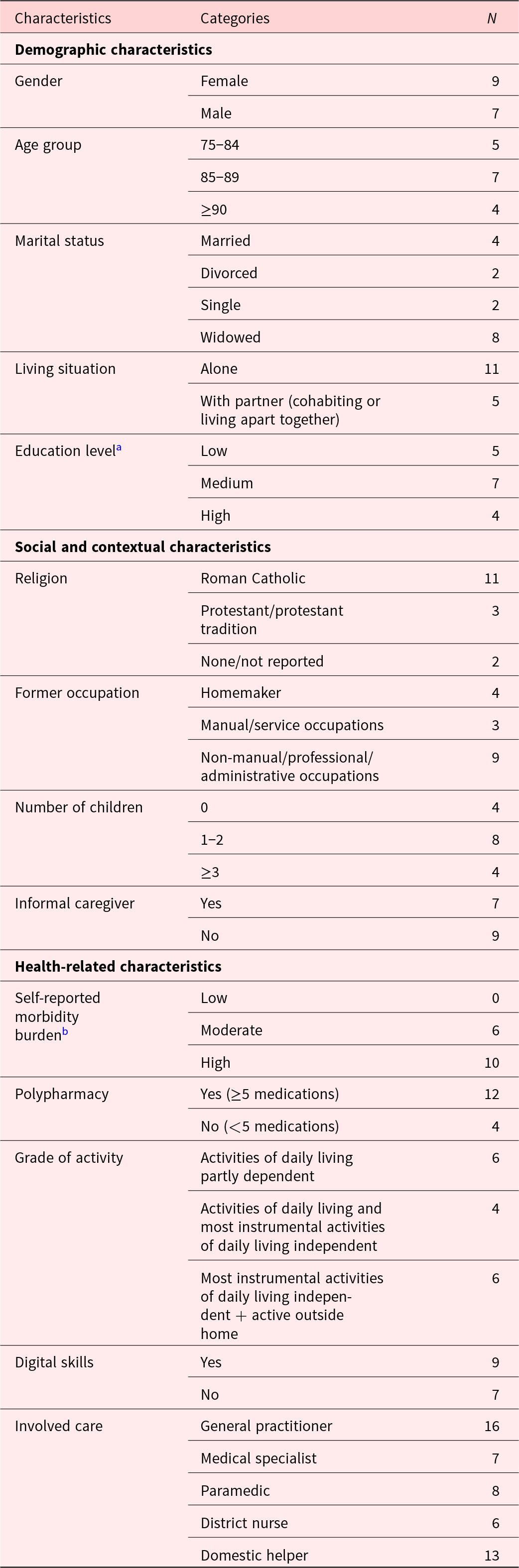
The participants varied in gender, age, marital status, living status, and educational level (Table 1). All were community-dwelling and were born and raised in the Netherlands. Almost all had a religious background; however, only 1 considered herself practicing. About half reported having digital skills, varying from reading on the internet to internet banking on a smartphone. There was variation in morbidity, from only somatic problems to a combination of psychological, cognitive, and communicative difficulties, as well as mobility disabilities. Most cases involved polypharmacy, and all participants had frequent contact with the GP or general practice nurse; any other carer involved is listed in Table 1.
Participant characteristics

Table 1 Long description
Participant characteristics are listed by category with counts in the column labeled, N, covering demographic, social and contextual, and health related characteristics. Gender counts were female 9 and male 7. Age group counts were 75 to 84, 5; 85 to 89, 7; and 90 or older, 4. Marital status counts were married 4, divorced 2, single 2, and widowed 8, and living situation counts were alone 11 and with partner, cohabiting or living apart together, 5. Education level counts were low 5, medium 7, and high 4; religion counts were Roman Catholic 11, Protestant or Protestant tradition 3, and none or not reported 2. Former occupation counts were homemaker 4, manual or service occupations 3, and non manual, professional, or administrative occupations 9; number of children counts were 0, 4; 1 to 2, 8; and 3 or more, 4; and informal caregiver counts were yes 7 and no 9. Self reported morbidity burden counts were low 0, moderate 6, and high 10; polypharmacy counts were yes, 5 medications or more, 12, and no, fewer than 5 medications, 4. Grade of activity counts were activities of daily living partly dependent 6, activities of daily living and most instrumental activities of daily living independent 4, and most instrumental activities of daily living independent and active outside home 6; digital skills counts were yes 9 and no 7. Involved care counts were general practitioner 16, medical specialist 7, paramedic 8, district nurse 6, and domestic helper 13.
a Education is categorized as: low (ranging from less than 6 years from primary school to vocational school), moderate (ranging from secondary professional education to university entrance level), and high (university or tertiary education) (Verhage Reference Verhage1964).
b Self-reported morbidity burden is categorized as low, moderate, or high based on participants’ reported chronic conditions and their overall impact on health and functioning. Low burden is defined as 1–2 stable conditions with limited functional impact; moderate burden as 2–3 conditions or the presence of at least 1 chronic condition with relevant health impact; and high burden as 4 or more conditions and/or the presence of multiple chronic conditions affecting different organ systems and/or associated with functional limitations.
Themes reflecting frail community-dwelling older persons’ perspectives on ACP and EOL conversations
We generated 163 codes, grouped into 31 subcategories, 14 categories, and 5 overarching themes (Supplementary File 2). To support clarity in presenting the findings, we distinguished 3 phases in participants’ accounts: (i) the planning phase, referring to the here and now of thinking about, discussing, and documenting EOL wishes (i.e., ACP); (ii) the EOL phase, referring to the anticipated final period of life in which care is delivered; and (iii) the moment of death and its aftermath, including the deathbed, funeral, inheritance, and organ or body donation. This distinction is used in the Results section to clarify the phase to which participants are referring.
Theme 1: Personal identity as the foundation for ACP and EOL preferences
Participants described their ACP and EOL preferences as closely connected to their broader personal values. These values shaped how they viewed acceptable care and decision-making and guided how preferences were formed and expressed.
1.1 Personal values as underlying orientations. Four interrelated domains through which personal values were expressed were identified: psychoemotional, social, existential, and physical well-being. In the planning phase, psychoemotional well-being was most often expressed in terms of autonomy and self-determination, with participants emphasizing the importance of remaining in control of decisions. For example, 1 participant stated: “I make the decisions, I decide, I don’t want to be resuscitated” (P4), illustrating how a general value of autonomy translated into a specific treatment preference. Social well-being was reflected in the importance of close relationships, including wanting support, mutual understanding, and proximity to family and close friends. This value was particularly salient when participants reflected on the EOL phase, where being surrounded by family was seen as essential. Physical well-being was described in terms of maintaining independence in daily activities and adapting to functional decline, for instance, by adjusting the living environment. Existential well-being referred to maintaining hope and a sense of meaning, even when considering EOL, as illustrated by 1 participant: “Well, maybe, that there’s always a silver lining” (P6).
1.2 EOL preferences: desired and undesired care and outcomes. Participants’ EOL preferences reflected how their underlying values were translated into concrete wishes across the 3 phases. In the planning phase, participants described mainly anticipatory limits to future care. They emphasized avoiding treatment situations perceived as burdensome or futile, particularly when recovery or meaningful quality of life was no longer expected. This included reluctance toward life-prolonging interventions and a general wish to prevent unnecessary suffering. As 1 participant stated: “When it’s really the case that I’m in the process of dying, they don’t have to do anything about it [life-prolonging interventions]. No, I’ve had my life” (P9). In the anticipated EOL phase, preferences focused on the nature and intensity of care. Participants emphasized comfort-oriented approaches, including adequate symptom control. In some cases, they expressed a preference for palliative sedation or euthanasia when suffering became unbearable. Preferences relating to the moment of death and its aftermath were described in more concrete and situational terms. Participants frequently expressed a preference to die at home and in the presence of family or close others, as illustrated by 1 participant: “I want to die at home and certainly not in the hospital or anywhere else…and with my family around me” (P14). Others emphasized the physical setting of dying, such as being in a familiar bed or space: “I’d prefer to die in my bed or right here, in the chair…I’d like that best” (P17). Participants also discussed post-partem wishes, including funeral arrangements, inheritance, and organ or body donation, which they framed as ways of maintaining control and contributing beyond death. For example: “If I give my body to science, they can do something with it, they can learn something from it. There may be some part of me they can use. I’d rather do that than a funeral or cremation” (P15).
Theme 2: External factors shaping EOL perspectives
Theme 2 describes how external factors shaped EOL perspectives. Three sources of influence were identified: lived experiences with illness, suffering, and the dying of others; the social environment, including others’ opinions, experiences, and spirituality; and information channels, such as media, agencies, and self-directed information seeking.
2.1 Lived experiences with illness, suffering, and the dying of others. Participants referred to both their own illness experience and those of others as shaping how they thought about future care and treatment preferences. These experiences were particularly present in the planning phase, where they informed reflections on what they would or would not want in similar situations. Witnessing illness in others, such as dementia in close contacts, was described as prompting reflection on future care wishes and advance directives. A participant illustrated this: “You also hear things that are happening around you, which, of course, play a role…a good friend who developed dementia, then you have conversations with her about a living will…and those conversations influence you” (P2).
2.2 The social environment, including others’ opinions, experiences, and spirituality. Participants described how EOL considerations were shaped through interaction with others, including family and close friends. These influences were often present in the planning phase, where discussion and reflection contributed to forming or revising preferences. However, participants emphasized that external opinions were not determinative but were weighed against their own conclusions. As one stated: “Of course, it’s influenced by the environment to a certain extent. But that’s also relative because everyone knows better. Everyone has their own opinion. So, in the end, you come to your own opinion and conclusion” (P18), reflecting a dynamic interplay between external influence and personal conviction. This was also visible in relation to spirituality and religion. One participant explained how religious belief provided a frame of reference but did not determine all decisions: “I do believe in God. He will take care of things, but resuscitation is different – euthanasia I do not want. I don’t think I will change my mind, and my children know that” (P10).
2.3 Information channels: media, agencies, and self-directed information seeking. Participants described how information from media, agencies, and personal searching contributed to their awareness of EOL options. Encountering such information could prompt reflection on documenting wishes or considering ACP. Some participants actively sought information, for example, through reading about advance directives. One participant noted: “I just read about a ‘do not resuscitate’ medallion, and then I started thinking about it, and then I thought, yes, it’s important that at least something is recorded” (P13). In other cases, information was introduced through external organizations, such as insurance companies distributing forms about resuscitation preferences, which in some cases prompted formalization of decisions not yet actively initiated.
Theme 3: Attitudes and motivations shaping engagement with ACP and EOL conversations
Older persons’ attitudes toward ACP and EOL conversations ranged from active engagement to more reluctant or skeptical positions. These attitudes were shaped by a combination of personal experiences, perceived responsibilities, and views on the usefulness of planning ahead. Participants described engagement primarily in relation to the planning phase, when ACP and EOL conversations are initiated and preferences are discussed or recorded. Whereas Theme 2 describes how experiences shaped what participants thought about EOL care, Theme 3 focuses on how these and other considerations shaped whether and how participants engaged in ACP and EOL conversations.
3.1 Active engagement. Participants who described a more active approach to ACP and EOL conversations often referred to specific moments or situations that prompted them to initiate conversations or document their preferences. These were typically concrete experiences that made the possibility of deterioration or medical decision-making more immediate, such as hospital admission or exposure to the illness trajectories of others. For example, 1 participant stated: “Yes, talking about the end of life came after being admitted to hospital. There, I heard that, if I were to be resuscitated, I could become a vegetable, that’s when I realized, that’s not for me” (P19). Similarly, others described how conversations or observations in their social environment prompted them to reflect and act upon their own preferences: “I think it was only about a year and a half ago that we discussed my wish for no resuscitation. That time, I also heard it more from my friends. I said ‘yes, that’s a good idea’” (P6). Beyond these initiating moments, participants described several motivations for engaging actively in ACP and EOL conversations. A key motivation was the desire to provide clarity for others, including family, close friends, and healthcare professionals, so that decisions would not be uncertain. As 1 participant explained: “Yes, that the GP will know… Then it’s no longer a riddle” (P1). For other participants, preventing suffering was a reason for a more active attitude. This was linked to the desire to concretize treatment preferences in a timely manner and described as contributing to a sense of peace. Some mentioned practical considerations, such as avoiding potential difficulties for next of kin, including issues related to inheritance.
3.2 Relational avoidance and unreadiness. Other participants described a more hesitant approach to ACP and EOL conversations. This was characterized by relational avoidance, reflected in concerns about burdening family, close friends, and healthcare professionals: “Yes, you know, I just feel that this [ACP and EOL conversations] would be quite a heavy burden for my children, and I don’t want to put that on them” (P9). Others described delegating decision-making to others or relying on the assumption that their preferences were already known within their social networks. A further group of participants described unreadiness to engage in ACP and EOL conversations, referring to difficulty talking about EOL, indecisiveness, and a preference to postpone such conversations until they felt more prepared. “It is a topic [end of life] that you tend to keep putting off. I’m not ready for it yet, just leave it” (P13).
3.3 Skepticism about the value of planning. A distinct attitude concerned skepticism about the value of ACP and EOL conversations. Participants emphasized the unpredictability of the future and questioned whether preferences documented in advance would remain applicable, thereby challenging the perceived stability of advance directives over time. As 1 participant reflected: “So we thought in the beginning, in our innocence, that once you fill in a living will like that, that’s it, but then you later conclude that you haven’t got there at all….because if you can’t reproduce it yourself, you can chuck it in the trash” (P2).
Theme 4: Organization and conditions of ACP and EOL conversations
ACP and EOL conversations were shaped by who initiated them, who was involved, and the conditions under which they took place. Participants described these conversations as occurring across a wide network of actors, including family members, friends, healthcare professionals, and care workers (including home and domestic care workers), and requiring varying degrees of trust, communication, and practical readiness. Participants referred primarily to the planning phase when describing how conversations were initiated and conducted. Conversations differed systematically in what was discussed and how outcomes were recorded, depending on the relational context and perceived responsibilities, indicating that participants actively aligned content and documentation with those whom they considered appropriate to involve.
4.1 The different initiators. ACP and EOL conversations were initiated by older persons themselves, family and close friends, or healthcare professionals. Who initiated the conversation influenced the perceived appropriateness of the timing and manner of the discussion. Initiation by healthcare professionals was sometimes appreciated when it aligned with relevant health events, such as hospital admission or increased EOL proximity. In such contexts, participants indicated that conversations about future care were considered more acceptable and timelier. Conversely, unsolicited initiation could be experienced as intrusive, particularly when it was perceived as not aligned with the participant’s readiness. As 1 participant noted in response to whether the GP should have initiated the conversation: “No, then I might have thought: what an intrusive person” (P1).
4.2 The different conversation partners. Participants described a broad range of possible conversation partners, extending from intimate relationships to professional care contexts. These included life partners, children, siblings, friends, GPs, nurses, medical specialists, and care workers. Conversations were not confined to formal healthcare encounters but also embedded in everyday care relationships. This was illustrated by accounts in which care workers were aware of specific preferences, indicating that ACP-related information was also shared and held within everyday care relationships. For example, 1 participant described how a homecare worker was familiar with their resuscitation preference and knew how to respond in relevant situations: “The homecare worker also knows about the resuscitation policy. She knows what to do” (P20).
4.3 Conditions for engaging in ACP and EOL conversations. Participants emphasized several conditions that shaped whether they were willing to engage in ACP and EOL conversations. First, conversation partners needed to be perceived as trustworthy based on willingness, empathy, continuity, attentiveness, and perceived competence. Second, communication needed to be appropriately tailored. Some participants preferred careful and gradual communication, whereas others emphasized clarity and directness, even when this was emotionally challenging. As 1 participant noted: “You shouldn’t beat around the bush. No, I think I’m quite direct. And sometimes, I find that hard. Because then I get emotional… But yes, that’s part of the conversation” (P18). Privacy was another key condition, particularly at healthcare access points where disclosure of the reason for contact was required before the conversation could proceed. One participant described discomfort with this initial gatekeeping process and the difficulty of introducing ACP-related wishes in that context: “When you call, you have to tell the assistant what’s going on. I’m not too fond of that. She asked, ‘What’s going on?’ So, I said, ‘Something with my breathing.’ She said, ‘Yes, and what else?’ and then I said, ‘Yeah, I want a euthanasia directive…’But, I wasn’t comfortable saying that to her…that’s personal” (P15). Finally, sufficient time, preparation, and an appropriate moment and setting were seen as necessary to allow for meaningful conversation.
4.4 What is discussed with whom. The content of ACP and EOL conversations varied according to the conversation partner. With family and close friends, participants reported discussing a broad range of topics, including inheritance, funeral arrangements, place of death, euthanasia wishes, and preferences regarding medical treatment and care. With GPs, conversations focused primarily on medical aspects of future care, including euthanasia wishes, life-prolonging treatment, pain relief, and advance directives. With medical specialists, discussions were generally limited to decisions about life-prolonging treatment, particularly do-not-resuscitate orders and refusal of life-prolonging interventions.
4.5 Recording of preferences. Participants described different ways of recording their ACP and EOL preferences. Some formalized their wishes in documents such as a living will, GP record, donor register, or insurance forms. Others relied on informal arrangements, including oral agreements or written notes kept at home. In some cases, verbal communication itself was considered sufficient, with participants emphasizing the confidential nature of such discussions: “I: ‘And did you record that in a will?’ P: ‘No, I said it like that (…) You should be able to discuss that verbally; it’s confidential’” (P15). In other cases, there was no formal documentation, as participants assumed that their preferences were sufficiently known by those close to them: “No, I didn’t write down my personal preferences around my deathbed. But… I’m almost sure they all know…they know me well enough, I think” (P14).
Theme 5: Expectations regarding involvement of others in ACP and EOL conversations
Participants described clear expectations regarding the involvement of family, close friends, and healthcare professionals in ACP and EOL conversations. These centered on 2 key dimensions: the need for proximity and the expectations that others would take responsibility in supporting decision-making.
5.1 The need for proximity: accessibility, engagement, and presence of others. Participants emphasized the importance of proximity to family, close friends, and healthcare professionals. This included accessibility, particularly in relation to healthcare professionals, who were expected to be approachable and available to engage in conversations about EOL preferences. Participants also described the importance of their family’s and close friends’ engagement, including being involved in discussions, understanding preferences, and supporting decision-making. Proximity extended to physical presence in the EOL phase and at the moment of death, where participants expressed the importance of having family and close friends nearby, for example, to say goodbye. Expectations of presence were, in some cases, extended to healthcare professionals. One participant described the GP’s role as being present at EOL: “I: ‘What do you think the GP’s role is around the end of life? What’s the role of the GP?’ P: ‘Yes, if the children, or whoever, if I’m dying, then, a GP would be there, then, yes… Yes, well that then he or she would note the end of, the life cycle, so to speak’” (P19).
5.2 The expectation that others take responsibility. Participants described expectations that others would take responsibility in the context of ACP and EOL conversations. Particularly in the planning phase, healthcare professionals were expected to initiate conversations about ACP and EOL care, to anticipate the consequences of aging, and provide information about available options. They were also expected to document preferences and to attune care to the older person’s goals and wishes. Mainly in the EOL phase, family and close friends were expected to be aware of previously expressed preferences and align with them when decisions became necessary. This was often framed not as active decision-making but as a form of relational continuity grounded in prior knowledge of the person’s wishes. In some accounts, responsibility for decision-making was explicitly delegated in advance to others, including both healthcare professionals and family members. A participant described fully deferring decisions to the physician: “I: ‘And, the bit just before you die? For example, going to a nursing home or being referred to the hospital? Are there things you don’t want?’ P: ‘No, no. Look, you know what it is? Look, a doctor’s just there to help you, right? So, I mean, I’ll leave that completely to the doctor’” (P18). Similarly, others expressed trust in family members to make decisions on their behalf: “I: ‘Have you also thought about, for example, where you want to die?’ P: ‘No, I just think like this: they [family] will figure it out’” (P5).
Discussion
Main findings
In this interview study, we obtained insights into frail community-dwelling older persons’ perspectives and attitudes regarding ACP, including EOL conversations. When asked about ACP, participants discussed mainly matters concerning their EOL preferences, expectations, and wishes. The participants’ personal identity formed the foundation for ACP and EOL decision-making, which was shaped by their personal values and external factors, including lived experiences, others’ opinions, and information channels. Participants described differing attitudes and motivations toward engaging in ACP and EOL conversations. Some were motivated to engage, often triggered by experiences such as deterioration or hospitalization, whereas others expressed hesitation or skepticism, particularly because of the unpredictability of the future. ACP and EOL conversations involved family and close friends, GPs, and medical specialists, with the content of discussions varying across these relationships. With family and close friends, participants discussed a broad range of EOL preferences. With GPs, conversations focused mainly on ACP-related wishes, including EOL care, palliative care, and medical assistance in dying. With medical specialists, discussions were largely limited to preferences regarding the non-initiation of life-prolonging treatment. These variations reflected the organization and the conditions of ACP and EOL conversations as shaped by trust, respectful and tailored communication, privacy, and practical readiness. Participants also described clear expectations regarding the involvement of others. These centered on the need for proximity, including accessibility, engagement, and the presence of both family and close friends and healthcare professionals, as well as the expectation that others take responsibility in initiating ACP and EOL conversations, supporting alignment with their preferences, and contributing to decision-making when needed.
Personal identity and experiences shaped attitudes toward ACP
The finding that personal identity formed the foundation for ACP and EOL decision-making is consistent with previous research showing that individuals’ values and personal experiences shape their preferences for future medical care. In particular, past experiences with personal illness or with family and close friends who had been seriously ill or were dying have been shown to influence current preferences for medical care (McMahan et al. Reference McMahan, Knight and Fried2013), an influence also highlighted during the COVID-19 pandemic (Dujardin et al. Reference Dujardin, Schuurmans and Westerduin2021; Ter Brugge et al. Reference Ter Brugge, van Atteveld and Fleuren2022). Our findings extend this perspective by showing that such experiences were not only used to formulate specific EOL preferences but also influenced participants’ attitudes toward ACP and EOL conversations. Thus, personal experiences appeared to shape both what participants wanted and whether and when they considered ACP meaningful.
Participants described differing attitudes and motivations toward engaging in ACP and EOL conversations. Some were motivated to engage, whereas others expressed hesitation or skepticism, particularly because of the unpredictability of the future. This is consistent with previous research showing that attitudes toward ACP vary, although they are generally positive (Sharp et al. Reference Sharp, Moran and Kuhn2013; Mignani et al. Reference Mignani, Ingravallo and Mariani2017). However, previous literature has identified barriers such as lack of readiness, fear of death, and cognitive or physical limitations (Fujimoto et al. Reference Fujimoto, Evans and Zhou2025; JMS Tang et al. Reference Tang, Cher and Lim2023a), whereas our findings suggest that reluctance may also arise from perceived uncertainty about the future and skepticism about the value of planning. This suggests that reluctance toward ACP may not necessarily reflect an unwillingness to discuss EOL care but rather uncertainty about whether preferences expressed in advance will remain relevant.
ACP was primarily understood as EOL planning
When asked about ACP, participants focused mainly on EOL expectations, wishes, and preferences rather than on future care planning in a broader sense. This is consistent with findings that frail older persons tend to associate ACP with EOL decisions. This narrowing of focus may reflect the uncertainty, multimorbidity, and unpredictable illness trajectories that characterize frailty and limit individuals’ ability to anticipate broader future care needs (Collins et al. Reference Collins, Hopkins and Milbourn2024). Consequently, ACP conversations may naturally shift toward preparing for the final life phase (Wolff et al. Reference Wolff, Scerpella and Giovannetti2025). Frail older persons may also perceive discussions about EOL preferences as more concrete, meaningful, and actionable than broader future care planning (Hermansen et al. Reference Hermansen, Alnes and Lereim Saevareid2025).
Our findings further suggest that participants tended to focus on desired outcomes of care rather than on specific medical interventions, consistent with previous evidence that individuals tend to formulate preferences in terms of desired outcomes rather than particular treatments (Rosenfeld et al. Reference Rosenfeld, Wenger and Kagawa-Singer2000).
ACP and EOL conversations differed across relationships
Most participants reported having discussed their EOL preferences with family and close friends. This differs from earlier studies suggesting that many older persons do not engage in such discussions, often assuming that preferences are already known (Mignani et al. Reference Mignani, Ingravallo and Mariani2017; Combes et al. Reference Combes, Gillett and Norton2021). Although some participants in our study similarly assumed that others already knew their preferences, most described explicit communication with family and close friends. This difference may partly be explained by selection bias, as individuals with more proactive attitudes toward ACP may have been more likely to participate. It may also relate to our study design, which encouraged reflection on a broad range of EOL topics in a home-based setting, potentially facilitating more open discussion of sensitive issues (Festvag et al. Reference Festvag, Sverre and Paulsen2024). Nevertheless, the finding that most participants had explicitly discussed their EOL preferences with family and close friends highlights the importance of involving them in ACP and EOL planning, as they are likely to have a good understanding of the person’s preferences. In addition to being familiar with the person’s preferences, family and close friends may also serve as surrogate decision-makers if the person loses the capacity to make decisions themselves, making their involvement in ACP particularly relevant.
Trust and involvement of others shaped ACP and EOL conversations
Participants described several conditions that facilitated ACP and EOL conversations, particularly trust, respectful and tailored communication, privacy, and practical readiness. These findings are consistent with previous research identifying conditions for ACP conversations among frail older persons, including expectations regarding who should initiate conversations and the importance of having a trusted conversation partner (Jimenez et al. Reference Jimenez, Tan and Virk2018; Zwakman et al. Reference Zwakman, Jabbarian and van Delden2018). Recent studies similarly emphasize trust as a key prerequisite for engagement in ACP across stakeholders (Fujimoto et al. Reference Fujimoto, Evans and Zhou2025; Iida et al. Reference Iida, Ishimaru and Tsujimura2025; Tang et al. Reference Tang, Cher and Lim2023a).
Our findings extend this literature by showing that trust was embedded in broader expectations regarding the involvement of others. Participants expected family, close friends, and healthcare professionals to be accessible and engaged, and to contribute to initiating conversations, supporting their preferences, and making decisions when needed. This finding suggests that ACP may be experienced as a shared rather than solely individual process.
Strengths and limitations
A key strength is the focus on frail older community-dwelling persons in general rather than on persons living in long-term care facilities or with specific diseases. This approach is particularly relevant given the increasing number of frail older people in primary care (Gobbens Reference Gobbens2023), many of whom have multiple health conditions. By broadening the scope of our study, we were able to capture a more comprehensive view of ACP and EOL preferences and attitudes among this population, thereby enhancing the robustness and applicability of our findings.
A limitation is that our inclusion method may have led to selection bias. (Gerger et al. Reference Gerger, van Dijk-de Vries and Moser2024) identified 3 subgroups of older adults with differential needs regarding ACP-related activities: those who avoid talking about ACP, those who are open to ACP but do not initiate it themselves, and those who start the ACP process themselves. It is plausible that people from the latter group were asked by their GPs to participate. Moreover, these persons with positive proactive attitudes toward ACP and specific ideas about EOL preferences were probably more willing to participate. Second, although we intended to include frail older persons from cultural minorities, we were not successful in recruiting them. This limits the diversity of perspectives captured in our study, particularly regarding culturally shaped views on ACP and EOL decision-making. Previous research shows that cultural background can influence attitudes toward ACP, including preferences for family-centered decision-making and lower awareness of ACP, for example, because of lower health literacy (Hong et al. Reference Hong, Yi and Johnson2018). This probably limits the generalizability of our findings. Future research should aim to include more diverse populations by using culturally sensitive recruitment strategies, for example, by building trust through transparent communication, engaging community networks, alongside the use of professional interpreters to support accurate and independent data collection (Ramadhan et al. Reference Ramadhan, Schrag and Tufail2025). These groups deserve attention, especially in light of increasing ethnic diversity (Vertovec Reference Vertovec2019).
Implications for practice
In recent years, various interventions have been developed to support ACP, including the use of ACP toolkits (Nouri et al. Reference Nouri, Ritchie and Volow2021), adapted Respecting Choices programs (Overbeek et al. Reference Overbeek, Korfage and Hammes2019), and ACP information meetings (Bergman et al. Reference Bergman, van der Plas and Pasman2026). However, evidence suggests that these interventions have only modest effects on overall ACP readiness, with limited impact on specific ACP-related behaviors (Tan et al. Reference Tan, Tang and Feder2024; Fujimoto et al. Reference Fujimoto, Evans and Zhou2025). Moreover, individual behavior-change models alone are insufficient to explain ACP engagement, as readiness is strongly shaped by contextual and relational factors such as family dynamics, social relationships, and care context, and may require ongoing, flexible assessment over time (Fujimoto et al. Reference Fujimoto, Evans and Zhou2025).
Building on these insights, our findings suggest that ACP conversations with frail community-dwelling older persons should not start primarily from medical decisions but from exploration of personal values, identity, and what gives life meaning. This value-based starting point may help healthcare professionals better align ACP with how frail older persons actually think about EOL issues. Furthermore, the uncertainty associated with frailty emerged as a key barrier, suggesting that ACP should be framed as a flexible and ongoing process rather than a fixed plan. Scenario-based discussions may help professionals to make future care situations more tangible, thereby reducing perceived uncertainty without requiring definitive decisions (Poelman et al. Reference Poelman, Ermers and Schers2024).
Given the central role of family and close friends in ACP discussions, healthcare professionals should actively consider involving them in the decision-making process. However, such involvement should be tailored to individual preferences, as family dynamics may facilitate but also complicate decision-making (Fujimoto et al. Reference Fujimoto, Evans and Zhou2025). In practice, this requires healthcare professionals to explicitly explore whether and how ACP discussions are shared across the family and the healthcare context, as communication was found to differ across these relational settings.
Supplementary material
The supplementary material for this article can be found at https://doi.org/10.1017/S1478951526103885.
Data availability statement
Data are available on reasonable request via the corresponding author.
Acknowledgments
We are grateful to all GPs who invited patients to participate, all interviewees who participated in our study, and Kim Bergmans (K.B.), Marleen Pieters (M.P.i.), and Tineke van Iersel (T.v.I.) for their contributions during the peer group discussions. Finally, we would like to thank Roger Staats, a native English speaker, for his invaluable assistance in reviewing and providing constructive feedback on the language and clarity of this manuscript.
Author contributions
Conception/design: M.B.I.v.d.H. and M.K.D. Data acquisition: M.B.I.v.d.H. Data analysis: M.B.I.v.d.H. and D.J.M.E. Data interpretation: all authors. Manuscript writing: M.B.I.v.d.H. and D.J.M.E. Critical revision of manuscripts and final approval: all authors. All authors have participated sufficiently in the work to take public responsibility for the appropriate content. M.B.I.v.d.H. and D.J.M.E. contributed equally.
Funding
The authors received no financial support for the research, authorship, and/or publication of this article.
Competing interests
The authors declared no potential conflicts of interest with respect to research, authorship, and/or publication of this article.
Ethical approval
This study was subject to the Medical Research Involving Human Subjects Act (WMO) and was conducted following the ICH-GCP guidelines (Good Clinical Practice). The Medical Research Ethics Committee, CMO region Arnhem-Nijmegen, approved the study (case number 2019-5292; ABR number 69758).
Ethics and consents
Not applicable. All quotations included in this paper are anonymized and cannot be traced to any specific individual. Informed consent was obtained from all research participants prior to the interviews. Technical and organizational measures were implemented to safeguard the availability, integrity, and confidentiality of the data, including pseudonymization, access authorization, and secure data storage.


 Open access

