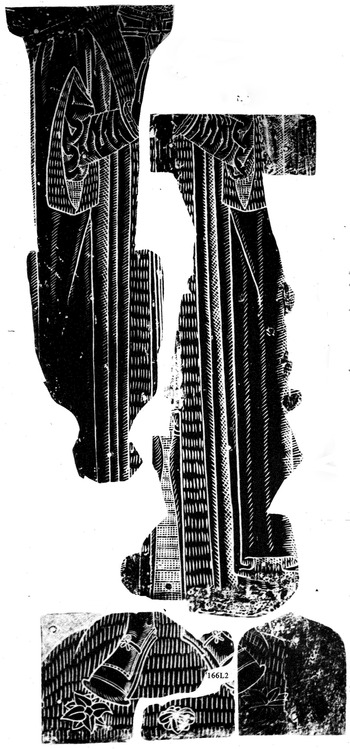
During the reign of Edward vi (1547–53), monumental brasses – metal plates with engraved epitaphs, images of the deceased and their heraldry – were ripped up from graves during evangelical ‘cleansing’ of ‘popish’ material culture from churches and cathedrals. The Revd Herbert Macklin, former president of the Monumental Brass Society, commented: ‘Had Edward vi’s reign continued but a few years longer, we might have been obliged to count our brasses only by hundreds, instead of by thousands’.Footnote 1 The plates’ reverses were re-engraved to form new monuments. Evidence of such reuse is revealed during conservation, as jigsaws of fragments are found behind brasses in scattered locations,Footnote 2 misleadingly termed ‘palimpsests’ (figs 1–2).Footnote 3 This article explores the despoilation and reuse of looted brass plates and monumental stonework in London in this period and attempts to calculate the scale of loss (Tables 1–3). It follows earlier research into how production of brasses was affected by the politico-religious changes of the Reformation.Footnote 4 Was this state-sponsored looting motivated mainly by iconoclastic zeal, or was it driven by opportunistic personal gain, or to fund repairs to churches?
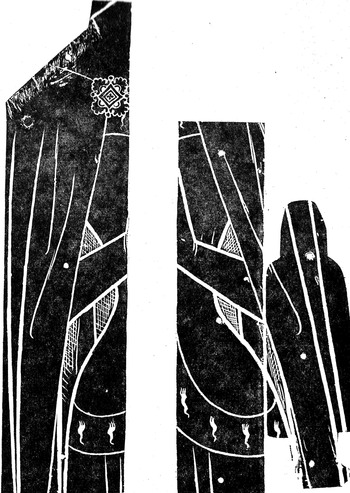
Left: Reverse of John Latton’s inscription, redated to 1551, at Blewbury, Berks. Right: reverse of figure of Richard Newport and inscription at Greystoke, Cumberland, 1551. These form part of a lady, c 1430, in an ermine-trimmed dress with broach. Blewbury inscription height: 495mm. From Trans Monumental Brass Soc; courtesy: Monumental Brass Society.

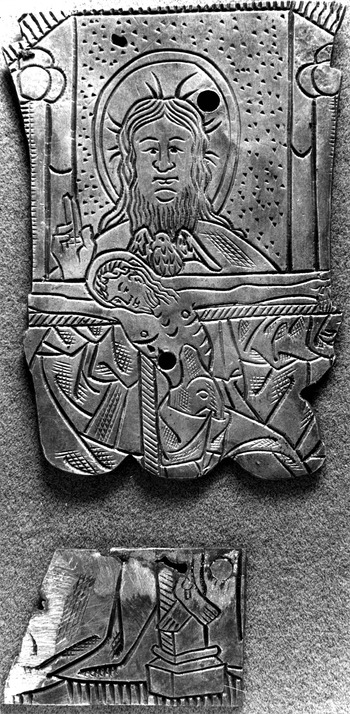
Reverse of three daughters and part of a shield at Great Hampden (Bucks) from 1553, two parts of a Trinity of c 1500. Use of small fragments indicates temporary scarcity of despoiled metal. Height of daughters (upside down): 157mm. Photograph: Bran Egan.

The root cause of the despoilation was money. Henry viii had bequeathed a bankrupt realm to his nine-year-old son, Edward. The old king’s final profligate wars with France and Scotland were financed by taxation, debasements of coinage, crown property sales and reckless borrowing. Peace with France came in June 1546, but the debilitating costs of defending English-held Boulogne continued. The Scottish war dragged on after Henry’s death, but Boulogne was returned to France in 1550 and French troops left Scotland. Three years later, a fastidious Tudor clerk calculated that England’s military expenditure in 1538–51 had totalled £3,486,471 15s 5¼dFootnote 5 – or £1.49 billion in today’s money.Footnote 6
In 1545, Henry had coveted the riches of England’s churches, hoping he might ‘borrow’ their wealth to solve his economic crisis.Footnote 7 Edward Seymour (1500–52), then 1st earl of Hertford, endorsed the idea ‘as the least chargeable to the king’s subjects. God’s service, which consists not in jewels, plate or ornaments … cannot thereby be … diminished and those things better employed for the … defence of the realm’.Footnote 8 After the northern rebellions of 1536–7, however, Henry dared not plunder the churches, fearing fresh uprisings. Seymour, afterwards 1st duke of Somerset and ‘Governor and Protector’ of the young king, resurrected the plan in 1550. The Privy Council established commissions to appropriate ‘into the Kinges handes such church plate as remaigneth to be emploied unto his Highnes use’ to obviate ‘the pressing neede presently of a masse of mooney’.Footnote 9
Some churchwardens avoided seizure of church goods by selling them before the commissioners arrived. Sixty-nine out of a sample ninety parishes in England recorded pre-emptive sales in 1547–52.Footnote 10 Descendants also sought to protect brasses by burying them beneath church floors, as at Broadwater and Clapham, Sussex. Edward vi noted in 1552 that ‘It was agreed that Commissioners should … take certificate of the superfluous Church Plate to Mine use and to see how it hath been embezeled’ and ordered ‘sell off … to Our use by weight, all parcells or peces of metall except the metall of the great bell and saunce bell …’.Footnote 11
This analysis of the loss of brasses and monuments is derived from both inventories of church goods and churchwardens’ accounts in London. Ninety-five parishes returned inventories, of which eighty-four survive (three are fragmentary and one almost obliterated); enough to build an evidence base from which conclusions may be drawn. Few churchwardens’ accounts remain from this period, and some were unavailable for research because of the coronavirus pandemic. Essex and Surrey church inventories were also investigated, as London metal purchasers were active in these counties.
THE LONDON MARBLER WORKSHOPS
Manufacturers of brasses were known as ‘marblers’. These memorials were engraved on brass plates, which were rivetted into indents in marble (mainly Purbeck) slabs, flush with the polished surface. The industry had flourished in London since the fourteenth century and its output, found throughout England and Wales (with outliers in Ireland, Guernsey, France and Germany), are grouped typologically by figure design and inscription lettering. These are categorised by a chronological letter sequence, with the ‘G’ series emerging around 1500.Footnote 12 This evolved into the ‘Gyfford’ figure style around 1530, probably owned by the marbler William Raynton (d. 1556), of Lad Lane, with an atelier in St Paul’s churchyard.Footnote 13 During the Dissolution of the Monasteries, it prospered by recycling plundered metal, with production peaking in 1540.Footnote 14
The copper alloy used for brasses (and also liturgical plate) was known as ‘latten’, with a metallurgy in 1500–50 of 64–70 per cent copper, 11–28 per cent zinc, <3 per cent tin and 1–8 per cent lead.Footnote 15 Before brass production began in England after 1568 the metal was smelted in the Cologne area and imported as rectangular plates, between 3.5mm and 5.5mm thick.Footnote 16 During this period, London customs receipts suggest declining imports by Hanseatic merchants of ‘shaven latten’, or milled plates used for engraving, as demand became depressed by use of looted brasses. Twelve barrels of latten plates, worth £6 each, were recorded in July 1535, plus 113kg of unspecified latten, compared with three barrels and 273kg in March and June 1537.Footnote 17 From 1544, imports may have been interrupted by the conflict in northern France. The dissolution of chantries in 1548 followed the emergence of a fresh figure design by the London marblers, using newly plundered metal and introducing more naturalistic portrayal. The ‘Fermer’ series (see supplementary material, appendix 3) was initially associated with the Gyfford atelier, as parts of the same recycled brasses are found behind both figure styles, before the latter faded out in c 1550.Footnote 18
Fermer production relied heavily on looted metal, predominantly from London churches, with 55 per cent of its output known to have employed reused metal, with another 10 per cent yet to be investigated. Just two memorials utilised imported latten plate with blank reverses: an inscription and two shields of 1550 at Isleham (Cambs) and the upper half of a large effigy of 1553 at Ashby St Leger (Northants) (see supplementary material, appendix 5). The 1552 inventory for St Faith, beneath St Paul’s Cathedral, identifies the Fermer marblers as Roger Syluester (Sylvester)Footnote 19 and Aleyne Gaulyn, who bought 64kg of ‘olde & broken lattyn’ for 48s 6d on 20 February.Footnote 20 An inscription to Richard Tabbe (d. 1490), on the back of a Fermer brass of 1553 at Great Hampden (Bucks), came from St Faith’s. Another, to William Storteford (d. 1416), canon and treasurer of St Paul’s, from the cathedral’s crypt, forms a reverse of a Fermer product of c 1552 at Twyford (Bucks).
The Fermer atelier probably abutted the church of St Dunstan-in-the West, Fleet Street, pinpointed by the will of Thomas Salter, chantry priest, who requested in 1558 that his brass be made by the ‘cunynge marbler that dwellithe in saincte Dunstons parishe in the West ageynste the sowthe syde of the Churche’.Footnote 21 Sylvester’s business partner, ‘Gauylyn’ or ‘Gammon’, received £7 6s 8d for erecting a tomb with brasses for Henry Tooley (d. 1551) in St Mary Quay, Ipswich, Suffolk, in 1568/9.Footnote 22 ‘Alan Gamman, marbeldur ov’against St Donstons churche’ also witnessed a receipt in 1558/9.Footnote 23
The nouveau riche created by the Dissolution required monuments that exhibited their new-found status and wealth. To meet this demand, the Fermer workshop manufactured at least eighty-seven brasses in 1546–56, averaging almost eight per annum.Footnote 24 Given the limited technology and transportation resources of the mid-sixteenth century, this was remarkably high productivity. Twenty-eight armoured effigies (with or without wives) form the major group, followed by brasses to thirteen civilians, six ladies, six clerics and two senior judges. The most magnificent example is that to Thomas Goodrich (d. 1554), bishop of Ely and lord chancellor to Edward vi, in Ely Cathedral. The remainder are humble inscriptions with heraldry, some possibly deliberately understated monuments because of the civil unrest of 1549. In contrast, marblers’ workshops in Bury St Edmunds, Norwich, Coventry and Canterbury disappeared in c 1550, unable to survive challenges posed by the Reformation.Footnote 25 However, at least two provincial ateliers copied Fermer designs: a civilian brass at Lowestoft, Suffolk, redated c 1550 (now lost), and a civilian and three wives at Rettendon, Essex, of c 1552.Footnote 26
ICONOCLASM AND PROFIT
In 1547 religious statues, or ‘images’, were ordered to be removed from London churches, and this edict was extended throughout the realm in February 1548. The 1549 Acte for the abolishinge and puttinge away of diverse Books and Images, imposed penalties for failing to deface or destroy ‘anye Images of Stone, Tymbre Allleblaster or Earthe graven, carved or paynted whiche … stande in anye Churche or Chappell’. Greed, or iconoclasm, emboldened some to ignore the Act’s specific exemption of ‘any Image or Picture sett or graven upon anye Tombe … which hath not been commonly reputed … for a Sainct …’.Footnote 27 The antiquary John Weever described how ‘marbles which covered the dead were digged up and put to other uses … Tombes hackt and hewne apeeces; Images or representatyons of the defunct broken [and] erased … for greedinesse of the brasse … [which was] pulled out from the Sepulchres and purloined’.Footnote 28 Some statues were exported to Catholic countries; in September 1550, Sir John Masone, ambassador to France, reported: ‘Three or four ships have … arrived from England … laden with images which have been sold at Paris, Rouen and other places and … eagerly purchased.’ None would have sold if instructions to deface them had been obeyed.Footnote 29
Judgement on who held reformist beliefs must remain conjectural, although some London parishes were reputed hotbeds of evangelical reform. Church goods were sold only after the churchwardens obtained parishioners’ consent, and exceptions may be due to the iconoclastic zeal of these individuals. In 1547–8, William Pettyngar and Henry Awncell, of St Thomas the Apostle, London, sold its brasses despite parish opposition.Footnote 30 The same year, Oliver Tatum at St Andrew, Holborn, removed ‘old copper off the tombs and gravestones as come to one cwt’ (51kg), raising thirty-six shillings to fund ‘setting vp the Kinges maiesties armes with Skriptures vpon the roode loft’, in place of the figure of Christ crucified. The following year, the churchwardens there ‘took up as much more old latten or copper in the church’ for 18s 6d. Footnote 31 At Bletchingley, Surrey, in 1553, the reformist local magnate Sir Thomas Cawarden, master of the revels to Edward vi, demanded repayment of his costs in ‘abolleshyng and defasyng of the idollative and allteryng the ollde superstysyon’. He accepted 43kg of broken latten in part-payment, and £27 in cash.Footnote 32 Churchwardens at All Hallows London Wall, St Antonin, St Katherine Cree, St Martin Ludgate, St Mary Staining and St Stephen Walbrook all sold altar slabs in 1547–9, ahead of the abolition of altars in London in 1550. They, and their successors, were probably religious reformists, as ten confirmed or probable sales of despoiled brasses were recorded at these churches in 1548–9, 1550–1 and 1552 (see supplementary material, appendices 1A and 1B) (fig 3).
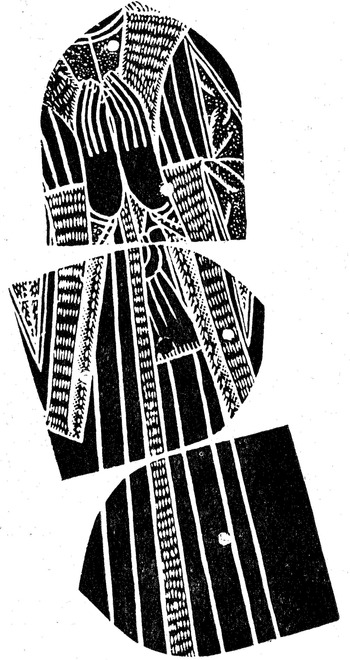
Reverse of three shields from Easton Neston, Northants, 1552, formed from the central portion of a civilian of c 1515, in a furred gown with a purse. From Page-Phillips Reference Page-Phillips1980; courtesy: Monumental Brass Society.

Plunder for personal gain forms another motivational group. A contemporary example is the memorial to Richard Whittington (d. 1422), four times mayor, who was buried under a tomb-chest with a brass marginal inscription in St Michael Paternoster Royal.Footnote 33 The antiquary John Stow recorded: ‘In the Raigne of Edward the 6, the parson of that church, thinking some great riches … to bee buried with him, caused his monument to bee broken, his body to spoyled of his leaden sheet and … the second time to bee buried.’Footnote 34 Stow lamented such losses of London’s church monuments – ‘destroyed by bad and greedy men of spoyle’Footnote 35 – and further tomb destruction continued in Elizabeth i’s reign.
Fourteen occupations were recorded among those who purchased latten in London, unexpectedly including a joiner, girdler and grocer, doubtless all seeking opportunistic profit. Three – Thomas Castell, grocer and merchant; Robert Nashe, wax chandler; and Thomas Gonne, armourer – bought brasses, as well as stonework. As these were the marblers’ stock-in-trade, one might speculate that they were acting as middlemen or brokers. In addition to Gonne, two other armourers acquired brasses: Richard Leycroft and Leonard Richeman. Founders based in the city’s Lothbury area were the most ubiquitous buyers. Prominent among them is Thomas Thaxton, who bought twelve parcels of latten in 1547–50 from four London churches and six in Surrey. Most were crucifixes, lamps and candlesticks that were sold on or melted down — more likely the latter, as the second-hand market for church goods was becoming saturated. He acquired ‘all the brasse of the gravestones’, for £7 in 1551–2 at St Michael Queenhithe and earlier, ‘certeyn old latten’ from St Andrew-by-the-Wardrobe,Footnote 36 which was probably sold on to marblers. Another founder, Christopher Stubbes, bought 15kg of ‘certain old latten’ in 1547–8 from St Thomas the Apostle and 14kg of ‘mettell which was taken vpon the graue stones and other molumentes’ (sic) from All Hallows, London Wall.Footnote 37
Some brasses may have been recast as ordnance. John Owen,Footnote 38 who, together with his brothers Robert and Thomas, was a royal gun founder in Houndsditch, acquired 103kg of latten at St Katherine Cree in 1547 and 356kg of ‘Bell mettall’ in 1550–1 from St Giles Cripplegate.Footnote 39 Four Falcon cannon, cast by them in 1549–51, weigh up to 356kg.Footnote 40
Some Essex purchasers may have had another motive for buying metal: the illegal export of latten. Because of the strategic importance of latten in manufacturing cannon, Parliamentary Acts of 1529 and 1541 prohibited its unlicenced sale overseas.Footnote 41 The cost of copper, its main constituent, increased sharply after production slumped during the European wars of 1521–30, and afterwards its price was fixed by monopolies linked to the Fugger bankers. New legislation in 1549 acknowledged that ‘dyvers covetous and greedy persons’ had bribed ‘Maisters, Purssers or other officers of Shyppes’ to secretly export contraband metal from small creeks.Footnote 42 At least five sales of latten (probably mainly church goods) in Essex in 1547–9 were to buyers who lived in or near Thames estuary ports that traded with Europe, convenient for smuggling operations.Footnote 43 One was ‘Father Coc of Chellmsford’, father-in-law of the churchwarden handling the sale. The metal ‘remayneth in ye handes of John Cock of Lygh [Leigh] mariner’.Footnote 44
THE SELLING PROCESS
Disposal methods included informal auctions of church goods in situ and, in the case of metal, each lot was weighed carefully. Candlesticks, censors, lamps and latten taken from graves were sometimes bulked up in batches. Purchasers’ names often went unrecorded. A buyer at St Andrew, Holborn, in 1549–50 was identified only as the ‘Marchante man’ who bought 102kg of brasses for thirty-six shillings. Footnote 45 In 1551–2, two founders bought 155kg of ‘old latten’ for £57 at St Botolph, Aldersgate, but they ‘departed [and we] know not theyr names’. Footnote 46 There were also casual sales to itinerant purchasers – brasiers and tinkers – who toured churches to acquire metal, as at Little Ilford, Essex, in 1553, when a quantity was sold ‘to one that came to enquere to bie lattin as to come to ijs but [who] he was [we] cannot tell’.Footnote 47 Conversely, Willam Burfeld, a proactive churchwarden at Paglesham, Essex, sold ‘serte’ latten’ at ‘bartholomew fayre’ in Smithfield, London, in August 1548, receiving twenty-nine shillings.Footnote 48 Occasionally transactions were merely a figure brass, or an inscription, like the ‘copper plate … taken owte of a gravestone’ bought by Richard Thornwood for fifteen shillings in 1547–8 at All Hallows the Great, where, earlier that year, ‘grave stone mettell’ formed most of a 47kg parcel of latten.Footnote 49 Similarly, ‘certein plates of[f] gravestones’ were in ‘a chest full of latten’ items at St Magnus in September 1552.Footnote 50
Other sales were opportunistic. In 1553, the Reading bellfounder John Saunder bought 199kg of ‘metall that was taken upp of the graves and old candlestycks’ for 65s 2d from St Mary’s in the Berkshire town. Shortly afterwards, he acquired a further 27kg for 8s 6d.Footnote 51 The parish had commissioned a new bell and he had insufficient metal. The parish paid him four pence per 0.45kg for extra brass.
SALES OF PLUNDERED BRASSES
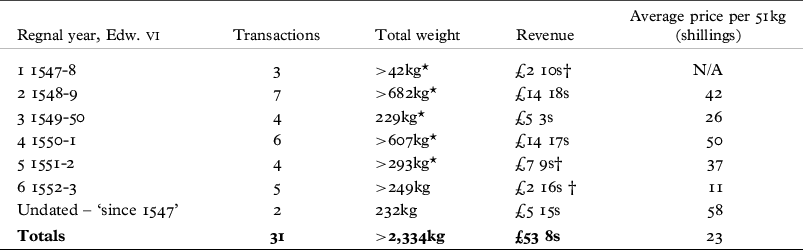
Confirmed sales of despoiled brasses in London in 1547–53 are shown in Table 1 and listed, with known purchasers, in supplementary material, appendix 1A. Income from thirty-one transactions from twenty-five London churches, involving more than 2.3 tonnes of ‘grave metal’, totalled £53 8s, or £21,030 in modern money values. Sales of looted brasses could be prompted by the need to pay for church renovation or to recoup expenses incurred by obliterating physical manifestations of the old religion.Footnote 52 Many churches were in poor condition. Thirty-six London inventories reported spending proceeds on fabric repairs: St Ethelburga, Bishopsgate, had ‘fallen into such ruin and decay whereby it raineth in divers places to the great annoyance and disquietness of the … parishoners’.Footnote 53 Other churches paid to remove altar slabs and, as at St Mary Aldermary, for ‘whytyng and wrtyng of scryptures abawght the chyrche’Footnote 54 – whitewashing wall paintings and then over-writing with Biblical texts – as well as replacing smashed stained glass with clear quarries.
Known sales of despoiled brasses, London 1547–53.

Key:
N/A = not applicable – insufficient data available
* = weight of metal missing from one or more sales; volume estimated from price
† = revenue missing from one or more transaction
Note: average prices rounded up.
Sources: appendices 1A and 1B, supplementary material.
Brasses were looted during the 1548 chantry suppressions, and this, with a surge of iconoclasm, probably accounts for higher volume sales in 1548–9. The following year’s decline was caused by the turmoil of the rebellions of 1549 – martial law was imposed in London on 18 July – but plunder increased again in 1550–1 as commissioners tightened the state’s grip on church goods. Thereafter, there is a decline in supplies. Revenues from looted brasses broadly matched sales volumes; in 1548–9 the total was almost six times that of 1547–8, and in 1550–1 the yield was nearly three times that of the previous regnal year. Growing demand had triggered higher prices; twenty-seven Fermer brasses (31 per cent of the surviving total) were produced during these two years. Revenues fell thereafter, perhaps because evangelical churches had already cleared out their brasses.
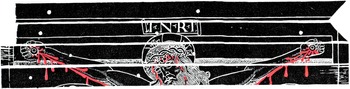
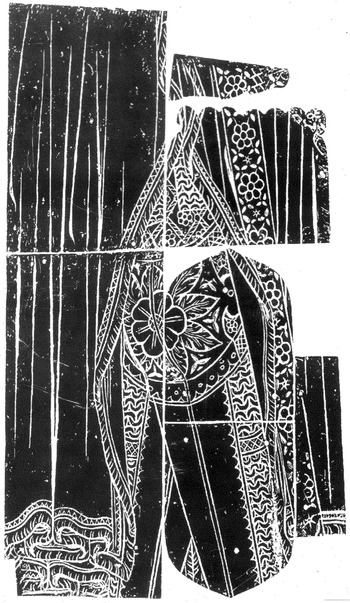
Some brasses were reused soon after manufacture. A large civilian effigy of 1553 found behind Fermer brasses at Halton (Bucks) and another of 1552 from Easton Neston (Northants) were both engraved in 1552, probably using a reject plate or ‘waster’ (fig 4). The female figure of 1551 at Blewbury (Berks) is a Gyfford style plate of c 1545, with a blank reverse. The marginal inscription at Easton Neston is formed of strips from the upper section of a latten rood of c 1540, probably a reredos above an ancillary altar (fig 5). Originally measuring 660mm × 604mm, it depicts the head and arms of the crucified Christ, a prime target for iconoclasts. This plate has a different metallurgy: 80.2 per cent copper and 19.2 per cent zinc, compared with 64–70 per cent and 11–28 for brasses.Footnote 55 It was probably cast at a different facility from those supplying latten to the London marblers and the delicacy of its engraving suggests north German origins.
Reverses of Fermer brasses at Easton Neston (Northants) from 1552 and Halton (Bucks) from 1553; from an effigy of a civilian in a fur-edged gown with square-toed sabatons, standing on spikey grass. This is a Fermer product of c 1552 and is rejected work, prudently reused. Height of large vertical fragment: 691mm. From Page-Phillips Reference Page-Phillips1980; courtesy: Monumental Brass Society.

Reverse of marginal inscription at Easton Neston (Northants) of 1552, forming the top of a latten rood, c 1540, 660mm × 604mm when complete, above a secondary altar. Red resin is used to portray the Holy Wounds. The haloes of the standing figures of the Virgin Mary and St John are visible on the lowest strip. From Trans Monumental Brass Soc; courtesy: Monumental Brass Society.

HOW MANY BRASSES WERE LOST?
Determining the scale of losses of brasses in London during Edward vi’s reign poses challenging statistical problems. Prime evidence are the volumes of metal sold, recorded in church inventories. During conservation, it was established that the large effigy of Sir Richard Catesby from 1553, at Ashby St Legers (Northants), weighed 13kg, and John Latton’s smaller figure of 1551 at Blewbury (Berks) weighed 0.84kg. The weight of an average brass, with two effigies, perhaps four shields, an inscription and two groups of children, might total c 6kg of metal. Dividing this estimate into the 2.334 tonnes of known monumental brass sales suggests the loss of 389 brasses from twenty-five London parishes, an average of almost sixteen per church (see supplementary material, appendix 1A). Given the city’s affluence, the number of larger brasses in London would be greater, so perhaps an average metal weight of 10kg is more appropriate, producing a revised total of 233 losses. However, the complexity of the analysis does not end there. As 55 per cent of the surviving 7,616 brasses in England are inscriptions,Footnote 56 the prevalence of such humble memorials skews this calculation. Most would be an epitaph and one or two shields, so the average weight of such humble memorials would be about 2.5kg,Footnote 57 and this suggests losses of 689 brasses, derived from the percentage shares of figure and inscription brasses. However, affluent London probably had a different ratio, with more figure brasses laid down (fig 6). Of the eighty-six extant brasses in London and Westminster,Footnote 58 just 28 per cent are inscriptions. On this basis, employing the capital’s percentages, the losses would be 261 and 280, totalling 541 brasses. If the 10kg weight of larger brasses is applied, this total would fall to 430, which looks a more credible estimate.
Portions of a large high-status brass of an armoured figure of c 1330, wearing a surcoat with crossed legs, on the reverse of a Fermer brass of c 1552 at Ludford (Herefordshire). From Bull Monumental Brass Soc; courtesy: Monumental Brass Society.

A different methodology involves examination of the fragments of known reused brasses forming Fermer products. Appendix 5 in the supplementary material lists 243 separate pieces so far discovered, of which twenty-one are elements of the same brass and another twenty are associated fragments found behind recycled brasses, totalling forty-one discrete memorials. This may add credence to the lower estimates, or, alternatively, could indicate how many more brasses disappeared into founders’ crucibles.
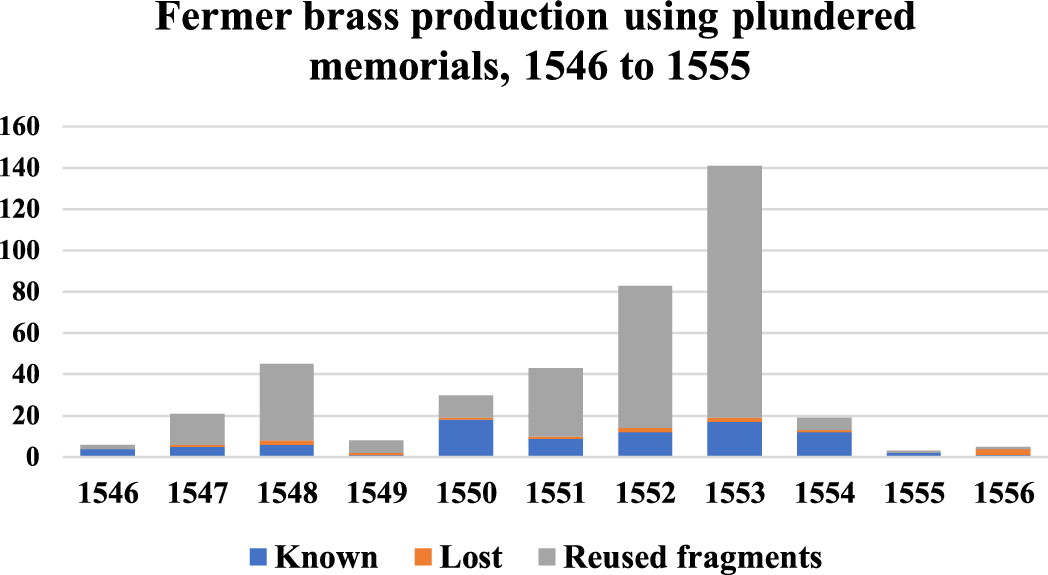
Fig 7 compares annual Fermer production with the number of discovered fragments that formed the workshop’s brasses, arranged by obverse date. Peak years were 1550–3, when other marblers must have been recruited to assist production. One may be John Crococke, who bought plundered brasses as well as altar slabs and gravestones.Footnote 59 Growth in 1551–2 may have been affected by that year’s virulent epidemic of Sudor Anglicus, or sweating sickness, in England. After the accession of Mary i in August 1553, cessation of Reformation spoil hampered production and earlier interruptions in plundered latten supplies had prevented stockpiling. In addition to these factors, the Fermer atelier may have been damaged during the violent occupation of Fleet Street by Sir Thomas Wyatt’s insurgents in February 1554.Footnote 60 Only twelve brasses dated 1554–7 have been discovered with reused metal, and two (from the rival ‘Nayle’ workshop that emerged in 1555) were probably completed after Elizabeth’s accession in 1558, when destruction of monumental brasses was renewed.
Graph showing annual production levels of known and lost Fermer brasses, compared with levels of reused fragments recycled in the same years. Sources: supplementary material, appendices 3 and 5.

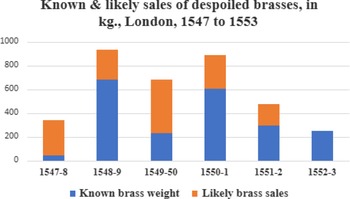
Undoubtedly there are more despoiled brasses hidden within church inventory entries such as ‘certain metall of brasse belonging to the said church’ (St Dunstan-in-the-West) and ‘brazen metal’ (St Sepulchre).Footnote 61 Evaluating how much was looted brasses is again problematical. Weight might be an indicator, but some latten church goods were bulky; St Mary Abchurch listed a 55kg brass eagle lectern and two ‘standard’ chancel candlesticks, totalling 53kg. Equally, a smaller quantity could be just one looted brass. Sales descriptions provide clues. The coy entry ‘certeyne old lattyn’ might well be brasses and the 117kg of ‘lattyn metell gathereryde in this parysshe’ of St Giles may include plundered plates, particularly as the church was damaged by fire in 1545 and only partially rebuilt. Other suspicious phrases are ‘mettall out of the churche’, ‘latten work’,Footnote 62 ‘all the brass of the seid church’ (St John Evangelist)Footnote 63 and the 34kg of ‘copper’ purchased by ‘Pryor the peawterer’ from St Lawrence Pountney.Footnote 64 Based on this somewhat arbitrary process, probable additional sales of plundered brasses total 1.465 tonnes in twenty-seven sales from eighteen London parishes (fig 8; and see supplementary material, appendix 1B) yielding £39 9s 4d in receipts, or just over £14,000 in modern spending terms. Applying the average weight described above and the London ratio of inscriptions to larger figure brasses, this total might represent 270 lost brasses. Add this to the earlier estimate derived from confirmed sales of grave metal and the total loss of brasses in London in 1547–53 may be in the range of 700–812 memorials (the lower figure more likely), or an average of sixteen to nineteen in the forty-three churches involved.Footnote 65
Graph showing known and likely sales of despoiled brasses in London during Edward vi’s reign. Source: supplementary material, appendices 1a and 1b.

USE OF HAMMERED PLATE FOR ENGRAVING
From 1552, Fermer brasses are made up of more fragments, suggesting temporary scarcity in supply; twenty-seven of c 1553 are at St Mellion (Cornwall), and eighteen at Easton Neston. At Milton (Cambs), there are twenty-two of 1553, including one scrap of very worn metal bolstered with lead.Footnote 66 Fragments were joined by filing down each edge and daubing hot solder into the resultant ‘V’ shape to secure a bevelled butt joint. In 1553, at Dry Drayton (Cambs), a piece of inscription was utilised to press the hot solder into place; at Blatherwyck (Northants), in c 1553, and Chilton (Bucks), in 1554, a piece of textile was used to wipe the soft solder, as shown by a weave of fibres. Redundant rivet holes were plugged with brass discs.
After 1550, the founders’ recasting of latten church goods into thin plate for engraving provided assurance of production when supplies of reused metal were interrupted. The melt was cast in shallow stone or clay trays, measuring 450mm × 500mm. This sheet, up to 2mm thick, was then hammered. An early appearance of such plate – appropriated effigies of c 1520 at Southwick (Hants) – suggests experiments in this technique. Plate thicknesses of 2.0–3.1mm in Gyfford brasses at Fairford (Gloucs), of 1534, and Upminster (Essex), of 1542, are probably melted Dissolution latten. Hammered plate was used for five Fermer inscriptions of c 1550 at Holdenby (Northants), two at Swyre (Dorset) and one at Isleham (Cambs), dated the same year. Marginal inscriptions in 2mm plate are at St Mellion, in c 1553, and Ashby St Legers and Chilton (Bucks), in 1554. Figures at Great Hampden (Bucks), from 1553, were engraved on hammered plate. A year later, thinner metal, 1.3–1.8mm thick, was employed at Warminghurst (Sussex), probably because supplies of latten church goods dried up after Mary i’s accession. The metallurgy of hammered plate probably resembles that of despoiled metal, as the original latten melt in Flanders was the resource used to manufacture both brasses and church goods.
TRACEABLE REFORMATION SPOIL
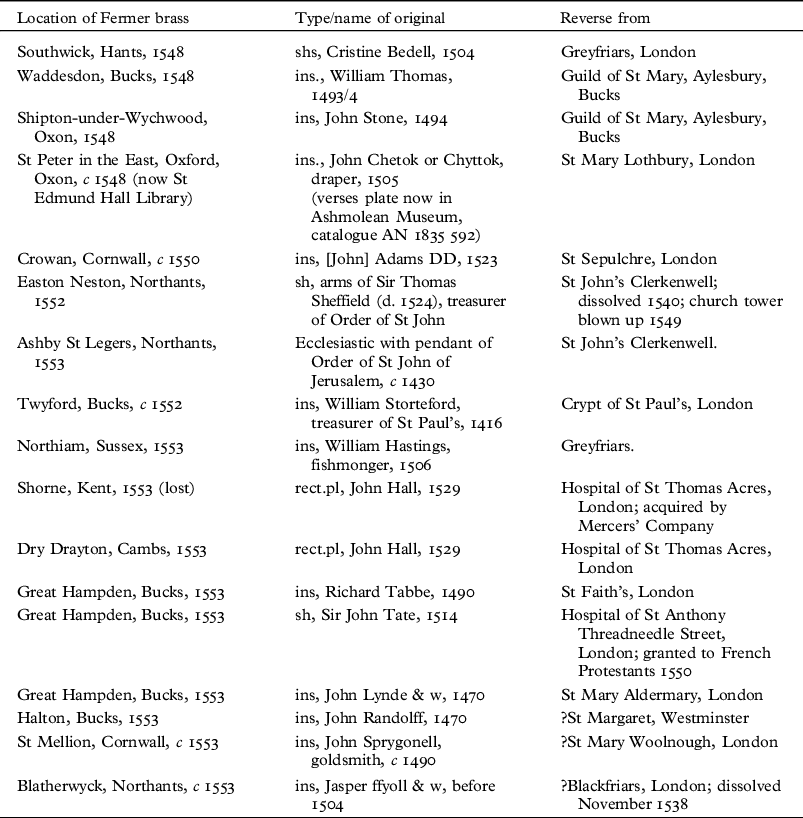
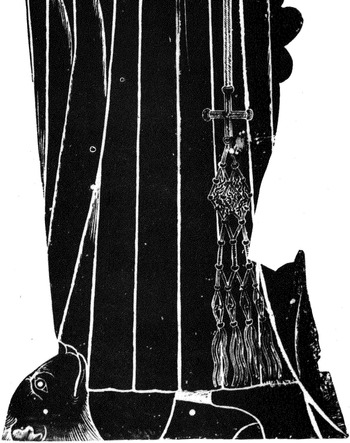
Wills and antiquarian accounts have identified seventeen original locations of reused brasses, described in Table 2. Some identifications reveal timing anomalies. In 1547, Alderman Sir Martin Bowes sold ten monuments and 140 marble gravestones (doubtless many with brasses) from the dissolved priory of Christ Church for £50 ‘or thereaboutes’Footnote 67 to meet his costs of purchasing St Bartholomew’s priory and Greyfriars from the crown; shields reused for the tomb of 1548 at Southwick (Hants), are traceable to Greyfriars, but plundered brass from the same source forms the reverse of an inscription at Northiam (Sussex), dated five years later. Similarly, an inscription from the Blackfriars, dissolved in November 1538, was used at Blatherwyck (Northants), c 1553.Footnote 68 Reverses at Easton Neston, from 1552, and Ashby St Legers, from 1553, probably came from St John Clerkenwell, dissolved in 1540 (fig 9). Its great bell tower was blown up in 1549 to provide building materials for the Protector’s new mansion in the Strand. The greatest time lag is the portion of a lady of the Beauchamp family on the reverse of 1548 brass in North Crawley (Bucks) and her face, behind a shield from 1556, at All Hallows Barking.
Traceable plundered brasses.

Key:
sh(s) = shield(s)
ins = inscription
rect.pl = rectangular plate
Source: appendix 2, supplementary material.
Reverse of lower half of effigy of Sir Richard Catesby dating to 1553, Ashby St Legers (Northants), lower section of an ecclesiastic, c 1430, with pendant of the Order of St John of Jerusalem, probably from St John, Clerkenwell. Width at base: 360mm. From Bertram Reference Bertram2006; courtesy: Monumental Brass Society.

Why this delay in utilising despoiled brasses? Perhaps the plundered plates were stacked in the marblers’ workshop and the pile regularly replenished, so earlier purchases beneath were reachable only during periods of scarcity? Alternatively, these memorials were laid down during the lifetime of those commemorated and the date of death was inserted later. However, the workshop’s high productivity rate seems to preclude the long absences required by a peripatetic engraver travelling around the country to fulfil this task.Footnote 69 Brasses also remained in situ in dissolved houses for years, and it may be that subsequent sales were driven by market demand, exploitation of transitory high prices or financial expediency. In 1547 the collegiate church at South Malling, Sussex, was suppressed. A survey reported ‘There is … in the fllowre … and chawncelle xxix marbyll stones wherein were Images and scryptures of brasses, the which brasse ys bettyn owtt and stollyn and the stones much spoylyd, the whyche stones and pavyng left … to be worthe xxs’.Footnote 70 The fabric was sold off as building materials and bought by James Gage, brother of Edward, one of the survey’s overseers. The slabs were used by his cousin, John Gage, in 1595 when he commissioned the sculptor Garat Johnson of Southwark to erect five dynastic monuments at West Firle, Sussex, and two mural brasses to family members at Clapham and Framfield in the same county.
A second example of long-term storage is at Isfield, Sussex. Edward Shurley, cofferer to Henry viii, and his wife Joan were commemorated by brasses of 1558 within a reused canopied monument and tomb-chest. The Purbeck slab is also recycled, with a redundant shield indent between the effigies, products of the ‘Nayle’ or ‘H’ workshop (see supplementary material, appendix 4).Footnote 71 A black Tournai limestone slab to Gundrada de Warenne, foundress of St Pancras priory, Lewes, was placed on the tomb-chest. This twelfth-century Tournai marble slab, with an inscription in Romanesque lettering, lay in the priory’s chapter house before the suppression of 1538. It was acquired by the Shurley family and was at their Isfield home in 1550.Footnote 72 It was recognised in 1775Footnote 73 and moved to Southover church, Lewes.
SALES OF DESPOILED STONEWORK
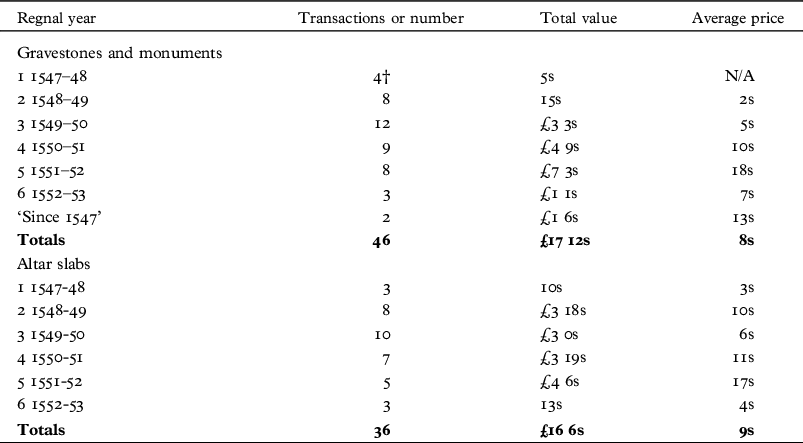
In May 1550, Nicholas Ridley, the new bishop of London and Westminster, abolished altars and this prohibition was extended to England and Wales that November. Sales of thirty-six altar slabs, or mensas, from London churches are recorded in Edward vi’s reign, generating £16 6s, with peak years in 1549–51 but, as with brasses, declining thereafter.Footnote 74 The Fermer marblers purchased a ‘lytle awterstone of marbell’ for 3s 4d from St Faith’s in 1552.Footnote 75 The only brass set in an altar slab in this period is the inscription to William Hatton, c 1550, at Holdenby (Northants) (fig 10). Were others turned over and the reverse polished? Considering the number of parishes in the City of London, the sales total seems remarkably low. Probably such transactions were mainly limited to religiously radical churches, with other parishes concealing their mensas in the hope that the evangelical storm would soon pass. As seen in Table 3, sales of gravestones and monuments in London began in 1547 and peaked in 1549–50. Thereafter, prices were maintained at high levels, driven by demand, before falling back in 1552–3. Recorded sales totalled forty-six by Edward vi’s death, raising £17 12s.
Inscription to William Hatton (two shields lost), Holdenby (Northants) from c 1550, set in a Purbeck altar slab with five consecration crosses. The central cross is partially obscured by the inscription, 565mm wide. Photograph: Frank Wheaton.

Sales of despoiled gravestones, monuments and altar slabs, 1547–53.

Key:
† = some revenues unreported in one or more transactions
N/A = not applicable
Note: average figures rounded up.
Source: appendix 2, supplementary material.
This ejected stonework became a commodity for recycling into new monuments or for construction work or repairs, such as the two stones sold for 2s 4d to Peter Corant at St Margaret, Fish Street, in 1551–2 as steps for his street door.Footnote 76 Inventories of two London churches earmarked stonework for disposal; in 1552 St Martin Outwich listed ‘A faire marble Tombe ffyrneshed’ (with brasses?) and ‘iij graves with dyvers other stones’, and at St Mary-le-Bow in 1547–8 there were four entries relating to gravestones with a fifth alluding to a ‘litill Tombe’ and the ‘Tymber over the Tombe’ – perhaps indicating an Easter sepulchre.Footnote 77 Two aldermen acquired probable gravestones from St Andrew Undershaft in 1551–2. Stephen Kyrton,Footnote 78 churchwarden, purchased 21.3m of ‘hard stone’ for 23s 3d, presumably to pave a floor. Ironically, he was commemorated by a lost brass in this church after his death in August 1553.Footnote 79 Sir Andrew JuddeFootnote 80 also bought 1.52m of stone, probably also for floor repairs.Footnote 81
Those eager to buy a cheap gravestone to commemorate a departed spouse form a significant group among buyers. These include two presumed widows in 1551–2: ‘Mistress Crooke’, who bought ‘a marbell stone for a tomble’ for ten shillings at St Faith’s,Footnote 82 and Mrs Longe, who purchased ‘on’ stone of marble’ for the same price at St Lawrence Jewry.Footnote 83 A similar example may be the acquisition of ‘a stone to ley ower Winkles [?] grave’ for four shillings, at St Mary Aldermary, probably in 1547.Footnote 84 At St Mary at Hill, an anonymous purchaser paid 3s 6d in 1549–50 for ‘one of the Alter Stones that lyeth on the good wife Sampsons pit’ – a contemporary term for grave,Footnote 85 perhaps a second sale of the same slab. Prominent among these bereaved was Thomas Lodge,Footnote 86 churchwarden at St Michael Cornhill in 1548, who that year paid 6s 8d for a ‘gravestowne’ to commemorate his deceased first wife.Footnote 87 Lodge, a religious reformer and warden of the Grocers’ Company in 1548, had a penchant for speculative ventures. He paid £4 6s for 210kg of ‘old latten candyllstyckes & olde bras of the Church’ that year (presumably for selling on to founders and marblers), £15 14s for copes and vestments in 1550 and £222 17s 10d for 18,711gms of silver and gold church plate.Footnote 88 Another churchwarden involved in such ventures was John Bevercottes, who, together with John Crococke and Charles Horsley, bought six ‘marbill stones’ for 7s 5d in 1549–50 from his church, St Mary Staining.Footnote 89
Those commemorated by a destroyed tomb can sometimes be identified. In 1546, Henry viii gave the city’s corporation the churches of St Nicholas Shambles and St Ewin and created a new parish, including the Greyfriars. St Nicholas was demolished in 1551 and a tomb ‘for Master Penson’ was sold in 1552–3 to William Cooke for £1 6s 8d. This is almost certainly the butcher Nicholas Pynchon, who died during his shrievalty in 1533 and was buried under a Purbeck canopied tomb ‘before the image of Our Lady’, near his wife’s grave.Footnote 90 Elsewhere, a mason bought ‘ye tombe of Mr Sutton’, together with ‘ye crosse of stone’ and probably twelve metres of gravestones from St Michael Cornhill in 1550. The same year, six gravestones of named individuals from the cloisters were also sold, together with a memorial to Sir Thomas Baker.Footnote 91
As with metal, the Fermer marblers and their clients reused looted stonework extensively. At Melbury Sampford, Dorset, the alabaster effigy of John Brounyng of c 1470 and its Purbeck tomb-chest was brazenly appropriated by replacing the brass chamfer inscription with another to Sir Gyles Strangways the elder (d. 1547).Footnote 92 Another appropriation occurred at Southwick, Hants, where John White’s monument is a tomb-chest of c 1475, probably from Southwick Priory, granted to him in 1539. His will of 1567 requested burial ‘in the Churche of Sowthworke in the vaulte under the marble tombe … I made’Footnote 93 after his first wife’s death in 1548. A Purbeck slab, 1.81m × 0.89m, with brasses of an armoured effigy and wife of c 1520, probably London spoil, covers the tomb-chest; two extra daughters were added (fig 11a and b) and another son (now lost) soldered onto a plate with five sons. A new marginal inscription was also inserted.
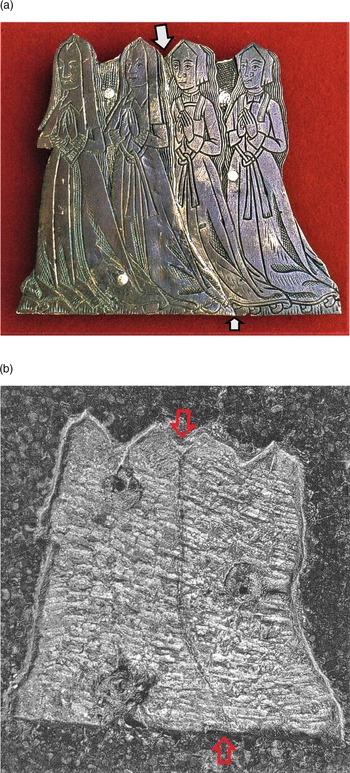
(a) John White’s daughters at Southwick (Hants). Two additional daughters of 1548 (wearing a later fashion in headdress, but copying the earlier design of looped girdles around the waist) were added to two girls of c 1520. Arrows indicate the join. (b) The indent of the daughters’ plate at Southwick (Hants), measuring 167mm × 190m. This was recut to take the extra daughters. Photographs: Bryan Egan.

A slab with brass of an armoured figure of c 1400 under a triple canopy was appropriated at Laughton (Lincs) by the addition, in 1556, of an inscription to William Dalison (d. 1546), and his son George (d. 1549). The head of a lion at the effigy’s foot was renewed, replicating the older engraving style. The lower half of the right canopy shaft was replaced, copying that on the left. The heraldry on the pommel of the effigy’s sword was erased. A Purbeck slab, 2.7m × 1.2m, was reused at Ashby St Legers, with more than fifty polished down rivets, empty dowel holes and lead plugs, indicating a brass of an armoured figure and wife of c 1425–30. As the original indents were 5–7mm deep, scraping down and repolishing the slab must have been laborious. Scraped slabs are also at North Crawley (Bucks) in 1548,Footnote 94 Somerton (Oxon) in 1552, Twyford (Bucks) in c 1552 and Great Hampden (Bucks) in 1553. Elsewhere, indents were left untouched, as at Winchester St Cross (Hants), where an inscription was placed beneath the indent of a half-effigy of a prior c 1430, and at Blewbury, where the indent of a female figure of c 1510 is between the new effigies. Thirty Fermer brasses have reused slabs or stonework but, as thirteen more were later relaid, this will be an underestimate.
CONCLUSIONS
There were 109 parishes in the City of London in 1552, of which eighty-four have surviving inventories of church goods. Analysis of losses of brasses in 1547–53, based on volumes of metal sold recorded in these inventories, indicate that twenty-five parishes (30 per cent) sold around 430, with a further eighteen churches (21 per cent) being ‘likely’ sellers of such memorials. This speculative category yields a further 270 losses, producing a total of 700–812, with the lower figure more likely, according to this model. Therefore, forty-three churches may have been involved in this desecration, an unexpectedly low number, perhaps justifying another look at Macklin’s apocalyptic view of Edwardine destruction of brasses. Why were only 51 per cent of parishes involved in despoilation of brasses? Were these churches hotbeds of reformist zeal? Was such destruction mainly motivated by iconoclasm? While some undoubted speculative profiteering went on, the answer is probably ‘yes’. Most brasses were probably recycled, but the remainder were melted down for other purposes, such as ordnance manufacture, or perhaps even smuggled overseas as contraband metal.
Iconoclasm also plays a role in the removal of thirty-six altar slabs from London churches with sales peaks in 1548–51, another unexpectedly low number. While only one is known to have been reused as a grave slab, at Holdenby (Northants) from c 1550, others probably were turned over and reused by the marblers.
The Fermer workshop, which produced at least eighty-seven monumental brasses in 1546–56, had a business model that relied on reusing Reformation spoil, both metal and stonework. When supplies of despoiled brass were temporarily interrupted, production was maintained by using thinner hammered plate, cast from looted latten church goods. However, when supplies of church plunder ceased on the accession of Mary i, the workshop’s business plan was invalidated. Despite some hammered plate still being available, the Fermer series faded out in c 1556.
POSTSCRIPT
After the end of Mary i’s reign in 1558, the destruction of brasses was renewed by Protestant zealots, and despoiled metal began to flow again into the two London marblers’ workshops producing ‘Lytkott’ (successors to the Fermers) and the rival ‘Nayle’ brasses, the latter being smaller, lower quality memorials. Part of the reverse of the inscription of 1558 at Isfield, Sussex, was the central section of a brass to a monk, of c 1440. Other fragments to abbots or priors are behind brasses at Waddesdon (Bucks) of 1561 and Piddlehinton (Dorset) of 1562. These monastic brasses were probably moved during the Dissolution to churches of safety by of the deceased.Footnote 95 However, in Elizabeth’s i’s reign, when these descendants had died or moved away, the memorials were looted for their metal. In September 1560, Elizabeth i signed a proclamation against breaking or defacing monuments, and this briefly impeded supplies of plundered brasses, which might explain the apparent demise of the Nayle workshop that year.
New supplies of looted brasses arrived in London in 1566. That August, churches in Amsterdam, Antwerp, Ghent and Tournai were despoiled by Protestants.Footnote 96 An entry in the Exchequer coastal trade accounts for 5 October 1566 records the Colchester ship Le Pellican, 42 tons, with a cargo of five barrels of ‘rubbishe de brass’ for William Watson, merchant,Footnote 97 doubtless the fruits of iconoclasm across the North Sea. More despoilation followed in the Low Countries in 1571, 1575 and 1578, and this produced a flood of foreign brasses for reuse in London up to the mid-1580s.
ACKNOWLEDGEMENTS
My sincere thanks are due to Bryan Egan and Frank Wheaton for assistance with illustrations and to the Monumental Brass Society for permission to reproduce material from its publications. I am also very grateful to the two anonymous reviewers for their helpful comments.
ABBREVIATIONS AND BIBLIOGRAPHY
Abbreviations
- Berks
-
Berkshire
- BL
-
British Library, London
- Bodleian
-
Bodleian Library, Oxford
- Bucks
-
Buckinghamshire
- Cambs
-
Cambridgeshire
- ERO
-
Essex Record Office, Chelmsford
- Gloucs
-
Gloucestershire
- Hants
-
Hampshire
- Herts
-
Hertfordshire
- Lincs
-
Lincolnshire
- Northants
-
Northamptonshire
- Oxon
-
Oxfordshire
- TNA
-
The National Archives, Kew
Supplementary material
To view supplementary material for this article, please visit https://doi.org/10.1017/S0003581522000075.